Experimental and  Quasi-Experimental  Research EDUU 600 Notes from  McMillan and Schumacher
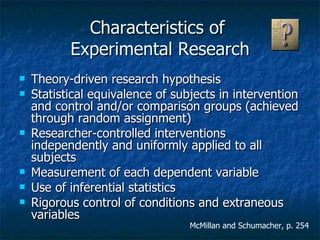
Characteristics of  Experimental Research Theory-driven research hypothesis Statistical equivalence of subjects in intervention and control and/or comparison groups (achieved through random assignment) Researcher-controlled interventions independently and uniformly applied to all subjects Measurement of each dependent variable Use of inferential statistics Rigorous control of conditions and extraneous variables McMillan and Schumacher, p. 254
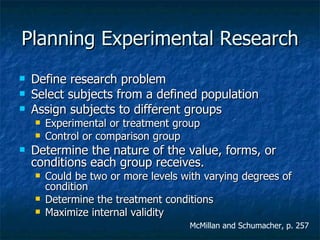
Planning Experimental Research Define research problem Select subjects from a defined population Assign subjects to different groups Experimental or treatment group Control or comparison group Determine the nature of the value, forms, or conditions each group receives. Could be two or more levels with varying degrees of condition Determine the treatment conditions Maximize internal validity McMillan and Schumacher, p. 257
Validity Statistical Conclusion Validity Is the conclusion valid in determining a relationship or difference between groups? Is the hypothesis supported or not supported by the results or findings? Construct Validity How well measured variables and interventions represent the theoretical constructs that have been hypothesized. McMillan and Schumacher, p. 260
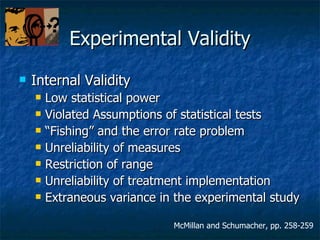
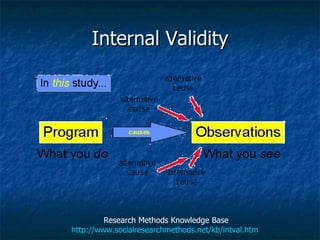
Experimental Validity Internal Validity Low statistical power Violated Assumptions of statistical tests “ Fishing” and the error rate problem Unreliability of measures Restriction of range Unreliability of treatment implementation Extraneous variance in the experimental study McMillan and Schumacher, pp. 258-259
Internal Validity Research Methods Knowledge Base http://www.socialresearchmethods.net/kb/intval.htm
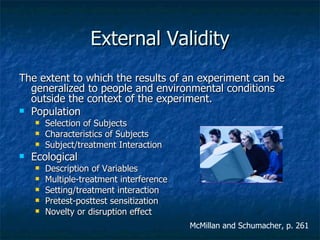
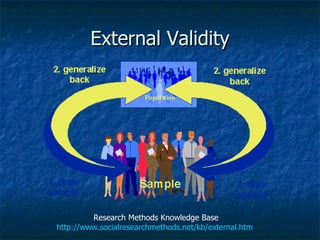
External Validity The extent to which the results of an experiment can be generalized to people and environmental conditions outside the context of the experiment. Population Selection of Subjects Characteristics of Subjects Subject/treatment Interaction Ecological Description of Variables Multiple-treatment interference Setting/treatment interaction Pretest-posttest sensitization Novelty or disruption effect McMillan and Schumacher, p. 261
External Validity Research Methods Knowledge Base http://www.socialresearchmethods.net/kb/external.htm
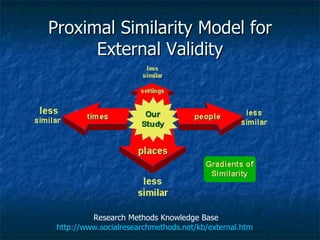
Proximal Similarity Model for External Validity Research Methods Knowledge Base http://www.socialresearchmethods.net/kb/external.htm
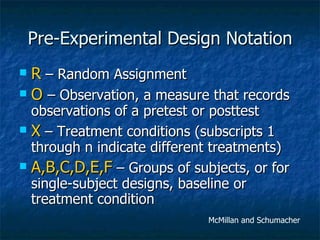
Pre-Experimental Design Notation R  – Random Assignment O   – Observation, a measure that records observations of a pretest or posttest X  – Treatment conditions (subscripts 1 through n indicate different treatments) A,B,C,D,E,F  – Groups of subjects, or for single-subject designs, baseline or treatment condition McMillan and Schumacher
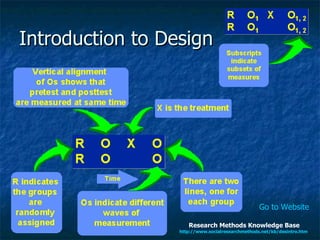
Introduction to Design Research Methods Knowledge Base http://www.socialresearchmethods.net/kb/desintro.htm   Go to Website
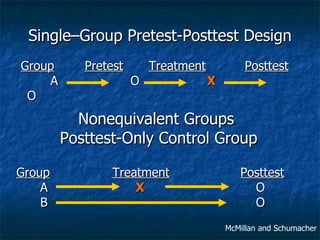
Single–Group Pretest-Posttest Design Group Treatment Posttest A   X     O B         O Group Pretest Treatment Posttest A   O   X   O Nonequivalent Groups  Posttest-Only Control Group McMillan and Schumacher
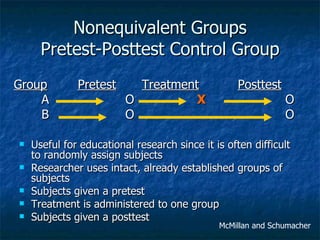
Nonequivalent Groups Pretest-Posttest Control Group Useful for educational research since it is often difficult to randomly assign subjects Researcher uses intact, already established groups of subjects Subjects given a pretest Treatment is administered to one group Subjects given a posttest Group Pretest Treatment Posttest A   O    X     O B   O        O McMillan and Schumacher
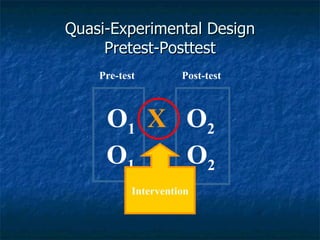
Quasi-Experimental Design Pretest-Posttest O 1  X   O 2 O 1  O 2 Pre-test Post-test Intervention
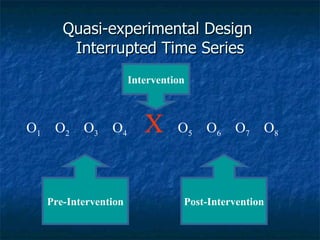
Quasi-experimental Design  Interrupted Time Series O 1     O 2     O 3     O 4      X     O 5     O 6     O 7     O 8   Pre-Intervention Post-Intervention Intervention
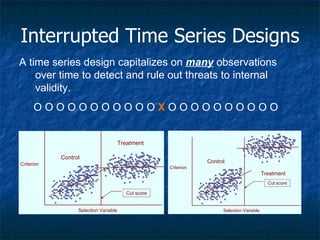
Interrupted Time Series Designs A time series design capitalizes on  many  observations over time to detect and rule out threats to internal validity. O O O O O O O O O O O  X  O O O O O O O O O O
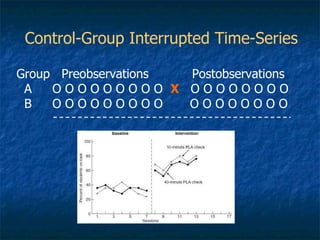
Control-Group Interrupted Time-Series Group  Preobservations   Postobservations A  O O O O O O O O O  X   O O O O O O O O B  O O O O O O O O O  O O O O O O O O
Inferential Statistics Statistics derived from a small group and then generalized to a population Procedures that are used to indicate the probability associated with saying something about a population based on data from a sample.”  (McMillan & Schumacher) Two Common Statistical Tests The t-test ANOVA – Analysis of Variance
The Statistical Hypothesis If  X , then  Y and If  not  X , then  not  Y If the program is given, then the outcome occurs and If the program is  not  given, then the outcome does  not  occur Research Methods Knowledge Base http://www.socialresearchmethods.net/kb/desexper.htm
Null Hypothesis The working hypothesis that there is  NO  difference between groups A formal statistical statement of  NO  relationship between two or more variables  (McMillan & Schumacher) State your question in the form of a null hypothesis and an alternative hypothesis
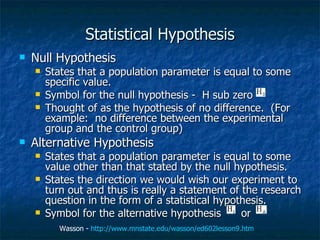
Statistical Hypothesis Null Hypothesis States that a population parameter is equal to some specific value.  Symbol for the null hypothesis -  H sub zero  Thought of as the hypothesis of no difference.  (For example:  no difference between the experimental group and the control group) Alternative Hypothesis States that a population parameter is equal to some value other than that stated by the null hypothesis.  States the direction we would wish our experiment to turn out and thus is really a statement of the research question in the form of a statistical hypothesis.  Symbol for the alternative hypothesis  or Wasson -  http://www.mnstate.edu/wasson/ed602lesson9.htm
Null and Alternative Hypotheses The first step is to specify the  null hypothesis  and an  alternative hypothesis . For experiments testing differences between means, the null hypothesis is that the difference between means is some specified value. Usually the null hypothesis is that the difference is zero.  For this example, the null and alternative hypotheses are: Ho: µ1 - µ2 = 0 H1: µ1 - µ2 ≠ 0  HyperStat Online -  http://davidmlane.com/hyperstat/B58842.html
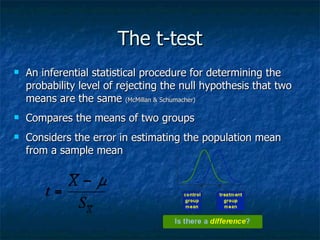
The t-test An inferential statistical procedure for determining the probability level of rejecting the null hypothesis that two means are the same  (McMillan & Schumacher) Compares the means of two groups Considers the error in estimating the population mean from a sample mean
What do you need to determine? Probability - How likely is your result accurate? Sampling Error - Do samples accurately reflect the population? Standard Error - Standard deviation of the population means Standard Deviation - Indicates average variability of scores
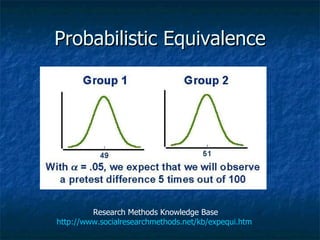
Probabilistic Equivalence Research Methods Knowledge Base http://www.socialresearchmethods.net/kb/expequi.htm
The t-test Formula Research Knowledge Base -  http://www.socialresearchmethods.net/kb/stat_t.htm
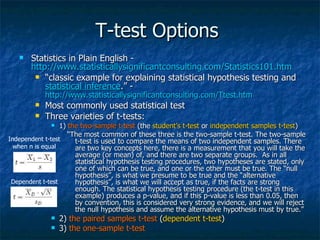
T-test Options  Statistics in Plain English -  http://www.statisticallysignificantconsulting.com/Statistics101.htm   “ classic example for explaining statistical hypothesis testing and  statistical inference .” -  http://www.statisticallysignificantconsulting.com/Ttest.htm   Most commonly used statistical test  Three varieties of t-tests:  1)  the two-sample t-test  (the  student’s t-test  or  independent samples t-test )  “ The most common of these three is the two-sample t-test. The two-sample t-test is used to compare the means of two independent samples. There are two key concepts here, there is a measurement that you will take the average (or mean) of, and there are two separate groups.  As in all statistical hypothesis testing procedures, two hypotheses are stated, only one of which can be true, and one or the other must be true. The “null hypothesis”, is what we presume to be true and the “alternative hypothesis”, is what we will accept as true, if the facts are strong enough. The statistical hypothesis testing procedure (the t-test in this example) produces a p-value, and if this p-value is less than 0.05, then by convention, this is considered very strong evidence, and we will reject the null hypothesis and assume the alternative hypothesis must by true.” 2)  the paired samples t-test  ( dependent t-test ) 3)  the one-sample t-test   Independent t-test when n is equal Dependent t-test
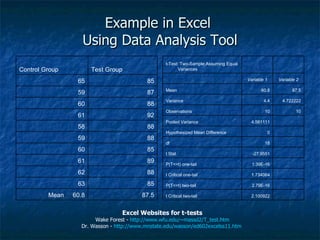
Example in Excel  Using Data Analysis Tool Excel Websites for t-tests Wake Forest -  http://www.wfu.edu/~massd2/T_test.htm Dr. Wasson -  http://www.mnstate.edu/wasson/ed602excelss11.htm   Control Group Test Group 65 85 59 87 60 88 61 92 58 88 59 88 60 85 61 89 62 88 63 85 Mean  60.8 87.5 t-Test: Two-Sample Assuming Equal Variances       Variable 1 Variable 2 Mean 60.8 87.5 Variance 4.4 4.722222 Observations 10 10 Pooled Variance 4.561111   Hypothesized Mean Difference 0   df 18   t Stat -27.9551   P(T<=t) one-tail 1.39E-16   t Critical one-tail 1.734064   P(T<=t) two-tail 2.79E-16   t Critical two-tail 2.100922  
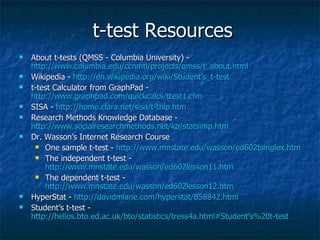
t-test Resources About t-tests (QMSS - Columbia University) -  http://www.columbia.edu/ccnmtl/projects/qmss/t_about.html   Wikipedia -  http://en.wikipedia.org/wiki/Student's_t-test   t-test Calculator from GraphPad -  http://www.graphpad.com/quickcalcs/ttest1.cfm   SISA -  http://home.clara.net/sisa/t-thlp.htm   Research Methods Knowledge Database -  http://www.socialresearchmethods.net/kb/statsimp.htm Dr. Wasson’s Internet Research Course One sample t-test -  http://www.mnstate.edu/wasson/ed602tsinglex.htm   The independent t-test -  http://www.mnstate.edu/wasson/ed602lesson11.htm The dependent t-test -  http://www.mnstate.edu/wasson/ed602lesson12.htm   HyperStat -  http://davidmlane.com/hyperstat/B58842.html   Student’s t-test -  http://helios.bto.ed.ac.uk/bto/statistics/tress4a.html#Student's%20t-test
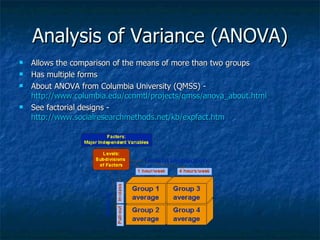
Analysis of Variance (ANOVA) Allows the comparison of the means of more than two groups Has multiple forms About ANOVA from Columbia University (QMSS) -  http://www.columbia.edu/ccnmtl/projects/qmss/anova_about.html   See factorial designs -  http://www.socialresearchmethods.net/kb/expfact.htm
Multiple Regression Multiple linear regression – a statistical procedure for using several variables to predict an outcome  About Multiple Regression (Columbia University QMSS) -  http://www.columbia.edu/ccnmtl/projects/qmss/multreg_about.html   Interactive Website -  http://people.hofstra.edu/faculty/Stefan_Waner/Realworld/multlinreg.html Multiple Regression in Excel -  http://www.jeremymiles.co.uk/regressionbook/extras/appendix2/excel/   StatSoft -  http://www.statsoft.com/textbook/stmulreg.html
Statistics Websites American Statistics Association -  http://www.amstat.org/ Journal on Statistics Education -  http://www.amstat.org/publications/jse/   Inferential Statistics: Understanding Expert Knowledge and its Implications for Statistics Education -  http://www.amstat.org/publications/jse/v12n2/alacaci.html   A Visualization Tool for One- and Two-Way Analysis of Variance -  http://www.amstat.org/publications/jse/v13n1/sturm-beiss.html   Visualizing Multiple Regression -  http://www.amstat.org/publications/jse/v9n1/ip.html An Investigation of the Median-Median Method of Linear Regression -  http://www.amstat.org/publications/jse/v14n2/morrell.html   NCES  Statistical Standards Program -  http://nces.ed.gov/StatProg/index.asp NCES Digest of Statistics Education -  http://nces.ed.gov/programs/digest/d05/   Statistical Standards -  http://nces.ed.gov/statprog/2002/std5_1.asp

Experimental

  • 1.
    Experimental and Quasi-Experimental Research EDUU 600 Notes from McMillan and Schumacher
  • 2.
    Characteristics of Experimental Research Theory-driven research hypothesis Statistical equivalence of subjects in intervention and control and/or comparison groups (achieved through random assignment) Researcher-controlled interventions independently and uniformly applied to all subjects Measurement of each dependent variable Use of inferential statistics Rigorous control of conditions and extraneous variables McMillan and Schumacher, p. 254
  • 3.
    Planning Experimental ResearchDefine research problem Select subjects from a defined population Assign subjects to different groups Experimental or treatment group Control or comparison group Determine the nature of the value, forms, or conditions each group receives. Could be two or more levels with varying degrees of condition Determine the treatment conditions Maximize internal validity McMillan and Schumacher, p. 257
  • 4.
    Validity Statistical ConclusionValidity Is the conclusion valid in determining a relationship or difference between groups? Is the hypothesis supported or not supported by the results or findings? Construct Validity How well measured variables and interventions represent the theoretical constructs that have been hypothesized. McMillan and Schumacher, p. 260
  • 5.
    Experimental Validity InternalValidity Low statistical power Violated Assumptions of statistical tests “ Fishing” and the error rate problem Unreliability of measures Restriction of range Unreliability of treatment implementation Extraneous variance in the experimental study McMillan and Schumacher, pp. 258-259
  • 6.
    Internal Validity ResearchMethods Knowledge Base http://www.socialresearchmethods.net/kb/intval.htm
  • 7.
    External Validity Theextent to which the results of an experiment can be generalized to people and environmental conditions outside the context of the experiment. Population Selection of Subjects Characteristics of Subjects Subject/treatment Interaction Ecological Description of Variables Multiple-treatment interference Setting/treatment interaction Pretest-posttest sensitization Novelty or disruption effect McMillan and Schumacher, p. 261
  • 8.
    External Validity ResearchMethods Knowledge Base http://www.socialresearchmethods.net/kb/external.htm
  • 9.
    Proximal Similarity Modelfor External Validity Research Methods Knowledge Base http://www.socialresearchmethods.net/kb/external.htm
  • 10.
    Pre-Experimental Design NotationR – Random Assignment O – Observation, a measure that records observations of a pretest or posttest X – Treatment conditions (subscripts 1 through n indicate different treatments) A,B,C,D,E,F – Groups of subjects, or for single-subject designs, baseline or treatment condition McMillan and Schumacher
  • 11.
    Introduction to DesignResearch Methods Knowledge Base http://www.socialresearchmethods.net/kb/desintro.htm Go to Website
  • 12.
    Single–Group Pretest-Posttest DesignGroup Treatment Posttest A X O B O Group Pretest Treatment Posttest A O X O Nonequivalent Groups Posttest-Only Control Group McMillan and Schumacher
  • 13.
    Nonequivalent Groups Pretest-PosttestControl Group Useful for educational research since it is often difficult to randomly assign subjects Researcher uses intact, already established groups of subjects Subjects given a pretest Treatment is administered to one group Subjects given a posttest Group Pretest Treatment Posttest A O X O B O O McMillan and Schumacher
  • 14.
    Quasi-Experimental Design Pretest-PosttestO 1 X O 2 O 1 O 2 Pre-test Post-test Intervention
  • 15.
    Quasi-experimental Design Interrupted Time Series O 1     O 2     O 3     O 4     X     O 5     O 6     O 7     O 8 Pre-Intervention Post-Intervention Intervention
  • 16.
    Interrupted Time SeriesDesigns A time series design capitalizes on many observations over time to detect and rule out threats to internal validity. O O O O O O O O O O O X O O O O O O O O O O
  • 17.
    Control-Group Interrupted Time-SeriesGroup Preobservations Postobservations A O O O O O O O O O X O O O O O O O O B O O O O O O O O O O O O O O O O O
  • 18.
    Inferential Statistics Statisticsderived from a small group and then generalized to a population Procedures that are used to indicate the probability associated with saying something about a population based on data from a sample.” (McMillan & Schumacher) Two Common Statistical Tests The t-test ANOVA – Analysis of Variance
  • 19.
    The Statistical HypothesisIf X , then Y and If not X , then not Y If the program is given, then the outcome occurs and If the program is not given, then the outcome does not occur Research Methods Knowledge Base http://www.socialresearchmethods.net/kb/desexper.htm
  • 20.
    Null Hypothesis Theworking hypothesis that there is NO difference between groups A formal statistical statement of NO relationship between two or more variables (McMillan & Schumacher) State your question in the form of a null hypothesis and an alternative hypothesis
  • 21.
    Statistical Hypothesis NullHypothesis States that a population parameter is equal to some specific value. Symbol for the null hypothesis - H sub zero Thought of as the hypothesis of no difference. (For example: no difference between the experimental group and the control group) Alternative Hypothesis States that a population parameter is equal to some value other than that stated by the null hypothesis. States the direction we would wish our experiment to turn out and thus is really a statement of the research question in the form of a statistical hypothesis. Symbol for the alternative hypothesis or Wasson - http://www.mnstate.edu/wasson/ed602lesson9.htm
  • 22.
    Null and AlternativeHypotheses The first step is to specify the null hypothesis and an alternative hypothesis . For experiments testing differences between means, the null hypothesis is that the difference between means is some specified value. Usually the null hypothesis is that the difference is zero. For this example, the null and alternative hypotheses are: Ho: µ1 - µ2 = 0 H1: µ1 - µ2 ≠ 0 HyperStat Online - http://davidmlane.com/hyperstat/B58842.html
  • 23.
    The t-test Aninferential statistical procedure for determining the probability level of rejecting the null hypothesis that two means are the same (McMillan & Schumacher) Compares the means of two groups Considers the error in estimating the population mean from a sample mean
  • 24.
    What do youneed to determine? Probability - How likely is your result accurate? Sampling Error - Do samples accurately reflect the population? Standard Error - Standard deviation of the population means Standard Deviation - Indicates average variability of scores
  • 25.
    Probabilistic Equivalence ResearchMethods Knowledge Base http://www.socialresearchmethods.net/kb/expequi.htm
  • 26.
    The t-test FormulaResearch Knowledge Base - http://www.socialresearchmethods.net/kb/stat_t.htm
  • 27.
    T-test Options Statistics in Plain English - http://www.statisticallysignificantconsulting.com/Statistics101.htm “ classic example for explaining statistical hypothesis testing and statistical inference .” - http://www.statisticallysignificantconsulting.com/Ttest.htm Most commonly used statistical test Three varieties of t-tests: 1) the two-sample t-test (the student’s t-test or independent samples t-test ) “ The most common of these three is the two-sample t-test. The two-sample t-test is used to compare the means of two independent samples. There are two key concepts here, there is a measurement that you will take the average (or mean) of, and there are two separate groups.  As in all statistical hypothesis testing procedures, two hypotheses are stated, only one of which can be true, and one or the other must be true. The “null hypothesis”, is what we presume to be true and the “alternative hypothesis”, is what we will accept as true, if the facts are strong enough. The statistical hypothesis testing procedure (the t-test in this example) produces a p-value, and if this p-value is less than 0.05, then by convention, this is considered very strong evidence, and we will reject the null hypothesis and assume the alternative hypothesis must by true.” 2) the paired samples t-test ( dependent t-test ) 3) the one-sample t-test Independent t-test when n is equal Dependent t-test
  • 28.
    Example in Excel Using Data Analysis Tool Excel Websites for t-tests Wake Forest - http://www.wfu.edu/~massd2/T_test.htm Dr. Wasson - http://www.mnstate.edu/wasson/ed602excelss11.htm Control Group Test Group 65 85 59 87 60 88 61 92 58 88 59 88 60 85 61 89 62 88 63 85 Mean 60.8 87.5 t-Test: Two-Sample Assuming Equal Variances       Variable 1 Variable 2 Mean 60.8 87.5 Variance 4.4 4.722222 Observations 10 10 Pooled Variance 4.561111   Hypothesized Mean Difference 0   df 18   t Stat -27.9551   P(T<=t) one-tail 1.39E-16   t Critical one-tail 1.734064   P(T<=t) two-tail 2.79E-16   t Critical two-tail 2.100922  
  • 29.
    t-test Resources Aboutt-tests (QMSS - Columbia University) - http://www.columbia.edu/ccnmtl/projects/qmss/t_about.html Wikipedia - http://en.wikipedia.org/wiki/Student's_t-test t-test Calculator from GraphPad - http://www.graphpad.com/quickcalcs/ttest1.cfm SISA - http://home.clara.net/sisa/t-thlp.htm Research Methods Knowledge Database - http://www.socialresearchmethods.net/kb/statsimp.htm Dr. Wasson’s Internet Research Course One sample t-test - http://www.mnstate.edu/wasson/ed602tsinglex.htm The independent t-test - http://www.mnstate.edu/wasson/ed602lesson11.htm The dependent t-test - http://www.mnstate.edu/wasson/ed602lesson12.htm HyperStat - http://davidmlane.com/hyperstat/B58842.html Student’s t-test - http://helios.bto.ed.ac.uk/bto/statistics/tress4a.html#Student's%20t-test
  • 30.
    Analysis of Variance(ANOVA) Allows the comparison of the means of more than two groups Has multiple forms About ANOVA from Columbia University (QMSS) - http://www.columbia.edu/ccnmtl/projects/qmss/anova_about.html See factorial designs - http://www.socialresearchmethods.net/kb/expfact.htm
  • 31.
    Multiple Regression Multiplelinear regression – a statistical procedure for using several variables to predict an outcome About Multiple Regression (Columbia University QMSS) - http://www.columbia.edu/ccnmtl/projects/qmss/multreg_about.html Interactive Website - http://people.hofstra.edu/faculty/Stefan_Waner/Realworld/multlinreg.html Multiple Regression in Excel - http://www.jeremymiles.co.uk/regressionbook/extras/appendix2/excel/ StatSoft - http://www.statsoft.com/textbook/stmulreg.html
  • 32.
    Statistics Websites AmericanStatistics Association - http://www.amstat.org/ Journal on Statistics Education - http://www.amstat.org/publications/jse/ Inferential Statistics: Understanding Expert Knowledge and its Implications for Statistics Education - http://www.amstat.org/publications/jse/v12n2/alacaci.html A Visualization Tool for One- and Two-Way Analysis of Variance - http://www.amstat.org/publications/jse/v13n1/sturm-beiss.html Visualizing Multiple Regression - http://www.amstat.org/publications/jse/v9n1/ip.html An Investigation of the Median-Median Method of Linear Regression - http://www.amstat.org/publications/jse/v14n2/morrell.html NCES Statistical Standards Program - http://nces.ed.gov/StatProg/index.asp NCES Digest of Statistics Education - http://nces.ed.gov/programs/digest/d05/ Statistical Standards - http://nces.ed.gov/statprog/2002/std5_1.asp