HypersensitivityHypersensitivity
reaction type-1reaction type-1
MADE BY: ZAHIR MEMON
GUIDED BY: SHOTA KEPULADZE
Although the word “hypersensitivity”
implies an increased response, the
immune response of a hypersensitivity
reaction is
not necessarily heightened but
instead, an inappropriate response to
an antigen.
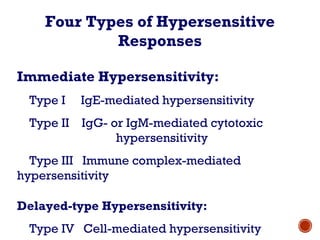
Four Types of Hypersensitive
Responses
Immediate Hypersensitivity:
Type I IgE-mediated hypersensitivity
Type II IgG- or IgM-mediated cytotoxic
hypersensitivity
Type III Immune complex-mediated
hypersensitivity
Delayed-type Hypersensitivity:
Type IV Cell-mediated hypersensitivity
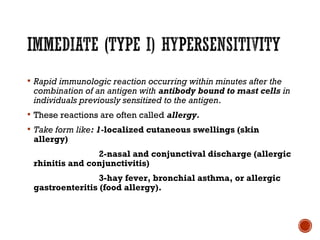
 Rapid immunologic reaction occurring within minutes after the
combination of an antigen with antibody bound to mast cells in
individuals previously sensitized to the antigen.
 These reactions are often called allergy.
 Take form like: 1-localized cutaneous swellings (skin
allergy)
2-nasal and conjunctival discharge (allergic
rhinitis and conjunctivitis)
3-hay fever, bronchial asthma, or allergic
gastroenteritis (food allergy).
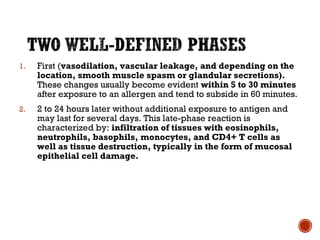
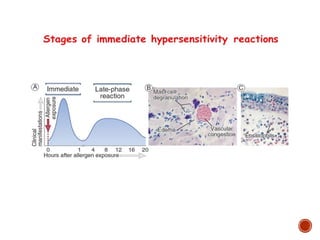
1. First (vasodilation, vascular leakage, and depending on the
location, smooth muscle spasm or glandular secretions).
These changes usually become evident within 5 to 30 minutes
after exposure to an allergen and tend to subside in 60 minutes.
2. 2 to 24 hours later without additional exposure to antigen and
may last for several days. This late-phase reaction is
characterized by: infiltration of tissues with eosinophils,
neutrophils, basophils, monocytes, and CD4+ T cells as
well as tissue destruction, typically in the form of mucosal
epithelial cell damage.
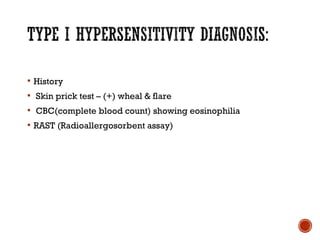
 History
 Skin prick test – (+) wheal & flare
 CBC(complete blood count) showing eosinophilia
 RAST (Radioallergosorbent assay)
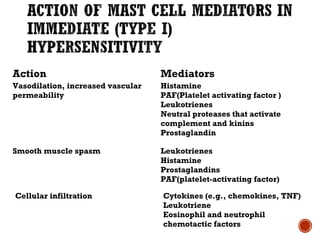
Action Mediators
Vasodilation, increased vascular
permeability
Histamine
PAF(Platelet activating factor )
Leukotrienes
Neutral proteases that activate
complement and kinins
Prostaglandin
Smooth muscle spasm Leukotrienes
Histamine
Prostaglandins
PAF(platelet-activating factor)
Cellular infiltration Cytokines (e.g., chemokines, TNF)
Leukotriene
Eosinophil and neutrophil
chemotactic factors
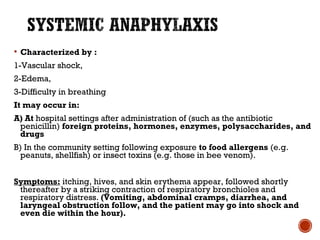
 Characterized by :
1-Vascular shock,
2-Edema,
3-Difficulty in breathing
It may occur in:
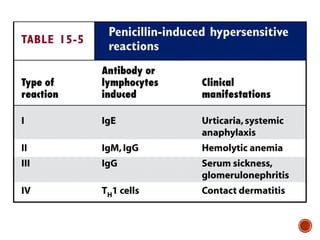
A) At hospital settings after administration of (such as the antibiotic
penicillin) foreign proteins, hormones, enzymes, polysaccharides, and
drugs
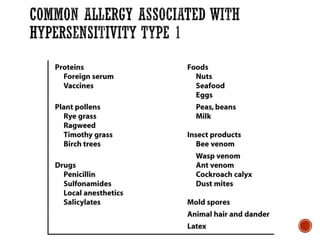
B) In the community setting following exposure to food allergens (e.g.
peanuts, shellfish) or insect toxins (e.g. those in bee venom).
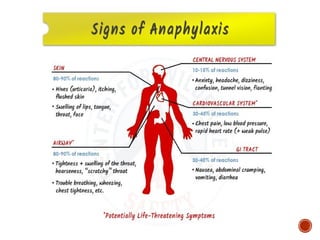
Symptoms: itching, hives, and skin erythema appear, followed shortly
thereafter by a striking contraction of respiratory bronchioles and
respiratory distress. (Vomiting, abdominal cramps, diarrhea, and
laryngeal obstruction follow, and the patient may go into shock and
even die within the hour).
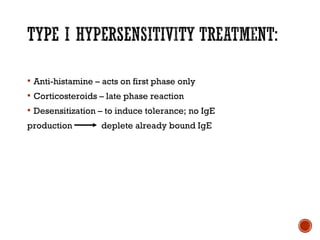
 Anti-histamine – acts on first phase only
 Corticosteroids – late phase reaction
 Desensitization – to induce tolerance; no IgE
production deplete already bound IgE
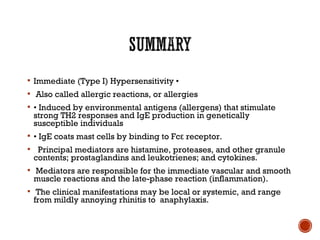
 Immediate (Type I) Hypersensitivity •
 Also called allergic reactions, or allergies
 • Induced by environmental antigens (allergens) that stimulate
strong TH2 responses and IgE production in genetically
susceptible individuals
 • IgE coats mast cells by binding to Fc receptor.ε
 Principal mediators are histamine, proteases, and other granule
contents; prostaglandins and leukotrienes; and cytokines.
 Mediators are responsible for the immediate vascular and smooth
muscle reactions and the late-phase reaction (inflammation).
 The clinical manifestations may be local or systemic, and range
from mildly annoying rhinitis to anaphylaxis.
 Robbins Basic Pathology 10th
edition.
 Google Images
 https://www.merriam-webster.com/dictionary/hypersensitive
 https://www.jacionline.org/article/S0091-6749(17)31020-5/pdf
hypersensitivity type 1

hypersensitivity type 1

  • 1.
  • 2.
    Although the word“hypersensitivity” implies an increased response, the immune response of a hypersensitivity reaction is not necessarily heightened but instead, an inappropriate response to an antigen.
  • 3.
    Four Types ofHypersensitive Responses Immediate Hypersensitivity: Type I IgE-mediated hypersensitivity Type II IgG- or IgM-mediated cytotoxic hypersensitivity Type III Immune complex-mediated hypersensitivity Delayed-type Hypersensitivity: Type IV Cell-mediated hypersensitivity
  • 4.
     Rapid immunologicreaction occurring within minutes after the combination of an antigen with antibody bound to mast cells in individuals previously sensitized to the antigen.  These reactions are often called allergy.  Take form like: 1-localized cutaneous swellings (skin allergy) 2-nasal and conjunctival discharge (allergic rhinitis and conjunctivitis) 3-hay fever, bronchial asthma, or allergic gastroenteritis (food allergy).
  • 5.
    1. First (vasodilation,vascular leakage, and depending on the location, smooth muscle spasm or glandular secretions). These changes usually become evident within 5 to 30 minutes after exposure to an allergen and tend to subside in 60 minutes. 2. 2 to 24 hours later without additional exposure to antigen and may last for several days. This late-phase reaction is characterized by: infiltration of tissues with eosinophils, neutrophils, basophils, monocytes, and CD4+ T cells as well as tissue destruction, typically in the form of mucosal epithelial cell damage.
  • 9.
     History  Skinprick test – (+) wheal & flare  CBC(complete blood count) showing eosinophilia  RAST (Radioallergosorbent assay)
  • 10.
    Action Mediators Vasodilation, increasedvascular permeability Histamine PAF(Platelet activating factor ) Leukotrienes Neutral proteases that activate complement and kinins Prostaglandin Smooth muscle spasm Leukotrienes Histamine Prostaglandins PAF(platelet-activating factor) Cellular infiltration Cytokines (e.g., chemokines, TNF) Leukotriene Eosinophil and neutrophil chemotactic factors
  • 11.
     Characterized by: 1-Vascular shock, 2-Edema, 3-Difficulty in breathing It may occur in: A) At hospital settings after administration of (such as the antibiotic penicillin) foreign proteins, hormones, enzymes, polysaccharides, and drugs B) In the community setting following exposure to food allergens (e.g. peanuts, shellfish) or insect toxins (e.g. those in bee venom). Symptoms: itching, hives, and skin erythema appear, followed shortly thereafter by a striking contraction of respiratory bronchioles and respiratory distress. (Vomiting, abdominal cramps, diarrhea, and laryngeal obstruction follow, and the patient may go into shock and even die within the hour).
  • 13.
     Anti-histamine –acts on first phase only  Corticosteroids – late phase reaction  Desensitization – to induce tolerance; no IgE production deplete already bound IgE
  • 14.
     Immediate (TypeI) Hypersensitivity •  Also called allergic reactions, or allergies  • Induced by environmental antigens (allergens) that stimulate strong TH2 responses and IgE production in genetically susceptible individuals  • IgE coats mast cells by binding to Fc receptor.ε  Principal mediators are histamine, proteases, and other granule contents; prostaglandins and leukotrienes; and cytokines.  Mediators are responsible for the immediate vascular and smooth muscle reactions and the late-phase reaction (inflammation).  The clinical manifestations may be local or systemic, and range from mildly annoying rhinitis to anaphylaxis.
  • 15.
     Robbins BasicPathology 10th edition.  Google Images  https://www.merriam-webster.com/dictionary/hypersensitive  https://www.jacionline.org/article/S0091-6749(17)31020-5/pdf