Cognitive Psychology
Made by:
Mirza Naadirhasan
Memon Ayan
Modhava sahel
Course Layout
Topics to be covered:
• Memory
• Attention
• Mental Imagery
• Language
• Problem Solving & Expertise
• Reasoning, Decision Making & Judgements
• Consciousness
• Knowledge
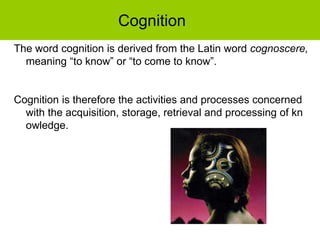
Cognition
The word cognition is derived from the Latin word cognoscere,
meaning “to know” or “to come to know”.
Cognition is therefore the activities and processes concerned
with the acquisition, storage, retrieval and processing of kn
owledge.
What is Cognitive Psychology?
It is the scientific study of how the mind works
“...cognitive psychology deals with how people perceive, learn
, remember, and think about information.”
— Sternberg (1999)
“Cognitive psychology [is] the study of processes underlying m
ental events”
— Solso (2005)
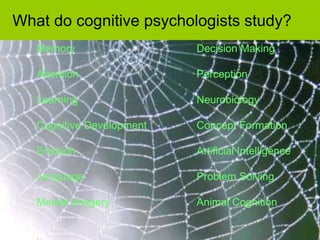
What do cognitive psychologists study?
Memory Decision Making
Attention Perception
Learning Neurobiology
Cognitive Development Concept Formation
Emotion Artificial Intelligence
Language Problem Solving
Mental Imagery Animal Cognition
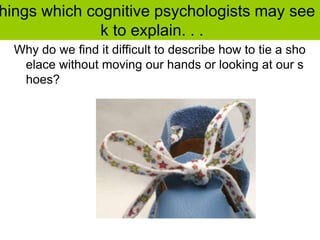
hings which cognitive psychologists may see
k to explain. . .
Why do we find it difficult to describe how to tie a sho
elace without moving our hands or looking at our s
hoes?
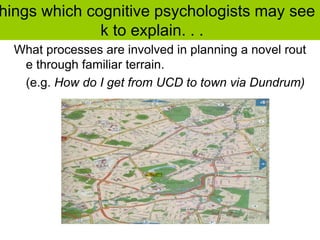
hings which cognitive psychologists may see
k to explain. . .
What processes are involved in planning a novel rout
e through familiar terrain.
(e.g. How do I get from UCD to town via Dundrum)
hings which cognitive psychologists may see
k to explain. . .
How can we recognise a song from its first few beats
?
Approaches to Cognitive Psychology
• Experimental Cognitive Psychology
• Computational Cognitive Science
• Cognitive Neuropsychology
• Cognitive Neuroscience
Experimental Cognitive Psychology
Tightly controlled experiments carried out under labor
atory conditions on healthy individuals.
Experiments often designed to disrupt cognitive proc
esses and thus reveal their workings.
(e.g. Distracting participants attention)
Findings lead to theories, which in turn lead to testabl
e claims
(e.g. “Instrumental music does not disrupt reading”)
Experimental Cognitive Psychology
Some limitations:
• Is behaviour in a laboratory fundamentally different
to that in real world settings. Are the findings of exp
eriments ecologically valid?
• Does not look directly at brain function, but rather t
he explicit behavioural results of brain function. Th
us we may miss something.
• Tendency to negate individual differences by avera
ging many participants’ performances. Does not all
ow for the possibility of unique cog. function
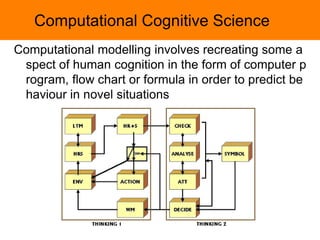
Computational Cognitive Science
Computational modelling involves recreating some a
spect of human cognition in the form of computer p
rogram, flow chart or formula in order to predict be
haviour in novel situations
Computational Cognitive Science
Some limitations
• There are usually many ways to model a particular
cognitive phenomenon
• There is a lack of a definite method for relating a c
omputational model’s behaviour to human behavio
ur
• It is extremely difficult, if not impossible, to take ev
ery cognitive factor into account when creating a m
odel .
Cognitive Neuropsychology
Concerned with the cognitive functioning of those wh
o have suffered brain damage
• Damage to region X disrupts ability Y
• People who have lost ability Y also have problems
with ability Z
From studying people with brain injuries we make as
sertions about healthy brain function
Cognitive Neuropsychology
Sample Case: Frontal Lobe damage
• People with frontal lobe damage often show little c
ognitive deficit when given IQ tests
• However they have extreme difficulty with things lik
e
–Socially acceptable behaviours
–Cognitive flexibility
–Abstract thinking
• Frontal lobes are the area which differ to the greate
st extent between human and ape brains
Cognitive Neuropsychology
Some limitations:
• Ethically we cannot cause brain damage in human
s so we have to work with what we find. This dama
ge is rarely ‘clean’
• Interpretation of findings in relation to those sufferi
ng damage to several areas is very difficult
• If ability Y is disrupted by damage to region X, it do
es not tell us what role X has in Y. Is it the function
al centre, or simply a vital there are 50 million inter
connected neurons.
Cognitive Neuroscience
Using brain imaging and brain anatomy to study ‘live’
cognitive functioning in healthy individuals
As the technology improves, these studies are beco
ming more influential and potentially useful
Methods include: (Details to follow!)
• Single Unit Recording
• Event Related Potentials (ERPs)
• Positron Emission Tomography (PET)
• (Functional) Magnetic Resonance Imaging (fMRI, MRI)
• Magneto-encephalography (MEG)
• Transcranial magnetic stimulation (TMS)
Cognitive Neuroscience
Some Limitations
• Techniques are of questionable use with high-order function
ing which might not be organised in a concise way
• If data from several individuals is averaged the interpretatio
ns become accordingly blunt
• Tendency for research to be conducted for the sake of rese
arch. Papers can often be lacking any theoretical basis, a
nd result in ad hoc hypotheses
• Threshold levels need to be set to disregard noise. These le
vels are a contentious issue!
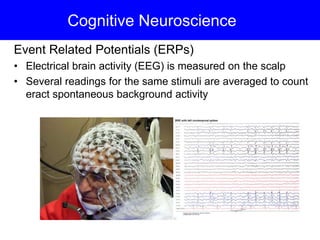
Cognitive Neuroscience
Event Related Potentials (ERPs)
• Electrical brain activity (EEG) is measured on the scalp
• Several readings for the same stimuli are averaged to count
eract spontaneous background activity
Cognitive Neuroscience
Event Related Potentials (ERPs)
Pros:
Best detail of the timeline of cognitive events
Cons:
Only useful with simple, low-level stimuli
Skull and scalp distort emerging electrical waves
Cognitive Neuroscience
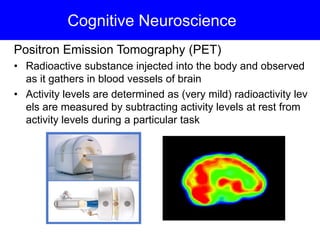
Positron Emission Tomography (PET)
• Radioactive substance injected into the body and observed
as it gathers in blood vessels of brain
• Activity levels are determined as (very mild) radioactivity lev
els are measured by subtracting activity levels at rest from
activity levels during a particular task
Cognitive Neuroscience
Positron Emission Tomography (PET)
Pros:
Maps wide range of cognitive activities including complex tasks
Reasonable location of active areas (3-4 millimeters)
Cons:
Scans indicate total amount of activity over 60 seconds. Not se
nsitive to rapid changes in activity.
Cognitive Neuroscience
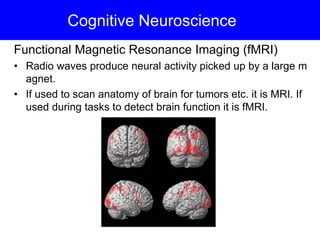
Functional Magnetic Resonance Imaging (fMRI)
• Radio waves produce neural activity picked up by a large m
agnet.
• If used to scan anatomy of brain for tumors etc. it is MRI. If
used during tasks to detect brain function it is fMRI.
Cognitive Neuroscience
Functional Magnetic Resonance Imaging (fMRI)
Pros:
No biological risks
Provides anatomical and functional information
Cons:
Poor temporal resolution of a few seconds
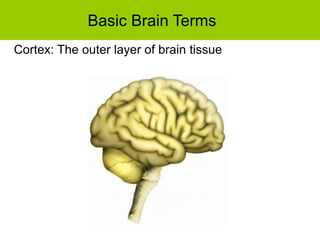
Basic Brain Terms
Cortex: The outer layer of brain tissue
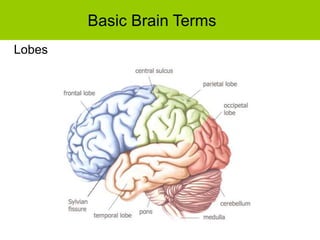
Basic Brain Terms
Lobes
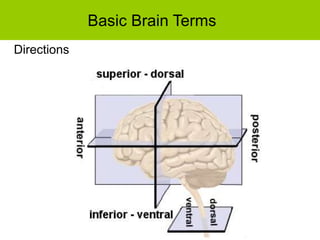
Basic Brain Terms
Directions
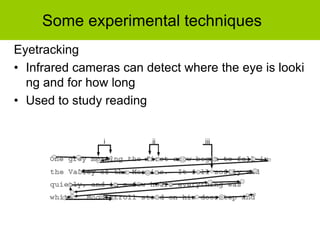
Some experimental techniques
Eyetracking
• Infrared cameras can detect where the eye is looki
ng and for how long
• Used to study reading
Some experimental techniques
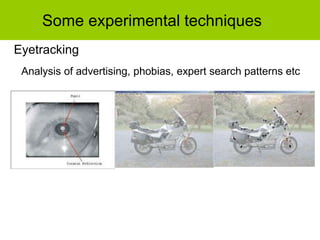
Eyetracking
Analysis of advertising, phobias, expert search patterns etc
Cognitive processes

Cognitive processes

  • 1.
    Cognitive Psychology Made by: MirzaNaadirhasan Memon Ayan Modhava sahel
  • 2.
    Course Layout Topics tobe covered: • Memory • Attention • Mental Imagery • Language • Problem Solving & Expertise • Reasoning, Decision Making & Judgements • Consciousness • Knowledge
  • 3.
    Cognition The word cognitionis derived from the Latin word cognoscere, meaning “to know” or “to come to know”. Cognition is therefore the activities and processes concerned with the acquisition, storage, retrieval and processing of kn owledge.
  • 4.
    What is CognitivePsychology? It is the scientific study of how the mind works “...cognitive psychology deals with how people perceive, learn , remember, and think about information.” — Sternberg (1999) “Cognitive psychology [is] the study of processes underlying m ental events” — Solso (2005)
  • 5.
    What do cognitivepsychologists study? Memory Decision Making Attention Perception Learning Neurobiology Cognitive Development Concept Formation Emotion Artificial Intelligence Language Problem Solving Mental Imagery Animal Cognition
  • 6.
    hings which cognitivepsychologists may see k to explain. . . Why do we find it difficult to describe how to tie a sho elace without moving our hands or looking at our s hoes?
  • 7.
    hings which cognitivepsychologists may see k to explain. . . What processes are involved in planning a novel rout e through familiar terrain. (e.g. How do I get from UCD to town via Dundrum)
  • 8.
    hings which cognitivepsychologists may see k to explain. . . How can we recognise a song from its first few beats ?
  • 9.
    Approaches to CognitivePsychology • Experimental Cognitive Psychology • Computational Cognitive Science • Cognitive Neuropsychology • Cognitive Neuroscience
  • 10.
    Experimental Cognitive Psychology Tightlycontrolled experiments carried out under labor atory conditions on healthy individuals. Experiments often designed to disrupt cognitive proc esses and thus reveal their workings. (e.g. Distracting participants attention) Findings lead to theories, which in turn lead to testabl e claims (e.g. “Instrumental music does not disrupt reading”)
  • 11.
    Experimental Cognitive Psychology Somelimitations: • Is behaviour in a laboratory fundamentally different to that in real world settings. Are the findings of exp eriments ecologically valid? • Does not look directly at brain function, but rather t he explicit behavioural results of brain function. Th us we may miss something. • Tendency to negate individual differences by avera ging many participants’ performances. Does not all ow for the possibility of unique cog. function
  • 12.
    Computational Cognitive Science Computationalmodelling involves recreating some a spect of human cognition in the form of computer p rogram, flow chart or formula in order to predict be haviour in novel situations
  • 13.
    Computational Cognitive Science Somelimitations • There are usually many ways to model a particular cognitive phenomenon • There is a lack of a definite method for relating a c omputational model’s behaviour to human behavio ur • It is extremely difficult, if not impossible, to take ev ery cognitive factor into account when creating a m odel .
  • 14.
    Cognitive Neuropsychology Concerned withthe cognitive functioning of those wh o have suffered brain damage • Damage to region X disrupts ability Y • People who have lost ability Y also have problems with ability Z From studying people with brain injuries we make as sertions about healthy brain function
  • 15.
    Cognitive Neuropsychology Sample Case:Frontal Lobe damage • People with frontal lobe damage often show little c ognitive deficit when given IQ tests • However they have extreme difficulty with things lik e –Socially acceptable behaviours –Cognitive flexibility –Abstract thinking • Frontal lobes are the area which differ to the greate st extent between human and ape brains
  • 16.
    Cognitive Neuropsychology Some limitations: •Ethically we cannot cause brain damage in human s so we have to work with what we find. This dama ge is rarely ‘clean’ • Interpretation of findings in relation to those sufferi ng damage to several areas is very difficult • If ability Y is disrupted by damage to region X, it do es not tell us what role X has in Y. Is it the function al centre, or simply a vital there are 50 million inter connected neurons.
  • 17.
    Cognitive Neuroscience Using brainimaging and brain anatomy to study ‘live’ cognitive functioning in healthy individuals As the technology improves, these studies are beco ming more influential and potentially useful Methods include: (Details to follow!) • Single Unit Recording • Event Related Potentials (ERPs) • Positron Emission Tomography (PET) • (Functional) Magnetic Resonance Imaging (fMRI, MRI) • Magneto-encephalography (MEG) • Transcranial magnetic stimulation (TMS)
  • 18.
    Cognitive Neuroscience Some Limitations •Techniques are of questionable use with high-order function ing which might not be organised in a concise way • If data from several individuals is averaged the interpretatio ns become accordingly blunt • Tendency for research to be conducted for the sake of rese arch. Papers can often be lacking any theoretical basis, a nd result in ad hoc hypotheses • Threshold levels need to be set to disregard noise. These le vels are a contentious issue!
  • 19.
    Cognitive Neuroscience Event RelatedPotentials (ERPs) • Electrical brain activity (EEG) is measured on the scalp • Several readings for the same stimuli are averaged to count eract spontaneous background activity
  • 20.
    Cognitive Neuroscience Event RelatedPotentials (ERPs) Pros: Best detail of the timeline of cognitive events Cons: Only useful with simple, low-level stimuli Skull and scalp distort emerging electrical waves
  • 21.
    Cognitive Neuroscience Positron EmissionTomography (PET) • Radioactive substance injected into the body and observed as it gathers in blood vessels of brain • Activity levels are determined as (very mild) radioactivity lev els are measured by subtracting activity levels at rest from activity levels during a particular task
  • 22.
    Cognitive Neuroscience Positron EmissionTomography (PET) Pros: Maps wide range of cognitive activities including complex tasks Reasonable location of active areas (3-4 millimeters) Cons: Scans indicate total amount of activity over 60 seconds. Not se nsitive to rapid changes in activity.
  • 23.
    Cognitive Neuroscience Functional MagneticResonance Imaging (fMRI) • Radio waves produce neural activity picked up by a large m agnet. • If used to scan anatomy of brain for tumors etc. it is MRI. If used during tasks to detect brain function it is fMRI.
  • 24.
    Cognitive Neuroscience Functional MagneticResonance Imaging (fMRI) Pros: No biological risks Provides anatomical and functional information Cons: Poor temporal resolution of a few seconds
  • 25.
    Basic Brain Terms Cortex:The outer layer of brain tissue
  • 26.
  • 27.
  • 28.
    Some experimental techniques Eyetracking •Infrared cameras can detect where the eye is looki ng and for how long • Used to study reading
  • 29.
    Some experimental techniques Eyetracking Analysisof advertising, phobias, expert search patterns etc