Peggy D. Johndrow 2009
Hypersensitivities/Allergies Increased or excessive response to presence of antigen to which client has been exposed Degree of reaction ranging from uncomfortable to life threatening Terms  hypersensitivity  and  allergy  used interchangeably
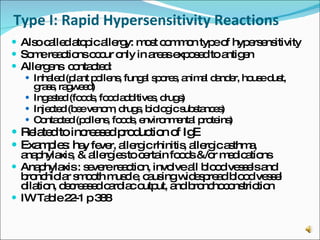
Type I: Rapid Hypersensitivity Reactions Also called atopic allergy: most common type of hypersensitivity Some reactions occur only in areas exposed to antigen Allergens  contacted: Inhaled (plant pollens, fungal spores, animal dander, house dust, grass, ragweed) Ingested (foods, food additives, drugs) Injected (bee venom, drugs, biologic substances) Contacted (pollens, foods, environmental proteins) Related to  increased production of IgE Examples: h ay fever, allergic rhinitis, allergic asthma, anaphylaxis, & allergies to certain foods &/or medications Anaphylaxis : severe reaction, involve all blood vessels and bronchiolar smooth muscle, causing widespread blood vessel dilation, decreased cardiac output, and bronchoconstriction IW Table 22-1 p 388
Allergic Rhinitis Triggered by reaction to airborne allergens Seasonal: coincides with timing of environmental exposure (i.e. spring) & lasts a short time Chronic: occurs intermittently without seasonal pattern or continuously when exposed to certain allergens Pathophysiology: initial exposure body responds by making antigen specific IgE which bind to surface of basophils & mast cells Repeat exposure to allergen results in two phase response Primary:  allergen binds to IgE molecules; cell degranulates, histamine released resulting in capillary leak, mucous secretion, pruritis, & erythema Secondary: additional proteins released,  increased WBC’s; more generalized reaction occurs
Assessment History: onset & duration symptoms: family history Clinical Manifestations:  rhinorrhea, itchy/watery eyes, H/A, swollen nasal mucosa, post nasal drip, dry/scratchy throat & pharyngitis  Diagnostic studies CBC: increased  eosinophil count (1-2%) IgE  indicates tendency to have allergic responses (>100 IU/mL) RAST: determines specific allergies by determining blood level of IgE against certain allergen Skin testing Immediate hypersensitivity reaction occurs in 15 min’ positive =  redness & wheal  Instruct client to stop systemic glucocorticoids &  antihistamines 5 days prior to procedure Emergency equipment available Intradermal testing Performed if a specific allergen did not produce a reaction Oral food challenge Used to identify specific allergens when skin testing or  food diary fails  IW Table 22-2 p 391
Latex Allergy Allergic reaction to a protein found in processed natural latex Signs and symptoms vary in range (immediate to delayed) Increased risk for allergy seen with high exposure to latex, spina bifida, allergy to bananas or avocados Management Ask all clients about use & known reaction to latex, or specific food allergies Utilize latex free products in care of client
Management History Physical assessment/clinical manifestations Laboratory assessment Allergy testing including skin testing, scratch testing, intradermal testing, oral food challenge Avoidance therapy, symptomatic therapy, pharmacotherapy IW Chart 22-1 p 390
Pharmacotherapy Decongestant: cause vasoconstriction of  inflamed tissue  Examples: Neo-synepherine, Afrin Antihistamines:  block histamine from binding to receptor site, prevents vasodilatation & capillary leak Examples: Benadryl, Chlor-trimeton, Zrytec, Clarinex, Allegra Corticosteroids: decrease  inflammation & immune response Examples: Prednisone, Delta-cortef, Beconase, Flonase Mast cell stabilizers:  prevent mast cell membrane from opening when allergen binds to IgE Example: Nasacrom Leukotriene antagonics:  blocks leukotriene receptor & prevents synthesis Examples:  Accolate, Zyflo, Singulair  Complementary and alternative therapy (IW Chart 22-3 p 393)
Avoidance and Desensitization Therapy Avoidance therapy Instruct client to avoid direct or close contact w/ known allergens Desensitization therapy Used when identified allergens can't be easily avoided Decrease  allergic response by competition
Anaphylaxis   Systemic reaction; occurs rapidly after exposure (in seconds) Initial feelings of uneasiness, apprehension, weakness & impending doom Pruritus & urticaria Erythema and sometimes angioedema eyes, lips, tongue Histamine causes capillary leak bronchoconstriction, mucosal edema & excess mucus secretion Congestion, rhinorrhea, dyspnea & increasing respiratory distress with audible wheezing result Potentially fatal IW Chart 22-2 p 392
Cascade Itching, urticaria    angioedema    dyspnea,  increased  salivation, audible wheezing    laryngeal edema, stridor, hypoxia    hypotension, dysrhythmias, shock     cardiopulmonary arrest
Interventions Initially assess respiratory function; must always establish and maintain an airway  Prepare for emergency intubation or tracheostomy Oxygen reduces hypoxemia: O2 via NC 2 2-6L/min to maintain SAO2 >90% Pharmacotherapy: (IW Chart 22-3 p 393) Epinephrine (1:1000) .03-0.5 mL SQ;  with initial symptoms Antihistamines (25-100mg) IM, IV or PO; treat angioedema & urticaria Theophylline (6mg/kg) IV over 20-30 min: bronchodilator Inhaled beta-adrenergic agonist via small volume (high flow) nebulizer Q2-4 hrs; bronchodilator Corticosteroids; decrease inflammation Dopamine, Levophed; increase B/P May require CPR
Type II: Cytotoxic Reactions  Body makes special autoantibodies directed against self cells that have some form of foreign protein attached  Clinical examples include hemolytic anemias, thrombocytopenic purpura, hemolytic transfusion reactions, Goodpasture’s syndrome, and drug-induced hemolytic anemia Management D/C medication or blood product Hemolytic crisis or renal failure can occur Treatment usually symptomatic May require plasmapheresis
Type III: Immune Complex Reactions Excess antigens cause immune complexes to form in blood; these circulating complexes usually lodge in small blood vessels  Usual sites include kidneys, skin, joints & small blood vessels Lodge in the small vessel walls, trigger inflammation & cause tissue or vessel damage Deposited complexes trigger inflammation, resulting in tissue or vessel damage Examples: rheumatoid arthritis, systemic lupus erythematosus & serum sickness  IW Table 22-3 & Women Health p 396
Type IV: Delayed Hypersensitivity Reactions Reactive cell  T-lymphocyte (T-cell) Antibodies & complement not involved Local collection of lymphocytes & macrophages causes edema, induration, ischemia & tissue damage at site within hours to days after exposure Examples: Tb test (positive purified protein derivative), contact dermatitis, poison ivy skin rashes, insect stings, tissue transplant rejection & sarcoidosis
Management Intervention Identification and removal of allergen Client preparation Procedure Follow-up care Reaction self-limiting & treated symptomatically
Type V: Stimulatory Reactions Inappropriate stimulation of a normal cell surface receptor by an autoantibody, resulting in a continuous “turned-on” state for the cell Example: Graves’ disease, form of hyperthyroidism IW Table 22-3 p 396 Management One organ: removal of enough tissue to return function to normal Widespread involvement:  decrease  autoantibody production with immunosupression
Sjögren’s Syndrome Group of problems often appear with other autoimmune disorders Dry eyes, dry mucous membranes of nose/mouth (xerostomia) & vaginal dryness Insufficient tears causing inflammation & ulceration of cornea Treatment: immunomodulation & symptomatic therapy
Goodpasture’s Syndrome Autoimmune disorder in which autoantibodies made against glomerular basement membrane & neutrophils Lungs and kidneys Shortness of breath, hemoptysis, decreased urine output, weight gain, edema, hypertension & tachycardia Treatment: high-dose corticosteroids
Therapies Pharmacotherapy: Rheumatrex (methotrexate) Cytoxan (cyclophosphamide) Corticosteroids Sandimmune (cyclosporine) Plaquenil (hydroxchloroquine) Symptomatic Artificial tears, saliva Lubricants Pain control Renal support: hemodialysis, peritoneal dialysis Other Plasmapheresis (filter plasma, remove proteins)

Hypersensitivity Concepts Vo

  • 1.
  • 2.
    Hypersensitivities/Allergies Increased orexcessive response to presence of antigen to which client has been exposed Degree of reaction ranging from uncomfortable to life threatening Terms hypersensitivity and allergy used interchangeably
  • 3.
    Type I: RapidHypersensitivity Reactions Also called atopic allergy: most common type of hypersensitivity Some reactions occur only in areas exposed to antigen Allergens contacted: Inhaled (plant pollens, fungal spores, animal dander, house dust, grass, ragweed) Ingested (foods, food additives, drugs) Injected (bee venom, drugs, biologic substances) Contacted (pollens, foods, environmental proteins) Related to increased production of IgE Examples: h ay fever, allergic rhinitis, allergic asthma, anaphylaxis, & allergies to certain foods &/or medications Anaphylaxis : severe reaction, involve all blood vessels and bronchiolar smooth muscle, causing widespread blood vessel dilation, decreased cardiac output, and bronchoconstriction IW Table 22-1 p 388
  • 4.
    Allergic Rhinitis Triggeredby reaction to airborne allergens Seasonal: coincides with timing of environmental exposure (i.e. spring) & lasts a short time Chronic: occurs intermittently without seasonal pattern or continuously when exposed to certain allergens Pathophysiology: initial exposure body responds by making antigen specific IgE which bind to surface of basophils & mast cells Repeat exposure to allergen results in two phase response Primary: allergen binds to IgE molecules; cell degranulates, histamine released resulting in capillary leak, mucous secretion, pruritis, & erythema Secondary: additional proteins released, increased WBC’s; more generalized reaction occurs
  • 5.
    Assessment History: onset& duration symptoms: family history Clinical Manifestations: rhinorrhea, itchy/watery eyes, H/A, swollen nasal mucosa, post nasal drip, dry/scratchy throat & pharyngitis Diagnostic studies CBC: increased eosinophil count (1-2%) IgE indicates tendency to have allergic responses (>100 IU/mL) RAST: determines specific allergies by determining blood level of IgE against certain allergen Skin testing Immediate hypersensitivity reaction occurs in 15 min’ positive = redness & wheal Instruct client to stop systemic glucocorticoids & antihistamines 5 days prior to procedure Emergency equipment available Intradermal testing Performed if a specific allergen did not produce a reaction Oral food challenge Used to identify specific allergens when skin testing or food diary fails IW Table 22-2 p 391
  • 6.
    Latex Allergy Allergicreaction to a protein found in processed natural latex Signs and symptoms vary in range (immediate to delayed) Increased risk for allergy seen with high exposure to latex, spina bifida, allergy to bananas or avocados Management Ask all clients about use & known reaction to latex, or specific food allergies Utilize latex free products in care of client
  • 7.
    Management History Physicalassessment/clinical manifestations Laboratory assessment Allergy testing including skin testing, scratch testing, intradermal testing, oral food challenge Avoidance therapy, symptomatic therapy, pharmacotherapy IW Chart 22-1 p 390
  • 8.
    Pharmacotherapy Decongestant: causevasoconstriction of inflamed tissue Examples: Neo-synepherine, Afrin Antihistamines: block histamine from binding to receptor site, prevents vasodilatation & capillary leak Examples: Benadryl, Chlor-trimeton, Zrytec, Clarinex, Allegra Corticosteroids: decrease inflammation & immune response Examples: Prednisone, Delta-cortef, Beconase, Flonase Mast cell stabilizers: prevent mast cell membrane from opening when allergen binds to IgE Example: Nasacrom Leukotriene antagonics: blocks leukotriene receptor & prevents synthesis Examples: Accolate, Zyflo, Singulair Complementary and alternative therapy (IW Chart 22-3 p 393)
  • 9.
    Avoidance and DesensitizationTherapy Avoidance therapy Instruct client to avoid direct or close contact w/ known allergens Desensitization therapy Used when identified allergens can't be easily avoided Decrease allergic response by competition
  • 10.
    Anaphylaxis Systemic reaction; occurs rapidly after exposure (in seconds) Initial feelings of uneasiness, apprehension, weakness & impending doom Pruritus & urticaria Erythema and sometimes angioedema eyes, lips, tongue Histamine causes capillary leak bronchoconstriction, mucosal edema & excess mucus secretion Congestion, rhinorrhea, dyspnea & increasing respiratory distress with audible wheezing result Potentially fatal IW Chart 22-2 p 392
  • 11.
    Cascade Itching, urticaria  angioedema  dyspnea, increased salivation, audible wheezing  laryngeal edema, stridor, hypoxia  hypotension, dysrhythmias, shock  cardiopulmonary arrest
  • 12.
    Interventions Initially assessrespiratory function; must always establish and maintain an airway Prepare for emergency intubation or tracheostomy Oxygen reduces hypoxemia: O2 via NC 2 2-6L/min to maintain SAO2 >90% Pharmacotherapy: (IW Chart 22-3 p 393) Epinephrine (1:1000) .03-0.5 mL SQ; with initial symptoms Antihistamines (25-100mg) IM, IV or PO; treat angioedema & urticaria Theophylline (6mg/kg) IV over 20-30 min: bronchodilator Inhaled beta-adrenergic agonist via small volume (high flow) nebulizer Q2-4 hrs; bronchodilator Corticosteroids; decrease inflammation Dopamine, Levophed; increase B/P May require CPR
  • 13.
    Type II: CytotoxicReactions Body makes special autoantibodies directed against self cells that have some form of foreign protein attached Clinical examples include hemolytic anemias, thrombocytopenic purpura, hemolytic transfusion reactions, Goodpasture’s syndrome, and drug-induced hemolytic anemia Management D/C medication or blood product Hemolytic crisis or renal failure can occur Treatment usually symptomatic May require plasmapheresis
  • 14.
    Type III: ImmuneComplex Reactions Excess antigens cause immune complexes to form in blood; these circulating complexes usually lodge in small blood vessels Usual sites include kidneys, skin, joints & small blood vessels Lodge in the small vessel walls, trigger inflammation & cause tissue or vessel damage Deposited complexes trigger inflammation, resulting in tissue or vessel damage Examples: rheumatoid arthritis, systemic lupus erythematosus & serum sickness IW Table 22-3 & Women Health p 396
  • 15.
    Type IV: DelayedHypersensitivity Reactions Reactive cell T-lymphocyte (T-cell) Antibodies & complement not involved Local collection of lymphocytes & macrophages causes edema, induration, ischemia & tissue damage at site within hours to days after exposure Examples: Tb test (positive purified protein derivative), contact dermatitis, poison ivy skin rashes, insect stings, tissue transplant rejection & sarcoidosis
  • 16.
    Management Intervention Identificationand removal of allergen Client preparation Procedure Follow-up care Reaction self-limiting & treated symptomatically
  • 17.
    Type V: StimulatoryReactions Inappropriate stimulation of a normal cell surface receptor by an autoantibody, resulting in a continuous “turned-on” state for the cell Example: Graves’ disease, form of hyperthyroidism IW Table 22-3 p 396 Management One organ: removal of enough tissue to return function to normal Widespread involvement: decrease autoantibody production with immunosupression
  • 18.
    Sjögren’s Syndrome Groupof problems often appear with other autoimmune disorders Dry eyes, dry mucous membranes of nose/mouth (xerostomia) & vaginal dryness Insufficient tears causing inflammation & ulceration of cornea Treatment: immunomodulation & symptomatic therapy
  • 19.
    Goodpasture’s Syndrome Autoimmunedisorder in which autoantibodies made against glomerular basement membrane & neutrophils Lungs and kidneys Shortness of breath, hemoptysis, decreased urine output, weight gain, edema, hypertension & tachycardia Treatment: high-dose corticosteroids
  • 20.
    Therapies Pharmacotherapy: Rheumatrex(methotrexate) Cytoxan (cyclophosphamide) Corticosteroids Sandimmune (cyclosporine) Plaquenil (hydroxchloroquine) Symptomatic Artificial tears, saliva Lubricants Pain control Renal support: hemodialysis, peritoneal dialysis Other Plasmapheresis (filter plasma, remove proteins)