DENTAL
CARIES
VACCINE
Dr. R. Venkitachalam,
PG I year, Department of Public Health Dentistry, Amrita School of
Dentistry
Learning objectives
 How immune system works
 The need for caries vaccine in public health
point of view
 Methods of caries vaccine administration
CONTENTS
 Introduction
 Immunity
 Need for caries vaccine
 Microbiology of dental caries
 Routes of administration
 Advantages
 Disadvantages
 Passive immunization
 Public Health perspective
 Summary
 References
INTRODUCTION
 Definition: Dental caries is an infectious microbiological
disease of the teeth that results in localized dissolution
and destruction of the calcified tissue. It is one of the most
common diseases in humans.
 Dental caries is a major public health problem.
 Vaccine: An immunobiological substance designed to
produce a specific protection against a given disease.
IMMUNITY
It is defined as resistance exhibited by the
host against any foreign antigen including
microorganisms.
Classification - ??
Classification of immunity
IMMUNITY
Innate
Skin, tears, low
pH of stomach,
respiratory cilia,
normal flora of gut
Acquired
Natural
Natural active
During exposure
to disease ,
antibobies are
produced
Natural passive
Transmission from
mother to child
Artificial
Artificial active
Vaccination (low
dose of antigen
introduced in the
body)
Artificial passive
Immunization
(introduction of
antibodies in the
body)
Classification of immunity
IMMUNITY
CELL
MEDIATED
Activation of T
lymphocytes,
PMN’s
Production of
Tc, TH, Ts and
memory T cells
Phagocytosis
HUMORAL
Production of B
lymphocytes
Plasma cells
Produces Ab
leading to Ag-
Ab reaction
Memory B cells
Helps in
secondary
attack
Antibodies (Immunoglobulin)
Definition: An immunoglobulin, a specialized
immune protein, produced because of the introduction of
an antigen into the body, and which possesses the
remarkable ability to combine with the very antigen that
triggered its production.
Types of Immunoglobulins:
IgG - protects the body fluids
IgA - protects the body surfaces
IgM - protects the blood stream
IgD - serves as recognition receptors for antigens
IgE - mediates allergic response or hypersensitivity
Need for vaccination
 Dental caries is a major public health problem.
 Has an impact on Oral health related quality of life
loss of man hours
Keyes triad
Newbrun tetrad
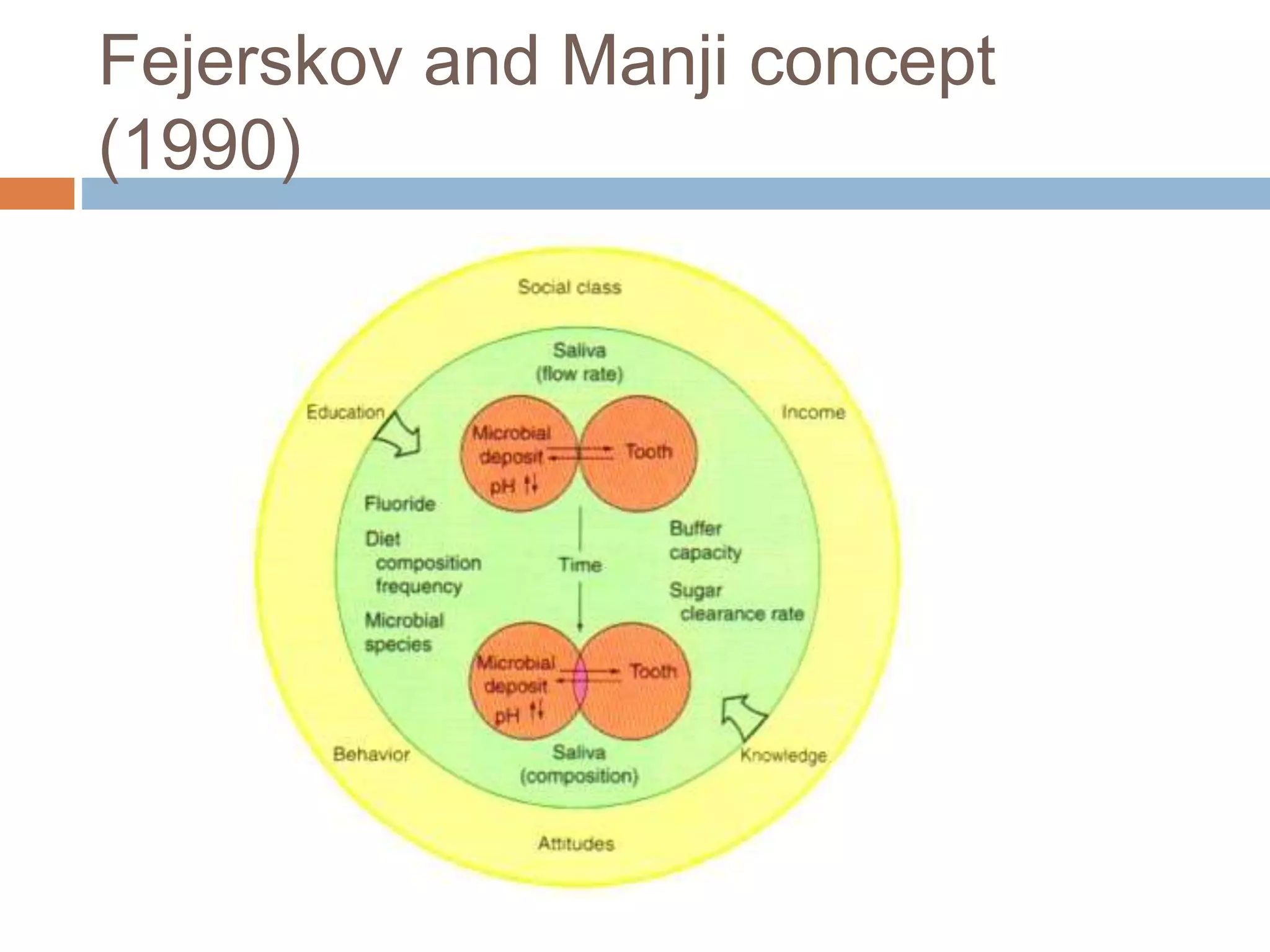
Fejerskov and Manji concept
(1990)
MICROBIOLOGY
A wide group of microorganisms are identified
from carious lesions which include:
Mutans group of streptococci
 S. mutans, S. sobrinus, S. crecitus, S. rattus, S. ferus, S.
macacae, S. downei
Streptococcus mutans (initiation)
Lactobacillus (progression)
Actinomyces species (root surface)
Streptococcus mutans
PROFILE: Gram positive and facultative anaerobe
 colonize the host only after the first teeth erupt, and their preferential
colonization site is the teeth
 they are highly localized on the surfaces of the teeth and their
abundance in the plaque is highest over initial lesions
 their level of colonization within the plaque is increased by sucrose
consumption
 they synthesize certain macro-molecules from sucrose that foster their
attachment to the teeth
 they are rapid producers of acid from simple carbohydrates
(acidogenic), including sucrose, and are tolerant to low pH (aciduric).
 they are essentially always recovered on cultivation of initial and
established carious lesion sites
Antigenic determinants of S.
mutans
ADHESINS (WALL ASSOCIATED PROTEINS)
Form the 2 principal human pathogens of S.mutans (Ag I/II, Pac, or P1) and of
S.sobrinus (Spa-A or Pag) and have been purified.
Ag I/II: Associated with binding or attachment of S. mutans with tooth surface
GLUCOSYLTRANSFERASE
S.mutans has 3 forms of GTF’s:
- Water insoluble glucan sythesizing enzyme: GTF-I
- Water insoluble & water-soluble glucan synthesizing enzymes: GTF-S-I.
- Water-soluble glucan synthesizing enzymes: GTF-S.
Genes encoding the 3 forms are:
- GTF-I: GTF-B - GTF-SI: GTF-C - GTF-S: GTF-D
Antigenic determinants
GLUCAN BINDING PROTEIN (GBP):
- S.mutans secretes at least 3 distinct proteins with glucan binding activity:
GBP-A, GBP-B and GBP-C.
- It helps in binding of glucan to S. mutans
DEXTRANASES:
- Dextran is an important constituent of early dental plaque.
- Dextranase is an enzyme produced by mutans streptococus.
They destroy dextran and thus the bacteria can invade dextran-rich early
plaque.
Dextran, when used as an antigen, can prevent the colonization of the
organism in early dental plaque.
ROUTES OF
ADMINISTRATION
 Common Mucosal Immune Pathway
 Systemic Route
 Active Gingivo-salivary Route
Routes of administration
COMMON MUCOSAL IMMUNE SYSTEM:
Mucosal applications of dental caries vaccines are generally
preferred for the induction of Secretory-IgA antibodies.
Several routes which have been used for induction are as follows.
ORAL ROUTE:
Relied on oral induction of immunity in the GALT.
Antigen was applied by oral feeding, gastric intubation, or in
vaccine containing capsules or liposomes.
Routes of administration
INTRANASAL ROUTE:
Intranasal instillation of antigen, the NALT, has been used to
induce immunity to bacterial antigens including those associated with
mutans Streptococcus colonization and accumulation.
Routes of administration
TONSILLAR ROUTE:
The tonsillar tissues contain the required elements of immune
induction of S-IgA and IgG.
Palatine tonsils, especially the nasopharyngeal tonsils have been
suggested to contribute precursor cells to mucosal effector sites, such as
salivary glands.
Routes of administration
MINOR SALIVARY GLAND
They populate the lips, cheeks and soft palate.
They have been suggested as potential routes for mucosal
induction, given their short, broad secretory ducts that facilitate
retrograde access of bacteria & their products & give the lymphatic tissue
aggregates.
Routes of administration
RECTAL
This region as an inductive location for immune responses in
humans is suggested as this site has the highest concentration of
lymphoid follicles in the lower intestinal tract.
Hence the use of vaccine suppositories as an alternative in
children in whom respiratory ailments preclude intranasal route may be
considered.
Routes of administration
SYSTEMIC ROUTE
This route was used successfully and elicited predominantly IgG, IgM and
IgA antibodies.
The antibodies find their way into the oral cavity via GCF and are
protective against dental caries.
The development of serum IgG antibodies takes place within
months of immunization. Protection against caries was associated
predominantly with increased serum IgG antibodies.
Routes of administration
ACTIVE GINGIVO-SALIVARY ROUTE
In order to limit the potential side effects and to
localize the immune response, gingival crevicular fluid has
been used as the route of administration. It induces both IgA
and IgG antibodies.
Routes of administration
PASSIVE IMMUNIZATION
It involves passive or external supplementation of the antibodies.
Several approaches tried were:
1. Monoclonal antibodies:
- Monoclonal antibodies to S.mutans cell surface Ag I/II have been
investigated.
- Topical application in humans brought a marked reduction in the
implanted S.mutans.
2. Bovine milk:
- Systemic immunization of cows with a vaccine using whole S.mutans
led to the products containing polyclonal IgG Abs.
- This milk was then added to the diet of a rat model which reduced caries
- This whey was also used in mouth rinse which resulted in lower
percentage of S.mutans in plaque.
3. Egg-yolk antibodies:
- Vaccines used were formalin killed whole cells & cell associated
GTFs.
- Caries reduction has been found with both these treatments.
4. Transgenic plants:
- Researches have developed a caries vaccine from a genetically
modified (GM) tobacco plant.
- Vaccine is colorless, tasteless and can be painted onto the teeth.
- It is the first plant derived vaccine from GM plants.
Passive immunization
Adjuvants and delivery systems of
caries vaccine
 Synthetic Peptides
 Coupling With Cholera Toxin Subunits
 Fusing With Salmonella
 Microcapsules And Macroparticles
 Liposomes
ADVANTAGES
 Prevents the disease in children
 Can be incorporated to universal immunization
programme
 Cost effective in the long run
 Provides life long immunity
DISADVANTAGES/PITFALLS
 Clinical trials are few and concentrated only on S. mutans.
As caries is multifactorial, it’s effectiveness is questionable
 Risk of hypersensitivity
 Cross reactivity of certain antigenic components of S.
mutans with heart tissue (structurally similar to myosin)
 Microbial resistance
PUBLIC HEALTH
PERSPECTIVE
 Caries – declining trend due to various preventive
measures
 But are they effective enough ??
 An effective, safe, and readily deliverable vaccine may not
only help against pain and health issues associated with
caries but also save the billions of dollars that are
currently spent for restorative treatment.
 Considerable caries reduction could be attained if
colonization of S. mutans could be prevented or reduced at
the time of eruption of both deciduous and permanent
teeth.
 Thus, a successful vaccination directed against S.
mutans could be a valuable adjunct to other caries-
preventive measures.
Public Health Perspective
SUMMARY
 S.mutans is closely associated with dental caries.
 Active and passive immunization strategies, which target
key elements in the molecular pathogenesis of mutans
streptococci could be more helpful.
 Integrating these approaches into broad-based public
health programs may be of great value.
 Analysis of the need, cost benefits, and risk-benefits of a
vaccine against dental caries to be performed
For further reading refer . .
 Hiremath S. S. Textbook of Preventive and Community
Dentistry. (2nd edition). New Delhi: Elsevier; 2011
 Shivakumar KM, Vidya SK, Chandu GN. Dental caries
vaccine. Indian J Dent Res 2009;20:99-106.
 Jason M. Tanzer et al. The Microbiology of Primary Dental
Caries. J Dent Educ. 2001 Oct;65(10):1028-37
THANK YOU

Caries Vaccine ppt

  • 1.
    DENTAL CARIES VACCINE Dr. R. Venkitachalam, PGI year, Department of Public Health Dentistry, Amrita School of Dentistry
  • 2.
    Learning objectives  Howimmune system works  The need for caries vaccine in public health point of view  Methods of caries vaccine administration
  • 3.
    CONTENTS  Introduction  Immunity Need for caries vaccine  Microbiology of dental caries  Routes of administration  Advantages  Disadvantages  Passive immunization  Public Health perspective  Summary  References
  • 4.
    INTRODUCTION  Definition: Dentalcaries is an infectious microbiological disease of the teeth that results in localized dissolution and destruction of the calcified tissue. It is one of the most common diseases in humans.  Dental caries is a major public health problem.  Vaccine: An immunobiological substance designed to produce a specific protection against a given disease.
  • 5.
    IMMUNITY It is definedas resistance exhibited by the host against any foreign antigen including microorganisms. Classification - ??
  • 6.
    Classification of immunity IMMUNITY Innate Skin,tears, low pH of stomach, respiratory cilia, normal flora of gut Acquired Natural Natural active During exposure to disease , antibobies are produced Natural passive Transmission from mother to child Artificial Artificial active Vaccination (low dose of antigen introduced in the body) Artificial passive Immunization (introduction of antibodies in the body)
  • 7.
    Classification of immunity IMMUNITY CELL MEDIATED Activationof T lymphocytes, PMN’s Production of Tc, TH, Ts and memory T cells Phagocytosis HUMORAL Production of B lymphocytes Plasma cells Produces Ab leading to Ag- Ab reaction Memory B cells Helps in secondary attack
  • 8.
    Antibodies (Immunoglobulin) Definition: Animmunoglobulin, a specialized immune protein, produced because of the introduction of an antigen into the body, and which possesses the remarkable ability to combine with the very antigen that triggered its production. Types of Immunoglobulins: IgG - protects the body fluids IgA - protects the body surfaces IgM - protects the blood stream IgD - serves as recognition receptors for antigens IgE - mediates allergic response or hypersensitivity
  • 9.
    Need for vaccination Dental caries is a major public health problem.  Has an impact on Oral health related quality of life loss of man hours
  • 10.
  • 11.
  • 12.
    Fejerskov and Manjiconcept (1990)
  • 13.
    MICROBIOLOGY A wide groupof microorganisms are identified from carious lesions which include: Mutans group of streptococci  S. mutans, S. sobrinus, S. crecitus, S. rattus, S. ferus, S. macacae, S. downei Streptococcus mutans (initiation) Lactobacillus (progression) Actinomyces species (root surface)
  • 14.
    Streptococcus mutans PROFILE: Grampositive and facultative anaerobe  colonize the host only after the first teeth erupt, and their preferential colonization site is the teeth  they are highly localized on the surfaces of the teeth and their abundance in the plaque is highest over initial lesions  their level of colonization within the plaque is increased by sucrose consumption  they synthesize certain macro-molecules from sucrose that foster their attachment to the teeth  they are rapid producers of acid from simple carbohydrates (acidogenic), including sucrose, and are tolerant to low pH (aciduric).  they are essentially always recovered on cultivation of initial and established carious lesion sites
  • 15.
    Antigenic determinants ofS. mutans ADHESINS (WALL ASSOCIATED PROTEINS) Form the 2 principal human pathogens of S.mutans (Ag I/II, Pac, or P1) and of S.sobrinus (Spa-A or Pag) and have been purified. Ag I/II: Associated with binding or attachment of S. mutans with tooth surface GLUCOSYLTRANSFERASE S.mutans has 3 forms of GTF’s: - Water insoluble glucan sythesizing enzyme: GTF-I - Water insoluble & water-soluble glucan synthesizing enzymes: GTF-S-I. - Water-soluble glucan synthesizing enzymes: GTF-S. Genes encoding the 3 forms are: - GTF-I: GTF-B - GTF-SI: GTF-C - GTF-S: GTF-D
  • 16.
    Antigenic determinants GLUCAN BINDINGPROTEIN (GBP): - S.mutans secretes at least 3 distinct proteins with glucan binding activity: GBP-A, GBP-B and GBP-C. - It helps in binding of glucan to S. mutans DEXTRANASES: - Dextran is an important constituent of early dental plaque. - Dextranase is an enzyme produced by mutans streptococus. They destroy dextran and thus the bacteria can invade dextran-rich early plaque. Dextran, when used as an antigen, can prevent the colonization of the organism in early dental plaque.
  • 17.
    ROUTES OF ADMINISTRATION  CommonMucosal Immune Pathway  Systemic Route  Active Gingivo-salivary Route
  • 18.
    Routes of administration COMMONMUCOSAL IMMUNE SYSTEM: Mucosal applications of dental caries vaccines are generally preferred for the induction of Secretory-IgA antibodies. Several routes which have been used for induction are as follows.
  • 19.
    ORAL ROUTE: Relied onoral induction of immunity in the GALT. Antigen was applied by oral feeding, gastric intubation, or in vaccine containing capsules or liposomes. Routes of administration
  • 20.
    INTRANASAL ROUTE: Intranasal instillationof antigen, the NALT, has been used to induce immunity to bacterial antigens including those associated with mutans Streptococcus colonization and accumulation. Routes of administration
  • 21.
    TONSILLAR ROUTE: The tonsillartissues contain the required elements of immune induction of S-IgA and IgG. Palatine tonsils, especially the nasopharyngeal tonsils have been suggested to contribute precursor cells to mucosal effector sites, such as salivary glands. Routes of administration
  • 22.
    MINOR SALIVARY GLAND Theypopulate the lips, cheeks and soft palate. They have been suggested as potential routes for mucosal induction, given their short, broad secretory ducts that facilitate retrograde access of bacteria & their products & give the lymphatic tissue aggregates. Routes of administration
  • 23.
    RECTAL This region asan inductive location for immune responses in humans is suggested as this site has the highest concentration of lymphoid follicles in the lower intestinal tract. Hence the use of vaccine suppositories as an alternative in children in whom respiratory ailments preclude intranasal route may be considered. Routes of administration
  • 24.
    SYSTEMIC ROUTE This routewas used successfully and elicited predominantly IgG, IgM and IgA antibodies. The antibodies find their way into the oral cavity via GCF and are protective against dental caries. The development of serum IgG antibodies takes place within months of immunization. Protection against caries was associated predominantly with increased serum IgG antibodies. Routes of administration
  • 25.
    ACTIVE GINGIVO-SALIVARY ROUTE Inorder to limit the potential side effects and to localize the immune response, gingival crevicular fluid has been used as the route of administration. It induces both IgA and IgG antibodies. Routes of administration
  • 26.
    PASSIVE IMMUNIZATION It involvespassive or external supplementation of the antibodies. Several approaches tried were: 1. Monoclonal antibodies: - Monoclonal antibodies to S.mutans cell surface Ag I/II have been investigated. - Topical application in humans brought a marked reduction in the implanted S.mutans. 2. Bovine milk: - Systemic immunization of cows with a vaccine using whole S.mutans led to the products containing polyclonal IgG Abs. - This milk was then added to the diet of a rat model which reduced caries - This whey was also used in mouth rinse which resulted in lower percentage of S.mutans in plaque.
  • 27.
    3. Egg-yolk antibodies: -Vaccines used were formalin killed whole cells & cell associated GTFs. - Caries reduction has been found with both these treatments. 4. Transgenic plants: - Researches have developed a caries vaccine from a genetically modified (GM) tobacco plant. - Vaccine is colorless, tasteless and can be painted onto the teeth. - It is the first plant derived vaccine from GM plants. Passive immunization
  • 28.
    Adjuvants and deliverysystems of caries vaccine  Synthetic Peptides  Coupling With Cholera Toxin Subunits  Fusing With Salmonella  Microcapsules And Macroparticles  Liposomes
  • 29.
    ADVANTAGES  Prevents thedisease in children  Can be incorporated to universal immunization programme  Cost effective in the long run  Provides life long immunity
  • 30.
    DISADVANTAGES/PITFALLS  Clinical trialsare few and concentrated only on S. mutans. As caries is multifactorial, it’s effectiveness is questionable  Risk of hypersensitivity  Cross reactivity of certain antigenic components of S. mutans with heart tissue (structurally similar to myosin)  Microbial resistance
  • 31.
    PUBLIC HEALTH PERSPECTIVE  Caries– declining trend due to various preventive measures  But are they effective enough ??  An effective, safe, and readily deliverable vaccine may not only help against pain and health issues associated with caries but also save the billions of dollars that are currently spent for restorative treatment.
  • 32.
     Considerable cariesreduction could be attained if colonization of S. mutans could be prevented or reduced at the time of eruption of both deciduous and permanent teeth.  Thus, a successful vaccination directed against S. mutans could be a valuable adjunct to other caries- preventive measures. Public Health Perspective
  • 33.
    SUMMARY  S.mutans isclosely associated with dental caries.  Active and passive immunization strategies, which target key elements in the molecular pathogenesis of mutans streptococci could be more helpful.  Integrating these approaches into broad-based public health programs may be of great value.  Analysis of the need, cost benefits, and risk-benefits of a vaccine against dental caries to be performed
  • 34.
    For further readingrefer . .  Hiremath S. S. Textbook of Preventive and Community Dentistry. (2nd edition). New Delhi: Elsevier; 2011  Shivakumar KM, Vidya SK, Chandu GN. Dental caries vaccine. Indian J Dent Res 2009;20:99-106.  Jason M. Tanzer et al. The Microbiology of Primary Dental Caries. J Dent Educ. 2001 Oct;65(10):1028-37
  • 35.