Electrolyte Imbalances Part IV Peggy D. Johndrow 2009
Hypocalcemia Low serum calcium levels Causes include Decreased production of PTH Acute pancreatitis  Multiple blood transfusions  Alkalosis Decreased intake
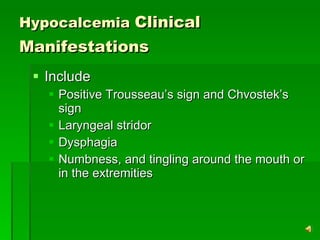
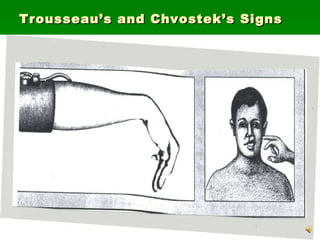
Hypocalcemia  Clinical Manifestations   Include  Positive Trousseau’s sign and Chvostek’s sign  Laryngeal stridor Dysphagia Numbness, and tingling around the mouth or in the extremities
Trousseau’s and Chvostek’s Signs
Hypocalcemia Management Treat cause Oral or IV calcium supplements Treatment of pain and anxiety to prevent hyperventilation-induced respiratory alkalosis
Nursing Diagnoses IW Bullets p 193 Risk for injury r/t Risk for decreased cardiac output r/t Risk for impaired gas exchange r/t Imbalanced nutrition r/t Knowledge deficit r/t Risk for bone injury r/t
Nursing Actions Assess S/S  Quiet, calm environment If IV Ca++ give slowly 0.5-1 mL per min; do not use central line Seizure precautions Observe laryngeal stridor; maintain airway Educate osteoporosis and foods Avoid hyperventilation Monitor ECG Assess for heart failure/ pulmonary edema Injury prevention strategies due to risk bone fracture
 
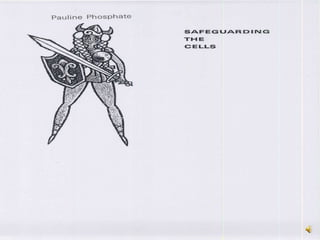
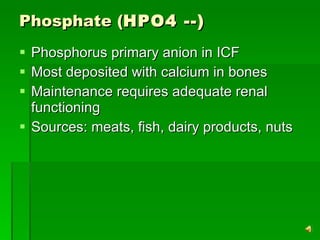
Phosphate ( HPO4 --) Phosphorus primary anion in ICF Most deposited with calcium in bones Maintenance requires adequate renal functioning Sources: meats, fish, dairy products, nuts
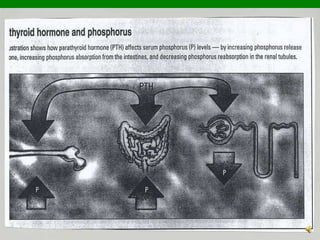
How does the PTH affect phosphorus?
 
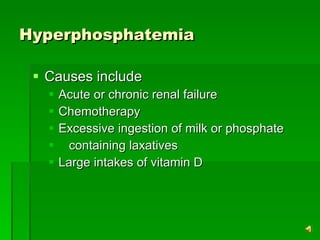
Hyperphosphatemia Causes include Acute or chronic renal failure Chemotherapy Excessive ingestion of milk or phosphate  containing laxatives Large intakes of vitamin D
Hyperphosphatemia Clinical Manifestations Hypocalcemia  Muscle problems (tetany)  Deposition of calcium-phosphate precipitates in skin, soft tissue, cornea, viscera, and blood vessels
Hyperphosphatemia Management Identifying and treating underlying cause Restricting foods and fluids containing phosphorus  Adequate hydration and correction of hypocalcemic conditions Sevelamer (Renagel)
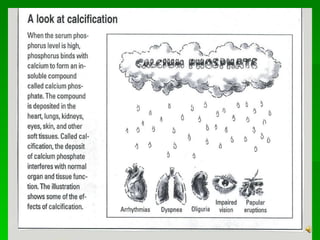
What effect does the reaction of high phosphorus levels with calcium affect the body?
 
Nursing Diagnoses Risk for injury r/t Knowledge deficit r/t Diagnoses r/t hypocalcemia
Nursing Actions Assess tetany Monitor serum HPO4- & Ca Limit vitamin D Observe for calcifications Monitor urine output, BUN, creatinine

Chapter 13 And 15 Electrolyte Imbalance Part 4

  • 1.
    Electrolyte Imbalances PartIV Peggy D. Johndrow 2009
  • 2.
    Hypocalcemia Low serumcalcium levels Causes include Decreased production of PTH Acute pancreatitis Multiple blood transfusions Alkalosis Decreased intake
  • 3.
    Hypocalcemia ClinicalManifestations Include Positive Trousseau’s sign and Chvostek’s sign Laryngeal stridor Dysphagia Numbness, and tingling around the mouth or in the extremities
  • 4.
  • 5.
    Hypocalcemia Management Treatcause Oral or IV calcium supplements Treatment of pain and anxiety to prevent hyperventilation-induced respiratory alkalosis
  • 6.
    Nursing Diagnoses IWBullets p 193 Risk for injury r/t Risk for decreased cardiac output r/t Risk for impaired gas exchange r/t Imbalanced nutrition r/t Knowledge deficit r/t Risk for bone injury r/t
  • 7.
    Nursing Actions AssessS/S Quiet, calm environment If IV Ca++ give slowly 0.5-1 mL per min; do not use central line Seizure precautions Observe laryngeal stridor; maintain airway Educate osteoporosis and foods Avoid hyperventilation Monitor ECG Assess for heart failure/ pulmonary edema Injury prevention strategies due to risk bone fracture
  • 8.
  • 9.
    Phosphate ( HPO4--) Phosphorus primary anion in ICF Most deposited with calcium in bones Maintenance requires adequate renal functioning Sources: meats, fish, dairy products, nuts
  • 10.
    How does thePTH affect phosphorus?
  • 11.
  • 12.
    Hyperphosphatemia Causes includeAcute or chronic renal failure Chemotherapy Excessive ingestion of milk or phosphate containing laxatives Large intakes of vitamin D
  • 13.
    Hyperphosphatemia Clinical ManifestationsHypocalcemia Muscle problems (tetany) Deposition of calcium-phosphate precipitates in skin, soft tissue, cornea, viscera, and blood vessels
  • 14.
    Hyperphosphatemia Management Identifyingand treating underlying cause Restricting foods and fluids containing phosphorus Adequate hydration and correction of hypocalcemic conditions Sevelamer (Renagel)
  • 15.
    What effect doesthe reaction of high phosphorus levels with calcium affect the body?
  • 16.
  • 17.
    Nursing Diagnoses Riskfor injury r/t Knowledge deficit r/t Diagnoses r/t hypocalcemia
  • 18.
    Nursing Actions Assesstetany Monitor serum HPO4- & Ca Limit vitamin D Observe for calcifications Monitor urine output, BUN, creatinine

Editor's Notes

  • #9 Phosphorus (2.5-4.5 mg/dl) General facts Inorganic salt; primary anion in ICF Metabolic functions – phosphate buffer system; forms ATP; RBC production; intermediary in metabolism of CHO, protein, fats Critical to normal nerve/muscle function Provides structural support for bones & teeth Excrete 90% kidneys; 10% feces Regulated by diet intake, GI absorption, hormone regulates bone reabsorptionHyperphosphatemia > 4.5 mg/dl Etiology - Renal insuff., hypoparathyroidism, increased vit. D, hypoparathyrodism, increased intake, Lab Tests - Serum HPO4-, PTH level, x-ray (skeletal changes) Therapeutic Management Correct cause IV Ca+, dialysis, phosphate binding gels (Al hydroxide), restrict intake Nursing care Assess S/S- anorexia, N/V, muscle weakness, hyperreflexia, tachycardia, tetany, soft tissue calcification Nursing diagnosis – Risk for injury r/t; Knowledge deficit r/t; Nursing actions Assess tetany Monitor serum HPO4- & Ca Limit vit D Observe for calcifications Monitor urine output, BUN, creatinine Client education Explanation of condition; include risk factors Strategies to prevent further episodes Foods high in phosphorus Medication therapy including possible side effects S/S and what and when to reportHypophosphatemia < 2.5 mg/dl Etiology – increased urine loss, decreased GI absorption, acid/base problems, ETOH withdrawal, phosphate binding antiacids, diabetic ketoacidosis, respiratory alkalosis Lab tests - Serum HPO4-, PTH, Mg+, x-ray Therapeutic Management Correct cause Increase diet intake Oral HPO4- if severe IV – very severe give NaHPO4 or KHPO4 Nursing Care Assess S/S - decreased energy (ATP), confusion, seizures, hemolytic anemia, chest pain, cyanosis Nursing diagnosis – Impaired physical mobility r/t; Risk for bone injury r/t; Impaired gas exchange r/t; Risk for falls r/t; Risk for decreased cardiac output Nursing actions Monitor V/S, resp rate & depth (assess S/S hypoxia) Monitor lab values Diet – increase foods high in HPO4 Oral/IV – if necessary Monitor ECG Monitor Serum K+ Salt substitutes Teach use of diuretics, laxatives, diet Client education Explanation of condition; include risk factors Strategies to prevent further episodes Foods high in phosphorus Medication therapy including possible side effects S/S and what and when to report