Fluid Imbalances Peggy D.  Johndrow 2009
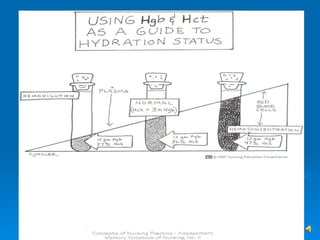
Fluid Movement Between ECF & ICF Water deficit (increased ECF) is associated with symptoms that result from cell shrinkage as water is pulled into vascular system Water excess (decreased ECF) develops from gain or retention of excess water
Fluid Spacing First spacing Normal distribution of fluid in ICF and ECF Second spacing Abnormal accumulation of interstitial fluid Third spacing Fluid accumulation in part of body where it is not easily exchanged with ECF
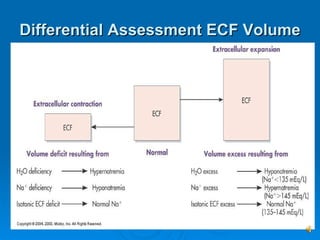
Differential Assessment ECF Volume
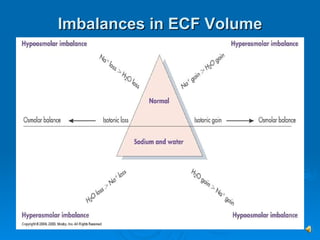
Imbalances in ECF Volume
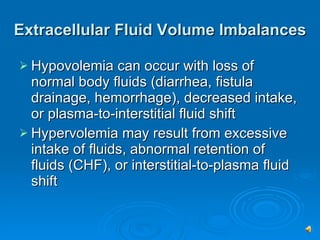
Extracellular Fluid Volume Imbalances Hypovolemia can occur with loss of normal body fluids (diarrhea, fistula drainage, hemorrhage), decreased intake, or plasma-to-interstitial fluid shift Hypervolemia may result from excessive intake of fluids, abnormal retention of fluids (CHF), or interstitial-to-plasma fluid shift
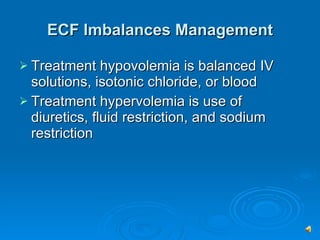
ECF Imbalances Management Treatment hypovolemia is balanced IV solutions, isotonic chloride, or blood Treatment hypervolemia is use of diuretics, fluid restriction, and sodium restriction
Nursing Management Hypervolemia: Excess fluid volume Ineffective airway clearance Risk for impaired skin integrity Disturbed body image Potential complications: pulmonary edema, ascites
Nursing Management Hypovolemia Deficient fluid volume Decreased cardiac output Potential complication: hypovolemic shock
Nursing Implementation I&O Monitor cardiovascular changes Assess respiratory status and monitor changes Daily weights Skin assessment Neurologic function LOC PERLA Voluntary movement of extremities Muscle strength Reflexes
Protein Imbalances Plasma proteins, particularly albumin, are significant determinants of plasma volume Hyperproteinemia is rare, but occurs with dehydration-induced hemoconcentration
Hypoproteinemia Caused by  Anorexia Malnutrition Starvation Fad dieting Poorly balanced vegetarian diets Poor absorption in certain GI malabsorptive diseases Protein can shift out of intravascular space with inflammation Hemorrhage  Nephrotic syndrome
Hypoproteinemia Clinical Manifestations Edema Slow healing Anorexia Fatigue Anemia Muscle loss  Ascites
Hypoproteinemia Management High-carbohydrate, high-protein diet Dietary protein supplements Enteral nutrition or total parenteral nutrition
IV Fluids Purposes Maintenance- when oral intake not adequate Replacement- when losses have occurred  IV fluids will cause electrolyte imbalances if not corrected Imbalances classified as deficits or excesses Sodium plays major role in homeostasis of ECF
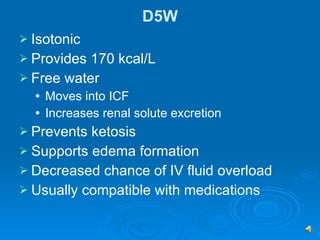
D5W Isotonic Provides 170 kcal/L Free water Moves into ICF Increases renal solute excretion  Prevents ketosis Supports edema formation  Decreased chance of IV fluid overload Usually compatible with medications
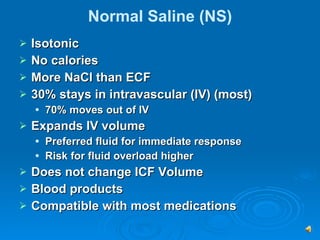
Normal Saline (NS) Isotonic  No calories More NaCl than ECF 30% stays in intravascular (IV) (most) 70% moves out of IV Expands IV volume Preferred fluid for immediate response Risk for fluid overload higher Does not change ICF Volume Blood products Compatible with most medications
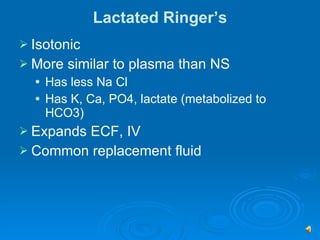
Lactated Ringer’s Isotonic More similar to plasma than NS Has less Na Cl Has K, Ca, PO4, lactate (metabolized to HCO3) Expands ECF, IV Common replacement fluid
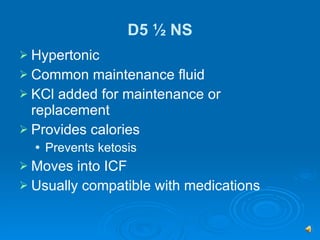
D5 ½ NS Hypertonic Common maintenance fluid KCl added for maintenance or replacement  Provides calories Prevents ketosis Moves into ICF Usually compatible with medications
D10W Hypertonic Provides 340 kcal/L Free water Limit of dextrose concentration may be infused peripherally
Plasma Expanders Pull fluid into IV from interstitium  Colloids Packed RBCs  Albumin Plasma


Chapter 13 And 15 Fluid Imbalances

  • 1.
    Fluid Imbalances PeggyD. Johndrow 2009
  • 2.
    Fluid Movement BetweenECF & ICF Water deficit (increased ECF) is associated with symptoms that result from cell shrinkage as water is pulled into vascular system Water excess (decreased ECF) develops from gain or retention of excess water
  • 3.
    Fluid Spacing Firstspacing Normal distribution of fluid in ICF and ECF Second spacing Abnormal accumulation of interstitial fluid Third spacing Fluid accumulation in part of body where it is not easily exchanged with ECF
  • 4.
  • 5.
  • 6.
    Extracellular Fluid VolumeImbalances Hypovolemia can occur with loss of normal body fluids (diarrhea, fistula drainage, hemorrhage), decreased intake, or plasma-to-interstitial fluid shift Hypervolemia may result from excessive intake of fluids, abnormal retention of fluids (CHF), or interstitial-to-plasma fluid shift
  • 7.
    ECF Imbalances ManagementTreatment hypovolemia is balanced IV solutions, isotonic chloride, or blood Treatment hypervolemia is use of diuretics, fluid restriction, and sodium restriction
  • 8.
    Nursing Management Hypervolemia:Excess fluid volume Ineffective airway clearance Risk for impaired skin integrity Disturbed body image Potential complications: pulmonary edema, ascites
  • 9.
    Nursing Management HypovolemiaDeficient fluid volume Decreased cardiac output Potential complication: hypovolemic shock
  • 10.
    Nursing Implementation I&OMonitor cardiovascular changes Assess respiratory status and monitor changes Daily weights Skin assessment Neurologic function LOC PERLA Voluntary movement of extremities Muscle strength Reflexes
  • 11.
    Protein Imbalances Plasmaproteins, particularly albumin, are significant determinants of plasma volume Hyperproteinemia is rare, but occurs with dehydration-induced hemoconcentration
  • 12.
    Hypoproteinemia Caused by Anorexia Malnutrition Starvation Fad dieting Poorly balanced vegetarian diets Poor absorption in certain GI malabsorptive diseases Protein can shift out of intravascular space with inflammation Hemorrhage Nephrotic syndrome
  • 13.
    Hypoproteinemia Clinical ManifestationsEdema Slow healing Anorexia Fatigue Anemia Muscle loss Ascites
  • 14.
    Hypoproteinemia Management High-carbohydrate,high-protein diet Dietary protein supplements Enteral nutrition or total parenteral nutrition
  • 15.
    IV Fluids PurposesMaintenance- when oral intake not adequate Replacement- when losses have occurred IV fluids will cause electrolyte imbalances if not corrected Imbalances classified as deficits or excesses Sodium plays major role in homeostasis of ECF
  • 16.
    D5W Isotonic Provides170 kcal/L Free water Moves into ICF Increases renal solute excretion Prevents ketosis Supports edema formation Decreased chance of IV fluid overload Usually compatible with medications
  • 17.
    Normal Saline (NS)Isotonic No calories More NaCl than ECF 30% stays in intravascular (IV) (most) 70% moves out of IV Expands IV volume Preferred fluid for immediate response Risk for fluid overload higher Does not change ICF Volume Blood products Compatible with most medications
  • 18.
    Lactated Ringer’s IsotonicMore similar to plasma than NS Has less Na Cl Has K, Ca, PO4, lactate (metabolized to HCO3) Expands ECF, IV Common replacement fluid
  • 19.
    D5 ½ NSHypertonic Common maintenance fluid KCl added for maintenance or replacement Provides calories Prevents ketosis Moves into ICF Usually compatible with medications
  • 20.
    D10W Hypertonic Provides340 kcal/L Free water Limit of dextrose concentration may be infused peripherally
  • 21.
    Plasma Expanders Pullfluid into IV from interstitium Colloids Packed RBCs Albumin Plasma
  • 22.
  • 23.
  • 24.