HYDROGEN FUEL CELL IN
AUTOMOBILES
Panchal Girish R.
Mehta Het D.
Panchal Vinay A.
Dept. of Mechanical Engineering ,
K. J. Somaiya Polytechnic.
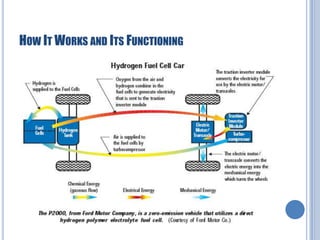
INTRODUCTION TO FUEL CELL
A fuel cell is a device that converts the chemical energy
from a fuel into electricity, water and heat through a
chemical reaction with oxygen.
 Fuel cells are different from batteries in that they require
a constant source of fuel and oxygen/air to sustain the
chemical reaction. Fuel cells can produce electricity
continually for as long as these inputs are supplied.
 The first fuel cells were invented in 1838. The first
commercial use of fuel cells came more than a century
later in NASA space programs.

PARTS OF A FUEL CELL








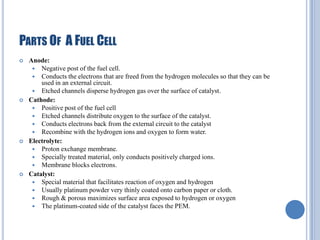
Anode:
 Negative post of the fuel cell.
 Conducts the electrons that are freed from the hydrogen molecules so that they can be
used in an external circuit.
 Etched channels disperse hydrogen gas over the surface of catalyst.
Cathode:
 Positive post of the fuel cell
 Etched channels distribute oxygen to the surface of the catalyst.
 Conducts electrons back from the external circuit to the catalyst
 Recombine with the hydrogen ions and oxygen to form water.
Electrolyte:
 Proton exchange membrane.
 Specially treated material, only conducts positively charged ions.
 Membrane blocks electrons.
Catalyst:
 Special material that facilitates reaction of oxygen and hydrogen
 Usually platinum powder very thinly coated onto carbon paper or cloth.
 Rough & porous maximizes surface area exposed to hydrogen or oxygen
 The platinum-coated side of the catalyst faces the PEM.
HYDROGEN FUEL CELL
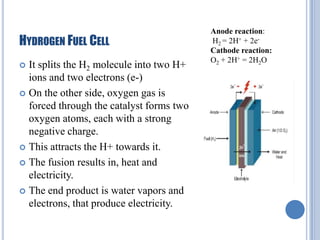
It splits the H2 molecule into two H+
ions and two electrons (e-)
 On the other side, oxygen gas is
forced through the catalyst forms two
oxygen atoms, each with a strong
negative charge.
 This attracts the H+ towards it.
 The fusion results in, heat and
electricity.
 The end product is water vapors and
electrons, that produce electricity.


Anode reaction:
H2 = 2H+ + 2eCathode reaction:
O2 + 2H+ = 2H2O
HYDROGEN FUEL CELL IN AUTO MOBILE


Heat and electrical energy is formed after the fusion of
electrons. Therefore, electrical energy is used to drive the
vehicle and we get water (H2O) as our exhaust. The heat
energy converts water into water vapor and thus our
exhaust from the vehicle is in the form of water vapor
which ultimately has no effect to the environment.



Thus, no pollution is created using this technology.
SOMETHING TO KNOW


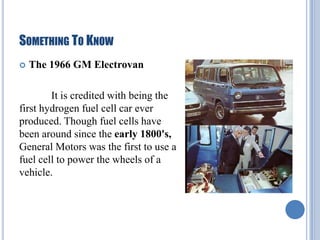
The 1966 GM Electrovan

It is credited with being the
first hydrogen fuel cell car ever
produced. Though fuel cells have
been around since the early 1800's,
General Motors was the first to use a
fuel cell to power the wheels of a
vehicle.
TERMINOLOGY OF HYDROGEN FUEL CELL IN AUTOMOBILE


Fuel cells: A fuel cell is a device that converts the chemical energy into
electrical energy, water and heat through chemical reactions.



Hydrogen tank: A cylinder tank used for storing hydrogen in a car.



Traction inverter module: The traction inverter module is used to
convert supplied energy as efficiently as possible and make it available
to the drive motors in a suitable way.



Turbo compressor: A dynamic-type compressor is used for the
compression and injection of gases (oxygen).



Transaxle: An automotive part that combines the transmission and the
differential and is used on vehicles with front-wheel drive.
HOW IT WORKS AND ITS FUNCTIONING
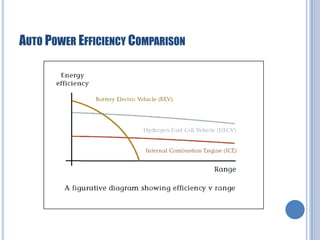
AUTO POWER EFFICIENCY COMPARISON
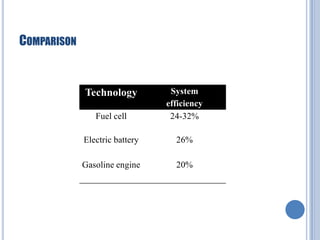
COMPARISON

Fuel cell

System
efficiency
24-32%

Electric battery

26%

Gasoline engine

20%

Technology
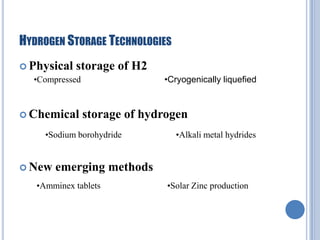
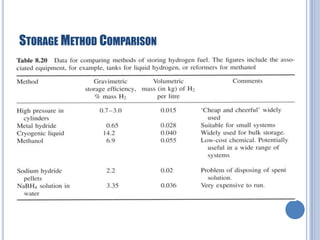
HYDROGEN STORAGE TECHNOLOGIES
 Physical storage
•Compressed

 Chemical

of H2

storage of hydrogen

•Sodium borohydride

 New

•Cryogenically liquefied

•Alkali metal hydrides

emerging methods

•Amminex tablets

•Solar Zinc production
STORAGE METHOD COMPARISON
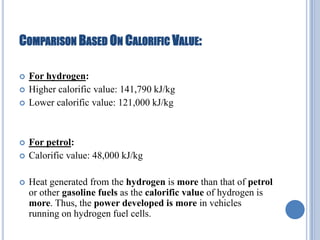
COMPARISON BASED ON CALORIFIC VALUE:









For hydrogen:
Higher calorific value: 141,790 kJ/kg
Lower calorific value: 121,000 kJ/kg

For petrol:
Calorific value: 48,000 kJ/kg
Heat generated from the hydrogen is more than that of petrol
or other gasoline fuels as the calorific value of hydrogen is
more. Thus, the power developed is more in vehicles
running on hydrogen fuel cells.
FUTURE SCOPE








The technology should be made cost effective.
Developing more safety features to the onboard hydrogen tank
and also at refilling stations by making the use of ‘Autolocking of supply valves by using hydrogen detector.’
In this technique, if the hydrogen is leaked from the cylinder
or supply line then hydrogen will be detected by the sensor
provided to it by sensing the tlv (threshold limit value) of
hydrogen.
When the gas is detected, the supply valves from the hydrogen
tank are closed. Thus, hydrogen gas leaking is thus avoided.
The other technique is to splash the water where the hydrogen
gas is leaked. But for this, there will be separate water storing
facility required. Thus, hazards expected from hydrogen gas
leaking are thus avoided
LIMITATIONS


For instance, you don't have a hydrogen pipeline coming

to your house, and you can't pull up to a hydrogen pump
at your local gas station.


Hydrogen is difficult to store and distribute, so it would
be much more convenient if fuel cells could use fuels
that are more readily available.



Technology is currently expensive.
CONCLUSION








Thus, it can be said that there will be a bright future if this
hydrogen fuel cell is put up to use in all vehicles by properly
considering the safety matter first.
And if this eco-friendly technology is used, the rate of
pollution is surely going to come down.
It is not only eco-friendly but, also serves to be a great fuel
source. Since the conventional sources of fuel may not prove
to be sufficient, there arises a need to develop a new
alternative source of energy. Although there are a few
problems related with the storage of hydrogen gas, which
might be overcome as the technology develops further.
“Hydrogen holds the great promise to meet our future energy
needs concerned with our environment.”
THANK YOU
Hope we see a better future.

Hydrogen fuel cells

  • 1.
    HYDROGEN FUEL CELLIN AUTOMOBILES Panchal Girish R. Mehta Het D. Panchal Vinay A. Dept. of Mechanical Engineering , K. J. Somaiya Polytechnic.
  • 2.
    INTRODUCTION TO FUELCELL A fuel cell is a device that converts the chemical energy from a fuel into electricity, water and heat through a chemical reaction with oxygen.  Fuel cells are different from batteries in that they require a constant source of fuel and oxygen/air to sustain the chemical reaction. Fuel cells can produce electricity continually for as long as these inputs are supplied.  The first fuel cells were invented in 1838. The first commercial use of fuel cells came more than a century later in NASA space programs. 
  • 3.
    PARTS OF AFUEL CELL     Anode:  Negative post of the fuel cell.  Conducts the electrons that are freed from the hydrogen molecules so that they can be used in an external circuit.  Etched channels disperse hydrogen gas over the surface of catalyst. Cathode:  Positive post of the fuel cell  Etched channels distribute oxygen to the surface of the catalyst.  Conducts electrons back from the external circuit to the catalyst  Recombine with the hydrogen ions and oxygen to form water. Electrolyte:  Proton exchange membrane.  Specially treated material, only conducts positively charged ions.  Membrane blocks electrons. Catalyst:  Special material that facilitates reaction of oxygen and hydrogen  Usually platinum powder very thinly coated onto carbon paper or cloth.  Rough & porous maximizes surface area exposed to hydrogen or oxygen  The platinum-coated side of the catalyst faces the PEM.
  • 4.
    HYDROGEN FUEL CELL Itsplits the H2 molecule into two H+ ions and two electrons (e-)  On the other side, oxygen gas is forced through the catalyst forms two oxygen atoms, each with a strong negative charge.  This attracts the H+ towards it.  The fusion results in, heat and electricity.  The end product is water vapors and electrons, that produce electricity.  Anode reaction: H2 = 2H+ + 2eCathode reaction: O2 + 2H+ = 2H2O
  • 5.
    HYDROGEN FUEL CELLIN AUTO MOBILE  Heat and electrical energy is formed after the fusion of electrons. Therefore, electrical energy is used to drive the vehicle and we get water (H2O) as our exhaust. The heat energy converts water into water vapor and thus our exhaust from the vehicle is in the form of water vapor which ultimately has no effect to the environment.  Thus, no pollution is created using this technology.
  • 6.
    SOMETHING TO KNOW  The1966 GM Electrovan It is credited with being the first hydrogen fuel cell car ever produced. Though fuel cells have been around since the early 1800's, General Motors was the first to use a fuel cell to power the wheels of a vehicle.
  • 7.
    TERMINOLOGY OF HYDROGENFUEL CELL IN AUTOMOBILE  Fuel cells: A fuel cell is a device that converts the chemical energy into electrical energy, water and heat through chemical reactions.  Hydrogen tank: A cylinder tank used for storing hydrogen in a car.  Traction inverter module: The traction inverter module is used to convert supplied energy as efficiently as possible and make it available to the drive motors in a suitable way.  Turbo compressor: A dynamic-type compressor is used for the compression and injection of gases (oxygen).  Transaxle: An automotive part that combines the transmission and the differential and is used on vehicles with front-wheel drive.
  • 8.
    HOW IT WORKSAND ITS FUNCTIONING
  • 9.
  • 10.
  • 11.
    HYDROGEN STORAGE TECHNOLOGIES Physical storage •Compressed  Chemical of H2 storage of hydrogen •Sodium borohydride  New •Cryogenically liquefied •Alkali metal hydrides emerging methods •Amminex tablets •Solar Zinc production
  • 12.
  • 13.
    COMPARISON BASED ONCALORIFIC VALUE:       For hydrogen: Higher calorific value: 141,790 kJ/kg Lower calorific value: 121,000 kJ/kg For petrol: Calorific value: 48,000 kJ/kg Heat generated from the hydrogen is more than that of petrol or other gasoline fuels as the calorific value of hydrogen is more. Thus, the power developed is more in vehicles running on hydrogen fuel cells.
  • 14.
    FUTURE SCOPE      The technologyshould be made cost effective. Developing more safety features to the onboard hydrogen tank and also at refilling stations by making the use of ‘Autolocking of supply valves by using hydrogen detector.’ In this technique, if the hydrogen is leaked from the cylinder or supply line then hydrogen will be detected by the sensor provided to it by sensing the tlv (threshold limit value) of hydrogen. When the gas is detected, the supply valves from the hydrogen tank are closed. Thus, hydrogen gas leaking is thus avoided. The other technique is to splash the water where the hydrogen gas is leaked. But for this, there will be separate water storing facility required. Thus, hazards expected from hydrogen gas leaking are thus avoided
  • 15.
    LIMITATIONS  For instance, youdon't have a hydrogen pipeline coming to your house, and you can't pull up to a hydrogen pump at your local gas station.  Hydrogen is difficult to store and distribute, so it would be much more convenient if fuel cells could use fuels that are more readily available.  Technology is currently expensive.
  • 16.
    CONCLUSION     Thus, it canbe said that there will be a bright future if this hydrogen fuel cell is put up to use in all vehicles by properly considering the safety matter first. And if this eco-friendly technology is used, the rate of pollution is surely going to come down. It is not only eco-friendly but, also serves to be a great fuel source. Since the conventional sources of fuel may not prove to be sufficient, there arises a need to develop a new alternative source of energy. Although there are a few problems related with the storage of hydrogen gas, which might be overcome as the technology develops further. “Hydrogen holds the great promise to meet our future energy needs concerned with our environment.”
  • 17.
    THANK YOU Hope wesee a better future.