Downloaded 45 times


![Basic Elements of PEMFC
[Image Info] www.wizdata.co.kr - Note to customers : This image has been licensed to be used within this PowerPoint template only. You may not extract the image for any other use.
Electrolyte
-This specially treated material, which looks something
like ordinary kitchen plastic wrap, only conducts
positively charged ions.
- The membrane blocks electrons.
Catalyst
- It is usually made of platinum powder very thinly
coated onto carbon paper or cloth.
- The catalyst is rough and porous so that the maximum
surface area of the platinum can be exposed to the
hydrogen or oxygen.
- The platinum-coated side of the catalyst faces the
PEM.](https://image.slidesharecdn.com/fuelcell-141221141840-conversion-gate02/85/Fuel-cell-14-320.jpg)


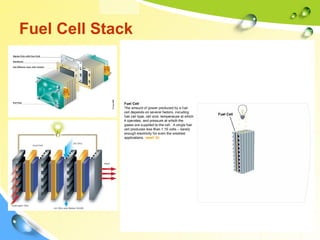


PEM fuel cells use a proton-conducting polymer membrane as the electrolyte and pure hydrogen as the fuel. PEM fuel cells were invented in the 1960s and have since been used in applications like submarines, portable power devices, and vehicles. A typical PEM fuel cell consists of an anode and cathode separated by a polymer electrolyte membrane. At the anode, hydrogen gas is oxidized to produce protons and electrons. The protons pass through the membrane to the cathode while the electrons are routed through an external circuit, producing electricity. At the cathode, oxygen and protons react to form water. PEM fuel cells are efficient, have high power density, and are well-suited for transportation and small stationary power applications.


