


Different Ways To Generate
Electricity
Hydrogen Fuel Cell
Electricity is the flow
of electrical power or
charge. It is both a
basic part of nature
and one of our most
widely used forms of
energy. Its not a source
of energy but an Energy
Carrier.
What is Electricity?
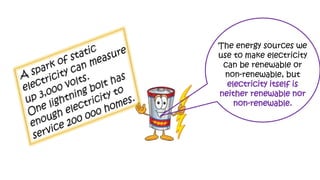
The energy sources we
use to make electricity
can be renewable or
non-renewable, but
electricity itself is
neither renewable nor
non-renewable.
Electricity travels at the speed of
light . That totals more than
186,000 miles every second.
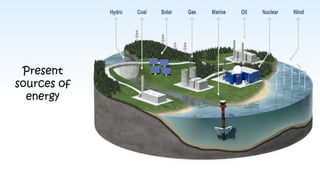
Present
sources of
energy
Harnessing The
Power Of
Hydrogen
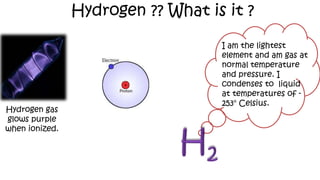
Hydrogen ?? What is it ?
Hydrogen gas
glows purple
when ionized.
I am the lightest
element and am gas at
normal temperature
and pressure. I
condenses to liquid
at temperatures of -
253° Celsius.
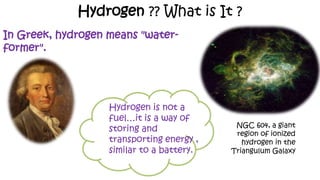
Hydrogen ?? What is It ?
In Greek, hydrogen means "water-
former".
NGC 604, a giant
region of ionized
hydrogen in the
Triangulum Galaxy
Hydrogen is not a
fuel…it is a way of
storing and
transporting energy ,
similar to a battery.
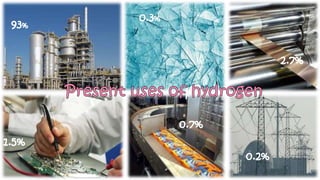
93%
0.3%
0.7%
2.7%
0.2%
1.5%
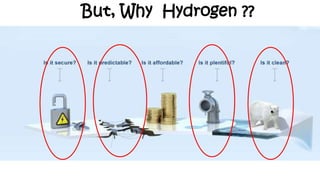
But, Why Hydrogen ??
2) CO + H2O → CO2 + H2
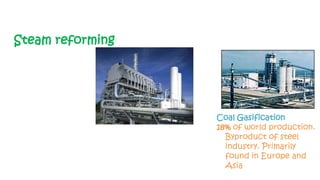
Steam reforming
1) CH4 + H2O → CO + 3 H2
Production of H2
Coal Gasification
18% of world production.
Byproduct of steel
industry. Primarily
found in Europe and
Asia
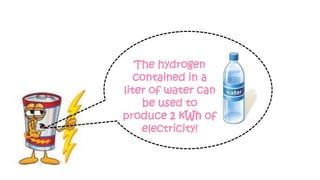
The hydrogen
contained in a
liter of water can
be used to
produce of
electricity!
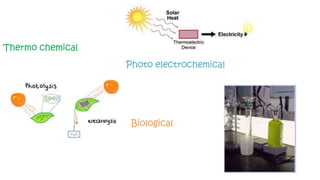
Thermo chemical
Split water with chemicals
and heat Photo electrochemical
Split water using sunlight directly, or using
chemicals and heat
Biological
Split water
using organisms
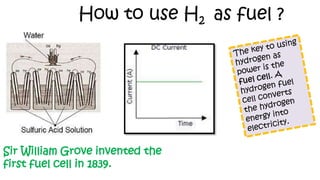
How to use H2 as fuel ?
Sir William Grove invented the
first fuel cell in 1839.
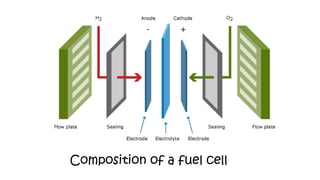
Composition of a fuel cell
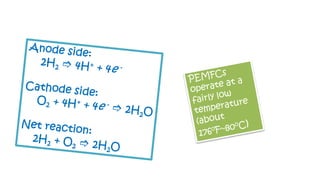
Chemistry of PEMFC
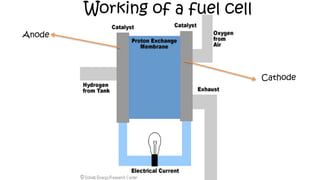
Working of a fuel cell
Anode
Cathode
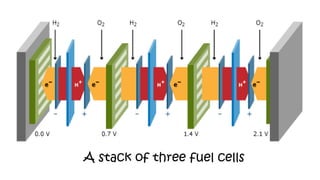
A stack of three fuel cells
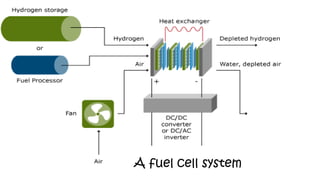
A fuel cell system
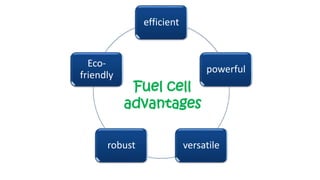
efficient
powerful
versatilerobust
Eco-
friendly
Fuel cell
advantages
expensive
Safety
concerns
No ready
fuel
Needs high
temperature
Developing
technology
Fuel cell
disadvantages
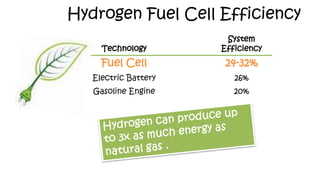
Hydrogen Fuel Cell Efficiency
Technology
System
Efficiency
Fuel Cell 24-32%
Electric Battery 26%
Gasoline Engine 20%
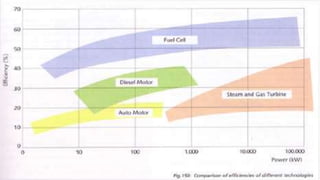
Fuel Cell Efficiency
0
10
20
30
40
50
60
70
PEMFC SOFC PAFC
ELECTRICAL EFFICIENCY
ELECTRICAL
EFFICIENCY
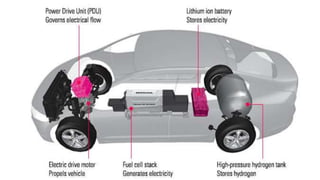
From Laboratory To Road
Hydrogen Safety
Hydrogen gas leaking into
external air may
spontaneously ignite.
Moreover, hydrogen fire,
while being extremely hot,
is almost invisible, and thus
can lead to accidental
burns.
reacts easily with air
The most challenging properties
of hydrogen are its high
dispersability, its wide explosion
limits, low ignition energy and its
colourless flame.
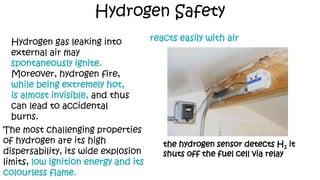
the hydrogen sensor detects H2 it
shuts off the fuel cell via relay
Created by:
Pinspiration

Hydrogen Fuel Cell