Technical Seminar on


           FUEL CELLS


             J.SRIKANTH(08FE5A0214)


VIGNAN’S LARA INSTITUTE OF TECHNOLOGY & SCIENCE
                Vadlamudi , Guntur.
What is a Fuel Cell?
• A Fuel Cell is an electrochemical device that
  combines hydrogen and oxygen to produce
  electricity, with water and heat as its by-
  product.
Why is Fuel Cell Technology
             Important?
• Since conversion of the fuel to energy takes
  place via an electrochemical process, not
  combustion.
• It is a clean, quiet and highly efficient process-
  two to three times more efficient than fuel
  burning.
How does a Fuel Cell work?
• It operates similarly to a battery, but it does not run
  down nor does it require recharging
• As long as fuel is supplied, a Fuel Cell will produce both
  energy and heat
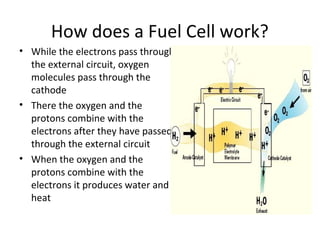
• A Fuel Cell consists of two catalyst coated electrodes
  surrounding an electrolyte
• One electrode is an anode and the other is a cathode
• The process begins when Hydrogen molecules enter
  the anode
• The catalyst coating separates hydrogen’s negatively
  charged electrons from the positively charged protons
How does a Fuel Cell work?
• While the electrons pass through
  the external circuit, oxygen
  molecules pass through the
  cathode
• There the oxygen and the
  protons combine with the
  electrons after they have passed
  through the external circuit
• When the oxygen and the
  protons combine with the
  electrons it produces water and
  heat
Major Types of Fuel Cells
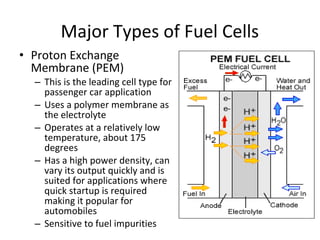
• Proton Exchange
  Membrane (PEM)
  – This is the leading cell type for
    passenger car application
  – Uses a polymer membrane as
    the electrolyte
  – Operates at a relatively low
    temperature, about 175
    degrees
  – Has a high power density, can
    vary its output quickly and is
    suited for applications where
    quick startup is required
    making it popular for
    automobiles
  – Sensitive to fuel impurities
Major Types of Fuel Cells
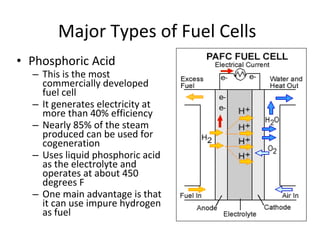
• Phosphoric Acid
  – This is the most
    commercially developed
    fuel cell
  – It generates electricity at
    more than 40% efficiency
  – Nearly 85% of the steam
    produced can be used for
    cogeneration
  – Uses liquid phosphoric acid
    as the electrolyte and
    operates at about 450
    degrees F
  – One main advantage is that
    it can use impure hydrogen
    as fuel
Major Types of Fuel Cells
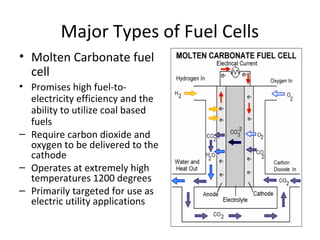
• Molten Carbonate fuel
  cell
• Promises high fuel-to-
  electricity efficiency and the
  ability to utilize coal based
  fuels
– Require carbon dioxide and
  oxygen to be delivered to the
  cathode
– Operates at extremely high
  temperatures 1200 degrees
– Primarily targeted for use as
  electric utility applications
Major Types of Fuel Cells
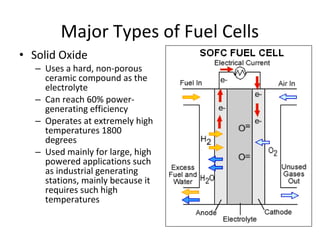
• Solid Oxide
   – Uses a hard, non-porous
     ceramic compound as the
     electrolyte
   – Can reach 60% power-
     generating efficiency
   – Operates at extremely high
     temperatures 1800
     degrees
   – Used mainly for large, high
     powered applications such
     as industrial generating
     stations, mainly because it
     requires such high
     temperatures
Major Types of Fuel Cells
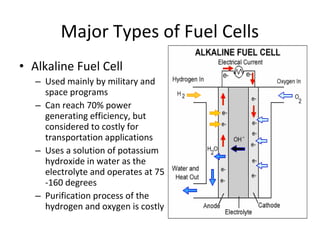
• Alkaline Fuel Cell
   – Used mainly by military and
     space programs
   – Can reach 70% power
     generating efficiency, but
     considered to costly for
     transportation applications
   – Uses a solution of potassium
     hydroxide in water as the
     electrolyte and operates at 75
     -160 degrees
   – Purification process of the
     hydrogen and oxygen is costly
Major Types of Fuel Cells
• Regenerative Fuel Cells
  – Currently researched by NASA
  – This type of fuel cell involves a closed loop form of
    power generation
  – Uses solar energy to separate water into hydrogen and
    oxygen
  – Hydrogen and oxygen are fed into the fuel cell
    generating electricity, heat and water
  – The water byproduct is then re-circulated back to the
    solar-powered electrolysers beginning the process
    again
Importance of Hydrogen
• Fuel Cells require highly purified hydrogen as
  a fuel.
• Researchers are developing a wide range of
  technologies to produce hydrogen
  economically from a variety of resources in
  environmentally friendly ways.
Importance of Hydrogen
• Hydrogen is a secondary energy resource,
  meaning it must be made from another fuel
• Hydrogen can be produced from a wide
  variety of energy resources including:
  – Fossil fuels, such as natural gas and coal
  – Nuclear energy
  – Renewable resources, such as solar, water, wind
    and biomass
Hydrogen Production
• The biggest challenge regarding hydrogen
  production is the cost
• Reducing the cost of hydrogen production so
  as to compete in the transportation sector
  with conventional fuels on a per-mile basis is a
  significant hurdle to Fuel Cell’s success in the
  commercial marketplace
How will the hydrogen be stored?
• Developing safe, reliable, compact and cost-
  effective hydrogen storage is one of the
  biggest challenges to widespread use of fuel
  cell technology
• Hydrogen has physical characteristics that
  make it difficult to store large quantities
  without taking up a great deal of space
How will the hydrogen be stored?
• Hydrogen has a very high energy content by
  weight (3x more than gasoline) and a very low
  energy content by volume (4x less than
  gasoline)
• If the hydrogen is compressed and
  cryogenically frozen it will take up a very small
  amount of space requiring a smaller tank, but
  it must be kept super cold- around -120 to
  -196 degrees Celsius
How can Fuel Cell technology be used?
•   Transportation
•   Stationary Power Stations
•   Telecommunications
•   Micro Power
How can Fuel Cell technology be used?
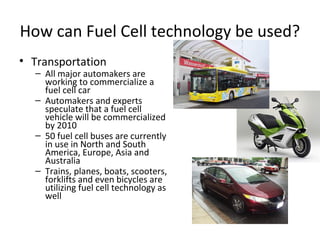
• Transportation
  – All major automakers are
    working to commercialize a
    fuel cell car
  – Automakers and experts
    speculate that a fuel cell
    vehicle will be commercialized
    by 2010
  – 50 fuel cell buses are currently
    in use in North and South
    America, Europe, Asia and
    Australia
  – Trains, planes, boats, scooters,
    forklifts and even bicycles are
    utilizing fuel cell technology as
    well
How can Fuel Cell technology be used?
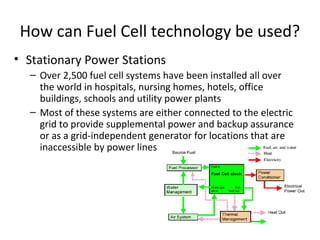
• Stationary Power Stations
  – Over 2,500 fuel cell systems have been installed all over
    the world in hospitals, nursing homes, hotels, office
    buildings, schools and utility power plants
  – Most of these systems are either connected to the electric
    grid to provide supplemental power and backup assurance
    or as a grid-independent generator for locations that are
    inaccessible by power lines
How can Fuel Cell technology be used?
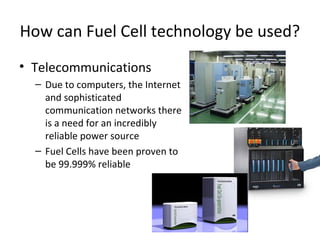
• Telecommunications
  – Due to computers, the Internet
    and sophisticated
    communication networks there
    is a need for an incredibly
    reliable power source
  – Fuel Cells have been proven to
    be 99.999% reliable
How can Fuel Cell technology be used?
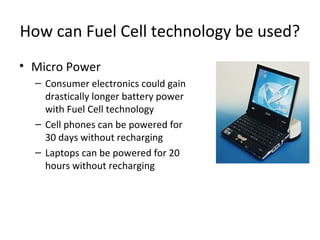
• Micro Power
  – Consumer electronics could gain
    drastically longer battery power
    with Fuel Cell technology
  – Cell phones can be powered for
    30 days without recharging
  – Laptops can be powered for 20
    hours without recharging
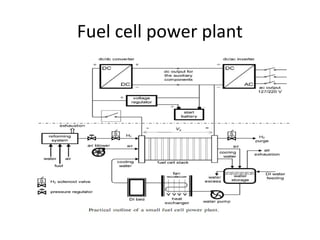
Fuel cell power plant
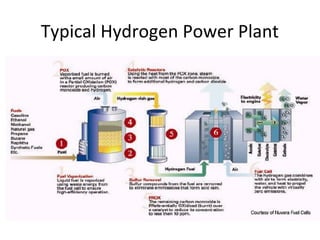
Typical Hydrogen Power Plant
Some other applications
26

fuel cells in modren generating station

  • 1.
    Technical Seminar on FUEL CELLS J.SRIKANTH(08FE5A0214) VIGNAN’S LARA INSTITUTE OF TECHNOLOGY & SCIENCE Vadlamudi , Guntur.
  • 2.
    What is aFuel Cell? • A Fuel Cell is an electrochemical device that combines hydrogen and oxygen to produce electricity, with water and heat as its by- product.
  • 3.
    Why is FuelCell Technology Important? • Since conversion of the fuel to energy takes place via an electrochemical process, not combustion. • It is a clean, quiet and highly efficient process- two to three times more efficient than fuel burning.
  • 4.
    How does aFuel Cell work? • It operates similarly to a battery, but it does not run down nor does it require recharging • As long as fuel is supplied, a Fuel Cell will produce both energy and heat • A Fuel Cell consists of two catalyst coated electrodes surrounding an electrolyte • One electrode is an anode and the other is a cathode • The process begins when Hydrogen molecules enter the anode • The catalyst coating separates hydrogen’s negatively charged electrons from the positively charged protons
  • 5.
    How does aFuel Cell work? • While the electrons pass through the external circuit, oxygen molecules pass through the cathode • There the oxygen and the protons combine with the electrons after they have passed through the external circuit • When the oxygen and the protons combine with the electrons it produces water and heat
  • 6.
    Major Types ofFuel Cells • Proton Exchange Membrane (PEM) – This is the leading cell type for passenger car application – Uses a polymer membrane as the electrolyte – Operates at a relatively low temperature, about 175 degrees – Has a high power density, can vary its output quickly and is suited for applications where quick startup is required making it popular for automobiles – Sensitive to fuel impurities
  • 7.
    Major Types ofFuel Cells • Phosphoric Acid – This is the most commercially developed fuel cell – It generates electricity at more than 40% efficiency – Nearly 85% of the steam produced can be used for cogeneration – Uses liquid phosphoric acid as the electrolyte and operates at about 450 degrees F – One main advantage is that it can use impure hydrogen as fuel
  • 8.
    Major Types ofFuel Cells • Molten Carbonate fuel cell • Promises high fuel-to- electricity efficiency and the ability to utilize coal based fuels – Require carbon dioxide and oxygen to be delivered to the cathode – Operates at extremely high temperatures 1200 degrees – Primarily targeted for use as electric utility applications
  • 9.
    Major Types ofFuel Cells • Solid Oxide – Uses a hard, non-porous ceramic compound as the electrolyte – Can reach 60% power- generating efficiency – Operates at extremely high temperatures 1800 degrees – Used mainly for large, high powered applications such as industrial generating stations, mainly because it requires such high temperatures
  • 10.
    Major Types ofFuel Cells • Alkaline Fuel Cell – Used mainly by military and space programs – Can reach 70% power generating efficiency, but considered to costly for transportation applications – Uses a solution of potassium hydroxide in water as the electrolyte and operates at 75 -160 degrees – Purification process of the hydrogen and oxygen is costly
  • 11.
    Major Types ofFuel Cells • Regenerative Fuel Cells – Currently researched by NASA – This type of fuel cell involves a closed loop form of power generation – Uses solar energy to separate water into hydrogen and oxygen – Hydrogen and oxygen are fed into the fuel cell generating electricity, heat and water – The water byproduct is then re-circulated back to the solar-powered electrolysers beginning the process again
  • 12.
    Importance of Hydrogen •Fuel Cells require highly purified hydrogen as a fuel. • Researchers are developing a wide range of technologies to produce hydrogen economically from a variety of resources in environmentally friendly ways.
  • 13.
    Importance of Hydrogen •Hydrogen is a secondary energy resource, meaning it must be made from another fuel • Hydrogen can be produced from a wide variety of energy resources including: – Fossil fuels, such as natural gas and coal – Nuclear energy – Renewable resources, such as solar, water, wind and biomass
  • 14.
    Hydrogen Production • Thebiggest challenge regarding hydrogen production is the cost • Reducing the cost of hydrogen production so as to compete in the transportation sector with conventional fuels on a per-mile basis is a significant hurdle to Fuel Cell’s success in the commercial marketplace
  • 15.
    How will thehydrogen be stored? • Developing safe, reliable, compact and cost- effective hydrogen storage is one of the biggest challenges to widespread use of fuel cell technology • Hydrogen has physical characteristics that make it difficult to store large quantities without taking up a great deal of space
  • 16.
    How will thehydrogen be stored? • Hydrogen has a very high energy content by weight (3x more than gasoline) and a very low energy content by volume (4x less than gasoline) • If the hydrogen is compressed and cryogenically frozen it will take up a very small amount of space requiring a smaller tank, but it must be kept super cold- around -120 to -196 degrees Celsius
  • 17.
    How can FuelCell technology be used? • Transportation • Stationary Power Stations • Telecommunications • Micro Power
  • 18.
    How can FuelCell technology be used? • Transportation – All major automakers are working to commercialize a fuel cell car – Automakers and experts speculate that a fuel cell vehicle will be commercialized by 2010 – 50 fuel cell buses are currently in use in North and South America, Europe, Asia and Australia – Trains, planes, boats, scooters, forklifts and even bicycles are utilizing fuel cell technology as well
  • 19.
    How can FuelCell technology be used? • Stationary Power Stations – Over 2,500 fuel cell systems have been installed all over the world in hospitals, nursing homes, hotels, office buildings, schools and utility power plants – Most of these systems are either connected to the electric grid to provide supplemental power and backup assurance or as a grid-independent generator for locations that are inaccessible by power lines
  • 20.
    How can FuelCell technology be used? • Telecommunications – Due to computers, the Internet and sophisticated communication networks there is a need for an incredibly reliable power source – Fuel Cells have been proven to be 99.999% reliable
  • 21.
    How can FuelCell technology be used? • Micro Power – Consumer electronics could gain drastically longer battery power with Fuel Cell technology – Cell phones can be powered for 30 days without recharging – Laptops can be powered for 20 hours without recharging
  • 22.
  • 23.
  • 24.
  • 25.
  • 26.