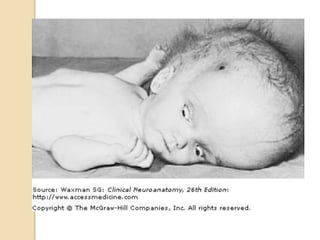
Hydrocephalus
(literally, "water brain")
Congenital/infantile
hydrocephalus
 The cranial bones fuse by the end of
  the third year; for the head to enlarge,
  hydrocephalus must develop before
  this time.
 It may begin in utero but usually
  happens in the first few months of life
 even of mild degree, it molds the
  shape of the skull in early life
 in radiographs the inner table is
  unevenly thinned, an appearance
  referred to as "beaten silver" or as
  convolutional or digital markings.
 The frontal regions are unusually
  prominent [bossing]
 Face relatively small and pinched
 Skin over the cranial bones tight and
  thin
 Prominent distended veins.
Usual causes
 Intraventricular matrix hemorrhages in
  premature infants
 fetal and neonatal infections
 Arnold -Chiari malformation
 Aqueductal atresia and stenosis
 Dandy-Walker syndrome.
Clinical features
 Rapid head enlargement
 Tense anterior and posterior
  fontanelles
 Infant is fretful, feeds poorly, and may
  vomit frequently.
 With continued enlargement of the
  brain, inactivity sets in and the infant
  appears languid, uninterested in his
  surroundings, and unable to sustain
  activity.
 Later, the upper eyelids are retracted
  and the eyes tend to turn down
  paralysis of upward gaze
 sclerae above the irises are visible;
  "setting-sun sign"
 caused by hydrocephalic pressure on
  the mesencephalic tegmentum.
 Gradually the infant adopts a posture
  of flexed arms and flexed or extended
  legs.
 Signs of corticospinal tract damage
  are usually elicitable.
 Movements are feeble and sometimes
  the arms show tremors
 later the optic discs become pale and
  vision is reduced.
 If the hydrocephalus becomes
  arrested, the infant or child is retarded
  but often surprisingly verbal.
 The head may be so large that the
  child cannot hold it up and must
  remain in bed
 If the head is only moderately
  enlarged, the child may be able to sit
  but not stand or stand but not walk.
 If ambulatory, the child is clumsy.
 Acute exacerbations of hydrocephalus
  or a febrile illness may cause
  vomiting, stupor, or coma.
Non-communicating
hydrocephalus
‘beaten-silver’ appearance
Intracranial pressure
   The intact cranium and vertebral
    canal, together with the relatively
    inelastic dura, form a rigid container,
    such that an increase of any of its
    contents—brain, blood, or CSF—will
    elevate the ICP.
 an increase in volume of any one of
  these three components must be at
  the expense of the other two [Monro-
  Kellie doctrine]
Compensatory measures
 Small increments in brain volume do
  not immediately raise the ICP due to
  displacement of CSF from the cranial
  cavity into the spinal canal
 deformation of the brain and limited
  stretching of dural folds, specifically,
  the falx cerebri and the tentorium
  cerebelli
 Failure of compensating measures -
  mass within one dural compartment
  leads to displacement, or "herniation"
  from that compartment into an
  adjacent one
 Further increment in brain volume will
  reduce the volume of intracranial
  blood contained in the veins and dural
  sinuses.
 CSF is formed more slowly
 As the brain, blood, or CSF volumes
  continue to increase, the
  accommodative mechanisms fail and
  ICP rises exponentially
Cerebral perfusion pressure
(CPP).
 numerical difference between ICP and
  mean blood pressure within the
  cerebral vessels
 elevation in ICP that approaches the
  level of mean systemic blood
  pressure→ widespread reduction in
  cerebral blood flow/perfusion.
 In its most severe form, this global
  ischemia produces brain death.
 Lesser degrees of raised ICP and
  reduced cerebral circulation cause
  correspondingly less severe, but still
  widespread, cerebral infarction that is
  similar to what arises after cardiac
  arrest.
   Determinants of the degree of cerebral
    damage are the severity and the
    duration of reduction of CPP
CAUSES OF RAISED ICP

 A cerebral or extracerebral mass
  such as brain tumor; massive
  infarction with edema; extensive
  traumatic contusion; parenchymal,
  subdural, or extradural hematoma; or
  abscess
 Generalized brain swelling, as
  occurs in ischemic–anoxic states,
  acute hepatic failure, hypertensive
  encephalopathy, hypercarbia, and the
  Reye hepatocerebral syndrome
 An increase in venous pressure-
  cerebral venous sinus thrombosis,
  heart failure, or obstruction of the
  superior mediastinal or jugular veins.
 Obstruction to the flow and
  absorption of CSF - within the
  ventricles or in the subarachnoid
  space at the base of the brain,
  extensive meningeal disease
   Any process that expands the
    volume of CSF (meningitis,
    subarachnoid hemorrhage) or
    increases CSF production (choroid
    plexus tumor).
CLINICAL FEATURES OF
RAISED ICP
 Headache
 Nausea and vomiting
 Drowsiness
 Ocular palsies
 Papilledema →periodic visual
  obscurations.
 Protracted papilledema →optic
  atrophy and blindness
The consequences of increased
intracranial pressure differ in
infants and small children, whose
cranial sutures have not closed.
TRANSTENTORIAL AND
OTHER HERNIATIONS
   An expanding lesion in the
    supratentorial compartment, such as a
    subdural hematoma or a tumor in a
    cerebral hemisphere, may push the
    medial part of the temporal lobe (the
    uncus) down into the tentorial notch
UNCAL herniation
 presses on the ipsilateral oculomotor
  nerve.
 The first clinical sign of this event is
  impairment of the pupillary light reflex
  because the preganglionic
  parasympathetic fibers for constriction
  of the pupil are superficially located in
  the nerve.
Further herniation
 damage to descending motor fibers in
  one or both cerebral peduncles →
  weakness, spasticity, and exaggerated
  tendon reflexes on either side or
  bilaterally.
 midbrain displacement toward the
  opposite side→the pressure of the rigid
  edge of the tentorium on the basis
  pedunculi →upper motor neuron
  paresis on the same side of the body as
  the cerebral lesion.
   Sometimes the downward
    displacement of the brain →occlusion
    of one or both posterior cerebral
    arteries by stretching these vessels
    over the free edge of the tentorium,
Later stages
 Contralateral oculomotor nerve may
  be affected.
 The pupil that dilates first is the most
  reliable lateralizing sign for the
  causative lesion.
Subfalcial herniation
   A space-occupying lesion pushes the
    cingulate gyrus of one hemisphere
    across the midline beneath the
    anterior part of the free edge of the
    falx cerebri.
Upward transtentorial herniation
 brain stem and cerebellum are
  displaced into the supratentorial
  compartment by a mass in the
  posterior fossa.
 may also cause medullary coning,
  when the brain stem and part of the
  cerebellum descend through the
  foramen magnum into the spinal
  canal.
 Cerbellar tonsils compress the
  medulla, and the condition can be
  quickly fatal.
 Medullary coning can occur after
  withdrawal of CSF from the lumbar
  subarachnoid space in a patient with
  raised intracranial pressure
(1) cingulate herniation under the falx, (2) downward
transtentorial (central) herniation, (3) uncal herniation over the
edge of the tentorium, or (4) cerebellar tonsillar herniation into
the foramen magnum. Coma and ultimately death result when
(2), (3), or (4) produces brainstem compression.
Hydrocephalus by DR.ARSHAD

Hydrocephalus by DR.ARSHAD

  • 2.
  • 9.
    Congenital/infantile hydrocephalus  The cranialbones fuse by the end of the third year; for the head to enlarge, hydrocephalus must develop before this time.  It may begin in utero but usually happens in the first few months of life
  • 10.
     even ofmild degree, it molds the shape of the skull in early life  in radiographs the inner table is unevenly thinned, an appearance referred to as "beaten silver" or as convolutional or digital markings.  The frontal regions are unusually prominent [bossing]
  • 11.
     Face relativelysmall and pinched  Skin over the cranial bones tight and thin  Prominent distended veins.
  • 12.
    Usual causes  Intraventricularmatrix hemorrhages in premature infants  fetal and neonatal infections  Arnold -Chiari malformation  Aqueductal atresia and stenosis  Dandy-Walker syndrome.
  • 13.
    Clinical features  Rapidhead enlargement  Tense anterior and posterior fontanelles  Infant is fretful, feeds poorly, and may vomit frequently.  With continued enlargement of the brain, inactivity sets in and the infant appears languid, uninterested in his surroundings, and unable to sustain activity.
  • 14.
     Later, theupper eyelids are retracted and the eyes tend to turn down paralysis of upward gaze  sclerae above the irises are visible; "setting-sun sign"  caused by hydrocephalic pressure on the mesencephalic tegmentum.
  • 15.
     Gradually theinfant adopts a posture of flexed arms and flexed or extended legs.  Signs of corticospinal tract damage are usually elicitable.  Movements are feeble and sometimes the arms show tremors
  • 16.
     later theoptic discs become pale and vision is reduced.  If the hydrocephalus becomes arrested, the infant or child is retarded but often surprisingly verbal.  The head may be so large that the child cannot hold it up and must remain in bed
  • 17.
     If thehead is only moderately enlarged, the child may be able to sit but not stand or stand but not walk.  If ambulatory, the child is clumsy.  Acute exacerbations of hydrocephalus or a febrile illness may cause vomiting, stupor, or coma.
  • 20.
  • 21.
  • 22.
    Intracranial pressure  The intact cranium and vertebral canal, together with the relatively inelastic dura, form a rigid container, such that an increase of any of its contents—brain, blood, or CSF—will elevate the ICP.
  • 23.
     an increasein volume of any one of these three components must be at the expense of the other two [Monro- Kellie doctrine] Compensatory measures  Small increments in brain volume do not immediately raise the ICP due to displacement of CSF from the cranial cavity into the spinal canal
  • 24.
     deformation ofthe brain and limited stretching of dural folds, specifically, the falx cerebri and the tentorium cerebelli  Failure of compensating measures - mass within one dural compartment leads to displacement, or "herniation" from that compartment into an adjacent one
  • 25.
     Further incrementin brain volume will reduce the volume of intracranial blood contained in the veins and dural sinuses.  CSF is formed more slowly  As the brain, blood, or CSF volumes continue to increase, the accommodative mechanisms fail and ICP rises exponentially
  • 26.
    Cerebral perfusion pressure (CPP). numerical difference between ICP and mean blood pressure within the cerebral vessels  elevation in ICP that approaches the level of mean systemic blood pressure→ widespread reduction in cerebral blood flow/perfusion.
  • 27.
     In itsmost severe form, this global ischemia produces brain death.  Lesser degrees of raised ICP and reduced cerebral circulation cause correspondingly less severe, but still widespread, cerebral infarction that is similar to what arises after cardiac arrest.
  • 28.
    Determinants of the degree of cerebral damage are the severity and the duration of reduction of CPP
  • 29.
    CAUSES OF RAISEDICP  A cerebral or extracerebral mass such as brain tumor; massive infarction with edema; extensive traumatic contusion; parenchymal, subdural, or extradural hematoma; or abscess  Generalized brain swelling, as occurs in ischemic–anoxic states, acute hepatic failure, hypertensive encephalopathy, hypercarbia, and the Reye hepatocerebral syndrome
  • 30.
     An increasein venous pressure- cerebral venous sinus thrombosis, heart failure, or obstruction of the superior mediastinal or jugular veins.  Obstruction to the flow and absorption of CSF - within the ventricles or in the subarachnoid space at the base of the brain, extensive meningeal disease
  • 31.
    Any process that expands the volume of CSF (meningitis, subarachnoid hemorrhage) or increases CSF production (choroid plexus tumor).
  • 32.
    CLINICAL FEATURES OF RAISEDICP  Headache  Nausea and vomiting  Drowsiness  Ocular palsies  Papilledema →periodic visual obscurations.  Protracted papilledema →optic atrophy and blindness
  • 33.
    The consequences ofincreased intracranial pressure differ in infants and small children, whose cranial sutures have not closed.
  • 34.
    TRANSTENTORIAL AND OTHER HERNIATIONS  An expanding lesion in the supratentorial compartment, such as a subdural hematoma or a tumor in a cerebral hemisphere, may push the medial part of the temporal lobe (the uncus) down into the tentorial notch
  • 35.
    UNCAL herniation  presseson the ipsilateral oculomotor nerve.  The first clinical sign of this event is impairment of the pupillary light reflex because the preganglionic parasympathetic fibers for constriction of the pupil are superficially located in the nerve.
  • 36.
    Further herniation  damageto descending motor fibers in one or both cerebral peduncles → weakness, spasticity, and exaggerated tendon reflexes on either side or bilaterally.  midbrain displacement toward the opposite side→the pressure of the rigid edge of the tentorium on the basis pedunculi →upper motor neuron paresis on the same side of the body as the cerebral lesion.
  • 37.
    Sometimes the downward displacement of the brain →occlusion of one or both posterior cerebral arteries by stretching these vessels over the free edge of the tentorium,
  • 38.
    Later stages  Contralateraloculomotor nerve may be affected.  The pupil that dilates first is the most reliable lateralizing sign for the causative lesion.
  • 39.
    Subfalcial herniation  A space-occupying lesion pushes the cingulate gyrus of one hemisphere across the midline beneath the anterior part of the free edge of the falx cerebri.
  • 40.
    Upward transtentorial herniation brain stem and cerebellum are displaced into the supratentorial compartment by a mass in the posterior fossa.  may also cause medullary coning, when the brain stem and part of the cerebellum descend through the foramen magnum into the spinal canal.
  • 41.
     Cerbellar tonsilscompress the medulla, and the condition can be quickly fatal.  Medullary coning can occur after withdrawal of CSF from the lumbar subarachnoid space in a patient with raised intracranial pressure
  • 50.
    (1) cingulate herniationunder the falx, (2) downward transtentorial (central) herniation, (3) uncal herniation over the edge of the tentorium, or (4) cerebellar tonsillar herniation into the foramen magnum. Coma and ultimately death result when (2), (3), or (4) produces brainstem compression.