CEREBRAL CIRCULATION
FACTS ABOUT BLOOD SUPPLY
OF BRAIN
 Brain – 2% of body weight
 Receives 17% of cardiac output

 Consumes 20% of entire Oxygen used by the body

 10 seconds of interruption in blood flow leads to
  unconsciousness
 Most neurologic disorders are due to vascular
  lesions
ANTERIOR AND POSTERIOR
CIRCULATIONS
Anterior – Internal carotid arteries
Posterior – Vertebral arteries
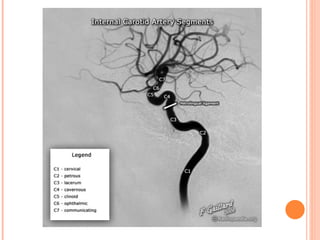
INTERNAL CAROTID ARTERY
Course
 Entry – carotid canal

 Middle cranial fossa- beside dorsum sellae

 Enters cavernous sinus

 Approaches medial side of anterior clinoid
  process
 Pierces dura and arachnoid maters
 Moves lateral to optic chiasma

 Divides into Anterior and Middle cerebral
  arteries
BRANCHES OF INTERNAL CAROTID
ARTERY[PRIOR TO BIFURCATION]
    Occasionally, Anterior choroidal artery supplies
2.   Rostral midbrain
3.   Ventral thalamus
4.   Subthalamus
ARTERIAL
‘CIRCLE’/’CIRCLE’ OF
WILLIS
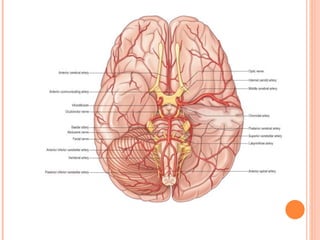
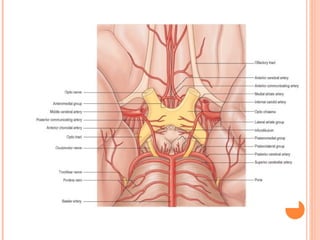
“CIRCLE” OF WILLIS
 Looks more like a polygon
 Connects anterior and posterior circulations
COMPONENTS
    From anterior
2.   Anterior communicating artery
3.   Anterior cerebral artery
4.   Posterior communicating artery
5.   Posterior cerebral artery
  Alternate route – inadequate, especially in the
   elderly [atherosclerosis]
 Variations

3. In approximately 33% persons Posterior cerebral
   artery arises from Internal carotid artery
4. One Anterior cerebral artery may be small-
   anterior communicating artery is wider
TERRITORIES OF
CEREBRAL ARTERIES
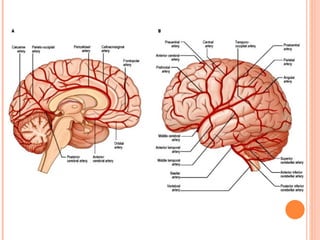
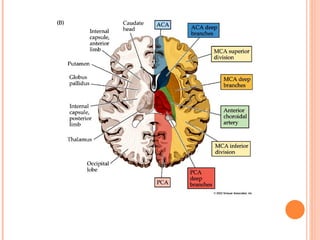
ANTERIOR CEREBRAL ARTERY
  Midline proximity [longitudinal horizontal
   fissure]
 Joined together by anterior communicating
   artery
Branches
4. Medial striate/recurrent artery of
   Heubner→ventral part of head of caudate
   nucleus, putamen, anterior limb and genu of
   internal capsule
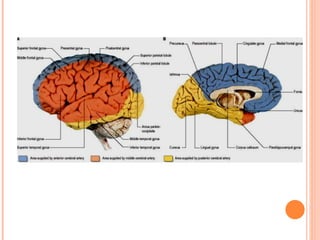
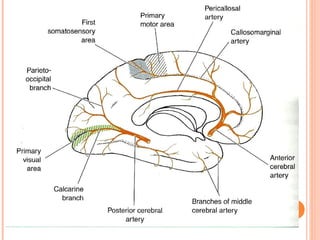
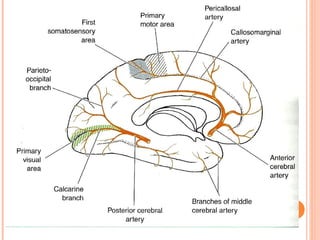
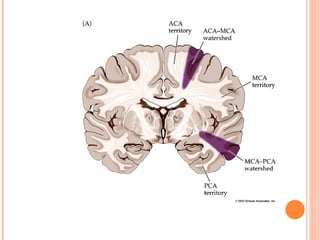
AREA SUPPLIED
 Medial part of orbital surface of frontal lobe
  [includes olfactory bulb and tract]
 Medial surfaces of frontal and parietal lobes

 Corpus callosum

 A strip on lateral surface
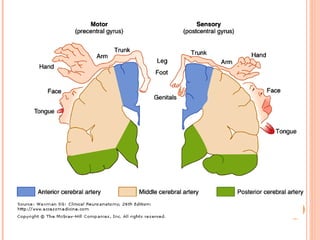
FUNCTIONAL AREAS SUPPLIED
 Supplementary and cingulate motor areas
 Dorsal parts of primary motor and sensorimotor
  areas
OTHER ASSOCIATED DEFICITS IN
ACA BLOCK
   Mental confusion and dysphasia[functional loss
    in prefrontal cortex, cingulate gyrus,
    supplementary motor area]
EFFECTS OF OCCLUSION
 Paralysis and sensory deficits in contralateral
  leg, perineum
 Urinary incontinence [inadequate perineal
  sensation, defective cortical control of pelvic floor
  muscles]
If obstruction is proximal to anterior
  communicating artery [blocked medial striate
  artery]
 UMN weakness of face, tongue and upper limb
  [lesion in or near genu]
 Ipsilateral anosmia [maybe]
POSTERIOR CEREBRAL
ARTERY
BRANCHES
    Central branches supply
2.   Midbrain
3.   Pineal gland
4.   Lateral geniculate body
5.   Lentiform nucleus [partly]
6.   Thalamus [partly]
 Temporal branches→ inferolateral and medial
  surfaces of temporal lobe, much of
  parahippocampal gyrus
 Calcarine and parieto-occipital branches→
  peripheral strip on lateral surface
 Calcarine branch supplies all of primary
  visual cortex and some of Visual association
  cortex
 Posterior choroidal artery supplies
d Choroid plexus of inferior horn of lateral
  ventricle
f Choroid plexus of 3rd ventricle

f Thalamus

f Fornix

f Tectum of midbrain

 anastomoses with Anterior choroidal artery
EFFECTS OF OCCLUSION
 Blindness in contralateral visual fields of both
  eyes – homonymous hemianopia
 Disturbance of memory – transient

 In case of dominant hemisphere being affected,
  the infarct extends into corpus callosum→
  disconnection of contralateral visual area from
  language area of dominant hemisphere→ alexia
  in addition to homonymous hemianopia
SPECIAL CIRCUMSTANCES
 Expanding space-occupying lesion in
  supratentorial compartment→ herniation of
  uncus and midbrain→ compression of one or both
  PCA→ necrosis of areas supplied [even after
  surgical correction of cause]→ cortical
  blindness+inability to form new memories
 Traumatic Intracranial hemorrhage can lead to
  the same consequences
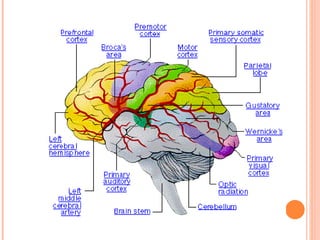
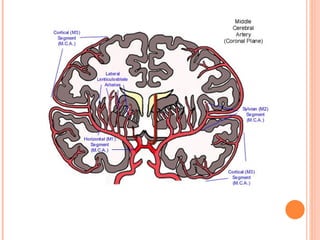
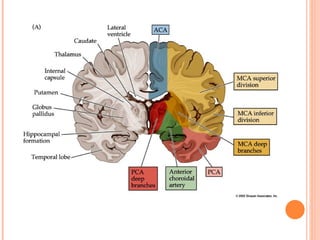
MIDDLE CEREBRAL
ARTERY
 Larger, more direct continuation of ICA
 Occupies lateral sulcus

 Central branches →Head of caudate
  nucleus,Putamen, Lateral pallidum, Internal
  capsule [anterior limb, genu, posterior limb],
  External capsule, Claustrum, Lateral
  hypothalamus
FUNCTIONAL AREAS SUPPLIED
 Most of primary motor and premotor areas
 Frontal eye field

 Primary somatosensory area

 Geniculocalcarine tract

  EXCEPT motor and sensory cortex for
  lower limb and perineum
  In most persons, left MCA supplies all
  cortical areas concerned with language
  [Wernicke’s,Broca’s]
EFFECTS OF OCCLUSION
 Contralateral paralysis of lower face, upper limb
 General somatosensory deficits in the same areas

 Astereognosis

 Hemianopia in contralateral visual fields of both
  eyes
 Global aphasia if dominant hemisphere involved

 Aprosodia if non-dominant hemisphere involved
 Cortical neglect, if right hemisphere involved
 Conjugate eye movements affected[ at rest, eyes
  turn towards the side of lesion]
 Hearing unaffected [bilateral representation]

 Obstruction to central branches- contralateral
  hemiplegia without aphasia
Cerebral circulation by DR.ARSHAD

Cerebral circulation by DR.ARSHAD

  • 1.
  • 2.
    FACTS ABOUT BLOODSUPPLY OF BRAIN  Brain – 2% of body weight  Receives 17% of cardiac output  Consumes 20% of entire Oxygen used by the body  10 seconds of interruption in blood flow leads to unconsciousness  Most neurologic disorders are due to vascular lesions
  • 3.
    ANTERIOR AND POSTERIOR CIRCULATIONS Anterior– Internal carotid arteries Posterior – Vertebral arteries
  • 5.
    INTERNAL CAROTID ARTERY Course Entry – carotid canal  Middle cranial fossa- beside dorsum sellae  Enters cavernous sinus  Approaches medial side of anterior clinoid process
  • 6.
     Pierces duraand arachnoid maters  Moves lateral to optic chiasma  Divides into Anterior and Middle cerebral arteries
  • 8.
    BRANCHES OF INTERNALCAROTID ARTERY[PRIOR TO BIFURCATION]
  • 9.
    Occasionally, Anterior choroidal artery supplies 2. Rostral midbrain 3. Ventral thalamus 4. Subthalamus
  • 10.
  • 11.
    “CIRCLE” OF WILLIS Looks more like a polygon  Connects anterior and posterior circulations
  • 12.
    COMPONENTS  From anterior 2. Anterior communicating artery 3. Anterior cerebral artery 4. Posterior communicating artery 5. Posterior cerebral artery
  • 13.
     Alternateroute – inadequate, especially in the elderly [atherosclerosis]  Variations 3. In approximately 33% persons Posterior cerebral artery arises from Internal carotid artery 4. One Anterior cerebral artery may be small- anterior communicating artery is wider
  • 15.
  • 18.
    ANTERIOR CEREBRAL ARTERY  Midline proximity [longitudinal horizontal fissure]  Joined together by anterior communicating artery Branches 4. Medial striate/recurrent artery of Heubner→ventral part of head of caudate nucleus, putamen, anterior limb and genu of internal capsule
  • 20.
    AREA SUPPLIED  Medialpart of orbital surface of frontal lobe [includes olfactory bulb and tract]  Medial surfaces of frontal and parietal lobes  Corpus callosum  A strip on lateral surface
  • 21.
    FUNCTIONAL AREAS SUPPLIED Supplementary and cingulate motor areas  Dorsal parts of primary motor and sensorimotor areas
  • 22.
    OTHER ASSOCIATED DEFICITSIN ACA BLOCK  Mental confusion and dysphasia[functional loss in prefrontal cortex, cingulate gyrus, supplementary motor area]
  • 23.
    EFFECTS OF OCCLUSION Paralysis and sensory deficits in contralateral leg, perineum  Urinary incontinence [inadequate perineal sensation, defective cortical control of pelvic floor muscles] If obstruction is proximal to anterior communicating artery [blocked medial striate artery]  UMN weakness of face, tongue and upper limb [lesion in or near genu]  Ipsilateral anosmia [maybe]
  • 24.
  • 26.
    BRANCHES  Central branches supply 2. Midbrain 3. Pineal gland 4. Lateral geniculate body 5. Lentiform nucleus [partly] 6. Thalamus [partly]
  • 27.
     Temporal branches→inferolateral and medial surfaces of temporal lobe, much of parahippocampal gyrus  Calcarine and parieto-occipital branches→ peripheral strip on lateral surface  Calcarine branch supplies all of primary visual cortex and some of Visual association cortex
  • 28.
     Posterior choroidalartery supplies d Choroid plexus of inferior horn of lateral ventricle f Choroid plexus of 3rd ventricle f Thalamus f Fornix f Tectum of midbrain anastomoses with Anterior choroidal artery
  • 29.
    EFFECTS OF OCCLUSION Blindness in contralateral visual fields of both eyes – homonymous hemianopia  Disturbance of memory – transient  In case of dominant hemisphere being affected, the infarct extends into corpus callosum→ disconnection of contralateral visual area from language area of dominant hemisphere→ alexia in addition to homonymous hemianopia
  • 30.
    SPECIAL CIRCUMSTANCES  Expandingspace-occupying lesion in supratentorial compartment→ herniation of uncus and midbrain→ compression of one or both PCA→ necrosis of areas supplied [even after surgical correction of cause]→ cortical blindness+inability to form new memories  Traumatic Intracranial hemorrhage can lead to the same consequences
  • 31.
  • 32.
     Larger, moredirect continuation of ICA  Occupies lateral sulcus  Central branches →Head of caudate nucleus,Putamen, Lateral pallidum, Internal capsule [anterior limb, genu, posterior limb], External capsule, Claustrum, Lateral hypothalamus
  • 33.
    FUNCTIONAL AREAS SUPPLIED Most of primary motor and premotor areas  Frontal eye field  Primary somatosensory area  Geniculocalcarine tract EXCEPT motor and sensory cortex for lower limb and perineum In most persons, left MCA supplies all cortical areas concerned with language [Wernicke’s,Broca’s]
  • 34.
    EFFECTS OF OCCLUSION Contralateral paralysis of lower face, upper limb  General somatosensory deficits in the same areas  Astereognosis  Hemianopia in contralateral visual fields of both eyes  Global aphasia if dominant hemisphere involved  Aprosodia if non-dominant hemisphere involved
  • 35.
     Cortical neglect,if right hemisphere involved  Conjugate eye movements affected[ at rest, eyes turn towards the side of lesion]  Hearing unaffected [bilateral representation]  Obstruction to central branches- contralateral hemiplegia without aphasia