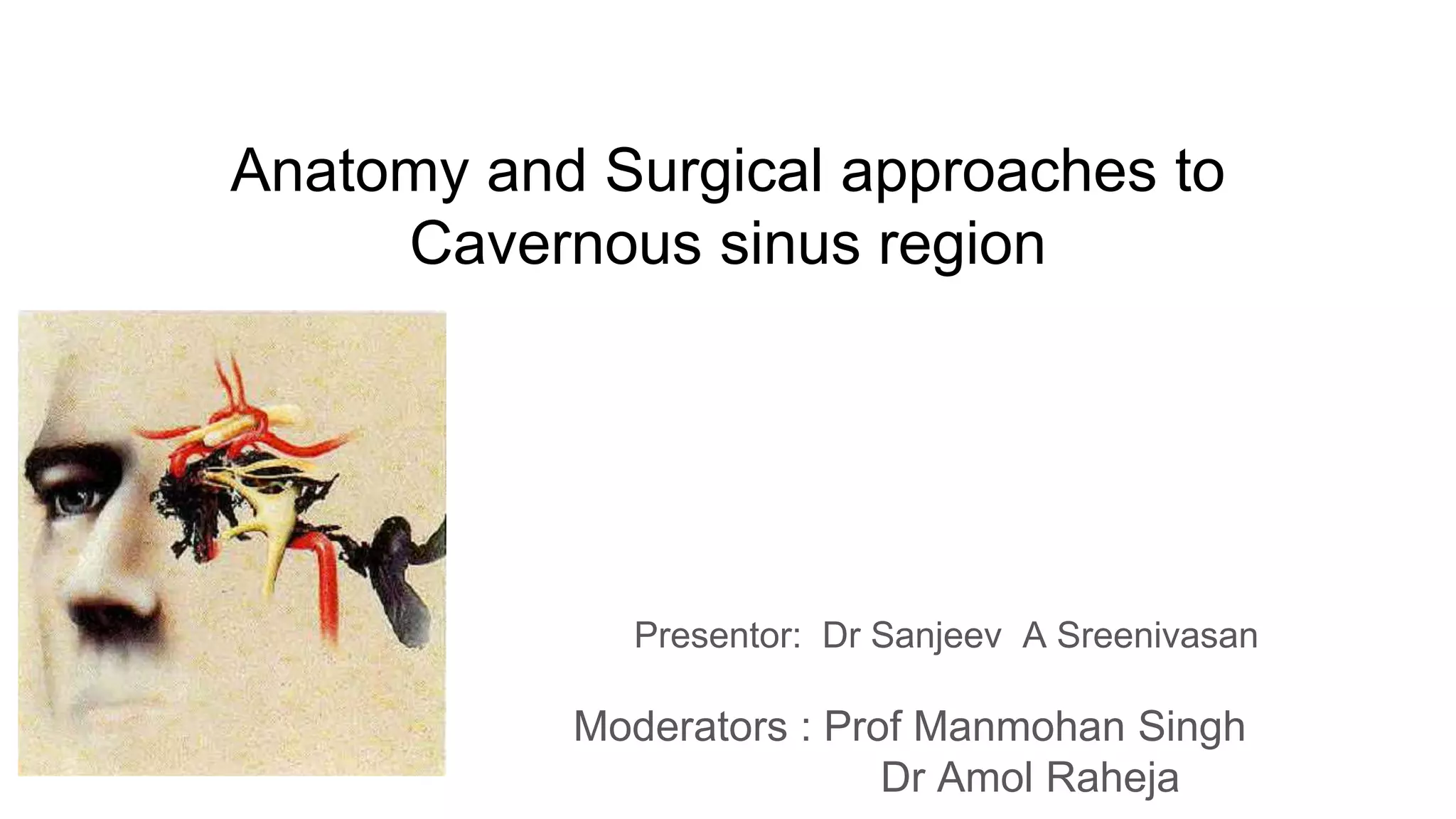
Anatomy and Surgical approaches to
Cavernous sinus region
Presentor: Dr Sanjeev A Sreenivasan
Moderators : Prof Manmohan Singh
Dr Amol Raheja
Schema of discussion
Anatomy
Surgical Approaches
Historical perspective
Research and Advances
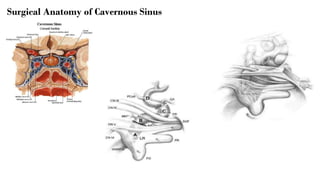
Surgical Anatomy of Cavernous Sinus
Surgical anatomy of cavernous sinus is best explained under following
headings –
1) Bony relationships
2) Dural relationships
3) Venous relationships
4) Neural relationships
5) Arterial relationships
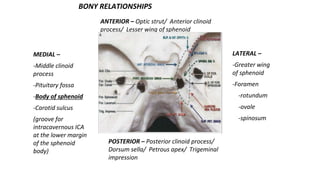
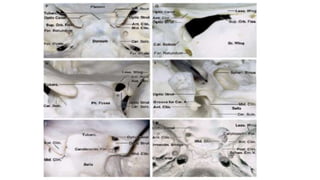
BONY RELATIONSHIPS
MEDIAL –
-Middle clinoid
process
-Pituitary fossa
-Body of sphenoid
-Carotid sulcus
(groove for
intracavernous ICA
at the lower margin
of the sphenoid
body)
ANTERIOR – Optic strut/ Anterior clinoid
process/ Lesser wing of sphenoid
LATERAL –
-Greater wing
of sphenoid
-Foramen
-rotundum
-ovale
-spinosum
POSTERIOR – Posterior clinoid process/
Dorsum sella/ Petrous apex/ Trigeminal
impression
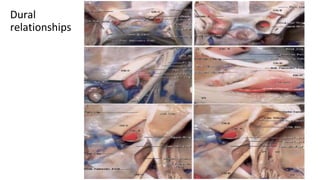
Dural
relationships
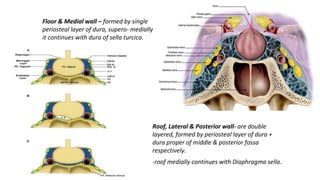
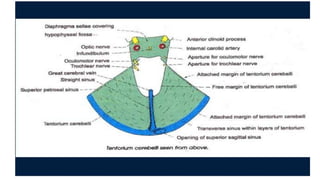
Floor & Medial wall – formed by single
periosteal layer of dura, supero- medially
it continues with dura of sella turcica.
Roof, Lateral & Posterior wall- are double
layered, formed by periosteal layer of dura +
dura proper of middle & posterior fossa
respectively.
-roof medially continues with Diaphragma sella.
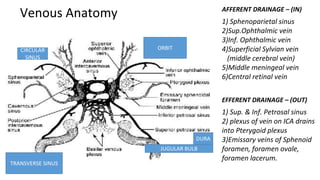
Venous Anatomy
ORBIT
DURA
TRANSVERSE SINUS
JUGULAR BULB
CIRCULAR
SINUS
AFFERENT DRAINAGE – (IN)
1) Sphenoparietal sinus
2)Sup.Ophthalmic vein
3)Inf. Ophthalmic vein
4)Superficial Sylvian vein
(middle cerebral vein)
5)Middle meningeal vein
6)Central retinal vein
EFFERENT DRAINAGE – (OUT)
1) Sup. & Inf. Petrosal sinus
2) plexus of vein on ICA drains
into Pterygoid plexus
3)Emissary veins of Sphenoid
foramen, foramen ovale,
foramen lacerum.
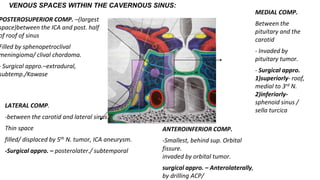
VENOUS SPACES WITHIN THE CAVERNOUS SINUS:
LATERAL COMP.
-between the carotid and lateral sinus wall
Thin space
filled/ displaced by 5th N. tumor, ICA aneurysm.
-Surgical appro. – posterolater./ subtemporal
MEDIAL COMP.
Between the
pituitary and the
carotid
- Invaded by
pituitary tumor.
- Surgical appro.
1)superiorly- roof,
medial to 3rd N.
2)inferiorly-
sphenoid sinus /
sella turcica
ANTEROINFERIOR COMP.
-Smallest, behind sup. Orbital
fissure.
invaded by orbital tumor.
surgical appro. – Anterolaterally,
by drilling ACP/
POSTEROSUPERIOR COMP. –(largest
space)between the ICA and post. half
of roof of sinus
Filled by sphenopetroclival
meningioma/ clival chordoma.
- Surgical appro.–extradural,
subtemp./Kawase
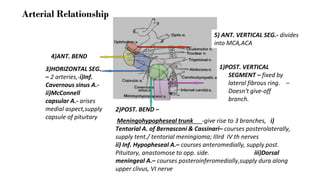
Arterial Relationship
1)POST. VERTICAL
SEGMENT – fixed by
lateral fibrous ring. –
Doesn't give-off
branch.
2)POST. BEND –
Meningohypopheseal trunk -give rise to 3 branches, i)
Tentorial A. of Bernasconi & Cassinari– courses posterolaterally,
supply tent./ tentorial meningioma; IIIrd IV th nerves
ii) Inf. Hypopheseal A.– courses anteromedially, supply post.
Pituitary, anastomose to opp. side. iii)Dorsal
meningeal A.– courses posteroinferomedially,supply dura along
upper clivus, VI nerve
3)HORIZONTAL SEG.
– 2 arteries,-i)Inf.
Cavernous sinus A.-
ii)McConnell
capsular A.- arises
medial aspect,supply
capsule of pituitary
4)ANT. BEND
5) ANT. VERTICAL SEG.- divides
into MCA,ACA
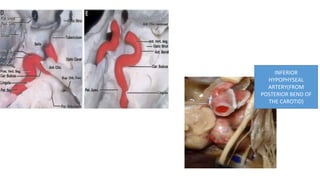
INFERIOR
HYPOPHYSEAL
ARTERY(FROM
POSTERIOR BEND OF
THE CAROTID)
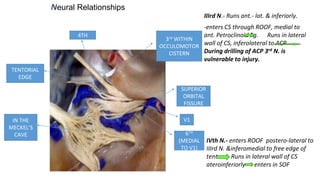
Neural Relationships
IIIrd N.- Runs ant.- lat. & inferiorly.
-enters CS through ROOF, medial to
ant. Petroclinoid lig. Runs in lateral
wall of CS, inferolateral to ACP
During drilling of ACP 3rd N. is
vulnerable to injury.
IVth N.- enters ROOF postero-lateral to
IIIrd N. &inferomedial to free edge of
tent Runs in lateral wall of CS
ateroinferiorly enters in SOF
SUPERIOR
ORBITAL
FISSURE
3rd WITHIN
OCCULOMOTOR
CISTERN
4TH
6TH
(MEDIAL
TO V1)
V1IN THE
MECKEL’S
CAVE
TENTORIAL
EDGE
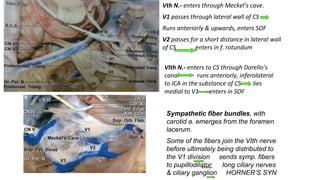
Vth N.- enters through Meckel’s cave.
V1 passes through lateral wall of CS
Runs anteriorly & upwards, enters SOF
V2 passes for a short distance in lateral wall
of CS enters in f. rotundum
VIth N.- enters to CS through Dorello’s
canal runs anteriorly, inferolateral
to ICA in the substance of CS lies
medial to V1 enters in SOF
Sympathetic fiber bundles, with
carotid a. emerges from the foramen
lacerum.
Some of the fibers join the VIth nerve
before ultimately being distributed to
the V1 division sends symp. fibers
to pupillodilator long ciliary nerves
& ciliary ganglion HORNER’S SYN
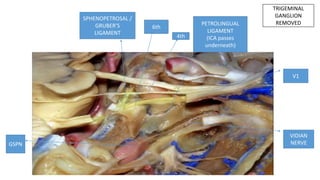
4th
SPHENOPETROSAL /
GRUBER’S
LIGAMENT
6th
TRIGEMINAL
GANGLION
REMOVEDPETROLINGUAL
LIGAMENT
(ICA passes
underneath)
GSPN
V1
VIDIAN
NERVE
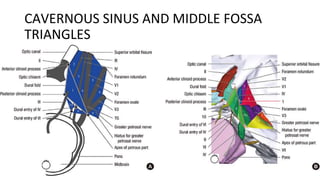
CAVERNOUS SINUS AND MIDDLE FOSSA
TRIANGLES
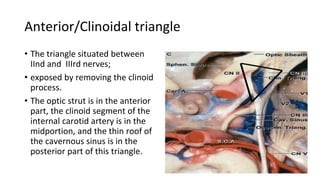
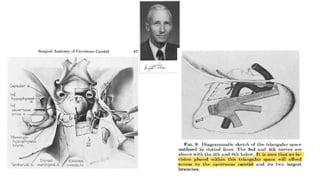
Anterior/Clinoidal triangle
• The triangle situated between
IInd and IIIrd nerves;
• exposed by removing the clinoid
process.
• The optic strut is in the anterior
part, the clinoid segment of the
internal carotid artery is in the
midportion, and the thin roof of
the cavernous sinus is in the
posterior part of this triangle.
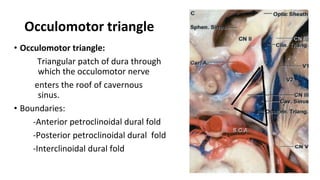
Occulomotor triangle
• Occulomotor triangle:
Triangular patch of dura through
which the occulomotor nerve
enters the roof of cavernous
sinus.
• Boundaries:
-Anterior petroclinoidal dural fold
-Posterior petroclinoidal dural fold
-Interclinoidal dural fold
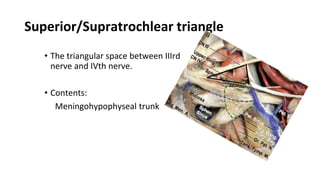
Superior/Supratrochlear triangle
• The triangular space between IIIrd
nerve and IVth nerve.
• Contents:
Meningohypophyseal trunk
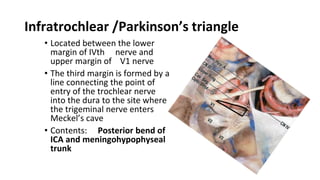
Infratrochlear /Parkinson’s triangle
• Located between the lower
margin of IVth nerve and
upper margin of V1 nerve
• The third margin is formed by a
line connecting the point of
entry of the trochlear nerve
into the dura to the site where
the trigeminal nerve enters
Meckel’s cave
• Contents: Posterior bend of
ICA and meningohypophyseal
trunk
Middle fossa triangles
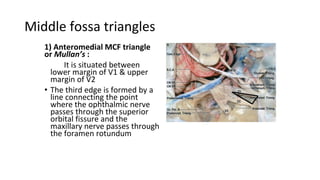
1) Anteromedial MCF triangle
or Mullan’s :
It is situated between
lower margin of V1 & upper
margin of V2
• The third edge is formed by a
line connecting the point
where the ophthalmic nerve
passes through the superior
orbital fissure and the
maxillary nerve passes through
the foramen rotundum
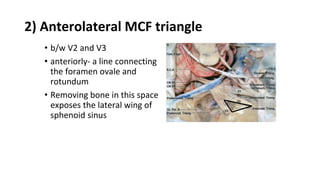
2) Anterolateral MCF triangle
• b/w V2 and V3
• anteriorly- a line connecting
the foramen ovale and
rotundum
• Removing bone in this space
exposes the lateral wing of
sphenoid sinus
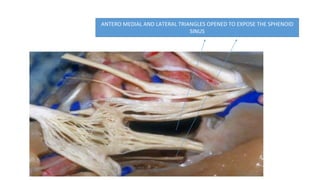
ANTERO MEDIAL AND LATERAL TRIANGLES OPENED TO EXPOSE THE SPHENOID
SINUS
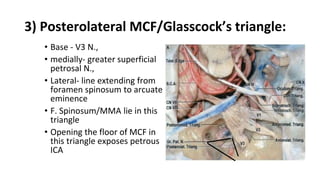
3) Posterolateral MCF/Glasscock’s triangle:
• Base - V3 N.,
• medially- greater superficial
petrosal N.,
• Lateral- line extending from
foramen spinosum to arcuate
eminence
• F. Spinosum/MMA lie in this
triangle
• Opening the floor of MCF in
this triangle exposes petrous
ICA
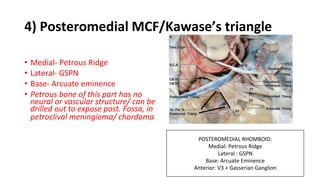
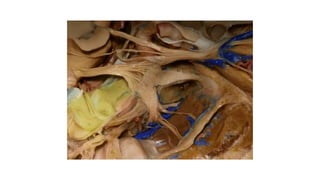
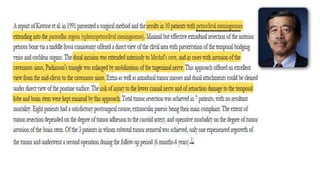
4) Posteromedial MCF/Kawase’s triangle
• Medial- Petrous Ridge
• Lateral- GSPN
• Base- Arcuate eminence
• Petrous bone of this part has no
neural or vascular structure/ can be
drilled out to expose post. Fossa, in
petroclival meningioma/ chordoma
POSTEROMEDIAL RHOMBOID:
Medial: Petrous Ridge
Lateral : GSPN
Base: Arcuate Eminence
Anterior: V3 + Gasserian Ganglion
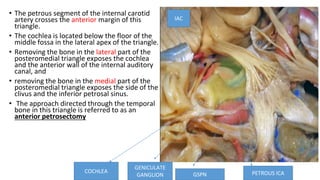
• The petrous segment of the internal carotid
artery crosses the anterior margin of this
triangle.
• The cochlea is located below the floor of the
middle fossa in the lateral apex of the triangle.
• Removing the bone in the lateral part of the
posteromedial triangle exposes the cochlea
and the anterior wall of the internal auditory
canal, and
• removing the bone in the medial part of the
posteromedial triangle exposes the side of the
clivus and the inferior petrosal sinus.
• The approach directed through the temporal
bone in this triangle is referred to as an
anterior petrosectomy
GSPN
GENICULATE
GANGLION
COCHLEA
IAC
PETROUS ICA
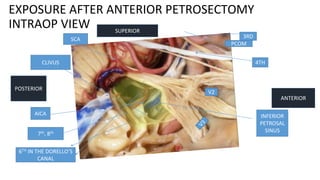
EXPOSURE AFTER ANTERIOR PETROSECTOMY
INTRAOP VIEW
ANTERIOR
POSTERIOR
SUPERIOR
CLIVUS
INFERIOR
PETROSAL
SINUS
V2
6TH IN THE DORELLO’S
CANAL
4TH
3RD
AICA
PCOM
SCA
7th, 8th
Surgical approaches to cavernous sinus
Fronto temporal Extradural & Intradural Approaches
Anterolateral Temporopolar transcavernous approaches
Lateral Approach to posterior cavernous sinus(Rhomboid Approach)
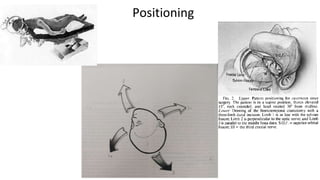
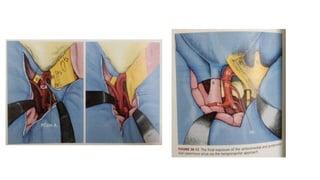
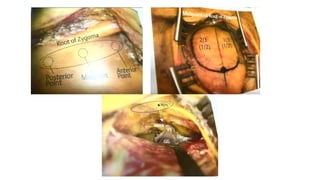
Positioning
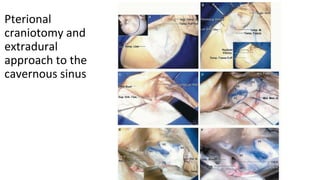
Pterional
craniotomy and
extradural
approach to the
cavernous sinus
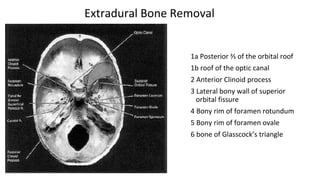
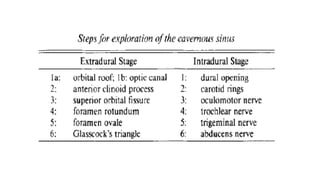
Extradural Bone Removal
1a Posterior ⅔ of the orbital roof
1b roof of the optic canal
2 Anterior Clinoid process
3 Lateral bony wall of superior
orbital fissure
4 Bony rim of foramen rotundum
5 Bony rim of foramen ovale
6 bone of Glasscock’s triangle
Op video: ACP drilling
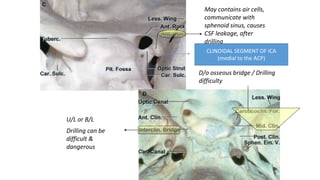
May contains air cells,
communicate with
sphenoid sinus, causes
CSF leakage, after
drilling
D/o osseous bridge / Drilling
difficulty
U/L or B/L
Drilling can be
difficult &
dangerous
CLINOIDAL SEGMENT OF ICA
(medial to the ACP)
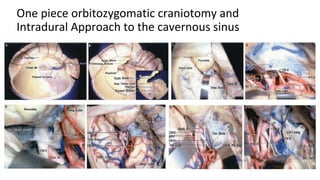
One piece orbitozygomatic craniotomy and
Intradural Approach to the cavernous sinus
FRONTOTEMPORAL EXTRADURAL & INTRADURAL APPROACH
Initially developed by DOLENC ––as anteromedial transcavernous
approach, for intracavernous aneurysm
UNDERWENT SEVERAL MODIFICATIONS
INDICATION ––Lesions confined to cavernous sinus/ with
supratentorial extension
ADVANTAGE --Can be combined with Middle fossa transpetrosal
approach for excision of for posterior extension of tumor.
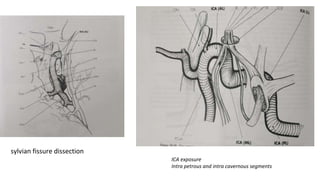
sylvian fissure dissection
ICA exposure
Intra petrous and intra cavernous segments
Op Video
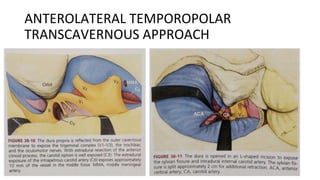
ANTEROLATERAL TEMPOROPOLAR
TRANSCAVERNOUS APPROACH
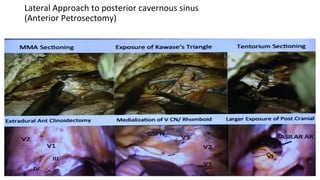
Lateral Approach to posterior cavernous sinus
(Anterior Petrosectomy)
Op video
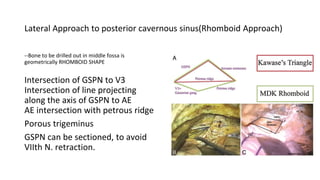
Lateral Approach to posterior cavernous sinus(Rhomboid Approach)
--Bone to be drilled out in middle fossa is
geometrically RHOMBOID SHAPE
Intersection of GSPN to V3
Intersection of line projecting
along the axis of GSPN to AE
AE intersection with petrous ridge
Porous trigeminus
GSPN can be sectioned, to avoid
VIIth N. retraction.
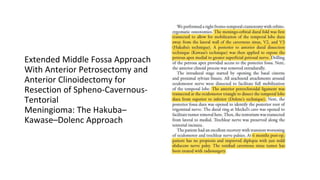
Extended Middle Fossa Approach
With Anterior Petrosectomy and
Anterior Clinoidectomy for
Resection of Spheno-Cavernous-
Tentorial
Meningioma: The Hakuba–
Kawase–Dolenc Approach
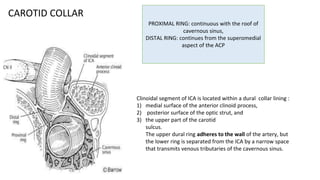
PROXIMAL RING: continuous with the roof of
cavernous sinus,
DISTAL RING: continues from the superomedial
aspect of the ACP
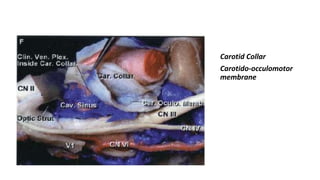
Clinoidal segment of ICA is located within a dural collar lining :
1) medial surface of the anterior clinoid process,
2) posterior surface of the optic strut, and
3) the upper part of the carotid
sulcus.
The upper dural ring adheres to the wall of the artery, but
the lower ring is separated from the ICA by a narrow space
that transmits venous tributaries of the cavernous sinus.
CAROTID COLLAR
Carotid Collar
Carotido-occulomotor
membrane
Bone resection begins with exposure of Internal Auditory Canal
2700 ICA exposure by drilling
Petrous ridge is drilled inferiorly up to INFERIOR PETROSAL Sinus
SUPERIOR PETROSAL SINUS is clipped & divided after opening dura
EXPOSURE:posteromedial, posteroinferior corridors & petroclival area
COMPLICATION:hearing loss due to violation of cochlea or bony
labyrinth.
TECHNICAL CONSIDERATION OF INTRACAVERNOUS TUMOR
RESECTIONINTRACAVERNOUS RESECTION-
Well encapsulated & nonadherent tumors can be removed by
1)exposure of tumor capsule from surrounding tissue
2) debulking of tumor
3) sharp dissection of tumor capsule from surrounding tissue
Invasive & adherent tumors can be removed by
1) interruption of tumor blood supply from periphery of tumor
2) nerve become nonfunctional to be divided
3) invasion of intracavernous ICA requires bypass procedure.
TECHNICAL CONSIDERATION OF HEMOSTASIS
Bone bleeding can be controlled with wax & monopolar cautry
Bleeding from cavernous sinus is controlled by surgicel & packing with
cottonoids
Triangle Area to be avoided for packing
structure
Anteromedial lateral & medial
2nd& 3rdN
Anterolateral medial
6th
Far lateral medial
6thN.
REFERENCES:
• Harris FS, Rhoton AL: Anatomy of the cavernous sinus. A microsurgical study. J Neurosurg 45:169-180, 1976
• Inoue T, Rhoton AL, Jr., Theele D, et al: Surgical approaches to the cavernous sinus: A microsurgical
study. Neurosurgery 26:903-932, 1990
• Natori Y, Rhoton AL, Jr. Microsurgical anatomy of the superior orbital fissure. Neurosurgery 36:762-775,
1995
• Parkinson D: A surgical approach to the cavernous portion of the carotid artery. Anatomical studies and case
report. J Neurosurg 23:474-483, 1965
• BNI Quaterly-Volume 12, No. 2, 1996. Microsurgical Anatomy of the Cavernous Sinus
• Rhoton Cranial Anatomy and Surgical Approaches – Cavernous Sinus, Cavernous Venous Plexus, and
Carotid Collar : 403-438, Oct 2003
• Barrow Quarterly - Volume 18, No. 1, 2002-Microsurgical Anatomy of the Clinoidal Segment of the Internal
Carotid Artery, Carotid Cave, and Paraclinoid Space
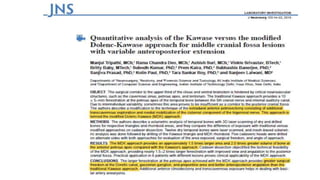
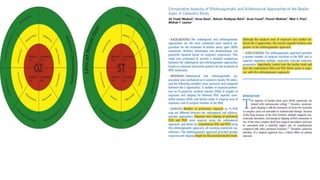
• J Neurosurg. 2015 Apr 3:1-9. Quantitative analysis of the Kawase versus the modified Dolenc-Kawase
approach for middle cranial fossa lesions with variable anteroposterior extension. Tripathi M1, Deo
RC, Suri A, Srivastav V, Baby B, Kumar S, Kalra P, Banerjee S, Prasad S, Paul K, Roy TS, Lalwani S.
THANK YOU
EXTRADURAL BONE
REMOVAL
AIM:
To improve exposure, mobility & transposition of neurovascular
structures for wider corridors of access.
SPHENOID WING is drilled-out, under constant irrigation
medially up to meningoorbital artery.
SUPERIOR ORBITAL FISSURE is drilled is to expose approx. 10 cm of
periobital fascia
ANTERIOR CLINOID PROCESS is slowly drilled, till it becomes papery
thin & shouldnever be removed in single never piece
If, there is calcification of intraclinoidal dural folds, it should be
intermittently drilled & separated from dura, removed with
intermittently biopsy forceps
Foramen rotundum is drilled to mobilize 5--8 mm of V2 N for exposure
through anterolateral corridor
Foramen Ovale is drilled to mobilize V3 N. , for exposure through far
lateral & posterolateral corridors.
INTRAPETROUS CAROTID ARTERY exposure
1)Dura is elevated in posterolateral (Glasscock) triangle
2) MMA is coagulated & divided
3) GSPNis identified in groove
4) below & parallel to GSPN lies ICA
5) if needed GSPN can be divided
6) Drilling is done post. To V3 N.& medial to foramen spinosum
Danger of cochlear disruption
INTRADURAL TRANSCAVERNOUS DISSECTION
Dura is either in curvilinear fashion or in inverted T-shaped in the
direction of sylvian fissure
Anterior 3-4 cm of sylvian fissure is opened
anteromedial, paramedial,Oculomotor, Parkinson's triangle &
posteromedial triangular corridors can be explored
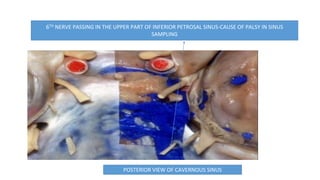
6TH NERVE PASSING IN THE UPPER PART OF INFERIOR PETROSAL SINUS-CAUSE OF PALSY IN SINUS
SAMPLING
POSTERIOR VIEW OF CAVERNOUS SINUS

Cavernous sinus-ANATOMY AND SURGICAL APPROACHES

  • 1.
    Anatomy and Surgicalapproaches to Cavernous sinus region Presentor: Dr Sanjeev A Sreenivasan Moderators : Prof Manmohan Singh Dr Amol Raheja
  • 2.
    Schema of discussion Anatomy SurgicalApproaches Historical perspective Research and Advances
  • 3.
    Surgical Anatomy ofCavernous Sinus
  • 4.
    Surgical anatomy ofcavernous sinus is best explained under following headings – 1) Bony relationships 2) Dural relationships 3) Venous relationships 4) Neural relationships 5) Arterial relationships
  • 5.
    BONY RELATIONSHIPS MEDIAL – -Middleclinoid process -Pituitary fossa -Body of sphenoid -Carotid sulcus (groove for intracavernous ICA at the lower margin of the sphenoid body) ANTERIOR – Optic strut/ Anterior clinoid process/ Lesser wing of sphenoid LATERAL – -Greater wing of sphenoid -Foramen -rotundum -ovale -spinosum POSTERIOR – Posterior clinoid process/ Dorsum sella/ Petrous apex/ Trigeminal impression
  • 7.
  • 8.
    Floor & Medialwall – formed by single periosteal layer of dura, supero- medially it continues with dura of sella turcica. Roof, Lateral & Posterior wall- are double layered, formed by periosteal layer of dura + dura proper of middle & posterior fossa respectively. -roof medially continues with Diaphragma sella.
  • 9.
    Venous Anatomy ORBIT DURA TRANSVERSE SINUS JUGULARBULB CIRCULAR SINUS AFFERENT DRAINAGE – (IN) 1) Sphenoparietal sinus 2)Sup.Ophthalmic vein 3)Inf. Ophthalmic vein 4)Superficial Sylvian vein (middle cerebral vein) 5)Middle meningeal vein 6)Central retinal vein EFFERENT DRAINAGE – (OUT) 1) Sup. & Inf. Petrosal sinus 2) plexus of vein on ICA drains into Pterygoid plexus 3)Emissary veins of Sphenoid foramen, foramen ovale, foramen lacerum.
  • 10.
    VENOUS SPACES WITHINTHE CAVERNOUS SINUS: LATERAL COMP. -between the carotid and lateral sinus wall Thin space filled/ displaced by 5th N. tumor, ICA aneurysm. -Surgical appro. – posterolater./ subtemporal MEDIAL COMP. Between the pituitary and the carotid - Invaded by pituitary tumor. - Surgical appro. 1)superiorly- roof, medial to 3rd N. 2)inferiorly- sphenoid sinus / sella turcica ANTEROINFERIOR COMP. -Smallest, behind sup. Orbital fissure. invaded by orbital tumor. surgical appro. – Anterolaterally, by drilling ACP/ POSTEROSUPERIOR COMP. –(largest space)between the ICA and post. half of roof of sinus Filled by sphenopetroclival meningioma/ clival chordoma. - Surgical appro.–extradural, subtemp./Kawase
  • 11.
    Arterial Relationship 1)POST. VERTICAL SEGMENT– fixed by lateral fibrous ring. – Doesn't give-off branch. 2)POST. BEND – Meningohypopheseal trunk -give rise to 3 branches, i) Tentorial A. of Bernasconi & Cassinari– courses posterolaterally, supply tent./ tentorial meningioma; IIIrd IV th nerves ii) Inf. Hypopheseal A.– courses anteromedially, supply post. Pituitary, anastomose to opp. side. iii)Dorsal meningeal A.– courses posteroinferomedially,supply dura along upper clivus, VI nerve 3)HORIZONTAL SEG. – 2 arteries,-i)Inf. Cavernous sinus A.- ii)McConnell capsular A.- arises medial aspect,supply capsule of pituitary 4)ANT. BEND 5) ANT. VERTICAL SEG.- divides into MCA,ACA
  • 12.
  • 13.
    Neural Relationships IIIrd N.-Runs ant.- lat. & inferiorly. -enters CS through ROOF, medial to ant. Petroclinoid lig. Runs in lateral wall of CS, inferolateral to ACP During drilling of ACP 3rd N. is vulnerable to injury. IVth N.- enters ROOF postero-lateral to IIIrd N. &inferomedial to free edge of tent Runs in lateral wall of CS ateroinferiorly enters in SOF SUPERIOR ORBITAL FISSURE 3rd WITHIN OCCULOMOTOR CISTERN 4TH 6TH (MEDIAL TO V1) V1IN THE MECKEL’S CAVE TENTORIAL EDGE
  • 14.
    Vth N.- entersthrough Meckel’s cave. V1 passes through lateral wall of CS Runs anteriorly & upwards, enters SOF V2 passes for a short distance in lateral wall of CS enters in f. rotundum VIth N.- enters to CS through Dorello’s canal runs anteriorly, inferolateral to ICA in the substance of CS lies medial to V1 enters in SOF Sympathetic fiber bundles, with carotid a. emerges from the foramen lacerum. Some of the fibers join the VIth nerve before ultimately being distributed to the V1 division sends symp. fibers to pupillodilator long ciliary nerves & ciliary ganglion HORNER’S SYN
  • 15.
  • 16.
    CAVERNOUS SINUS ANDMIDDLE FOSSA TRIANGLES
  • 17.
    Anterior/Clinoidal triangle • Thetriangle situated between IInd and IIIrd nerves; • exposed by removing the clinoid process. • The optic strut is in the anterior part, the clinoid segment of the internal carotid artery is in the midportion, and the thin roof of the cavernous sinus is in the posterior part of this triangle.
  • 18.
    Occulomotor triangle • Occulomotortriangle: Triangular patch of dura through which the occulomotor nerve enters the roof of cavernous sinus. • Boundaries: -Anterior petroclinoidal dural fold -Posterior petroclinoidal dural fold -Interclinoidal dural fold
  • 19.
    Superior/Supratrochlear triangle • Thetriangular space between IIIrd nerve and IVth nerve. • Contents: Meningohypophyseal trunk
  • 20.
    Infratrochlear /Parkinson’s triangle •Located between the lower margin of IVth nerve and upper margin of V1 nerve • The third margin is formed by a line connecting the point of entry of the trochlear nerve into the dura to the site where the trigeminal nerve enters Meckel’s cave • Contents: Posterior bend of ICA and meningohypophyseal trunk
  • 21.
    Middle fossa triangles 1)Anteromedial MCF triangle or Mullan’s : It is situated between lower margin of V1 & upper margin of V2 • The third edge is formed by a line connecting the point where the ophthalmic nerve passes through the superior orbital fissure and the maxillary nerve passes through the foramen rotundum
  • 22.
    2) Anterolateral MCFtriangle • b/w V2 and V3 • anteriorly- a line connecting the foramen ovale and rotundum • Removing bone in this space exposes the lateral wing of sphenoid sinus
  • 23.
    ANTERO MEDIAL ANDLATERAL TRIANGLES OPENED TO EXPOSE THE SPHENOID SINUS
  • 24.
    3) Posterolateral MCF/Glasscock’striangle: • Base - V3 N., • medially- greater superficial petrosal N., • Lateral- line extending from foramen spinosum to arcuate eminence • F. Spinosum/MMA lie in this triangle • Opening the floor of MCF in this triangle exposes petrous ICA
  • 25.
    4) Posteromedial MCF/Kawase’striangle • Medial- Petrous Ridge • Lateral- GSPN • Base- Arcuate eminence • Petrous bone of this part has no neural or vascular structure/ can be drilled out to expose post. Fossa, in petroclival meningioma/ chordoma POSTEROMEDIAL RHOMBOID: Medial: Petrous Ridge Lateral : GSPN Base: Arcuate Eminence Anterior: V3 + Gasserian Ganglion
  • 27.
    • The petroussegment of the internal carotid artery crosses the anterior margin of this triangle. • The cochlea is located below the floor of the middle fossa in the lateral apex of the triangle. • Removing the bone in the lateral part of the posteromedial triangle exposes the cochlea and the anterior wall of the internal auditory canal, and • removing the bone in the medial part of the posteromedial triangle exposes the side of the clivus and the inferior petrosal sinus. • The approach directed through the temporal bone in this triangle is referred to as an anterior petrosectomy GSPN GENICULATE GANGLION COCHLEA IAC PETROUS ICA
  • 28.
    EXPOSURE AFTER ANTERIORPETROSECTOMY INTRAOP VIEW ANTERIOR POSTERIOR SUPERIOR CLIVUS INFERIOR PETROSAL SINUS V2 6TH IN THE DORELLO’S CANAL 4TH 3RD AICA PCOM SCA 7th, 8th
  • 29.
    Surgical approaches tocavernous sinus Fronto temporal Extradural & Intradural Approaches Anterolateral Temporopolar transcavernous approaches Lateral Approach to posterior cavernous sinus(Rhomboid Approach)
  • 30.
  • 31.
  • 32.
    Extradural Bone Removal 1aPosterior ⅔ of the orbital roof 1b roof of the optic canal 2 Anterior Clinoid process 3 Lateral bony wall of superior orbital fissure 4 Bony rim of foramen rotundum 5 Bony rim of foramen ovale 6 bone of Glasscock’s triangle
  • 33.
    Op video: ACPdrilling
  • 34.
    May contains aircells, communicate with sphenoid sinus, causes CSF leakage, after drilling D/o osseous bridge / Drilling difficulty U/L or B/L Drilling can be difficult & dangerous CLINOIDAL SEGMENT OF ICA (medial to the ACP)
  • 36.
    One piece orbitozygomaticcraniotomy and Intradural Approach to the cavernous sinus
  • 37.
    FRONTOTEMPORAL EXTRADURAL &INTRADURAL APPROACH Initially developed by DOLENC ––as anteromedial transcavernous approach, for intracavernous aneurysm UNDERWENT SEVERAL MODIFICATIONS INDICATION ––Lesions confined to cavernous sinus/ with supratentorial extension ADVANTAGE --Can be combined with Middle fossa transpetrosal approach for excision of for posterior extension of tumor.
  • 38.
    sylvian fissure dissection ICAexposure Intra petrous and intra cavernous segments
  • 39.
  • 40.
  • 42.
    Lateral Approach toposterior cavernous sinus (Anterior Petrosectomy)
  • 43.
  • 45.
    Lateral Approach toposterior cavernous sinus(Rhomboid Approach) --Bone to be drilled out in middle fossa is geometrically RHOMBOID SHAPE Intersection of GSPN to V3 Intersection of line projecting along the axis of GSPN to AE AE intersection with petrous ridge Porous trigeminus GSPN can be sectioned, to avoid VIIth N. retraction.
  • 51.
    Extended Middle FossaApproach With Anterior Petrosectomy and Anterior Clinoidectomy for Resection of Spheno-Cavernous- Tentorial Meningioma: The Hakuba– Kawase–Dolenc Approach
  • 54.
    PROXIMAL RING: continuouswith the roof of cavernous sinus, DISTAL RING: continues from the superomedial aspect of the ACP Clinoidal segment of ICA is located within a dural collar lining : 1) medial surface of the anterior clinoid process, 2) posterior surface of the optic strut, and 3) the upper part of the carotid sulcus. The upper dural ring adheres to the wall of the artery, but the lower ring is separated from the ICA by a narrow space that transmits venous tributaries of the cavernous sinus. CAROTID COLLAR
  • 55.
  • 56.
    Bone resection beginswith exposure of Internal Auditory Canal 2700 ICA exposure by drilling Petrous ridge is drilled inferiorly up to INFERIOR PETROSAL Sinus SUPERIOR PETROSAL SINUS is clipped & divided after opening dura EXPOSURE:posteromedial, posteroinferior corridors & petroclival area COMPLICATION:hearing loss due to violation of cochlea or bony labyrinth.
  • 57.
    TECHNICAL CONSIDERATION OFINTRACAVERNOUS TUMOR RESECTIONINTRACAVERNOUS RESECTION- Well encapsulated & nonadherent tumors can be removed by 1)exposure of tumor capsule from surrounding tissue 2) debulking of tumor 3) sharp dissection of tumor capsule from surrounding tissue Invasive & adherent tumors can be removed by 1) interruption of tumor blood supply from periphery of tumor 2) nerve become nonfunctional to be divided 3) invasion of intracavernous ICA requires bypass procedure.
  • 58.
    TECHNICAL CONSIDERATION OFHEMOSTASIS Bone bleeding can be controlled with wax & monopolar cautry Bleeding from cavernous sinus is controlled by surgicel & packing with cottonoids Triangle Area to be avoided for packing structure Anteromedial lateral & medial 2nd& 3rdN Anterolateral medial 6th Far lateral medial 6thN.
  • 59.
    REFERENCES: • Harris FS,Rhoton AL: Anatomy of the cavernous sinus. A microsurgical study. J Neurosurg 45:169-180, 1976 • Inoue T, Rhoton AL, Jr., Theele D, et al: Surgical approaches to the cavernous sinus: A microsurgical study. Neurosurgery 26:903-932, 1990 • Natori Y, Rhoton AL, Jr. Microsurgical anatomy of the superior orbital fissure. Neurosurgery 36:762-775, 1995 • Parkinson D: A surgical approach to the cavernous portion of the carotid artery. Anatomical studies and case report. J Neurosurg 23:474-483, 1965 • BNI Quaterly-Volume 12, No. 2, 1996. Microsurgical Anatomy of the Cavernous Sinus • Rhoton Cranial Anatomy and Surgical Approaches – Cavernous Sinus, Cavernous Venous Plexus, and Carotid Collar : 403-438, Oct 2003 • Barrow Quarterly - Volume 18, No. 1, 2002-Microsurgical Anatomy of the Clinoidal Segment of the Internal Carotid Artery, Carotid Cave, and Paraclinoid Space • J Neurosurg. 2015 Apr 3:1-9. Quantitative analysis of the Kawase versus the modified Dolenc-Kawase approach for middle cranial fossa lesions with variable anteroposterior extension. Tripathi M1, Deo RC, Suri A, Srivastav V, Baby B, Kumar S, Kalra P, Banerjee S, Prasad S, Paul K, Roy TS, Lalwani S.
  • 60.
  • 61.
    EXTRADURAL BONE REMOVAL AIM: To improveexposure, mobility & transposition of neurovascular structures for wider corridors of access. SPHENOID WING is drilled-out, under constant irrigation medially up to meningoorbital artery. SUPERIOR ORBITAL FISSURE is drilled is to expose approx. 10 cm of periobital fascia
  • 62.
    ANTERIOR CLINOID PROCESSis slowly drilled, till it becomes papery thin & shouldnever be removed in single never piece If, there is calcification of intraclinoidal dural folds, it should be intermittently drilled & separated from dura, removed with intermittently biopsy forceps Foramen rotundum is drilled to mobilize 5--8 mm of V2 N for exposure through anterolateral corridor Foramen Ovale is drilled to mobilize V3 N. , for exposure through far lateral & posterolateral corridors.
  • 63.
    INTRAPETROUS CAROTID ARTERYexposure 1)Dura is elevated in posterolateral (Glasscock) triangle 2) MMA is coagulated & divided 3) GSPNis identified in groove 4) below & parallel to GSPN lies ICA 5) if needed GSPN can be divided 6) Drilling is done post. To V3 N.& medial to foramen spinosum Danger of cochlear disruption
  • 64.
    INTRADURAL TRANSCAVERNOUS DISSECTION Durais either in curvilinear fashion or in inverted T-shaped in the direction of sylvian fissure Anterior 3-4 cm of sylvian fissure is opened anteromedial, paramedial,Oculomotor, Parkinson's triangle & posteromedial triangular corridors can be explored
  • 66.
    6TH NERVE PASSINGIN THE UPPER PART OF INFERIOR PETROSAL SINUS-CAUSE OF PALSY IN SINUS SAMPLING POSTERIOR VIEW OF CAVERNOUS SINUS