HEAD INJURY
BY
KUMODE STEPHEN ONIMISI
Head Injury
It is an external mechanical injury to the scalp,
skull and/or the brain which can lead to impaired
cognitive or psychosocial/psychomotor functions
or alterations in consciousness.
A head injury is any form of trauma that injures
the scalp, skull or brain.
It is used interchangeably with traumatic brain
injury[TBI]
INCIDENCE
• Almost 10 million head injury occurs annually in the
united states
• About 4-7million cases is recorded annually in
Nigeria.
• About 20% of which are serious enough to cause brain
damage
• Head injury occurs twice as many in males ,under
35yrs[usually vehicle/motor cycle collision account
are the chief cause of death].[Brindles L.M,Elizabeth
B.2012]
types of Head Injury
Head injury is broadly classified into external
and internal injury.
Other classifications;
1. Scalp
2. Skull
3. brain
Scalp injuries include;
Abrasions; a wound consisting of superficial
damage to the skin, not deeper than the
epidermis. It may just be a scrape.
Lacerations ; irregular tear-like wound cause by
blunt trauma
Avulsion; forcibly detachement of a body
structures from it normal point of insertion.
Skull – it may be open or close, depressed or
undisplaced
Injury to the anterior skull base will cause;
• Subconjuctival haemorrhage
• Raccon’s eye (panda’s eye) - a peri-orbital
ecchymosis that occurs at a time of head injury
in which there is bilateral haemorrhage as a
result of tearing of the meninges causing the
venous sinuses to bleed into the arachnoid villi
i.e blood seeps from the skull into the soft
tissues around the eye.
Basal skull injury will cause
Csf rhinorrhea
Csf otorrhea
Battle’s sign ( HALO sign)
Possible damage to internal carotid artery
High risk of infection or meningitis
Brain
1. Primary brain injury – injury occuring
immediately at the point of impact to the brain.
It may be ;
Concussion; a type of TBI cause by a blow to the
head that jars and shakes the brain inside the skull
Contussion;
2. Secondary brain injury; refers to changes that
occur over a period of time (from hours to days)
after a primary brain injury.
Causes of secondary brain injury
Hypotension
Hypoxia
Hypercapnia
Pyrexia
Siezures
Hypoglycaemia
Hypo/hyperthermia
Metabolic disturbances
Classification of head injury
1. By severity ( GCS)
2. By pathology
a. Diffuse injury – injury that occurs over a
wide area
b. Focal injury – injury located in a small
specific area
3. By mechanism of trauma
c. Blunt
d. Penetrating injury
• Classification by
mechanism of injury
-blunt [closed]
head injury
-penetrating
[open] head injury-
high & low velocity.
Causes of head injury
 Motor vehicle accidents
 Fire arms related injuries
 Falls
 Assaults
 Sport related injuries
 Recreational accident
 Pathological conditions – cva, neoplasm
pathophysiology
The Brain receives 20% of cardiac output
Brain oxygen consumption is 3.5ml/100g/min and relies
on blood glucose for 90% of it’s energy requirements.
Autoregulation; Autoregulation could be defined as
the inherent ability of the brain to maintain a fairly
steady cerebral blood flow in the presence of wide
variations in systemic blood pressure, in order to ensure
adequate cerebral perfusion and maintain the viability of
the brain for optimal neuronal function
Cerebral blood flow -55ml/100gm/min, brain cannot
maintain this function if MAP is (less than 50 or greater
than 150mmHg)
Morbidity and mortality of head injury results
from
1. Raised intracranial pressure(ICP)
2. Focal brain ischaemia
Increased ICP
When there is an impact either by RTA, blow, fall
etc, injury may or may not occur immediately, it
may involve the lobes or the entire brain.
During this impact, the brain crashes back and
forth inside the skull causing bruises, bleeding
and nerve fibers tearing depending on the
severity of the impact.
Inflammatory processes takes place in response
to the injury, vasodilatation occurs, as a result,
extra fluid and nutrients accumulates causing
further brain swelling thus increasing the ICP.
The increase ICP pushes the brain to one side thus
causing injury to parts of the brain that were not
initially injured. Headache, nausea and vomiting,
hyper/hypotension, decreased mental disability,
disorientation to time place and person, bipolar,
hypercapnia
with increase pressure, part of the brain is squeezed
across structures (foramen magnum herniation/ brain
herniaion) resulting in 3 cardinal signs ;
hypertension, bradycardia and irregular breathing
( cushing triad),cardiac depression and loss of all
brain stem reflexes
Focal brain ischaemia
Monro Kelly principles; The intracranial
compartment is a rigid encasement because of the
limited space for expansion within the skull. it
contain 3 incompressible tissues- brain, blood and
cerebrospinal fluid.
It states that, the volume of brain, blood and CSF
remains constant.
So an increase in the volume of any of the 3
would lead to a rise in intracranial pressure.
Estimated volumes: Brain volume 1300 to 1600ml
Blood volume 100 to 150ml
CSF volume 100 to 150ml
Under normal circumstances , the 3 tissues exerts
an intracranial pressure of 10mmHg or less. In
premature infants, pressure could be as low as 2.5
mmHg
Focal brain ischaemia occurs as a result of
decrease cerebral perfusion and pressure as a
result of herniation of the arteries.
This lead to loss of coordination, slurred speech,
non reactive or dilated pupils or possibly
blindness
Clinical manifestations
• Altered LOC
Raised ICP
CSF leakage (otorrhoea or rhinorhea)
• Persistent localized pain
• Depression
• Dizziness or balance problem
• Double or fuzzy vision
• Feeling foggy or gloggy(confusion)
• Feeling sluggish or tired
Headache
Memory loss
Nausea , vomiting
Sensitivity to light or/and noise
Sleep disturbance
Complaining of head and neck pain (if
conscious)
Vomits repeatedly
Difficult to console
Change in breathing pattern (abnormal
breathing)
Diagnostic investigations
– Computerized tomography scan
– Magnetic resonance imaging
– Skull x-ray
– Cervical spine x-ray
– Evoked potential studies
– Continuous cerebral blood flow studies
– Other investigations include ;
– ABG
– FBC
– E/U/CR
– Urinalysis
– PCV
Management
Assessment
• Assess the LOC of the patient using GCS
• Pupillary response
• Assess the pattern of respiration
• Assess for possible signs of ICP( hypotension,
hypercapnia)
• Assess for indicators of spinal cord injury ( loss of motor
and sensory functions, abnormal head tilt, tenderness along
the spine)
• Carefully observe patient’s nose and ear for any csf leak
• Observe for seizures
• Monitor pts vital signs and urine output
Positioning
• Maintain 30 head up
• Turn head to one side to allow drainage of
secretions
• Proper alignment of the head with the body
Airway management
Suctioning prn
Oropharyngeal airway
Intubate pt
Tracheostomy
Place pt on mechanical ventilator
Prevention of raise icp
30 head up
Alignment of the head
Temperature control – head cooling
Administration of sodium thiopentone – reduce
metabolic rate of the brain
Administration ot diuretics – mannitol
Pain relieve
Nutrition and fluid maintenance
Assess fluid status
Pass urinary catheter
Hourly monitoring of urine output
Strict monitoring of intake and output
Observe for early signs of AKI
Pass NGT for feeding, maintain 2 hourly feeding as ordered
Prevention of infection
Wound dressing
Maintain aseptic technique
change soiled linen and diaper
Assess catheter tip for any suppurative sign
Condom catheter more preferable
Maintenance of skin integrity
Bed bathing
Turning patient 2 hourly
Application of sudo cream in pressure areas
Medications
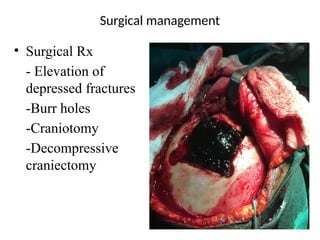
Surgical management
• Surgical Rx
- Elevation of
depressed fractures
-Burr holes
-Craniotomy
-Decompressive
craniectomy
Complications
1. Cardiovascular disorders e.g dysrrhythmia.
2. Altered consciousness e.g vegetative coma,
3. Permanent neurological deficit.
4. Mendelson syndrome
5. Infection
6. Seizures
7. Raised intracranial pressure
8. Respiratory failure
9. Post traumatic seizure
10.Memory loss
1. Hemiplegia
2. Meningitis
3. Cerebral abscess
4. Cranial nerve injuries( 7,8,1,2,3,4,6)
5. Headache
6. Post concussion syndrome
7. CSF leak.
Nursing diagnosis
1. Ineffective Airway clearance related to excessive
secretions evidenced by grunting respiration
2. Deficient fluid volume related inability to take
orals evidenced by reduced urine output (less
than 0.5mls/Kg) and concentrated
3. Hyperthermia related to altered thermoregulation
evidenced by thermometer reading of 39.8O
C
4. Ineffective Cerebral Tissue Perfusion related to
raised intracranial pressure (ICP) evidenced by
decreased level of consciousness (GCS OF 3/15)
5. Imbalance Nutrition Less Than Body
Requirement related to reduced calorie
replacement evidenced by muscle wasting
6. Risk for aspiration related to loss of
consciousness and depressed cough and gag
reflex

Presentation Package on HEAD INJURY.pptx

  • 1.
  • 2.
    Head Injury It isan external mechanical injury to the scalp, skull and/or the brain which can lead to impaired cognitive or psychosocial/psychomotor functions or alterations in consciousness. A head injury is any form of trauma that injures the scalp, skull or brain. It is used interchangeably with traumatic brain injury[TBI]
  • 3.
    INCIDENCE • Almost 10million head injury occurs annually in the united states • About 4-7million cases is recorded annually in Nigeria. • About 20% of which are serious enough to cause brain damage • Head injury occurs twice as many in males ,under 35yrs[usually vehicle/motor cycle collision account are the chief cause of death].[Brindles L.M,Elizabeth B.2012]
  • 4.
    types of HeadInjury Head injury is broadly classified into external and internal injury. Other classifications; 1. Scalp 2. Skull 3. brain
  • 5.
    Scalp injuries include; Abrasions;a wound consisting of superficial damage to the skin, not deeper than the epidermis. It may just be a scrape. Lacerations ; irregular tear-like wound cause by blunt trauma Avulsion; forcibly detachement of a body structures from it normal point of insertion.
  • 6.
    Skull – itmay be open or close, depressed or undisplaced Injury to the anterior skull base will cause; • Subconjuctival haemorrhage • Raccon’s eye (panda’s eye) - a peri-orbital ecchymosis that occurs at a time of head injury in which there is bilateral haemorrhage as a result of tearing of the meninges causing the venous sinuses to bleed into the arachnoid villi i.e blood seeps from the skull into the soft tissues around the eye.
  • 7.
    Basal skull injurywill cause Csf rhinorrhea Csf otorrhea Battle’s sign ( HALO sign) Possible damage to internal carotid artery High risk of infection or meningitis
  • 8.
    Brain 1. Primary braininjury – injury occuring immediately at the point of impact to the brain. It may be ; Concussion; a type of TBI cause by a blow to the head that jars and shakes the brain inside the skull Contussion; 2. Secondary brain injury; refers to changes that occur over a period of time (from hours to days) after a primary brain injury.
  • 9.
    Causes of secondarybrain injury Hypotension Hypoxia Hypercapnia Pyrexia Siezures Hypoglycaemia Hypo/hyperthermia Metabolic disturbances
  • 10.
    Classification of headinjury 1. By severity ( GCS) 2. By pathology a. Diffuse injury – injury that occurs over a wide area b. Focal injury – injury located in a small specific area 3. By mechanism of trauma c. Blunt d. Penetrating injury
  • 11.
    • Classification by mechanismof injury -blunt [closed] head injury -penetrating [open] head injury- high & low velocity.
  • 12.
    Causes of headinjury  Motor vehicle accidents  Fire arms related injuries  Falls  Assaults  Sport related injuries  Recreational accident  Pathological conditions – cva, neoplasm
  • 13.
    pathophysiology The Brain receives20% of cardiac output Brain oxygen consumption is 3.5ml/100g/min and relies on blood glucose for 90% of it’s energy requirements. Autoregulation; Autoregulation could be defined as the inherent ability of the brain to maintain a fairly steady cerebral blood flow in the presence of wide variations in systemic blood pressure, in order to ensure adequate cerebral perfusion and maintain the viability of the brain for optimal neuronal function Cerebral blood flow -55ml/100gm/min, brain cannot maintain this function if MAP is (less than 50 or greater than 150mmHg)
  • 14.
    Morbidity and mortalityof head injury results from 1. Raised intracranial pressure(ICP) 2. Focal brain ischaemia
  • 15.
    Increased ICP When thereis an impact either by RTA, blow, fall etc, injury may or may not occur immediately, it may involve the lobes or the entire brain. During this impact, the brain crashes back and forth inside the skull causing bruises, bleeding and nerve fibers tearing depending on the severity of the impact. Inflammatory processes takes place in response to the injury, vasodilatation occurs, as a result, extra fluid and nutrients accumulates causing further brain swelling thus increasing the ICP.
  • 16.
    The increase ICPpushes the brain to one side thus causing injury to parts of the brain that were not initially injured. Headache, nausea and vomiting, hyper/hypotension, decreased mental disability, disorientation to time place and person, bipolar, hypercapnia with increase pressure, part of the brain is squeezed across structures (foramen magnum herniation/ brain herniaion) resulting in 3 cardinal signs ; hypertension, bradycardia and irregular breathing ( cushing triad),cardiac depression and loss of all brain stem reflexes
  • 17.
    Focal brain ischaemia MonroKelly principles; The intracranial compartment is a rigid encasement because of the limited space for expansion within the skull. it contain 3 incompressible tissues- brain, blood and cerebrospinal fluid. It states that, the volume of brain, blood and CSF remains constant. So an increase in the volume of any of the 3 would lead to a rise in intracranial pressure.
  • 18.
    Estimated volumes: Brainvolume 1300 to 1600ml Blood volume 100 to 150ml CSF volume 100 to 150ml Under normal circumstances , the 3 tissues exerts an intracranial pressure of 10mmHg or less. In premature infants, pressure could be as low as 2.5 mmHg
  • 19.
    Focal brain ischaemiaoccurs as a result of decrease cerebral perfusion and pressure as a result of herniation of the arteries. This lead to loss of coordination, slurred speech, non reactive or dilated pupils or possibly blindness
  • 20.
    Clinical manifestations • AlteredLOC Raised ICP CSF leakage (otorrhoea or rhinorhea) • Persistent localized pain • Depression • Dizziness or balance problem • Double or fuzzy vision • Feeling foggy or gloggy(confusion) • Feeling sluggish or tired
  • 21.
    Headache Memory loss Nausea ,vomiting Sensitivity to light or/and noise Sleep disturbance Complaining of head and neck pain (if conscious) Vomits repeatedly Difficult to console Change in breathing pattern (abnormal breathing)
  • 22.
    Diagnostic investigations – Computerizedtomography scan – Magnetic resonance imaging – Skull x-ray – Cervical spine x-ray – Evoked potential studies – Continuous cerebral blood flow studies – Other investigations include ; – ABG – FBC – E/U/CR – Urinalysis – PCV
  • 23.
    Management Assessment • Assess theLOC of the patient using GCS • Pupillary response • Assess the pattern of respiration • Assess for possible signs of ICP( hypotension, hypercapnia) • Assess for indicators of spinal cord injury ( loss of motor and sensory functions, abnormal head tilt, tenderness along the spine) • Carefully observe patient’s nose and ear for any csf leak • Observe for seizures • Monitor pts vital signs and urine output
  • 24.
    Positioning • Maintain 30head up • Turn head to one side to allow drainage of secretions • Proper alignment of the head with the body Airway management Suctioning prn Oropharyngeal airway Intubate pt Tracheostomy Place pt on mechanical ventilator
  • 25.
    Prevention of raiseicp 30 head up Alignment of the head Temperature control – head cooling Administration of sodium thiopentone – reduce metabolic rate of the brain Administration ot diuretics – mannitol Pain relieve Nutrition and fluid maintenance Assess fluid status
  • 26.
    Pass urinary catheter Hourlymonitoring of urine output Strict monitoring of intake and output Observe for early signs of AKI Pass NGT for feeding, maintain 2 hourly feeding as ordered Prevention of infection Wound dressing Maintain aseptic technique change soiled linen and diaper Assess catheter tip for any suppurative sign Condom catheter more preferable
  • 27.
    Maintenance of skinintegrity Bed bathing Turning patient 2 hourly Application of sudo cream in pressure areas Medications
  • 28.
    Surgical management • SurgicalRx - Elevation of depressed fractures -Burr holes -Craniotomy -Decompressive craniectomy
  • 29.
    Complications 1. Cardiovascular disorderse.g dysrrhythmia. 2. Altered consciousness e.g vegetative coma, 3. Permanent neurological deficit. 4. Mendelson syndrome 5. Infection 6. Seizures 7. Raised intracranial pressure 8. Respiratory failure 9. Post traumatic seizure 10.Memory loss
  • 30.
    1. Hemiplegia 2. Meningitis 3.Cerebral abscess 4. Cranial nerve injuries( 7,8,1,2,3,4,6) 5. Headache 6. Post concussion syndrome 7. CSF leak.
  • 31.
    Nursing diagnosis 1. IneffectiveAirway clearance related to excessive secretions evidenced by grunting respiration 2. Deficient fluid volume related inability to take orals evidenced by reduced urine output (less than 0.5mls/Kg) and concentrated 3. Hyperthermia related to altered thermoregulation evidenced by thermometer reading of 39.8O C 4. Ineffective Cerebral Tissue Perfusion related to raised intracranial pressure (ICP) evidenced by decreased level of consciousness (GCS OF 3/15)
  • 32.
    5. Imbalance NutritionLess Than Body Requirement related to reduced calorie replacement evidenced by muscle wasting 6. Risk for aspiration related to loss of consciousness and depressed cough and gag reflex