CLINICAL
SEMINAR CASE
PRESENTATION
4/26/2014 ADU-POKU PATRICK
Clinical Case
Case Of A Hydrocephalus And
Associate Hydrops Fetalis In A
Single Viable Intrauterine
Gestation Of About 33w2d, In A
26-year Old Woman.
4/26/2014 ADU-POKU PATRICK
Patient Clinical History
 Current History :
• A 26-year-old pregnant woman presented with
chronic lower abdominal pains, pruritus, burning
sensations and swelling.
• First pregnancy and with no history of abortion.
• Abdomen was large for GA
 Previous Medical History:
• No history of heart /kidney disease, chronic
hypertension or diabetes mellitus
• Rhesus factor : D(+). Blood Group: O(RH)
• Sickling: (-)
4/26/2014 ADU-POKU PATRICK
REFERRING PHYSICIAN
REQUEST:
• ?? Hydrocephalus ?? Severity.
• Do obstetric scan.
• USG REQUEST ST, PATRICKS HOPITAL
OFINSO.pdf
4/26/2014 ADU-POKU PATRICK
Ultrasound Findings From Her
Previous Examination
• First trimester USG Date: 15/5/2013
• GA: 11w2d EDD: 2/12/2013 CRL-4.4cm
• Comment : normal early OBS USG.
SONOGRAM
 2nd USG Examination(3rd tri) Date:20/11/2013
 GA: 37w4d(HC/BPD) FH-138BPM
 EDD: 07/12/2013 Cephalic presentation
 Hydrocephalus noted. SONOGRAM
4/26/2014 ADU-POKU PATRICK
Department Protocol for Second
and Third Trimester OB USG
• Survey uterus and determine fetal number.
• Observe fetal cardiac activity.
• Determine fetal position(s) and placental
location(s).
• Check cervix and lower uterine segment.
• Survey for uterine or adnexal masses.
• Assess amniotic fluid.
• Perform anatomy survey of each fetus.
• Perform biometric measurements of each fetus.
 If anomaly is detected protocol is varied.
4/26/2014 ADU-POKU PATRICK
The Examination
 Patient in supine position
 Machine Exam preset: Gen. OB
 Transducer: curvilinear (2- 5MHZ) Fetal
 Trans-abdominal approach
 Biometry taken (i.e. HC, BPD, AC, FL and
EGA)
 For sex determination patients are asked to
vary their position (in terms of difficulty)
 There is variation of protocol and examination
in terms of twin gestation.
4/26/2014 ADU-POKU PATRICK
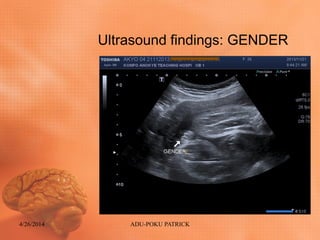
Ultrasound findings: GENDER
4/26/2014 ADU-POKU PATRICK
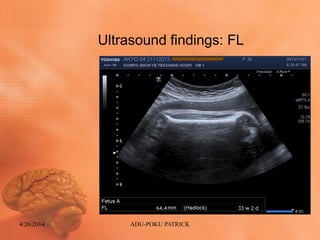
Ultrasound findings: FL
4/26/2014 ADU-POKU PATRICK
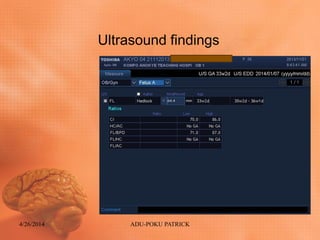
Ultrasound findings
4/26/2014 ADU-POKU PATRICK
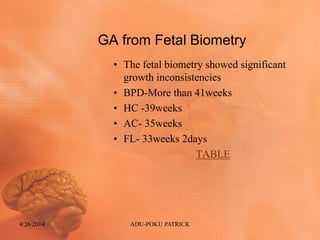
GA from Fetal Biometry
• The fetal biometry showed significant
growth inconsistencies
• BPD-More than 41weeks
• HC -39weeks
• AC- 35weeks
• FL- 33weeks 2days
TABLE
4/26/2014 ADU-POKU PATRICK
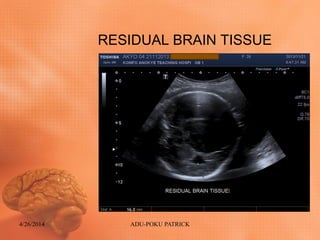
Ultrasound findings: FETAL
HEAD
• Intact skull
• Altered falx
• Extensive Intra cranial fluid collection with
little remnant of cortical mantle bilaterally
(residual brain tissue≥16mm)
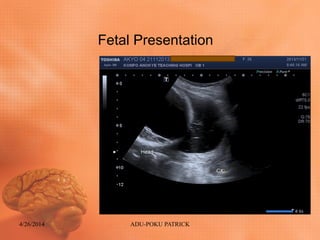
• Fetus lie in cephalic presentation with fetal
head close to the maternal cervix.
4/26/2014 ADU-POKU PATRICK
RESIDUAL BRAIN TISSUE
4/26/2014 ADU-POKU PATRICK
Fetal Presentation
4/26/2014 ADU-POKU PATRICK
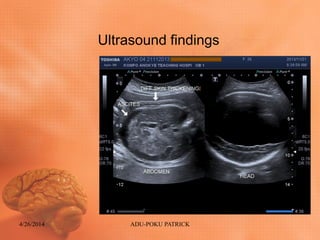
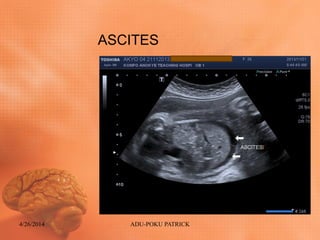
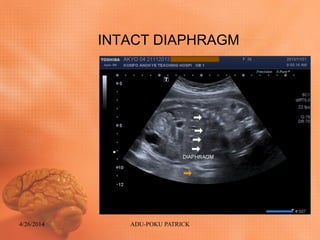
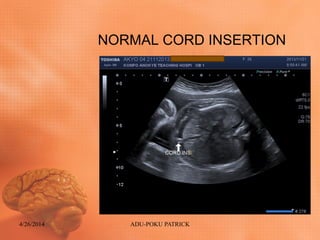
Ultrasound findings: ABDOMEN
• Diffuse skin thickening (Generalized body
Edema)
• Fetal Ascites
• Intact diaphragm
• Normal cord insertion
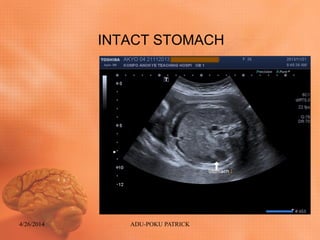
• Intact stomach
• Hepatomegaly
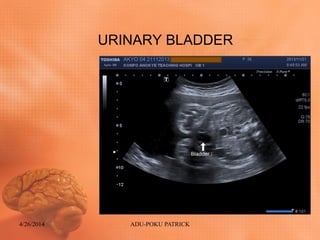
• Urinary bladder intact
4/26/2014 ADU-POKU PATRICK
Ultrasound findings
4/26/2014 ADU-POKU PATRICK
ASCITES
4/26/2014 ADU-POKU PATRICK
INTACT DIAPHRAGM
4/26/2014 ADU-POKU PATRICK
NORMAL CORD INSERTION
4/26/2014 ADU-POKU PATRICK
INTACT STOMACH
4/26/2014 ADU-POKU PATRICK
URINARY BLADDER
4/26/2014 ADU-POKU PATRICK
OTHER FINDINGS
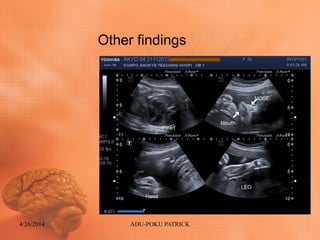
• Heart occupying about 3/4 of chest cavity
(CARDIOMEGALY) how ever no visible
defect and effusion noted.
• Normal Sonographic appearance of :
 Nose and lips
 Limbs and digits
 Spine was also intact
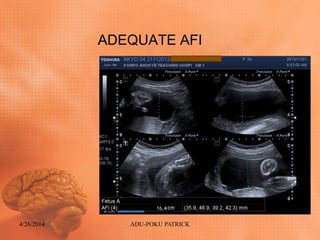
 Adequate AFI (16.4cm)
4/26/2014 ADU-POKU PATRICK
Other findings
4/26/2014 ADU-POKU PATRICK
ADEQUATE AFI
4/26/2014 ADU-POKU PATRICK
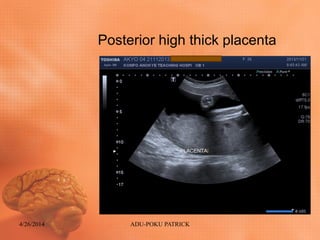
Posterior high thick placenta
4/26/2014 ADU-POKU PATRICK
CRITIQUE OF
IMAGES/INADEQUACIES OF
STUDY
• Color Doppler was not demonstrated through
out the study.
• Though spine was assessed but images on them
was not shown.
4/26/2014 ADU-POKU PATRICK
RELATION OF ENCOUNTERED PATHOLOGY IN
RELATION TO PATIENT PRESENTATION AND
INDICATIONS
• Extensive intra cranial pressure 2⁰ extensive
fluid collection with altered falx and bilateral
little remnant of brain cortical tissue (BPD/HC
>>AC/FL) detected on sonogram is an
evidence of severe hydrocephalus as suspected
by the referring clinician.
• Diffuse skin thickening (Generalized body
Edema),Fetal ascites, Hepatomegaly,
Cardiomegaly and edematous placenta noted
on sonogram as an incidental findings, per
patients history is consistence with Non-
immune fetal hydrops.
4/26/2014 ADU-POKU PATRICK
RELATION OF ENCOUNTERED PATHOLOGY IN
RELATION TO PATIENT PRESENTATION AND
INDICATIONS
• Normal umbilical cord insertion
• Intact spine, stomach, diaphragm, nose,
lips, limbs, urinary bladder and adequate
AFI, Cephalic presentation.
• No visible atrial-septal defect noted on
sonogram is a suggestive feature of
systemic malfunctioning of the
underlying condition under discussion
rather than chromosomal anomaly.
4/26/2014 ADU-POKU PATRICK
RELATION OF ENCOUNTERED PATHOLOGY IN
RELATION TO PATIENT PRESENTATION AND
INDICATIONS
• Large fetus(macrosomy) with
much pressure exerting on mothers
iliac vessels as well as the
lymphatic drainage channels is an
indicative feature of mothers
manifestation of lower abdominal
pains and swellings of the feet as a
result of poor venous returns and
lymphatic drainage.
4/26/2014 ADU-POKU PATRICK
CONCLUSIONS DRAWN
• After discussing case with my
supervisor we came to a
conclusion that the findings
were consistent with
hydrocephalus and suggestive
fetal hydrops in a single live
intrauterine gestation of about
33w2d.
4/26/2014 ADU-POKU PATRICK
Ultrasound Exams Final Report
Ultrasound Report
Differentials
Hydranencephaly
Holoprosencephaly
DIAGRAM
4/26/2014 ADU-POKU PATRICK
Follow-up
• Follow up was done through phone calls.
• 21/11/2013- patient seen @ KATH
• 25/11/2013- Patient was reviewed at St.
Patrick's Hospital Offinso, on interaction with
her Physician clinician he said patient is under
going counseling for termination of pregnancy
by cesarean section. If she agrees pregnancy
will be terminated and folic acids will be given
on her next and subsequent pregnancies.
• Patient shown consent upon the counseling and
opted for the termination by C/S
4/26/2014 ADU-POKU PATRICK
CONTINUAT
ION
• 26/11/2014-Patient was admitted, on
examination by an attendance nurse
fetal heart was absent on fetoscope.
• 27/11/2014- An Emergency C/S was
done on patient with intrauterine fetal
demise at 34w1d with macrocephaly
and anasarca, baby(female) weighing
more than 4kg
• Patient doing well and discharged from
the hospital after few days.
4/26/2014 ADU-POKU PATRICK
Presumption made from the entire
study up to follow up
• Extensive brain damaged 2⁰ intracranial
pressure from extensive hydrocephalus>
congestive heart failure > malfunctioning
system > fetal hydrops > intrauterine fetal
demise.
• NB: Death may set in as a results of tonsillar
herniation 2⁰ raised intracranial pressure with
compression of brain stem and subsequent
respiratory and cardiac arrest.
4/26/2014 ADU-POKU PATRICK
DISCU
SSION
• Hydrocephalus is defined as excess cerebrospinal fluid
(CSF) accumulation in the head caused by disturbance of
formation, flow, or absorption. The term stems from the
Greek hydro (water) and cephali (head). Davis et al,
• The incidence of hydrocephalus is 0.3 to 1.5 per 1000 live
births. This obstruction may be caused by a ventricular
defect, such as aqueductal stenosis, and is referred to
as noncommunicating hydrocephalus. The obstruction
may be noted outside of the ventricular system, such as
with an arachnoid cyst, and is referred to as
communicating hydrocephalus(Sandra Hagen page 1307)
• Generally, incidence is equal in males and females. The
exception is Bickers-Adams syndrome, an X-linked
hydrocephalus transmitted by females and manifested in
males. NPH has a slight male preponderance.(Vinchon et.
al)
4/26/2014 ADU-POKU PATRICK
• Ventriculomegaly refers to dilatation of the ventricles within
the brain measuring (10-15mm). Hydrocephalus occurs when
ventriculomegaly (15mm>) is coupled with enlargement of the
fetal head.(Sandra hagen)
• Normal CSF production is 0.20-0.35 mL/min; most CSF is
produced by the choroid plexus, which is located within the
ventricular system, mainly the lateral and fourth ventricles. The
capacity of the lateral and third ventricles in a healthy person is
20 mL. Total volume of CSF in an adult is 120 mL.
• Normal route of CSF from production to clearance is as follows:
From choroid plexus>CSF>lateral ventricle, > interventricular
foramen of Monro>third ventricle>cerebral aqueduct of
Sylvius>fourth ventricle>2 lateral foramina of Luschka and 1
medial foramen of Magendie, the subarachnoid space, the
arachnoid granulations, the dural sinus, and finally into the
venous drainage.
4/26/2014 ADU-POKU PATRICK
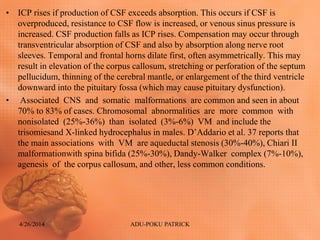
• ICP rises if production of CSF exceeds absorption. This occurs if CSF is
overproduced, resistance to CSF flow is increased, or venous sinus pressure is
increased. CSF production falls as ICP rises. Compensation may occur through
transventricular absorption of CSF and also by absorption along nerve root
sleeves. Temporal and frontal horns dilate first, often asymmetrically. This may
result in elevation of the corpus callosum, stretching or perforation of the septum
pellucidum, thinning of the cerebral mantle, or enlargement of the third ventricle
downward into the pituitary fossa (which may cause pituitary dysfunction).
• Associated CNS and somatic malformations are common and seen in about
70% to 83% of cases. Chromosomal abnormalities are more common with
nonisolated (25%-36%) than isolated (3%-6%) VM and include the
trisomiesand X-linked hydrocephalus in males. D’Addario et al. 37 reports that
the main associations with VM are aqueductal stenosis (30%-40%), Chiari II
malformationwith spina bifida (25%-30%), Dandy-Walker complex (7%-10%),
agenesis of the corpus callosum, and other, less common conditions.
4/26/2014 ADU-POKU PATRICK
• Fetal hydrops refers to the pathologic accumulation of fluid in body
cavities and tissues. US demonstrates ascites, pleural and pericardial
effusions, and subcutaneous edema. Immune hydrops is caused by
blood group incompatibility between mother and fetus. Current
treatment, including fetal transfusion, is highly successful.
Nonimmune hydrops is caused by a host of conditions including
cardiac disorders, infections, chromosomal anomalies, twin
pregnancy, urinary obstruction, and umbilical cord complications.
The cause of many cases is not identified. The prognosis for
nonimmune hydrops remains poor.(Goldstein et al)
• Preterm birth at less than 34 weeks' gestation and a serum albumin
concentration level of less than 2 g/dL are poor prognostic factors for
survival. A more recent study found that there is strong association
between gestational age, the presence of 2 or more serous cavity
effusions, and poor outcome in infants with hydrops fetalis (Takci et
al)
4/26/2014 ADU-POKU PATRICK
Role of ultrasound in detecting hyrocephalus/fetal hydrops
• Currently, most fetuses undergo in utero ultrasonographic scanning.
Ultrasonography allows for good identification of any ventricular dilatation that
indicates active hydrocephalus. In such cases, or in patients who present with
progressive head enlargement to pediatricians or family doctors, ultrasonography is
usually performed first because it is widely available and does not expose the Fetus
or child to ionizing radiation.
• In babies with open fontanelles and large heads, ultrasonography reveals the
enlarged ventricular system and any mass lesions or hemorrhage. However, the
anatomic detail produced by ultrasonography remains reduced and serves only as a
guide to further investigations.
• Fetal Hydrops. Image through the fetal thorax at the level of a four-chamber view
of the heart will demonstrates large bilateral pleural effusions.US of the fetal
abdomen will also shows marked skin thickening. Fluid collection in at least two
body cavities to qualify hydrops, other findings in hydrops can include
subcutaneous edema, polyhydramnios,and placentomegaly in which US is very
sensitive in picking.
• (T).(BOOK SOURCE FOUNDAMENTAL OF DIAGNOSTIC RADIOLOGY 4TH
ED BY WILLIAM E. BRANT AND CLYDE A. HELMS.)
4/26/2014 ADU-POKU PATRICK
Reference
s
 Davis BE, Daley CM, Shurtleff DB, Duguay S, Seidel K, Loeser
JD, et al. Long-term survival of individuals with
myelomeningocele. Pediatr Neurosurg. Jul-Aug 2005;41(4):186-
91. [Medline].
 Hagen-Ansert, S. L. (2012). Textbook of diagnostic sonography 7th
edition.
 Vinchon M, Rekate HL, Kulkarni AV. Pediatric hydrocephalus
outcomes: a review. Fluids Barriers CNS. Aug 27 2012;9(1):18.
[Medline].
 Rumack. (2011). Diagnostic ultrasound 4th edition.
 Bullen PJ, Rankin JM, Robson SC: Investigation of the
epidemiology and prenatal diagnosis of holoprosencephaly in the
North of England, Am J Obstet Gynecol 184:1256-1262, 2001
 Goldstein R. A practical approach to fetal chest masses.
Ultrasound Q 2006;22:177–19426.
 Takci S, Gharibzadeh M, Yurdakok M, Ozyuncu O, Korkmaz A,
Akcoren Z, et al. Etiology and Outcome of Hydrops Fetalis: Report
of 62 Cases. Pediatr Neonatol. Oct 1 2013;[Medline].
4/26/2014 ADU-POKU PATRICK

Hydrocephalus with fetal hydrops

  • 1.
  • 2.
    Clinical Case Case OfA Hydrocephalus And Associate Hydrops Fetalis In A Single Viable Intrauterine Gestation Of About 33w2d, In A 26-year Old Woman. 4/26/2014 ADU-POKU PATRICK
  • 3.
    Patient Clinical History Current History : • A 26-year-old pregnant woman presented with chronic lower abdominal pains, pruritus, burning sensations and swelling. • First pregnancy and with no history of abortion. • Abdomen was large for GA  Previous Medical History: • No history of heart /kidney disease, chronic hypertension or diabetes mellitus • Rhesus factor : D(+). Blood Group: O(RH) • Sickling: (-) 4/26/2014 ADU-POKU PATRICK
  • 4.
    REFERRING PHYSICIAN REQUEST: • ??Hydrocephalus ?? Severity. • Do obstetric scan. • USG REQUEST ST, PATRICKS HOPITAL OFINSO.pdf 4/26/2014 ADU-POKU PATRICK
  • 5.
    Ultrasound Findings FromHer Previous Examination • First trimester USG Date: 15/5/2013 • GA: 11w2d EDD: 2/12/2013 CRL-4.4cm • Comment : normal early OBS USG. SONOGRAM  2nd USG Examination(3rd tri) Date:20/11/2013  GA: 37w4d(HC/BPD) FH-138BPM  EDD: 07/12/2013 Cephalic presentation  Hydrocephalus noted. SONOGRAM 4/26/2014 ADU-POKU PATRICK
  • 6.
    Department Protocol forSecond and Third Trimester OB USG • Survey uterus and determine fetal number. • Observe fetal cardiac activity. • Determine fetal position(s) and placental location(s). • Check cervix and lower uterine segment. • Survey for uterine or adnexal masses. • Assess amniotic fluid. • Perform anatomy survey of each fetus. • Perform biometric measurements of each fetus.  If anomaly is detected protocol is varied. 4/26/2014 ADU-POKU PATRICK
  • 7.
    The Examination  Patientin supine position  Machine Exam preset: Gen. OB  Transducer: curvilinear (2- 5MHZ) Fetal  Trans-abdominal approach  Biometry taken (i.e. HC, BPD, AC, FL and EGA)  For sex determination patients are asked to vary their position (in terms of difficulty)  There is variation of protocol and examination in terms of twin gestation. 4/26/2014 ADU-POKU PATRICK
  • 8.
  • 9.
  • 10.
  • 11.
    GA from FetalBiometry • The fetal biometry showed significant growth inconsistencies • BPD-More than 41weeks • HC -39weeks • AC- 35weeks • FL- 33weeks 2days TABLE 4/26/2014 ADU-POKU PATRICK
  • 12.
    Ultrasound findings: FETAL HEAD •Intact skull • Altered falx • Extensive Intra cranial fluid collection with little remnant of cortical mantle bilaterally (residual brain tissue≥16mm) • Fetus lie in cephalic presentation with fetal head close to the maternal cervix. 4/26/2014 ADU-POKU PATRICK
  • 13.
  • 14.
  • 15.
    Ultrasound findings: ABDOMEN •Diffuse skin thickening (Generalized body Edema) • Fetal Ascites • Intact diaphragm • Normal cord insertion • Intact stomach • Hepatomegaly • Urinary bladder intact 4/26/2014 ADU-POKU PATRICK
  • 16.
  • 17.
  • 18.
  • 19.
  • 20.
  • 21.
  • 22.
    OTHER FINDINGS • Heartoccupying about 3/4 of chest cavity (CARDIOMEGALY) how ever no visible defect and effusion noted. • Normal Sonographic appearance of :  Nose and lips  Limbs and digits  Spine was also intact  Adequate AFI (16.4cm) 4/26/2014 ADU-POKU PATRICK
  • 23.
  • 24.
  • 25.
    Posterior high thickplacenta 4/26/2014 ADU-POKU PATRICK
  • 26.
    CRITIQUE OF IMAGES/INADEQUACIES OF STUDY •Color Doppler was not demonstrated through out the study. • Though spine was assessed but images on them was not shown. 4/26/2014 ADU-POKU PATRICK
  • 27.
    RELATION OF ENCOUNTEREDPATHOLOGY IN RELATION TO PATIENT PRESENTATION AND INDICATIONS • Extensive intra cranial pressure 2⁰ extensive fluid collection with altered falx and bilateral little remnant of brain cortical tissue (BPD/HC >>AC/FL) detected on sonogram is an evidence of severe hydrocephalus as suspected by the referring clinician. • Diffuse skin thickening (Generalized body Edema),Fetal ascites, Hepatomegaly, Cardiomegaly and edematous placenta noted on sonogram as an incidental findings, per patients history is consistence with Non- immune fetal hydrops. 4/26/2014 ADU-POKU PATRICK
  • 28.
    RELATION OF ENCOUNTEREDPATHOLOGY IN RELATION TO PATIENT PRESENTATION AND INDICATIONS • Normal umbilical cord insertion • Intact spine, stomach, diaphragm, nose, lips, limbs, urinary bladder and adequate AFI, Cephalic presentation. • No visible atrial-septal defect noted on sonogram is a suggestive feature of systemic malfunctioning of the underlying condition under discussion rather than chromosomal anomaly. 4/26/2014 ADU-POKU PATRICK
  • 29.
    RELATION OF ENCOUNTEREDPATHOLOGY IN RELATION TO PATIENT PRESENTATION AND INDICATIONS • Large fetus(macrosomy) with much pressure exerting on mothers iliac vessels as well as the lymphatic drainage channels is an indicative feature of mothers manifestation of lower abdominal pains and swellings of the feet as a result of poor venous returns and lymphatic drainage. 4/26/2014 ADU-POKU PATRICK
  • 30.
    CONCLUSIONS DRAWN • Afterdiscussing case with my supervisor we came to a conclusion that the findings were consistent with hydrocephalus and suggestive fetal hydrops in a single live intrauterine gestation of about 33w2d. 4/26/2014 ADU-POKU PATRICK
  • 31.
    Ultrasound Exams FinalReport Ultrasound Report Differentials Hydranencephaly Holoprosencephaly DIAGRAM 4/26/2014 ADU-POKU PATRICK
  • 32.
    Follow-up • Follow upwas done through phone calls. • 21/11/2013- patient seen @ KATH • 25/11/2013- Patient was reviewed at St. Patrick's Hospital Offinso, on interaction with her Physician clinician he said patient is under going counseling for termination of pregnancy by cesarean section. If she agrees pregnancy will be terminated and folic acids will be given on her next and subsequent pregnancies. • Patient shown consent upon the counseling and opted for the termination by C/S 4/26/2014 ADU-POKU PATRICK
  • 33.
    CONTINUAT ION • 26/11/2014-Patient wasadmitted, on examination by an attendance nurse fetal heart was absent on fetoscope. • 27/11/2014- An Emergency C/S was done on patient with intrauterine fetal demise at 34w1d with macrocephaly and anasarca, baby(female) weighing more than 4kg • Patient doing well and discharged from the hospital after few days. 4/26/2014 ADU-POKU PATRICK
  • 34.
    Presumption made fromthe entire study up to follow up • Extensive brain damaged 2⁰ intracranial pressure from extensive hydrocephalus> congestive heart failure > malfunctioning system > fetal hydrops > intrauterine fetal demise. • NB: Death may set in as a results of tonsillar herniation 2⁰ raised intracranial pressure with compression of brain stem and subsequent respiratory and cardiac arrest. 4/26/2014 ADU-POKU PATRICK
  • 35.
    DISCU SSION • Hydrocephalus isdefined as excess cerebrospinal fluid (CSF) accumulation in the head caused by disturbance of formation, flow, or absorption. The term stems from the Greek hydro (water) and cephali (head). Davis et al, • The incidence of hydrocephalus is 0.3 to 1.5 per 1000 live births. This obstruction may be caused by a ventricular defect, such as aqueductal stenosis, and is referred to as noncommunicating hydrocephalus. The obstruction may be noted outside of the ventricular system, such as with an arachnoid cyst, and is referred to as communicating hydrocephalus(Sandra Hagen page 1307) • Generally, incidence is equal in males and females. The exception is Bickers-Adams syndrome, an X-linked hydrocephalus transmitted by females and manifested in males. NPH has a slight male preponderance.(Vinchon et. al) 4/26/2014 ADU-POKU PATRICK
  • 36.
    • Ventriculomegaly refersto dilatation of the ventricles within the brain measuring (10-15mm). Hydrocephalus occurs when ventriculomegaly (15mm>) is coupled with enlargement of the fetal head.(Sandra hagen) • Normal CSF production is 0.20-0.35 mL/min; most CSF is produced by the choroid plexus, which is located within the ventricular system, mainly the lateral and fourth ventricles. The capacity of the lateral and third ventricles in a healthy person is 20 mL. Total volume of CSF in an adult is 120 mL. • Normal route of CSF from production to clearance is as follows: From choroid plexus>CSF>lateral ventricle, > interventricular foramen of Monro>third ventricle>cerebral aqueduct of Sylvius>fourth ventricle>2 lateral foramina of Luschka and 1 medial foramen of Magendie, the subarachnoid space, the arachnoid granulations, the dural sinus, and finally into the venous drainage. 4/26/2014 ADU-POKU PATRICK
  • 37.
    • ICP risesif production of CSF exceeds absorption. This occurs if CSF is overproduced, resistance to CSF flow is increased, or venous sinus pressure is increased. CSF production falls as ICP rises. Compensation may occur through transventricular absorption of CSF and also by absorption along nerve root sleeves. Temporal and frontal horns dilate first, often asymmetrically. This may result in elevation of the corpus callosum, stretching or perforation of the septum pellucidum, thinning of the cerebral mantle, or enlargement of the third ventricle downward into the pituitary fossa (which may cause pituitary dysfunction). • Associated CNS and somatic malformations are common and seen in about 70% to 83% of cases. Chromosomal abnormalities are more common with nonisolated (25%-36%) than isolated (3%-6%) VM and include the trisomiesand X-linked hydrocephalus in males. D’Addario et al. 37 reports that the main associations with VM are aqueductal stenosis (30%-40%), Chiari II malformationwith spina bifida (25%-30%), Dandy-Walker complex (7%-10%), agenesis of the corpus callosum, and other, less common conditions. 4/26/2014 ADU-POKU PATRICK
  • 38.
    • Fetal hydropsrefers to the pathologic accumulation of fluid in body cavities and tissues. US demonstrates ascites, pleural and pericardial effusions, and subcutaneous edema. Immune hydrops is caused by blood group incompatibility between mother and fetus. Current treatment, including fetal transfusion, is highly successful. Nonimmune hydrops is caused by a host of conditions including cardiac disorders, infections, chromosomal anomalies, twin pregnancy, urinary obstruction, and umbilical cord complications. The cause of many cases is not identified. The prognosis for nonimmune hydrops remains poor.(Goldstein et al) • Preterm birth at less than 34 weeks' gestation and a serum albumin concentration level of less than 2 g/dL are poor prognostic factors for survival. A more recent study found that there is strong association between gestational age, the presence of 2 or more serous cavity effusions, and poor outcome in infants with hydrops fetalis (Takci et al) 4/26/2014 ADU-POKU PATRICK
  • 39.
    Role of ultrasoundin detecting hyrocephalus/fetal hydrops • Currently, most fetuses undergo in utero ultrasonographic scanning. Ultrasonography allows for good identification of any ventricular dilatation that indicates active hydrocephalus. In such cases, or in patients who present with progressive head enlargement to pediatricians or family doctors, ultrasonography is usually performed first because it is widely available and does not expose the Fetus or child to ionizing radiation. • In babies with open fontanelles and large heads, ultrasonography reveals the enlarged ventricular system and any mass lesions or hemorrhage. However, the anatomic detail produced by ultrasonography remains reduced and serves only as a guide to further investigations. • Fetal Hydrops. Image through the fetal thorax at the level of a four-chamber view of the heart will demonstrates large bilateral pleural effusions.US of the fetal abdomen will also shows marked skin thickening. Fluid collection in at least two body cavities to qualify hydrops, other findings in hydrops can include subcutaneous edema, polyhydramnios,and placentomegaly in which US is very sensitive in picking. • (T).(BOOK SOURCE FOUNDAMENTAL OF DIAGNOSTIC RADIOLOGY 4TH ED BY WILLIAM E. BRANT AND CLYDE A. HELMS.) 4/26/2014 ADU-POKU PATRICK
  • 40.
    Reference s  Davis BE,Daley CM, Shurtleff DB, Duguay S, Seidel K, Loeser JD, et al. Long-term survival of individuals with myelomeningocele. Pediatr Neurosurg. Jul-Aug 2005;41(4):186- 91. [Medline].  Hagen-Ansert, S. L. (2012). Textbook of diagnostic sonography 7th edition.  Vinchon M, Rekate HL, Kulkarni AV. Pediatric hydrocephalus outcomes: a review. Fluids Barriers CNS. Aug 27 2012;9(1):18. [Medline].  Rumack. (2011). Diagnostic ultrasound 4th edition.  Bullen PJ, Rankin JM, Robson SC: Investigation of the epidemiology and prenatal diagnosis of holoprosencephaly in the North of England, Am J Obstet Gynecol 184:1256-1262, 2001  Goldstein R. A practical approach to fetal chest masses. Ultrasound Q 2006;22:177–19426.  Takci S, Gharibzadeh M, Yurdakok M, Ozyuncu O, Korkmaz A, Akcoren Z, et al. Etiology and Outcome of Hydrops Fetalis: Report of 62 Cases. Pediatr Neonatol. Oct 1 2013;[Medline]. 4/26/2014 ADU-POKU PATRICK
  • 41.
  • 42.
  • 43.