

INTRACRANIAL PRESSURE
PRESENTER: DR. MUHAMMED ALIF
INTRODUCTION
 The brain tissue, blood vessel, intracranial part of CSF encased in rigid bony cage – skull.
 ICP – “The pressure within the craniospinal compartment, a closed system that comprises a fixed volume
of neural tissue, blood, and cerebrospinal fluid (CSF).”
 The pressure inside the lateral ventricles/ lumbar subarachnoid space in supine position.
 Measured in mmHg
 In normal states – typically mirrors jugular venous pressure, which is about 5 mmHg to 8 mmHg.
Properties
 Total skull volume = 1700 ml
 Total brain volume = 1300 ml
 CSF volume = 150 ml
 Blood volume = 110 ml
 ECF volume = 75 ml
Normal ICF Pressures
 10–15 mm Hg in adults, adolescent children
 3–7 mm Hg for young children
 1.5–6 mm Hg for term infants
 > 20 mm Hg = raised ICP.
INTRACRANIAL HYPERTENSION
 Defined as sustained elevations of ICP greater than 20 mm
Hg.
 Can reduce cerebral perfusion pressure (CPP)
 difference between the Mean Arterial Pressure (MAP) and
the Intracranial Pressure (ICP).
 CPP = MAP – ICP
 In pathologic states
 as ICP increases  CPP approaches zero  brain ischemia
and neuronal death if not rapidly corrected.
 The protective reflex response to elevated ICP causes
changes in blood pressure and heart rate – cushing’s
reflex.
 Many patients with raised ICP have elevated blood
pressure as a result of this compensatory reflex to try to
maintain adequate CPP
HISTORY OF THE MONRO-KELLIE DOCTRINE
 The intracranial pressure-volume relationship – initially described by Alexander Monro secundus.
 Expanded on by George Kellie.
 Known today as the Monro-Kellie doctrine.
 States that “the volume of the intracranial content must remain constant and, therefore, any change in
one of the intracranial components must be compensated by a reciprocal change in the volume of
another component.”
 Mathematically: VT = Vb+Vcsf+Vvasc
 VT = total intracranial volume (1700mL fixed in adulthood)
 Vb = brain parenchymal volume - 1400 mL
 Vcsf =CSF intracranial volume (approximately 30 mL in ventricles)
 Vvasc refers to circulatory volume (arteries and veins), which is approximately 150 mL.
 In pathologic states, a new intracranial volume (Vx) is added to the intracranial compartment:
 VT =Vb +Vcsf + Vvasc+ Vx
 To accommodate this new intracranial volume, one of the other components must be displaced
accordingly to maintain constant ICP.
 Most commonly, the first intracranial component to be displaced is CSF (Vcsf).
 CSF comes out from the ventricles or cerebral convexities through the arachnoid granulations into the
dural venous sinuses – temporary compensation.
 Further additions of intracranial volume
 Exhaust intracranial reserve mechanisms,
 Rise in ICP as well as potential compression of other intracranial structures (brain parenchyma (Vb) or vascular
structures (Vvasc)
 Cause brain damage or ischemia and infarction
 There are three fossa or recesses intracranially:
1. The anterior fossa – the cribriform plate and frontal lobes reside;
2. The middle fossa holds the temporal lobes and is medially adjacent to the border of the tentorium cerebelli.
3. The posterior fossa – separated by the tentorium cerebelli, which is a thick dural membrane that contains most of
the brainstem that exits the foramen magnum.
 Intracranial mass effect inside of these fossa,
 Encroach and extend into the tentorium cerebelli
 causes displacement of adjacent intracranial structures, such as the third cranial nerve
 subsequent ipsilateral pupil dilatation.
 Small increments in brain volume do not immediately raise ICP
 Because of the buffering displacement of CSF from the cranial cavity into the spinal canal.
 To a lesser extent  deformation of the brain.
 Once these compensating measures have been exhausted – a mass within one dural compartment leads
to displacement - herniation
INTRACRANIAL COMPLIANCE
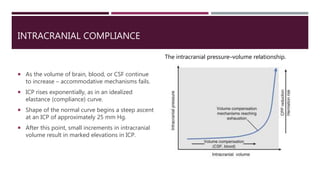
 As the volume of brain, blood, or CSF continue
to increase – accommodative mechanisms fails.
 ICP rises exponentially, as in an idealized
elastance (compliance) curve.
 Shape of the normal curve begins a steep ascent
at an ICP of approximately 25 mm Hg.
 After this point, small increments in intracranial
volume result in marked elevations in ICP.
The intracranial pressure–volume relationship.
ICP WAVE FORM
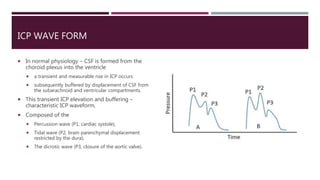
 In normal physiology – CSF is formed from the
choroid plexus into the ventricle
 a transient and measurable rise in ICP occurs
 subsequently buffered by displacement of CSF from
the subarachnoid and ventricular compartments.
 This transient ICP elevation and buffering –
characteristic ICP waveform,
 Composed of the
 Percussion wave (P1, cardiac systole),
 Tidal wave (P2, brain parenchymal displacement
restricted by the dura),
 The dicrotic wave (P3, closure of the aortic valve).
PATHOLOGIC PRESSURE WAVES
 In patients with increased ICP – pathologc ICP waves occur
 Lundberg – recorded and analyzed intraventricular pressures in patients with brain tumors.
 Found ICP to be subject to periodic spontaneous fluctuations.
 Three types of pressure waves, designated as A, B, and C.
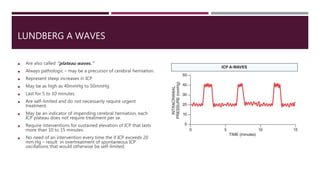
LUNDBERG A WAVES
 Are also called “plateau waves.”
 Always pathologic – may be a precursor of cerebral herniation.
 Represent steep increases in ICP
 May be as high as 40mmHg to 50mmHg
 Last for 5 to 10 minutes.
 Are self-limited and do not necessarily require urgent
treatment.
 May be an indicator of impending cerebral herniation, each
ICP plateau does not require treatment per se.
 Require interventions for sustained elevation of ICP that lasts
more than 10 to 15 minutes.
 No need of an intervention every time the if ICP exceeds 20
mm Hg – result in overtreatment of spontaneous ICP
oscillations that would otherwise be self-limited.
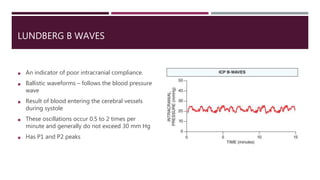
LUNDBERG B WAVES
 An indicator of poor intracranial compliance.
 Ballistic waveforms – follows the blood pressure
wave
 Result of blood entering the cerebral vessels
during systole
 These oscillations occur 0.5 to 2 times per
minute and generally do not exceed 30 mm Hg
 Has P1 and P2 peaks
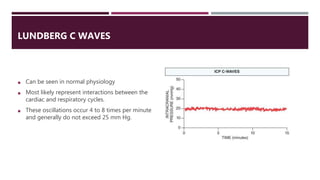
LUNDBERG C WAVES
 Can be seen in normal physiology
 Most likely represent interactions between the
cardiac and respiratory cycles.
 These oscillations occur 4 to 8 times per minute
and generally do not exceed 25 mm Hg.
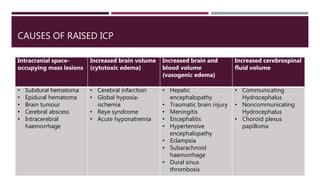
CAUSES OF RAISED ICP
Intracranial space-
occupying mass lesions
Increased brain volume
(cytotoxic edema)
Increased brain and
blood volume
(vasogenic edema)
Increased cerebrospinal
fluid volume
• Subdural hematoma
• Epidural hematoma
• Brain tumour
• Cerebral abscess
• Intracerebral
haemorrhage
• Cerebral infarction
• Global hypoxia-
ischemia
• Reye syndrome
• Acute hyponatremia
• Hepatic
encephalopathy
• Traumatic brain injury
• Meningitis
• Encephalitis
• Hypertensive
encephalopathy
• Eclampsia
• Subarachnoid
haemorrhage
• Dural sinus
thrombosis
• Communicating
Hydrocephalus
• Noncommunicating
Hydrocephalus
• Choroid plexus
papilloma
 Primary – intracranial lesions
 Brain tumor
 Trauma (epidural and subdural hematoma, cerebral contusions)
 Nontraumatic intra-cerebral hemorrhage
 Ischemic stroke
 Hydrocephalus
 Idiopathic or benign intracranial hypertension
 Other (eg, pseudo-tumorcerebri, pneumoencephalus, abscesses, cysts)
 Secondary – extracranial/systemic causes
 Airway obstruction
 Hypoxia or hypercarbia (hypoventilation)
 Hypertension (pain/cough) or hypotension (hypovolemia/sedation)
 Posture (head rotation)
 Hyperpyrexia
 Seizures
 Drug and metabolic (eg, tetracycline, rofecoxib, divalproex sodium, lead intoxication)
 Others (eg, high-altitude cerebral edema, hepatic failure)
 Postoperative
 Mass lesion (hematoma) Edema
 Increased cerebral blood volume (vasodilation)
 Disturbances of CSF
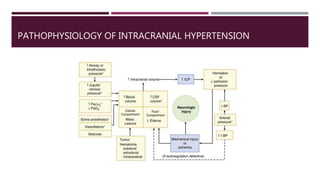
PATHOPHYSIOLOGY OF INTRACRANIAL HYPERTENSION
 4 compartment model
 Cells (including neurons, glia, tumors, and extravasated collections of blood)
 Fluid (intracellular and extracellular)
 CSF
 Blood
1. The cellular compartment
 The province of the surgeon
2. The CSF compartment.
 There is no pharmacologic manipulation
 The only practical means of manipulating the size of this compartment - drainage.
 Can be improved by passage of a brain needle into a lateral ventricle to drain CSF.
 Lumbar CSF drainage can be used to improve in situations with no substantial hazard of uncal or transforamen magnum
herniation.
3. The fluid compartment.
 Can be addressed with steroids and osmotic/diuretic agents.
4. The blood compartment.
 Receives the anesthesiologist’s greatest attention – it is the most amenable to rapid alteration.
 The blood compartment should be viewed as having two separate components: venous and arterial.
BLOOD COMPARTMENT
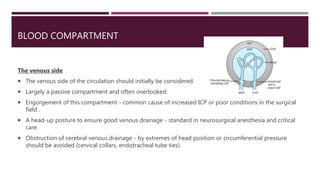
The venous side
 The venous side of the circulation should initially be considered.
 Largely a passive compartment and often overlooked.
 Engorgement of this compartment - common cause of increased ICP or poor conditions in the surgical
field .
 A head-up posture to ensure good venous drainage - standard in neurosurgical anesthesia and critical
care.
 Obstruction of cerebral venous drainage - by extremes of head position or circumferential pressure
should be avoided (cervical collars, endotracheal tube ties).
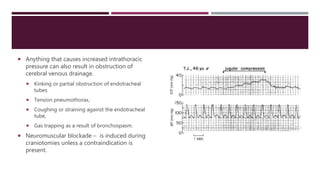
 Anything that causes increased intrathoracic
pressure can also result in obstruction of
cerebral venous drainage.
 Kinking or partial obstruction of endotracheal
tubes
 Tension pneumothorax,
 Coughing or straining against the endotracheal
tube,
 Gas trapping as a result of bronchospasm.
 Neuromuscular blockade – is induced during
craniotomies unless a contraindication is
present.
The arterial side of the circulation
 Attention to the effect of anesthetic drugs and techniques on CBF – established part of neuroanesthesia
 Increases in CBF are associated with increases in cerebral blood volume (CBV).
 Exception to this rule – cerebral ischemia caused by hypotension or vessel occlusion
 CBV may increase as the cerebral vasculature dilates in response to a sudden reduction in CBF.
 General approach - select anesthetics and to control physiologic variables in a manner that avoids
unnecessary increases in CBF.
PATHOPHYSIOLOGY OF INTRACRANIAL HYPERTENSION
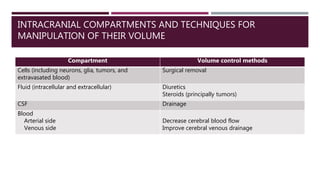
INTRACRANIAL COMPARTMENTS AND TECHNIQUES FOR
MANIPULATION OF THEIR VOLUME
Compartment Volume control methods
Cells (including neurons, glia, tumors, and
extravasated blood)
Surgical removal
Fluid (intracellular and extracellular) Diuretics
Steroids (principally tumors)
CSF Drainage
Blood
Arterial side
Venous side
Decrease cerebral blood flow
Improve cerebral venous drainage
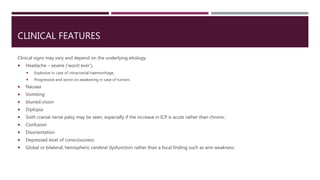
CLINICAL FEATURES
Clinical signs may vary and depend on the underlying etiology.
 Headache – severe (‘worst ever’),
 Explosive in case of intracranial haemorrhage,
 Progressive and worst on awakening in case of tumors
 Nausea
 Vomiting
 blurred vision
 Diplopia
 Sixth cranial nerve palsy may be seen, especially if the increase in ICP is acute rather than chronic.
 Confusion
 Disorientation
 Depressed level of consciousness
 Global or bilateral, hemispheric cerebral dysfunction rather than a focal finding such as arm weakness.
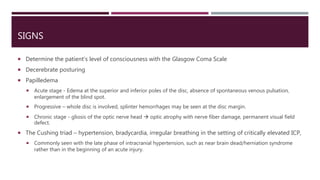
SIGNS
 Determine the patient’s level of consciousness with the Glasgow Coma Scale
 Decerebrate posturing
 Papilledema
 Acute stage - Edema at the superior and inferior poles of the disc, absence of spontaneous venous pulsation,
enlargement of the blind spot.
 Progressive – whole disc is involved, splinter hemorrhages may be seen at the disc margin.
 Chronic stage - gliosis of the optic nerve head  optic atrophy with nerve fiber damage, permanent visual field
defect.
 The Cushing triad – hypertension, bradycardia, irregular breathing in the setting of critically elevated ICP,
 Commonly seen with the late phase of intracranial hypertension, such as near brain dead/herniation syndrome
rather than in the beginning of an acute injury.
 ICP as an absolute value by itself may not have much clinical significance
 More important is the CPP and brain compliance.
 ICP elevation may become a local phenomenon and compartmentalized – as a result of the rigid
boundaries formed by the falx and tentorium cerebelli.
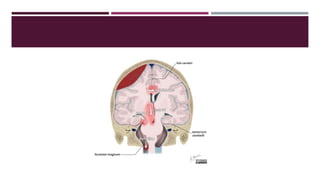
 Compartmentalized mass effect and pressure differentials  can lead to herniation of brain tissue from
the area of higher to lower pressure.
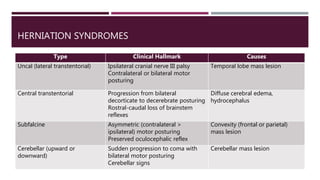
 Different herniation syndromes are each marked by characteristic signs
HERNIATION SYNDROMES
Type Clinical Hallmark Causes
Uncal (lateral transtentorial) Ipsilateral cranial nerve III palsy
Contralateral or bilateral motor
posturing
Temporal lobe mass lesion
Central transtentorial Progression from bilateral
decorticate to decerebrate posturing
Rostral-caudal loss of brainstem
reflexes
Diffuse cerebral edema,
hydrocephalus
Subfalcine Asymmetric (contralateral >
ipsilateral) motor posturing
Preserved oculocephalic reflex
Convexity (frontal or parietal)
mass lesion
Cerebellar (upward or
downward)
Sudden progression to coma with
bilateral motor posturing
Cerebellar signs
Cerebellar mass lesion
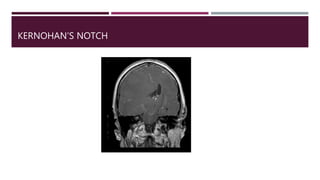
KERNOHAN’S NOTCH
INVESTIGATIONS
Imaging:
 Should aim to identify intracranial pathology that requires emergency surgery.
 Non contrast head CT – test of choice for trauma and most of the cases.
 If CT does not explain neurological findings  Magnetic Resonance Imaging (MRI) may be indicated.
 Magnetic resonance imaging – preferred imaging modality for sub-acute neurological insults and
seizure.
Transcranial Doppler
 Noninvasive procedure that allows the early detection of raised ICP by measuring blood flow velocity in
both middle cerebral arteries.
OTHER INVESTIGATIONS
 Jugular venous bulb oxygen saturations (SjvO2 usually 65-75%) reflects the balance between cerebral
oxygen delivery and CMRO2
 Low Sjv02 reliably indicates cerebral hypoperfusion.
 Microdialysis catheters – used to measure glucose, pyruvate, lactate, glycerol, glutamate (metabolic
variables) in CSF.
 Positron Emission Tomography – The distribution of radio labelled water in the brain is monitored to
indicate metabolic activity.
MONITORING
 Patients with suspected intracranial hypertension, especially secondary to TBI, should have monitoring of
ICP and monitoring of cerebral oxygen extraction.
 Other systemic parameters – ventilation, oxygenation, electrocardiogram, heart rate, blood pressure,
temperature, blood glucose, and fluid intake and output.
 Pulse oximetry and capnography – helpful to avoid unrecognized hypoxemia and hypoventilation or
hyperventilation.
 Central venous catheter – commonly needed to help evaluate volume status and administration of
inotropes.
 Foley’s catheter – to monitor urine output accurately.
MONITORING OF INTRACRANIAL PRESSURE
Indications for ICP Monitoring
 The diagnosis should not be made on clinical grounds alone
 clinical signs are not reliable and vary.
 In acute brain injury,  ICP must be directly measured in order to accurately diagnose intracranial
hypertension, .
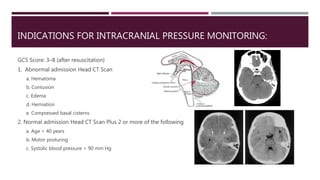
INDICATIONS FOR INTRACRANIAL PRESSURE MONITORING:
GCS Score: 3–8 (after resuscitation)
1. Abnormal admission Head CT Scan
a. Hematoma
b. Contusion
c. Edema
d. Herniation
e. Compressed basal cisterns
2. Normal admission Head CT Scan Plus 2 or more of the following
a. Age > 40 years
b. Motor posturing
c. Systolic blood pressure < 90 mm Hg
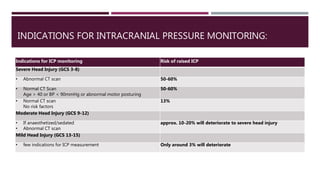
INDICATIONS FOR INTRACRANIAL PRESSURE MONITORING:
Indications for ICP monitoring Risk of raised ICP
Severe Head Injury (GCS 3-8)
• Abnormal CT scan 50-60%
• Normal CT Scan
Age > 40 or BP < 90mmHg or abnormal motor posturing
50-60%
• Normal CT scan
No risk factors
13%
Moderate Head Injury (GCS 9-12)
• If anaesthetized/sedated
• Abnormal CT scan
approx. 10-20% will deteriorate to severe head injury
Mild Head Injury (GCS 13-15)
• few indications for ICP measurement Only around 3% will deteriorate
INTRACRANIAL HYPERTENSION SECONDARY TO TRAUMATIC BRAIN
INJURY
In patients with traumatic brain injury (TBI), lesions may be heterogeneous – several factors often contribute
to increase the ICP.
1. Traumatically induced masses:
 epidural or subdural hematomas,
 Hemorrhagic contusions,
 foreign body
 depressed skull fractures
2. Cerebral edema
3. Hyperemia owing to vasomotor paralysis or loss of autoregulation
4. Hypoventilation that leads to hypercarbia with subsequent cerebral vasodilation.
5. Hydrocephalus resulting from obstruction of the CSF pathways or its absorption
6. Increase in intrathoracic or intra-abdominal pressure as a result of posturing, agitation, mechanical
ventilation, or valsalva maneuvers.
After evacuation of traumatic mass lesions, the most important cause of increased ICP – cerebral
edema.
 Patients should generally meet three criteria prior to placement of an ICP monitor:
 Because of the invasive nature of ICP monitoring and the need for ICU management
1. Brain imaging reveals a space-occupying lesion and severe cerebral edema suggesting that the patient is at risk
for high ICP
2. The patient has a depressed level of consciousness
3. The prognosis is such that aggressive ICU treatment is indicated.
ICP MONITORING DEVICES
Several types of ICP monitors
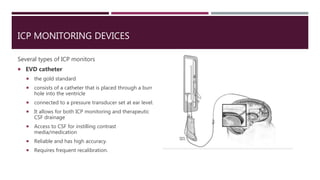
 EVD catheter
 the gold standard
 consists of a catheter that is placed through a burr
hole into the ventricle
 connected to a pressure transducer set at ear level.
 It allows for both ICP monitoring and therapeutic
CSF drainage
 Access to CSF for instilling contrast
media/medication
 Reliable and has high accuracy.
 Requires frequent recalibration.
MAJOR DRAWBACK
 Risk of infection – ventriculitis (potentially life-threatening)
 occurs in approximately 10% to 15% of patients
 steadily increases until the 10th day of use.
 Important to place the catheter with care using sterile technique and to maintain the sterility thereafter.
 Usually placed through a long subcutaneous tunnel in order to minimize the rate of infection.
 Hemorrhage with an incidence of 1.4%
 malfunction, obstruction, malposition.
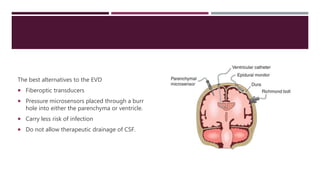
The best alternatives to the EVD
 Fiberoptic transducers
 Pressure microsensors placed through a burr
hole into either the parenchyma or ventricle.
 Carry less risk of infection
 Do not allow therapeutic drainage of CSF.
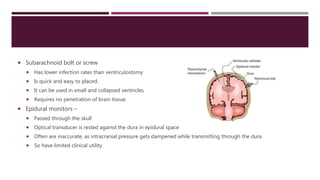
 Subarachnoid bolt or screw
 Has lower infection rates than ventriculostomy
 Is quick and easy to placed.
 It can be used in small and collapsed ventricles
 Requires no penetration of brain tissue.
 Epidural monitors –
 Passed through the skull
 Optical transducer is rested against the dura in epidural space
 Often are inaccurate, as intracranial pressure gets dampened while transmitting through the dura
 So have limited clinical utility
INTRACRANIAL PRESSURE TREATMENT MEASURES
Goals of therapy
 Maintain ICP at less than 20 to 25 mm Hg.
 Maintain CPP at greater than 60 mm Hg by maintaining adequate MAP.
 Avoid factors that aggravate or precipitate rise in ICP.
CPP TARGETED PROTOCOLS
 Conventional way of management of raised ICP – to reduce ICP below 20 mmHg
 Emerging evidence favours CPP targeted therapy.
 Measures are taken to achieve an optimum CPP
 Minimum CPP is needed - adequate supply of oxygen and essential nutrient to brain
 ? Minimum CPP, ? should be adjusted according to the patient’s age - remains unclear
 Studies - paediatric TBI
 Suggests CPP between 40- 65 mmHg represents an optimum threshold
 A CPP <40 mmHg is associated with high risk of death.
GENERAL MEASURES FOR ICP CONTROL
 Applies to all patients at risk for or ongoing intracranial hypertension
 Prevention or treatment of factors that may aggravate or precipitate intracranial hypertension
 Obstruction of venous return (head position, agitation)
 Respiratory problems (airway obstruction, hypoxia, hypercapnia)
 Fever
 Severe hypertension
 Hyponatremia
 Anemia
 Seizures
VENOUS OUTFLOW OPTIMIZATION
Head Position:
 Elevation of the head to at least 30° - advised in patients with raised ICP
 Keeping the head in a neutral position
 Increasing the head end will decrease ICP but will also decrease CPP
 Moderate elevation is safe as long as CPP is continuously maintained at > 60 mm Hg
 For patients with large abdominal girth
 Important to pay attention so that excessive head elevation is not causing abdominal distress
 increased abdominal pressure and pain may exacerbate ICP elevation.
*Avoid posture increasing in venacaval pressure like excess flexion of hips.
RESPIRATORY FAILURE
 Respiratory dysfunction - common in patients
with intracranial hypertension, especially in head
trauma
 Comatose patients (GCS<8) – have absent
airway protective reflexes and respiratory
dysfunction requiring mechanical ventilation.
 Hypoxia and hypercapnia can increase ICP
dramatically and mechanical ventilation can alter
cerebral hemodynamics.
 Optimal respiratory management is crucial for
control of ICP.
 Mechanical ventilation have adverse effects on
ICP.
PEEP
 needed to improve oxygenation
 Can increase ICP :
 By impeding venous return  increasing cerebral
venous pressure and ICP
 By decreasing blood pressure leading to a reflex
increase of cerebral blood volume.
 More in patient with low lung compliance such
as associated acute lung injury.
SEDATION AND ANALGESIA
 Agitation and pain – significantly increase blood pressure and ICP.
 Adequate sedation and analgesia is an important adjunct treatment.
 Opoids are avoided as it may increase ICP.
 Shorter acting agent like midazolam is used – permits interruption of sedation for neurologic
examination
 Fever increases metabolic rate by 10% to 13% per degree Celsius and is a potent vasodilator.
 Fever induced dilation of cerebral vessels can increase CBF and may increase ICP – worsens the
neurologic outcome.
 Fever – controlled with antipyretics and cooling blankets.
 Infectious causes must be sought and treated with appropriate antibiotics when present.
BLOOD PRESSURE
 Elevated blood pressure – seen commonly in patients with intracranial hypertension especially secondary
to head injury
 Characterized by a systolic blood pressure increase greater than diastolic increase.
 Unwise to reduce systemic blood pressure in patients with hypertension associated with untreated
intracranial mass lesions – cerebral perfusion is being maintained by the higher blood pressure.
 After TBI  pressure autoregulation is impaired  systemic hypertension may increase CBF and ICP
 Elevated blood pressure may exacerbate cerebral edema
 Increase the risk of postoperative intracranial hemorrhage
 In case of shock – BP must be ensured to adequate CPP and prevent further ischemia.
 Fluid boluses should be given to the hypotensive neurologically injured patient in the same way as in
any shock cases.
 Vasopressor support – initiated if the patient remains hypotensive despite appropriate fluid
resuscitation.
TREATMENT OF ANEMIA
 Anecdotal case reports
 In patients with severe anemia presenting with symptoms of increased ICP and signs of papilledema –
resolve with treatment of the anemia.
 There is increase in CBF, to maintain cerebral oxygen delivery when anemia is severe.
 A Hb level <7g/dL will be benefitted by blood transfusion.
PREVENTION OF SEIZURES
 The risk of seizures after trauma – related to the severity of the brain injury.
 Occur in 15% to 20% of patients with severe head injury.
 Increase cerebral metabolic rate and ICP.
 Sometimes seizures – subclinical and requires continuous electroencephalographic monitoring for its
detection
 Seizure prophylaxis for patients with severe brain injury – recommended for the first 7 days after injury.
HYPOTHERMIA
 A phase II trial to test safety and efficacy of hypothermia in children with TBI
 Reduction in ICP was evident during the hypothermia treatment
 Did not show a beneficial effect on neurologic outcome
 No significant differences between the hypothermia and no-hypothermia patients with respect to
complications viz. arrhythmia, coagulopathy or infection.
 The early hypothermia group had a trend toward better neurological outcome at 3 and 6 months.
 Recently completed multicenter trial by hypothermia paediatric head injury trial investigators, Canadian
Critical Care Groups
 Found a detrimental trend with hypothermia
 Routine induction of hypothermia is not indicated
 Hypothermia may be an effective adjunctive treatment for increased ICP refractory to other medical
management.
MEDICAL INTERVENTIONS
 Intracranial hypertension caused by agitation, posturing, or coughing can be prevented by sedation and
nondepolarizing muscle relaxants that do not alter cerebrovascular resistance.
 Morphine and midazolam for analgesia/sedation and cisatracurium or vecuronium as a muscle relaxant
 Myopathy – associated with the use of neuromuscular blocking agents specially if its used along with
steroids.
 There Should be limited use of neuromuscular blocking agents by monitoring train-of-four, measuring
creatine phosphokinase daily.
 Neurologic examination cannot be monitored closely in patient receiving sedations and muscle
relaxants.
 The sedatives and muscle relaxants can be interrupted once a day, usually before morning rounds, to
allow neurologic assessments.
HYPEROSMOLAR THERAPY – MANNITOL…
 Mannitol – most commonly used hyperosmolar agent.
 Intravenous bolus administration decreases the ICP in 1 to 5 minutes
 Maximum effect at 20 to 60 minutes
 Effect lasts for 1.5 to 6 hours, depending on the clinical condition
 Given as a bolus of 0.25 g/kg to 1 g/kg body weight.
 Patients who have herniated from diffuse brain swelling - benefitted by a higher dose of mannitol (1.4
g/kg).
RHEOLOGIC AND OSMOTIC EFFECTS OF MANNITOL
Rheological effect:
 Immediately after infusion of mannitol  expansion of plasma volume and a reduction in hematocrit
and in blood viscosity  increase CBF  increase oxygen delivery to the brain.
 These rheologic effects depend on the status of pressure autoregulation
 In patients with intact pressure autoregulation  infusion of mannitol induces cerebral vasoconstriction,
which maintains CBF constant, and the decrease in ICP is large
 In patients with absent auto regulation  it leads to increases CBF, and the decrease in ICP is less
pronounced
The osmotic effect of mannitol
 Increases serum osmolality  draws edema fluid from cerebral parenchyma into the intravascular
compartment.
 Takes 15 to 30 minutes to start until gradients are established.
 Serum osmolarity is optimal when increased to 300 to 320 mOsm.
 May cross open the blood-brain barrier
 Mannitol that has crossed the blood-brain barrier may draw fluid into the central nervous system, which
can aggravate vasogenic edema resulting in a “rebound” increase in ICP
 Mannitol is relatively contraindicated in hypovolemic patients because of the diuretic effects
HYPERTONIC SALINE
 Can be safely given in concentrations ranging from 3% to 23.4%
 Creates an osmotic force to draw water from the interstitial space of the brain parenchyma into the
intravascular compartment in the presence of an intact blood-brain barrier  redues intracranial volume
and ICP.
 Hypertonic saline augments intravascular volume and may increase blood pressure.
 Other situations where it may be preferred:
 Renal failure or serum osmolality >320 mosmol/Kg.
 Given as continuous infusion at 0.1 to 1.0mL/kg/hr,
 Target serum sodium level – 145 –155 meq/L.
 When the hypertonic saline therapy is no longer required, serum sodium should be slowly corrected to
normal values (hourly decline in serum sodium of not more than 0.5 meq/L).
HYPERVENTILATION
 Decreases PaCO2  which can induce constriction of cerebral arteries
 By alkalinizing the CSF.
 Resulting reduction in cerebral blood volume decreases ICP.
 Most effective use of hyperventilation is acutely to allow time for other more definitive treatments to be
put into action.
 But hyperventilation may cause vasoconstriction and decreases CBF leading to ↓ local cerebral perfusion
and worsen neurologic injury.
 Prolonged hyperventilation has a detrimental effect on outcome
 Prophylactic hyperventilation should be avoided.
BARBITURATE COMA
 Should only be considered for patients with refractory intracranial hypertension.
 Because of the serious complications associated with high-dose barbiturates,
 and The neurologic examination becomes unavailable for several days.
 Thiopentone is given in a loading dose of 10 mg/kg body weight followed by 5 mg/kg body weight
hourly for 3 doses.
 The maintenance dose is 1 to 2 mg/kg/h, titrated to maintain a serum level of 30 to 50 μg/mL.
 EEG burst suppression is an indication of maximal dosing.
 It acts by decreasing CBF and CMRO2 effect on ICP.
STEROIDS
 Commonly are used for primary and metastatic brain tumors, to decrease vasogenic cerebral edema.
 Focal neurologic signs and decreased mental status due to surrounding edema begin to improve within
hours.
 Dexamethasone, 4 mg every 6 hours.
 For other neurosurgical disorders such as TBI or spontaneous intracerebral hemorrhage, steroids are not
indicated.
 Some studies had detrimental effect – routine use of steroids is not indicated for patients with TBI.
 The mechanism of action – not clear
 Possible explanation
 Stabilization of the cell membranes  so that intracellular-extracellular gradients for water and electrolytes are
preserved
 Steroids also reduce the extrachoroidal production of CSF.
 Have the associated risk of
 developing or promoting nosocomial infection
 Hyperglycemia
 impaired wound healing
 muscle catabolism
 psychosis/delirium.
OTHER DRUGS…
 Acetazolamide (20–100 mg/kg/day, in 3 divided doses, max2 g/day)
 A carbonic anhydrase inhibitor
 Reduces the production of CSF.
 Particularly useful in patients with hydrocephalous, high altitude illness and benign intracranial
hypertension.
 Loop diuretics like Furosemide (1 mg/kg/day, q8hrly), has sometimes been administered either alone or
in combination with mannitol.
SURGICAL INTERVENTIONS
Resection of mass lesions
 Intracranial masses which produces raised ICP, should be removed when possible.
 Acute epidural and subdural hematomas are a hyperacute surgical emergency,
 Especially epidural hematoma because the bleeding is under arterial pressure.
 Brain abscess must be drained, and pneumocephalus must be evacuated if it is under sufficient tension
to increase ICP.
 Surgical management of spontaneous intracerebral bleeding is controversial.
CEREBROSPINAL FLUID DRAINAGE
 Lowers ICP immediately by reducing intracranial volume
 And in long-term by allowing edema fluid to drain into the ventricular system.
 Drainage of even a small volume of CSF can lower ICP significantly, especially when intracranial
compliance is reduced by injury.
 CSF should be removed at a rate of approximately 1 to 2 mL/minute, for two to three minutes at a time.
 intervals of two to three minutes in between is repeated till a satisfactory ICP has been achieved (ICP <20 mmHg).
 Is an important adjunct therapy for lowering ICP.
 If the brain is diffusely swollen, the ventricles may collapse  has limited utility.
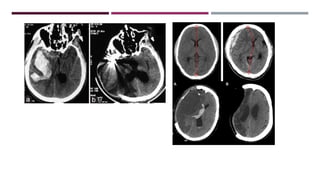
DECOMPRESSIVE CRANIECTOMY
 The surgical removal of part of the calvaria to create a window in the cranial vault  the most radical
intervention for intracranial hypertension
 Negates the Monro-Kellie doctrine of fixed intracranial volume.
 The swollen brain is allowed to herniate through the bone window to relieve pressure.
 Has been used to treat uncontrolled intracranial hypertension of various origins, including cerebral
infarction , trauma, subarachnoid hemorrhage, and spontaneous hemorrhage.
 Decompressive craniectomy effectively reduces ICP in most (85%) patients with intracranial hypertension
refractory to conventional medical treatment.
 Brain oxygenation measured by tissue PO2 and blood flow estimated by middle cerebral artery flow
velocity also are usually improved after decompressive craniectomy
 Complications:
 Hydrocephalus
 Hemorrhagic swelling ipsilateral to the craniotomy site
 subdural hygroma
EFFECTS OF ANAESTHETICS AGENTS ON ICP
IV AGENTS
 Thiopentone
 protect brain from incomplete ischemia.
 suppresses CMR.
 Helps in free radical scavenging effects and decrease ATP consumption.
 Cerebral autoregulation maintained and CO2 responsiveness intact.
 Methohexital:
 It has myoclonic activity and patients with seizures of temporal lobe origin [psychomotor variety] are specifically
at risk
PROPOFOL:
 Primarily reduce CMR.
 Decreases both CBF and ICP by vasoconstriction.
 In patients with high ICP, there is significant reduction in CPP following propofol induction.
 Fentanyl along with propofol : ablates increase in ICP at intubation.
 CO2 responsiveness and autoregulation is preserved.
 Though seizures, dystonic & choriform movements, opisthotonus etc have been reported with its
usesystematic studies have failed to confirm it.
ETOMIDATE:
 It causes parallel reduction in CBF and CMR,
 the effect varies regionally; more in forebrain.
 Reactivity to CO2 is preserved.
 Some of the concerns in using etomidate are
 adrenocortical suppression,
 worsening of acidosis,
 precipitate generalized epileptic EEG activity in epileptic patients.
 So is avoided in patient with history of recent seizure.
KETAMINE:
 Increases CMR.
 Secondarily increase ICP.
 And increases CBF but effect is regionally variable, more pronounced in limbic system.
BENZODIAZEPINES
 BZD’s cause parallel reductions in CBF and CMR.
 Safe to administer to patients with intracranial hypertension,
 provided that respiratory depression and an associated increase in Paco2 do not occur.
 Midazolam may have protective effects against hypoxia or cerebral ischemia
 The effects appear to be comparable with or slightly less than those of barbiturates
 Flumazenil - antagonizes the effects of midazolam on CBF, CMRO2 and ICP.
 Flumazenil-induced seizure – by unmasking the anticonvulsant effect of benzodiazepine might also be
considered.
INHALED ANESTHETICS
 At 0.5 MAC, the CMR suppression predominates and net blood flow decreases.
 At 1 MAC: CMR suppression is equal to vasodilation, so CBF is unchanged.
 At dose beyond 1 MAC, CMR is reduced, but vasodilatory effect is more predominate,
 Hence blood flow increases and coupling persists, ie. dose related increase in CBF/CMR.
 Order of vasodilatory potency: Halothane >> Enflurane > Desflurane = Isoflurane > Sevoflurane.
 Major impact on CBF & ICP occurs when we exceed 1 MAC.
 It will become significant if intracranial compliance is abnormal,
 Better to use a predominantly intravenous technique until the point of opening of cranium & dura.
 Net vasodilatory effect of isoflurane/ desflurane & sevoflurane less than halothane
 Enflurane is epileptogenic and there is slight risk with sevoflurane.
 CO2 reactivity and autoregulation preserved.
NITROUS OXIDE
 Can cause significant increase in CBF, CMR & ICP by its sympatho-adrenal stimulating effect.
 This effect is most extensive when used alone.
 Nitrous with IV agents: CBF effect considerably reduced [thiopentone, propofol, benzodiazepines,
narcotics].
 Nitrous with volatile agents: CBF increase is exaggerated.
 Vasodilator effect clinically significant in those with abnormal intracranial compliance.
 It should be avoided in cases, where a closed intracranial gas space may exist, since it can its cause
expansion.
OPIOIDS
 Effects of synthetic opioids on CBF, CMRO2 and ICP are variable.
 The variability appears to be due to the background anesthetic and opioid dose.
 When vasodilating drugs are used as the background anesthetic – acts as a cerebral vasoconstrictor.
 Conversely, when a vasoconstrictor is used as the background anesthetic or when no anesthetic is given,
opioids either have no effect or even increase CBF.
 Large doses of opioids decrease CBF in the absence of background anesthetics
MUSCLE RELAXANTS
Succinyl Choline
 Increase ICP in lightly anaesthetized patient, which can be prevented by deep anesthesia.
 Defasciculation with metocurine 0.03 mg/kg or with Vecuronium 0.01mg/kg is recommended.
 Consider risk/benefit of rise in ICP Vs rapid attainment of paralysis in a given case.
NDMR
 Atracurium can cause histamine release which can lead to cerebral vasodilation & increase ICP,
simultaneous decrease in BP leading to reduction in cerebral perfusion pressure.
 A metabolite of atracurium, laudanosine has epileptogenic properties in trials,
 but it appears highly unlikely that epileptogenesis will occur in humans with atracurium
 Cisatracurium - produces and releases less laudanosine and histamine than atracurium.
 The cerebral effects of cisatracurium are essentially similar to or weaker than those of atracurium.
 Pancuronium, vecuronium, rocuronium, and pipecuronium have little or minimal effect on CBF, CMRO2
or ICP.
 Pancuronium raises blood pressure and heart rate
 could be disadvantageous for certain patients, such as those with hypertension, especially if they have disturbed
autoregulation
 a substantial elevation of ICP could occur.
 Vecuronium neither induces histamine release nor does it change blood pressure or heart rate 
preferable.
 Rocuronium,
 its rapid onset of action in comparison with other nondeporalizing muscle relaxants
 its lack of adverse activity, such as histamine release,
 preferable to succinylcholine during rapid induction of anesthesia.
LIDOCAINE
 Has unique central nervous system effects that depend on the blood concentration
 At low concentration, sedation.
 At higher concentration, seizures may occur.
 Intravenous lidocaine 1.5 mg/kg - effective in preventing circulatory changes and an elevation of ICP
during
 Tracheal intubation, endotracheal suctioning or after application of a pin-type skull clamp or skin incision in
patients undergoing craniotomy
 Protective effect of lidocaine – not demonstrated in severe forebrain ischemia
 it was demonstrated in transient focal cerebral ischemia
Mechanism of protection:
 Preservation of mitochondrial function
 Inhibition of glutamate release
 Inhibition of apoptosis
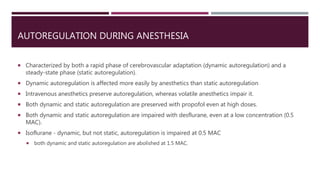
AUTOREGULATION DURING ANESTHESIA
 Characterized by both a rapid phase of cerebrovascular adaptation (dynamic autoregulation) and a
steady-state phase (static autoregulation).
 Dynamic autoregulation is affected more easily by anesthetics than static autoregulation
 Intravenous anesthetics preserve autoregulation, whereas volatile anesthetics impair it.
 Both dynamic and static autoregulation are preserved with propofol even at high doses.
 Both dynamic and static autoregulation are impaired with desflurane, even at a low concentration (0.5
MAC).
 Isoflurane - dynamic, but not static, autoregulation is impaired at 0.5 MAC
 both dynamic and static autoregulation are abolished at 1.5 MAC.
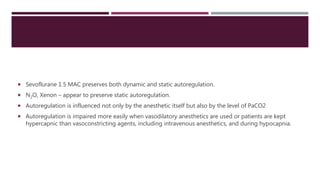
 Sevoflurane 1.5 MAC preserves both dynamic and static autoregulation.
 N2O, Xenon – appear to preserve static autoregulation.
 Autoregulation is influenced not only by the anesthetic itself but also by the level of PaCO2
 Autoregulation is impaired more easily when vasodilatory anesthetics are used or patients are kept
hypercapnic than vasoconstricting agents, including intravenous anesthetics, and during hypocapnia.
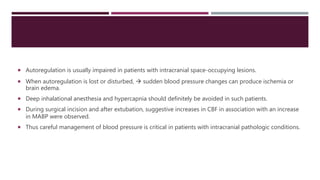
 Autoregulation is usually impaired in patients with intracranial space-occupying lesions.
 When autoregulation is lost or disturbed,  sudden blood pressure changes can produce ischemia or
brain edema.
 Deep inhalational anesthesia and hypercapnia should definitely be avoided in such patients.
 During surgical incision and after extubation, suggestive increases in CBF in association with an increase
in MABP were observed.
 Thus careful management of blood pressure is critical in patients with intracranial pathologic conditions.
SUMMARY
 Effective treatment of intracranial hypertension involves meticulous avoidance of factors that precipitate
or aggravate increased ICP.
 When ICP becomes elevated, it is important to rule out new mass lesions that should be surgically
evacuated.
 Medical management of increased ICP should include sedation, drainage of CSF, and osmotherapy with
either mannitol or hypertonic saline.
 For intracranial hypertension refractory to initial medical management, barbiturate coma, hypothermia,
or decompressive craniotomy should be considered.
 Steroids are not indicated and may be harmful in the treatment of intracranial hypertension resulting
from TBI.
REFERENCES
 Miller’s Anesthesia
 Cottrell and Patel’s Neuroanesthesia
 Adams And Victor’s Principles Of Neurology
 The Neuro ICU Book - Kiwon Lee, MD, FACP, FAHA, FCCM
 American Academy of Neurology – CONTINUUM Journal - Management of Intracranial Pressure – W.
David Freeman, MD, FSNS, FAAN
 Management of intracranial hypertension: Leonardo Rangel-Castillo, Shankar Gopinath, Claudia S
Robertson
 P. R. Knight, W. D. Wylie, T. E. J. Healy - Wylie and Churchill-Davidson's A practice of anesthesia-Arnold
(2003)
THANK YOU

Intracranial pressure

  • 1.
  • 2.
    INTRODUCTION  The braintissue, blood vessel, intracranial part of CSF encased in rigid bony cage – skull.  ICP – “The pressure within the craniospinal compartment, a closed system that comprises a fixed volume of neural tissue, blood, and cerebrospinal fluid (CSF).”  The pressure inside the lateral ventricles/ lumbar subarachnoid space in supine position.  Measured in mmHg  In normal states – typically mirrors jugular venous pressure, which is about 5 mmHg to 8 mmHg.
  • 3.
    Properties  Total skullvolume = 1700 ml  Total brain volume = 1300 ml  CSF volume = 150 ml  Blood volume = 110 ml  ECF volume = 75 ml Normal ICF Pressures  10–15 mm Hg in adults, adolescent children  3–7 mm Hg for young children  1.5–6 mm Hg for term infants  > 20 mm Hg = raised ICP.
  • 4.
    INTRACRANIAL HYPERTENSION  Definedas sustained elevations of ICP greater than 20 mm Hg.  Can reduce cerebral perfusion pressure (CPP)  difference between the Mean Arterial Pressure (MAP) and the Intracranial Pressure (ICP).  CPP = MAP – ICP  In pathologic states  as ICP increases  CPP approaches zero  brain ischemia and neuronal death if not rapidly corrected.  The protective reflex response to elevated ICP causes changes in blood pressure and heart rate – cushing’s reflex.  Many patients with raised ICP have elevated blood pressure as a result of this compensatory reflex to try to maintain adequate CPP
  • 5.
    HISTORY OF THEMONRO-KELLIE DOCTRINE  The intracranial pressure-volume relationship – initially described by Alexander Monro secundus.  Expanded on by George Kellie.  Known today as the Monro-Kellie doctrine.  States that “the volume of the intracranial content must remain constant and, therefore, any change in one of the intracranial components must be compensated by a reciprocal change in the volume of another component.”  Mathematically: VT = Vb+Vcsf+Vvasc  VT = total intracranial volume (1700mL fixed in adulthood)  Vb = brain parenchymal volume - 1400 mL  Vcsf =CSF intracranial volume (approximately 30 mL in ventricles)  Vvasc refers to circulatory volume (arteries and veins), which is approximately 150 mL.
  • 6.
     In pathologicstates, a new intracranial volume (Vx) is added to the intracranial compartment:  VT =Vb +Vcsf + Vvasc+ Vx  To accommodate this new intracranial volume, one of the other components must be displaced accordingly to maintain constant ICP.  Most commonly, the first intracranial component to be displaced is CSF (Vcsf).  CSF comes out from the ventricles or cerebral convexities through the arachnoid granulations into the dural venous sinuses – temporary compensation.  Further additions of intracranial volume  Exhaust intracranial reserve mechanisms,  Rise in ICP as well as potential compression of other intracranial structures (brain parenchyma (Vb) or vascular structures (Vvasc)  Cause brain damage or ischemia and infarction
  • 7.
     There arethree fossa or recesses intracranially: 1. The anterior fossa – the cribriform plate and frontal lobes reside; 2. The middle fossa holds the temporal lobes and is medially adjacent to the border of the tentorium cerebelli. 3. The posterior fossa – separated by the tentorium cerebelli, which is a thick dural membrane that contains most of the brainstem that exits the foramen magnum.
  • 8.
     Intracranial masseffect inside of these fossa,  Encroach and extend into the tentorium cerebelli  causes displacement of adjacent intracranial structures, such as the third cranial nerve  subsequent ipsilateral pupil dilatation.  Small increments in brain volume do not immediately raise ICP  Because of the buffering displacement of CSF from the cranial cavity into the spinal canal.  To a lesser extent  deformation of the brain.  Once these compensating measures have been exhausted – a mass within one dural compartment leads to displacement - herniation
  • 9.
    INTRACRANIAL COMPLIANCE  Asthe volume of brain, blood, or CSF continue to increase – accommodative mechanisms fails.  ICP rises exponentially, as in an idealized elastance (compliance) curve.  Shape of the normal curve begins a steep ascent at an ICP of approximately 25 mm Hg.  After this point, small increments in intracranial volume result in marked elevations in ICP. The intracranial pressure–volume relationship.
  • 10.
    ICP WAVE FORM In normal physiology – CSF is formed from the choroid plexus into the ventricle  a transient and measurable rise in ICP occurs  subsequently buffered by displacement of CSF from the subarachnoid and ventricular compartments.  This transient ICP elevation and buffering – characteristic ICP waveform,  Composed of the  Percussion wave (P1, cardiac systole),  Tidal wave (P2, brain parenchymal displacement restricted by the dura),  The dicrotic wave (P3, closure of the aortic valve).
  • 11.
    PATHOLOGIC PRESSURE WAVES In patients with increased ICP – pathologc ICP waves occur  Lundberg – recorded and analyzed intraventricular pressures in patients with brain tumors.  Found ICP to be subject to periodic spontaneous fluctuations.  Three types of pressure waves, designated as A, B, and C.
  • 12.
    LUNDBERG A WAVES Are also called “plateau waves.”  Always pathologic – may be a precursor of cerebral herniation.  Represent steep increases in ICP  May be as high as 40mmHg to 50mmHg  Last for 5 to 10 minutes.  Are self-limited and do not necessarily require urgent treatment.  May be an indicator of impending cerebral herniation, each ICP plateau does not require treatment per se.  Require interventions for sustained elevation of ICP that lasts more than 10 to 15 minutes.  No need of an intervention every time the if ICP exceeds 20 mm Hg – result in overtreatment of spontaneous ICP oscillations that would otherwise be self-limited.
  • 13.
    LUNDBERG B WAVES An indicator of poor intracranial compliance.  Ballistic waveforms – follows the blood pressure wave  Result of blood entering the cerebral vessels during systole  These oscillations occur 0.5 to 2 times per minute and generally do not exceed 30 mm Hg  Has P1 and P2 peaks
  • 14.
    LUNDBERG C WAVES Can be seen in normal physiology  Most likely represent interactions between the cardiac and respiratory cycles.  These oscillations occur 4 to 8 times per minute and generally do not exceed 25 mm Hg.
  • 15.
    CAUSES OF RAISEDICP Intracranial space- occupying mass lesions Increased brain volume (cytotoxic edema) Increased brain and blood volume (vasogenic edema) Increased cerebrospinal fluid volume • Subdural hematoma • Epidural hematoma • Brain tumour • Cerebral abscess • Intracerebral haemorrhage • Cerebral infarction • Global hypoxia- ischemia • Reye syndrome • Acute hyponatremia • Hepatic encephalopathy • Traumatic brain injury • Meningitis • Encephalitis • Hypertensive encephalopathy • Eclampsia • Subarachnoid haemorrhage • Dural sinus thrombosis • Communicating Hydrocephalus • Noncommunicating Hydrocephalus • Choroid plexus papilloma
  • 16.
     Primary –intracranial lesions  Brain tumor  Trauma (epidural and subdural hematoma, cerebral contusions)  Nontraumatic intra-cerebral hemorrhage  Ischemic stroke  Hydrocephalus  Idiopathic or benign intracranial hypertension  Other (eg, pseudo-tumorcerebri, pneumoencephalus, abscesses, cysts)
  • 17.
     Secondary –extracranial/systemic causes  Airway obstruction  Hypoxia or hypercarbia (hypoventilation)  Hypertension (pain/cough) or hypotension (hypovolemia/sedation)  Posture (head rotation)  Hyperpyrexia  Seizures  Drug and metabolic (eg, tetracycline, rofecoxib, divalproex sodium, lead intoxication)  Others (eg, high-altitude cerebral edema, hepatic failure)
  • 18.
     Postoperative  Masslesion (hematoma) Edema  Increased cerebral blood volume (vasodilation)  Disturbances of CSF
  • 19.
    PATHOPHYSIOLOGY OF INTRACRANIALHYPERTENSION  4 compartment model  Cells (including neurons, glia, tumors, and extravasated collections of blood)  Fluid (intracellular and extracellular)  CSF  Blood 1. The cellular compartment  The province of the surgeon 2. The CSF compartment.  There is no pharmacologic manipulation  The only practical means of manipulating the size of this compartment - drainage.  Can be improved by passage of a brain needle into a lateral ventricle to drain CSF.  Lumbar CSF drainage can be used to improve in situations with no substantial hazard of uncal or transforamen magnum herniation.
  • 20.
    3. The fluidcompartment.  Can be addressed with steroids and osmotic/diuretic agents. 4. The blood compartment.  Receives the anesthesiologist’s greatest attention – it is the most amenable to rapid alteration.  The blood compartment should be viewed as having two separate components: venous and arterial.
  • 21.
    BLOOD COMPARTMENT The venousside  The venous side of the circulation should initially be considered.  Largely a passive compartment and often overlooked.  Engorgement of this compartment - common cause of increased ICP or poor conditions in the surgical field .  A head-up posture to ensure good venous drainage - standard in neurosurgical anesthesia and critical care.  Obstruction of cerebral venous drainage - by extremes of head position or circumferential pressure should be avoided (cervical collars, endotracheal tube ties).
  • 22.
     Anything thatcauses increased intrathoracic pressure can also result in obstruction of cerebral venous drainage.  Kinking or partial obstruction of endotracheal tubes  Tension pneumothorax,  Coughing or straining against the endotracheal tube,  Gas trapping as a result of bronchospasm.  Neuromuscular blockade – is induced during craniotomies unless a contraindication is present.
  • 23.
    The arterial sideof the circulation  Attention to the effect of anesthetic drugs and techniques on CBF – established part of neuroanesthesia  Increases in CBF are associated with increases in cerebral blood volume (CBV).  Exception to this rule – cerebral ischemia caused by hypotension or vessel occlusion  CBV may increase as the cerebral vasculature dilates in response to a sudden reduction in CBF.  General approach - select anesthetics and to control physiologic variables in a manner that avoids unnecessary increases in CBF.
  • 24.
  • 25.
    INTRACRANIAL COMPARTMENTS ANDTECHNIQUES FOR MANIPULATION OF THEIR VOLUME Compartment Volume control methods Cells (including neurons, glia, tumors, and extravasated blood) Surgical removal Fluid (intracellular and extracellular) Diuretics Steroids (principally tumors) CSF Drainage Blood Arterial side Venous side Decrease cerebral blood flow Improve cerebral venous drainage
  • 26.
    CLINICAL FEATURES Clinical signsmay vary and depend on the underlying etiology.  Headache – severe (‘worst ever’),  Explosive in case of intracranial haemorrhage,  Progressive and worst on awakening in case of tumors  Nausea  Vomiting  blurred vision  Diplopia  Sixth cranial nerve palsy may be seen, especially if the increase in ICP is acute rather than chronic.  Confusion  Disorientation  Depressed level of consciousness  Global or bilateral, hemispheric cerebral dysfunction rather than a focal finding such as arm weakness.
  • 27.
    SIGNS  Determine thepatient’s level of consciousness with the Glasgow Coma Scale  Decerebrate posturing  Papilledema  Acute stage - Edema at the superior and inferior poles of the disc, absence of spontaneous venous pulsation, enlargement of the blind spot.  Progressive – whole disc is involved, splinter hemorrhages may be seen at the disc margin.  Chronic stage - gliosis of the optic nerve head  optic atrophy with nerve fiber damage, permanent visual field defect.  The Cushing triad – hypertension, bradycardia, irregular breathing in the setting of critically elevated ICP,  Commonly seen with the late phase of intracranial hypertension, such as near brain dead/herniation syndrome rather than in the beginning of an acute injury.
  • 28.
     ICP asan absolute value by itself may not have much clinical significance  More important is the CPP and brain compliance.  ICP elevation may become a local phenomenon and compartmentalized – as a result of the rigid boundaries formed by the falx and tentorium cerebelli.  Compartmentalized mass effect and pressure differentials  can lead to herniation of brain tissue from the area of higher to lower pressure.  Different herniation syndromes are each marked by characteristic signs
  • 29.
    HERNIATION SYNDROMES Type ClinicalHallmark Causes Uncal (lateral transtentorial) Ipsilateral cranial nerve III palsy Contralateral or bilateral motor posturing Temporal lobe mass lesion Central transtentorial Progression from bilateral decorticate to decerebrate posturing Rostral-caudal loss of brainstem reflexes Diffuse cerebral edema, hydrocephalus Subfalcine Asymmetric (contralateral > ipsilateral) motor posturing Preserved oculocephalic reflex Convexity (frontal or parietal) mass lesion Cerebellar (upward or downward) Sudden progression to coma with bilateral motor posturing Cerebellar signs Cerebellar mass lesion
  • 31.
  • 32.
    INVESTIGATIONS Imaging:  Should aimto identify intracranial pathology that requires emergency surgery.  Non contrast head CT – test of choice for trauma and most of the cases.  If CT does not explain neurological findings  Magnetic Resonance Imaging (MRI) may be indicated.  Magnetic resonance imaging – preferred imaging modality for sub-acute neurological insults and seizure. Transcranial Doppler  Noninvasive procedure that allows the early detection of raised ICP by measuring blood flow velocity in both middle cerebral arteries.
  • 33.
    OTHER INVESTIGATIONS  Jugularvenous bulb oxygen saturations (SjvO2 usually 65-75%) reflects the balance between cerebral oxygen delivery and CMRO2  Low Sjv02 reliably indicates cerebral hypoperfusion.  Microdialysis catheters – used to measure glucose, pyruvate, lactate, glycerol, glutamate (metabolic variables) in CSF.  Positron Emission Tomography – The distribution of radio labelled water in the brain is monitored to indicate metabolic activity.
  • 34.
    MONITORING  Patients withsuspected intracranial hypertension, especially secondary to TBI, should have monitoring of ICP and monitoring of cerebral oxygen extraction.  Other systemic parameters – ventilation, oxygenation, electrocardiogram, heart rate, blood pressure, temperature, blood glucose, and fluid intake and output.  Pulse oximetry and capnography – helpful to avoid unrecognized hypoxemia and hypoventilation or hyperventilation.  Central venous catheter – commonly needed to help evaluate volume status and administration of inotropes.  Foley’s catheter – to monitor urine output accurately.
  • 35.
    MONITORING OF INTRACRANIALPRESSURE Indications for ICP Monitoring  The diagnosis should not be made on clinical grounds alone  clinical signs are not reliable and vary.  In acute brain injury,  ICP must be directly measured in order to accurately diagnose intracranial hypertension, .
  • 36.
    INDICATIONS FOR INTRACRANIALPRESSURE MONITORING: GCS Score: 3–8 (after resuscitation) 1. Abnormal admission Head CT Scan a. Hematoma b. Contusion c. Edema d. Herniation e. Compressed basal cisterns 2. Normal admission Head CT Scan Plus 2 or more of the following a. Age > 40 years b. Motor posturing c. Systolic blood pressure < 90 mm Hg
  • 37.
    INDICATIONS FOR INTRACRANIALPRESSURE MONITORING: Indications for ICP monitoring Risk of raised ICP Severe Head Injury (GCS 3-8) • Abnormal CT scan 50-60% • Normal CT Scan Age > 40 or BP < 90mmHg or abnormal motor posturing 50-60% • Normal CT scan No risk factors 13% Moderate Head Injury (GCS 9-12) • If anaesthetized/sedated • Abnormal CT scan approx. 10-20% will deteriorate to severe head injury Mild Head Injury (GCS 13-15) • few indications for ICP measurement Only around 3% will deteriorate
  • 38.
    INTRACRANIAL HYPERTENSION SECONDARYTO TRAUMATIC BRAIN INJURY In patients with traumatic brain injury (TBI), lesions may be heterogeneous – several factors often contribute to increase the ICP. 1. Traumatically induced masses:  epidural or subdural hematomas,  Hemorrhagic contusions,  foreign body  depressed skull fractures 2. Cerebral edema 3. Hyperemia owing to vasomotor paralysis or loss of autoregulation
  • 39.
    4. Hypoventilation thatleads to hypercarbia with subsequent cerebral vasodilation. 5. Hydrocephalus resulting from obstruction of the CSF pathways or its absorption 6. Increase in intrathoracic or intra-abdominal pressure as a result of posturing, agitation, mechanical ventilation, or valsalva maneuvers. After evacuation of traumatic mass lesions, the most important cause of increased ICP – cerebral edema.
  • 40.
     Patients shouldgenerally meet three criteria prior to placement of an ICP monitor:  Because of the invasive nature of ICP monitoring and the need for ICU management 1. Brain imaging reveals a space-occupying lesion and severe cerebral edema suggesting that the patient is at risk for high ICP 2. The patient has a depressed level of consciousness 3. The prognosis is such that aggressive ICU treatment is indicated.
  • 41.
    ICP MONITORING DEVICES Severaltypes of ICP monitors  EVD catheter  the gold standard  consists of a catheter that is placed through a burr hole into the ventricle  connected to a pressure transducer set at ear level.  It allows for both ICP monitoring and therapeutic CSF drainage  Access to CSF for instilling contrast media/medication  Reliable and has high accuracy.  Requires frequent recalibration.
  • 42.
    MAJOR DRAWBACK  Riskof infection – ventriculitis (potentially life-threatening)  occurs in approximately 10% to 15% of patients  steadily increases until the 10th day of use.  Important to place the catheter with care using sterile technique and to maintain the sterility thereafter.  Usually placed through a long subcutaneous tunnel in order to minimize the rate of infection.  Hemorrhage with an incidence of 1.4%  malfunction, obstruction, malposition.
  • 43.
    The best alternativesto the EVD  Fiberoptic transducers  Pressure microsensors placed through a burr hole into either the parenchyma or ventricle.  Carry less risk of infection  Do not allow therapeutic drainage of CSF.
  • 44.
     Subarachnoid boltor screw  Has lower infection rates than ventriculostomy  Is quick and easy to placed.  It can be used in small and collapsed ventricles  Requires no penetration of brain tissue.  Epidural monitors –  Passed through the skull  Optical transducer is rested against the dura in epidural space  Often are inaccurate, as intracranial pressure gets dampened while transmitting through the dura  So have limited clinical utility
  • 45.
    INTRACRANIAL PRESSURE TREATMENTMEASURES Goals of therapy  Maintain ICP at less than 20 to 25 mm Hg.  Maintain CPP at greater than 60 mm Hg by maintaining adequate MAP.  Avoid factors that aggravate or precipitate rise in ICP.
  • 46.
    CPP TARGETED PROTOCOLS Conventional way of management of raised ICP – to reduce ICP below 20 mmHg  Emerging evidence favours CPP targeted therapy.  Measures are taken to achieve an optimum CPP  Minimum CPP is needed - adequate supply of oxygen and essential nutrient to brain  ? Minimum CPP, ? should be adjusted according to the patient’s age - remains unclear  Studies - paediatric TBI  Suggests CPP between 40- 65 mmHg represents an optimum threshold  A CPP <40 mmHg is associated with high risk of death.
  • 47.
    GENERAL MEASURES FORICP CONTROL  Applies to all patients at risk for or ongoing intracranial hypertension  Prevention or treatment of factors that may aggravate or precipitate intracranial hypertension  Obstruction of venous return (head position, agitation)  Respiratory problems (airway obstruction, hypoxia, hypercapnia)  Fever  Severe hypertension  Hyponatremia  Anemia  Seizures
  • 48.
    VENOUS OUTFLOW OPTIMIZATION HeadPosition:  Elevation of the head to at least 30° - advised in patients with raised ICP  Keeping the head in a neutral position  Increasing the head end will decrease ICP but will also decrease CPP  Moderate elevation is safe as long as CPP is continuously maintained at > 60 mm Hg  For patients with large abdominal girth  Important to pay attention so that excessive head elevation is not causing abdominal distress  increased abdominal pressure and pain may exacerbate ICP elevation. *Avoid posture increasing in venacaval pressure like excess flexion of hips.
  • 49.
    RESPIRATORY FAILURE  Respiratorydysfunction - common in patients with intracranial hypertension, especially in head trauma  Comatose patients (GCS<8) – have absent airway protective reflexes and respiratory dysfunction requiring mechanical ventilation.  Hypoxia and hypercapnia can increase ICP dramatically and mechanical ventilation can alter cerebral hemodynamics.  Optimal respiratory management is crucial for control of ICP.  Mechanical ventilation have adverse effects on ICP. PEEP  needed to improve oxygenation  Can increase ICP :  By impeding venous return  increasing cerebral venous pressure and ICP  By decreasing blood pressure leading to a reflex increase of cerebral blood volume.  More in patient with low lung compliance such as associated acute lung injury.
  • 50.
    SEDATION AND ANALGESIA Agitation and pain – significantly increase blood pressure and ICP.  Adequate sedation and analgesia is an important adjunct treatment.  Opoids are avoided as it may increase ICP.  Shorter acting agent like midazolam is used – permits interruption of sedation for neurologic examination
  • 51.
     Fever increasesmetabolic rate by 10% to 13% per degree Celsius and is a potent vasodilator.  Fever induced dilation of cerebral vessels can increase CBF and may increase ICP – worsens the neurologic outcome.  Fever – controlled with antipyretics and cooling blankets.  Infectious causes must be sought and treated with appropriate antibiotics when present.
  • 52.
    BLOOD PRESSURE  Elevatedblood pressure – seen commonly in patients with intracranial hypertension especially secondary to head injury  Characterized by a systolic blood pressure increase greater than diastolic increase.  Unwise to reduce systemic blood pressure in patients with hypertension associated with untreated intracranial mass lesions – cerebral perfusion is being maintained by the higher blood pressure.  After TBI  pressure autoregulation is impaired  systemic hypertension may increase CBF and ICP  Elevated blood pressure may exacerbate cerebral edema  Increase the risk of postoperative intracranial hemorrhage
  • 53.
     In caseof shock – BP must be ensured to adequate CPP and prevent further ischemia.  Fluid boluses should be given to the hypotensive neurologically injured patient in the same way as in any shock cases.  Vasopressor support – initiated if the patient remains hypotensive despite appropriate fluid resuscitation.
  • 54.
    TREATMENT OF ANEMIA Anecdotal case reports  In patients with severe anemia presenting with symptoms of increased ICP and signs of papilledema – resolve with treatment of the anemia.  There is increase in CBF, to maintain cerebral oxygen delivery when anemia is severe.  A Hb level <7g/dL will be benefitted by blood transfusion.
  • 55.
    PREVENTION OF SEIZURES The risk of seizures after trauma – related to the severity of the brain injury.  Occur in 15% to 20% of patients with severe head injury.  Increase cerebral metabolic rate and ICP.  Sometimes seizures – subclinical and requires continuous electroencephalographic monitoring for its detection  Seizure prophylaxis for patients with severe brain injury – recommended for the first 7 days after injury.
  • 56.
    HYPOTHERMIA  A phaseII trial to test safety and efficacy of hypothermia in children with TBI  Reduction in ICP was evident during the hypothermia treatment  Did not show a beneficial effect on neurologic outcome  No significant differences between the hypothermia and no-hypothermia patients with respect to complications viz. arrhythmia, coagulopathy or infection.  The early hypothermia group had a trend toward better neurological outcome at 3 and 6 months.
  • 57.
     Recently completedmulticenter trial by hypothermia paediatric head injury trial investigators, Canadian Critical Care Groups  Found a detrimental trend with hypothermia  Routine induction of hypothermia is not indicated  Hypothermia may be an effective adjunctive treatment for increased ICP refractory to other medical management.
  • 58.
    MEDICAL INTERVENTIONS  Intracranialhypertension caused by agitation, posturing, or coughing can be prevented by sedation and nondepolarizing muscle relaxants that do not alter cerebrovascular resistance.  Morphine and midazolam for analgesia/sedation and cisatracurium or vecuronium as a muscle relaxant  Myopathy – associated with the use of neuromuscular blocking agents specially if its used along with steroids.  There Should be limited use of neuromuscular blocking agents by monitoring train-of-four, measuring creatine phosphokinase daily.  Neurologic examination cannot be monitored closely in patient receiving sedations and muscle relaxants.  The sedatives and muscle relaxants can be interrupted once a day, usually before morning rounds, to allow neurologic assessments.
  • 59.
    HYPEROSMOLAR THERAPY –MANNITOL…  Mannitol – most commonly used hyperosmolar agent.  Intravenous bolus administration decreases the ICP in 1 to 5 minutes  Maximum effect at 20 to 60 minutes  Effect lasts for 1.5 to 6 hours, depending on the clinical condition  Given as a bolus of 0.25 g/kg to 1 g/kg body weight.  Patients who have herniated from diffuse brain swelling - benefitted by a higher dose of mannitol (1.4 g/kg).
  • 60.
    RHEOLOGIC AND OSMOTICEFFECTS OF MANNITOL Rheological effect:  Immediately after infusion of mannitol  expansion of plasma volume and a reduction in hematocrit and in blood viscosity  increase CBF  increase oxygen delivery to the brain.  These rheologic effects depend on the status of pressure autoregulation  In patients with intact pressure autoregulation  infusion of mannitol induces cerebral vasoconstriction, which maintains CBF constant, and the decrease in ICP is large  In patients with absent auto regulation  it leads to increases CBF, and the decrease in ICP is less pronounced
  • 61.
    The osmotic effectof mannitol  Increases serum osmolality  draws edema fluid from cerebral parenchyma into the intravascular compartment.  Takes 15 to 30 minutes to start until gradients are established.  Serum osmolarity is optimal when increased to 300 to 320 mOsm.  May cross open the blood-brain barrier  Mannitol that has crossed the blood-brain barrier may draw fluid into the central nervous system, which can aggravate vasogenic edema resulting in a “rebound” increase in ICP  Mannitol is relatively contraindicated in hypovolemic patients because of the diuretic effects
  • 62.
    HYPERTONIC SALINE  Canbe safely given in concentrations ranging from 3% to 23.4%  Creates an osmotic force to draw water from the interstitial space of the brain parenchyma into the intravascular compartment in the presence of an intact blood-brain barrier  redues intracranial volume and ICP.  Hypertonic saline augments intravascular volume and may increase blood pressure.  Other situations where it may be preferred:  Renal failure or serum osmolality >320 mosmol/Kg.
  • 63.
     Given ascontinuous infusion at 0.1 to 1.0mL/kg/hr,  Target serum sodium level – 145 –155 meq/L.  When the hypertonic saline therapy is no longer required, serum sodium should be slowly corrected to normal values (hourly decline in serum sodium of not more than 0.5 meq/L).
  • 64.
    HYPERVENTILATION  Decreases PaCO2 which can induce constriction of cerebral arteries  By alkalinizing the CSF.  Resulting reduction in cerebral blood volume decreases ICP.  Most effective use of hyperventilation is acutely to allow time for other more definitive treatments to be put into action.  But hyperventilation may cause vasoconstriction and decreases CBF leading to ↓ local cerebral perfusion and worsen neurologic injury.  Prolonged hyperventilation has a detrimental effect on outcome  Prophylactic hyperventilation should be avoided.
  • 65.
    BARBITURATE COMA  Shouldonly be considered for patients with refractory intracranial hypertension.  Because of the serious complications associated with high-dose barbiturates,  and The neurologic examination becomes unavailable for several days.  Thiopentone is given in a loading dose of 10 mg/kg body weight followed by 5 mg/kg body weight hourly for 3 doses.  The maintenance dose is 1 to 2 mg/kg/h, titrated to maintain a serum level of 30 to 50 μg/mL.  EEG burst suppression is an indication of maximal dosing.  It acts by decreasing CBF and CMRO2 effect on ICP.
  • 66.
    STEROIDS  Commonly areused for primary and metastatic brain tumors, to decrease vasogenic cerebral edema.  Focal neurologic signs and decreased mental status due to surrounding edema begin to improve within hours.  Dexamethasone, 4 mg every 6 hours.  For other neurosurgical disorders such as TBI or spontaneous intracerebral hemorrhage, steroids are not indicated.  Some studies had detrimental effect – routine use of steroids is not indicated for patients with TBI.
  • 67.
     The mechanismof action – not clear  Possible explanation  Stabilization of the cell membranes  so that intracellular-extracellular gradients for water and electrolytes are preserved  Steroids also reduce the extrachoroidal production of CSF.  Have the associated risk of  developing or promoting nosocomial infection  Hyperglycemia  impaired wound healing  muscle catabolism  psychosis/delirium.
  • 68.
    OTHER DRUGS…  Acetazolamide(20–100 mg/kg/day, in 3 divided doses, max2 g/day)  A carbonic anhydrase inhibitor  Reduces the production of CSF.  Particularly useful in patients with hydrocephalous, high altitude illness and benign intracranial hypertension.  Loop diuretics like Furosemide (1 mg/kg/day, q8hrly), has sometimes been administered either alone or in combination with mannitol.
  • 69.
    SURGICAL INTERVENTIONS Resection ofmass lesions  Intracranial masses which produces raised ICP, should be removed when possible.  Acute epidural and subdural hematomas are a hyperacute surgical emergency,  Especially epidural hematoma because the bleeding is under arterial pressure.  Brain abscess must be drained, and pneumocephalus must be evacuated if it is under sufficient tension to increase ICP.  Surgical management of spontaneous intracerebral bleeding is controversial.
  • 70.
    CEREBROSPINAL FLUID DRAINAGE Lowers ICP immediately by reducing intracranial volume  And in long-term by allowing edema fluid to drain into the ventricular system.  Drainage of even a small volume of CSF can lower ICP significantly, especially when intracranial compliance is reduced by injury.  CSF should be removed at a rate of approximately 1 to 2 mL/minute, for two to three minutes at a time.  intervals of two to three minutes in between is repeated till a satisfactory ICP has been achieved (ICP <20 mmHg).  Is an important adjunct therapy for lowering ICP.  If the brain is diffusely swollen, the ventricles may collapse  has limited utility.
  • 71.
    DECOMPRESSIVE CRANIECTOMY  Thesurgical removal of part of the calvaria to create a window in the cranial vault  the most radical intervention for intracranial hypertension  Negates the Monro-Kellie doctrine of fixed intracranial volume.  The swollen brain is allowed to herniate through the bone window to relieve pressure.  Has been used to treat uncontrolled intracranial hypertension of various origins, including cerebral infarction , trauma, subarachnoid hemorrhage, and spontaneous hemorrhage.  Decompressive craniectomy effectively reduces ICP in most (85%) patients with intracranial hypertension refractory to conventional medical treatment.
  • 73.
     Brain oxygenationmeasured by tissue PO2 and blood flow estimated by middle cerebral artery flow velocity also are usually improved after decompressive craniectomy  Complications:  Hydrocephalus  Hemorrhagic swelling ipsilateral to the craniotomy site  subdural hygroma
  • 74.
  • 75.
    IV AGENTS  Thiopentone protect brain from incomplete ischemia.  suppresses CMR.  Helps in free radical scavenging effects and decrease ATP consumption.  Cerebral autoregulation maintained and CO2 responsiveness intact.  Methohexital:  It has myoclonic activity and patients with seizures of temporal lobe origin [psychomotor variety] are specifically at risk
  • 76.
    PROPOFOL:  Primarily reduceCMR.  Decreases both CBF and ICP by vasoconstriction.  In patients with high ICP, there is significant reduction in CPP following propofol induction.  Fentanyl along with propofol : ablates increase in ICP at intubation.  CO2 responsiveness and autoregulation is preserved.  Though seizures, dystonic & choriform movements, opisthotonus etc have been reported with its usesystematic studies have failed to confirm it.
  • 77.
    ETOMIDATE:  It causesparallel reduction in CBF and CMR,  the effect varies regionally; more in forebrain.  Reactivity to CO2 is preserved.  Some of the concerns in using etomidate are  adrenocortical suppression,  worsening of acidosis,  precipitate generalized epileptic EEG activity in epileptic patients.  So is avoided in patient with history of recent seizure.
  • 78.
    KETAMINE:  Increases CMR. Secondarily increase ICP.  And increases CBF but effect is regionally variable, more pronounced in limbic system.
  • 79.
    BENZODIAZEPINES  BZD’s causeparallel reductions in CBF and CMR.  Safe to administer to patients with intracranial hypertension,  provided that respiratory depression and an associated increase in Paco2 do not occur.  Midazolam may have protective effects against hypoxia or cerebral ischemia  The effects appear to be comparable with or slightly less than those of barbiturates  Flumazenil - antagonizes the effects of midazolam on CBF, CMRO2 and ICP.  Flumazenil-induced seizure – by unmasking the anticonvulsant effect of benzodiazepine might also be considered.
  • 80.
    INHALED ANESTHETICS  At0.5 MAC, the CMR suppression predominates and net blood flow decreases.  At 1 MAC: CMR suppression is equal to vasodilation, so CBF is unchanged.  At dose beyond 1 MAC, CMR is reduced, but vasodilatory effect is more predominate,  Hence blood flow increases and coupling persists, ie. dose related increase in CBF/CMR.  Order of vasodilatory potency: Halothane >> Enflurane > Desflurane = Isoflurane > Sevoflurane.  Major impact on CBF & ICP occurs when we exceed 1 MAC.
  • 81.
     It willbecome significant if intracranial compliance is abnormal,  Better to use a predominantly intravenous technique until the point of opening of cranium & dura.  Net vasodilatory effect of isoflurane/ desflurane & sevoflurane less than halothane  Enflurane is epileptogenic and there is slight risk with sevoflurane.  CO2 reactivity and autoregulation preserved.
  • 82.
    NITROUS OXIDE  Cancause significant increase in CBF, CMR & ICP by its sympatho-adrenal stimulating effect.  This effect is most extensive when used alone.  Nitrous with IV agents: CBF effect considerably reduced [thiopentone, propofol, benzodiazepines, narcotics].  Nitrous with volatile agents: CBF increase is exaggerated.  Vasodilator effect clinically significant in those with abnormal intracranial compliance.  It should be avoided in cases, where a closed intracranial gas space may exist, since it can its cause expansion.
  • 83.
    OPIOIDS  Effects ofsynthetic opioids on CBF, CMRO2 and ICP are variable.  The variability appears to be due to the background anesthetic and opioid dose.  When vasodilating drugs are used as the background anesthetic – acts as a cerebral vasoconstrictor.  Conversely, when a vasoconstrictor is used as the background anesthetic or when no anesthetic is given, opioids either have no effect or even increase CBF.  Large doses of opioids decrease CBF in the absence of background anesthetics
  • 84.
    MUSCLE RELAXANTS Succinyl Choline Increase ICP in lightly anaesthetized patient, which can be prevented by deep anesthesia.  Defasciculation with metocurine 0.03 mg/kg or with Vecuronium 0.01mg/kg is recommended.  Consider risk/benefit of rise in ICP Vs rapid attainment of paralysis in a given case.
  • 85.
    NDMR  Atracurium cancause histamine release which can lead to cerebral vasodilation & increase ICP, simultaneous decrease in BP leading to reduction in cerebral perfusion pressure.  A metabolite of atracurium, laudanosine has epileptogenic properties in trials,  but it appears highly unlikely that epileptogenesis will occur in humans with atracurium  Cisatracurium - produces and releases less laudanosine and histamine than atracurium.  The cerebral effects of cisatracurium are essentially similar to or weaker than those of atracurium.
  • 86.
     Pancuronium, vecuronium,rocuronium, and pipecuronium have little or minimal effect on CBF, CMRO2 or ICP.  Pancuronium raises blood pressure and heart rate  could be disadvantageous for certain patients, such as those with hypertension, especially if they have disturbed autoregulation  a substantial elevation of ICP could occur.  Vecuronium neither induces histamine release nor does it change blood pressure or heart rate  preferable.  Rocuronium,  its rapid onset of action in comparison with other nondeporalizing muscle relaxants  its lack of adverse activity, such as histamine release,  preferable to succinylcholine during rapid induction of anesthesia.
  • 87.
    LIDOCAINE  Has uniquecentral nervous system effects that depend on the blood concentration  At low concentration, sedation.  At higher concentration, seizures may occur.  Intravenous lidocaine 1.5 mg/kg - effective in preventing circulatory changes and an elevation of ICP during  Tracheal intubation, endotracheal suctioning or after application of a pin-type skull clamp or skin incision in patients undergoing craniotomy  Protective effect of lidocaine – not demonstrated in severe forebrain ischemia  it was demonstrated in transient focal cerebral ischemia
  • 88.
    Mechanism of protection: Preservation of mitochondrial function  Inhibition of glutamate release  Inhibition of apoptosis
  • 89.
    AUTOREGULATION DURING ANESTHESIA Characterized by both a rapid phase of cerebrovascular adaptation (dynamic autoregulation) and a steady-state phase (static autoregulation).  Dynamic autoregulation is affected more easily by anesthetics than static autoregulation  Intravenous anesthetics preserve autoregulation, whereas volatile anesthetics impair it.  Both dynamic and static autoregulation are preserved with propofol even at high doses.  Both dynamic and static autoregulation are impaired with desflurane, even at a low concentration (0.5 MAC).  Isoflurane - dynamic, but not static, autoregulation is impaired at 0.5 MAC  both dynamic and static autoregulation are abolished at 1.5 MAC.
  • 90.
     Sevoflurane 1.5MAC preserves both dynamic and static autoregulation.  N2O, Xenon – appear to preserve static autoregulation.  Autoregulation is influenced not only by the anesthetic itself but also by the level of PaCO2  Autoregulation is impaired more easily when vasodilatory anesthetics are used or patients are kept hypercapnic than vasoconstricting agents, including intravenous anesthetics, and during hypocapnia.
  • 91.
     Autoregulation isusually impaired in patients with intracranial space-occupying lesions.  When autoregulation is lost or disturbed,  sudden blood pressure changes can produce ischemia or brain edema.  Deep inhalational anesthesia and hypercapnia should definitely be avoided in such patients.  During surgical incision and after extubation, suggestive increases in CBF in association with an increase in MABP were observed.  Thus careful management of blood pressure is critical in patients with intracranial pathologic conditions.
  • 93.
    SUMMARY  Effective treatmentof intracranial hypertension involves meticulous avoidance of factors that precipitate or aggravate increased ICP.  When ICP becomes elevated, it is important to rule out new mass lesions that should be surgically evacuated.  Medical management of increased ICP should include sedation, drainage of CSF, and osmotherapy with either mannitol or hypertonic saline.  For intracranial hypertension refractory to initial medical management, barbiturate coma, hypothermia, or decompressive craniotomy should be considered.  Steroids are not indicated and may be harmful in the treatment of intracranial hypertension resulting from TBI.
  • 94.
    REFERENCES  Miller’s Anesthesia Cottrell and Patel’s Neuroanesthesia  Adams And Victor’s Principles Of Neurology  The Neuro ICU Book - Kiwon Lee, MD, FACP, FAHA, FCCM  American Academy of Neurology – CONTINUUM Journal - Management of Intracranial Pressure – W. David Freeman, MD, FSNS, FAAN  Management of intracranial hypertension: Leonardo Rangel-Castillo, Shankar Gopinath, Claudia S Robertson  P. R. Knight, W. D. Wylie, T. E. J. Healy - Wylie and Churchill-Davidson's A practice of anesthesia-Arnold (2003)
  • 95.

Editor's Notes

  • #5 The Cushing reflex classically presents as an increase in systolic and pulse pressure, reduction of the heart rate (bradycardia), and irregular respiration
  • #41 Because of the invasive nature of ICP monitoring and the need for ICU management,