• The pressure in the cranial vault is measured in
millimeters of mercury (mm Hg) and is normally less
than 20 mm Hg. The cranium is a rigid structure that
contains 3 main components: brain, cerebrospinal
fluid, and blood. Any increase in the volume of its
contents will increase the pressure within the cranial
vault. An increase in the volume of one component will
result in a decrease in volume in one or two of the
other components. The clinical implication of the
change in volume of the component is a decrease in
cerebral blood flow or herniation of the brain.
• Describe the causes of increased intracranial
pressure.
• Review the clinical presentation of a patient with
increased intracranial pressure.
• Summarize the treatment of increased
intracranial pressure.
• Explain modalities to improve care coordination
among interprofessional team members in order
to improve outcomes for patients affected by
increased intracranial pressure.
• Intracranial hypertension (IH) is a clinical
condition that is associated with an elevation
of the pressures within the cranium. The
pressure in the cranial vault is measured in
millimeters of mercury (mm Hg) and is
normally less than 20 mm Hg.
• The cranium is a rigid structure that contains three
main components: brain, cerebrospinal fluid, and
blood. Any increase in the volume of its contents will
increase the pressure within the cranial vault. The
Monroe-Kellie Doctrine states that the contents of the
cranium are in a state of constant volume.[1] That is,
the total volumes of the brain tissues, cerebrospinal
fluid (CSF), and intracranial blood are fixed. An increase
in the volume of one component will result in a
decrease in volume in one or two of the other
components. The clinical implication of the change in
volume of the component is a decrease in cerebral
blood flow or herniation of the brain.
• CSF is a clear fluid found in the subarachnoid
spaces and ventricles that cushions the brain and
spinal cord. It is secreted by the choroid plexus in
the lateral ventricles, travels to the third ventricle
via the foramen of Monroe. From the third
ventricle, CSF reaches the fourth ventricle
through the aqueduct of Sylvius. From here, it
flows into the subarachnoid space via the
foramina of Magendie and Luschka and is
eventually reabsorbed into the dural venous
sinuses by arachnoid granulation.
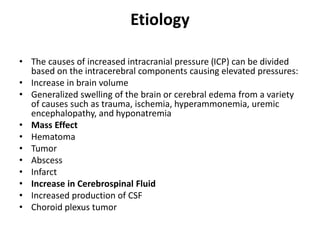
Etiology
• The causes of increased intracranial pressure (ICP) can be divided
based on the intracerebral components causing elevated pressures:
• Increase in brain volume
• Generalized swelling of the brain or cerebral edema from a variety
of causes such as trauma, ischemia, hyperammonemia, uremic
encephalopathy, and hyponatremia
• Mass Effect
• Hematoma
• Tumor
• Abscess
• Infarct
• Increase in Cerebrospinal Fluid
• Increased production of CSF
• Choroid plexus tumor
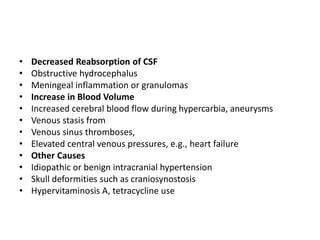
• Decreased Reabsorption of CSF
• Obstructive hydrocephalus
• Meningeal inflammation or granulomas
• Increase in Blood Volume
• Increased cerebral blood flow during hypercarbia, aneurysms
• Venous stasis from
• Venous sinus thromboses,
• Elevated central venous pressures, e.g., heart failure
• Other Causes
• Idiopathic or benign intracranial hypertension
• Skull deformities such as craniosynostosis
• Hypervitaminosis A, tetracycline use
Epidemiology
• The true incidence of intracranial hypertension is
unknown. The Centers for Disease Control and
Prevention (CDC) estimates that in 2010, 2.5
million people sustained a traumatic brain injury
(TBI). TBI is associated with increased ICP. ICP
monitoring is recommended for all patients with
severe TBI. Studies of American-based
populations have estimated that the incidence of
idiopathic intracranial hypertension (IIH) ranges
from 0.9 to 1.0 per 100,000 in the general
population, increasing in women that are
overweight.[2]
Pathophysiology
• The harmful effects of intracranial hypertension are primarily due to
brain injury caused by cerebral ischemia. Cerebral ischemia is the
result of decreased brain perfusion secondary to increased ICP.
Cerebral perfusion pressure (CPP) is the pressure gradient between
mean arterial pressure (MAP) and intracranial pressure (CPP = MAP
- ICP).[3] CPP = MAP - CVP if central venous pressure is higher than
intracranial pressure. CPP target for adults following severe
traumatic brain injury is recommended at greater than 60 to 70 mm
Hg, and a minimum CPP greater than 40 mm Hg is recommended
for infants, with very limited data on normal CPP targets for
children in between.
• Cerebral autoregulation is the process by which cerebral blood flow
varies to maintain adequate cerebral perfusion. When the MAP is
elevated, vasoconstriction occurs to limit blood flow and maintain
cerebral perfusion. However, if a patient is hypotensive, cerebral
vasculature can dilate to increase blood flow and maintain CPP.
History and Physical
• Clinical suspicion for intracranial hypertension should be raised if a
patient presents with the following signs and symptoms:
headaches, vomiting, and altered mental status varying from
drowsiness to coma. Visual changes can range from blurred vision,
double vision from cranial nerve defects, photophobia to optic disc
edema, and eventually optic atrophy. Infants in whom the anterior
fontanelle is still open may have a bulge overlying the area.
• Cushing triad is a clinical syndrome consisting of hypertension,
bradycardia, and irregular respiration and is a sign of impending
brain herniation. This occurs when the ICP is too high the elevation
of blood pressure is a reflex mechanism to maintain CPP. High blood
pressure causes reflex bradycardia and brain stem compromise
affecting respiration. Ultimately the contents of the cranium are
displaced downwards due to the high ICP, causing a phenomenon
known as herniation which can be potentially fatal.[4]
Evaluation
• The evaluation of increased ICP should include detailed history taking, physical examination, and
ancillary studies.
• It is extremely important to identify increased ICP as early as possible to prevent herniation and
death. For example malignant middle cerebral artery stroke presenting with increased ICP.
Malignant middle cerebral artery stroke is seen more commonly in the younger population. Usually,
these patients are admitted to the ICU setting. Following the neurological exam closely is very
important. Usually, there is an altered mental status and development of a fixed and dilated
pupil. Patients presenting with findings suggestive of cerebral insult should undergo computed
tomography (CT) scan of the brain; this can show the edema, which is visible as areas of low density
and loss of gray/white matter differentiation, on an unenhanced image. There can also be an
obliteration of the cisterns and sulcal spaces. A CT scan can also reveal the cause in some cases. If
flattened gyri or narrowed sulci, or compression of the ventricles, is seen, this suggests increased
ICP. Serial CT scans are used to monitor the progression or improvement of the edema.[5]
• A funduscopic exam can reveal papilledema which is a tell-tale sign of raised ICP as the
cerebrospinal fluid is in continuity with the fluid around the optic nerve.
• Imaging- a computed tomography (CT) of the head or magnetic resonance imaging (MRI) can reveal
signs of raised ICP such as enlarged ventricles, herniation, or mass effect from causes such as
tumors, abscesses, and hematomas, among others.
• Measurement of Opening Pressure with a Lumbar Puncture
• In this procedure, a needle is introduced in the subarachnoid space. This can be
connected to a manometer to give the pressure of the CSF prior to drainage. A
measurement greater than 20 mm Hg is suggestive of raised ICP. Brain imaging
should precede an LP because LP can cause a sudden and rapid decrease in ICP
and the sudden change in volume can lead to herniation.
• ICP Monitoring [6]
• Several devices can be used for ICP monitoring.
• The procedure involves the placement of a fiber optic catheter into the brain
parenchyma to measure the pressure transmitted to the brain tissue.
• External Ventricular Drain (EVD)
• A drain placed directly into the lateral ventricles can be connected to a manometer
to give a reading for the pressure in the ventricles.
• Optic Nerve Sheath Diameter (ONSD) [7]
• The use of ultrasound to measure the diameter of the optic nerve sheath has been
recently identified as a method to indicate raised ICP. This is usually measured 3
mm behind the globe with 2–3 measurements taken in each eye. The threshold for
denoting elevated ICP usually ranges from 0.48 cm to 0.63 cm.
Treatment / Management
• Assessment and management of the airway, specifically breathing and circulation should always be
the priority.[8]
• Management principles should be targeted toward:
• Maintenance of cerebral perfusion pressure by raising MAP
• Treatment of the underlying cause.
• Lowering of ICP.[9]
• Measures to lower ICP include:[10]
• Elevation of the head of the bed to greater than 30 degrees.
• Keep the neck midline to facilitate venous drainage from the head.
• Hypercarbia lowers serum pH and can increase cerebral blood flow contributing to rising ICP, hence
hyperventilation to lower pCO2 to around 30 mm Hg can be transiently used.
• Osmotic agents can be used to create an osmotic gradient across blood thereby drawing fluid
intravascularly and decreasing cerebral edema. Mannitol was the primary agent used at doses of
0.25 to 1 g/kg body weight and is thought to exert its greatest benefit by decreasing blood viscosity
and to a lesser extent by decreasing blood volume. Side effects of mannitol use are eventual
osmotic diuresis and dehydration as well as renal injury if serum osmolality exceeds 320
mOsm.[11] Steroids are indicated to reduce ICP in intracranial neoplastic tumors, but not in
traumatic brain injury.
• Three percent hypertonic saline is also commonly used to decrease
cerebral edema and can be administered as a 5 ml/kg bolus or a
continuous infusion, monitoring serum sodium levels closely. It is
considered relatively safe while serum sodium is < than 160mEq/dl
or serum osmolality is less than 340 mOsm.[12]
• Drugs of the carbonic anhydrase inhibitor class, such as
acetazolamide, can be used to decrease the production of CSF and
is used to treat idiopathic intracranial hypertension.
• Lumbar punctures, besides being diagnostic, can be used to drain
CSF thus reducing the ICP. The limitation to this is raised ICP
secondary to mass effect with a possible risk of herniation if the CSF
pressure drops too low.
• Similar to a lumbar puncture, an EVD can also be used to not only
monitor ICP but also to drain CSF.
• Optic nerve fenestrations can be performed for patients with chronic
idiopathic hypertension at a risk of blindness. Neurosurgical shunts such
as ventriculoperitoneal or lumbar-peritoneal shunts can divert CSF to
another part of the body from where it can be reabsorbed.[13]
• Intravenous (IV) glyburide is being investigated in the prevention of
hemispheric stroke edema. It acts by inhibiting SUR1 receptors.[14]
• Barbiturates can be considered in cases where sedation and usual
methods of treatment are not successful in reducing the ICP.[15]
• Therapeutic hypothermia to 32-35 degrees Celcius can be used in a
refractory rise in ICP not responding to hyperosmolar therapy and
barbiturate coma. But its use has been questioned in recent days.
• A decompressive craniectomy is a neurosurgical procedure wherein a part
of the skull is removed, and dura lifted, allowing the brain to swell without
causing compression.[16] It is usually considered as a last resort when all
other ICP lowering measures have failed.
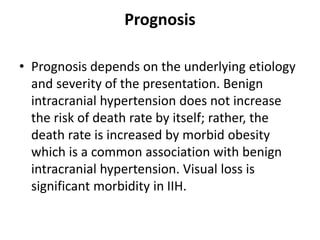
Prognosis
• Prognosis depends on the underlying etiology
and severity of the presentation. Benign
intracranial hypertension does not increase
the risk of death rate by itself; rather, the
death rate is increased by morbid obesity
which is a common association with benign
intracranial hypertension. Visual loss is
significant morbidity in IIH.
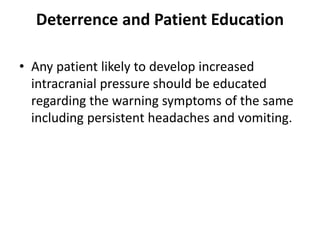
Deterrence and Patient Education
• Any patient likely to develop increased
intracranial pressure should be educated
regarding the warning symptoms of the same
including persistent headaches and vomiting.
Pearls and Other Issues
• A patient who presents with a headache,
vomiting, and blurred vision should be evaluated
for neurologic deficits and receive head imaging
to rule out the causes of intracranial
hypertension.
• All patients with severe TBI (Glasgow coma scale
of 3 to 8 on initial presentation) should follow the
latest guidelines on the management of severe
TBI that includes monitoring of ICP, maintenance
of CPP greater than 60 to 70 mm Hg for adults,
and treatment of ICP greater than 22 mm Hg.
Enhancing Healthcare Team
Outcomes
• The clinical presentation of increased intracranial pressure can
easily be mistaken for other issues, such as intoxication, stroke,
infection, or post-ictal state. It requires a high index of suspicion,
particularly in milder cases. In more severe cases, close neurological
monitoring and consultation with neurology and neurosurgery are
important. Communication regarding
indications/risks/contraindications for ICP monitoring or craniotomy
needs to be ongoing, particularly with respect to goals of care.
Nursing care must pay close attention to changes in neurologic
status, any change in vitals such as an increasingly erratic heart rate,
development of bradycardia, accurate and equal intake and output
when having diuresis, and maintenance of proper blood pressure.
As the patient recovers, physical therapy, occupational therapy, and
speech-language pathology can help the patient maximize function
after the brain injury and evaluate patient safety both before and
after discharge.
• Patient education regarding avoidance of future complications
should come from all team members, with social work involvement
to ensure home safety after discharge, and the patient's primary
care provider should be updated, to ensure appropriate follow-up.
In cases of vasogenic edema due to brain tumor, both oncology,
radiation oncology, and neurosurgery should be consulted to co-
manage the evaluation and management of the neoplasm,
determine the best treatment for the tumor
(resection/radiation/palliation) based on the tumor type/stage, and
follow up with the patient after discharge. And, finally, the patient
and the patient's family and care providers should be educated
about what to watch for that may suggest the need for re-
evaluation because of recurrence, or complications from any of the
interventions.
• Mokri B. The Monro-Kellie hypothesis: applications in CSF volume depletion. Neurology. 2001 Jun 26;56(12):1746-8. [PubMed]
• 2.Kilgore KP, Lee MS, Leavitt JA, Mokri B, Hodge DO, Frank RD, Chen JJ. Re-evaluating the Incidence of Idiopathic Intracranial Hypertension in an Era
of Increasing Obesity. Ophthalmology. 2017 May;124(5):697-700. [PMC free article] [PubMed]
• 3.Mount CA, M Das J. StatPearls [Internet]. StatPearls Publishing; Treasure Island (FL): Apr 5, 2022. Cerebral Perfusion Pressure. [PubMed]
• 4.Munakomi S, M Das J. StatPearls [Internet]. StatPearls Publishing; Treasure Island (FL): Aug 9, 2022. Brain Herniation. [PubMed]
• 5.Nehring SM, Tadi P, Tenny S. StatPearls [Internet]. StatPearls Publishing; Treasure Island (FL): Jul 31, 2022. Cerebral Edema. [PubMed]
• 6.Munakomi S, M Das J. StatPearls [Internet]. StatPearls Publishing; Treasure Island (FL): Aug 9, 2022. Intracranial Pressure Monitoring. [PubMed]
• 7.Changa AR, Czeisler BM, Lord AS. Management of Elevated Intracranial Pressure: a Review. Curr Neurol Neurosci Rep. 2019 Nov
26;19(12):99. [PubMed]
• 8.Mtaweh H, Bell MJ. Management of pediatric traumatic brain injury. Curr Treat Options Neurol. 2015 May;17(5):348. [PubMed]
• 9.Marehbian J, Muehlschlegel S, Edlow BL, Hinson HE, Hwang DY. Medical Management of the Severe Traumatic Brain Injury Patient. Neurocrit
Care. 2017 Dec;27(3):430-446. [PMC free article] [PubMed]
• 10.Geeraerts T, Velly L, Abdennour L, Asehnoune K, Audibert G, Bouzat P, Bruder N, Carrillon R, Cottenceau V, Cotton F, Courtil-Teyssedre S, Dahyot-
Fizelier C, Dailler F, David JS, Engrand N, Fletcher D, Francony G, Gergelé L, Ichai C, Javouhey É, Leblanc PE, Lieutaud T, Meyer P, Mirek S, Orliaguet G,
Proust F, Quintard H, Ract C, Srairi M, Tazarourte K, Vigué B, Payen JF., French Society of Anaesthesia. Intensive Care Medicine. in partnership with
Association de neuro-anesthésie-réanimation de langue française (Anarlf). French Society of Emergency Medicine (Société Française de Médecine
d'urgence (SFMU). Société française de neurochirurgie (SFN). Groupe francophone de réanimation et d’urgences pédiatriques (GFRUP). Association
des anesthésistes-réanimateurs pédiatriques d’expression française (Adarpef). Management of severe traumatic brain injury (first 24hours). Anaesth
Crit Care Pain Med. 2018 Apr;37(2):171-186. [PubMed]
• 11.Knapp JM. Hyperosmolar therapy in the treatment of severe head injury in children: mannitol and hypertonic saline. AACN Clin Issues. 2005 Apr-
Jun;16(2):199-211. [PubMed]
• 12.Upadhyay P, Tripathi VN, Singh RP, Sachan D. Role of hypertonic saline and mannitol in the management of raised intracranial pressure in
children: A randomized comparative study. J Pediatr Neurosci. 2010 Jan;5(1):18-21. [PMC free article] [PubMed]
• 13.Friedman DI, Jacobson DM. Idiopathic intracranial hypertension. J Neuroophthalmol. 2004 Jun;24(2):138-45. [PubMed]
• 14.Sheth KN, Elm JJ, Molyneaux BJ, Hinson H, Beslow LA, Sze GK, Ostwaldt AC, Del Zoppo GJ, Simard JM, Jacobson S, Kimberly WT. Safety and efficacy
of intravenous glyburide on brain swelling after large hemispheric infarction (GAMES-RP): a randomised, double-blind, placebo-controlled phase 2
trial. Lancet Neurol. 2016 Oct;15(11):1160-9. [PubMed]
• 15.Velle F, Lewén A, Howells T, Nilsson P, Enblad P. Temporal effects of barbiturate coma on intracranial pressure and compensatory reserve in
children with traumatic brain injury. Acta Neurochir (Wien). 2021 Feb;163(2):489-498. [PMC free article] [PubMed]
• 16.Smith M. Refractory Intracranial Hypertension: The Role of Decompressive Craniectomy. Anesth Analg. 2017 Dec;125(6):1999-2008. [PubMed]

increased intracranial pressure.pptx

  • 2.
    • The pressurein the cranial vault is measured in millimeters of mercury (mm Hg) and is normally less than 20 mm Hg. The cranium is a rigid structure that contains 3 main components: brain, cerebrospinal fluid, and blood. Any increase in the volume of its contents will increase the pressure within the cranial vault. An increase in the volume of one component will result in a decrease in volume in one or two of the other components. The clinical implication of the change in volume of the component is a decrease in cerebral blood flow or herniation of the brain.
  • 3.
    • Describe thecauses of increased intracranial pressure. • Review the clinical presentation of a patient with increased intracranial pressure. • Summarize the treatment of increased intracranial pressure. • Explain modalities to improve care coordination among interprofessional team members in order to improve outcomes for patients affected by increased intracranial pressure.
  • 4.
    • Intracranial hypertension(IH) is a clinical condition that is associated with an elevation of the pressures within the cranium. The pressure in the cranial vault is measured in millimeters of mercury (mm Hg) and is normally less than 20 mm Hg.
  • 5.
    • The craniumis a rigid structure that contains three main components: brain, cerebrospinal fluid, and blood. Any increase in the volume of its contents will increase the pressure within the cranial vault. The Monroe-Kellie Doctrine states that the contents of the cranium are in a state of constant volume.[1] That is, the total volumes of the brain tissues, cerebrospinal fluid (CSF), and intracranial blood are fixed. An increase in the volume of one component will result in a decrease in volume in one or two of the other components. The clinical implication of the change in volume of the component is a decrease in cerebral blood flow or herniation of the brain.
  • 6.
    • CSF isa clear fluid found in the subarachnoid spaces and ventricles that cushions the brain and spinal cord. It is secreted by the choroid plexus in the lateral ventricles, travels to the third ventricle via the foramen of Monroe. From the third ventricle, CSF reaches the fourth ventricle through the aqueduct of Sylvius. From here, it flows into the subarachnoid space via the foramina of Magendie and Luschka and is eventually reabsorbed into the dural venous sinuses by arachnoid granulation.
  • 7.
    Etiology • The causesof increased intracranial pressure (ICP) can be divided based on the intracerebral components causing elevated pressures: • Increase in brain volume • Generalized swelling of the brain or cerebral edema from a variety of causes such as trauma, ischemia, hyperammonemia, uremic encephalopathy, and hyponatremia • Mass Effect • Hematoma • Tumor • Abscess • Infarct • Increase in Cerebrospinal Fluid • Increased production of CSF • Choroid plexus tumor
  • 8.
    • Decreased Reabsorptionof CSF • Obstructive hydrocephalus • Meningeal inflammation or granulomas • Increase in Blood Volume • Increased cerebral blood flow during hypercarbia, aneurysms • Venous stasis from • Venous sinus thromboses, • Elevated central venous pressures, e.g., heart failure • Other Causes • Idiopathic or benign intracranial hypertension • Skull deformities such as craniosynostosis • Hypervitaminosis A, tetracycline use
  • 9.
    Epidemiology • The trueincidence of intracranial hypertension is unknown. The Centers for Disease Control and Prevention (CDC) estimates that in 2010, 2.5 million people sustained a traumatic brain injury (TBI). TBI is associated with increased ICP. ICP monitoring is recommended for all patients with severe TBI. Studies of American-based populations have estimated that the incidence of idiopathic intracranial hypertension (IIH) ranges from 0.9 to 1.0 per 100,000 in the general population, increasing in women that are overweight.[2]
  • 10.
    Pathophysiology • The harmfuleffects of intracranial hypertension are primarily due to brain injury caused by cerebral ischemia. Cerebral ischemia is the result of decreased brain perfusion secondary to increased ICP. Cerebral perfusion pressure (CPP) is the pressure gradient between mean arterial pressure (MAP) and intracranial pressure (CPP = MAP - ICP).[3] CPP = MAP - CVP if central venous pressure is higher than intracranial pressure. CPP target for adults following severe traumatic brain injury is recommended at greater than 60 to 70 mm Hg, and a minimum CPP greater than 40 mm Hg is recommended for infants, with very limited data on normal CPP targets for children in between. • Cerebral autoregulation is the process by which cerebral blood flow varies to maintain adequate cerebral perfusion. When the MAP is elevated, vasoconstriction occurs to limit blood flow and maintain cerebral perfusion. However, if a patient is hypotensive, cerebral vasculature can dilate to increase blood flow and maintain CPP.
  • 11.
    History and Physical •Clinical suspicion for intracranial hypertension should be raised if a patient presents with the following signs and symptoms: headaches, vomiting, and altered mental status varying from drowsiness to coma. Visual changes can range from blurred vision, double vision from cranial nerve defects, photophobia to optic disc edema, and eventually optic atrophy. Infants in whom the anterior fontanelle is still open may have a bulge overlying the area. • Cushing triad is a clinical syndrome consisting of hypertension, bradycardia, and irregular respiration and is a sign of impending brain herniation. This occurs when the ICP is too high the elevation of blood pressure is a reflex mechanism to maintain CPP. High blood pressure causes reflex bradycardia and brain stem compromise affecting respiration. Ultimately the contents of the cranium are displaced downwards due to the high ICP, causing a phenomenon known as herniation which can be potentially fatal.[4]
  • 12.
    Evaluation • The evaluationof increased ICP should include detailed history taking, physical examination, and ancillary studies. • It is extremely important to identify increased ICP as early as possible to prevent herniation and death. For example malignant middle cerebral artery stroke presenting with increased ICP. Malignant middle cerebral artery stroke is seen more commonly in the younger population. Usually, these patients are admitted to the ICU setting. Following the neurological exam closely is very important. Usually, there is an altered mental status and development of a fixed and dilated pupil. Patients presenting with findings suggestive of cerebral insult should undergo computed tomography (CT) scan of the brain; this can show the edema, which is visible as areas of low density and loss of gray/white matter differentiation, on an unenhanced image. There can also be an obliteration of the cisterns and sulcal spaces. A CT scan can also reveal the cause in some cases. If flattened gyri or narrowed sulci, or compression of the ventricles, is seen, this suggests increased ICP. Serial CT scans are used to monitor the progression or improvement of the edema.[5] • A funduscopic exam can reveal papilledema which is a tell-tale sign of raised ICP as the cerebrospinal fluid is in continuity with the fluid around the optic nerve. • Imaging- a computed tomography (CT) of the head or magnetic resonance imaging (MRI) can reveal signs of raised ICP such as enlarged ventricles, herniation, or mass effect from causes such as tumors, abscesses, and hematomas, among others.
  • 13.
    • Measurement ofOpening Pressure with a Lumbar Puncture • In this procedure, a needle is introduced in the subarachnoid space. This can be connected to a manometer to give the pressure of the CSF prior to drainage. A measurement greater than 20 mm Hg is suggestive of raised ICP. Brain imaging should precede an LP because LP can cause a sudden and rapid decrease in ICP and the sudden change in volume can lead to herniation. • ICP Monitoring [6] • Several devices can be used for ICP monitoring. • The procedure involves the placement of a fiber optic catheter into the brain parenchyma to measure the pressure transmitted to the brain tissue. • External Ventricular Drain (EVD) • A drain placed directly into the lateral ventricles can be connected to a manometer to give a reading for the pressure in the ventricles. • Optic Nerve Sheath Diameter (ONSD) [7] • The use of ultrasound to measure the diameter of the optic nerve sheath has been recently identified as a method to indicate raised ICP. This is usually measured 3 mm behind the globe with 2–3 measurements taken in each eye. The threshold for denoting elevated ICP usually ranges from 0.48 cm to 0.63 cm.
  • 14.
    Treatment / Management •Assessment and management of the airway, specifically breathing and circulation should always be the priority.[8] • Management principles should be targeted toward: • Maintenance of cerebral perfusion pressure by raising MAP • Treatment of the underlying cause. • Lowering of ICP.[9] • Measures to lower ICP include:[10] • Elevation of the head of the bed to greater than 30 degrees. • Keep the neck midline to facilitate venous drainage from the head. • Hypercarbia lowers serum pH and can increase cerebral blood flow contributing to rising ICP, hence hyperventilation to lower pCO2 to around 30 mm Hg can be transiently used. • Osmotic agents can be used to create an osmotic gradient across blood thereby drawing fluid intravascularly and decreasing cerebral edema. Mannitol was the primary agent used at doses of 0.25 to 1 g/kg body weight and is thought to exert its greatest benefit by decreasing blood viscosity and to a lesser extent by decreasing blood volume. Side effects of mannitol use are eventual osmotic diuresis and dehydration as well as renal injury if serum osmolality exceeds 320 mOsm.[11] Steroids are indicated to reduce ICP in intracranial neoplastic tumors, but not in traumatic brain injury.
  • 15.
    • Three percenthypertonic saline is also commonly used to decrease cerebral edema and can be administered as a 5 ml/kg bolus or a continuous infusion, monitoring serum sodium levels closely. It is considered relatively safe while serum sodium is < than 160mEq/dl or serum osmolality is less than 340 mOsm.[12] • Drugs of the carbonic anhydrase inhibitor class, such as acetazolamide, can be used to decrease the production of CSF and is used to treat idiopathic intracranial hypertension. • Lumbar punctures, besides being diagnostic, can be used to drain CSF thus reducing the ICP. The limitation to this is raised ICP secondary to mass effect with a possible risk of herniation if the CSF pressure drops too low. • Similar to a lumbar puncture, an EVD can also be used to not only monitor ICP but also to drain CSF.
  • 16.
    • Optic nervefenestrations can be performed for patients with chronic idiopathic hypertension at a risk of blindness. Neurosurgical shunts such as ventriculoperitoneal or lumbar-peritoneal shunts can divert CSF to another part of the body from where it can be reabsorbed.[13] • Intravenous (IV) glyburide is being investigated in the prevention of hemispheric stroke edema. It acts by inhibiting SUR1 receptors.[14] • Barbiturates can be considered in cases where sedation and usual methods of treatment are not successful in reducing the ICP.[15] • Therapeutic hypothermia to 32-35 degrees Celcius can be used in a refractory rise in ICP not responding to hyperosmolar therapy and barbiturate coma. But its use has been questioned in recent days. • A decompressive craniectomy is a neurosurgical procedure wherein a part of the skull is removed, and dura lifted, allowing the brain to swell without causing compression.[16] It is usually considered as a last resort when all other ICP lowering measures have failed.
  • 17.
    Prognosis • Prognosis dependson the underlying etiology and severity of the presentation. Benign intracranial hypertension does not increase the risk of death rate by itself; rather, the death rate is increased by morbid obesity which is a common association with benign intracranial hypertension. Visual loss is significant morbidity in IIH.
  • 18.
    Deterrence and PatientEducation • Any patient likely to develop increased intracranial pressure should be educated regarding the warning symptoms of the same including persistent headaches and vomiting.
  • 19.
    Pearls and OtherIssues • A patient who presents with a headache, vomiting, and blurred vision should be evaluated for neurologic deficits and receive head imaging to rule out the causes of intracranial hypertension. • All patients with severe TBI (Glasgow coma scale of 3 to 8 on initial presentation) should follow the latest guidelines on the management of severe TBI that includes monitoring of ICP, maintenance of CPP greater than 60 to 70 mm Hg for adults, and treatment of ICP greater than 22 mm Hg.
  • 20.
    Enhancing Healthcare Team Outcomes •The clinical presentation of increased intracranial pressure can easily be mistaken for other issues, such as intoxication, stroke, infection, or post-ictal state. It requires a high index of suspicion, particularly in milder cases. In more severe cases, close neurological monitoring and consultation with neurology and neurosurgery are important. Communication regarding indications/risks/contraindications for ICP monitoring or craniotomy needs to be ongoing, particularly with respect to goals of care. Nursing care must pay close attention to changes in neurologic status, any change in vitals such as an increasingly erratic heart rate, development of bradycardia, accurate and equal intake and output when having diuresis, and maintenance of proper blood pressure. As the patient recovers, physical therapy, occupational therapy, and speech-language pathology can help the patient maximize function after the brain injury and evaluate patient safety both before and after discharge.
  • 21.
    • Patient educationregarding avoidance of future complications should come from all team members, with social work involvement to ensure home safety after discharge, and the patient's primary care provider should be updated, to ensure appropriate follow-up. In cases of vasogenic edema due to brain tumor, both oncology, radiation oncology, and neurosurgery should be consulted to co- manage the evaluation and management of the neoplasm, determine the best treatment for the tumor (resection/radiation/palliation) based on the tumor type/stage, and follow up with the patient after discharge. And, finally, the patient and the patient's family and care providers should be educated about what to watch for that may suggest the need for re- evaluation because of recurrence, or complications from any of the interventions.
  • 22.
    • Mokri B.The Monro-Kellie hypothesis: applications in CSF volume depletion. Neurology. 2001 Jun 26;56(12):1746-8. [PubMed] • 2.Kilgore KP, Lee MS, Leavitt JA, Mokri B, Hodge DO, Frank RD, Chen JJ. Re-evaluating the Incidence of Idiopathic Intracranial Hypertension in an Era of Increasing Obesity. Ophthalmology. 2017 May;124(5):697-700. [PMC free article] [PubMed] • 3.Mount CA, M Das J. StatPearls [Internet]. StatPearls Publishing; Treasure Island (FL): Apr 5, 2022. Cerebral Perfusion Pressure. [PubMed] • 4.Munakomi S, M Das J. StatPearls [Internet]. StatPearls Publishing; Treasure Island (FL): Aug 9, 2022. Brain Herniation. [PubMed] • 5.Nehring SM, Tadi P, Tenny S. StatPearls [Internet]. StatPearls Publishing; Treasure Island (FL): Jul 31, 2022. Cerebral Edema. [PubMed] • 6.Munakomi S, M Das J. StatPearls [Internet]. StatPearls Publishing; Treasure Island (FL): Aug 9, 2022. Intracranial Pressure Monitoring. [PubMed] • 7.Changa AR, Czeisler BM, Lord AS. Management of Elevated Intracranial Pressure: a Review. Curr Neurol Neurosci Rep. 2019 Nov 26;19(12):99. [PubMed] • 8.Mtaweh H, Bell MJ. Management of pediatric traumatic brain injury. Curr Treat Options Neurol. 2015 May;17(5):348. [PubMed] • 9.Marehbian J, Muehlschlegel S, Edlow BL, Hinson HE, Hwang DY. Medical Management of the Severe Traumatic Brain Injury Patient. Neurocrit Care. 2017 Dec;27(3):430-446. [PMC free article] [PubMed] • 10.Geeraerts T, Velly L, Abdennour L, Asehnoune K, Audibert G, Bouzat P, Bruder N, Carrillon R, Cottenceau V, Cotton F, Courtil-Teyssedre S, Dahyot- Fizelier C, Dailler F, David JS, Engrand N, Fletcher D, Francony G, Gergelé L, Ichai C, Javouhey É, Leblanc PE, Lieutaud T, Meyer P, Mirek S, Orliaguet G, Proust F, Quintard H, Ract C, Srairi M, Tazarourte K, Vigué B, Payen JF., French Society of Anaesthesia. Intensive Care Medicine. in partnership with Association de neuro-anesthésie-réanimation de langue française (Anarlf). French Society of Emergency Medicine (Société Française de Médecine d'urgence (SFMU). Société française de neurochirurgie (SFN). Groupe francophone de réanimation et d’urgences pédiatriques (GFRUP). Association des anesthésistes-réanimateurs pédiatriques d’expression française (Adarpef). Management of severe traumatic brain injury (first 24hours). Anaesth Crit Care Pain Med. 2018 Apr;37(2):171-186. [PubMed] • 11.Knapp JM. Hyperosmolar therapy in the treatment of severe head injury in children: mannitol and hypertonic saline. AACN Clin Issues. 2005 Apr- Jun;16(2):199-211. [PubMed] • 12.Upadhyay P, Tripathi VN, Singh RP, Sachan D. Role of hypertonic saline and mannitol in the management of raised intracranial pressure in children: A randomized comparative study. J Pediatr Neurosci. 2010 Jan;5(1):18-21. [PMC free article] [PubMed] • 13.Friedman DI, Jacobson DM. Idiopathic intracranial hypertension. J Neuroophthalmol. 2004 Jun;24(2):138-45. [PubMed] • 14.Sheth KN, Elm JJ, Molyneaux BJ, Hinson H, Beslow LA, Sze GK, Ostwaldt AC, Del Zoppo GJ, Simard JM, Jacobson S, Kimberly WT. Safety and efficacy of intravenous glyburide on brain swelling after large hemispheric infarction (GAMES-RP): a randomised, double-blind, placebo-controlled phase 2 trial. Lancet Neurol. 2016 Oct;15(11):1160-9. [PubMed] • 15.Velle F, Lewén A, Howells T, Nilsson P, Enblad P. Temporal effects of barbiturate coma on intracranial pressure and compensatory reserve in children with traumatic brain injury. Acta Neurochir (Wien). 2021 Feb;163(2):489-498. [PMC free article] [PubMed] • 16.Smith M. Refractory Intracranial Hypertension: The Role of Decompressive Craniectomy. Anesth Analg. 2017 Dec;125(6):1999-2008. [PubMed]