KEROGEN: COMPOSITION AND
CLASSIFICATION
BY
OLATINPO, OLUSEGUN AYOBAMI
MATRIC NO: 14/68ET003
APRIL 29, 2015
1OLUSEGUN OLATINPO
OUTLINE
• What Kerogen is
• Composition of Kerogen
• Classification of Kerogen
• Summary and Conclusion
2OLUSEGUN OLATINPO
WHAT KEROGEN IS
 Defined by solubility:
Organic Matter insoluble in organic solvents because
of the large molecular weight up to several thousand
Daltons
 Defined by petroleum:
• Organic Matter capable of producing petroleum
• End result of diagenesis stage during the process of petroleum
formation is conversion of organic matter to kerogen
Extraction method alters kerogen properties: physical,
compositional, and structural!
• Can be mixed with other insoluble OM: tar, asphaltene,
bitumen!
OLUSEGUN OLATINPO 3
Ingredient for generatingkerogen
• For kerogen to be generated, organic matter must be present in
abundance
• Organic matter is accumulated mostly in a dispersed state in
predominantly clay-sized marine deposits
• It comprises mainly algae and plants, and some animal matter
• However, the type and amount of kerogen generation from organic
matter in a basin depends on:
nature of the organic matter in the sediments
abundance of the organic matter
thermal maturity (degree of cooking by heating) of the
organic matter during burial
nature and type of environment in which the organic matter
accumulated
OLUSEGUN OLATINPO 4
NOTE!!!
OLUSEGUN OLATINPO 5
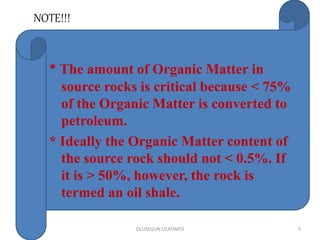
* The amount of Organic Matter in
source rocks is critical because < 75%
of the Organic Matter is converted to
petroleum.
* Ideally the Organic Matter content of
the source rock should not < 0.5%. If
it is > 50%, however, the rock is
termed an oil shale.
OLUSEGUN OLATINPO 6
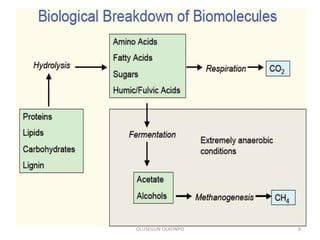
“The decomposed components of
bacteria, zooplankton (esp.
foraminifers & crustaceans),
macro benthos, etc along with
that from primary producers (i.e.
molecules derived from proteins,
carbohydrates, lipids, lignin)
form the organic matter that is
found in sediment” (Armstrong,
2010)
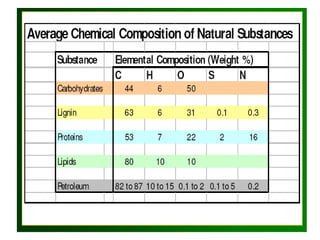
COMPOSITION OF KEROGEN
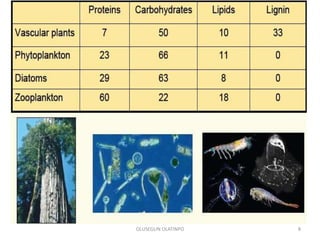
• Organic matter is divided into:
1. Humic OM: results in the formation of coal & gas.
2.Sapropelic OM: gives rise to liquid & gaseous HCs.
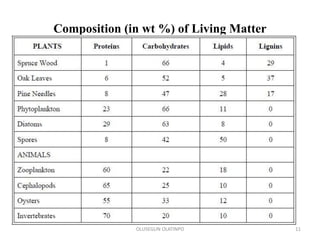
• On average, the composition of organic matter in sediment is as
follows:
40% Proteins
40% Carbohydrates
10% Lipids
10% Lignin
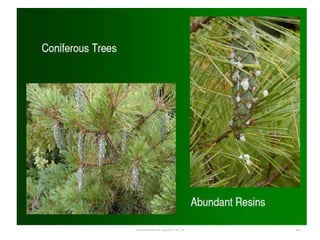
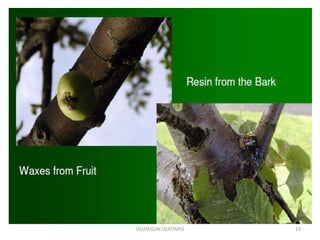
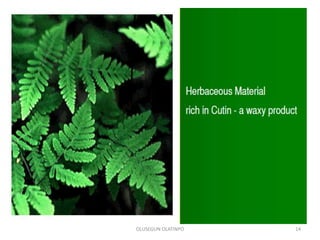
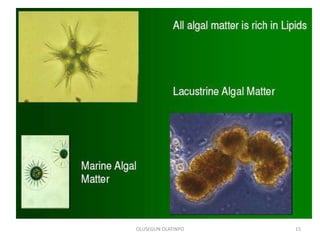
• These materials are supplied by: Trees, Herbaceous plants, Fungi,
Algae, Protozoa, Bacteria, and Faeces
• All of these + Time + Temperature + Pressure = KEROGEN
OLUSEGUN OLATINPO 7
OLUSEGUN OLATINPO 8
OLUSEGUN OLATINPO 9
OLUSEGUN OLATINPO 10
Composition (in wt %) of Living Matter
OLUSEGUN OLATINPO 11
OLUSEGUN OLATINPO 12
OLUSEGUN OLATINPO 13
OLUSEGUN OLATINPO 14
OLUSEGUN OLATINPO 15
CLASSIFICATION OF KEROGEN
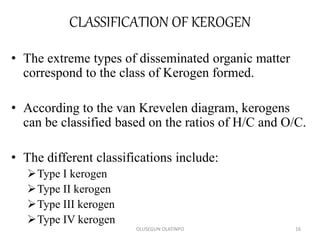
• The extreme types of disseminated organic matter
correspond to the class of Kerogen formed.
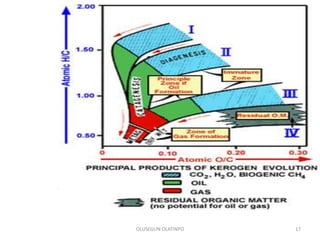
• According to the van Krevelen diagram, kerogens
can be classified based on the ratios of H/C and O/C.
• The different classifications include:
Type I kerogen
Type II kerogen
Type III kerogen
Type IV kerogen
OLUSEGUN OLATINPO 16
OLUSEGUN OLATINPO 17
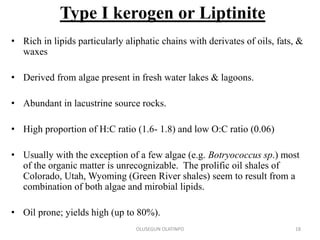
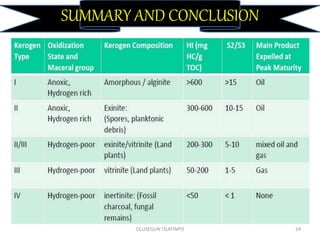
Type I kerogen or Liptinite
• Rich in lipids particularly aliphatic chains with derivates of oils, fats, &
waxes
• Derived from algae present in fresh water lakes & lagoons.
• Abundant in lacustrine source rocks.
• High proportion of H:C ratio (1.6- 1.8) and low O:C ratio (0.06)
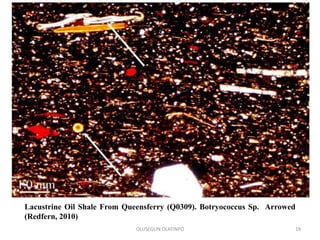
• Usually with the exception of a few algae (e.g. Botryococcus sp.) most
of the organic matter is unrecognizable. The prolific oil shales of
Colorado, Utah, Wyoming (Green River shales) seem to result from a
combination of both algae and mirobial lipids.
• Oil prone; yields high (up to 80%).
OLUSEGUN OLATINPO 18
Lacustrine Oil Shale From Queensferry (Q0309). Botryococcus Sp. Arrowed
(Redfern, 2010)
OLUSEGUN OLATINPO 19
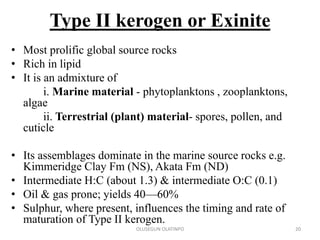
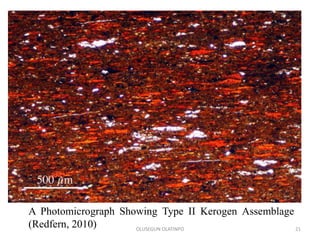
Type II kerogen or Exinite
• Most prolific global source rocks
• Rich in lipid
• It is an admixture of
i. Marine material - phytoplanktons , zooplanktons,
algae
ii. Terrestrial (plant) material- spores, pollen, and
cuticle
• Its assemblages dominate in the marine source rocks e.g.
Kimmeridge Clay Fm (NS), Akata Fm (ND)
• Intermediate H:C (about 1.3) & intermediate O:C (0.1)
• Oil & gas prone; yields 40—60%
• Sulphur, where present, influences the timing and rate of
maturation of Type II kerogen.
OLUSEGUN OLATINPO 20
A Photomicrograph Showing Type II Kerogen Assemblage
(Redfern, 2010) OLUSEGUN OLATINPO 21
Type III kerogen (or Vitrinite)
• Rich in lignin derived from woody land plant debris
• The debris occurs abundantly in coals
• Low H:C ratio (< 1.0) & high O:C ratio (0.15)
• Low yield for oil but gas prone
• Low in aliphatic compounds but rich in aromatic compounds
• Example of vitrinite-dominated source rocks include the
Carboniferous Coal Measures of the southern North Sea basin
OLUSEGUN OLATINPO 22
Type IV kerogen (or Inertinite)
• High in carbon and very low in hydrogen
• Often termed “dead-carbon”
• No effective potential to generate petroleum
OLUSEGUN OLATINPO 23
SUMMARY AND CONCLUSION
OLUSEGUN OLATINPO 24
I APPRECIATE YOUR ATTENTION
OLUSEGUN OLATINPO 25

OLATINPO KEROGEN PRESENTATION

  • 1.
    KEROGEN: COMPOSITION AND CLASSIFICATION BY OLATINPO,OLUSEGUN AYOBAMI MATRIC NO: 14/68ET003 APRIL 29, 2015 1OLUSEGUN OLATINPO
  • 2.
    OUTLINE • What Kerogenis • Composition of Kerogen • Classification of Kerogen • Summary and Conclusion 2OLUSEGUN OLATINPO
  • 3.
    WHAT KEROGEN IS Defined by solubility: Organic Matter insoluble in organic solvents because of the large molecular weight up to several thousand Daltons  Defined by petroleum: • Organic Matter capable of producing petroleum • End result of diagenesis stage during the process of petroleum formation is conversion of organic matter to kerogen Extraction method alters kerogen properties: physical, compositional, and structural! • Can be mixed with other insoluble OM: tar, asphaltene, bitumen! OLUSEGUN OLATINPO 3
  • 4.
    Ingredient for generatingkerogen •For kerogen to be generated, organic matter must be present in abundance • Organic matter is accumulated mostly in a dispersed state in predominantly clay-sized marine deposits • It comprises mainly algae and plants, and some animal matter • However, the type and amount of kerogen generation from organic matter in a basin depends on: nature of the organic matter in the sediments abundance of the organic matter thermal maturity (degree of cooking by heating) of the organic matter during burial nature and type of environment in which the organic matter accumulated OLUSEGUN OLATINPO 4
  • 5.
    NOTE!!! OLUSEGUN OLATINPO 5 *The amount of Organic Matter in source rocks is critical because < 75% of the Organic Matter is converted to petroleum. * Ideally the Organic Matter content of the source rock should not < 0.5%. If it is > 50%, however, the rock is termed an oil shale.
  • 6.
    OLUSEGUN OLATINPO 6 “Thedecomposed components of bacteria, zooplankton (esp. foraminifers & crustaceans), macro benthos, etc along with that from primary producers (i.e. molecules derived from proteins, carbohydrates, lipids, lignin) form the organic matter that is found in sediment” (Armstrong, 2010)
  • 7.
    COMPOSITION OF KEROGEN •Organic matter is divided into: 1. Humic OM: results in the formation of coal & gas. 2.Sapropelic OM: gives rise to liquid & gaseous HCs. • On average, the composition of organic matter in sediment is as follows: 40% Proteins 40% Carbohydrates 10% Lipids 10% Lignin • These materials are supplied by: Trees, Herbaceous plants, Fungi, Algae, Protozoa, Bacteria, and Faeces • All of these + Time + Temperature + Pressure = KEROGEN OLUSEGUN OLATINPO 7
  • 8.
  • 9.
  • 10.
  • 11.
    Composition (in wt%) of Living Matter OLUSEGUN OLATINPO 11
  • 12.
  • 13.
  • 14.
  • 15.
  • 16.
    CLASSIFICATION OF KEROGEN •The extreme types of disseminated organic matter correspond to the class of Kerogen formed. • According to the van Krevelen diagram, kerogens can be classified based on the ratios of H/C and O/C. • The different classifications include: Type I kerogen Type II kerogen Type III kerogen Type IV kerogen OLUSEGUN OLATINPO 16
  • 17.
  • 18.
    Type I kerogenor Liptinite • Rich in lipids particularly aliphatic chains with derivates of oils, fats, & waxes • Derived from algae present in fresh water lakes & lagoons. • Abundant in lacustrine source rocks. • High proportion of H:C ratio (1.6- 1.8) and low O:C ratio (0.06) • Usually with the exception of a few algae (e.g. Botryococcus sp.) most of the organic matter is unrecognizable. The prolific oil shales of Colorado, Utah, Wyoming (Green River shales) seem to result from a combination of both algae and mirobial lipids. • Oil prone; yields high (up to 80%). OLUSEGUN OLATINPO 18
  • 19.
    Lacustrine Oil ShaleFrom Queensferry (Q0309). Botryococcus Sp. Arrowed (Redfern, 2010) OLUSEGUN OLATINPO 19
  • 20.
    Type II kerogenor Exinite • Most prolific global source rocks • Rich in lipid • It is an admixture of i. Marine material - phytoplanktons , zooplanktons, algae ii. Terrestrial (plant) material- spores, pollen, and cuticle • Its assemblages dominate in the marine source rocks e.g. Kimmeridge Clay Fm (NS), Akata Fm (ND) • Intermediate H:C (about 1.3) & intermediate O:C (0.1) • Oil & gas prone; yields 40—60% • Sulphur, where present, influences the timing and rate of maturation of Type II kerogen. OLUSEGUN OLATINPO 20
  • 21.
    A Photomicrograph ShowingType II Kerogen Assemblage (Redfern, 2010) OLUSEGUN OLATINPO 21
  • 22.
    Type III kerogen(or Vitrinite) • Rich in lignin derived from woody land plant debris • The debris occurs abundantly in coals • Low H:C ratio (< 1.0) & high O:C ratio (0.15) • Low yield for oil but gas prone • Low in aliphatic compounds but rich in aromatic compounds • Example of vitrinite-dominated source rocks include the Carboniferous Coal Measures of the southern North Sea basin OLUSEGUN OLATINPO 22
  • 23.
    Type IV kerogen(or Inertinite) • High in carbon and very low in hydrogen • Often termed “dead-carbon” • No effective potential to generate petroleum OLUSEGUN OLATINPO 23
  • 24.
  • 25.
    I APPRECIATE YOURATTENTION OLUSEGUN OLATINPO 25