http://upload.wikimedia.org/wikipedia/commons/c/ce/Oil_well.jpg
http://en.wikipedia.org/wiki/Image:Moscow_traffic_congestion.JPG
NASA
en.wikipedia.org/wiki/Image:Oil_platform.jpg
en.wikipedia.org/wiki/Image:Ceratium_hirundinella.jpg
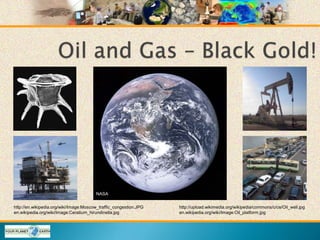
Part 1: Origin – How do oil and gas form?
Practical: Non-Renewable Energy
Part 2: Exploration and Production –
How do we find oil and gas and how is it produced?
Practical: Prospector Game
Part 3: Politics – Why are oil and gas important?
Crude Oil
Hydrocarbon
en.wikipedia.org/wiki/Image:Octane_molecule_3D_model.png
en.wikipedia.org/wiki/Image:Petroleum.JPG
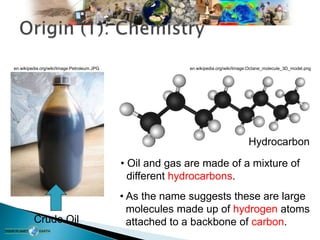
• Oil and gas are made of a mixture of
different hydrocarbons.
• As the name suggests these are large
molecules made up of hydrogen atoms
attached to a backbone of carbon.
cache.eb.com/eb/image?id=93510
en.wikipedia.org/wiki/Image:Copepod.
en.wikipedia.org/wiki/Image:Ceratium_hirundinella.jpg
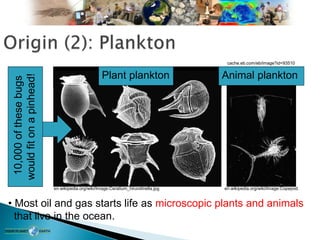
• Most oil and gas starts life as microscopic plants and animals
that live in the ocean.
Plant plankton Animal plankton
10,000
of
these
bugs
would
fit
on
a
pinhead!
serc.carleton.edu/images/microbelife/topics/red_tide_genera.v3.jpg
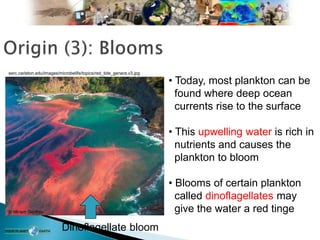
• Today, most plankton can be
found where deep ocean
currents rise to the surface
• This upwelling water is rich in
nutrients and causes the
plankton to bloom
• Blooms of certain plankton
called dinoflagellates may
give the water a red tinge
© Miriam Godfrey
Dinoflagellate bloom
upload.wikimedia.org/wikipedia/en/0/04/Plankton.jpg
When the plankton dies it rains
down on sea bed to form an
organic mush
Sea bed
en.wikipedia.org/wiki/Image:Nerr0328.jpg
If there are any animals on the
sea bed these will feed on the
organic particles
upload.wikimedia.org/wikipedia/en/0/04/Plankton.jpg
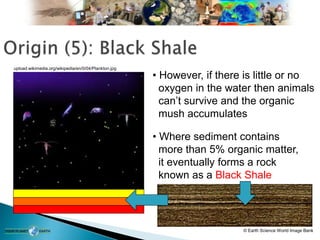
• However, if there is little or no
oxygen in the water then animals
can’t survive and the organic
mush accumulates
• Where sediment contains
more than 5% organic matter,
it eventually forms a rock
known as a Black Shale
© Earth Science World Image Bank
www.oilandgasgeology.com/oil_gas_window.jpg
As Black Shale is buried, it is heated.
Kerogen
Gas
Oil
Organic matter is first changed by the
increase in temperature into kerogen,
which is a solid form of hydrocarbon
Around 90°C, it is changed into a liquid
state, which we call oil
Around 150°C, it is changed into a gas
A rock that has produced oil and gas in
this way is known as a Source Rock
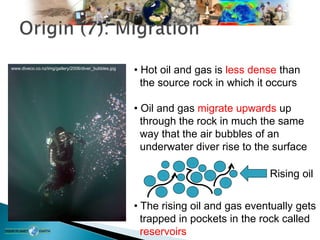
www.diveco.co.nz/img/gallery/2006/diver_bubbles.jpg
• Hot oil and gas is less dense than
the source rock in which it occurs
• Oil and gas migrate upwards up
through the rock in much the same
way that the air bubbles of an
underwater diver rise to the surface
• The rising oil and gas eventually gets
trapped in pockets in the rock called
reservoirs
Rising oil
© Ron Blakey, Arizona Flagstaff
• During mid-Mesozoic times
around 150 million years ago,
conditions were just right
to build up huge thicknesses
of Black Shale source rocks
Ancient Earth
The world’s main oil deposits all formed in warm shallow seas
where plankton bloomed but bottom waters were deoxygenated
Ancient Earth
© Ian and Tonya West
The Kimmeridge Clay is a Black Shale with up to 50% organic
matter. It is the main source rock for the North Sea Oil & Gas
Province
Black Shale
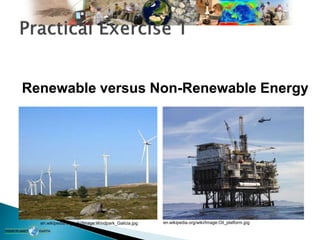
Renewable versus Non-Renewable Energy
en.wikipedia.org/wiki/Image:Oil_platform.jpg
en.wikipedia.org/wiki/Image:Windpark_Galicia.jpg
• Some rocks are permeable
and allow oil and gas to freely
pass through them
• Other rocks are impermeable
and block the upward passage
of oil and gas
• Where oil and gas rises up
into a dome (or anticline)
capped by impermeable rocks
it can’t escape. This is one
type of an Oil Trap.
Impermeable
Permeable
Dome Trap
Earth Science World Image Bank Image #h5innl
• The permeable strata in an oil trap
is known as the Reservoir Rock
• Reservoir rocks have lots of
interconnected holes called pores.
These absorb the oil and gas like a
sponge
This is a highly magnified picture of
a sandy reservoir rock (water-filled
pores are shown in blue)
As oil migrates it fills up the pores
(oil-filled pores shown in black)
Earth Science World Image Bank Image #h5inpj
Earth Science World Image Bank Image #h5inor
• Seismic surveys are used to locate likely rock structures
underground in which oil and gas might be found
• Shock waves are fired into the ground. These bounce off layers
of rock and reveal any structural domes that might contain oil
Drill here!
• Once an oil or gas prospect has
been identified, a hole is drilled to
assess the potential
• The cost of drilling is very great.
On an offshore rig, it may cost
$10,000 for each metre drilled.
• A company incurs vast losses
for every “dry hole” drilled
en.wikipedia.org/wiki/Image:Oil_platform.jpg
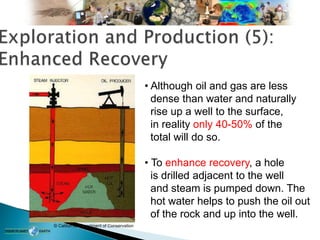
© California Department of Conservation
• Although oil and gas are less
dense than water and naturally
rise up a well to the surface,
in reality only 40-50% of the
total will do so.
• To enhance recovery, a hole
is drilled adjacent to the well
and steam is pumped down. The
hot water helps to push the oil out
of the rock and up into the well.
United States Geological Survey
• Once extracted oil and
gas must be sent to a
refinery for processing
• Pipelines transport
most of the world’s oil
from well to refinery
• Massive Oil Tankers
also play an important
role in distribution
Trans-Alaskan Pipeline
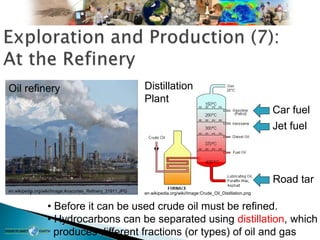
• Before it can be used crude oil must be refined.
• Hydrocarbons can be separated using distillation, which
produces different fractions (or types) of oil and gas
Oil refinery Distillation
Plant
en.wikipedia.org/wiki/Image:Anacortes_Refinery_31911.JPG en.wikipedia.org/wiki/Image:Crude_Oil_Distillation.png
Jet fuel
Car fuel
Road tar
en.wikipedia.org/wiki/Image:Abraham_Gesner.gif
en.wikipedia.org/wiki/Image:Oilfields_California.jpg
Abraham Gesner
(1797-1864)
Californian oil gusher
• The modern era of oil
usage began in 1846 when
Gesner perfected the art
of paraffin distillation.
• This triggered a massive
worldwide boom in oil
production.
• California was centre of
activity in the early 1900s,
famous for its gushers.
en.wikipedia.org/wiki/Image:Lucas_gusher.jpg
USGS
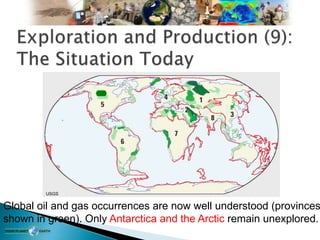
Global oil and gas occurrences are now well understood (provinces
shown in green). Only Antarctica and the Arctic remain unexplored.
The Oil Prospector Game
• 84% of crude oil is refined
into fuel, principally for cars
and planes
• Demand is ever increasing,
especially due to growth of
Chinese economy
http://en.wikipedia.org/wiki/Image:Shellgasstationlosthills.jpg
blogs.sun.com/richb/resource/NBC_at_the_Pump.jpg
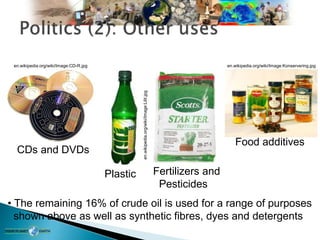
• The remaining 16% of crude oil is used for a range of purposes
shown above as well as synthetic fibres, dyes and detergents
Fertilizers and
Pesticides
Food additives
Plastic
en.wikipedia.org/wiki/Image:CD-R.jpg
CDs and DVDs
en.wikipedia.org/wiki/Image:Lilit.jpg
en.wikipedia.org/wiki/Image:Konservering.jpg
en.wikipedia.org/wiki/Image:Opec_Organization_of_the_Petroleum_Exporting_Countries_countries.PNG
• Organization of the Petroleum Exporting Countries (OPEC) is a
group of 13 countries that produce 36% of the world’s oil, or
32 million barrels of oil per day.
• The biggest producer is Saudi Arabia, but Iran, United Arab
Emirates, Kuwait and Venezuela are also major suppliers
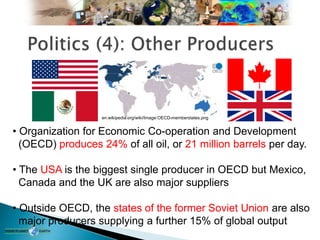
• Organization for Economic Co-operation and Development
(OECD) produces 24% of all oil, or 21 million barrels per day.
• The USA is the biggest single producer in OECD but Mexico,
Canada and the UK are also major suppliers
• Outside OECD, the states of the former Soviet Union are also
major producers supplying a further 15% of global output
en.wikipedia.org/wiki/Image:OECD-memberstates.png
• In 2007, global consumption grew by 1.2 million barrels per day.
• OPEC and OECD nations can only raise production by a further
2.5 million barrels per day so a squeeze is on the cards
en.wikipedia.org/wiki/Image:OilConsumptionpercapita.png
USA uses 24% of global
supply but China shows
the biggest year-to-year
increase in usage
Oil consumption per person
(darker reds indicate higher usage)
en.wikipedia.org/wiki/Image:Hubbert_peak_oil_plot.svg en.wikipedia.org/wiki/Image:Hubbert.jpg
Hubbert (1903-1989)
Era of
energy
crisis
• In 1956, Hubbert predicted that global oil production would peak
around the Year 2000 and trigger an Energy Crisis with power
blackouts and rising costs of energy and fuel
en.wikipedia.org/wiki/Image:Oil_Prices_Medium_Term.png
$139 by June 2008
• Oil prices have been steadily rising for
several years and in June 2008 stand
at a record high of $139 per barrel.
• Is the rise due to a squeeze in availability
(peak oil) or are other political or
economic factors to blame?
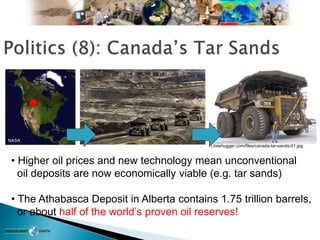
• Higher oil prices and new technology mean unconventional
oil deposits are now economically viable (e.g. tar sands)
• The Athabasca Deposit in Alberta contains 1.75 trillion barrels,
or about half of the world’s proven oil reserves!
i.treehugger.com/files/canada-tar-sands-01.jpg
NASA
• Oil and Gas emit 15-30% less CO2 than coal per watt of energy
produced. Renewable energy is clean but not yet viable as fuel.
en.wikipedia.org/wiki/Image:Coal_anthracite.jpg en.wikipedia.org/wiki/Image:Windpark_Galicia.jpg
en.wikipedia.org/wiki/Image:Bluebbl.gif
OIL
http://upload.wikimedia.org/wikipedia/commons/c/ce/Oil_well.jpg
http://en.wikipedia.org/wiki/Image:Moscow_traffic_congestion.JPG
NASA
en.wikipedia.org/wiki/Image:Oil_platform.jpg
en.wikipedia.org/wiki/Image:Ceratium_hirundinella.jpg

@ OIL LECT.ppt

  • 1.
  • 2.
    Part 1: Origin– How do oil and gas form? Practical: Non-Renewable Energy Part 2: Exploration and Production – How do we find oil and gas and how is it produced? Practical: Prospector Game Part 3: Politics – Why are oil and gas important?
  • 3.
    Crude Oil Hydrocarbon en.wikipedia.org/wiki/Image:Octane_molecule_3D_model.png en.wikipedia.org/wiki/Image:Petroleum.JPG • Oiland gas are made of a mixture of different hydrocarbons. • As the name suggests these are large molecules made up of hydrogen atoms attached to a backbone of carbon.
  • 4.
    cache.eb.com/eb/image?id=93510 en.wikipedia.org/wiki/Image:Copepod. en.wikipedia.org/wiki/Image:Ceratium_hirundinella.jpg • Most oiland gas starts life as microscopic plants and animals that live in the ocean. Plant plankton Animal plankton 10,000 of these bugs would fit on a pinhead!
  • 5.
    serc.carleton.edu/images/microbelife/topics/red_tide_genera.v3.jpg • Today, mostplankton can be found where deep ocean currents rise to the surface • This upwelling water is rich in nutrients and causes the plankton to bloom • Blooms of certain plankton called dinoflagellates may give the water a red tinge © Miriam Godfrey Dinoflagellate bloom
  • 6.
    upload.wikimedia.org/wikipedia/en/0/04/Plankton.jpg When the planktondies it rains down on sea bed to form an organic mush Sea bed en.wikipedia.org/wiki/Image:Nerr0328.jpg If there are any animals on the sea bed these will feed on the organic particles
  • 7.
    upload.wikimedia.org/wikipedia/en/0/04/Plankton.jpg • However, ifthere is little or no oxygen in the water then animals can’t survive and the organic mush accumulates • Where sediment contains more than 5% organic matter, it eventually forms a rock known as a Black Shale © Earth Science World Image Bank
  • 8.
    www.oilandgasgeology.com/oil_gas_window.jpg As Black Shaleis buried, it is heated. Kerogen Gas Oil Organic matter is first changed by the increase in temperature into kerogen, which is a solid form of hydrocarbon Around 90°C, it is changed into a liquid state, which we call oil Around 150°C, it is changed into a gas A rock that has produced oil and gas in this way is known as a Source Rock
  • 9.
    www.diveco.co.nz/img/gallery/2006/diver_bubbles.jpg • Hot oiland gas is less dense than the source rock in which it occurs • Oil and gas migrate upwards up through the rock in much the same way that the air bubbles of an underwater diver rise to the surface • The rising oil and gas eventually gets trapped in pockets in the rock called reservoirs Rising oil
  • 10.
    © Ron Blakey,Arizona Flagstaff • During mid-Mesozoic times around 150 million years ago, conditions were just right to build up huge thicknesses of Black Shale source rocks Ancient Earth The world’s main oil deposits all formed in warm shallow seas where plankton bloomed but bottom waters were deoxygenated
  • 11.
    Ancient Earth © Ianand Tonya West The Kimmeridge Clay is a Black Shale with up to 50% organic matter. It is the main source rock for the North Sea Oil & Gas Province Black Shale
  • 12.
    Renewable versus Non-RenewableEnergy en.wikipedia.org/wiki/Image:Oil_platform.jpg en.wikipedia.org/wiki/Image:Windpark_Galicia.jpg
  • 13.
    • Some rocksare permeable and allow oil and gas to freely pass through them • Other rocks are impermeable and block the upward passage of oil and gas • Where oil and gas rises up into a dome (or anticline) capped by impermeable rocks it can’t escape. This is one type of an Oil Trap. Impermeable Permeable Dome Trap
  • 14.
    Earth Science WorldImage Bank Image #h5innl • The permeable strata in an oil trap is known as the Reservoir Rock • Reservoir rocks have lots of interconnected holes called pores. These absorb the oil and gas like a sponge This is a highly magnified picture of a sandy reservoir rock (water-filled pores are shown in blue) As oil migrates it fills up the pores (oil-filled pores shown in black)
  • 15.
    Earth Science WorldImage Bank Image #h5inpj Earth Science World Image Bank Image #h5inor • Seismic surveys are used to locate likely rock structures underground in which oil and gas might be found • Shock waves are fired into the ground. These bounce off layers of rock and reveal any structural domes that might contain oil Drill here!
  • 16.
    • Once anoil or gas prospect has been identified, a hole is drilled to assess the potential • The cost of drilling is very great. On an offshore rig, it may cost $10,000 for each metre drilled. • A company incurs vast losses for every “dry hole” drilled en.wikipedia.org/wiki/Image:Oil_platform.jpg
  • 17.
    © California Departmentof Conservation • Although oil and gas are less dense than water and naturally rise up a well to the surface, in reality only 40-50% of the total will do so. • To enhance recovery, a hole is drilled adjacent to the well and steam is pumped down. The hot water helps to push the oil out of the rock and up into the well.
  • 18.
    United States GeologicalSurvey • Once extracted oil and gas must be sent to a refinery for processing • Pipelines transport most of the world’s oil from well to refinery • Massive Oil Tankers also play an important role in distribution Trans-Alaskan Pipeline
  • 19.
    • Before itcan be used crude oil must be refined. • Hydrocarbons can be separated using distillation, which produces different fractions (or types) of oil and gas Oil refinery Distillation Plant en.wikipedia.org/wiki/Image:Anacortes_Refinery_31911.JPG en.wikipedia.org/wiki/Image:Crude_Oil_Distillation.png Jet fuel Car fuel Road tar
  • 20.
    en.wikipedia.org/wiki/Image:Abraham_Gesner.gif en.wikipedia.org/wiki/Image:Oilfields_California.jpg Abraham Gesner (1797-1864) Californian oilgusher • The modern era of oil usage began in 1846 when Gesner perfected the art of paraffin distillation. • This triggered a massive worldwide boom in oil production. • California was centre of activity in the early 1900s, famous for its gushers. en.wikipedia.org/wiki/Image:Lucas_gusher.jpg
  • 21.
    USGS Global oil andgas occurrences are now well understood (provinces shown in green). Only Antarctica and the Arctic remain unexplored.
  • 22.
  • 23.
    • 84% ofcrude oil is refined into fuel, principally for cars and planes • Demand is ever increasing, especially due to growth of Chinese economy http://en.wikipedia.org/wiki/Image:Shellgasstationlosthills.jpg blogs.sun.com/richb/resource/NBC_at_the_Pump.jpg
  • 24.
    • The remaining16% of crude oil is used for a range of purposes shown above as well as synthetic fibres, dyes and detergents Fertilizers and Pesticides Food additives Plastic en.wikipedia.org/wiki/Image:CD-R.jpg CDs and DVDs en.wikipedia.org/wiki/Image:Lilit.jpg en.wikipedia.org/wiki/Image:Konservering.jpg
  • 25.
    en.wikipedia.org/wiki/Image:Opec_Organization_of_the_Petroleum_Exporting_Countries_countries.PNG • Organization ofthe Petroleum Exporting Countries (OPEC) is a group of 13 countries that produce 36% of the world’s oil, or 32 million barrels of oil per day. • The biggest producer is Saudi Arabia, but Iran, United Arab Emirates, Kuwait and Venezuela are also major suppliers
  • 26.
    • Organization forEconomic Co-operation and Development (OECD) produces 24% of all oil, or 21 million barrels per day. • The USA is the biggest single producer in OECD but Mexico, Canada and the UK are also major suppliers • Outside OECD, the states of the former Soviet Union are also major producers supplying a further 15% of global output en.wikipedia.org/wiki/Image:OECD-memberstates.png
  • 27.
    • In 2007,global consumption grew by 1.2 million barrels per day. • OPEC and OECD nations can only raise production by a further 2.5 million barrels per day so a squeeze is on the cards en.wikipedia.org/wiki/Image:OilConsumptionpercapita.png USA uses 24% of global supply but China shows the biggest year-to-year increase in usage Oil consumption per person (darker reds indicate higher usage)
  • 28.
    en.wikipedia.org/wiki/Image:Hubbert_peak_oil_plot.svg en.wikipedia.org/wiki/Image:Hubbert.jpg Hubbert (1903-1989) Eraof energy crisis • In 1956, Hubbert predicted that global oil production would peak around the Year 2000 and trigger an Energy Crisis with power blackouts and rising costs of energy and fuel
  • 29.
    en.wikipedia.org/wiki/Image:Oil_Prices_Medium_Term.png $139 by June2008 • Oil prices have been steadily rising for several years and in June 2008 stand at a record high of $139 per barrel. • Is the rise due to a squeeze in availability (peak oil) or are other political or economic factors to blame?
  • 30.
    • Higher oilprices and new technology mean unconventional oil deposits are now economically viable (e.g. tar sands) • The Athabasca Deposit in Alberta contains 1.75 trillion barrels, or about half of the world’s proven oil reserves! i.treehugger.com/files/canada-tar-sands-01.jpg NASA
  • 31.
    • Oil andGas emit 15-30% less CO2 than coal per watt of energy produced. Renewable energy is clean but not yet viable as fuel. en.wikipedia.org/wiki/Image:Coal_anthracite.jpg en.wikipedia.org/wiki/Image:Windpark_Galicia.jpg en.wikipedia.org/wiki/Image:Bluebbl.gif OIL
  • 32.