Reservoir modeling
and characterization
Sigve Hamilton Aspelund
The origins of oil and gas and how they are
formed
■
■
■
■ Kerogen is the lipid-rich part of organic matter that is insoluble in
common organic solvents (lipids are the more waxy parts of animals
and some plants). The extractable part is known as bitumen.
Kerogen is converted to bitumen during the maturation process. The
amount of extractable bitumen is a measure of the maturity of a source
rock.
Bitumen becomes petroleum during migration.
Petroleum is the liquid organic substance recovered in wells.
The origins of oil and gas and how they
are formed
■
■
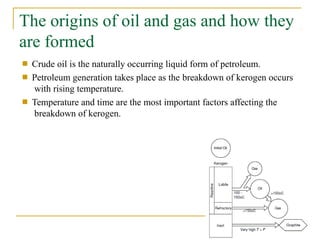
Crude oil is the naturally occurring liquid form of petroleum.
Petroleum generation takes place as the breakdown of kerogen occurs
with rising temperature.
Temperature and time are the most important factors affecting the
breakdown of kerogen.
■
The origins of oil and gas and how they are
formed
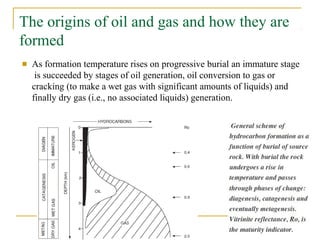
■ As formation temperature rises on progressive burial an immature stage
is succeeded by stages of oil generation, oil conversion to gas or
cracking (to make a wet gas with significant amounts of liquids) and
finally dry gas (i.e., no associated liquids) generation.
Conventional Oil and Gas
■ Conventional oil is a mixture of mainly pentanes and heavier
hydrocarbons recoverable at a well from an underground reservoir
and liquid at atmospheric pressure and temperature. Unlike
bitumen, conventional oil flows through a well without stimulation and
through a pipeline without processing or dilution.
■ Conventional oil production is now in the final stages of depletion in
most mature oil fields. There is a need to implement advanced methods
of oil recovery to maximize the production and to extend the
economic life of the oil fields.
Unconventional
oil
■ Unconventional oil is petroleum produced or extracted using
techniques other than the conventional (oil well) method.
Oil industries and governments across the globe are investing in
unconventional oil sources due to the increasing scarcity of
conventional oil reserves.
Although the depletion of such reserves is evident, unconventional oil
production is a less efficient process and has greater environmental
impacts than that of conventional oil production.
■
■
Sources of unconventional
oil
■ According to the International Energy Agency's Oil Market
Report unconventional oil includes the following sources:
Oil shales
Oil sands-based synthetic crudes and derivative products
Coal-based liquid supplies
Biomass-based liquid supplies
Liquids arising from chemical processing of natural gas
[1]
■
■
■
■
■
Sedimentary basins and the dynamic nature
of Earth’s crust
What are sedimentary basins?
■
■
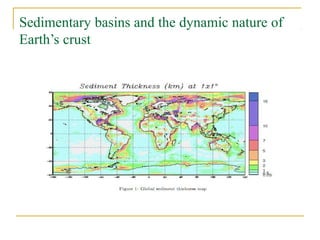
■ Sedimentary basins are regions where considerable thicknesses of
sediments have accumulated (in places up to 20 km).
Sedimentary basins are widespread both onshore and offshore. The way
in which they form was a matter of considerable debate until the last 20
years.
The advance in our understanding during this very short period is
mainly due to the efforts of the oil industry.
Sedimentary basins and the dynamic nature of
Earth’s crust
Sedimentary basins and the dynamic nature of
Earth’s crust
■ Basin classification schemes
Extensional basins, strike-slip basins, flexural basins, basins associated
with subduction zones, mystery basins. There are many different
classification schemes for sedimentary basins but most are unwieldy
and use rather spurious criteria . The most useful scheme (presented
here) is very simple and is based on basin forming mechanisms. About
80% of the sedimentary basins on Earth have formed by extension of
the plates (often termed lithospheric extension).
Sedimentary basins and the dynamic nature of
Earth’s crust
■ Most of the remaining 20% of basins were formed by flexure of the
plates beneath various forms of loading (this class will be covered in
the next lecture). Pull-apart or strike-slip basins are relatively small and
form in association with bends in strike-slip faults, such as the San
Andreas Fault or the North Anatolian Fault. Only a very small number
of basins still defy explanation, although we suspect that at least some
of these have a thermal origin.
Sedimentary basin
■ A depression in the crust of the Earth formed by plate tectonic activity
in which sediments accumulate. Continued deposition can cause further
depression or subsidence. Sedimentary basins, or simply basins, vary
from bowl-shaped to elongated troughs. If rich hydrocarbon source
rocks occur in combination with appropriate depth and duration of
burial, hydrocarbon generation can occur within the basin.
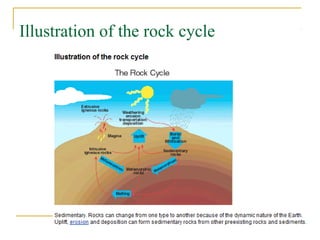
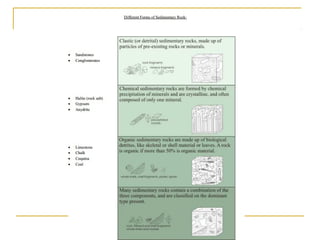
Sedimentary
■ One of the three main classes of rock (igneous, metamorphic and
sedimentary). Sedimentary rocks are formed at the Earth's surface
through deposition of sediments derived from weathered rocks,
biogenic activity or precipitation from solution. Clastic sedimentary
rocks such as conglomerates, sandstones, siltstones and shales form as
older rocks weather and erode, and their particles accumulate and
lithify, or harden, as they are compacted and cemented. Biogenic
sedimentary rocks form as a result of activity by organisms, including
coral reefs that become limestone.
Sedimentary
■ Precipitates, such as the evaporite minerals halite (salt) and
gypsum can form vast thicknesses of rock as seawater
evaporates. Sedimentary rocks can include a wide variety of
minerals, but quartz, feldspar, calcite, dolomite and evaporite
group and clay group minerals are most common because of their
greater stability at the Earth's surface than many minerals that
comprise igneous and metamorphic rocks. Sedimentary rocks,
unlike most igneous and metamorphic rocks, can contain fossils
because they form at temperatures and pressures that do not
obliterate fossil remnants.
Illustration of the rock cycle
Concepts of finite resources and limitations
on recovery
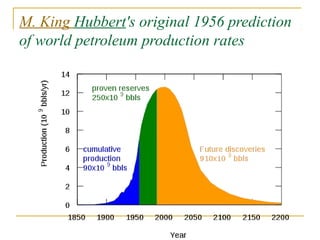
■ The Hubbert peak theory posits that for any given
geographical area, from an individual oil-producing region to
the planet as a whole, the rate of petroleum production tends
to follow a bell-shaped curve. It is one of the primary theories
on peak oil.
■ Choosing a particular curve determines a point of maximum
production based on discovery rates, production rates and
cumulative production. Early in the curve (pre-peak), the
production rate increases because of the discovery rate and the
addition of infrastructure. Late in the curve (post-peak),
production declines because of resource depletion.
■ The Hubbert peak theory is based on the observation
that the amount of oil under the ground in any region
is finite, therefore the rate of discovery which
initially increases quickly must reach a maximum and
decline. In the US, oil extraction followed the
discovery curve after a time lag of 32 to 35 years.[1][2]
The theory is named after American geophysicist
M. King Hubbert, who created a method of modeling
the production curve given an assumed ultimate
recovery volume.
M. King Hubbert's original 1956 prediction
of world petroleum production rates
Global distribution of fossil fuels and
OPEC’s resource endowment
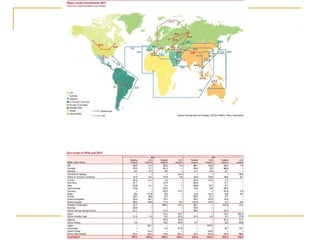
■ Reserves Around the World
■ While most of the known oil and gas reserves are held in
the Middle East, they can be found in many places
around the world, such as Australia, Italy, Malaysia and
New Zealand. The leading petroleum producers include
Saudi Arabia, Iran, Iraq, Kuwait and the United Arab
Emirates. Oil is also produced in Russia, Canada, China,
Brazil, Norway, Mexico, Venezuela, Great Britain,
Nigeria and the United States — chiefly Texas,
California, Louisiana, Oklahoma, Kansas and Alaska.
Offshore reservoirs have been discovered in the North
Sea, Africa, South America and the Gulf of Mexico.
• Components that constitute natural gas
■ Natural gas is a naturally occurring gas mixture consisting primarily of
methane, typically with 0–20% higher hydrocarbons[1] (primarily ethane).
It is found associated with other hydrocarbon fuel, in coal beds, as
methane clathrates, and is an important fuel source and a major
feedstock for fertilizers.
Most natural gas is created by two mechanisms: biogenic and
thermogenic. Biogenic gas is created by methanogenic organisms in
marshes, bogs, landfills, and shallow sediments. Deeper in the earth, at
greater temperature and pressure, thermogenic gas is created from
buried organic material.[2]
Before natural gas can be used as a fuel, it must undergo processing to
remove almost all materials other than methane. The by-products of
that processing include ethane, propane, butanes, pentanes, and
higher molecular weight hydrocarbons, elemental sulfur, carbon dioxide
, water vapor, and sometimes helium and nitrogen.
Natural gas is often informally referred to as simply gas, especially
when compared to other energy sources such as oil or coal.
■
■
■
Uses and markets for oil and gas
■ Who are the main consumers of oil?
■ Nearly two thirds of global crude oil production is
consumed by the leading industrialised nations – i.e. the
nations that make up the Organisation of Economic
Cooperation and Development. But a rising share of oil
demand is coming from the emerging market economies
including China, Brazil, Russia and India.
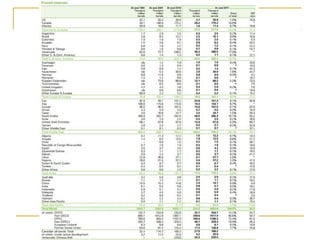
BP Statistical Review of World Energy
June 2012
■ For 61 years, the BP Statistical Review of
World Energy has provided high-quality
objective and globally consistent data on
world energy markets. The review is one of
the most widely respected and authoritative
publications in the fi eld of energy economics,
used for reference by the media, academia,
world governments and energy companies. A
new edition is published every June.
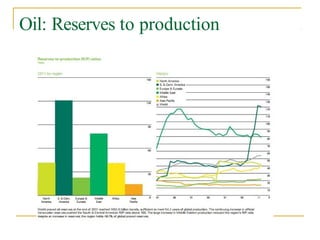
Oil: Reserves to production
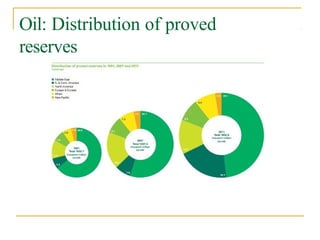
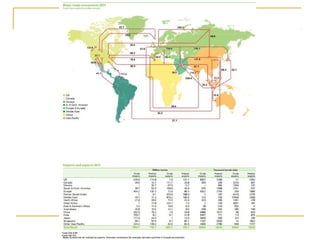
Oil: Distribution of proved
reserves
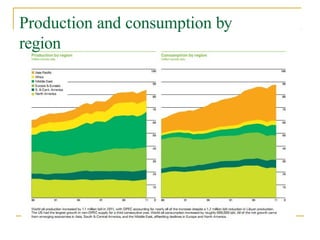
Production and consumption by
region
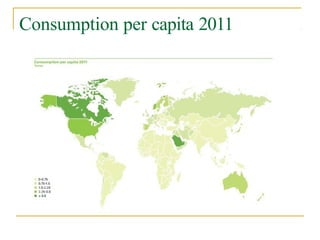
Consumption per capita 2011
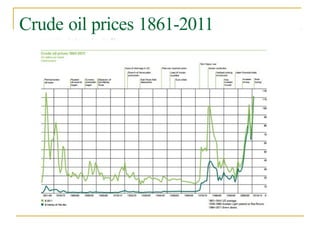
Crude oil prices 1861-2011
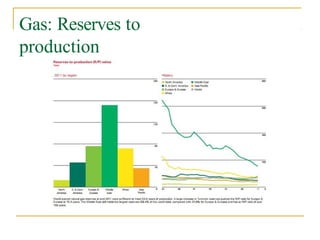
Gas: Reserves to
production
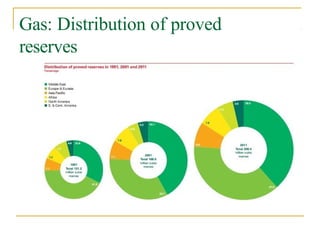
Gas: Distribution of proved
reserves
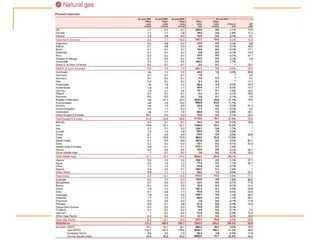
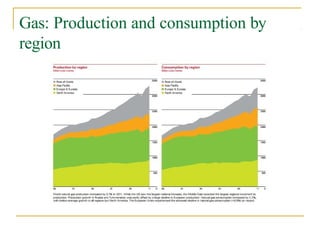
Gas: Production and consumption by
region
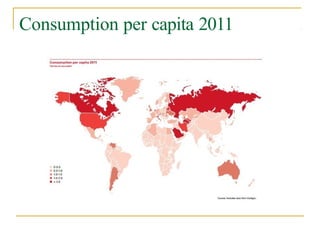
Consumption per capita 2011
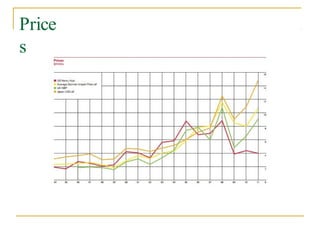
Price
s
An introduction to petroleum geology
■
■
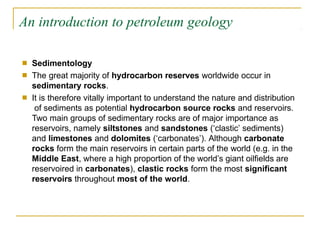
Sedimentology
The great majority of hydrocarbon reserves worldwide occur in
sedimentary rocks.
It is therefore vitally important to understand the nature and distribution
of sediments as potential hydrocarbon source rocks and reservoirs.
Two main groups of sedimentary rocks are of major importance as
reservoirs, namely siltstones and sandstones (‘clastic’ sediments)
and limestones and dolomites (‘carbonates’). Although carbonate
rocks form the main reservoirs in certain parts of the world (e.g. in the
Middle East, where a high proportion of the world’s giant oilfields are
reservoired in carbonates), clastic rocks form the most significant
reservoirs throughout most of the world.
■
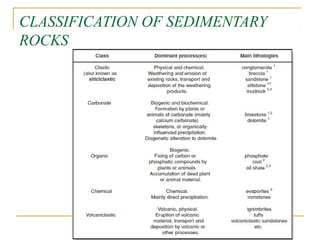
CLASSIFICATION OF SEDIMENTARY
ROCKS
Texture in Granular Sediments
■
■
■
■
■
■
■
The main textural components of granular rocks include:
grain size
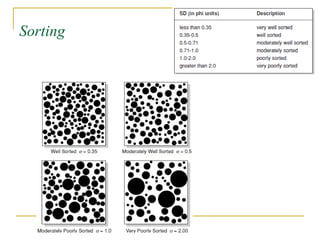
grain sorting
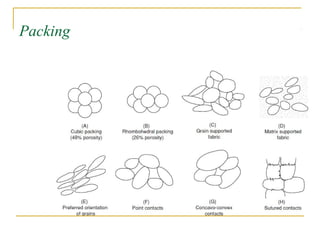
packing
sediment fabric
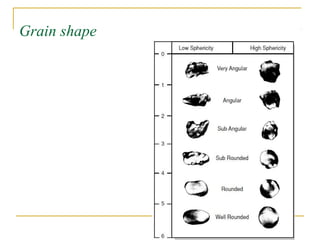
grain morphology
grain surface texture
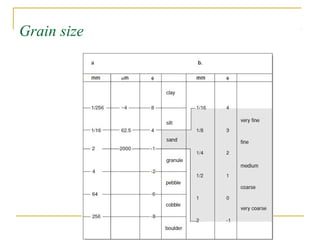
Grain size
Sorting
Grain shape
Packing
Sand and sandstone
■ Sands are defined as sediments with a mean grain size between
0.0625 and 2 mm which, on compaction and cementation will become
sandstones. Sandstones form the bulk of clastic hydrocarbon
reservoirs, as they commonly have high porosities and permeabilities.
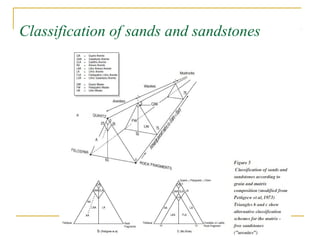
Sandstones are classified on the basis of their composition
(mineralogical content) and texture (matrix content). The most common
grains in sandstones are quartz, feldspar and fragments of older rocks.
These rock fragments may include fragments of igneous, metamorphic
and older sedimentary rocks.
■
Classification of sands and sandstones
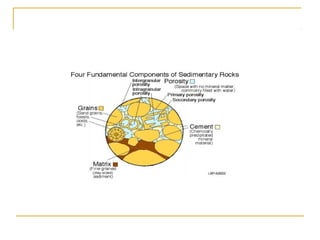
Porosity
■ Total porosity (φ) is defined as the volume of void (pore) space within a
rock, expressed as a fraction or percentage of the total rock volume. It
is a measure of a rock’s fluid storage capacity.
The effective porosity of a rock is defined as the ratio of the
interconnected pore volume to the bulk volume
Microporosity (φm) consists of pores less than 0.5 microns in size,
whereas pores greater than 0.5 microns form macroporosity (φM)
■
■
Permeability
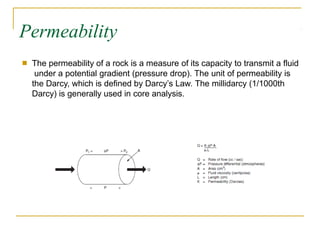
■ The permeability of a rock is a measure of its capacity to transmit a fluid
under a potential gradient (pressure drop). The unit of permeability is
the Darcy, which is defined by Darcy’s Law. The millidarcy (1/1000th
Darcy) is generally used in core analysis.
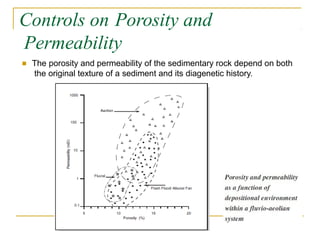
Controls on Porosity and
Permeability
■ The porosity and permeability of the sedimentary rock depend on both
the original texture of a sediment and its diagenetic history.
Grain size
■ In theory, porosity is independent of grain size, as it is merely a
measure of the proportion of pore space in the rock, not the size of the
pores. In practice, however, porosity tends to increase with
decreasing grain size for two reasons. Finer grains, especially clays,
tend to have less regular shapes than coarser grains, and so are often
less efficiently packed. Also, fine sediments are commonly better
sorted than coarser sediments. Both of these factors result in higher
porosities.
For example, clays can have primary porosities of 50%-85% and fine
sand can have 48% porosity whereas the primary porosity of coarse
sand rarely exceeds 40%.
Permeability decreases with decreasing grain size because the size
of pores and pore throats will also be smaller, leading to increased
grain surface drag effects.
■
■
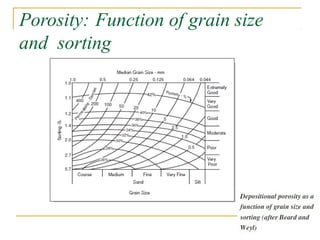
Porosity: Function of grain size
and sorting
■ Grain Shape
❑
❑
The more unequidimensional the grain shape, the greater the porosity
As permeability is a vector, rather than scalar property, grain shape will
affect the anisotropy of the permeability. The more unequidimensional
the grains, the more anisotropic the permeability tensor.
■ Packing
❑ The closer the packing, the lower the porosity and permeability
Fabric
■
❑ Rock fabric will have the greatest influence on porosity and permeability
when the grains are non spherical (i.e. are either disc-like or rod-like). In
these cases, the porosity and permeability of the sediment will decrease
with increased alignment of the grains.
Grain Morphology and Surface Texture
■
❑ The smoother the grain surface, the higher the permeability
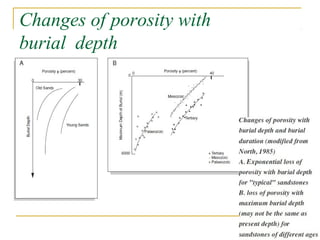
Diagenesis (e.g. Compaction,
Cementation)
■ Diagenesis is the totality of physical and chemical processes
which occur after deposition of a sediment and during burial and
which turn the sediment into a sedimentary rock. The majority
of these processes, including compaction, cementation and the
precipitation of authigenic clays, tend to reduce porosity and
permeability, but others, such as grain or cement dissolution,
may increase porosity and permeability. In general, porosity
reduces exponentially with burial depth, but burial duration also
an important criterion. Sediments that have spent a long time at
great depths will tend to have lower porosities and permeabilities
than those which have been rapidly buried.
Changes of porosity with
burial depth
Reservoir Rock & Source Rock Types:
Classification
■ Reservoir rock: A permeable subsurface
rock that contains petroleum. Must be
both porous and permeable.
■ Source rock: A sedimentary rock in
which petroleum forms.
■ Reservoir rocks are dominantly sedimentary (sandstones and
carbonates); however, highly fractured igneous and metamorphic
rocks have been known to produce hydrocarbons, albeit on a
much smaller scale
Source rocks are widely agreed to be sedimentary
■
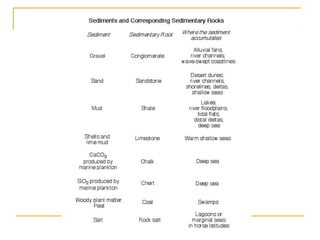
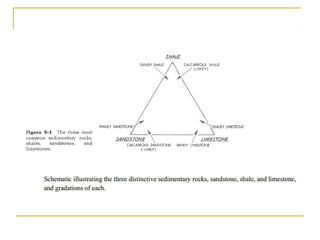
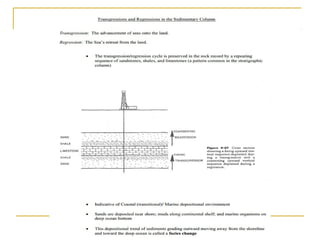
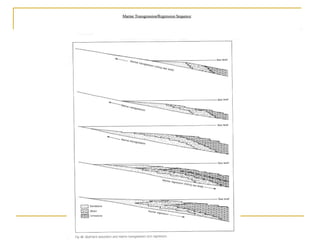
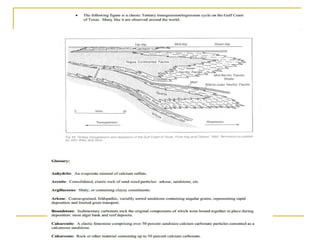
■ The three sedimentary rock types most frequently encountered in
oil fields are shales, sandstones and carbonates
Each of these rock types has a characteristic composition and
texture that is a direct result of depositional environment and
post-depositional (diagenetic) processes (i.e., cementation, etc.)
Understanding reservoir rock properties and their associated
characteristics is crucial in developing a prospect
■
■
Shales: Source rocks and
seals
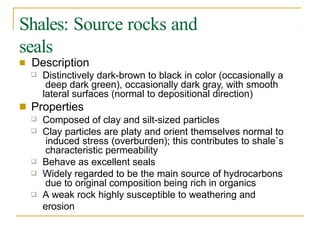
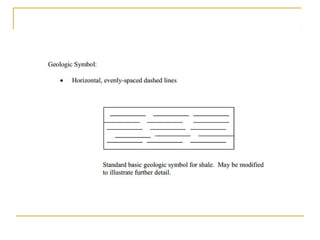
■ Description
❑ Distinctively dark-brown to black in color (occasionally a
deep dark green), occasionally dark gray, with smooth
lateral surfaces (normal to depositional direction)
Properties
■
❑
❑
Composed of clay and silt-sized particles
Clay particles are platy and orient themselves normal to
induced stress (overburden); this contributes to shale`s
characteristic permeability
Behave as excellent seals
Widely regarded to be the main source of hydrocarbons
due to original composition being rich in organics
A weak rock highly susceptible to weathering and
erosion
❑
❑
❑
• History:
• Deposited on river floodplaing, deep oceans, lakes or lagoons
• Occurrence:
• The most abundant sedimentary rock (about 42%)
Sandstones and Sandstone
Reservoirs
Description:
■
■
Composed of sand-sized particles (q.v., week 2 notes)
Recall that sandstones may contain textural features indicative of the environment in which
they were deposited: ripple marks (alluvial/fluvial), cross-bedding (alluvial/fluvial or eolian),
gradedbedding (turbidity current)
Typically light beige to tan in color; can also be dark brown to rusty red
■
Classification:
Sandstones can be further classified according to the abundance of grains of a
particular chemical composition (i.e., common source rock); for example, an arkosic
sanstone (usually abbreviated: ark. s.s.) is a sandstone largely composed of feldspar
(feldspathic) grains….Can you recall which continental rock contains feldspar as one of
its mineral constituents???
■ Sandstones composed of nearly all quartz grains are labeled quartz sandstones
(usually abbreviated: qtz. s.s.)
Properties:
■
■
■
Sandstone porosity is on the range of 10-30%
Intergranular porosity is largely determined by sorting (primary porosity)
Poorly indurated sandstones are referred to as fissile (easily disaggregated when
scratched), whereas highly indurated sandstones can be very resistant to weathering
and erosion
Sandstone and sandstone
reservoirs
■
■
History:
Sandstones are deposited in a number of different environments. These can include
deserts (e.g., wind-blown sands, i.e., eolian), stream valleys (e.g., alluvial/fluvial), and
coastal/transitional environments (e.g., beach sands, barrier islands, deltas, turbidites)
Because of the wide variety of depositional environments in which sandstones can be
found, care should be taken to observe textural features (i.e., grading, cross-bedding,
etc.) within the reservoir that may provide evidence of its original diagenetic environment
Knowing the depositional environment of the s.s. reservoir is especially important in
determining reservoir geometry and in anticipating potentially underpressured
(commonly found in channel sandstones) and overpressured reservoir conditions
Occurrence:
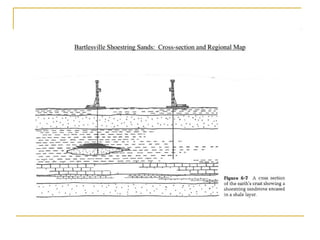
Are the second most abundant (about 37%) sedimentary rock type of the three
(sanstones, shales, carbonates), the most common reservoir rock, and are the
second highest producer (about 37%)
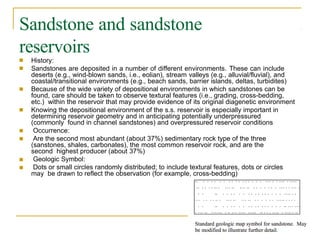
Geologic Symbol:
Dots or small circles randomly distributed; to include textural features, dots or circles
may be drawn to reflect the observation (for example, cross-bedding)
■
■
■
■
■
■
Carbonate and carbonate
reservoirs
■
■
Description
Grains (clasts) are laregly the skeletal or shell remains of shallow
marine dwelling organisms, varying in size and shape, that
either lived on the ocean bottom (benthic) or floated in water
column (nerithic)
Many of these clasts can be identified by skilled paleontologists
and micropaleontologists and can be used for correlative
purposes or age range dating; also beneficial in establishing
index fossils for marker beds used in regional stratigraphic
correlations
Dolomites are a product of solution recrystallization of
limestones
Usually light or dark gray, abundant fossil molds and casts,
vuggy (vugular) porositity
■
■
■
■ Classification:
■ Divided into limestones (Calsium carbonate-
CaCO3) and dolomites (Calcium magnesium
carbonate – CaMg(CO3)2)
■ Limestones can be divided further into
mudstones, wackenstones, packstones,
grainstones and boundstones according to
the limestones depositional texture
■ Properties:
❑
❑
Porosity is largely a result of dissolution and fracturing (secondary porosity)
Carbonates such as coquina are nearly 100% fossil fragments (largely
primary porosity)
Are characteristically hard rocks, especially dolomite
Susceptible to dissolution weathering
❑
❑
■ History:
❑ Limestone reservoirs owe their origin exclusively to shallow marine
depositional environments (lagoons, atolls, etc)
Limestone formations slowly accumulate when the remains of calcareous shelly
marine organisms (brachiopods, bivalves, foramaniferans) and coral and algae living
in a shallow tropical environment settle to the ocean bottom
Over large geologic time scales these accumulations can grow to hundreds of
feet thick (El Capitan, a Permian reef complex, in West Texas is over 600 ft thick)
❑
❑
■
■
Occurrence:
Are the least geologically abundant (about 21%) of the three (shales,
sandstones, carbonates), but the highest producer (about 61.5%)
Geologic Symbol:
■
❑
❑
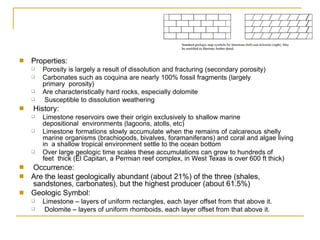
Limestone – layers of uniform rectangles, each layer offset from that above it.
Dolomite – layers of uniform rhomboids, each layer offset from that above it.
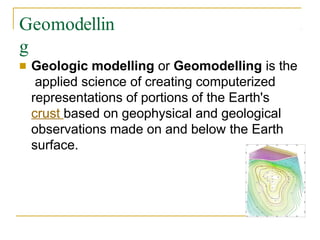
Geomodellin
g
■ Geologic modelling or Geomodelling is the
applied science of creating computerized
representations of portions of the Earth's
crust based on geophysical and geological
observations made on and below the Earth
surface.
■ A Geomodel is the numerical equivalent of a
three-dimensional geological map
complemented by a description of physical
quantities in the domain of interest.
Geomodelling is related to the concept of
Shared Earth Model which is a
pluridisciplinary, interoperable and updatable
knowledge base about the subsurface.
■ Geologic modelling is a relatively recent
subdiscipline of geology which integrates
structural geology, sedimentology,
stratigraphy, paleoclimatology and
diagenesis
■ In 2 dimensions a geologic formation or unit is
represented by a polygon, which can be bounded by
faults, unconformities or by its lateral extent, or
crop. In geological models a geological unit is
bounded by 3-dimensional triangulated or gridded
surfaces. The equivalent to the mapped polygon is
the fully enclosed geological unit, using a
triangulated mesh. For the purpose of property or
fluid modelling these volumes can be separated
further into an array of cells, often referred to as
voxels (volumetric elements). These 3D grids are
the equivalent to 2D grids used to express
properties of single surfaces.
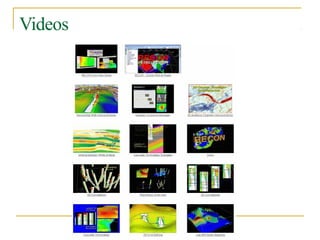
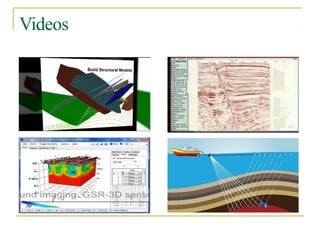
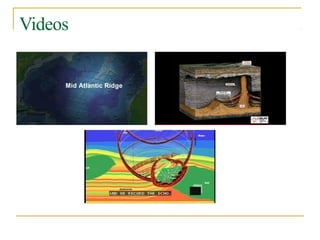
Videos
Videos
Videos
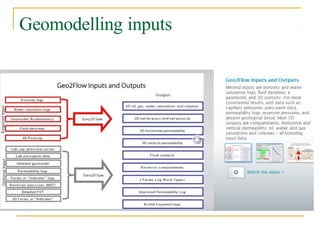
Geomodelling inputs
Geostatistics
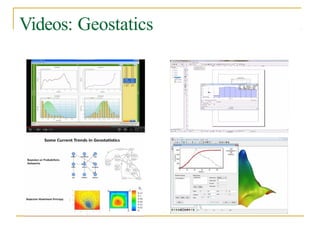
■ Geostatistics is a branch of statistics focusing on spatial or
spatiotemporal datasets. Developed originally to predict
probability distributions of ore grades for mining operations, it is
currently applied in diverse disciplines including
petroleum geology, hydrogeology, hydrology, meteorology,
oceanography, geochemistry, geometallurgy, geography,
forestry, environmental control, landscape ecology, soil science,
and agriculture (esp. in precision farming). Geostatistics is
applied in varied branches of geography, particularly those
involving the spread of diseases (epidemiology), the practice of
commerce and military planning (logistics), and the development
of efficient spatial networks. Geostatistical algorithms are
incorporated in many places, including geographic information
systems (GIS) and the R statistical environment.
Videos: Geostatics
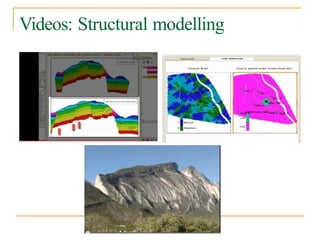
Videos: Structural modelling
Stratigraphic modelling
■ Stratigraphic modelling has been long recognised as
a method of presenting an organised picture of the
unseen subterranean world. This has distinct
advantages when trying to assess:
i. the extent of a resource (eg. oil, minerals,
sand/aggregate, heavy minerals, groundwater);
ii. geotechnical properties or;
iii. environmental properties (eg. examine the
spread of pollutants or potential pollutants).
■
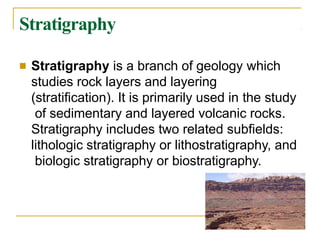
Stratigraphy
■ Stratigraphy is a branch of geology which
studies rock layers and layering
(stratification). It is primarily used in the study
of sedimentary and layered volcanic rocks.
Stratigraphy includes two related subfields:
lithologic stratigraphy or lithostratigraphy, and
biologic stratigraphy or biostratigraphy.
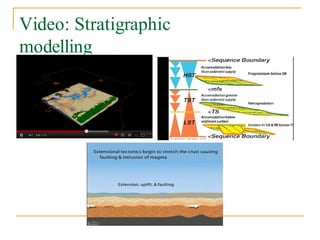
Video: Stratigraphic
modelling
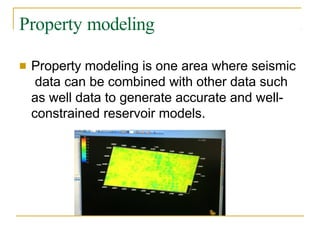
Property modeling
■ Property modeling is one area where seismic
data can be combined with other data such
as well data to generate accurate and well-
constrained reservoir models.
Property modelling
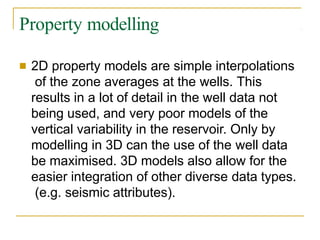
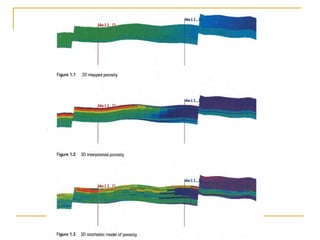
■ 2D property models are simple interpolations
of the zone averages at the wells. This
results in a lot of detail in the well data not
being used, and very poor models of the
vertical variability in the reservoir. Only by
modelling in 3D can the use of the well data
be maximised. 3D models also allow for the
easier integration of other diverse data types.
(e.g. seismic attributes).
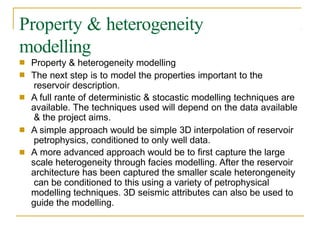
Property & heterogeneity
modelling
■
■
Property & heterogeneity modelling
The next step is to model the properties important to the
reservoir description.
A full rante of deterministic & stocastic modelling techniques are
available. The techniques used will depend on the data available
& the project aims.
A simple approach would be simple 3D interpolation of reservoir
petrophysics, conditioned to only well data.
A more advanced approach would be to first capture the large
scale heterogeneity through facies modelling. After the reservoir
architecture has been captured the smaller scale heterongeneity
can be conditioned to this using a variety of petrophysical
modelling techniques. 3D seismic attributes can also be used to
guide the modelling.
■
■
■
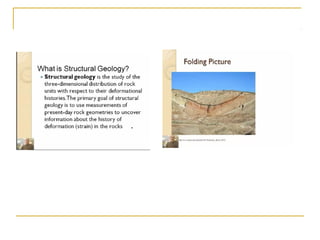
Structural modelling
■ Generating a hight quality structural
framework is an essential first step in the 3D
modelling workflow.
■ An integral part of structural modelling in
modeling software is the construction of a
fault model. This fault model can then be
used to build 3D grids which honour both
reservoir volumes and connectivity.
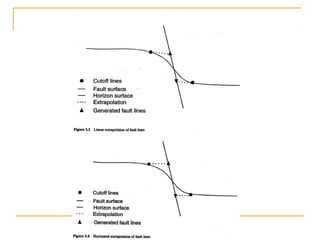
Building a fault
model
Why build a fault model?
Building a fauld model is not an essential part of the
the modeling software 3D modelling workflow. There
are however many reasons to consider the
inclusion of a fault model:
■
■
Accurate volumes in faulted areas
Correct communications in 3D grid. Very important
for any dynamic modelling.
Improved stratigraphic modelling
Generate fault segments (blocks) for further
modelling control
Generate separation diagrams
■
■
■
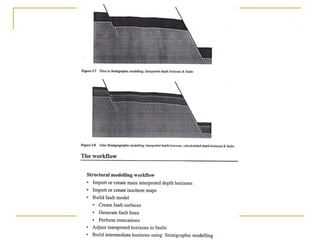
Stratigraphic modelling
■ Stratigraphic modelling is the process of
building the intermediate reservoir horizons
based on the interpreted depth horizons and
the thickness data. In modeling software a
fault model can also be included in order to
give a consistant faulted structural
framework.
Stratigraphic
■ Stratigraphic modelling is the process of
building the intermediate reservoir horizons
based on the interpreted depth horizons and
thickness data. In modeling software a fault
model can also be included in order to five
a consistant faulted structural framework.
■ Terminology
■ Interpreted horizon:
■ A horizon derived from the seismic
interpretation. Can be time or depth. Must
have an interpreted depth horizon for
stratigraphic modelling. The horizons can be
created from raw data in modeling software
or can be imported.
■ Stratigraphic modelling is the process of
building the intermediate reservoir horizons
based on the interpreted depth horizons and
thickness data. In modeling software a fault
model can also be included in order to give a
consistant faulted structural framework.
Stochastic
Simulation
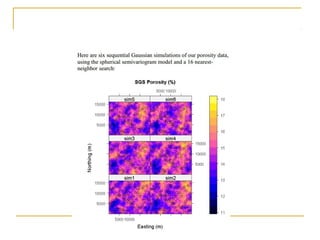
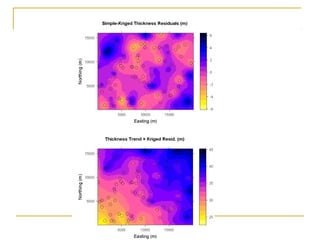
■ Stochastic simulation is a means for generating multiple equiprobable
realizations of the property in question, rather than simply estimating the mean.
Essentially, we are adding back in some noise to undo the smoothing effect of
kriging. This possibly gives a better representation of the natural variability of the
property in question and gives us a means for quantifying our uncertainty
regarding what’s really down there. The two most commonly used forms of
simulation for reservoir modeling applications are sequential Gaussian
simulation for continuous variables like porosity and sequential indicator
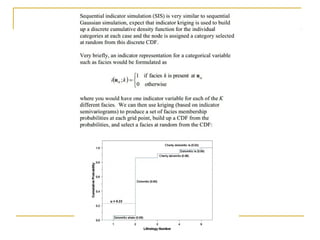
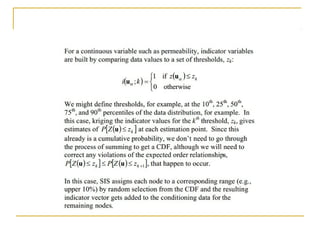
simulation for categorical variables like facies.The basic idea of sequential
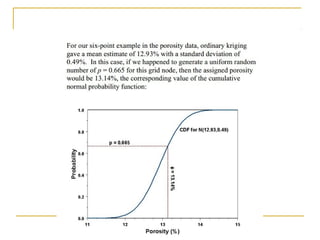
Gaussian simulation (SGS) is very simple. Recall that kriging gives us an
estimate of both the mean and standard deviation of the variable at each grid
node, meaning we can represent the variable at each grid node as a random
variable following a normal (Gaussian) distribution. Rather than chooses the
mean as the estimate at each node, SGS chooses a random deviate from this
normal distribution, selected according to a uniform random number
representing the probability level.
■ So, the basic steps in the SGS process are:
❑
❑
Generate a random path through the grid nodes
Visit the first node along the path and use kriging to estimate a mean and
standard deviation for the variable at that node based on surrounding data values
Select a value at random from the corresponding normal distribution and set
the variable value at that node to that number
Visit each successive node in the random path and repeat the process,
including previously simulated nodes as data values in the kriging process
❑
❑
■ We use a random path to avoid artifacts induced by walking through the grid in a
regular fashion. We include previously simulated grid nodes as “data” in order
to preserve the proper covariance structure between the simulated values.
Sometimes SGS is implemented in a “multigrid” fashion, first simulating on a
coarse grid (a subset of the fine grid – maybe every 10 th grid node) and then on
the finer grid (maybe with an intermediate step or two) in order to reproduce
large-scale semivariogram structures. Without this the “screening” effect of
kriging quickly takes over as the simulation progresses and nodes get filled in,
so that most nodes are conditioned only on nearby values, so that small-scale
structure is reproduced better than largescale structure.
■
Typical Reservoir Modeling Workflow
■ Basically, work from large-scale structure to small-scale structure, and
generally from more deterministic methods to more stochastic methods:
❑ Establish large-scale geologic structure, for example, by deterministic
interpolation of formation tops; this creates a sete of distinct zones
Within each zone, use SIS or some other discrete simulation technique (such
as object-based simulation) to generate realizations of the facies distribution
– the primary control on the porosity & permeability distributions
Within each facies, use SGS (or similar) to generate porosity distirubtion and
then simulate permeability distribution conditional to porosity distribution,
assuming there is some relationship between the two Porosity and facies
simulations could be conditioned to other secondary data, such as seismic.
Methods also exist for conditioning to well test and production data, but these
are fairly elaborate and probably not in very common use as yet. More
typical (maybe) to run flow simulations after the fact and rank realizations by
comparison to historical production & well tests.
❑
❑
Simulation grid building
principles
■ An optimum grid for reservoir simulation
results from the compromise between the
desired accuracy of fluid flow modeling and
the available computing power. Many factors
have to be considered.
Optimized grid
size
■ The final number of grid blocks is often dictated by
the available computing power. A few hundred
thousand blocks for black oil and only a few then
thousand blocks for compositional simulation are
standard. The grid block size must, however, allow a
minimum number of grid blocks between wells,
remain within the correlation length of
hereogeneities if multi-phase upscaling is to be
avoided, as well as maintain acceptable levels of
numerical dispersion. For the best compromise, grid
blocks should be fine in high flow areas (near wells,
in high permeability regions, etc) and coarse
elsewhere (eg below OWC)
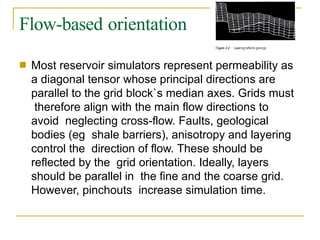
Flow-based orientation
■ Most reservoir simulators represent permeability as
a diagonal tensor whose principal directions are
parallel to the grid block`s median axes. Grids must
therefore align with the main flow directions to
avoid neglecting cross-flow. Faults, geological
bodies (eg shale barriers), anisotropy and layering
control the direction of flow. These should be
reflected by the grid orientation. Ideally, layers
should be parallel in the fine and the coarse grid.
However, pinchouts increase simulation time.
Hierarchical fault
incorporation
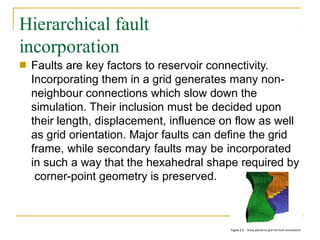
■ Faults are key factors to reservoir connectivity.
Incorporating them in a grid generates many non-
neighbour connections which slow down the
simulation. Their inclusion must be decided upon
their length, displacement, influence on flow as well
as grid orientation. Major faults can define the grid
frame, while secondary faults may be incorporated
in such a way that the hexahedral shape required by
corner-point geometry is preserved.
Corner point
geometry
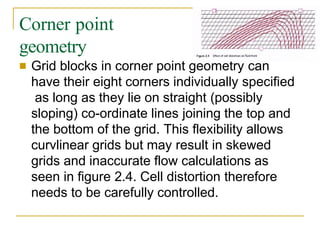
■ Grid blocks in corner point geometry can
have their eight corners individually specified
as long as they lie on straight (possibly
sloping) co-ordinate lines joining the top and
the bottom of the grid. This flexibility allows
curvlinear grids but may result in skewed
grids and inaccurate flow calculations as
seen in figure 2.4. Cell distortion therefore
needs to be carefully controlled.
Upscaling of heterogeneity
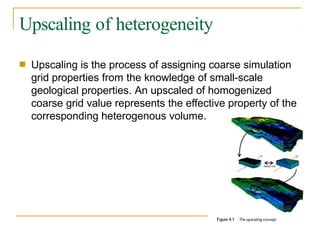
■ Upscaling is the process of assigning coarse simulation
grid properties from the knowledge of small-scale
geological properties. An upscaled of homogenized
coarse grid value represents the effective property of the
corresponding heterogenous volume.
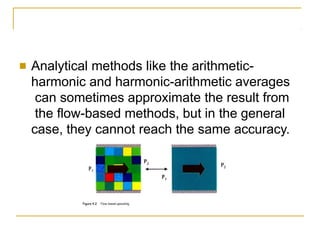
■ Flow-based methods implement the following basic
rule: find the permeability of the homogeneous
medium that gives the same flux as the
heterogenous medium under the same boundary
conditions. Figure 4.2 shows the principle of the
numerical experiment repeated for each simulation
grid block and each direction:
❑
❑
❑
❑
Apply a pressure drop and numerical boundary conditions
Simulate fluid flow in the heterogenous volume
Sum the flux accross the system
Apply Darcy`s law to derive the effective permeability from
the total flux and the pressure drop
Assign the effective permeability to the coarse grid block
❑
■ Analytical methods like the arithmetic-
harmonic and harmonic-arithmetic averages
can sometimes approximate the result from
the flow-based methods, but in the general
case, they cannot reach the same accuracy.
Defining the re-scaling
process
■ In modeling software , re-scaling designates
the process of copying a parameter from a
3D grid into another using appropriate
sampling and, if necessary, homogenisation
methods. Here, we deal with upscaling,
where the target (output) grid is normally
coarser than the source (input) grid, and
averaging methods should be carefully
selected.
■ Upscaling is performed from a finely gridded 3D representation
of the geological model into a coarser 3D grid covering roughly
the same volume. Fine cells contributing to each coarse block
are determined by various sampling methods which have to be
chosen after considering the alignment between the two corner-
point grids. Upscaling is then performed sequentially on every
coarse grid block.
The upscaling process can be composed of several upscalers or
re-scalers is defined by a fine-scale parameter, an upscaling
method and various attributes for sampling options and method-
specific settings.
■
Weight parameter
■ Simple averaging methods, summation and
discrete methods allow using a weight
parameter. Drop any fine grid parameter to
use for weigthing into the drop site. Use this
for rock or pore volume weigting.
■ For the discrete method, the weights are
added and the rock type obtaining the highest
sum is assigned to the coarse block.
Sampling method
■ The sampling method determines how the
fine computation grid is built and populated
with geological parameters. This is an
essential pre-processing step to the
upscaling.
Direct sampling
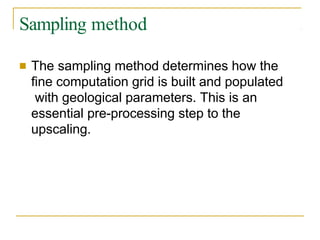
■ This is the default method. The fine grid from which
effective properties are derived is made from the
geological grid blocks hving their centre inside the
simulation grid block, as pictured in figure 4.11. This
respects the resolution and orientation of the geological
grid. Cells are either counted all in or all out, unless `Use
volume fractions` is toggled on (available only for simple
methods).
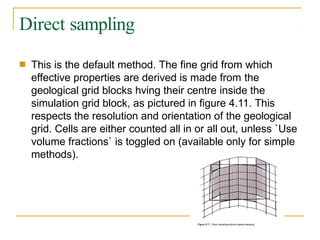
■ Figure 4.12 shows how volume fractions can
produce more accurate results for volumes.
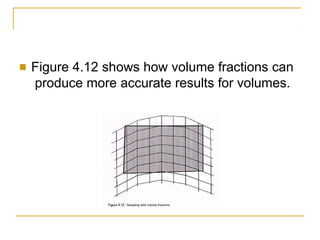
■ Re-sampling. The fine grid used to derive
effective properties is a uniform sub-division
of the simulation grid block. This is faster to
compute but may not match the fine grid
resolution and orientation. Figure 4.13 shows
the principle.
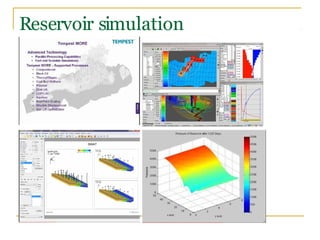
Reservoir simulation
videos
Defining and calculating resources
and reserves
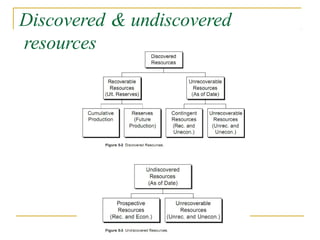
■ The total oil and gas estimated to have originally existed in the
earth’s crust in naturally occurring accumulations is defined
as original resources.
Original resources comprise discovered and undiscovered
resources; in each of these, some are recoverable and some are
unrecoverable.
The discovered recoverable resources are referred to as ultimate
reserves — cumulative production plus future production
(reserves).
The discovered unrecoverable resources are divided into
contingent resources, which are technically recoverable but not
economic, and unrecoverable resources, which are neither
technically recoverable nor economic.
■
■
■
■ The undiscovered future recoverable resources are simply future
production and are referred to as prospective resources, which
are technically recoverable and economic. The undiscovered
unrecoverable resources are neither technically recoverable nor
economic
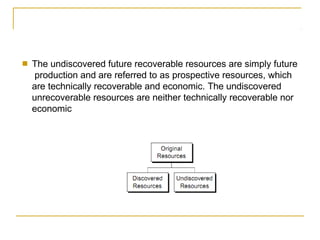
Discovered & undiscovered
resources
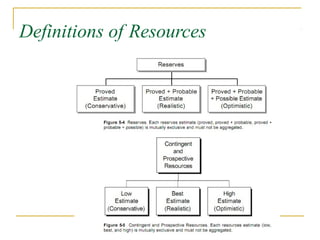
Definitions of Resources
Original Resources
■ Original resources are those quantities of oil and gas estimated
to exist originally in naturally occurring accumulations.
They are, therefore, those quantities estimated on a given date
to be remaining in known accumulations plus those quantities
already produced from known accumulations plus those
quantities in accumulations yet to be discovered. Original
resources are divided into discovered and undiscovered
resources, with discovered resources limited to known
accumulations.
Discovered Resources
■ Discovered resources are those quantities of oil and gas
estimated on a given date to be remaining in, plus those
quantities already produced from, known accumulations.
Discovered resources are divided into economic and
uneconomic categories, with the estimated future recoverable
portion classified as reserves and contingent resources,
respectively.
■
Reserves
■ Those quantities of oil and gas anticipated to be economically
recoverable from discovered resources are classified as
reserves
Estimated recoverable quantities from known accumulations that
are not economic are classified as contingent resources. The
definition of economic for an accumulation will vary according to
local conditions of prices, costs, and operating circumstances
and is left to the discretion of the country or company
concerned.
■
■ Nevertheless, reserves must be classified according to the
definitions. In general, quantities must not be classified as
reserves unless there is an expectation that the accumulation will
be developed and placed on production within a reasonable
timeframe.
■ In certain circumstances, reserves can be assigned to known
accumulations even though development might not occur for
some time. For example, fields might be dedicated to a long-
term supply contract and will only be developed when they are
needed to satisfy that contract.
Contingent Resources
■ Contingent resources are defined as those quantities of oil
and gas estimated on a given date to be potentially
recoverable from known accumulations but are not currently
economic. Contingent resources include, for example,
accumulations for which there is currently no viable market.
■ Undiscovered resources are defined as those quantities of oil
and gas estimated on a given date to be contained in
accumulations yet to be discovered. The estimated potentially
recoverable portion of undiscovered resources is classified as
prospective resources.
■ Prospective resources are defined as those quantities of oil
and gas estimated on a given date to be potentially recoverable
from undiscovered accumulations. They are technically viable
and economic to recover.
■
■
Discovered and Undiscovered Unrecoverable Resources
Unrecoverable resources, whether discovered or undiscovered,
are neither technically possible nor economic to produce. They
represent quantities of petroleum that are in the reservoir after
commercial production has ceased, and in known and unknown
accumulations that are not deemed recoverable due to lack of
technical and economic recovery processes.
■
■
Resources Categories
Due to the high uncertainty in estimating resources, evaluations
of these assets require some type of probabilistic method.
Expected value concepts and decision tree analyses are routine;
however, in high-risk, high-reward projects, Monte Carlo
simulation can be used. In any event, three success cases plus
a failure case should be included in the evaluation of the
resources.
■
■
Classification of Resources
When evaluating resources, in particular contingent and prospective
resources, the following mutually exclusive categories are recommended:
Low Estimate: This is considered to be a conservative estimate of the
quantity that will actually be recovered from the accumulation. If probabilistic
methods are used, this term reflects a P90 confidence level.
Best Estimate: This is considered to be the best estimate of the quantity
that will actually be recovered from the accumulation. If probabilistic
methods are used, this term is a measure of central tendency of the
uncertainty distribution (most likely/mode, P50/median, or
arithmetic average/mean.)
High Estimate: This is considered to be an optimistic estimate of the
quantity that will actually be recovered from the accumulation. If probabilistic
methods are used, this term reflects a P10 confidence level.
■
■
■
Definitions of Reserves
■
■
Reserves Categories
Reserves are estimated remaining quantities of oil and natural gas and
related substances anticipated to be recoverable from known
accumulations, from a given date forward, based on
❑
❑
❑
analysis of drilling, geological, geophysical, and engineering data;
the use of established technology;
specified economic conditions, which are generally accepted as being reasonable, and shall
be disclosed.
■ Reserves are classified according to the degree of certainty associated with
the estimates
Proved Reserves
Proved reserves are those reserves that can be estimated with a high
degree of certainty to be recoverable. It is likely that the actual remaining
quantities recovered will exceed the estimated proved reserves.
■
■
■
■
Probable Reserves
Probable reserves are those additional reserves that are less certain to be
recovered than proved reserves. It is equally likely that the actual remaining
quantities recovered will be greater or less than the sum of the estimated
proved + probable reserves.
Possible Reserve
Possible reserves are those additional reserves that are less certain to be
recovered than probable reserves. It is unlikely that the actual remaining
quantities recovered will exceed the sum of the estimated proved +
probable + possible reserves.
■
■
Development and Production Status
■ Each of the reserves categories (proved, probable, and possible) may be
divided into developed and undeveloped categories.
Developed Reserves
Developed reserves are those reserves that are expected to be recovered
from existing wells and installed facilities or, if facilities have not been
installed, that would involve a low expenditure (e.g., when compared to the
cost of drilling a well) to put the reserves on production. The developed
category may be subdivided into producing and non-producing.
Developed Producing Reserves
Developed producing reserves are those reserves that are expected to be
recovered from completion intervals open at the time of the estimate. These
reserves may be currently producing or, if shut in, they must have
previously been on production, and the date of resumption of production
must be known with reasonable certainty.
■
■
■
■
■
■
Developed Non-Producing Reserves
Developed non-producing reserves are those reserves that either have not been
on production, or have previously been on production, but are shut in, and the
date of resumption of production is unknown.
Undeveloped Reserves
Undeveloped reserves are those reserves expected to be recovered from
known accumulations where a significant expenditure (e.g., when compared to
the cost of drilling a well) is required to render them capable of production. They
must fully meet the requirements of the reserves classification (proved,
probable, possible) to which they are assigned.
In multi-well pools, it may be appropriate to allocate total pool reserves between
the developed and undeveloped categories or to subdivide the developed
reserves for the pool between developed producing and developed non-
producing. This allocation should be based on the estimator’s assessment as to
the reserves that will be recovered from specific wells, facilities, and completion
intervals in the pool and their respective development and production status.
■
■
■
■
■
■
Levels of Certainty for Reported Reserves
Reported Reserves should target the following levels of certainty under a
specific set of economic conditions:
❑ at least a 90 percent probability that the quantities actually recovered will equal or exceed the
estimated proved reserves;
at least a 50 percent probability that the quantities actually recovered will equal or exceed the sum of
the estimated proved + probable reserves;
at least a 10 percent probability that the quantities actually recovered will equal or exceed the sum of
the estimated proved + probable + possible reserves.
❑
❑
■ A quantitative measure of the certainty levels pertaining to estimates prepared
for the various reserves categories is desirable to provide a clearer
understanding of the associated risks and uncertainties. However, the majority
of reserves estimates will be prepared using deterministic methods that do
not provide a mathematically derived quantitative measure of probability. In
principle, there should be no difference between estimates prepared using
probabilistic or deterministic methods.
General Guidelines for Estimation
ofReserves
■
■
Uncertainty in Reserves Estimation
Reserves estimation has characteristics that are common to any measurement
process that uses uncertain data. An understanding of statistical concepts and
the associated terminology is essential to understanding the confidence
associated with reserves definitions and categories.
Uncertainty in a reserves estimate arises from a combination of error and bias:
■
❑ Error is inherent in the data that are used to estimate reserves. Note that the term “error” refers to
limitations in the input data, not to a mistake in interpretation or application of the data. The
procedures and concepts dealing with error lie within the realm of statistics and are well established.
Bias, which is a predisposition of the evaluator, has various sources that are not necessarily
conscious or intentional.
❑
■ In the absence of bias, different qualified evaluators using the same information
at the same time should produce reserves estimates that will not be materially
different, particularly for the aggregate of a large number of estimates. The
range within which these estimates should reasonably fall depends on the
quantity and quality of the basic information, and the extent of analysis of the
data
■
■
Deterministic and Probabilistic Method
Reserves estimates may be prepared using either deterministic or probabilistic
methods.
Deterministic Method
The deterministic approach, which is the one most commonly employed
worldwide, involves the selection of a single value for each parameter in the
reserves calculation. The discrete value for each parameter is selected based
on the estimator’s determination of the value that is most appropriate for the
corresponding reserves category.
■
■
■
■
Probabilistic Method
Probabilistic analysis involves describing the full range of possible values for
each unknown parameter. This approach typically consists of employing
computer software to perform repetitive calculations (e.g., Monte Carlo
simulation) to generate the full range of possible outcomes and their associated
probability of occurrence.
Comparison of Deterministic and Probabilistic Estimates
Deterministic and probabilistic methods are not distinct and separate. A
deterministic estimate is a single value within a range of outcomes that could be
derived by a probabilistic analysis. There should be no material difference
between Reported Reserves estimates prepared using deterministic and
probabilistic methods.
■
■
■
■
Application of Guidelines to the Probabilistic Method
The following guidelines include criteria that provide specific limits to
parameters for proved reserves estimates. For example, volumetric
estimates are restricted by the lowest known hydrocarbon (LKH). Inclusion
of such specific limits may conflict with standard probabilistic procedures,
which require that input parameters honour the range of potential values.
Nonetheless, it is required that the guidelines be met regardless of analysis
method. Accordingly, when probabilistic methods are used, constraints on
input parameters may be required in certain instances. Alternatively, a
deterministic check may be made in such instances to ensure that
aggregate estimates prepared using probabilistic methods do not exceed
those prepared using a deterministic approach including all appropriate
constraints.
■
General Requirements for
Classification ofReserves
■
■
Drilling Requirements
Proved, probable, or possible reserves may be assigned only to known
accumulations that have been penetrated by a wellbore. Potential
hydrocarbon accumulations that have not been penetrated by a wellbore
may be classified as prospective resources.
Testing Requirements
Confirmation of commercial productivity of an accumulation by production or
a formation test is required for classification of reserves as proved. In
the absence of production or formation testing, probable and/or possible
reserves may be assigned to an accumulation on the basis of well logs
and/or core analysis that indicate that the zone is hydrocarbon bearing and
is analogous to other reservoirs in the immediate area that have
demonstrated commercial productivity by actual production or formation
testing.
■
■
■ Economic Requirements
Proved, probable, or possible reserves may be assigned only to
those volumes that are economically recoverable. The fiscal
conditions under which reserves estimates are prepared should
generally be those which are considered to be a reasonable outlook
on the future. If required by securities regulators or other agencies,
constant or other prices and costs also may be used. In any event,
the fiscal assumptions used in the preparation of reserves estimates
must be disclosed.
Undeveloped recoverable volumes must have a sufficient return on
investment to justify the associated capital expenditure in order to
be classified as reserves, as opposed to contingent resources.
■
■
■ Regulatory Considerations
In general, proved, probable, or possible reserves may be assigned
only in instances where production or development of those
reserves is not prohibited by governmental regulation. This
provision would, for instance, preclude the assignment of reserves
in designated environmentally sensitive areas. Reserves may be
assigned in instances where regulatory restraints may be removed
subject to satisfaction of minor conditions. In such cases, the
classification of reserves as proved, probable, or possible should be
made with consideration given to the risk associated with project
approval.
■
Procedures for Estimation and
Classification of Reserves
■ The process of reserves estimation falls into three broad categories:
volumetric material balance, and decline analysis. Selection of the
most appropriate reserves estimation procedures depends on the
information that is available. Generally, the range of uncertainty
associated with an estimate decreases and confidence level
increases as more information becomes available, and when the
estimate is supported by more than one estimation method.
■ Volumetric Methods
Volumetric methods involve the calculation of reservoir rock volume,
the hydrocarbons in place in that rock volume, and the estimation
of the portion of the hydrocarbons in place that ultimately will be
recovered. For various reservoir types at varied stages of
development and depletion, the key unknown in volumetric reserves
determinations may be rock volume, effective porosity, fluid
saturation, or recovery factor. Important considerations affecting a
volumetric reserves estimate are outlined below:
■
■ Rock Volume: Rock volume may simply be determined as the
product of a single well drainage area and wellbore net pay or by
more complex geological mapping. Estimates must take into
account geological characteristics, reservoir fluid properties, and the
drainage area that could be expected from the well or wells.
Consideration must be given to any limitations indicated by
geological, geophysical data or interpretations, as well as pressure
depletion or boundary conditions exhibited by test data.
■ Elevation of Fluid Contacts: In the absence of data that clearly
define fluid contacts, the structural interval for volumetric
calculations of proved reserves should be restricted by the lowest
known structural elevation of occurrence of hydrocarbons (LKH) as
defined by well logs, core analyses, or formation testing.
■ Effective Porosity, Fluid Saturation and Other Reservoir
Parameters: These are determined from logs and core and well test
data.
■ Recovery Factor: Recovery factor is based on analysis of
production behaviour from the subject reservoir, by analogy with
other producing reservoirs and/or by engineering analysis. In
estimating recovery factors, the evaluator must consider factors that
influence recoveries, such as rock and fluid properties,
hydrocarbons in place, drilling density, future changes in operating
conditions, depletion mechanisms, and economic factors.
■
■
Material Balance Methods
Material balance methods of reserves estimation involve the
analysis of pressure behaviour as reservoir fluids are withdrawn,
and generally result in more reliable reserves estimates than
volumetric estimates. Reserves may be based on material balance
calculations when sufficient production and pressure data are
available.
Confident application of material balance methods requires
knowledge of rock and fluid properties, aquifer characteristics, and
accurate average reservoir pressures. In complex situations,
such as those involving water influx, multi-phase behaviour, multi-
layered, or low permeability reservoirs, material balance
estimates alone may provide erroneous results.
■
■ Computer reservoir modeling can be considered a sophisticated
form of material balance analysis. While modeling can be a reliable
predictor of reservoir behaviour, the input rock properties,
reservoir geometry, and fluid properties are critical.
■ Evaluators must be aware of the limitations of predictive models
when using these results for reserves estimation.
The portion of reserves estimated as proved, probable, or possible
should reflect the quantity and quality of the available data and
the confidence in the associated estimate.
■
■ Production Decline Method
■ Production decline analysis methods of reserves estimation involve
the analysis of production behaviour as reservoir fluids are
withdrawn. Confident application of decline analysis methods
requires a sufficient period of stable operating conditions after the
wells in a reservoir have established drainage areas. In estimating
reserves, evaluators must take into consideration factors affecting
production decline behaviour, such as reservoir rock and fluid
properties, transient versus stabilized flow, changes in operating
conditions (both past and future), and depletion mechanism.
■ Reserves may be assigned based on decline analysis when
sufficient production data are available. The decline relationship
used in projecting production should be supported by all available
data. The portion of reserves estimated as proved, probable, or
possible should reflect the confidence in the associated estimate.
■
■
Future Drilling and Planned Enhanced Recovery Projects
The foregoing reserves estimation methodologies are
applicable to recoveries from existing wells and enhanced
recovery projects that have been demonstrated to be
economically and technically successful in the subject
reservoir by actual performance or a successful pilot. The
following criteria should be considered when estimating
incremental reserves associated with development drilling or
implementation of enhanced recovery projects. In all
instances, the probability of recovery of the associated
reserves must meet the certainty criteria contained in
previous section.
■
■
Additional Reserves Related to Future Drilling
Additional reserves associated with future drilling in known
accumulations may be assigned where economics
support and regulations do not prohibit the drilling of the
location.
Aside from the criteria stipulated in previous section, factors
to be considered in classifying reserves estimates associated
with future drilling as proved, probable, or possible include
■
❑
❑
❑ whether the proposed location directly offsets existing wells or acreage
with proved or probable reserves assigned,
the expected degree of geological continuity within the reservoir unit
containing the reserves,
the likelihood that the location will be drilled
■ In addition, where infill wells will be drilled and placed on
production, the evaluator must quantify well interference
effects, that portion of infill well recovery that represents
accelerated production of developed reserves, and that
portion that represents incremental recovery beyond those
reserves recognized for the existing reservoir development.
■
■
Reserves Related to Planned Enhanced Recovery Projects
Reserves that can be economically recovered through the future
application of an established enhanced recovery method may
be classified as follows.
Proved reserves may be assigned to planned enhanced recovery
projects when the following criteria are met:
■
❑
❑
❑ Repeated commercial success of the enhanced recovery process has been
demonstrated in reservoirs in the area with analogous rock and fluid
properties.
The project is highly likely to be carried out in the near future. This may be
demonstrated by factors such as the commitment of project funding.
Where required, either regulatory approvals have been obtained, or no
regulatory impediments are expected, as clearly demonstrated by the
approval of analogous projects.
■ Probable reserves may be assigned when a planned enhanced
recovery project does not meet the requirements for classification
as proved; however, the following criteria are met:
❑
❑
❑ The project can be shown to be practically and technically reasonable.
Commercial success of the enhanced recovery process has been demonstrated in
reservoirs with analogous rock and fluid properties.
It is reasonably certain that the project will be implemented.
■ Possible reserves may be assigned when a planned enhanced
recovery project does not meet the requirements for classification
as proved or probable; however, the following criteria are met:
❑ The project can be shown to be practically and technically reasonable.
❑ Commercial success of the enhanced recovery process has been demonstrated in
reservoirs with analogous rock and fluid properties, but there remains some doubt
that the process will be successful in the subject reservoir.
■
■
Validation of Reserves Estimate
A practical method of validating and confirming that reserves estimates
meet the definitions and guidelines is through periodic reserves
reconciliation of both entity and aggregate estimates. The tests described
below should be applied to the same entities or groups of entities over time,
excluding revisions due to differing economic assumptions:
❑
❑
❑
❑ Revisions to proved reserves estimates should generally be positive as
new information becomes available.
Revisions to proved + probable reserves estimates should generally be neutral as new
information becomes available.
Revisions to proved + probable + possible estimates should generally be negative as
new information becomes available.
These tests can be used to monitor whether procedures and practices employed are
achieving results consistent with certainty criteria contained in previous section. In
the event that the above tests are not satisfied on a consistent basis, appropriate
adjustments should be made to evaluation procedures and practices.

Reservoir Modeling and charactarization.pptx

  • 1.
  • 2.
    The origins ofoil and gas and how they are formed ■ ■ ■ ■ Kerogen is the lipid-rich part of organic matter that is insoluble in common organic solvents (lipids are the more waxy parts of animals and some plants). The extractable part is known as bitumen. Kerogen is converted to bitumen during the maturation process. The amount of extractable bitumen is a measure of the maturity of a source rock. Bitumen becomes petroleum during migration. Petroleum is the liquid organic substance recovered in wells.
  • 3.
    The origins ofoil and gas and how they are formed ■ ■ Crude oil is the naturally occurring liquid form of petroleum. Petroleum generation takes place as the breakdown of kerogen occurs with rising temperature. Temperature and time are the most important factors affecting the breakdown of kerogen. ■
  • 4.
    The origins ofoil and gas and how they are formed ■ As formation temperature rises on progressive burial an immature stage is succeeded by stages of oil generation, oil conversion to gas or cracking (to make a wet gas with significant amounts of liquids) and finally dry gas (i.e., no associated liquids) generation.
  • 5.
    Conventional Oil andGas ■ Conventional oil is a mixture of mainly pentanes and heavier hydrocarbons recoverable at a well from an underground reservoir and liquid at atmospheric pressure and temperature. Unlike bitumen, conventional oil flows through a well without stimulation and through a pipeline without processing or dilution. ■ Conventional oil production is now in the final stages of depletion in most mature oil fields. There is a need to implement advanced methods of oil recovery to maximize the production and to extend the economic life of the oil fields.
  • 6.
    Unconventional oil ■ Unconventional oilis petroleum produced or extracted using techniques other than the conventional (oil well) method. Oil industries and governments across the globe are investing in unconventional oil sources due to the increasing scarcity of conventional oil reserves. Although the depletion of such reserves is evident, unconventional oil production is a less efficient process and has greater environmental impacts than that of conventional oil production. ■ ■
  • 7.
    Sources of unconventional oil ■According to the International Energy Agency's Oil Market Report unconventional oil includes the following sources: Oil shales Oil sands-based synthetic crudes and derivative products Coal-based liquid supplies Biomass-based liquid supplies Liquids arising from chemical processing of natural gas [1] ■ ■ ■ ■ ■
  • 8.
    Sedimentary basins andthe dynamic nature of Earth’s crust What are sedimentary basins? ■ ■ ■ Sedimentary basins are regions where considerable thicknesses of sediments have accumulated (in places up to 20 km). Sedimentary basins are widespread both onshore and offshore. The way in which they form was a matter of considerable debate until the last 20 years. The advance in our understanding during this very short period is mainly due to the efforts of the oil industry.
  • 9.
    Sedimentary basins andthe dynamic nature of Earth’s crust
  • 10.
    Sedimentary basins andthe dynamic nature of Earth’s crust ■ Basin classification schemes Extensional basins, strike-slip basins, flexural basins, basins associated with subduction zones, mystery basins. There are many different classification schemes for sedimentary basins but most are unwieldy and use rather spurious criteria . The most useful scheme (presented here) is very simple and is based on basin forming mechanisms. About 80% of the sedimentary basins on Earth have formed by extension of the plates (often termed lithospheric extension).
  • 11.
    Sedimentary basins andthe dynamic nature of Earth’s crust ■ Most of the remaining 20% of basins were formed by flexure of the plates beneath various forms of loading (this class will be covered in the next lecture). Pull-apart or strike-slip basins are relatively small and form in association with bends in strike-slip faults, such as the San Andreas Fault or the North Anatolian Fault. Only a very small number of basins still defy explanation, although we suspect that at least some of these have a thermal origin.
  • 12.
    Sedimentary basin ■ Adepression in the crust of the Earth formed by plate tectonic activity in which sediments accumulate. Continued deposition can cause further depression or subsidence. Sedimentary basins, or simply basins, vary from bowl-shaped to elongated troughs. If rich hydrocarbon source rocks occur in combination with appropriate depth and duration of burial, hydrocarbon generation can occur within the basin.
  • 13.
    Sedimentary ■ One ofthe three main classes of rock (igneous, metamorphic and sedimentary). Sedimentary rocks are formed at the Earth's surface through deposition of sediments derived from weathered rocks, biogenic activity or precipitation from solution. Clastic sedimentary rocks such as conglomerates, sandstones, siltstones and shales form as older rocks weather and erode, and their particles accumulate and lithify, or harden, as they are compacted and cemented. Biogenic sedimentary rocks form as a result of activity by organisms, including coral reefs that become limestone.
  • 14.
    Sedimentary ■ Precipitates, suchas the evaporite minerals halite (salt) and gypsum can form vast thicknesses of rock as seawater evaporates. Sedimentary rocks can include a wide variety of minerals, but quartz, feldspar, calcite, dolomite and evaporite group and clay group minerals are most common because of their greater stability at the Earth's surface than many minerals that comprise igneous and metamorphic rocks. Sedimentary rocks, unlike most igneous and metamorphic rocks, can contain fossils because they form at temperatures and pressures that do not obliterate fossil remnants.
  • 15.
  • 16.
    Concepts of finiteresources and limitations on recovery ■ The Hubbert peak theory posits that for any given geographical area, from an individual oil-producing region to the planet as a whole, the rate of petroleum production tends to follow a bell-shaped curve. It is one of the primary theories on peak oil. ■ Choosing a particular curve determines a point of maximum production based on discovery rates, production rates and cumulative production. Early in the curve (pre-peak), the production rate increases because of the discovery rate and the addition of infrastructure. Late in the curve (post-peak), production declines because of resource depletion.
  • 17.
    ■ The Hubbertpeak theory is based on the observation that the amount of oil under the ground in any region is finite, therefore the rate of discovery which initially increases quickly must reach a maximum and decline. In the US, oil extraction followed the discovery curve after a time lag of 32 to 35 years.[1][2] The theory is named after American geophysicist M. King Hubbert, who created a method of modeling the production curve given an assumed ultimate recovery volume.
  • 18.
    M. King Hubbert'soriginal 1956 prediction of world petroleum production rates
  • 19.
    Global distribution offossil fuels and OPEC’s resource endowment ■ Reserves Around the World ■ While most of the known oil and gas reserves are held in the Middle East, they can be found in many places around the world, such as Australia, Italy, Malaysia and New Zealand. The leading petroleum producers include Saudi Arabia, Iran, Iraq, Kuwait and the United Arab Emirates. Oil is also produced in Russia, Canada, China, Brazil, Norway, Mexico, Venezuela, Great Britain, Nigeria and the United States — chiefly Texas, California, Louisiana, Oklahoma, Kansas and Alaska. Offshore reservoirs have been discovered in the North Sea, Africa, South America and the Gulf of Mexico.
  • 20.
    • Components thatconstitute natural gas ■ Natural gas is a naturally occurring gas mixture consisting primarily of methane, typically with 0–20% higher hydrocarbons[1] (primarily ethane). It is found associated with other hydrocarbon fuel, in coal beds, as methane clathrates, and is an important fuel source and a major feedstock for fertilizers. Most natural gas is created by two mechanisms: biogenic and thermogenic. Biogenic gas is created by methanogenic organisms in marshes, bogs, landfills, and shallow sediments. Deeper in the earth, at greater temperature and pressure, thermogenic gas is created from buried organic material.[2] Before natural gas can be used as a fuel, it must undergo processing to remove almost all materials other than methane. The by-products of that processing include ethane, propane, butanes, pentanes, and higher molecular weight hydrocarbons, elemental sulfur, carbon dioxide , water vapor, and sometimes helium and nitrogen. Natural gas is often informally referred to as simply gas, especially when compared to other energy sources such as oil or coal. ■ ■ ■
  • 21.
    Uses and marketsfor oil and gas ■ Who are the main consumers of oil? ■ Nearly two thirds of global crude oil production is consumed by the leading industrialised nations – i.e. the nations that make up the Organisation of Economic Cooperation and Development. But a rising share of oil demand is coming from the emerging market economies including China, Brazil, Russia and India.
  • 22.
    BP Statistical Reviewof World Energy June 2012 ■ For 61 years, the BP Statistical Review of World Energy has provided high-quality objective and globally consistent data on world energy markets. The review is one of the most widely respected and authoritative publications in the fi eld of energy economics, used for reference by the media, academia, world governments and energy companies. A new edition is published every June.
  • 24.
    Oil: Reserves toproduction
  • 25.
    Oil: Distribution ofproved reserves
  • 28.
  • 29.
  • 30.
  • 33.
  • 34.
    Gas: Distribution ofproved reserves
  • 35.
    Gas: Production andconsumption by region
  • 36.
  • 37.
  • 39.
    An introduction topetroleum geology ■ ■ Sedimentology The great majority of hydrocarbon reserves worldwide occur in sedimentary rocks. It is therefore vitally important to understand the nature and distribution of sediments as potential hydrocarbon source rocks and reservoirs. Two main groups of sedimentary rocks are of major importance as reservoirs, namely siltstones and sandstones (‘clastic’ sediments) and limestones and dolomites (‘carbonates’). Although carbonate rocks form the main reservoirs in certain parts of the world (e.g. in the Middle East, where a high proportion of the world’s giant oilfields are reservoired in carbonates), clastic rocks form the most significant reservoirs throughout most of the world. ■
  • 40.
  • 41.
    Texture in GranularSediments ■ ■ ■ ■ ■ ■ ■ The main textural components of granular rocks include: grain size grain sorting packing sediment fabric grain morphology grain surface texture
  • 42.
  • 43.
  • 44.
  • 45.
  • 46.
    Sand and sandstone ■Sands are defined as sediments with a mean grain size between 0.0625 and 2 mm which, on compaction and cementation will become sandstones. Sandstones form the bulk of clastic hydrocarbon reservoirs, as they commonly have high porosities and permeabilities. Sandstones are classified on the basis of their composition (mineralogical content) and texture (matrix content). The most common grains in sandstones are quartz, feldspar and fragments of older rocks. These rock fragments may include fragments of igneous, metamorphic and older sedimentary rocks. ■
  • 47.
  • 48.
    Porosity ■ Total porosity(φ) is defined as the volume of void (pore) space within a rock, expressed as a fraction or percentage of the total rock volume. It is a measure of a rock’s fluid storage capacity. The effective porosity of a rock is defined as the ratio of the interconnected pore volume to the bulk volume Microporosity (φm) consists of pores less than 0.5 microns in size, whereas pores greater than 0.5 microns form macroporosity (φM) ■ ■
  • 49.
    Permeability ■ The permeabilityof a rock is a measure of its capacity to transmit a fluid under a potential gradient (pressure drop). The unit of permeability is the Darcy, which is defined by Darcy’s Law. The millidarcy (1/1000th Darcy) is generally used in core analysis.
  • 50.
    Controls on Porosityand Permeability ■ The porosity and permeability of the sedimentary rock depend on both the original texture of a sediment and its diagenetic history.
  • 51.
    Grain size ■ Intheory, porosity is independent of grain size, as it is merely a measure of the proportion of pore space in the rock, not the size of the pores. In practice, however, porosity tends to increase with decreasing grain size for two reasons. Finer grains, especially clays, tend to have less regular shapes than coarser grains, and so are often less efficiently packed. Also, fine sediments are commonly better sorted than coarser sediments. Both of these factors result in higher porosities. For example, clays can have primary porosities of 50%-85% and fine sand can have 48% porosity whereas the primary porosity of coarse sand rarely exceeds 40%. Permeability decreases with decreasing grain size because the size of pores and pore throats will also be smaller, leading to increased grain surface drag effects. ■ ■
  • 52.
    Porosity: Function ofgrain size and sorting
  • 53.
    ■ Grain Shape ❑ ❑ Themore unequidimensional the grain shape, the greater the porosity As permeability is a vector, rather than scalar property, grain shape will affect the anisotropy of the permeability. The more unequidimensional the grains, the more anisotropic the permeability tensor. ■ Packing ❑ The closer the packing, the lower the porosity and permeability Fabric ■ ❑ Rock fabric will have the greatest influence on porosity and permeability when the grains are non spherical (i.e. are either disc-like or rod-like). In these cases, the porosity and permeability of the sediment will decrease with increased alignment of the grains. Grain Morphology and Surface Texture ■ ❑ The smoother the grain surface, the higher the permeability
  • 54.
    Diagenesis (e.g. Compaction, Cementation) ■Diagenesis is the totality of physical and chemical processes which occur after deposition of a sediment and during burial and which turn the sediment into a sedimentary rock. The majority of these processes, including compaction, cementation and the precipitation of authigenic clays, tend to reduce porosity and permeability, but others, such as grain or cement dissolution, may increase porosity and permeability. In general, porosity reduces exponentially with burial depth, but burial duration also an important criterion. Sediments that have spent a long time at great depths will tend to have lower porosities and permeabilities than those which have been rapidly buried.
  • 55.
    Changes of porositywith burial depth
  • 56.
    Reservoir Rock &Source Rock Types: Classification ■ Reservoir rock: A permeable subsurface rock that contains petroleum. Must be both porous and permeable. ■ Source rock: A sedimentary rock in which petroleum forms.
  • 57.
    ■ Reservoir rocksare dominantly sedimentary (sandstones and carbonates); however, highly fractured igneous and metamorphic rocks have been known to produce hydrocarbons, albeit on a much smaller scale Source rocks are widely agreed to be sedimentary ■ ■ The three sedimentary rock types most frequently encountered in oil fields are shales, sandstones and carbonates Each of these rock types has a characteristic composition and texture that is a direct result of depositional environment and post-depositional (diagenetic) processes (i.e., cementation, etc.) Understanding reservoir rock properties and their associated characteristics is crucial in developing a prospect ■ ■
  • 62.
    Shales: Source rocksand seals ■ Description ❑ Distinctively dark-brown to black in color (occasionally a deep dark green), occasionally dark gray, with smooth lateral surfaces (normal to depositional direction) Properties ■ ❑ ❑ Composed of clay and silt-sized particles Clay particles are platy and orient themselves normal to induced stress (overburden); this contributes to shale`s characteristic permeability Behave as excellent seals Widely regarded to be the main source of hydrocarbons due to original composition being rich in organics A weak rock highly susceptible to weathering and erosion ❑ ❑ ❑
  • 63.
    • History: • Depositedon river floodplaing, deep oceans, lakes or lagoons • Occurrence: • The most abundant sedimentary rock (about 42%)
  • 65.
    Sandstones and Sandstone Reservoirs Description: ■ ■ Composedof sand-sized particles (q.v., week 2 notes) Recall that sandstones may contain textural features indicative of the environment in which they were deposited: ripple marks (alluvial/fluvial), cross-bedding (alluvial/fluvial or eolian), gradedbedding (turbidity current) Typically light beige to tan in color; can also be dark brown to rusty red ■ Classification: Sandstones can be further classified according to the abundance of grains of a particular chemical composition (i.e., common source rock); for example, an arkosic sanstone (usually abbreviated: ark. s.s.) is a sandstone largely composed of feldspar (feldspathic) grains….Can you recall which continental rock contains feldspar as one of its mineral constituents??? ■ Sandstones composed of nearly all quartz grains are labeled quartz sandstones (usually abbreviated: qtz. s.s.) Properties: ■ ■ ■ Sandstone porosity is on the range of 10-30% Intergranular porosity is largely determined by sorting (primary porosity) Poorly indurated sandstones are referred to as fissile (easily disaggregated when scratched), whereas highly indurated sandstones can be very resistant to weathering and erosion
  • 66.
    Sandstone and sandstone reservoirs ■ ■ History: Sandstonesare deposited in a number of different environments. These can include deserts (e.g., wind-blown sands, i.e., eolian), stream valleys (e.g., alluvial/fluvial), and coastal/transitional environments (e.g., beach sands, barrier islands, deltas, turbidites) Because of the wide variety of depositional environments in which sandstones can be found, care should be taken to observe textural features (i.e., grading, cross-bedding, etc.) within the reservoir that may provide evidence of its original diagenetic environment Knowing the depositional environment of the s.s. reservoir is especially important in determining reservoir geometry and in anticipating potentially underpressured (commonly found in channel sandstones) and overpressured reservoir conditions Occurrence: Are the second most abundant (about 37%) sedimentary rock type of the three (sanstones, shales, carbonates), the most common reservoir rock, and are the second highest producer (about 37%) Geologic Symbol: Dots or small circles randomly distributed; to include textural features, dots or circles may be drawn to reflect the observation (for example, cross-bedding) ■ ■ ■ ■ ■ ■
  • 68.
    Carbonate and carbonate reservoirs ■ ■ Description Grains(clasts) are laregly the skeletal or shell remains of shallow marine dwelling organisms, varying in size and shape, that either lived on the ocean bottom (benthic) or floated in water column (nerithic) Many of these clasts can be identified by skilled paleontologists and micropaleontologists and can be used for correlative purposes or age range dating; also beneficial in establishing index fossils for marker beds used in regional stratigraphic correlations Dolomites are a product of solution recrystallization of limestones Usually light or dark gray, abundant fossil molds and casts, vuggy (vugular) porositity ■ ■ ■
  • 69.
    ■ Classification: ■ Dividedinto limestones (Calsium carbonate- CaCO3) and dolomites (Calcium magnesium carbonate – CaMg(CO3)2) ■ Limestones can be divided further into mudstones, wackenstones, packstones, grainstones and boundstones according to the limestones depositional texture
  • 70.
    ■ Properties: ❑ ❑ Porosity islargely a result of dissolution and fracturing (secondary porosity) Carbonates such as coquina are nearly 100% fossil fragments (largely primary porosity) Are characteristically hard rocks, especially dolomite Susceptible to dissolution weathering ❑ ❑ ■ History: ❑ Limestone reservoirs owe their origin exclusively to shallow marine depositional environments (lagoons, atolls, etc) Limestone formations slowly accumulate when the remains of calcareous shelly marine organisms (brachiopods, bivalves, foramaniferans) and coral and algae living in a shallow tropical environment settle to the ocean bottom Over large geologic time scales these accumulations can grow to hundreds of feet thick (El Capitan, a Permian reef complex, in West Texas is over 600 ft thick) ❑ ❑ ■ ■ Occurrence: Are the least geologically abundant (about 21%) of the three (shales, sandstones, carbonates), but the highest producer (about 61.5%) Geologic Symbol: ■ ❑ ❑ Limestone – layers of uniform rectangles, each layer offset from that above it. Dolomite – layers of uniform rhomboids, each layer offset from that above it.
  • 78.
    Geomodellin g ■ Geologic modellingor Geomodelling is the applied science of creating computerized representations of portions of the Earth's crust based on geophysical and geological observations made on and below the Earth surface.
  • 79.
    ■ A Geomodelis the numerical equivalent of a three-dimensional geological map complemented by a description of physical quantities in the domain of interest. Geomodelling is related to the concept of Shared Earth Model which is a pluridisciplinary, interoperable and updatable knowledge base about the subsurface.
  • 80.
    ■ Geologic modellingis a relatively recent subdiscipline of geology which integrates structural geology, sedimentology, stratigraphy, paleoclimatology and diagenesis
  • 81.
    ■ In 2dimensions a geologic formation or unit is represented by a polygon, which can be bounded by faults, unconformities or by its lateral extent, or crop. In geological models a geological unit is bounded by 3-dimensional triangulated or gridded surfaces. The equivalent to the mapped polygon is the fully enclosed geological unit, using a triangulated mesh. For the purpose of property or fluid modelling these volumes can be separated further into an array of cells, often referred to as voxels (volumetric elements). These 3D grids are the equivalent to 2D grids used to express properties of single surfaces.
  • 82.
  • 83.
  • 84.
  • 85.
  • 87.
    Geostatistics ■ Geostatistics isa branch of statistics focusing on spatial or spatiotemporal datasets. Developed originally to predict probability distributions of ore grades for mining operations, it is currently applied in diverse disciplines including petroleum geology, hydrogeology, hydrology, meteorology, oceanography, geochemistry, geometallurgy, geography, forestry, environmental control, landscape ecology, soil science, and agriculture (esp. in precision farming). Geostatistics is applied in varied branches of geography, particularly those involving the spread of diseases (epidemiology), the practice of commerce and military planning (logistics), and the development of efficient spatial networks. Geostatistical algorithms are incorporated in many places, including geographic information systems (GIS) and the R statistical environment.
  • 88.
  • 89.
  • 91.
    Stratigraphic modelling ■ Stratigraphicmodelling has been long recognised as a method of presenting an organised picture of the unseen subterranean world. This has distinct advantages when trying to assess: i. the extent of a resource (eg. oil, minerals, sand/aggregate, heavy minerals, groundwater); ii. geotechnical properties or; iii. environmental properties (eg. examine the spread of pollutants or potential pollutants). ■
  • 92.
    Stratigraphy ■ Stratigraphy isa branch of geology which studies rock layers and layering (stratification). It is primarily used in the study of sedimentary and layered volcanic rocks. Stratigraphy includes two related subfields: lithologic stratigraphy or lithostratigraphy, and biologic stratigraphy or biostratigraphy.
  • 93.
  • 94.
    Property modeling ■ Propertymodeling is one area where seismic data can be combined with other data such as well data to generate accurate and well- constrained reservoir models.
  • 95.
    Property modelling ■ 2Dproperty models are simple interpolations of the zone averages at the wells. This results in a lot of detail in the well data not being used, and very poor models of the vertical variability in the reservoir. Only by modelling in 3D can the use of the well data be maximised. 3D models also allow for the easier integration of other diverse data types. (e.g. seismic attributes).
  • 97.
    Property & heterogeneity modelling ■ ■ Property& heterogeneity modelling The next step is to model the properties important to the reservoir description. A full rante of deterministic & stocastic modelling techniques are available. The techniques used will depend on the data available & the project aims. A simple approach would be simple 3D interpolation of reservoir petrophysics, conditioned to only well data. A more advanced approach would be to first capture the large scale heterogeneity through facies modelling. After the reservoir architecture has been captured the smaller scale heterongeneity can be conditioned to this using a variety of petrophysical modelling techniques. 3D seismic attributes can also be used to guide the modelling. ■ ■ ■
  • 99.
    Structural modelling ■ Generatinga hight quality structural framework is an essential first step in the 3D modelling workflow. ■ An integral part of structural modelling in modeling software is the construction of a fault model. This fault model can then be used to build 3D grids which honour both reservoir volumes and connectivity.
  • 100.
    Building a fault model Whybuild a fault model? Building a fauld model is not an essential part of the the modeling software 3D modelling workflow. There are however many reasons to consider the inclusion of a fault model: ■ ■ Accurate volumes in faulted areas Correct communications in 3D grid. Very important for any dynamic modelling. Improved stratigraphic modelling Generate fault segments (blocks) for further modelling control Generate separation diagrams ■ ■ ■
  • 103.
    Stratigraphic modelling ■ Stratigraphicmodelling is the process of building the intermediate reservoir horizons based on the interpreted depth horizons and the thickness data. In modeling software a fault model can also be included in order to give a consistant faulted structural framework.
  • 104.
    Stratigraphic ■ Stratigraphic modellingis the process of building the intermediate reservoir horizons based on the interpreted depth horizons and thickness data. In modeling software a fault model can also be included in order to five a consistant faulted structural framework.
  • 105.
    ■ Terminology ■ Interpretedhorizon: ■ A horizon derived from the seismic interpretation. Can be time or depth. Must have an interpreted depth horizon for stratigraphic modelling. The horizons can be created from raw data in modeling software or can be imported.
  • 106.
    ■ Stratigraphic modellingis the process of building the intermediate reservoir horizons based on the interpreted depth horizons and thickness data. In modeling software a fault model can also be included in order to give a consistant faulted structural framework.
  • 108.
    Stochastic Simulation ■ Stochastic simulationis a means for generating multiple equiprobable realizations of the property in question, rather than simply estimating the mean. Essentially, we are adding back in some noise to undo the smoothing effect of kriging. This possibly gives a better representation of the natural variability of the property in question and gives us a means for quantifying our uncertainty regarding what’s really down there. The two most commonly used forms of simulation for reservoir modeling applications are sequential Gaussian simulation for continuous variables like porosity and sequential indicator simulation for categorical variables like facies.The basic idea of sequential Gaussian simulation (SGS) is very simple. Recall that kriging gives us an estimate of both the mean and standard deviation of the variable at each grid node, meaning we can represent the variable at each grid node as a random variable following a normal (Gaussian) distribution. Rather than chooses the mean as the estimate at each node, SGS chooses a random deviate from this normal distribution, selected according to a uniform random number representing the probability level.
  • 110.
    ■ So, thebasic steps in the SGS process are: ❑ ❑ Generate a random path through the grid nodes Visit the first node along the path and use kriging to estimate a mean and standard deviation for the variable at that node based on surrounding data values Select a value at random from the corresponding normal distribution and set the variable value at that node to that number Visit each successive node in the random path and repeat the process, including previously simulated nodes as data values in the kriging process ❑ ❑ ■ We use a random path to avoid artifacts induced by walking through the grid in a regular fashion. We include previously simulated grid nodes as “data” in order to preserve the proper covariance structure between the simulated values. Sometimes SGS is implemented in a “multigrid” fashion, first simulating on a coarse grid (a subset of the fine grid – maybe every 10 th grid node) and then on the finer grid (maybe with an intermediate step or two) in order to reproduce large-scale semivariogram structures. Without this the “screening” effect of kriging quickly takes over as the simulation progresses and nodes get filled in, so that most nodes are conditioned only on nearby values, so that small-scale structure is reproduced better than largescale structure. ■
  • 115.
    Typical Reservoir ModelingWorkflow ■ Basically, work from large-scale structure to small-scale structure, and generally from more deterministic methods to more stochastic methods: ❑ Establish large-scale geologic structure, for example, by deterministic interpolation of formation tops; this creates a sete of distinct zones Within each zone, use SIS or some other discrete simulation technique (such as object-based simulation) to generate realizations of the facies distribution – the primary control on the porosity & permeability distributions Within each facies, use SGS (or similar) to generate porosity distirubtion and then simulate permeability distribution conditional to porosity distribution, assuming there is some relationship between the two Porosity and facies simulations could be conditioned to other secondary data, such as seismic. Methods also exist for conditioning to well test and production data, but these are fairly elaborate and probably not in very common use as yet. More typical (maybe) to run flow simulations after the fact and rank realizations by comparison to historical production & well tests. ❑ ❑
  • 127.
    Simulation grid building principles ■An optimum grid for reservoir simulation results from the compromise between the desired accuracy of fluid flow modeling and the available computing power. Many factors have to be considered.
  • 128.
    Optimized grid size ■ Thefinal number of grid blocks is often dictated by the available computing power. A few hundred thousand blocks for black oil and only a few then thousand blocks for compositional simulation are standard. The grid block size must, however, allow a minimum number of grid blocks between wells, remain within the correlation length of hereogeneities if multi-phase upscaling is to be avoided, as well as maintain acceptable levels of numerical dispersion. For the best compromise, grid blocks should be fine in high flow areas (near wells, in high permeability regions, etc) and coarse elsewhere (eg below OWC)
  • 129.
    Flow-based orientation ■ Mostreservoir simulators represent permeability as a diagonal tensor whose principal directions are parallel to the grid block`s median axes. Grids must therefore align with the main flow directions to avoid neglecting cross-flow. Faults, geological bodies (eg shale barriers), anisotropy and layering control the direction of flow. These should be reflected by the grid orientation. Ideally, layers should be parallel in the fine and the coarse grid. However, pinchouts increase simulation time.
  • 130.
    Hierarchical fault incorporation ■ Faultsare key factors to reservoir connectivity. Incorporating them in a grid generates many non- neighbour connections which slow down the simulation. Their inclusion must be decided upon their length, displacement, influence on flow as well as grid orientation. Major faults can define the grid frame, while secondary faults may be incorporated in such a way that the hexahedral shape required by corner-point geometry is preserved.
  • 131.
    Corner point geometry ■ Gridblocks in corner point geometry can have their eight corners individually specified as long as they lie on straight (possibly sloping) co-ordinate lines joining the top and the bottom of the grid. This flexibility allows curvlinear grids but may result in skewed grids and inaccurate flow calculations as seen in figure 2.4. Cell distortion therefore needs to be carefully controlled.
  • 132.
    Upscaling of heterogeneity ■Upscaling is the process of assigning coarse simulation grid properties from the knowledge of small-scale geological properties. An upscaled of homogenized coarse grid value represents the effective property of the corresponding heterogenous volume.
  • 133.
    ■ Flow-based methodsimplement the following basic rule: find the permeability of the homogeneous medium that gives the same flux as the heterogenous medium under the same boundary conditions. Figure 4.2 shows the principle of the numerical experiment repeated for each simulation grid block and each direction: ❑ ❑ ❑ ❑ Apply a pressure drop and numerical boundary conditions Simulate fluid flow in the heterogenous volume Sum the flux accross the system Apply Darcy`s law to derive the effective permeability from the total flux and the pressure drop Assign the effective permeability to the coarse grid block ❑
  • 134.
    ■ Analytical methodslike the arithmetic- harmonic and harmonic-arithmetic averages can sometimes approximate the result from the flow-based methods, but in the general case, they cannot reach the same accuracy.
  • 135.
    Defining the re-scaling process ■In modeling software , re-scaling designates the process of copying a parameter from a 3D grid into another using appropriate sampling and, if necessary, homogenisation methods. Here, we deal with upscaling, where the target (output) grid is normally coarser than the source (input) grid, and averaging methods should be carefully selected.
  • 136.
    ■ Upscaling isperformed from a finely gridded 3D representation of the geological model into a coarser 3D grid covering roughly the same volume. Fine cells contributing to each coarse block are determined by various sampling methods which have to be chosen after considering the alignment between the two corner- point grids. Upscaling is then performed sequentially on every coarse grid block. The upscaling process can be composed of several upscalers or re-scalers is defined by a fine-scale parameter, an upscaling method and various attributes for sampling options and method- specific settings. ■
  • 137.
    Weight parameter ■ Simpleaveraging methods, summation and discrete methods allow using a weight parameter. Drop any fine grid parameter to use for weigthing into the drop site. Use this for rock or pore volume weigting. ■ For the discrete method, the weights are added and the rock type obtaining the highest sum is assigned to the coarse block.
  • 138.
    Sampling method ■ Thesampling method determines how the fine computation grid is built and populated with geological parameters. This is an essential pre-processing step to the upscaling.
  • 139.
    Direct sampling ■ Thisis the default method. The fine grid from which effective properties are derived is made from the geological grid blocks hving their centre inside the simulation grid block, as pictured in figure 4.11. This respects the resolution and orientation of the geological grid. Cells are either counted all in or all out, unless `Use volume fractions` is toggled on (available only for simple methods).
  • 140.
    ■ Figure 4.12shows how volume fractions can produce more accurate results for volumes.
  • 141.
    ■ Re-sampling. Thefine grid used to derive effective properties is a uniform sub-division of the simulation grid block. This is faster to compute but may not match the fine grid resolution and orientation. Figure 4.13 shows the principle.
  • 142.
  • 144.
    Defining and calculatingresources and reserves ■ The total oil and gas estimated to have originally existed in the earth’s crust in naturally occurring accumulations is defined as original resources. Original resources comprise discovered and undiscovered resources; in each of these, some are recoverable and some are unrecoverable. The discovered recoverable resources are referred to as ultimate reserves — cumulative production plus future production (reserves). The discovered unrecoverable resources are divided into contingent resources, which are technically recoverable but not economic, and unrecoverable resources, which are neither technically recoverable nor economic. ■ ■ ■
  • 145.
    ■ The undiscoveredfuture recoverable resources are simply future production and are referred to as prospective resources, which are technically recoverable and economic. The undiscovered unrecoverable resources are neither technically recoverable nor economic
  • 146.
  • 147.
  • 148.
    Original Resources ■ Originalresources are those quantities of oil and gas estimated to exist originally in naturally occurring accumulations. They are, therefore, those quantities estimated on a given date to be remaining in known accumulations plus those quantities already produced from known accumulations plus those quantities in accumulations yet to be discovered. Original resources are divided into discovered and undiscovered resources, with discovered resources limited to known accumulations.
  • 149.
    Discovered Resources ■ Discoveredresources are those quantities of oil and gas estimated on a given date to be remaining in, plus those quantities already produced from, known accumulations. Discovered resources are divided into economic and uneconomic categories, with the estimated future recoverable portion classified as reserves and contingent resources, respectively. ■
  • 150.
    Reserves ■ Those quantitiesof oil and gas anticipated to be economically recoverable from discovered resources are classified as reserves Estimated recoverable quantities from known accumulations that are not economic are classified as contingent resources. The definition of economic for an accumulation will vary according to local conditions of prices, costs, and operating circumstances and is left to the discretion of the country or company concerned. ■
  • 151.
    ■ Nevertheless, reservesmust be classified according to the definitions. In general, quantities must not be classified as reserves unless there is an expectation that the accumulation will be developed and placed on production within a reasonable timeframe. ■ In certain circumstances, reserves can be assigned to known accumulations even though development might not occur for some time. For example, fields might be dedicated to a long- term supply contract and will only be developed when they are needed to satisfy that contract.
  • 152.
    Contingent Resources ■ Contingentresources are defined as those quantities of oil and gas estimated on a given date to be potentially recoverable from known accumulations but are not currently economic. Contingent resources include, for example, accumulations for which there is currently no viable market.
  • 153.
    ■ Undiscovered resourcesare defined as those quantities of oil and gas estimated on a given date to be contained in accumulations yet to be discovered. The estimated potentially recoverable portion of undiscovered resources is classified as prospective resources. ■ Prospective resources are defined as those quantities of oil and gas estimated on a given date to be potentially recoverable from undiscovered accumulations. They are technically viable and economic to recover.
  • 154.
    ■ ■ Discovered and UndiscoveredUnrecoverable Resources Unrecoverable resources, whether discovered or undiscovered, are neither technically possible nor economic to produce. They represent quantities of petroleum that are in the reservoir after commercial production has ceased, and in known and unknown accumulations that are not deemed recoverable due to lack of technical and economic recovery processes.
  • 155.
    ■ ■ Resources Categories Due tothe high uncertainty in estimating resources, evaluations of these assets require some type of probabilistic method. Expected value concepts and decision tree analyses are routine; however, in high-risk, high-reward projects, Monte Carlo simulation can be used. In any event, three success cases plus a failure case should be included in the evaluation of the resources.
  • 156.
    ■ ■ Classification of Resources Whenevaluating resources, in particular contingent and prospective resources, the following mutually exclusive categories are recommended: Low Estimate: This is considered to be a conservative estimate of the quantity that will actually be recovered from the accumulation. If probabilistic methods are used, this term reflects a P90 confidence level. Best Estimate: This is considered to be the best estimate of the quantity that will actually be recovered from the accumulation. If probabilistic methods are used, this term is a measure of central tendency of the uncertainty distribution (most likely/mode, P50/median, or arithmetic average/mean.) High Estimate: This is considered to be an optimistic estimate of the quantity that will actually be recovered from the accumulation. If probabilistic methods are used, this term reflects a P10 confidence level. ■ ■ ■
  • 157.
    Definitions of Reserves ■ ■ ReservesCategories Reserves are estimated remaining quantities of oil and natural gas and related substances anticipated to be recoverable from known accumulations, from a given date forward, based on ❑ ❑ ❑ analysis of drilling, geological, geophysical, and engineering data; the use of established technology; specified economic conditions, which are generally accepted as being reasonable, and shall be disclosed. ■ Reserves are classified according to the degree of certainty associated with the estimates Proved Reserves Proved reserves are those reserves that can be estimated with a high degree of certainty to be recoverable. It is likely that the actual remaining quantities recovered will exceed the estimated proved reserves. ■ ■
  • 158.
    ■ ■ Probable Reserves Probable reservesare those additional reserves that are less certain to be recovered than proved reserves. It is equally likely that the actual remaining quantities recovered will be greater or less than the sum of the estimated proved + probable reserves. Possible Reserve Possible reserves are those additional reserves that are less certain to be recovered than probable reserves. It is unlikely that the actual remaining quantities recovered will exceed the sum of the estimated proved + probable + possible reserves. ■ ■
  • 159.
    Development and ProductionStatus ■ Each of the reserves categories (proved, probable, and possible) may be divided into developed and undeveloped categories. Developed Reserves Developed reserves are those reserves that are expected to be recovered from existing wells and installed facilities or, if facilities have not been installed, that would involve a low expenditure (e.g., when compared to the cost of drilling a well) to put the reserves on production. The developed category may be subdivided into producing and non-producing. Developed Producing Reserves Developed producing reserves are those reserves that are expected to be recovered from completion intervals open at the time of the estimate. These reserves may be currently producing or, if shut in, they must have previously been on production, and the date of resumption of production must be known with reasonable certainty. ■ ■ ■ ■
  • 160.
    ■ ■ Developed Non-Producing Reserves Developednon-producing reserves are those reserves that either have not been on production, or have previously been on production, but are shut in, and the date of resumption of production is unknown. Undeveloped Reserves Undeveloped reserves are those reserves expected to be recovered from known accumulations where a significant expenditure (e.g., when compared to the cost of drilling a well) is required to render them capable of production. They must fully meet the requirements of the reserves classification (proved, probable, possible) to which they are assigned. In multi-well pools, it may be appropriate to allocate total pool reserves between the developed and undeveloped categories or to subdivide the developed reserves for the pool between developed producing and developed non- producing. This allocation should be based on the estimator’s assessment as to the reserves that will be recovered from specific wells, facilities, and completion intervals in the pool and their respective development and production status. ■ ■ ■
  • 161.
    ■ ■ ■ Levels of Certaintyfor Reported Reserves Reported Reserves should target the following levels of certainty under a specific set of economic conditions: ❑ at least a 90 percent probability that the quantities actually recovered will equal or exceed the estimated proved reserves; at least a 50 percent probability that the quantities actually recovered will equal or exceed the sum of the estimated proved + probable reserves; at least a 10 percent probability that the quantities actually recovered will equal or exceed the sum of the estimated proved + probable + possible reserves. ❑ ❑
  • 162.
    ■ A quantitativemeasure of the certainty levels pertaining to estimates prepared for the various reserves categories is desirable to provide a clearer understanding of the associated risks and uncertainties. However, the majority of reserves estimates will be prepared using deterministic methods that do not provide a mathematically derived quantitative measure of probability. In principle, there should be no difference between estimates prepared using probabilistic or deterministic methods.
  • 163.
    General Guidelines forEstimation ofReserves ■ ■ Uncertainty in Reserves Estimation Reserves estimation has characteristics that are common to any measurement process that uses uncertain data. An understanding of statistical concepts and the associated terminology is essential to understanding the confidence associated with reserves definitions and categories. Uncertainty in a reserves estimate arises from a combination of error and bias: ■ ❑ Error is inherent in the data that are used to estimate reserves. Note that the term “error” refers to limitations in the input data, not to a mistake in interpretation or application of the data. The procedures and concepts dealing with error lie within the realm of statistics and are well established. Bias, which is a predisposition of the evaluator, has various sources that are not necessarily conscious or intentional. ❑
  • 164.
    ■ In theabsence of bias, different qualified evaluators using the same information at the same time should produce reserves estimates that will not be materially different, particularly for the aggregate of a large number of estimates. The range within which these estimates should reasonably fall depends on the quantity and quality of the basic information, and the extent of analysis of the data
  • 165.
    ■ ■ Deterministic and ProbabilisticMethod Reserves estimates may be prepared using either deterministic or probabilistic methods. Deterministic Method The deterministic approach, which is the one most commonly employed worldwide, involves the selection of a single value for each parameter in the reserves calculation. The discrete value for each parameter is selected based on the estimator’s determination of the value that is most appropriate for the corresponding reserves category. ■ ■
  • 166.
    ■ ■ Probabilistic Method Probabilistic analysisinvolves describing the full range of possible values for each unknown parameter. This approach typically consists of employing computer software to perform repetitive calculations (e.g., Monte Carlo simulation) to generate the full range of possible outcomes and their associated probability of occurrence. Comparison of Deterministic and Probabilistic Estimates Deterministic and probabilistic methods are not distinct and separate. A deterministic estimate is a single value within a range of outcomes that could be derived by a probabilistic analysis. There should be no material difference between Reported Reserves estimates prepared using deterministic and probabilistic methods. ■ ■
  • 167.
    ■ ■ Application of Guidelinesto the Probabilistic Method The following guidelines include criteria that provide specific limits to parameters for proved reserves estimates. For example, volumetric estimates are restricted by the lowest known hydrocarbon (LKH). Inclusion of such specific limits may conflict with standard probabilistic procedures, which require that input parameters honour the range of potential values. Nonetheless, it is required that the guidelines be met regardless of analysis method. Accordingly, when probabilistic methods are used, constraints on input parameters may be required in certain instances. Alternatively, a deterministic check may be made in such instances to ensure that aggregate estimates prepared using probabilistic methods do not exceed those prepared using a deterministic approach including all appropriate constraints. ■
  • 168.
    General Requirements for ClassificationofReserves ■ ■ Drilling Requirements Proved, probable, or possible reserves may be assigned only to known accumulations that have been penetrated by a wellbore. Potential hydrocarbon accumulations that have not been penetrated by a wellbore may be classified as prospective resources. Testing Requirements Confirmation of commercial productivity of an accumulation by production or a formation test is required for classification of reserves as proved. In the absence of production or formation testing, probable and/or possible reserves may be assigned to an accumulation on the basis of well logs and/or core analysis that indicate that the zone is hydrocarbon bearing and is analogous to other reservoirs in the immediate area that have demonstrated commercial productivity by actual production or formation testing. ■ ■
  • 169.
    ■ Economic Requirements Proved,probable, or possible reserves may be assigned only to those volumes that are economically recoverable. The fiscal conditions under which reserves estimates are prepared should generally be those which are considered to be a reasonable outlook on the future. If required by securities regulators or other agencies, constant or other prices and costs also may be used. In any event, the fiscal assumptions used in the preparation of reserves estimates must be disclosed. Undeveloped recoverable volumes must have a sufficient return on investment to justify the associated capital expenditure in order to be classified as reserves, as opposed to contingent resources. ■ ■
  • 170.
    ■ Regulatory Considerations Ingeneral, proved, probable, or possible reserves may be assigned only in instances where production or development of those reserves is not prohibited by governmental regulation. This provision would, for instance, preclude the assignment of reserves in designated environmentally sensitive areas. Reserves may be assigned in instances where regulatory restraints may be removed subject to satisfaction of minor conditions. In such cases, the classification of reserves as proved, probable, or possible should be made with consideration given to the risk associated with project approval. ■
  • 171.
    Procedures for Estimationand Classification of Reserves ■ The process of reserves estimation falls into three broad categories: volumetric material balance, and decline analysis. Selection of the most appropriate reserves estimation procedures depends on the information that is available. Generally, the range of uncertainty associated with an estimate decreases and confidence level increases as more information becomes available, and when the estimate is supported by more than one estimation method.
  • 172.
    ■ Volumetric Methods Volumetricmethods involve the calculation of reservoir rock volume, the hydrocarbons in place in that rock volume, and the estimation of the portion of the hydrocarbons in place that ultimately will be recovered. For various reservoir types at varied stages of development and depletion, the key unknown in volumetric reserves determinations may be rock volume, effective porosity, fluid saturation, or recovery factor. Important considerations affecting a volumetric reserves estimate are outlined below: ■
  • 173.
    ■ Rock Volume:Rock volume may simply be determined as the product of a single well drainage area and wellbore net pay or by more complex geological mapping. Estimates must take into account geological characteristics, reservoir fluid properties, and the drainage area that could be expected from the well or wells. Consideration must be given to any limitations indicated by geological, geophysical data or interpretations, as well as pressure depletion or boundary conditions exhibited by test data.
  • 174.
    ■ Elevation ofFluid Contacts: In the absence of data that clearly define fluid contacts, the structural interval for volumetric calculations of proved reserves should be restricted by the lowest known structural elevation of occurrence of hydrocarbons (LKH) as defined by well logs, core analyses, or formation testing. ■ Effective Porosity, Fluid Saturation and Other Reservoir Parameters: These are determined from logs and core and well test data.
  • 175.
    ■ Recovery Factor:Recovery factor is based on analysis of production behaviour from the subject reservoir, by analogy with other producing reservoirs and/or by engineering analysis. In estimating recovery factors, the evaluator must consider factors that influence recoveries, such as rock and fluid properties, hydrocarbons in place, drilling density, future changes in operating conditions, depletion mechanisms, and economic factors.
  • 176.
    ■ ■ Material Balance Methods Materialbalance methods of reserves estimation involve the analysis of pressure behaviour as reservoir fluids are withdrawn, and generally result in more reliable reserves estimates than volumetric estimates. Reserves may be based on material balance calculations when sufficient production and pressure data are available. Confident application of material balance methods requires knowledge of rock and fluid properties, aquifer characteristics, and accurate average reservoir pressures. In complex situations, such as those involving water influx, multi-phase behaviour, multi- layered, or low permeability reservoirs, material balance estimates alone may provide erroneous results. ■
  • 177.
    ■ Computer reservoirmodeling can be considered a sophisticated form of material balance analysis. While modeling can be a reliable predictor of reservoir behaviour, the input rock properties, reservoir geometry, and fluid properties are critical. ■ Evaluators must be aware of the limitations of predictive models when using these results for reserves estimation. The portion of reserves estimated as proved, probable, or possible should reflect the quantity and quality of the available data and the confidence in the associated estimate. ■
  • 178.
    ■ Production DeclineMethod ■ Production decline analysis methods of reserves estimation involve the analysis of production behaviour as reservoir fluids are withdrawn. Confident application of decline analysis methods requires a sufficient period of stable operating conditions after the wells in a reservoir have established drainage areas. In estimating reserves, evaluators must take into consideration factors affecting production decline behaviour, such as reservoir rock and fluid properties, transient versus stabilized flow, changes in operating conditions (both past and future), and depletion mechanism.
  • 179.
    ■ Reserves maybe assigned based on decline analysis when sufficient production data are available. The decline relationship used in projecting production should be supported by all available data. The portion of reserves estimated as proved, probable, or possible should reflect the confidence in the associated estimate.
  • 180.
    ■ ■ Future Drilling andPlanned Enhanced Recovery Projects The foregoing reserves estimation methodologies are applicable to recoveries from existing wells and enhanced recovery projects that have been demonstrated to be economically and technically successful in the subject reservoir by actual performance or a successful pilot. The following criteria should be considered when estimating incremental reserves associated with development drilling or implementation of enhanced recovery projects. In all instances, the probability of recovery of the associated reserves must meet the certainty criteria contained in previous section.
  • 181.
    ■ ■ Additional Reserves Relatedto Future Drilling Additional reserves associated with future drilling in known accumulations may be assigned where economics support and regulations do not prohibit the drilling of the location. Aside from the criteria stipulated in previous section, factors to be considered in classifying reserves estimates associated with future drilling as proved, probable, or possible include ■ ❑ ❑ ❑ whether the proposed location directly offsets existing wells or acreage with proved or probable reserves assigned, the expected degree of geological continuity within the reservoir unit containing the reserves, the likelihood that the location will be drilled
  • 182.
    ■ In addition,where infill wells will be drilled and placed on production, the evaluator must quantify well interference effects, that portion of infill well recovery that represents accelerated production of developed reserves, and that portion that represents incremental recovery beyond those reserves recognized for the existing reservoir development.
  • 183.
    ■ ■ Reserves Related toPlanned Enhanced Recovery Projects Reserves that can be economically recovered through the future application of an established enhanced recovery method may be classified as follows. Proved reserves may be assigned to planned enhanced recovery projects when the following criteria are met: ■ ❑ ❑ ❑ Repeated commercial success of the enhanced recovery process has been demonstrated in reservoirs in the area with analogous rock and fluid properties. The project is highly likely to be carried out in the near future. This may be demonstrated by factors such as the commitment of project funding. Where required, either regulatory approvals have been obtained, or no regulatory impediments are expected, as clearly demonstrated by the approval of analogous projects.
  • 184.
    ■ Probable reservesmay be assigned when a planned enhanced recovery project does not meet the requirements for classification as proved; however, the following criteria are met: ❑ ❑ ❑ The project can be shown to be practically and technically reasonable. Commercial success of the enhanced recovery process has been demonstrated in reservoirs with analogous rock and fluid properties. It is reasonably certain that the project will be implemented.
  • 185.
    ■ Possible reservesmay be assigned when a planned enhanced recovery project does not meet the requirements for classification as proved or probable; however, the following criteria are met: ❑ The project can be shown to be practically and technically reasonable. ❑ Commercial success of the enhanced recovery process has been demonstrated in reservoirs with analogous rock and fluid properties, but there remains some doubt that the process will be successful in the subject reservoir.
  • 186.
    ■ ■ Validation of ReservesEstimate A practical method of validating and confirming that reserves estimates meet the definitions and guidelines is through periodic reserves reconciliation of both entity and aggregate estimates. The tests described below should be applied to the same entities or groups of entities over time, excluding revisions due to differing economic assumptions: ❑ ❑ ❑ ❑ Revisions to proved reserves estimates should generally be positive as new information becomes available. Revisions to proved + probable reserves estimates should generally be neutral as new information becomes available. Revisions to proved + probable + possible estimates should generally be negative as new information becomes available. These tests can be used to monitor whether procedures and practices employed are achieving results consistent with certainty criteria contained in previous section. In the event that the above tests are not satisfied on a consistent basis, appropriate adjustments should be made to evaluation procedures and practices.