Introduction to Hydraulics and
Pneumatics
Principles of Hydraulics
§ The word “hydraulics” generally refers to power produced
by moving liquids. Modern hydraulics is defined as the use
of confined liquid to transmit power, multiply force, or
produce motion.
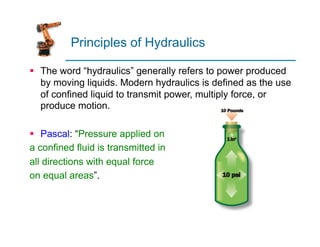
§ Pascal: “Pressure applied on
a confined fluid is transmitted in
all directions with equal force
on equal areas”.
Multiplication of Force
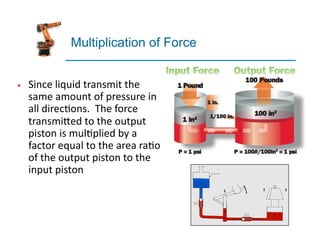
§ Since	
  liquid	
  transmit	
  the	
  
same	
  amount	
  of	
  pressure	
  in	
  
all	
  direc4ons.	
  	
  The	
  force	
  
transmi7ed	
  to	
  the	
  output	
  
piston	
  is	
  mul4plied	
  by	
  a	
  
factor	
  equal	
  to	
  the	
  area	
  ra4o	
  
of	
  the	
  output	
  piston	
  to	
  the	
  
input	
  piston	
  
Components of Hydraulic/Pneumatic
Systems
Components of Hydraulic/Pneumatic
Systems
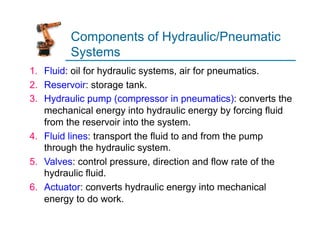
1. Fluid: oil for hydraulic systems, air for pneumatics.
2. Reservoir: storage tank.
3. Hydraulic pump (compressor in pneumatics): converts the
mechanical energy into hydraulic energy by forcing fluid
from the reservoir into the system.
4. Fluid lines: transport the fluid to and from the pump
through the hydraulic system.
5. Valves: control pressure, direction and flow rate of the
hydraulic fluid.
6. Actuator: converts hydraulic energy into mechanical
energy to do work.
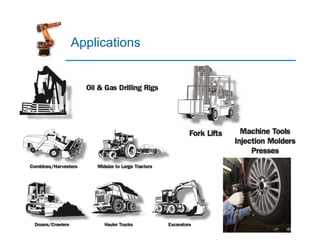
Applications
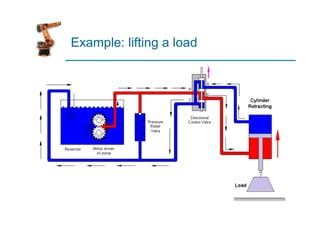
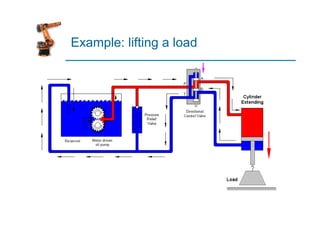
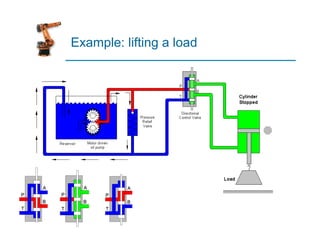
Example: lifting a load
Control valves
Control valves: are valves used to control conditions such
as flow, pressure, and direction of flow.
§ Pressure control valves.
§ Flow control valves.
§ Directional control valves
§ Check Valves
§ Directional valves
Pressure Control Valves
A pressure control valve is
used to reduce the amount of
pressure in a tank or system
of pipes.
Pressure Control Valves
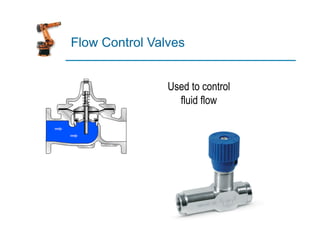
Flow Control Valves
Used to control
fluid flow
Flow Control Valves
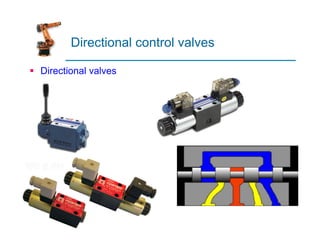
Directional control valves
§ Check Valves
Directional control valves
§ Directional valves
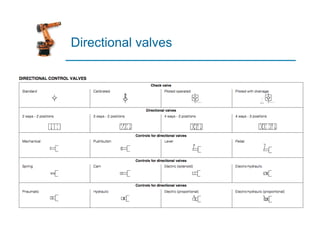
Directional valves
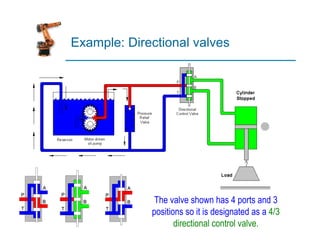
Example: Directional valves
The valve shown has 4 ports and 3
positions so it is designated as a 4/3
directional control valve.
Symbols
§ In hydraulics the pressure port is designated P and the
return port R or T (for tank). The two other ports are
designated A and B.
§ Boxes to identify normal and operating positions.
§ Arrows to identify flow directions.
§ In Pneumatics the pressure port is numbered (1) and the
exhaust port (3). The other two are numbered (2) and (4).
Example: 4-ports 2-position directional
control valve
Example: 4-ports 3-position directional
control valve
Example: 4-ports 3-position directional
control valve
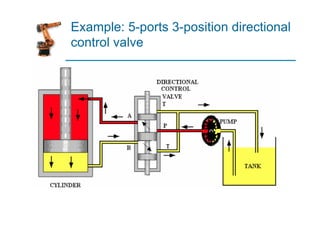
Example: 5-ports 3-position directional
control valve
Cylinders
Pneumatic Circuits
Flow control valve (with check)
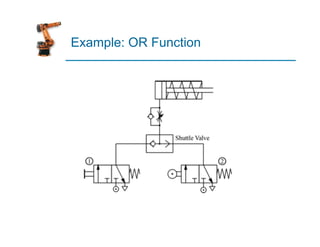
Shuttle valve
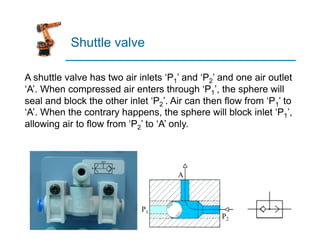
A shuttle valve has two air inlets ‘P1’ and ‘P2’ and one air outlet
‘A’. When compressed air enters through ‘P1’, the sphere will
seal and block the other inlet ‘P2’. Air can then flow from ‘P1’ to
‘A’. When the contrary happens, the sphere will block inlet ‘P1’,
allowing air to flow from ‘P2’ to ‘A’ only.
Pneumatic circuits
§ Pneumatic control systems can be designed in the form of
pneumatic circuits. A pneumatic circuit is formed by
various pneumatic components, such as cylinders,
directional control valves, flow control valves, etc.
§ Pneumatic circuits have the following functions:
1. To control the injection and release of compressed air
in the cylinders.
2. To use one valve to control another valve.
§ Displayed as Pneumatic circuit diagram.
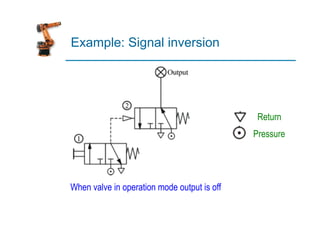
Example: Signal inversion
Pressure
Return
When valve in operation mode output is off
Example: Memory Function
When valve 1 is operated output is on until valve 2 is on then output is off.
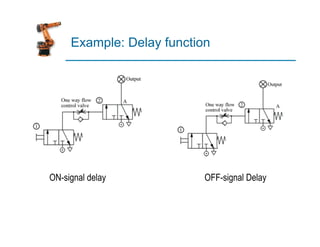
Example: Delay function
ON-signal delay OFF-signal Delay
Example: Delay function cont.
Time delay valve
Example: Speed control
Example: OR Function
Example: AND Function
Example: NOT Function
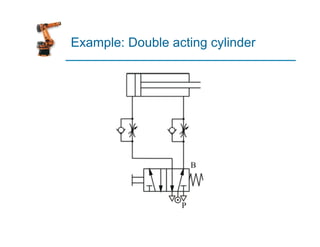
Example: Double acting cylinder
Example: Transport system
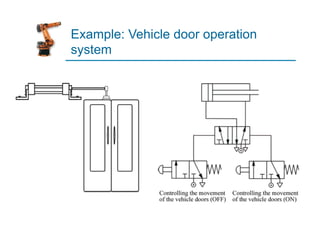
Example: Vehicle door operation
system
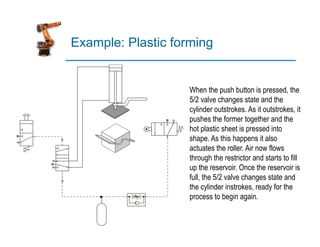
Example: Plastic forming
When the push button is pressed, the
5/2 valve changes state and the
cylinder outstrokes. As it outstrokes, it
pushes the former together and the
hot plastic sheet is pressed into
shape. As this happens it also
actuates the roller. Air now flows
through the restrictor and starts to fill
up the reservoir. Once the reservoir is
full, the 5/2 valve changes state and
the cylinder instrokes, ready for the
process to begin again.
Example: full automatic circuit
As the piston instrokes, it trips
valve A and the 5/2 valve
changes state and the piston
is sent positive. When it is
fully outstroked, it trips valve
B and the 5/2 valve returns to
its original position, allowing
the piston to instroke. The
process begins all over again
and continues to operate.
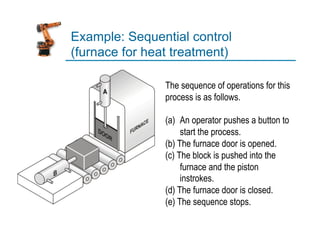
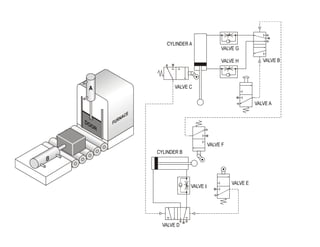
Example: Sequential control
(furnace for heat treatment)
The sequence of operations for this
process is as follows.
(a) An operator pushes a button to
start the process.
(b) The furnace door is opened.
(c) The block is pushed into the
furnace and the piston
instrokes.
(d) The furnace door is closed.
(e) The sequence stops.
Hydraulics and Pneumatics.pdf

Hydraulics and Pneumatics.pdf