HVCA & REFRIGATION COURSE
Methods of producing low temperature
Refrigeration cycle
HVAC systems
BY Mohamed Anis
Methods of producing low temperature
• Sensible cooling by a cold medium
• Phase change process
• Expansion of liquids/gases
• Thermoelectric cooling
• Adiabatic demagnetization
BY Mohamed Anis
• If a body is at lower temperature than the cooling
temperature, then the body can be used to get the
required cooling temperature by sensible cooling,
i.e. bring the object to be cooled in contact with the
body
• For example, cooling of a room with circulation of
cold air
SENSIBLE COOLING BY A COLD MEDIUM
BY Mohamed Anis
PHASE CHANGE PROCESSES
• Endothermic phase change processes produce cooling effect.
• For example, sublimation, melting, and evaporation processes absorb
energy from the surroundings which results in a decrease of
temperature.
• Two parameters are important for these processes:
the phase change temperature and the latent heat
BY Mohamed Anis
• Expansion through a turbine (isentropic
expansion)
• the process is isentropic (ideally)
• the enthalpy drop is equal to the specific work
output
EXPANSION OF LIQUIDS
Wnet
1
2
BY Mohamed Anis
• Similar to liquids, gases can also be expanded either by using a turbine
(isentropic expansion) or a throttling device (isenthalpic process).
• Since the enthalpy of an ideal gas is a function of temperature only,
during an isenthalpic process, the temperature of the ideal gas remains
constant.
• In case of real gases, whether the temperature decreases or increases
during an isenthalpic expansion depends on the Joule‐Thomson coefficient
EXPANSION OF GASES
BY Mohamed Anis
• the thermal expansion
coefficient
• the heat capacity at constant
pressure
THE JOULE‐THOMSON COEFFICIENT
BY Mohamed Anis
WHAT WILL THE MAIN
REFRIGERATION CYCLE
WHAT WILL THE CYCLE
IMPROVEMENTS
MAIN COMPONENT
Compressor Throttle
Condenser
Cooler
WHAT DOES THE COMPRESSOR DO?
The compressor has two main functions.
1) To circulate the refrigerant around the system.
2) To increase the pressure of the refrigerant vapour to a pressure at
which it can be condensed back into a liquid.
BY Mohamed Anis
The condenser provides the surface area and storage space to
1) Remove sensible and latent heat from the high pressure refrigerant
vapour to change it to a liquid.
2) To store sufficient liquid to create a vapour seal between the
condenser and expansion device
WHAT HAPPENS IN THE CONDENSER?
BY Mohamed Anis
The expansion device is a throttling device or orifice. It causes the high
pressure liquid from the condenser to convert to a mixture of low pressure
vapour and liquid.
• Automatic Exp. Valves
• Thermostatic Exp. Valves
• Capillary Tubes
• Float Valves
WHAT DOES THE EXPANSION DEVICE DO?
BY Mohamed Anis
Compressor Type
• Centrifugal
• Reciprocating
• Scroll
• Screw
BY Mohamed Anis
CENTRIFUGAL
BY Mohamed Anis
Reciprocating compressor
Scroll compressor
BY Mohamed Anis
Screw compressor
BY Mohamed Anis
Cooling the refrigerant below its condensing temperature. A refrigerant
must be in a complete liquid state before it can be subcooled.
SUBCOOLING
BY Mohamed Anis
To raise the temperature of a vapor beyond its
boiling point. No liquid can remain when a
refrigerant is superheated.
SUPERHEAT
BY Mohamed Anis
All mass will be liquid in touch with this line
Before this line it supcooled
SATURATED LIQUID
Pressure
Enthalpy
BY Mohamed Anis
All mass will be vapor in touch with this
line Before this line it was fraction
SATURATED VAPOR
Pressure
Enthalpy
BY Mohamed Anis
- refrigeration enters the compressor as a saturated vapor come out
as vapor with high pressure and temperature
- Enters the condenser as saturated vapor exit as saturated liquid
- Enter the expansion valve to decrease pressure to evaporator
Pressure
- Enter evaporator as saturation liquid exit as saturation vapor to
compressor
HOW TO WORK
BY Mohamed Anis
SAMPLE REFRIGERATION CYCLE
Pressure
Evaporator
Compressor
Condenser
Metering
Device
Refrigerant absorbs heat from
load
Refrigerant rejects heat to
atmosphere
BY Mohamed Anis
SUBCOOLED & SUPERHEAT
Refrigeration
Effect
Pressure
Enthalpy
Adding a subcooler
Increases refrigeration effect
Increases energy efficiency
Subcooled
Superheat
Condenser
Compressor
Evaporator
Metering
Device
BY Mohamed Anis
REVERSE CYCLE HEAT PUMP – COOLING CYCLE
outdoor coil Indoor coil
4 ways reversing
valves
Heat out Heat in
BY Mohamed Anis
A single stage system consists of one low side pressure
(evaporator) and one high side pressure(condenser) For the low
temperature difference between the evaporator and the condenser
(temperature lift), one can use single stage system But, for large
temperature lift, use of single stage is not justified
LIMITATION OF A SINGLE STAGE SYSTEM
BY Mohamed Anis
For cases temperature can be quite certain cases, the lift high. For example, in
frozen food industries the required evaporator can be as low as –40 ºC, while in
chemical industries temperatures as low as –150 ºC may be required for liquefaction
of gases.
LIMITATION OF A SINGLE STAGE SYSTEM
BY Mohamed Anis
• A multistage system is a system with two or more number low side
pressures can of low‐pressures.
• Multistage systems are generally more energy efficient because of
this feature. In a single-stage system your air is either on or off.
Meaning the system outputs a set amount of heat/air per hour,
operating only at 100% capacity or off.
MULTISTAGE SYSTEMS
BY Mohamed Anis
i. Multi‐compression systems
ii. Multi‐evaporator systems
iii. Cascade systems
MULTISTAGE SYSTEMS CLASSIFIED
BY Mohamed Anis
• flash gas removal
• intercooling
CONCEPTS
BY Mohamed Anis
• For high temperature lift, the inlet to the evaporator contains more vapor in
a single stage system. This vapor is called as the flash gas and it develops
during throttling process
• This flash gas has to be compressed to the condenser pressure because it
does not contribute to the refrigeration effect (as it is already in a gaseous
phase) Also, it increases the pressure drop across the evaporator. This
deteriorates the performance.
• One way is to remove the flash gas as soon as it forms and recompress
it to condenser pressure
FLASH GAS
BY Mohamed Anis
A flash tank is a pressure vessel where the
liquid refrigerant and vapor are separated at
an intermediate pressure
FLASH GAS REMOVAL WITH FLASH TANK
BY Mohamed Anis
-
BY Mohamed Anis
1
2
4
5
6
7
Evaporator
Condenser
Pressure
Enthalpy
3
4
5
2
1
7
6
Pc
Pe
Pi
3
BY Mohamed Anis
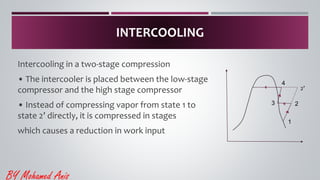
Intercooling in a two‐stage compression
• The intercooler is placed between the low‐stage
compressor and the high stage compressor
• Instead of compressing vapor from state 1 to
state 2’ directly, it is compressed in stages
which causes a reduction in work input
INTERCOOLING
1
2
2’
3
4
BY Mohamed Anis
 Using water cooled heat exchanger
 Refrigerant in the flash chamber
 Combination of the both
TYPES OF INTERCOOLING
BY Mohamed Anis
USING WATER COOLED HEAT EXCHANGER
1
2
2’
3
4
Water out
Water in
Low stage
compressor
high stage
compressor
1
2 3
4
BY Mohamed Anis
REFRIGERANT IN THE FLASH CHAMBER
Refrigerant
liquid from
condenser
Low stage
compressor
high stage
compressor
• The heat rejected to the liquid
refrigerant creates more vapour
which needs to be compressed in
the high‐stage compressor
• Whether the power input to the
system decreases or not depends
on the relative magnitude of the
increase in power consumption due
to the increased mass flow rate and
the decrease in work input due to
intercooling
BY Mohamed Anis
• Intercooling using flash chamber is usually effective for ammonia.
However, the input power marginally increases for refrigerants R11
and R12. Hence, it is not effective for R11 and R12 refrigerants.
• But, incorporation of this method reduces the discharge temperature
of the compressor which in turn enhances the compressor lubrication
and increases its life.
REFRIGERANT IN THE FLASH CHAMBER
BY Mohamed Anis
COMBINATION OF THE BOTH
Evaporator
Condenser
1
2
2’
3
4
1
2
3
9
5
6
4 5
6
7
7
8
8
9
BY Mohamed Anis
• higher refrigeration effect
• throttling losses are reduced
• volumetric efficiency of compressors will be high due to reduced
pressure ratio
• compressor discharge temperature is reduced considerably
ADVANTAGES OF MULTISTAGE SYSTEM WITH FLASH
GAS REMOVAL AND INTERCOOLING
BY Mohamed Anis
A cooling tower is a heat rejection device
which rejects waste heat to the
atmosphere through the cooling of a
water stream to a lower temperature
COOLING TOWER
BY Mohamed Anis
BY Mohamed Anis
AHU & FCU
AHU FCU
BY Mohamed Anis
• AHU is generally a bigger system than FCU.
• AHU is more complex than the FCU and that AHU are often used in bigger
establishments or spaces.
• The AHU system usually channels air through ducts whereas the FCU don’t have
any ductworks.
• AHU system treats outside air while FCUs basically recycle or re-circulates the air.
• AHU have sections for reheating and humidifying whereas the FCU does not have
any.
• FCU are often observed to be noisier than the AHU
AHU & FCU
BY Mohamed Anis
Motor Expansion Valve
Evaporator
Condenser
Compressor
Cooling Tower
HVAC CYCLE
BY Mohamed Anis
HVAC SYSTEMS
DX (direct
expansion )
Chilled water
system
Package units Split units
window
Central
package
Central spilt Mini spilt
Roof top
vertical
High wall Floor &
ceiling
Floor
standing
cassette
CCD
Ceiling
concealed
ducted
VRF system
FCU
Fan cool unit
AHU
Air handing
unit
BY Mohamed Anis
Central package - rooftop
BY Mohamed Anis
Central package - rooftop
BY Mohamed Anis
Central package – vertical
BY Mohamed Anis
Central spilt – high wall
BY Mohamed Anis
Central spilt – FLOOR & CEILING
BY Mohamed Anis
Central spilt –floor standing
BY Mohamed Anis
Central spilt -Cassette
BY Mohamed Anis
Central spilt- VRF system
BY Mohamed Anis
CENTRAL SPILT
-CCD -ceiling concealed ducted
BY Mohamed Anis
CHILLED WATER SYSTEM
AHU
BY Mohamed Anis
Chilled water system
AHU
BY Mohamed Anis
CHILLED WATER SYSTEM
FCU
BY Mohamed Anis

Training electrical engineering HVAC System Fundamentals .pdf

  • 1.
    HVCA & REFRIGATIONCOURSE Methods of producing low temperature Refrigeration cycle HVAC systems BY Mohamed Anis
  • 2.
    Methods of producinglow temperature • Sensible cooling by a cold medium • Phase change process • Expansion of liquids/gases • Thermoelectric cooling • Adiabatic demagnetization BY Mohamed Anis
  • 3.
    • If abody is at lower temperature than the cooling temperature, then the body can be used to get the required cooling temperature by sensible cooling, i.e. bring the object to be cooled in contact with the body • For example, cooling of a room with circulation of cold air SENSIBLE COOLING BY A COLD MEDIUM BY Mohamed Anis
  • 4.
    PHASE CHANGE PROCESSES •Endothermic phase change processes produce cooling effect. • For example, sublimation, melting, and evaporation processes absorb energy from the surroundings which results in a decrease of temperature. • Two parameters are important for these processes: the phase change temperature and the latent heat BY Mohamed Anis
  • 5.
    • Expansion througha turbine (isentropic expansion) • the process is isentropic (ideally) • the enthalpy drop is equal to the specific work output EXPANSION OF LIQUIDS Wnet 1 2 BY Mohamed Anis
  • 6.
    • Similar toliquids, gases can also be expanded either by using a turbine (isentropic expansion) or a throttling device (isenthalpic process). • Since the enthalpy of an ideal gas is a function of temperature only, during an isenthalpic process, the temperature of the ideal gas remains constant. • In case of real gases, whether the temperature decreases or increases during an isenthalpic expansion depends on the Joule‐Thomson coefficient EXPANSION OF GASES BY Mohamed Anis
  • 7.
    • the thermalexpansion coefficient • the heat capacity at constant pressure THE JOULE‐THOMSON COEFFICIENT BY Mohamed Anis
  • 8.
    WHAT WILL THEMAIN REFRIGERATION CYCLE WHAT WILL THE CYCLE IMPROVEMENTS
  • 9.
  • 10.
    WHAT DOES THECOMPRESSOR DO? The compressor has two main functions. 1) To circulate the refrigerant around the system. 2) To increase the pressure of the refrigerant vapour to a pressure at which it can be condensed back into a liquid. BY Mohamed Anis
  • 11.
    The condenser providesthe surface area and storage space to 1) Remove sensible and latent heat from the high pressure refrigerant vapour to change it to a liquid. 2) To store sufficient liquid to create a vapour seal between the condenser and expansion device WHAT HAPPENS IN THE CONDENSER? BY Mohamed Anis
  • 12.
    The expansion deviceis a throttling device or orifice. It causes the high pressure liquid from the condenser to convert to a mixture of low pressure vapour and liquid. • Automatic Exp. Valves • Thermostatic Exp. Valves • Capillary Tubes • Float Valves WHAT DOES THE EXPANSION DEVICE DO? BY Mohamed Anis
  • 13.
    Compressor Type • Centrifugal •Reciprocating • Scroll • Screw BY Mohamed Anis
  • 14.
  • 15.
  • 16.
  • 17.
  • 18.
    Cooling the refrigerantbelow its condensing temperature. A refrigerant must be in a complete liquid state before it can be subcooled. SUBCOOLING BY Mohamed Anis
  • 19.
    To raise thetemperature of a vapor beyond its boiling point. No liquid can remain when a refrigerant is superheated. SUPERHEAT BY Mohamed Anis
  • 20.
    All mass willbe liquid in touch with this line Before this line it supcooled SATURATED LIQUID Pressure Enthalpy BY Mohamed Anis
  • 21.
    All mass willbe vapor in touch with this line Before this line it was fraction SATURATED VAPOR Pressure Enthalpy BY Mohamed Anis
  • 22.
    - refrigeration entersthe compressor as a saturated vapor come out as vapor with high pressure and temperature - Enters the condenser as saturated vapor exit as saturated liquid - Enter the expansion valve to decrease pressure to evaporator Pressure - Enter evaporator as saturation liquid exit as saturation vapor to compressor HOW TO WORK BY Mohamed Anis
  • 23.
    SAMPLE REFRIGERATION CYCLE Pressure Evaporator Compressor Condenser Metering Device Refrigerantabsorbs heat from load Refrigerant rejects heat to atmosphere BY Mohamed Anis
  • 24.
    SUBCOOLED & SUPERHEAT Refrigeration Effect Pressure Enthalpy Addinga subcooler Increases refrigeration effect Increases energy efficiency Subcooled Superheat Condenser Compressor Evaporator Metering Device BY Mohamed Anis
  • 25.
    REVERSE CYCLE HEATPUMP – COOLING CYCLE outdoor coil Indoor coil 4 ways reversing valves Heat out Heat in BY Mohamed Anis
  • 26.
    A single stagesystem consists of one low side pressure (evaporator) and one high side pressure(condenser) For the low temperature difference between the evaporator and the condenser (temperature lift), one can use single stage system But, for large temperature lift, use of single stage is not justified LIMITATION OF A SINGLE STAGE SYSTEM BY Mohamed Anis
  • 27.
    For cases temperaturecan be quite certain cases, the lift high. For example, in frozen food industries the required evaporator can be as low as –40 ºC, while in chemical industries temperatures as low as –150 ºC may be required for liquefaction of gases. LIMITATION OF A SINGLE STAGE SYSTEM BY Mohamed Anis
  • 28.
    • A multistagesystem is a system with two or more number low side pressures can of low‐pressures. • Multistage systems are generally more energy efficient because of this feature. In a single-stage system your air is either on or off. Meaning the system outputs a set amount of heat/air per hour, operating only at 100% capacity or off. MULTISTAGE SYSTEMS BY Mohamed Anis
  • 29.
    i. Multi‐compression systems ii.Multi‐evaporator systems iii. Cascade systems MULTISTAGE SYSTEMS CLASSIFIED BY Mohamed Anis
  • 30.
    • flash gasremoval • intercooling CONCEPTS BY Mohamed Anis
  • 31.
    • For hightemperature lift, the inlet to the evaporator contains more vapor in a single stage system. This vapor is called as the flash gas and it develops during throttling process • This flash gas has to be compressed to the condenser pressure because it does not contribute to the refrigeration effect (as it is already in a gaseous phase) Also, it increases the pressure drop across the evaporator. This deteriorates the performance. • One way is to remove the flash gas as soon as it forms and recompress it to condenser pressure FLASH GAS BY Mohamed Anis
  • 32.
    A flash tankis a pressure vessel where the liquid refrigerant and vapor are separated at an intermediate pressure FLASH GAS REMOVAL WITH FLASH TANK BY Mohamed Anis
  • 33.
  • 34.
  • 35.
    Intercooling in atwo‐stage compression • The intercooler is placed between the low‐stage compressor and the high stage compressor • Instead of compressing vapor from state 1 to state 2’ directly, it is compressed in stages which causes a reduction in work input INTERCOOLING 1 2 2’ 3 4 BY Mohamed Anis
  • 36.
     Using watercooled heat exchanger  Refrigerant in the flash chamber  Combination of the both TYPES OF INTERCOOLING BY Mohamed Anis
  • 37.
    USING WATER COOLEDHEAT EXCHANGER 1 2 2’ 3 4 Water out Water in Low stage compressor high stage compressor 1 2 3 4 BY Mohamed Anis
  • 38.
    REFRIGERANT IN THEFLASH CHAMBER Refrigerant liquid from condenser Low stage compressor high stage compressor • The heat rejected to the liquid refrigerant creates more vapour which needs to be compressed in the high‐stage compressor • Whether the power input to the system decreases or not depends on the relative magnitude of the increase in power consumption due to the increased mass flow rate and the decrease in work input due to intercooling BY Mohamed Anis
  • 39.
    • Intercooling usingflash chamber is usually effective for ammonia. However, the input power marginally increases for refrigerants R11 and R12. Hence, it is not effective for R11 and R12 refrigerants. • But, incorporation of this method reduces the discharge temperature of the compressor which in turn enhances the compressor lubrication and increases its life. REFRIGERANT IN THE FLASH CHAMBER BY Mohamed Anis
  • 40.
    COMBINATION OF THEBOTH Evaporator Condenser 1 2 2’ 3 4 1 2 3 9 5 6 4 5 6 7 7 8 8 9 BY Mohamed Anis
  • 41.
    • higher refrigerationeffect • throttling losses are reduced • volumetric efficiency of compressors will be high due to reduced pressure ratio • compressor discharge temperature is reduced considerably ADVANTAGES OF MULTISTAGE SYSTEM WITH FLASH GAS REMOVAL AND INTERCOOLING BY Mohamed Anis
  • 42.
    A cooling toweris a heat rejection device which rejects waste heat to the atmosphere through the cooling of a water stream to a lower temperature COOLING TOWER BY Mohamed Anis
  • 43.
  • 44.
    AHU & FCU AHUFCU BY Mohamed Anis
  • 45.
    • AHU isgenerally a bigger system than FCU. • AHU is more complex than the FCU and that AHU are often used in bigger establishments or spaces. • The AHU system usually channels air through ducts whereas the FCU don’t have any ductworks. • AHU system treats outside air while FCUs basically recycle or re-circulates the air. • AHU have sections for reheating and humidifying whereas the FCU does not have any. • FCU are often observed to be noisier than the AHU AHU & FCU BY Mohamed Anis
  • 46.
  • 47.
    HVAC SYSTEMS DX (direct expansion) Chilled water system Package units Split units window Central package Central spilt Mini spilt Roof top vertical High wall Floor & ceiling Floor standing cassette CCD Ceiling concealed ducted VRF system FCU Fan cool unit AHU Air handing unit BY Mohamed Anis
  • 48.
    Central package -rooftop BY Mohamed Anis
  • 49.
    Central package -rooftop BY Mohamed Anis
  • 50.
    Central package –vertical BY Mohamed Anis
  • 51.
    Central spilt –high wall BY Mohamed Anis
  • 52.
    Central spilt –FLOOR & CEILING BY Mohamed Anis
  • 53.
    Central spilt –floorstanding BY Mohamed Anis
  • 54.
  • 55.
    Central spilt- VRFsystem BY Mohamed Anis
  • 56.
    CENTRAL SPILT -CCD -ceilingconcealed ducted BY Mohamed Anis
  • 57.
  • 58.
  • 59.