IMMUNE STIMULATION
Ameena kadar K A
Grace College Of Pharmacy
Palakkad.
 Immune system: a brief introduction:
 The immune system is a complex and highly developed system, yet
its mission is simple: to seek and kill intruders.
 It is the body‘s defense system against infectious organisms and
other invaders.
 The purpose of the immune system is to keep infectious
microorganisms, such as bacteria, viruses, and fungi, out of the body,
and to destroy any infectious microorganisms that do invade the
body.
 Through a series of steps called the immune response, the immune
system protects us against invading organisms.
 It is a network of cells, tissues, and organs working together to
protect the body.
 The most important cell types involved in immune response are
white blood cells, which come in two basic types that combine to
seek out and destroy disease-causing organisms.
 Leukocytes are produced or stored in different locations in the body,
like the thymus, spleen, bone marrow lymph nodes, and special
deposits of lymphoid tissue (as in the gastrointestinal tract).
 These cells circulate through the body between the organs and nodes
via lymphatic and blood vessels, and work in a coordinated manner
to monitor the body for foreign invasions.
 A potent and active immune system is vital for staying healthy.
 The immune system differentiates between invaders and the body‘s
own cells—when immune system is not able to differentiate between
self and nonself, a reaction against ―self ‖ cells and molecules causes
autoimmune disease.
 The immune system will remain active by getting enough sleep,
exercise, and good nutrition.
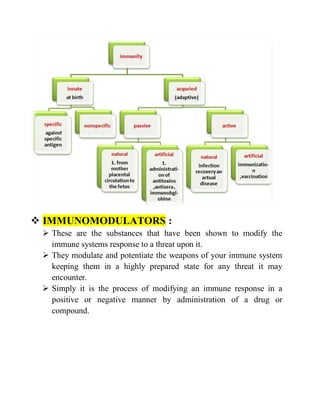
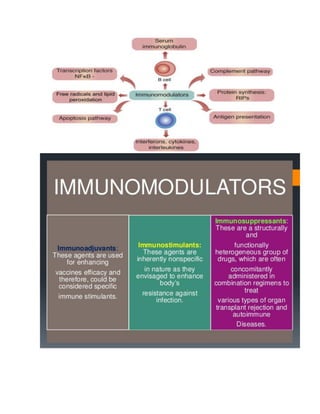
 IMMUNOMODULATORS :
 These are the substances that have been shown to modify the
immune systems response to a threat upon it.
 They modulate and potentiate the weapons of your immune system
keeping them in a highly prepared state for any threat it may
encounter.
 Simply it is the process of modifying an immune response in a
positive or negative manner by administration of a drug or
compound.
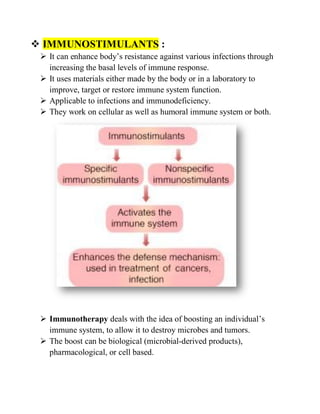
 IMMUNOSTIMULANTS :
 It can enhance body‘s resistance against various infections through
increasing the basal levels of immune response.
 It uses materials either made by the body or in a laboratory to
improve, target or restore immune system function.
 Applicable to infections and immunodeficiency.
 They work on cellular as well as humoral immune system or both.
 Immunotherapy deals with the idea of boosting an individual‘s
immune system, to allow it to destroy microbes and tumors.
 The boost can be biological (microbial-derived products),
pharmacological, or cell based.
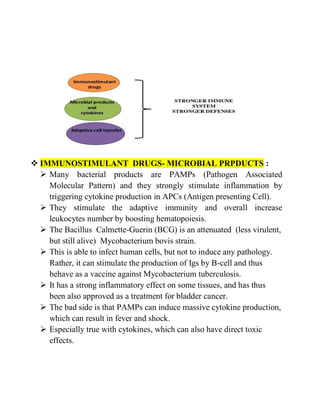
 IMMUNOSTIMULANT DRUGS- MICROBIAL PRPDUCTS :
 Many bacterial products are PAMPs (Pathogen Associated
Molecular Pattern) and they strongly stimulate inflammation by
triggering cytokine production in APCs (Antigen presenting Cell).
 They stimulate the adaptive immunity and overall increase
leukocytes number by boosting hematopoiesis.
 The Bacillus Calmette-Guerin (BCG) is an attenuated (less virulent,
but still alive) Mycobacterium bovis strain.
 This is able to infect human cells, but not to induce any pathology.
Rather, it can stimulate the production of Igs by B-cell and thus
behave as a vaccine against Mycobacterium tuberculosis.
 It has a strong inflammatory effect on some tissues, and has thus
been also approved as a treatment for bladder cancer.
 The bad side is that PAMPs can induce massive cytokine production,
which can result in fever and shock.
 Especially true with cytokines, which can also have direct toxic
effects.
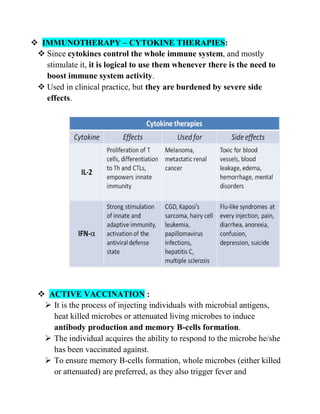
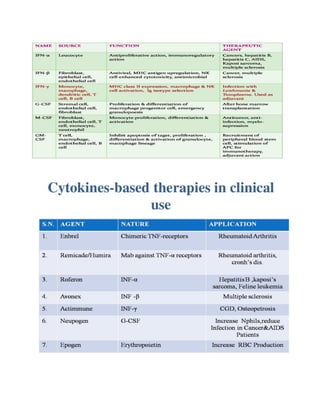
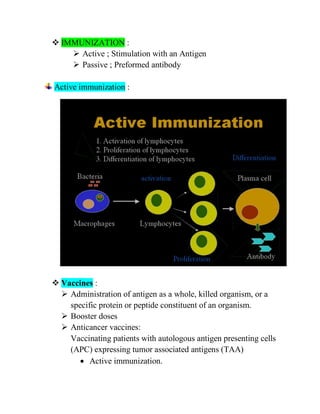
 IMMUNOTHERAPY – CYTOKINE THERAPIES:
 Since cytokines control the whole immune system, and mostly
stimulate it, it is logical to use them whenever there is the need to
boost immune system activity.
 Used in clinical practice, but they are burdened by severe side
effects.
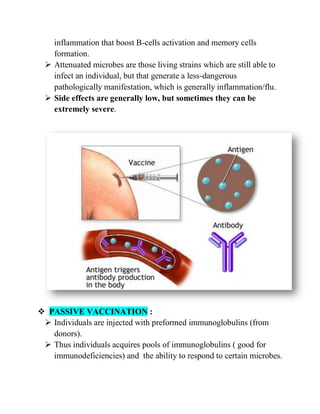
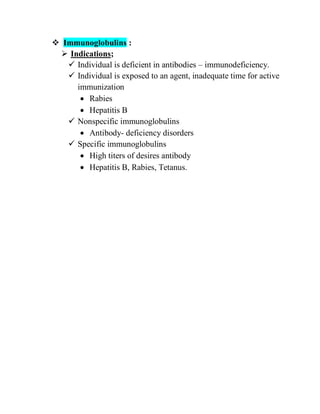
 ACTIVE VACCINATION :
 It is the process of injecting individuals with microbial antigens,
heat killed microbes or attenuated living microbes to induce
antibody production and memory B-cells formation.
 The individual acquires the ability to respond to the microbe he/she
has been vaccinated against.
 To ensure memory B-cells formation, whole microbes (either killed
or attenuated) are preferred, as they also trigger fever and
inflammation that boost B-cells activation and memory cells
formation.
 Attenuated microbes are those living strains which are still able to
infect an individual, but that generate a less-dangerous
pathologically manifestation, which is generally inflammation/flu.
 Side effects are generally low, but sometimes they can be
extremely severe.
 PASSIVE VACCINATION :
 Individuals are injected with preformed immunoglobulins (from
donors).
 Thus individuals acquires pools of immunoglobulins ( good for
immunodeficiencies) and the ability to respond to certain microbes.
 Transfusion of immunoglobulins is called intravenous
immunoglobulins (igv).
 Generally igv contain igG and igA.
 Anti-microbial igv are used against hepatitis b, botulism,
diphtheria, tetanus, rabies.
 It is generally well tolerated, but sporadic side effects can be
extremely severe.
ADJUVANTS USED FOR VACCINATION :
 Injecting a living microbe can be dangerous, and reducing the
amount of microbe to the minimum is mandatory. Here is the
need for adjuvants.
 Adjuvants are chemical or biological products that can either
boost T-cells, activate inflammation or help to stabilize the
antigen so that it can stimulate B-cells for a longer time.
 Adjuvants have been also implicated in clinical side effects of
vaccinations, like the onset of juvenile diabetes in the case of
Freund‘s adjuvant.
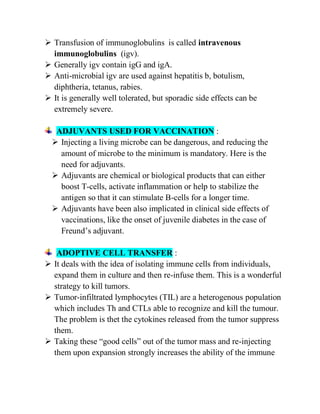
ADOPTIVE CELL TRANSFER :
 It deals with the idea of isolating immune cells from individuals,
expand them in culture and then re-infuse them. This is a wonderful
strategy to kill tumors.
 Tumor-infiltrated lymphocytes (TIL) are a heterogenous population
which includes Th and CTLs able to recognize and kill the tumour.
The problem is thet the cytokines released from the tumor suppress
them.
 Taking these ―good cells‖ out of the tumor mass and re-injecting
them upon expansion strongly increases the ability of the immune
system to react against tumors.
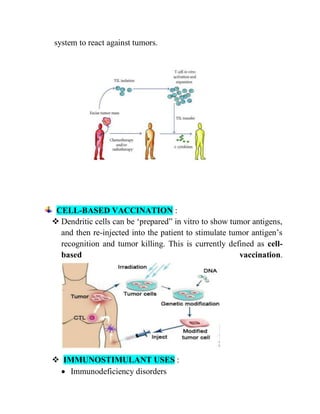
CELL-BASED VACCINATION :
 Dendritic cells can be ‗prepared‖ in vitro to show tumor antigens,
and then re-injected into the patient to stimulate tumor antigen‘s
recognition and tumor killing. This is currently defined as cell-
based vaccination.
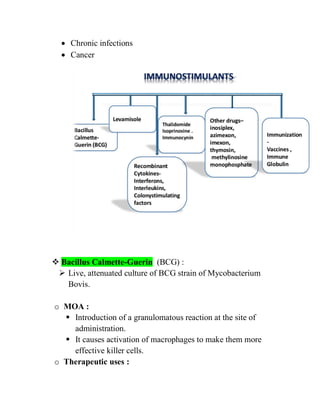
 IMMUNOSTIMULANT USES :
 Immunodeficiency disorders
 Chronic infections
 Cancer
 Bacillus Calmette-Guerin (BCG) :
 Live, attenuated culture of BCG strain of Mycobacterium
Bovis.
o MOA :
 Introduction of a granulomatous reaction at the site of
administration.
 It causes activation of macrophages to make them more
effective killer cells.
o Therapeutic uses :
 Treatment and prophylaxis of carcinoma of the urinary
bladder, prophylaxis of primary and recurrent stage of
papillary tumors after transurethral resection.
o Adverse effects :
 Hypersensitivity, shock, chills, fever, malaise and immune
complex disease.
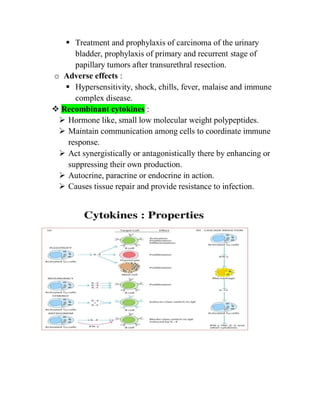
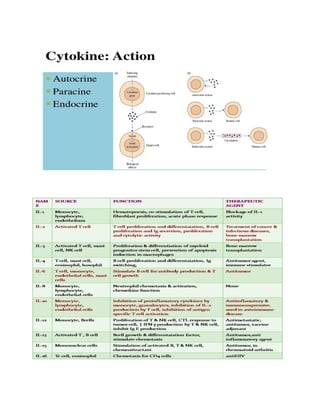
 Recombinant cytokines :
 Hormone like, small low molecular weight polypeptides.
 Maintain communication among cells to coordinate immune
response.
 Act synergistically or antagonistically there by enhancing or
suppressing their own production.
 Autocrine, paracrine or endocrine in action.
 Causes tissue repair and provide resistance to infection.
 IMMUNIZATION :
 Active ; Stimulation with an Antigen
 Passive ; Preformed antibody
Active immunization :
 Vaccines :
 Administration of antigen as a whole, killed organism, or a
specific protein or peptide constituent of an organism.
 Booster doses
 Anticancer vaccines:
Vaccinating patients with autologous antigen presenting cells
(APC) expressing tumor associated antigens (TAA)
 Active immunization.
 Immunoglobulins :
 Indications;
 Individual is deficient in antibodies – immunodeficiency.
 Individual is exposed to an agent, inadequate time for active
immunization
 Rabies
 Hepatitis B
 Nonspecific immunoglobulins
 Antibody- deficiency disorders
 Specific immunoglobulins
 High titers of desires antibody
 Hepatitis B, Rabies, Tetanus.
 REFERENCES :
 Goodman & Gilman‘s The pharmacological basis of
Therapeutics , 11th
edition by Laurence L Brunton, John S
Lazo , Keith L Parker.
 Suman kapur and anuradha pal, Article in Immune cell
activation: stimulation, costimulation, and regulation of
cellular activation.
Immune stimulation

Immune stimulation

  • 1.
    IMMUNE STIMULATION Ameena kadarK A Grace College Of Pharmacy Palakkad.
  • 2.
     Immune system:a brief introduction:  The immune system is a complex and highly developed system, yet its mission is simple: to seek and kill intruders.  It is the body‘s defense system against infectious organisms and other invaders.  The purpose of the immune system is to keep infectious microorganisms, such as bacteria, viruses, and fungi, out of the body, and to destroy any infectious microorganisms that do invade the body.  Through a series of steps called the immune response, the immune system protects us against invading organisms.  It is a network of cells, tissues, and organs working together to protect the body.  The most important cell types involved in immune response are white blood cells, which come in two basic types that combine to seek out and destroy disease-causing organisms.  Leukocytes are produced or stored in different locations in the body, like the thymus, spleen, bone marrow lymph nodes, and special deposits of lymphoid tissue (as in the gastrointestinal tract).  These cells circulate through the body between the organs and nodes via lymphatic and blood vessels, and work in a coordinated manner to monitor the body for foreign invasions.  A potent and active immune system is vital for staying healthy.  The immune system differentiates between invaders and the body‘s own cells—when immune system is not able to differentiate between self and nonself, a reaction against ―self ‖ cells and molecules causes autoimmune disease.  The immune system will remain active by getting enough sleep, exercise, and good nutrition.
  • 3.
     IMMUNOMODULATORS : These are the substances that have been shown to modify the immune systems response to a threat upon it.  They modulate and potentiate the weapons of your immune system keeping them in a highly prepared state for any threat it may encounter.  Simply it is the process of modifying an immune response in a positive or negative manner by administration of a drug or compound.
  • 5.
     IMMUNOSTIMULANTS : It can enhance body‘s resistance against various infections through increasing the basal levels of immune response.  It uses materials either made by the body or in a laboratory to improve, target or restore immune system function.  Applicable to infections and immunodeficiency.  They work on cellular as well as humoral immune system or both.  Immunotherapy deals with the idea of boosting an individual‘s immune system, to allow it to destroy microbes and tumors.  The boost can be biological (microbial-derived products), pharmacological, or cell based.
  • 6.
     IMMUNOSTIMULANT DRUGS-MICROBIAL PRPDUCTS :  Many bacterial products are PAMPs (Pathogen Associated Molecular Pattern) and they strongly stimulate inflammation by triggering cytokine production in APCs (Antigen presenting Cell).  They stimulate the adaptive immunity and overall increase leukocytes number by boosting hematopoiesis.  The Bacillus Calmette-Guerin (BCG) is an attenuated (less virulent, but still alive) Mycobacterium bovis strain.  This is able to infect human cells, but not to induce any pathology. Rather, it can stimulate the production of Igs by B-cell and thus behave as a vaccine against Mycobacterium tuberculosis.  It has a strong inflammatory effect on some tissues, and has thus been also approved as a treatment for bladder cancer.  The bad side is that PAMPs can induce massive cytokine production, which can result in fever and shock.  Especially true with cytokines, which can also have direct toxic effects.
  • 7.
     IMMUNOTHERAPY –CYTOKINE THERAPIES:  Since cytokines control the whole immune system, and mostly stimulate it, it is logical to use them whenever there is the need to boost immune system activity.  Used in clinical practice, but they are burdened by severe side effects.  ACTIVE VACCINATION :  It is the process of injecting individuals with microbial antigens, heat killed microbes or attenuated living microbes to induce antibody production and memory B-cells formation.  The individual acquires the ability to respond to the microbe he/she has been vaccinated against.  To ensure memory B-cells formation, whole microbes (either killed or attenuated) are preferred, as they also trigger fever and
  • 8.
    inflammation that boostB-cells activation and memory cells formation.  Attenuated microbes are those living strains which are still able to infect an individual, but that generate a less-dangerous pathologically manifestation, which is generally inflammation/flu.  Side effects are generally low, but sometimes they can be extremely severe.  PASSIVE VACCINATION :  Individuals are injected with preformed immunoglobulins (from donors).  Thus individuals acquires pools of immunoglobulins ( good for immunodeficiencies) and the ability to respond to certain microbes.
  • 9.
     Transfusion ofimmunoglobulins is called intravenous immunoglobulins (igv).  Generally igv contain igG and igA.  Anti-microbial igv are used against hepatitis b, botulism, diphtheria, tetanus, rabies.  It is generally well tolerated, but sporadic side effects can be extremely severe. ADJUVANTS USED FOR VACCINATION :  Injecting a living microbe can be dangerous, and reducing the amount of microbe to the minimum is mandatory. Here is the need for adjuvants.  Adjuvants are chemical or biological products that can either boost T-cells, activate inflammation or help to stabilize the antigen so that it can stimulate B-cells for a longer time.  Adjuvants have been also implicated in clinical side effects of vaccinations, like the onset of juvenile diabetes in the case of Freund‘s adjuvant. ADOPTIVE CELL TRANSFER :  It deals with the idea of isolating immune cells from individuals, expand them in culture and then re-infuse them. This is a wonderful strategy to kill tumors.  Tumor-infiltrated lymphocytes (TIL) are a heterogenous population which includes Th and CTLs able to recognize and kill the tumour. The problem is thet the cytokines released from the tumor suppress them.  Taking these ―good cells‖ out of the tumor mass and re-injecting them upon expansion strongly increases the ability of the immune
  • 10.
    system to reactagainst tumors. CELL-BASED VACCINATION :  Dendritic cells can be ‗prepared‖ in vitro to show tumor antigens, and then re-injected into the patient to stimulate tumor antigen‘s recognition and tumor killing. This is currently defined as cell- based vaccination.  IMMUNOSTIMULANT USES :  Immunodeficiency disorders
  • 11.
     Chronic infections Cancer  Bacillus Calmette-Guerin (BCG) :  Live, attenuated culture of BCG strain of Mycobacterium Bovis. o MOA :  Introduction of a granulomatous reaction at the site of administration.  It causes activation of macrophages to make them more effective killer cells. o Therapeutic uses :
  • 12.
     Treatment andprophylaxis of carcinoma of the urinary bladder, prophylaxis of primary and recurrent stage of papillary tumors after transurethral resection. o Adverse effects :  Hypersensitivity, shock, chills, fever, malaise and immune complex disease.  Recombinant cytokines :  Hormone like, small low molecular weight polypeptides.  Maintain communication among cells to coordinate immune response.  Act synergistically or antagonistically there by enhancing or suppressing their own production.  Autocrine, paracrine or endocrine in action.  Causes tissue repair and provide resistance to infection.
  • 15.
     IMMUNIZATION : Active ; Stimulation with an Antigen  Passive ; Preformed antibody Active immunization :  Vaccines :  Administration of antigen as a whole, killed organism, or a specific protein or peptide constituent of an organism.  Booster doses  Anticancer vaccines: Vaccinating patients with autologous antigen presenting cells (APC) expressing tumor associated antigens (TAA)  Active immunization.
  • 16.
     Immunoglobulins : Indications;  Individual is deficient in antibodies – immunodeficiency.  Individual is exposed to an agent, inadequate time for active immunization  Rabies  Hepatitis B  Nonspecific immunoglobulins  Antibody- deficiency disorders  Specific immunoglobulins  High titers of desires antibody  Hepatitis B, Rabies, Tetanus.
  • 17.
     REFERENCES : Goodman & Gilman‘s The pharmacological basis of Therapeutics , 11th edition by Laurence L Brunton, John S Lazo , Keith L Parker.  Suman kapur and anuradha pal, Article in Immune cell activation: stimulation, costimulation, and regulation of cellular activation.