HYBRIDOMA
TECHNOLOGY
 Hybridoma technique was Developed by Georges J.F. Kohler
and Cesar Milstein in 1975 .
 They shared nobel prize for this discovery in 1984 .
 The term hybridoma was coined by Leonard Herzenberg in
1975.
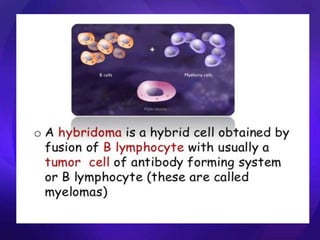
 A hybridoma is a hybrid cell obtained by fusion of B
lymphocyte with usually a tumor cell of antibody forming
system or B lymphocyte (these are called myelomas).
The hybrid cell has the capacity of antibody production
derived from B cells .
At the same time it can divide continuously by the quality
derived from Myeloma cells .
 By combining the desired qualities of both the cells, the
technology ensures large scale antibody production of single
specificity
 Specific hybridomas are either cultured in vitro or passed
through mouse peritoneal cavity to obtain monoclonal
antibodies, this is called as hybridoma technology
 Isolation of B cells from mice - 2-4 weeks old are immunized
with the antigen against which monoclonal antibodies are to be
raised by subcutaneous injection.
 Later B cells are isolated from the spleen of an immunized
mouse.
 Isolation of myeloma cells -Myeloma cells are isolated from
bone marrow .
 The myeloma cells used are HGPRT(Hypoxanthine-guanine
phosphoribosyl transferase) mutant cells ( raised by mutations
using 8- azaguanine).
 Electrofusion : cells are allowed to fuse with the application of an
electric field -Done by using PEG medium -PEG stands for Poly
Ethylene Glycol.
 Selection of hybrid cells -HAT medium is used for the selection of
hybrid cells -HAT stands for Hypoxanthine Aminopterine Thymidine.
 Nucleotide synthesis is essential for cell survival .
 In HAT medium, aminopterine blocks the cellular synthesis of purines
and pyrimidines from simple sugars (denovo pathway) .
 But cells can thrive by using hypoxanthine and thymidine present in
the medium by salvage pathway using the enzyme HGPRT.
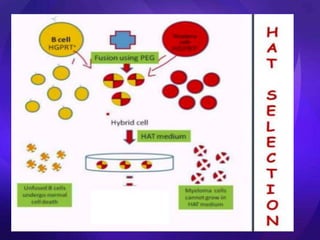
 B cells are HGPRT+ and can survive in the HAT medium, but
they undergo normal cell death after some division.
 In hybridoma technology, the myeloma cells used are HGPRT
deficient ,so these cells can’t survive in HAT medium as
Aminopterine blocks the Denovo pathway.
 Hybrid cells has HGPRT enzyme from the B cell as well as they
have the ability to multiply repeatedly as myeloma cells ,so
only hybrid cells can survive in HAT medium.
 Identification and isolation of the hybridoma cells.
 The first screening technique used is ELISA -Done by
incubating the hybridoma culture supernatant.
 Secondary enzyme labeled conjugate and chromogenic
substrate.
 Formation of a coloured product indicates a positive
hybridoma.
IN VIVO & IN VITRO
 Iv-vivo procedure involves introduction of hybridoma cells
into the peritoneal cavity of the animal .
 Then ascetic fluid is isolated and then antibodies are isolated
from it .
 In-vitro method involves culturing of hybridoma cells in
suitable culture media and then antibodies are isolated and
purified
 Once a hybridoma colony is established, it will continually
grow in culture medium like RPMI-1640 and produce
antibodies
 Multiwell plates are used initially to grow the hybridomas.
 After selection, they are changed to tissue culture flasks .
 This provides enough cells for cryopreservation and
supernatant for subsequent investigations .
 The supernatant can yield 1 to 60micrograms per ml which
can be maintained at lower temperatures for future use.
Hybridoma technology

Hybridoma technology

  • 1.
  • 2.
     Hybridoma techniquewas Developed by Georges J.F. Kohler and Cesar Milstein in 1975 .  They shared nobel prize for this discovery in 1984 .  The term hybridoma was coined by Leonard Herzenberg in 1975.  A hybridoma is a hybrid cell obtained by fusion of B lymphocyte with usually a tumor cell of antibody forming system or B lymphocyte (these are called myelomas).
  • 3.
    The hybrid cellhas the capacity of antibody production derived from B cells . At the same time it can divide continuously by the quality derived from Myeloma cells .  By combining the desired qualities of both the cells, the technology ensures large scale antibody production of single specificity  Specific hybridomas are either cultured in vitro or passed through mouse peritoneal cavity to obtain monoclonal antibodies, this is called as hybridoma technology
  • 5.
     Isolation ofB cells from mice - 2-4 weeks old are immunized with the antigen against which monoclonal antibodies are to be raised by subcutaneous injection.  Later B cells are isolated from the spleen of an immunized mouse.  Isolation of myeloma cells -Myeloma cells are isolated from bone marrow .  The myeloma cells used are HGPRT(Hypoxanthine-guanine phosphoribosyl transferase) mutant cells ( raised by mutations using 8- azaguanine).
  • 6.
     Electrofusion :cells are allowed to fuse with the application of an electric field -Done by using PEG medium -PEG stands for Poly Ethylene Glycol.  Selection of hybrid cells -HAT medium is used for the selection of hybrid cells -HAT stands for Hypoxanthine Aminopterine Thymidine.  Nucleotide synthesis is essential for cell survival .  In HAT medium, aminopterine blocks the cellular synthesis of purines and pyrimidines from simple sugars (denovo pathway) .  But cells can thrive by using hypoxanthine and thymidine present in the medium by salvage pathway using the enzyme HGPRT.
  • 7.
     B cellsare HGPRT+ and can survive in the HAT medium, but they undergo normal cell death after some division.  In hybridoma technology, the myeloma cells used are HGPRT deficient ,so these cells can’t survive in HAT medium as Aminopterine blocks the Denovo pathway.  Hybrid cells has HGPRT enzyme from the B cell as well as they have the ability to multiply repeatedly as myeloma cells ,so only hybrid cells can survive in HAT medium.
  • 9.
     Identification andisolation of the hybridoma cells.  The first screening technique used is ELISA -Done by incubating the hybridoma culture supernatant.  Secondary enzyme labeled conjugate and chromogenic substrate.  Formation of a coloured product indicates a positive hybridoma.
  • 10.
    IN VIVO &IN VITRO  Iv-vivo procedure involves introduction of hybridoma cells into the peritoneal cavity of the animal .  Then ascetic fluid is isolated and then antibodies are isolated from it .  In-vitro method involves culturing of hybridoma cells in suitable culture media and then antibodies are isolated and purified
  • 11.
     Once ahybridoma colony is established, it will continually grow in culture medium like RPMI-1640 and produce antibodies  Multiwell plates are used initially to grow the hybridomas.  After selection, they are changed to tissue culture flasks .  This provides enough cells for cryopreservation and supernatant for subsequent investigations .  The supernatant can yield 1 to 60micrograms per ml which can be maintained at lower temperatures for future use.