Self Study - II Semester
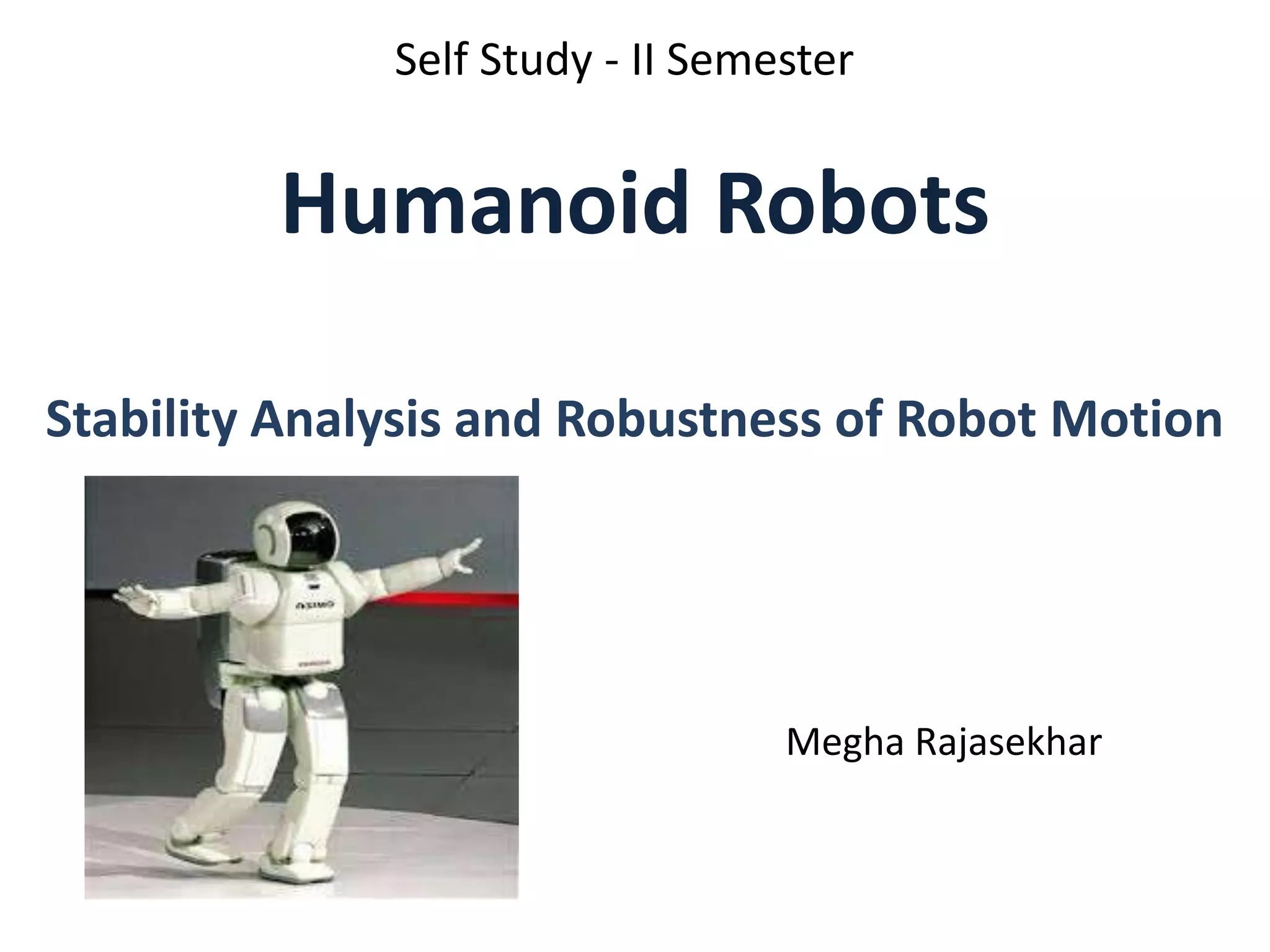
Humanoid Robots
Stability Analysis and Robustness of Robot Motion
Megha Rajasekhar
Need for Humanoid Robots
• Human-like motion and kinetics help robots work in an
environment suited for humans .
• Humanoid construction helps interaction with humans and
learn new tasks from these interactions.
• Human appearance makes robots more acceptable and allows
generation of speech and gestures.
Components of a robot
Sensors
• Proprioceptive Sensors
Proprioception is ability to vary movements
in immediate response to incoming information regarding
external enivronment.
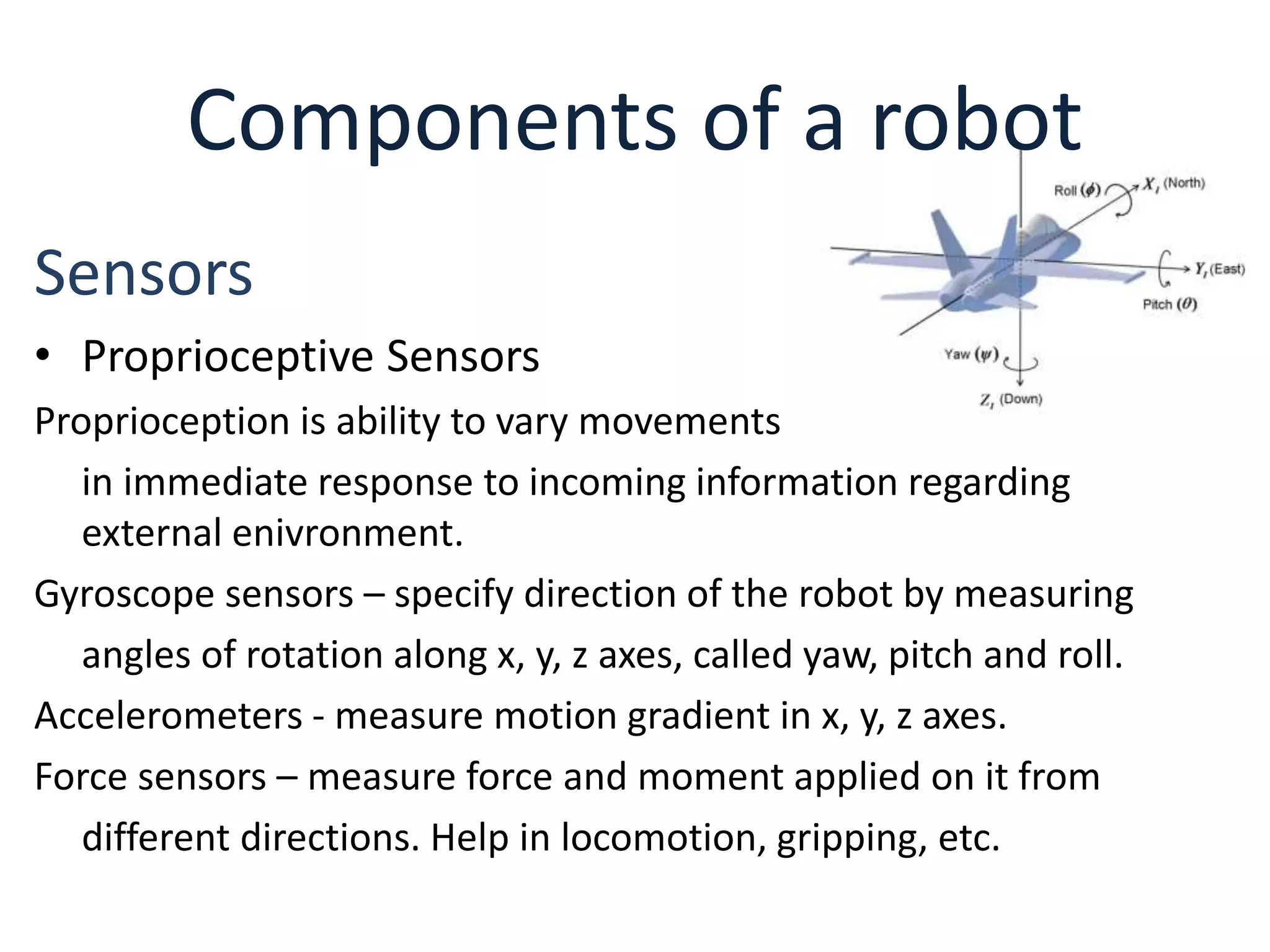
Gyroscope sensors – specify direction of the robot by measuring
angles of rotation along x, y, z axes, called yaw, pitch and roll.
Accelerometers - measure motion gradient in x, y, z axes.
Force sensors – measure force and moment applied on it from
different directions. Help in locomotion, gripping, etc.
Components of a robot
Sensors
• Exteroceptive sensors
Exteroception is sensing things about the environment.
Tactile sensors – usually present as an array of sensors. Mimics the
function of touch receptors in humans. Detects contact and
measures contact forces.
Range sensors – measure distance between robot and obstacles.
Help in robot navigation and obstacle avoidance.
Vision sensors – detect electromagnetic radiation.
Components of a robot
Actuators
Actuators are the motors responsible for motion in the robot.
Each human-like part of the robot is called a sub-system. Smaller
components of a sub-system are modules. Combinations of
actuators acting as muscles and joints make up modules.
Actuators can be either electric, pneumatic, hydraulic,
piezoelectric or ultrasonic.
Components of a robot
Planning and Control
Planning and control deals with development of algorithms and
strategies which control locomotion in a robot according to
required task while accommodating constraints of robot
motion.
It consists of breaking down a particular task into smaller
discrete movements using a motion planning algorithm. In the
process, obstacles are avoided, robot does not lose balance
and it moves within it constraints.
Stability Analysis of Robot Motion
Humanoid robots are expected to have bipedal motion. This
makes balancing the robot difficult. Several theories have
been introduced to make robot motion more stable and help
the robot calculate which paths to take to prevent loss of
balance.
Zero Moment Point
The ZMP is a point on the ground where the feet of robot do not
produce an horizontal moment so that there is no sliding.
Passive Dynamics
This refers to movement which isn’t supported by any power
sources. Motion is sustained due to the effects of gravity and
inertia.
Stability Analysis of Robot Motion
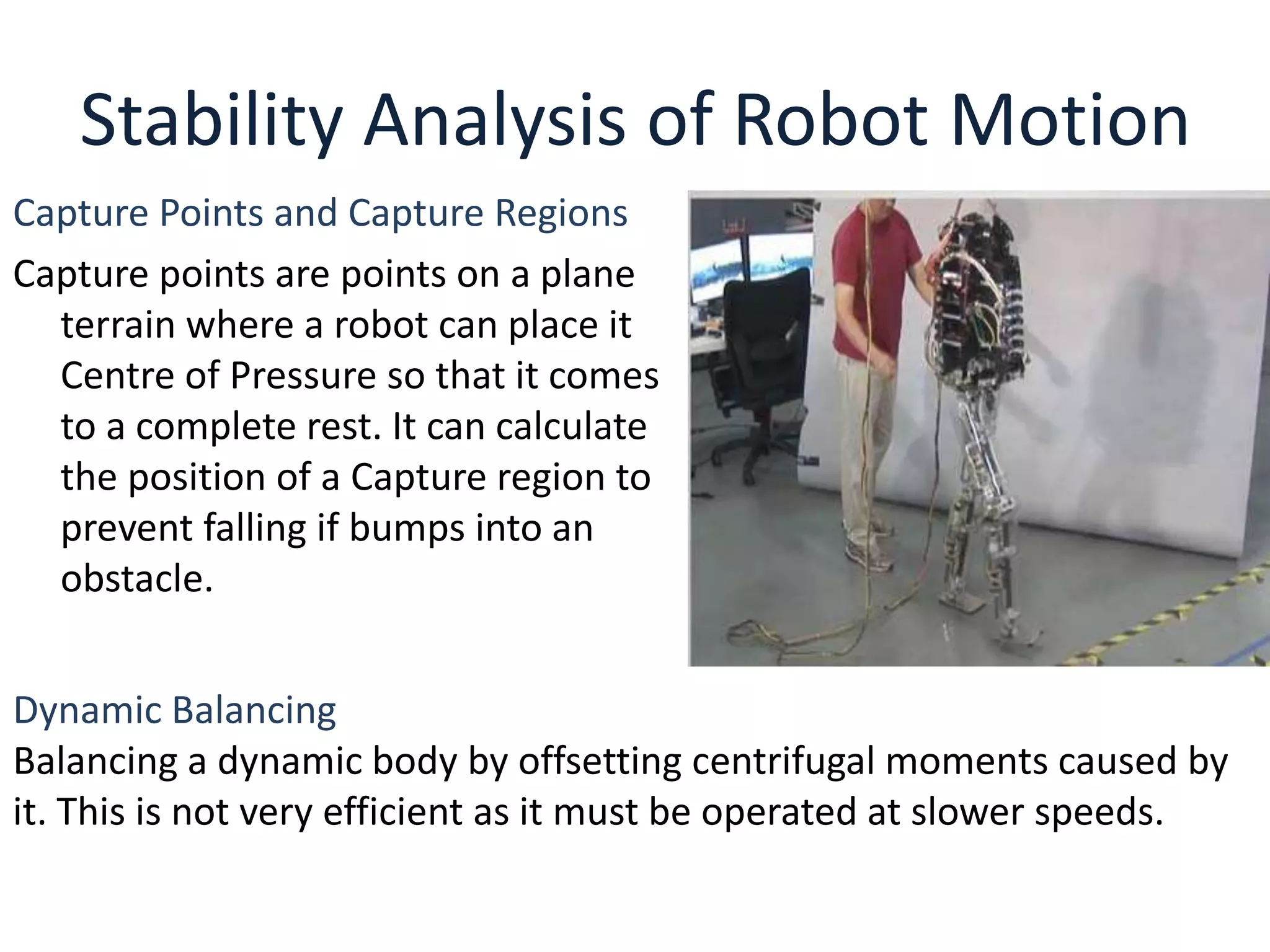
Capture Points and Capture Regions
Capture points are points on a plane
terrain where a robot can place it
Centre of Pressure so that it comes
to a complete rest. It can calculate
the position of a Capture region to
prevent falling if bumps into an
obstacle.
Dynamic Balancing
Balancing a dynamic body by offsetting centrifugal moments caused by
it. This is not very efficient as it must be operated at slower speeds.
Robustness
Robustness refers to adaptability in unpredictable situations.
Robust control is a method which deals uncertain situations.
Robust motion of a robot, therefore, refers to the ability of the
robot to move efficiently in an area with unpredictable
obstacles and react appropriately towards them.
Civil Component
Zero Moment Point
The ZMP is defined as the point on the ground about which the sum of
the horizontal moments of all the active forces equals zero. If the ZMP is
within the support polygon i.e. polygon of all contact points between
the feet and the ground, a bipedal robot is dynamically stable.
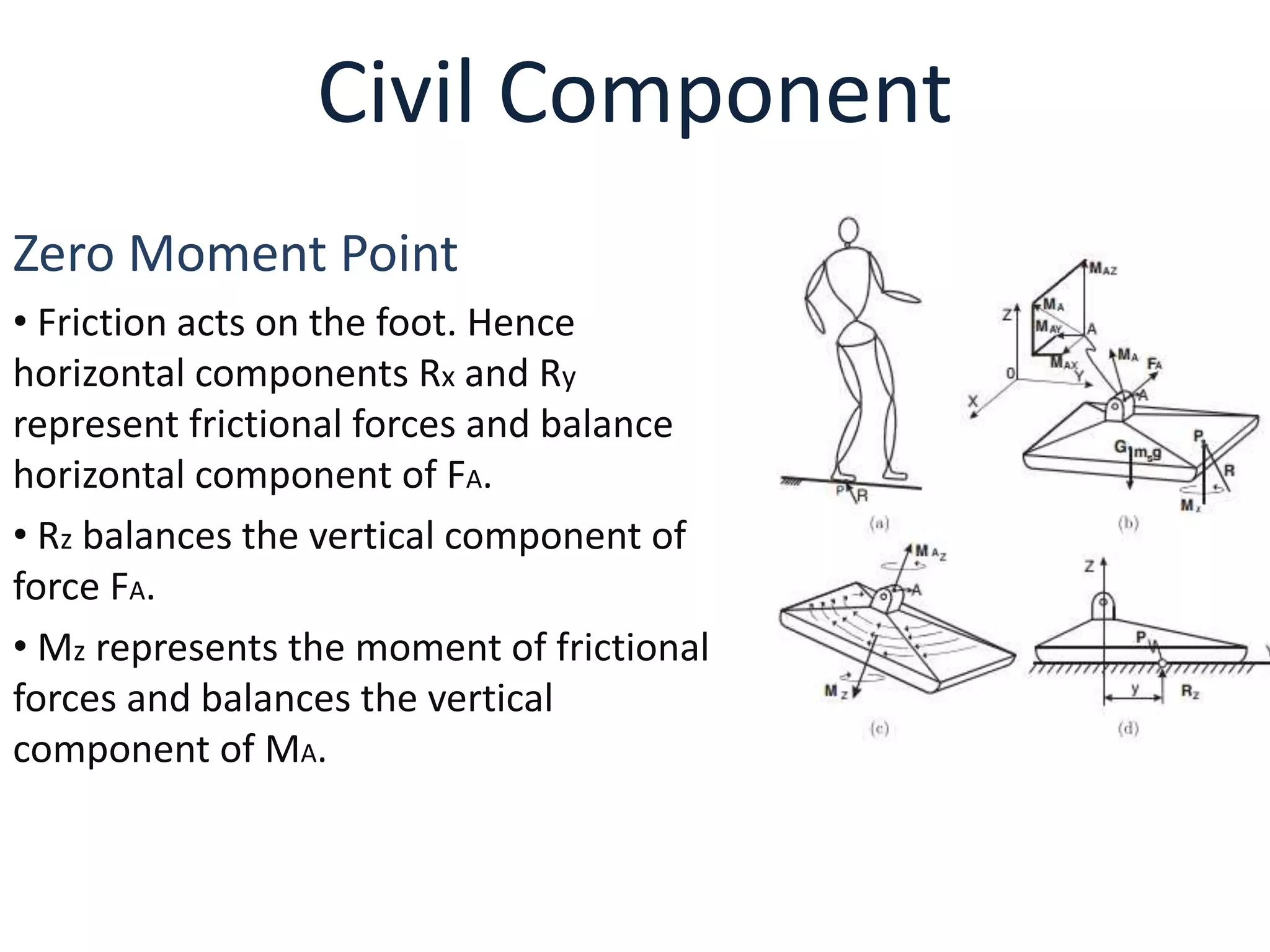
•Mechanism of robot above the foot can be replaced by force FA and
moment MA.
• The ground reaction force acts at point P. The force R and moment M
have three components R(Rx, Ry, Rz) and M(Mx, My, Mz).
• Friction acts on the foot. Hence horizontal components Rx and Ry
represent frictional forces and balance horizontal component of FA.
Civil Component
Zero Moment Point
• Friction acts on the foot. Hence
horizontal components Rx and Ry
represent frictional forces and balance
horizontal component of FA.
• Rz balances the vertical component of
force FA.
• Mz represents the moment of frictional
forces and balances the vertical
component of MA.
Civil Component
Zero Moment Point
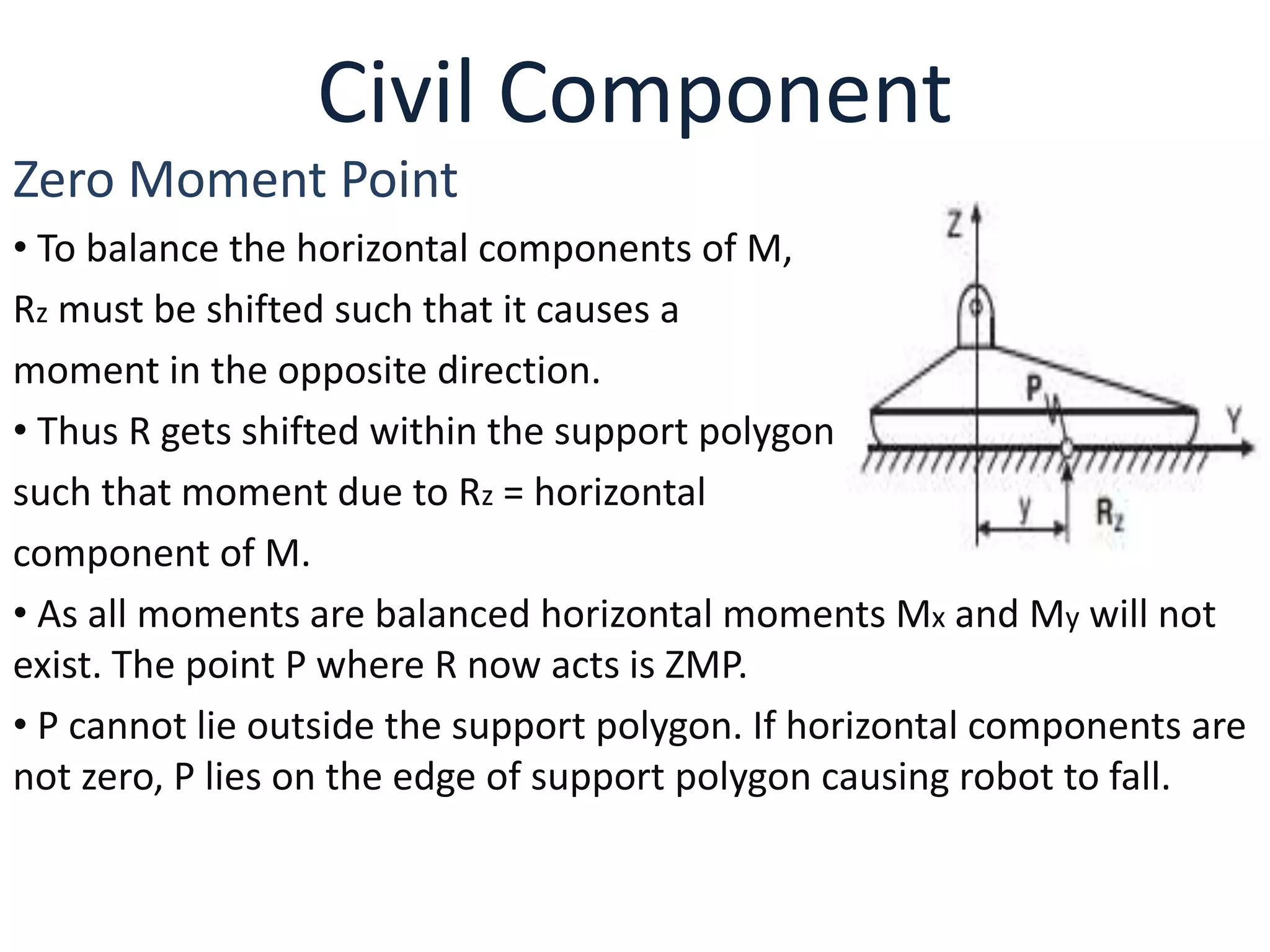
• To balance the horizontal components of M,
Rz must be shifted such that it causes a
moment in the opposite direction.
• Thus R gets shifted within the support polygon
such that moment due to Rz = horizontal
component of M.
• As all moments are balanced horizontal moments Mx and My will not
exist. The point P where R now acts is ZMP.
• P cannot lie outside the support polygon. If horizontal components are
not zero, P lies on the edge of support polygon causing robot to fall.
Physics Component
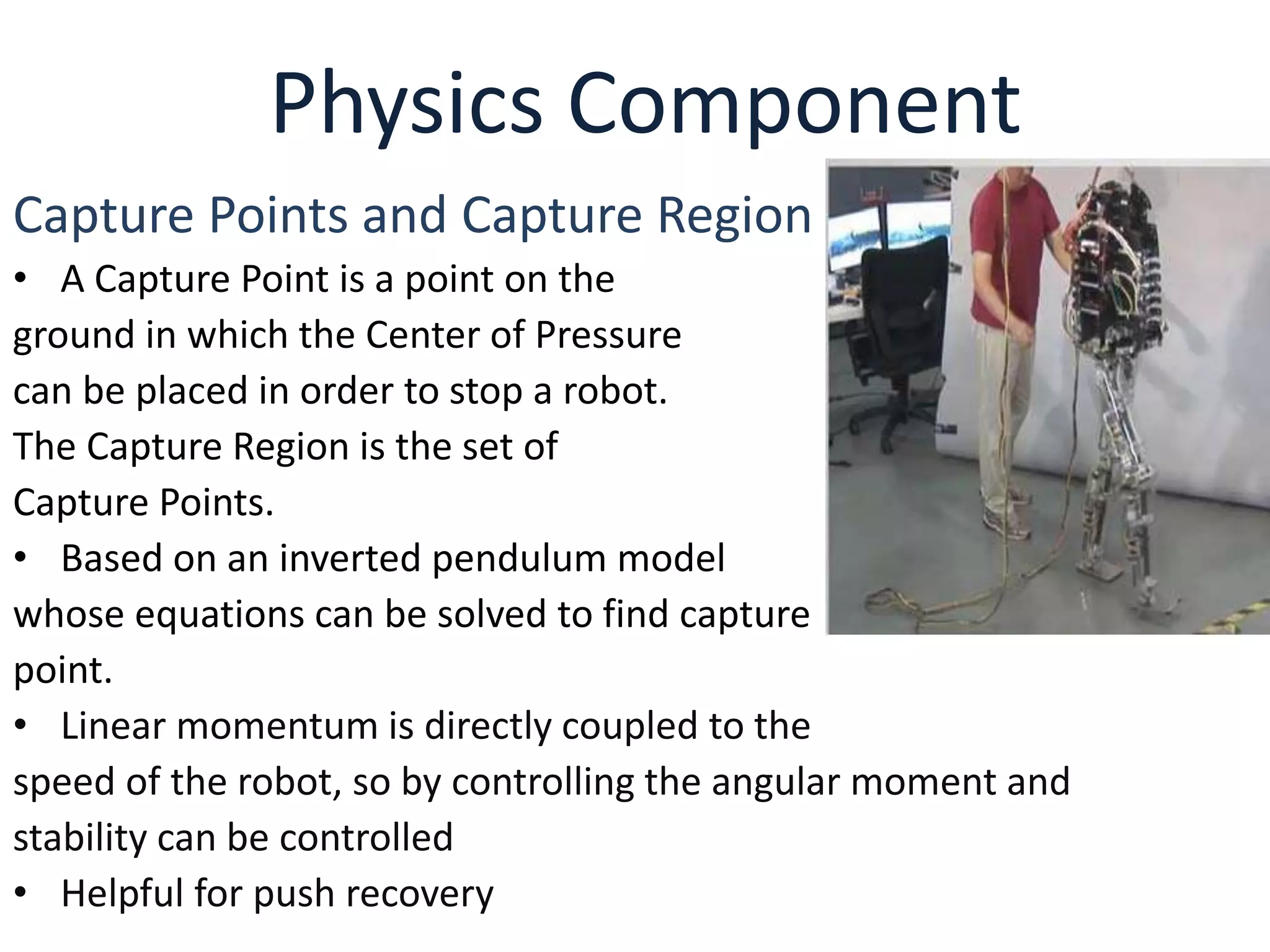
Capture Points and Capture Region
• A Capture Point is a point on the
ground in which the Center of Pressure
can be placed in order to stop a robot.
The Capture Region is the set of
Capture Points.
• Based on an inverted pendulum model
whose equations can be solved to find capture
point.
• Linear momentum is directly coupled to the
speed of the robot, so by controlling the angular moment and
stability can be controlled
• Helpful for push recovery
Physics Component
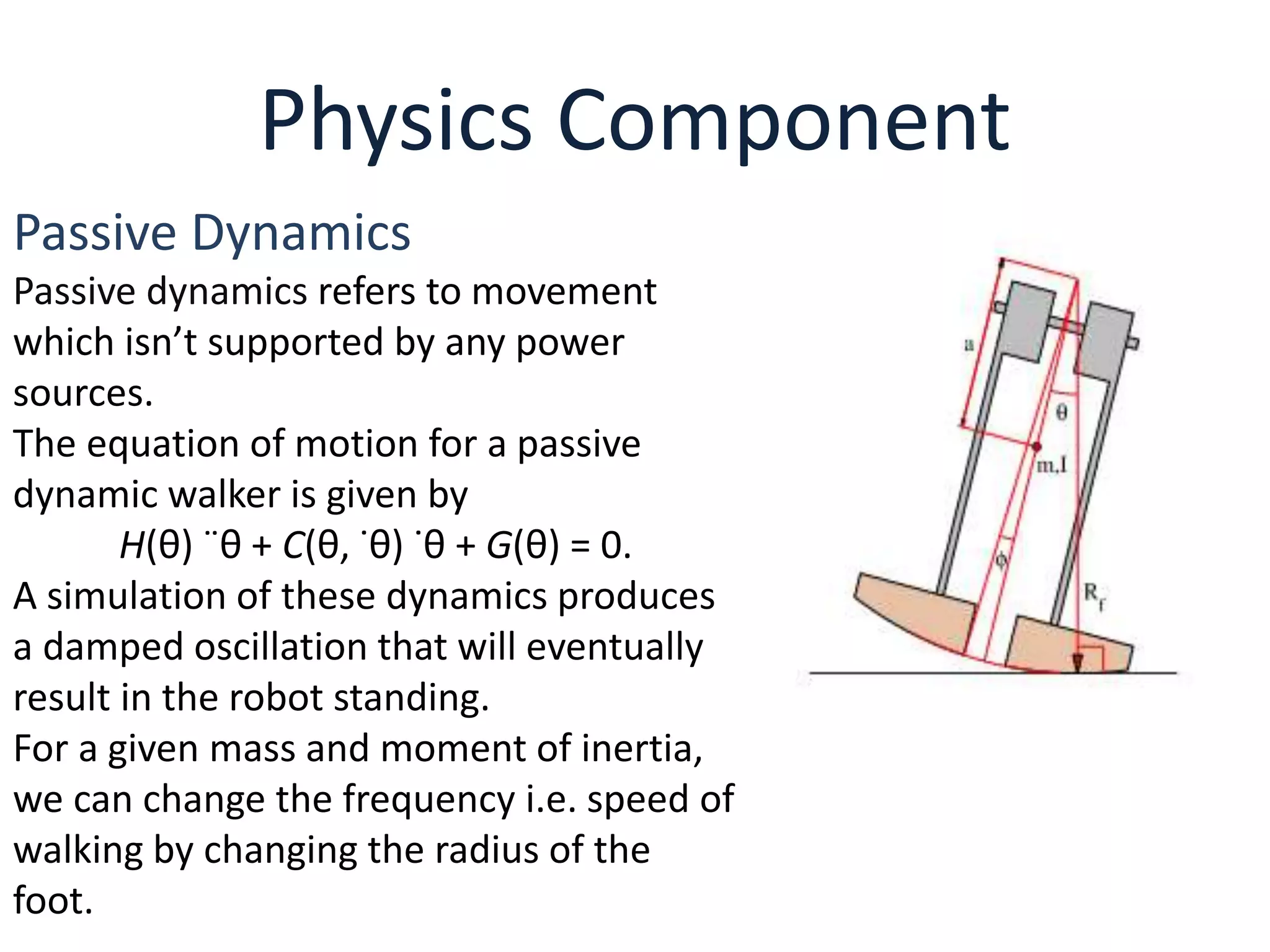
Passive Dynamics
Passive dynamics refers to movement
which isn’t supported by any power
sources.
The equation of motion for a passive
dynamic walker is given by
H(θ) ¨θ + C(θ, ˙θ) ˙θ + G(θ) = 0.
A simulation of these dynamics produces
a damped oscillation that will eventually
result in the robot standing.
For a given mass and moment of inertia,
we can change the frequency i.e. speed of
walking by changing the radius of the
foot.
Math Component
Limit Cycles
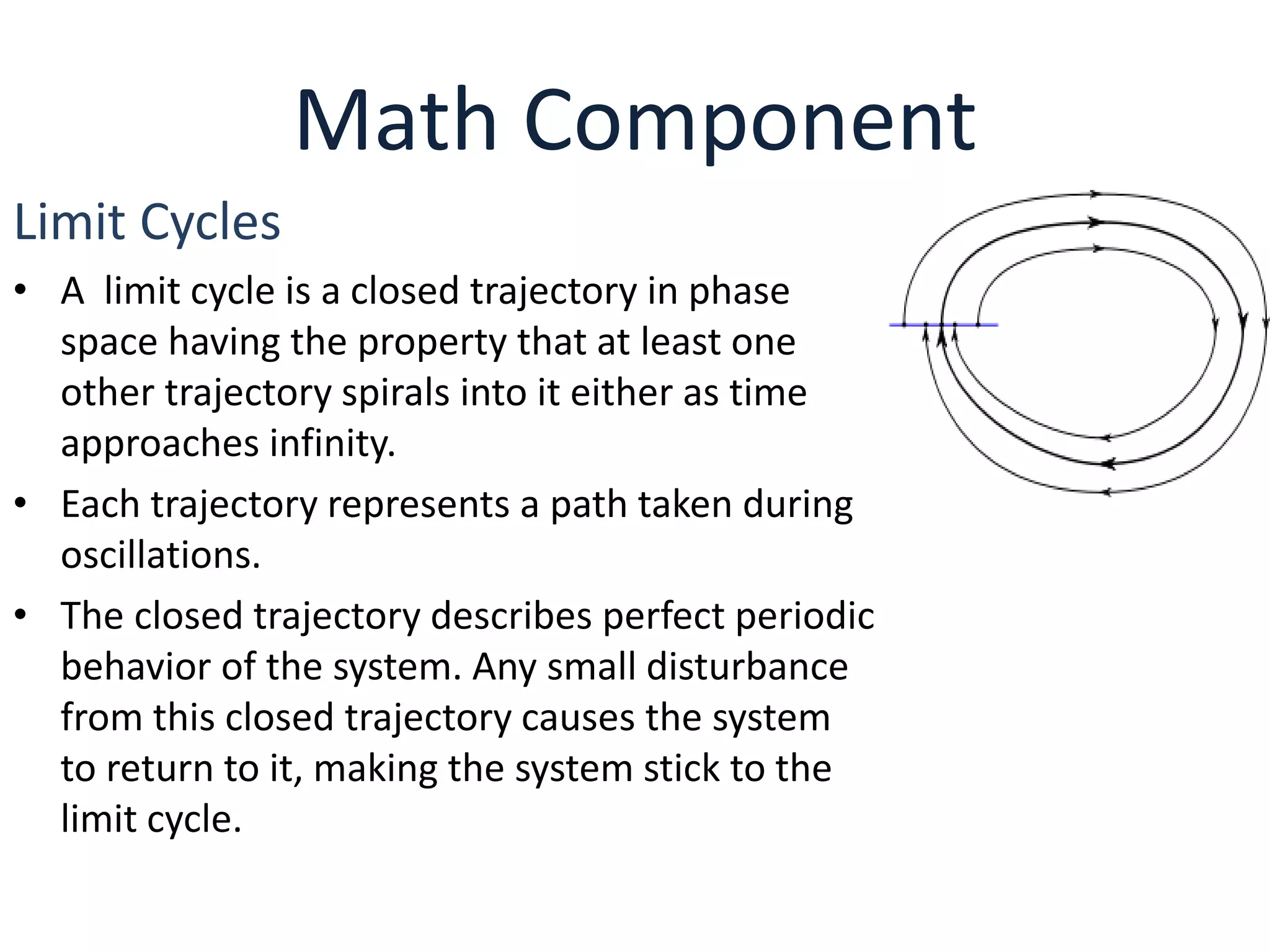
• A limit cycle is a closed trajectory in phase
space having the property that at least one
other trajectory spirals into it either as time
approaches infinity.
• Each trajectory represents a path taken during
oscillations.
• The closed trajectory describes perfect periodic
behavior of the system. Any small disturbance
from this closed trajectory causes the system
to return to it, making the system stick to the
limit cycle.
Math Component
Limit Cycles
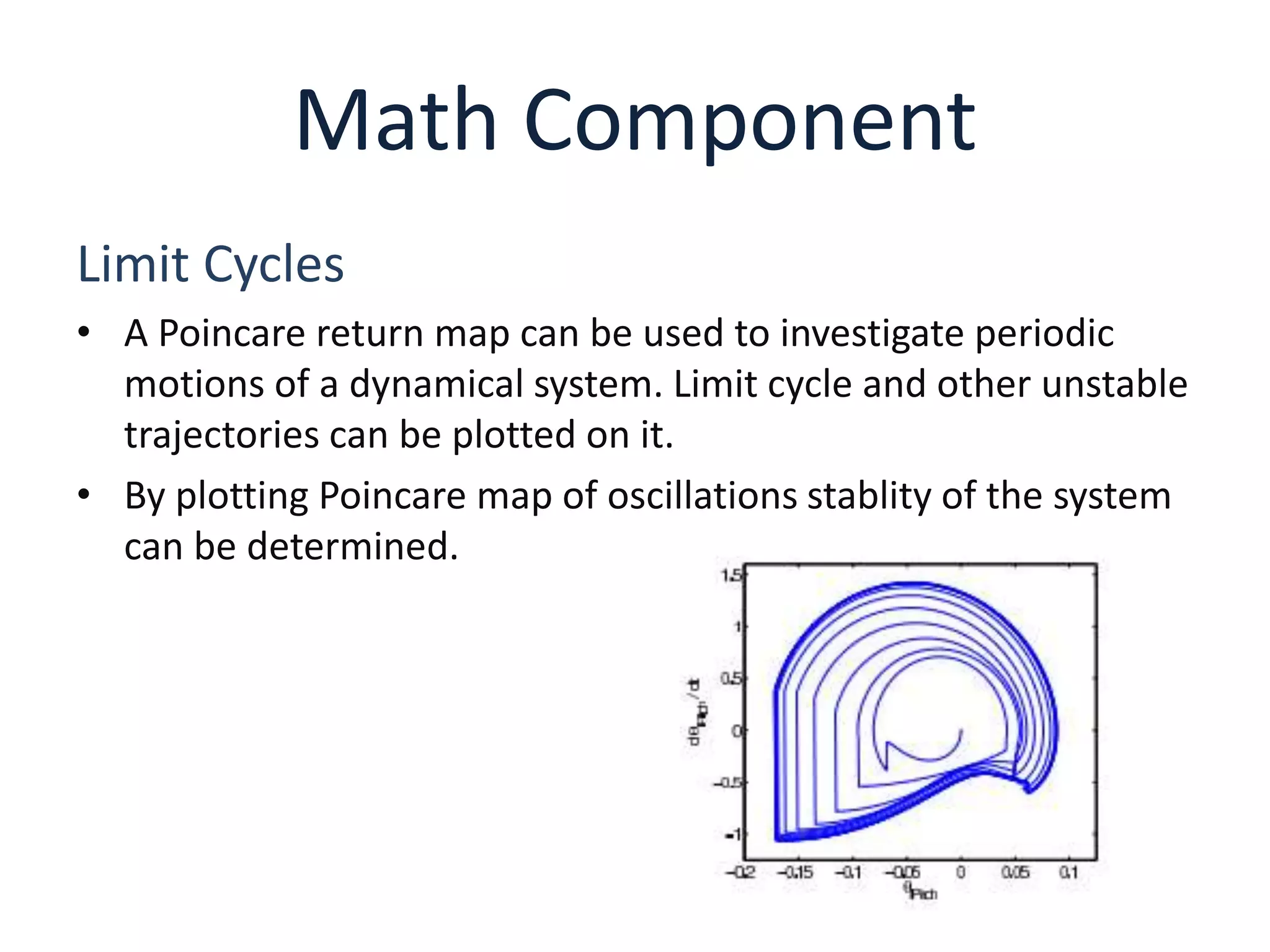
• A Poincare return map can be used to investigate periodic
motions of a dynamical system. Limit cycle and other unstable
trajectories can be plotted on it.
• By plotting Poincare map of oscillations stablity of the system
can be determined.
Electrical Component
Sensors
• Force sensors – also used in ZMP robots to find ground
reaction forces. Piezoelectric sensors which generate current
proportional to force or pressure applied.
• Slip sensors – Used to calculated required frictional force in
ZMP robots. Measures the acceleration of centre of mass.
• Torque sensors - Device for measuring and recording
the torque on a rotating system. Consist of strain gauge which
measure change in dimensions by measuring change in
resistance.
Electrical Component
Actuators
Actuators are the motors responsible for motion in the robot.
• Hydraulic - Have a very rigid behavior and operate well at low speed
and high load applications.
• Electric - Better suited for high speed and low load applications
• Piezoelectric - Generate a small movement with a high force. They
can be used for ultra-precise positioning.
• Ultrasonic - Designed to produce movements in a micrometer order
at ultrasonic frequencies
• Pneumatic - Operate on the basis of gas compressibility. Used for low
speed and low/medium load applications.
Thank You

Humanoid robots - stability analysis and robustness

  • 1.
    Self Study -II Semester Humanoid Robots Stability Analysis and Robustness of Robot Motion Megha Rajasekhar
  • 2.
    Need for HumanoidRobots • Human-like motion and kinetics help robots work in an environment suited for humans . • Humanoid construction helps interaction with humans and learn new tasks from these interactions. • Human appearance makes robots more acceptable and allows generation of speech and gestures.
  • 3.
    Components of arobot Sensors • Proprioceptive Sensors Proprioception is ability to vary movements in immediate response to incoming information regarding external enivronment. Gyroscope sensors – specify direction of the robot by measuring angles of rotation along x, y, z axes, called yaw, pitch and roll. Accelerometers - measure motion gradient in x, y, z axes. Force sensors – measure force and moment applied on it from different directions. Help in locomotion, gripping, etc.
  • 4.
    Components of arobot Sensors • Exteroceptive sensors Exteroception is sensing things about the environment. Tactile sensors – usually present as an array of sensors. Mimics the function of touch receptors in humans. Detects contact and measures contact forces. Range sensors – measure distance between robot and obstacles. Help in robot navigation and obstacle avoidance. Vision sensors – detect electromagnetic radiation.
  • 5.
    Components of arobot Actuators Actuators are the motors responsible for motion in the robot. Each human-like part of the robot is called a sub-system. Smaller components of a sub-system are modules. Combinations of actuators acting as muscles and joints make up modules. Actuators can be either electric, pneumatic, hydraulic, piezoelectric or ultrasonic.
  • 6.
    Components of arobot Planning and Control Planning and control deals with development of algorithms and strategies which control locomotion in a robot according to required task while accommodating constraints of robot motion. It consists of breaking down a particular task into smaller discrete movements using a motion planning algorithm. In the process, obstacles are avoided, robot does not lose balance and it moves within it constraints.
  • 7.
    Stability Analysis ofRobot Motion Humanoid robots are expected to have bipedal motion. This makes balancing the robot difficult. Several theories have been introduced to make robot motion more stable and help the robot calculate which paths to take to prevent loss of balance. Zero Moment Point The ZMP is a point on the ground where the feet of robot do not produce an horizontal moment so that there is no sliding. Passive Dynamics This refers to movement which isn’t supported by any power sources. Motion is sustained due to the effects of gravity and inertia.
  • 8.
    Stability Analysis ofRobot Motion Capture Points and Capture Regions Capture points are points on a plane terrain where a robot can place it Centre of Pressure so that it comes to a complete rest. It can calculate the position of a Capture region to prevent falling if bumps into an obstacle. Dynamic Balancing Balancing a dynamic body by offsetting centrifugal moments caused by it. This is not very efficient as it must be operated at slower speeds.
  • 9.
    Robustness Robustness refers toadaptability in unpredictable situations. Robust control is a method which deals uncertain situations. Robust motion of a robot, therefore, refers to the ability of the robot to move efficiently in an area with unpredictable obstacles and react appropriately towards them.
  • 10.
    Civil Component Zero MomentPoint The ZMP is defined as the point on the ground about which the sum of the horizontal moments of all the active forces equals zero. If the ZMP is within the support polygon i.e. polygon of all contact points between the feet and the ground, a bipedal robot is dynamically stable. •Mechanism of robot above the foot can be replaced by force FA and moment MA. • The ground reaction force acts at point P. The force R and moment M have three components R(Rx, Ry, Rz) and M(Mx, My, Mz). • Friction acts on the foot. Hence horizontal components Rx and Ry represent frictional forces and balance horizontal component of FA.
  • 11.
    Civil Component Zero MomentPoint • Friction acts on the foot. Hence horizontal components Rx and Ry represent frictional forces and balance horizontal component of FA. • Rz balances the vertical component of force FA. • Mz represents the moment of frictional forces and balances the vertical component of MA.
  • 12.
    Civil Component Zero MomentPoint • To balance the horizontal components of M, Rz must be shifted such that it causes a moment in the opposite direction. • Thus R gets shifted within the support polygon such that moment due to Rz = horizontal component of M. • As all moments are balanced horizontal moments Mx and My will not exist. The point P where R now acts is ZMP. • P cannot lie outside the support polygon. If horizontal components are not zero, P lies on the edge of support polygon causing robot to fall.
  • 13.
    Physics Component Capture Pointsand Capture Region • A Capture Point is a point on the ground in which the Center of Pressure can be placed in order to stop a robot. The Capture Region is the set of Capture Points. • Based on an inverted pendulum model whose equations can be solved to find capture point. • Linear momentum is directly coupled to the speed of the robot, so by controlling the angular moment and stability can be controlled • Helpful for push recovery
  • 14.
    Physics Component Passive Dynamics Passivedynamics refers to movement which isn’t supported by any power sources. The equation of motion for a passive dynamic walker is given by H(θ) ¨θ + C(θ, ˙θ) ˙θ + G(θ) = 0. A simulation of these dynamics produces a damped oscillation that will eventually result in the robot standing. For a given mass and moment of inertia, we can change the frequency i.e. speed of walking by changing the radius of the foot.
  • 16.
    Math Component Limit Cycles •A limit cycle is a closed trajectory in phase space having the property that at least one other trajectory spirals into it either as time approaches infinity. • Each trajectory represents a path taken during oscillations. • The closed trajectory describes perfect periodic behavior of the system. Any small disturbance from this closed trajectory causes the system to return to it, making the system stick to the limit cycle.
  • 17.
    Math Component Limit Cycles •A Poincare return map can be used to investigate periodic motions of a dynamical system. Limit cycle and other unstable trajectories can be plotted on it. • By plotting Poincare map of oscillations stablity of the system can be determined.
  • 18.
    Electrical Component Sensors • Forcesensors – also used in ZMP robots to find ground reaction forces. Piezoelectric sensors which generate current proportional to force or pressure applied. • Slip sensors – Used to calculated required frictional force in ZMP robots. Measures the acceleration of centre of mass. • Torque sensors - Device for measuring and recording the torque on a rotating system. Consist of strain gauge which measure change in dimensions by measuring change in resistance.
  • 19.
    Electrical Component Actuators Actuators arethe motors responsible for motion in the robot. • Hydraulic - Have a very rigid behavior and operate well at low speed and high load applications. • Electric - Better suited for high speed and low load applications • Piezoelectric - Generate a small movement with a high force. They can be used for ultra-precise positioning. • Ultrasonic - Designed to produce movements in a micrometer order at ultrasonic frequencies • Pneumatic - Operate on the basis of gas compressibility. Used for low speed and low/medium load applications.
  • 20.