Uniform Circular Motion
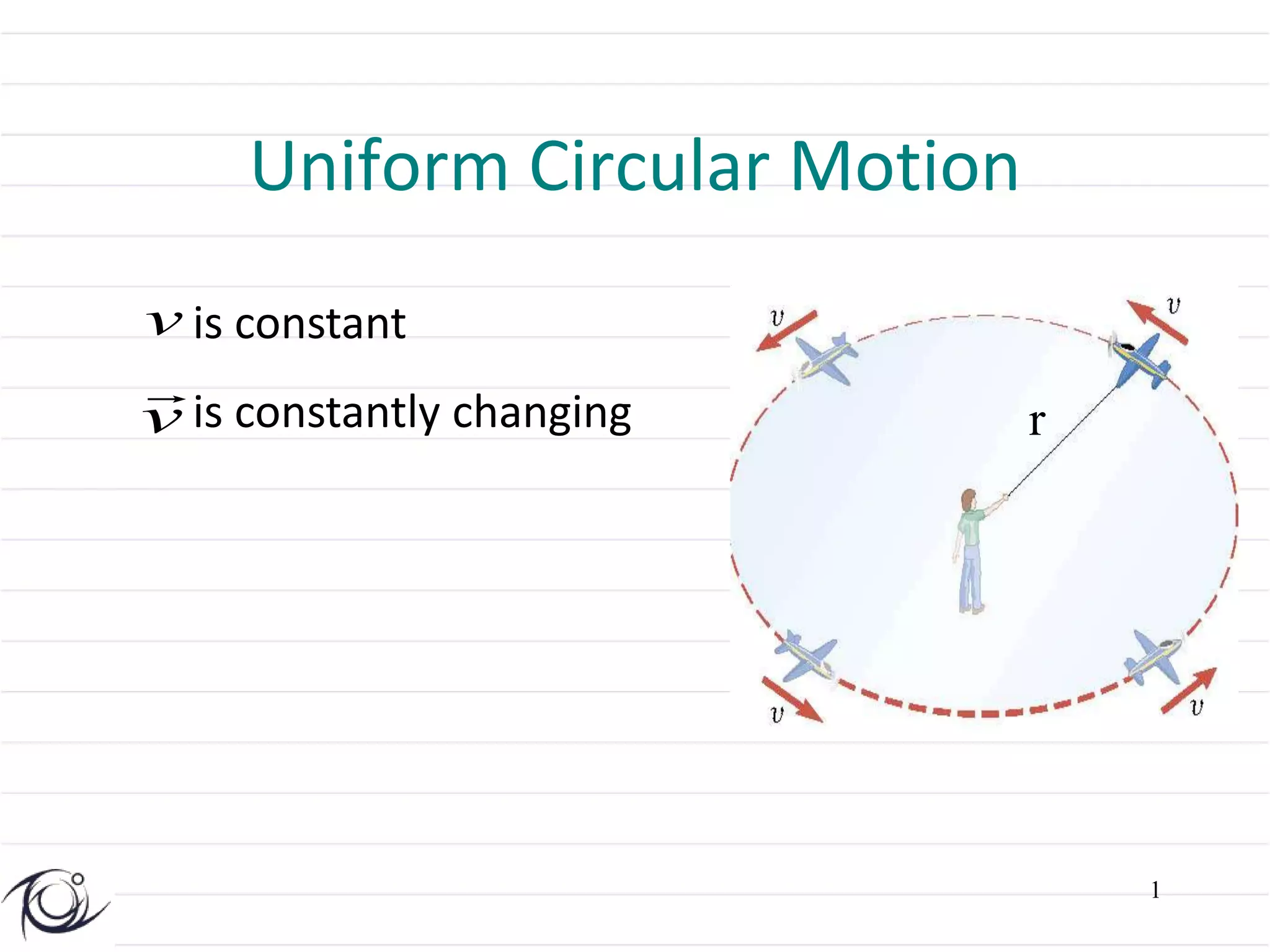
v is constant

v is constantly changing       r


                                   1
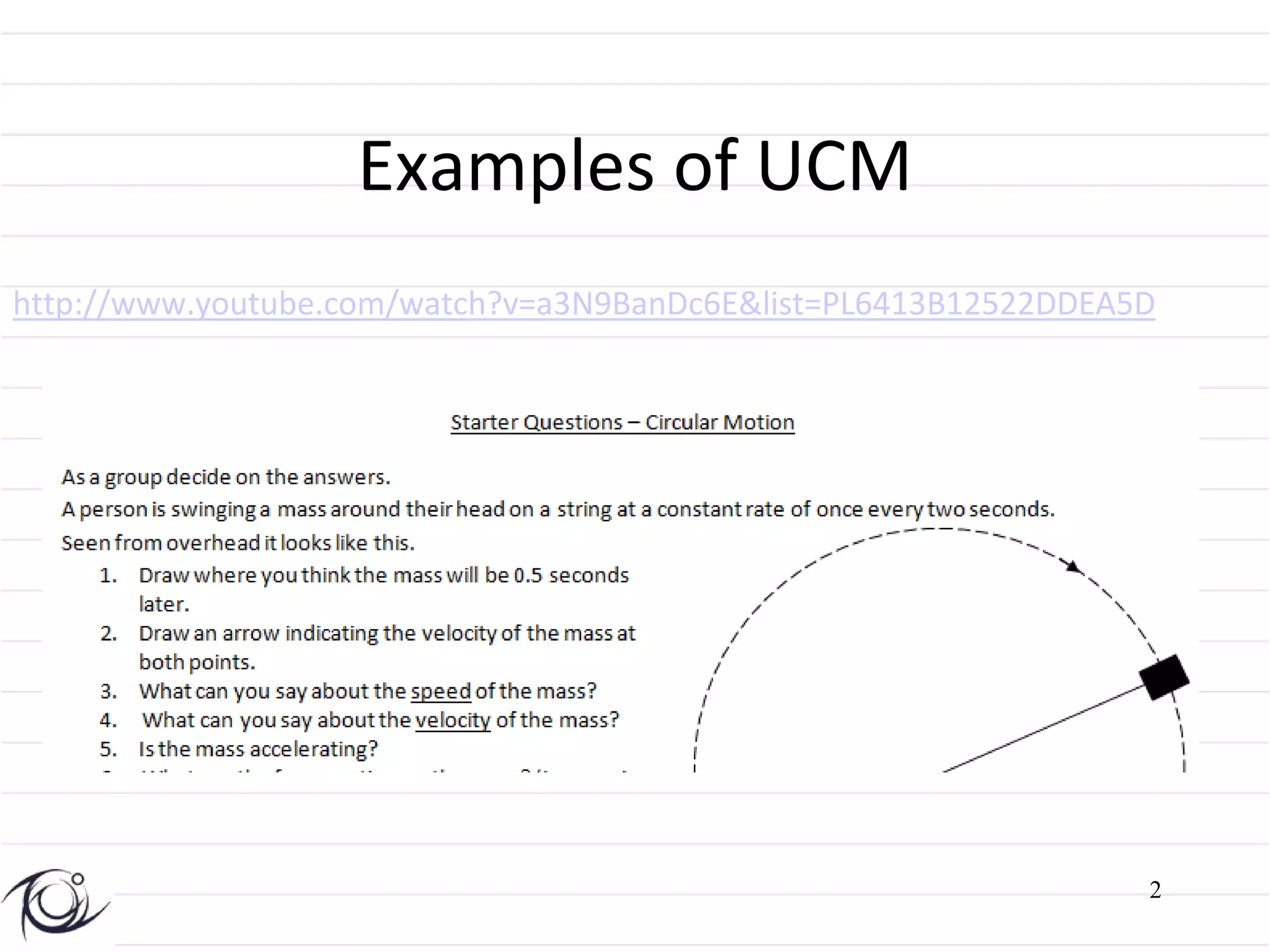
Examples of UCM
http://www.youtube.com/watch?v=a3N9BanDc6E&list=PL6413B12522DDEA5D


                                                                 2
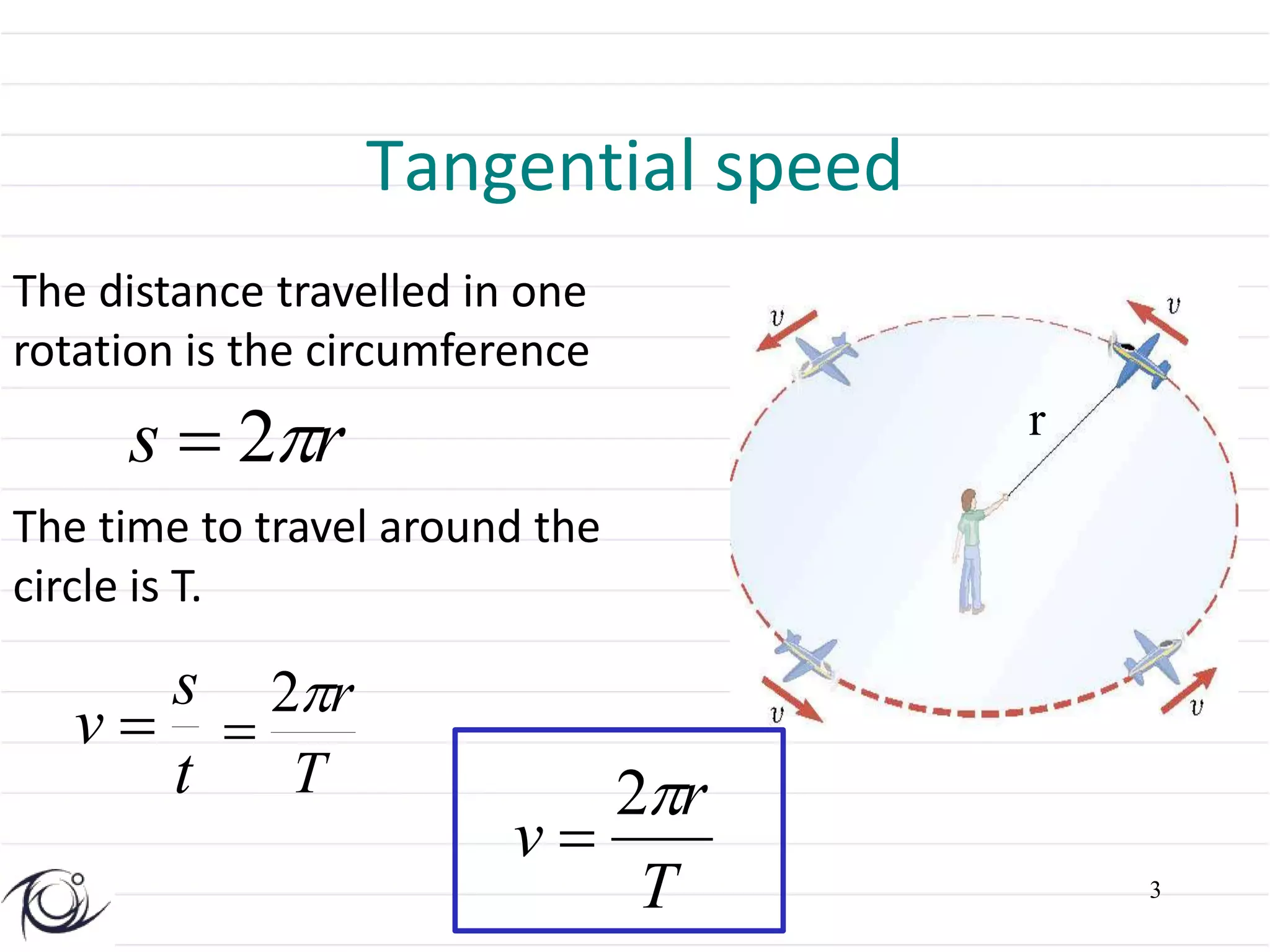
Tangential speed
The distance travelled in one
rotation is the circumference
     s  2r                        r

The time to travel around the
circle is T.

     s 2r
   v 
     t  T                   2r
                         v
                             T          3
Example : Tangential Speed
A merry-go-round does 5 complete revolutions in a
minute. It has a radius of 8 metres.
Calculate the tangential speed.


                                                    4
2 r
v
      T


       5
2 r
v
      T


       6
2 r
v
      T


       7
∆


                    Centripetal Acceleration

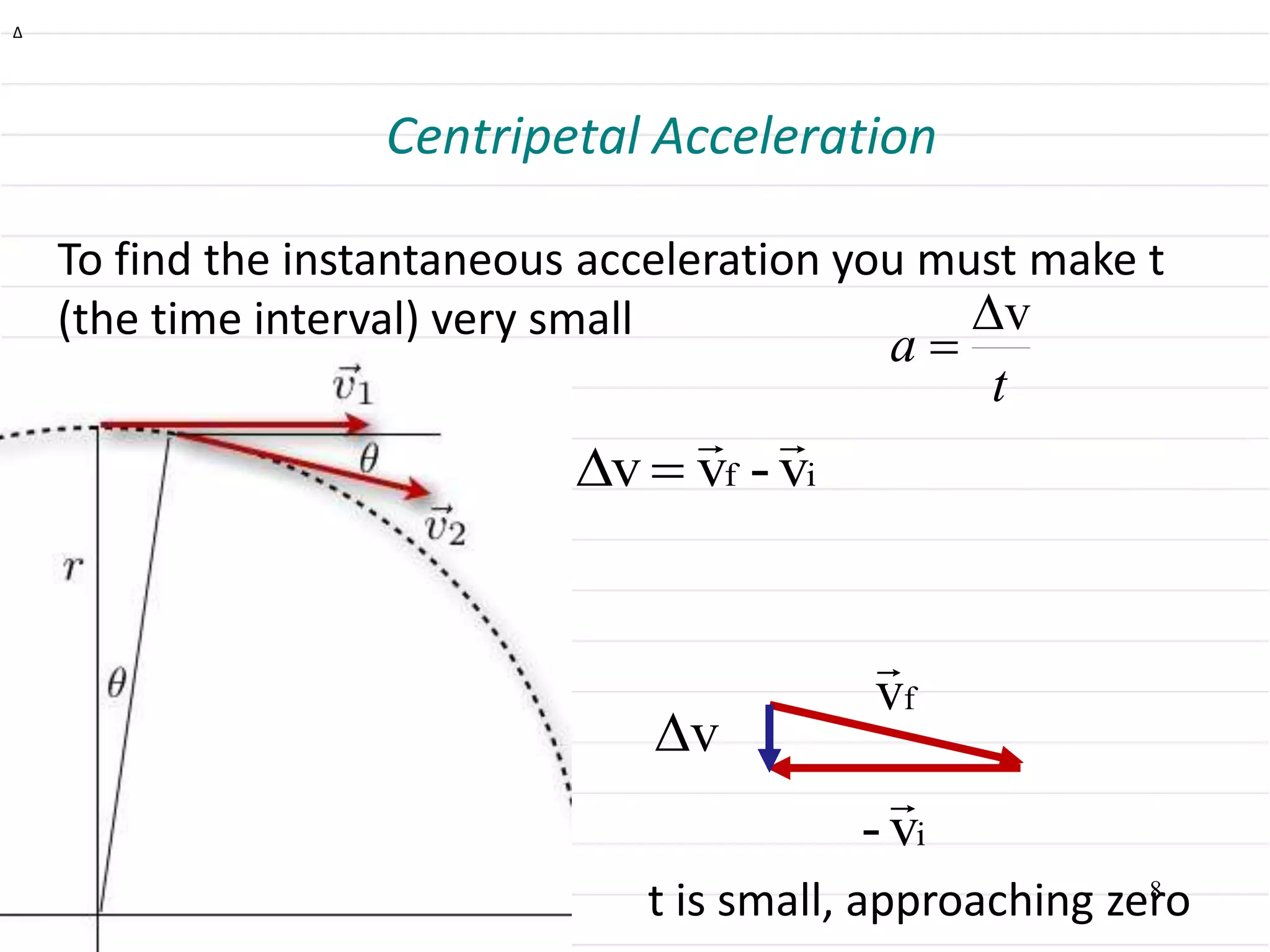
    To find the instantaneous acceleration you must make t
    (the time interval) very small               v
                                             a
                                                   t
                                   
                             v  vf - vi


                                            
                                            vf
                                 v
                                              
                                            - vi
                                t is small, approaching zero
                                                          8
∆


                       Centripetal Acceleration

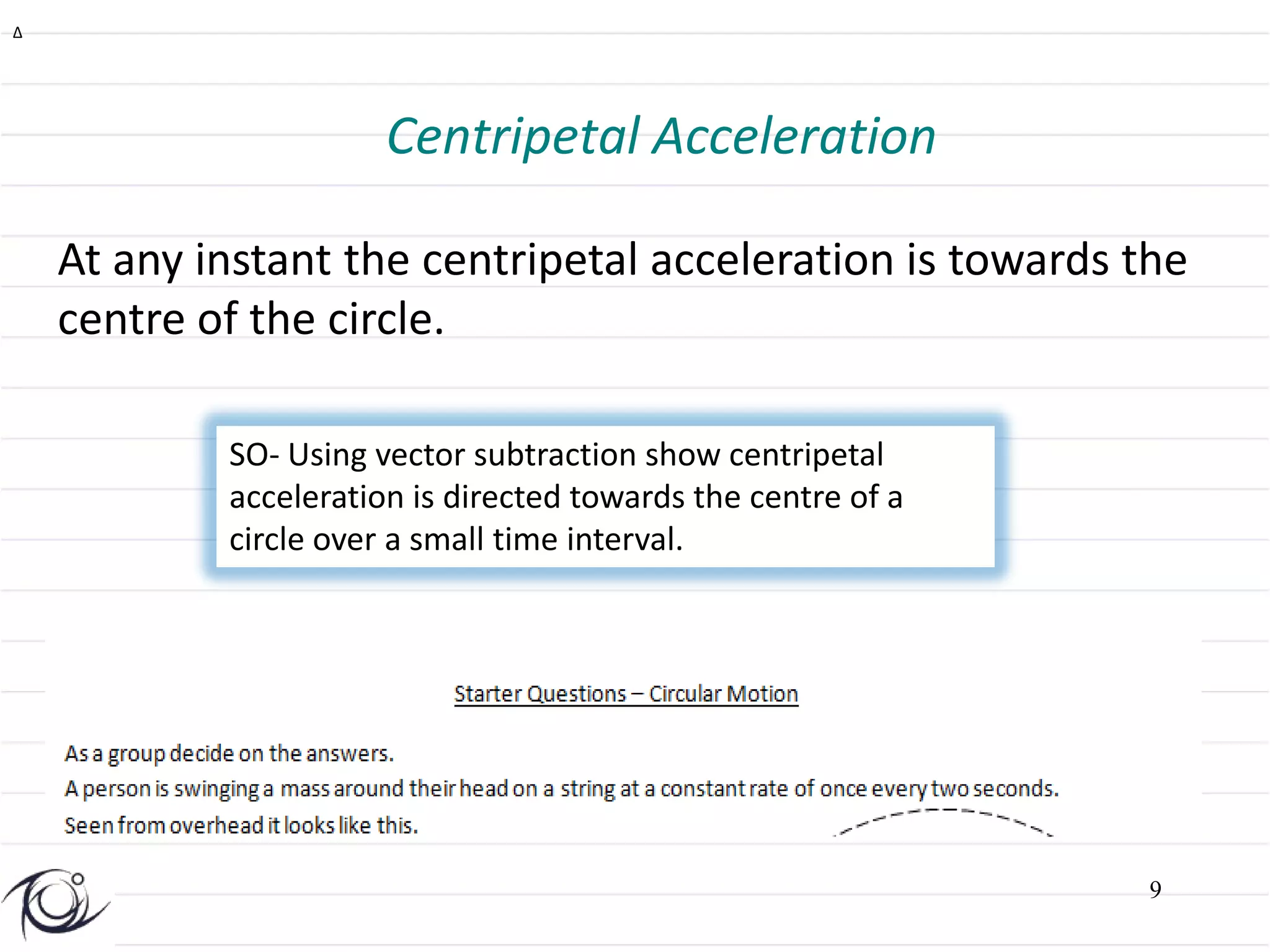
    At any instant the centripetal acceleration is towards the
    centre of the circle.

            SO- Using vector subtraction show centripetal
            acceleration is directed towards the centre of a
            circle over a small time interval.


                                                               9
Centripetal Acceleration
Magnitude calculated by :
                      2
                     v
                ac 
                      r


                                 10
Centripetal Acceleration
Magnitude calculated by :
                      2
                     v
                ac 
                      r


                                 11
Note              2
                 v
       if   ac           then
                  r

            ac  v    2


If you double the tangential speed, you
quadruple the centripetal acceleration


                                          12
1
     also ac 
               r


If you double the radius, you halve the
centripetal acceleration


                                          13
Example : The Effect of Radius on
    Centripetal Acceleration
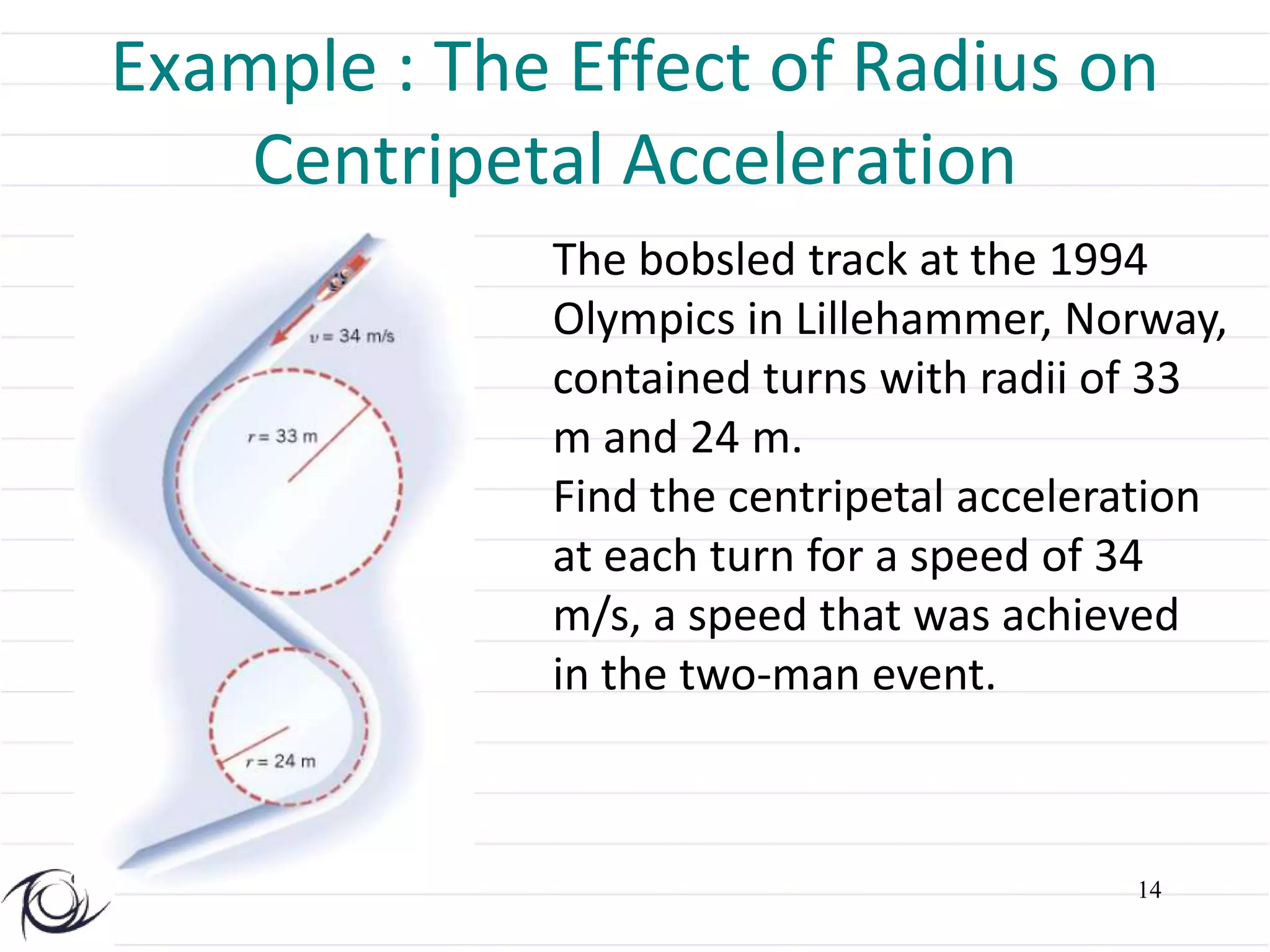
             The bobsled track at the 1994
             Olympics in Lillehammer, Norway,
             contained turns with radii of 33
             m and 24 m.
             Find the centripetal acceleration
             at each turn for a speed of 34
             m/s, a speed that was achieved
             in the two-man event.


                                         14
2
     v
ac 
      r


     15
v2
ac 
     r


      16
v2
ac 
     r


      17
Centripetal Force - FC
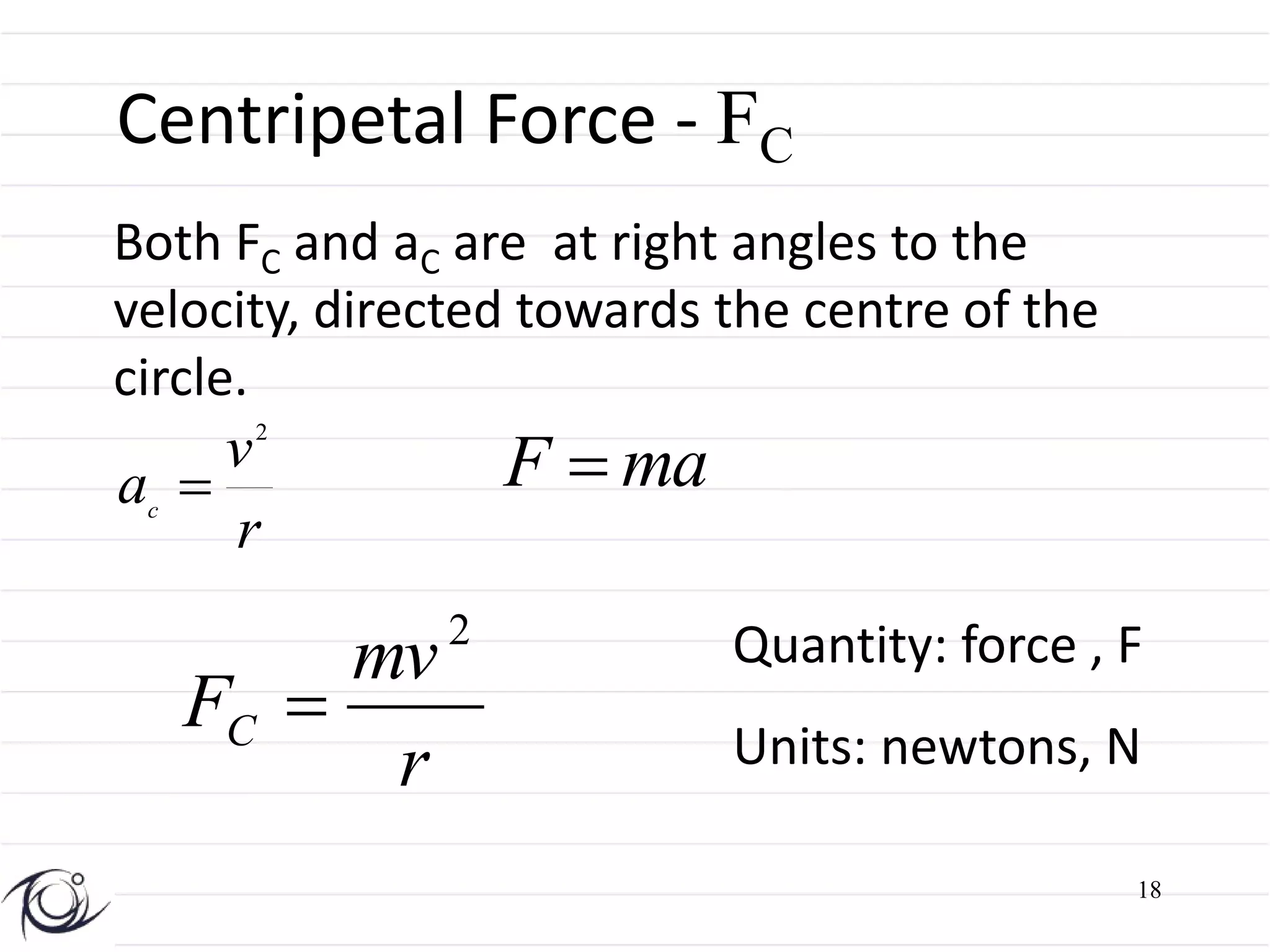
Both FC and aC are at right angles to the
velocity, directed towards the centre of the
circle.
                   F  ma
      2
    v
a 
 c
    r
               2            Quantity: force , F
          mv
     FC                    Units: newtons, N
           r
                                               18
Example: Centripetal Force
A model airplane has a mass of 0.90 kg and
moves at a constant speed on a circle that is
parallel to the ground.
Find the tension
in the 17.0m long string
if the plane circles
once every 3 seconds.

                                            19
mv 2
FC 
      r

     2 r
v
      T


            20
aC provided by the tension force       aC provided by the normal force


                    Describe situations in which the
                    centripetal acceleration is caused by a
                    tension force, a frictional force, a
                    gravitational force, or a normal force

aC provided by the frictional force aC provided by the gravitational force


                                                                      21
aC provided by the tension force      aC provided by the normal force

A bob on a string being whirled       A bobsled travelling around an
around .                              Olympic bobsled track.


aC provided by the frictional force aC provided by the gravitational force

A car driving around a flat           The Moon orbiting the Earth.
roundabout.


                                                                      22
Free body diagrams
                                       
Box on a table                         FN

                                       
                                    Fg
FNET  Fg  FN  0N

• Draw a dot at the centre of mass
• draw labelled force vectors from the centre of mass
• If body is not accelerating the forces are balanced 23
Box on a slope, not moving
                                         
                                        FN
                             Ffriction

                                        
            FNET  0                     Fg
• Normal force is perpendicular to the surface of
  contact


                                                    24
Hanging bob


              25
Car stationary


                 26
Car constant v


                 27
Car accelerating


                   28
Draw free body diagrams for a fridge
• Pushing against a fridge (not moving)
• Pushing against a fridge (accelerating)
• Pushing against a fridge (constant velocity)


                                             29
Car going around a bend
           SO: Identify the vertical and horizontal
           forces on a vehicle moving with constant
           velocity on a flat horizontal road.

                                          2
                                   mv
                    F friction   
                                    r


                                               30
Factors affecting cornering
                                 2
                            mv
             F friction   
                             r

                   r – radius of curvature
                   m – mass of vehicle
                   v - speed of vehicle
                   Ffriction – depends on
                              • tyres
                              • road surface

                                               31
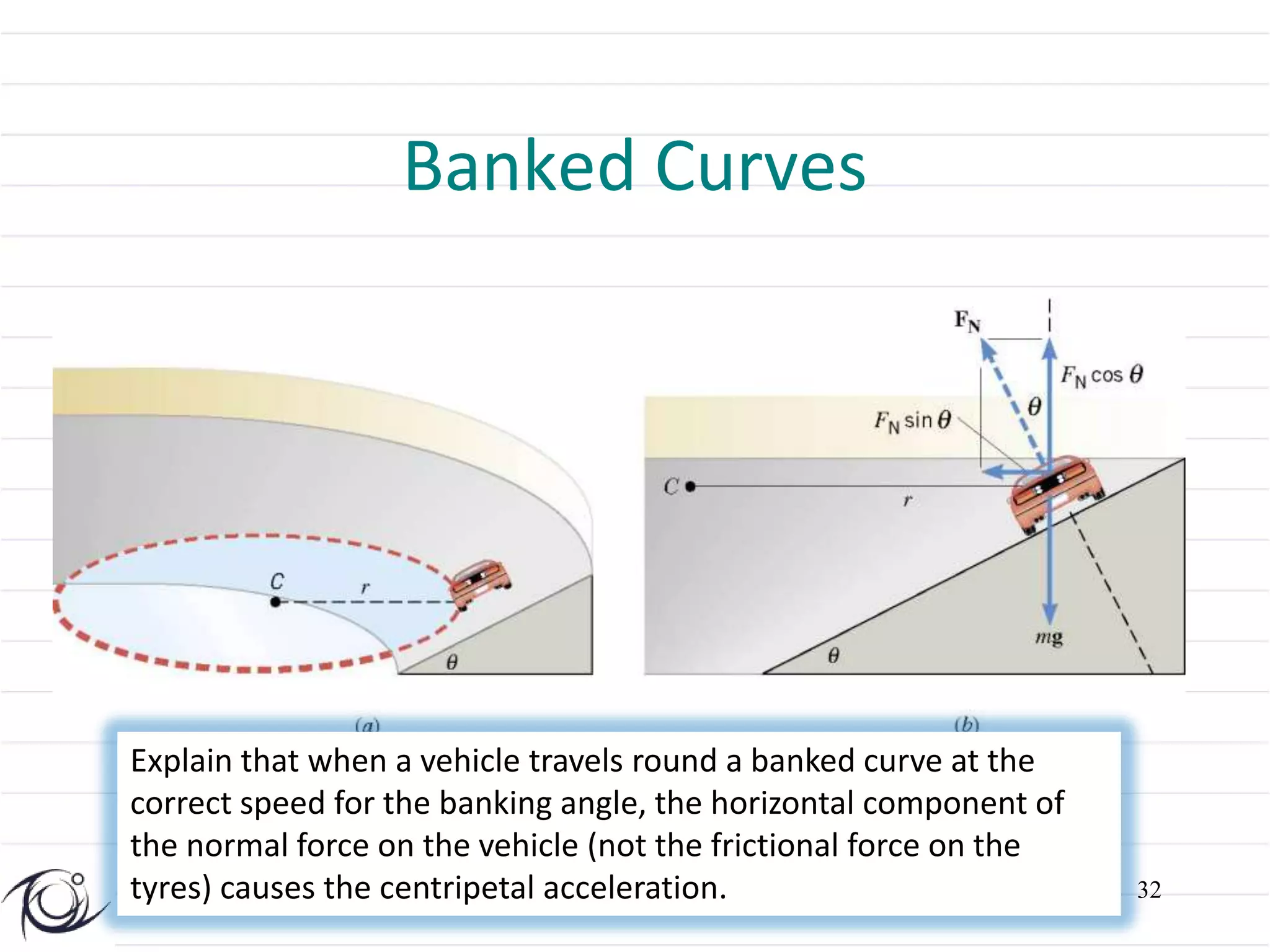
Banked Curves


Explain that when a vehicle travels round a banked curve at the
correct speed for the banking angle, the horizontal component of
the normal force on the vehicle (not the frictional force on the
tyres) causes the centripetal acceleration.                        32
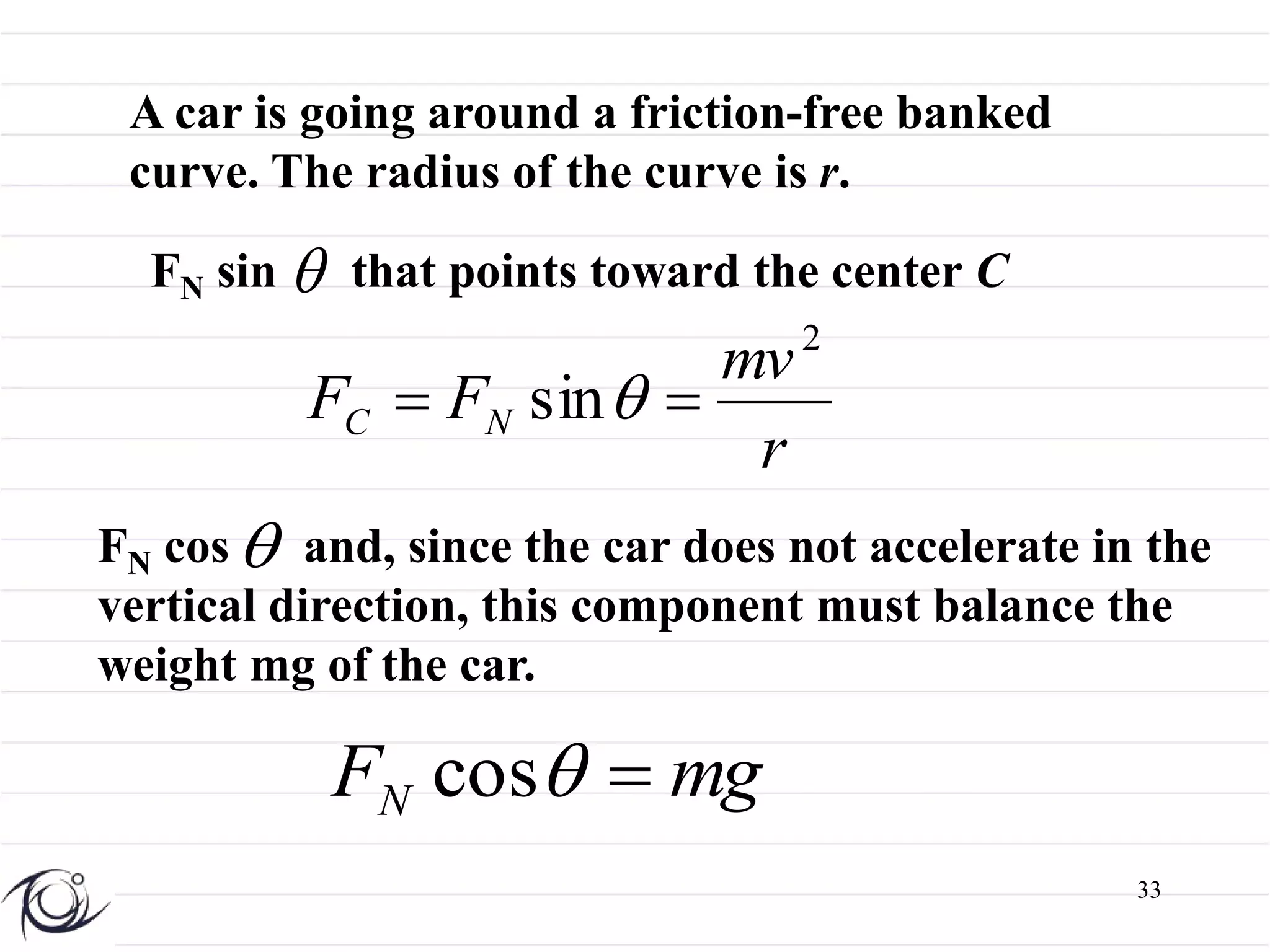
A car is going around a friction-free banked
 curve. The radius of the curve is r.

  FN sin  that points toward the center C
                                  2
                          mv
          FC  FN sin  
                           r
FN cos  and, since the car does not accelerate in the
vertical direction, this component must balance the
weight mg of the car.

           FN cos  mg
                                                  33
FN sin  mv / r      2
                   
           FN cos   mg
                            2
                        v
                tan  
                        rg

At a speed that is too small for a given  , a car
would slide down a frictionless banked curve: at
a speed that is too large, a car would slide off the
top.
                                                   34
Want to watch the derivation?
http://www.youtube.com/watch?v=OlUlLglTEn4


  Derive the equation                relating the banking angle
  to the speed of the vehicle and the radius of curvature .


                                                                  35
Banking Angle Example
 A curve has a radius of 50 m and a banking
 angle of 15o. What is the ideal speed (no
 friction required between cars tyres and the
 surface) for a car on this curve?


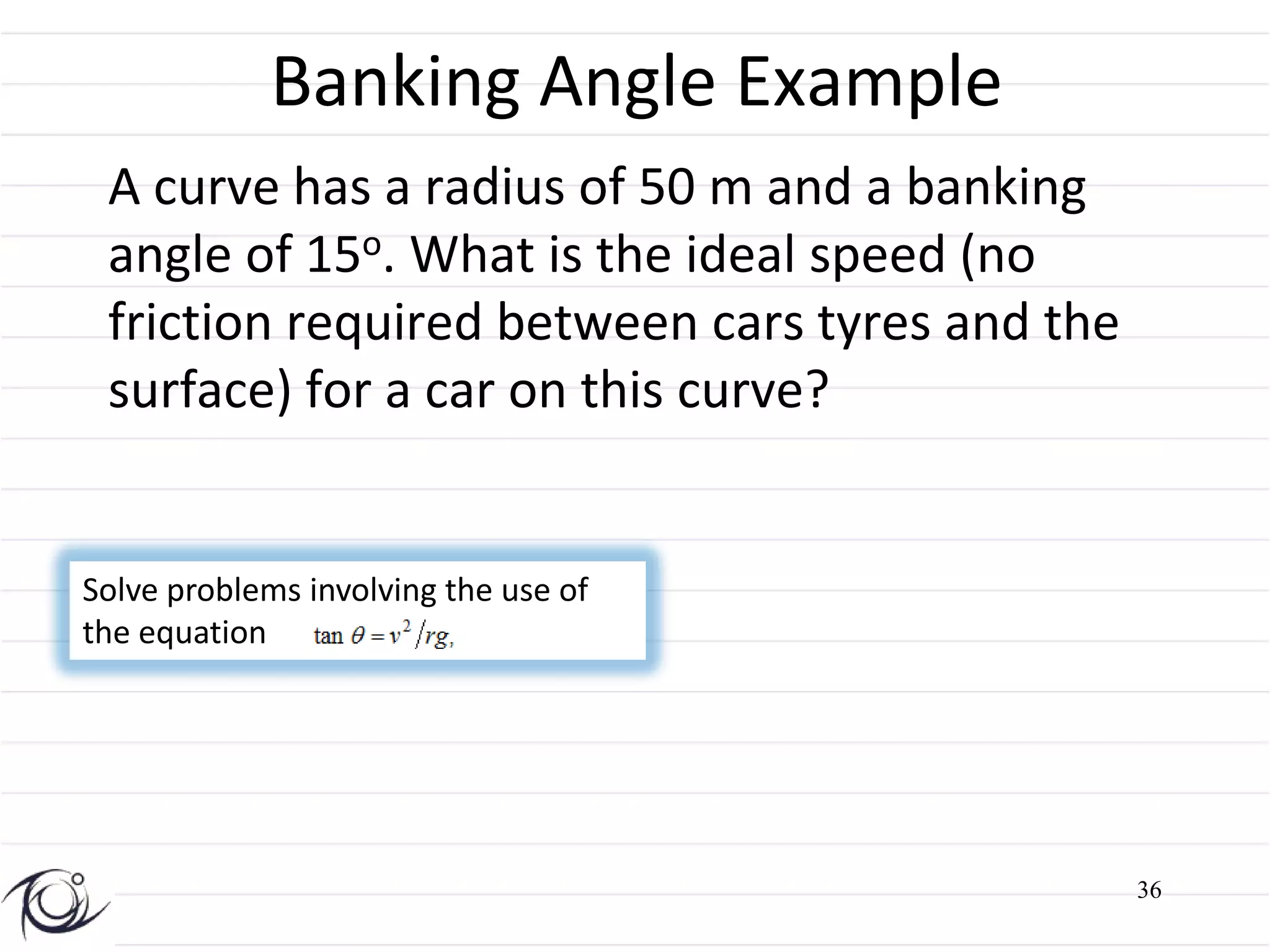
Solve problems involving the use of
the equation


                                                36
Banking Angle Example
A curve has a radius of 50 m and a banking angle of 15o.
What is the ideal speed (no friction required between cars
tyres and the surface) for a car on this curve?


                                                      37
Banking Angle Example
A curve has a radius of 50 m and a banking angle of 15o.
What is the ideal speed (no friction required between cars
tyres and the surface) for a car on this curve?


                                     If the car negotiates
                                     the bend at 11.5ms-1 it
                                     can do so without
                                                           38
                                     friction.
Conceptual Question
In a circus, a man hangs upside down from a trapeze, legs bent
over the bar and arms downward, holding his partner. Is it
harder for the man to hold his partner when the partner hangs
straight down and is stationary or when the partner is swinging
through the straight-down position?


                                                             39
When they are moving in a circular arc they have
centripetal acceleration. The acrobat exerts an
additional pull compared to when they are stationary.


                                                   40
Proportionality examples
A car is traveling in uniform circular motion on a section
   of road whose radius is r. The road is slippery, and
   the car is just on the verge of sliding.
(a) If the car’s speed was doubled, what would have to
    be the smallest radius in order that the car does not
    slide? Express your answer in terms of r.
(b) What would be your answer to part (a) if the car
    were replaced by one that weighted twice as much?

                                                       41

Uniform circular motion worked examples

  • 1.
    Uniform Circular Motion vis constant  v is constantly changing r 1
  • 2.
  • 3.
    Tangential speed The distancetravelled in one rotation is the circumference s  2r r The time to travel around the circle is T. s 2r v  t T 2r v T 3
  • 4.
    Example : TangentialSpeed A merry-go-round does 5 complete revolutions in a minute. It has a radius of 8 metres. Calculate the tangential speed. 4
  • 5.
  • 6.
  • 7.
  • 8.
    Centripetal Acceleration To find the instantaneous acceleration you must make t (the time interval) very small v a t   v  vf - vi  vf v  - vi t is small, approaching zero 8
  • 9.
    Centripetal Acceleration At any instant the centripetal acceleration is towards the centre of the circle. SO- Using vector subtraction show centripetal acceleration is directed towards the centre of a circle over a small time interval. 9
  • 10.
  • 11.
  • 12.
    Note 2 v if ac  then r ac  v 2 If you double the tangential speed, you quadruple the centripetal acceleration 12
  • 13.
    1 also ac  r If you double the radius, you halve the centripetal acceleration 13
  • 14.
    Example : TheEffect of Radius on Centripetal Acceleration The bobsled track at the 1994 Olympics in Lillehammer, Norway, contained turns with radii of 33 m and 24 m. Find the centripetal acceleration at each turn for a speed of 34 m/s, a speed that was achieved in the two-man event. 14
  • 15.
    2 v ac  r 15
  • 16.
  • 17.
  • 18.
    Centripetal Force -FC Both FC and aC are at right angles to the velocity, directed towards the centre of the circle. F  ma 2 v a  c r 2 Quantity: force , F mv FC  Units: newtons, N r 18
  • 19.
    Example: Centripetal Force Amodel airplane has a mass of 0.90 kg and moves at a constant speed on a circle that is parallel to the ground. Find the tension in the 17.0m long string if the plane circles once every 3 seconds. 19
  • 20.
    mv 2 FC  r 2 r v T 20
  • 21.
    aC provided bythe tension force aC provided by the normal force Describe situations in which the centripetal acceleration is caused by a tension force, a frictional force, a gravitational force, or a normal force aC provided by the frictional force aC provided by the gravitational force 21
  • 22.
    aC provided bythe tension force aC provided by the normal force A bob on a string being whirled A bobsled travelling around an around . Olympic bobsled track. aC provided by the frictional force aC provided by the gravitational force A car driving around a flat The Moon orbiting the Earth. roundabout. 22
  • 23.
    Free body diagrams  Box on a table FN     Fg FNET  Fg  FN  0N • Draw a dot at the centre of mass • draw labelled force vectors from the centre of mass • If body is not accelerating the forces are balanced 23
  • 24.
    Box on aslope, not moving   FN Ffriction   FNET  0 Fg • Normal force is perpendicular to the surface of contact 24
  • 25.
  • 26.
  • 27.
  • 28.
  • 29.
    Draw free bodydiagrams for a fridge • Pushing against a fridge (not moving) • Pushing against a fridge (accelerating) • Pushing against a fridge (constant velocity) 29
  • 30.
    Car going arounda bend SO: Identify the vertical and horizontal forces on a vehicle moving with constant velocity on a flat horizontal road. 2 mv F friction  r 30
  • 31.
    Factors affecting cornering 2 mv F friction  r r – radius of curvature m – mass of vehicle v - speed of vehicle Ffriction – depends on • tyres • road surface 31
  • 32.
    Banked Curves Explain thatwhen a vehicle travels round a banked curve at the correct speed for the banking angle, the horizontal component of the normal force on the vehicle (not the frictional force on the tyres) causes the centripetal acceleration. 32
  • 33.
    A car isgoing around a friction-free banked curve. The radius of the curve is r. FN sin  that points toward the center C 2 mv FC  FN sin   r FN cos  and, since the car does not accelerate in the vertical direction, this component must balance the weight mg of the car. FN cos  mg 33
  • 34.
    FN sin mv / r 2  FN cos mg 2 v tan   rg At a speed that is too small for a given  , a car would slide down a frictionless banked curve: at a speed that is too large, a car would slide off the top. 34
  • 35.
    Want to watchthe derivation? http://www.youtube.com/watch?v=OlUlLglTEn4 Derive the equation relating the banking angle to the speed of the vehicle and the radius of curvature . 35
  • 36.
    Banking Angle Example A curve has a radius of 50 m and a banking angle of 15o. What is the ideal speed (no friction required between cars tyres and the surface) for a car on this curve? Solve problems involving the use of the equation 36
  • 37.
    Banking Angle Example Acurve has a radius of 50 m and a banking angle of 15o. What is the ideal speed (no friction required between cars tyres and the surface) for a car on this curve? 37
  • 38.
    Banking Angle Example Acurve has a radius of 50 m and a banking angle of 15o. What is the ideal speed (no friction required between cars tyres and the surface) for a car on this curve? If the car negotiates the bend at 11.5ms-1 it can do so without 38 friction.
  • 39.
    Conceptual Question In acircus, a man hangs upside down from a trapeze, legs bent over the bar and arms downward, holding his partner. Is it harder for the man to hold his partner when the partner hangs straight down and is stationary or when the partner is swinging through the straight-down position? 39
  • 40.
    When they aremoving in a circular arc they have centripetal acceleration. The acrobat exerts an additional pull compared to when they are stationary. 40
  • 41.
    Proportionality examples A caris traveling in uniform circular motion on a section of road whose radius is r. The road is slippery, and the car is just on the verge of sliding. (a) If the car’s speed was doubled, what would have to be the smallest radius in order that the car does not slide? Express your answer in terms of r. (b) What would be your answer to part (a) if the car were replaced by one that weighted twice as much? 41