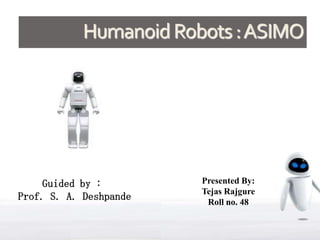
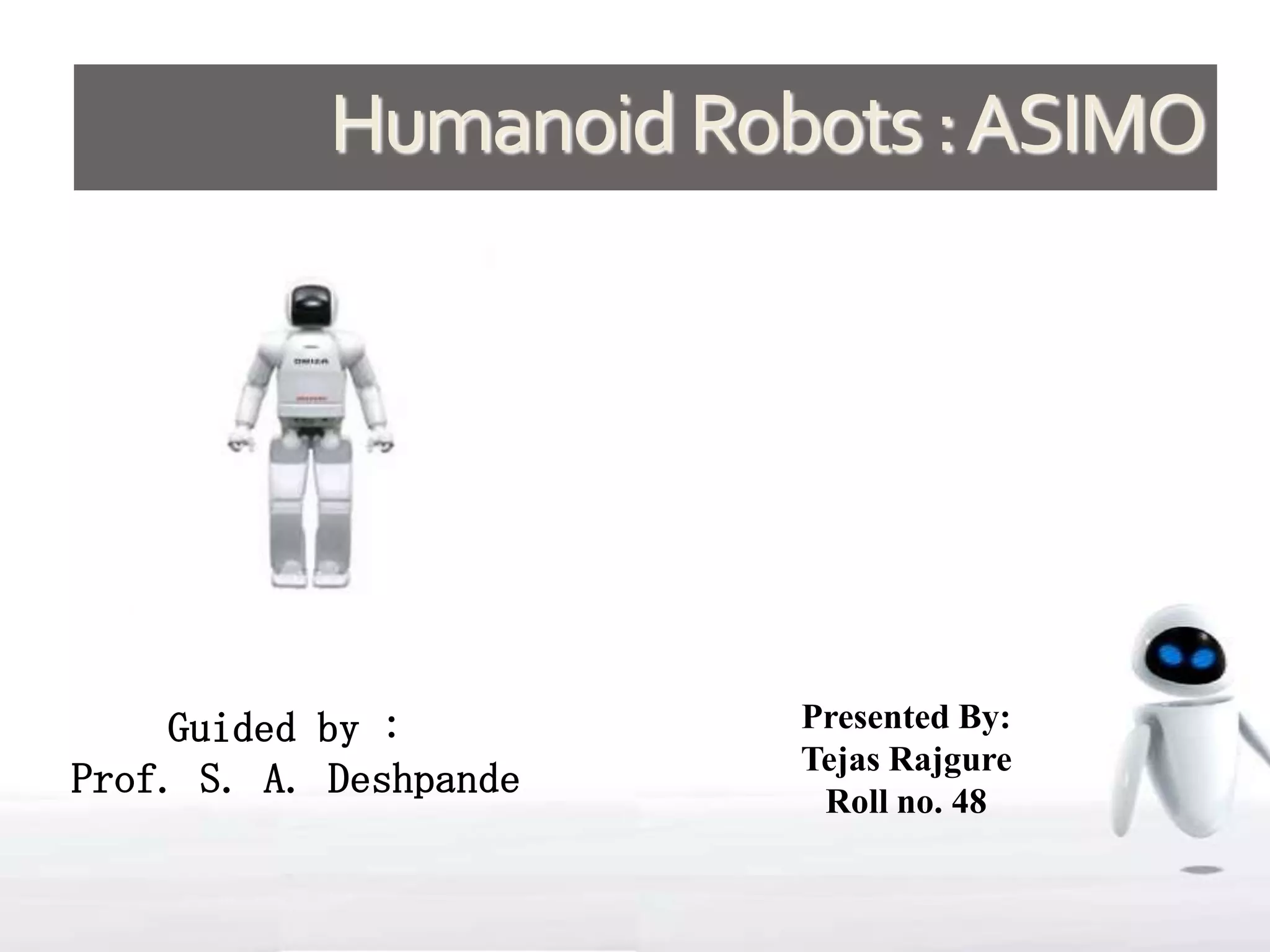
Humanoid Robots : ASIMO


     Guided by :        Presented By:
                        Tejas Rajgure
Prof. S. A. Deshpande    Roll no. 48
Outline

 What is a robot?
 History of robots
 Our Times
 Why Humanoid Robots?
 ASIMO
 Recognition Technology in ASIMO
 Conclusion
 References
What is Robot??
 “A reprogrammable, multifunctional
  manipulator designed to move
  material, parts, tools, or specialized
  devices through various programmed
  motions for the performance of a
  variety of tasks."
               - Robot Institute of
  America, 1979
 An Intelligent robot is a mechanical
  creature which can function
  autonomously”
History
 Early Stages
   The notion of putting machines
     to work can be credited to great
     thinkers like Aristotle.
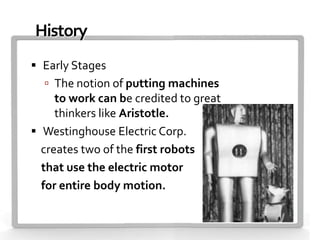
 Westinghouse Electric Corp.
  creates two of the first robots
  that use the electric motor
  for entire body motion.
History (cont.)

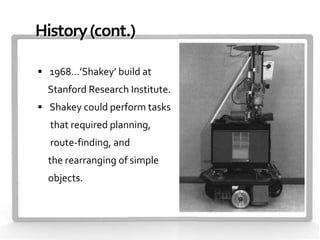
 1968…’Shakey’ build at
  Stanford Research Institute.
 Shakey could perform tasks
  that required planning,
  route-finding, and
  the rearranging of simple
  objects.
Our Times
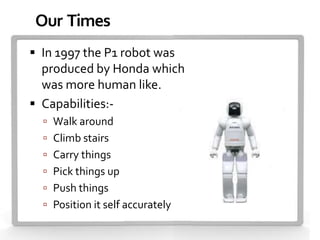
 In 1997 the P1 robot was
  produced by Honda which
  was more human like.
 Capabilities:-
   Walk around
   Climb stairs
   Carry things
   Pick things up
   Push things
   Position it self accurately
Our Times (cont.)
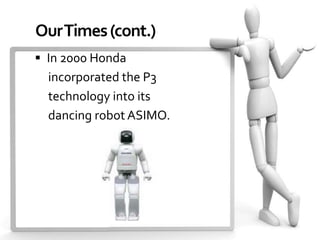
 In 2000 Honda
  incorporated the P3
  technology into its
  dancing robot ASIMO.
Why Humanoids??
 Are there any good reasons for doing
 research on humanoid robots?
   Work in dangerous environments
   Exhaustive and repetitive tasks.
   Division of labor with humans in cooperative
    tasks
   Anthropomorphism
   Embodiment
   Interaction and Communication
Why Humanoids??
 Anthropomorphism
   Humans have built complex
    environments, tools and equipment's
    very much adapted to our selves.
   Robots with human-like morphology
    and motion capabilities have a
    greater potential acting in living
    environments created for humans,
    than e.g. wheeled robots.
Why Humanoids??
 Embodiment
  The form of our bodies is critical to
   the representations that we
   develop and use for both our
   internal thought and our
   language.
  If we are to build a robot with
   human like intelligence then it
   must have a human like body in
   order to be able to develop similar
   sorts of representations.
Why Humanoids??

 Important aspects of being human are
  interaction and communication with other
  humans.
   Humanoids can communicate in a manner that
    supports the natural communication modalities of
    humans. Examples include: facial expression, body
    posture, gesture, gaze direction, and voice.
   If a robot has humanoid form, then it will be both easy
    and natural for humans to interact with it in a
    humanlike way.
Who is ASIMO?

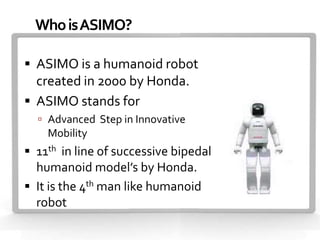
 ASIMO is a humanoid robot
  created in 2000 by Honda.
 ASIMO stands for
   Advanced Step in Innovative
    Mobility
 11th in line of successive bipedal
  humanoid model’s by Honda.
 It is the 4th man like humanoid
  robot.
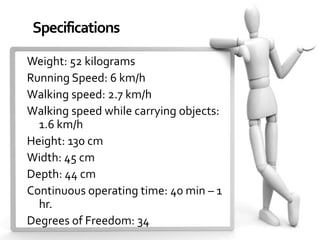
Specifications

Weight: 52 kilograms
Running Speed: 6 km/h
Walking speed: 2.7 km/h
Walking speed while carrying objects:
  1.6 km/h
Height: 130 cm
Width: 45 cm
Depth: 44 cm
Continuous operating time: 40 min – 1
  hr.
Degrees of Freedom: 34
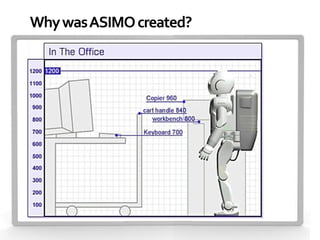
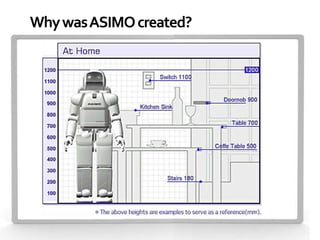
Why was ASIMO created?
Why Legs for Humanoids ?
 Potentially less weight
 Better handling of rough terrains
 Only about a half of the world’s land mass is accessible by current
   man built vehicles
 Do less damage to terrains (environmentally conscious)
 More energy-efficient
 Use of isolated footholds that optimize support and traction (i.e.
   ladder)
 Active suspension
 Decouples the path of body from the path of feet
 Exploit discrete footholds
Why Bipeds?

 Why 2 legs? 4 or 6 legs give more stability, don’t they?
 A biped robot body can be made shorter along the walking
   direction and can turn around in small areas
 Light weight
 More efficient due to less number of actuators needed
 Everything around us is built to be comfortable for use by
   human form
 Social interaction with robots and our perception
 Our instinctive desire to create a replica of ourselves
Walking vs. Running
 Motion of a legged system is called walking if in all instances
   at least one leg is supporting the body
 If there are instances where no legs are on the ground, it is
   called running
 Walking can be statically or dynamically stable
 Running is always dynamically stable
 Airborne time for ASIMO 0.08 sec.
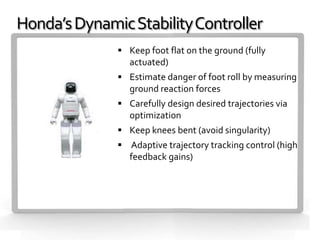
Honda’s Dynamic Stability Controller
               Keep foot flat on the ground (fully
                 actuated)
               Estimate danger of foot roll by measuring
                 ground reaction forces
               Carefully design desired trajectories via
                 optimization
               Keep knees bent (avoid singularity)
               Adaptive trajectory tracking control (high
                 feedback gains)
Walking - further challenges

 Can’t compete with humans in terms of:
      – Speed (0.44 m/s top speed)
      – Efficiency (uses roughly 20x
         as much energy per unit
         weight, per distance moved)
 Robustness (Cant perform fast actions
  as humans)
 DC electric motor runs Hot
Recognition Technology

 With 2000's ASIMO model Honda added many
  features, labeled "Intelligence Technology", that
  enable ASIMO to interact better with humans.
  These features fall under 5 categories:
  1. Recognition of moving objects
  2. Posture/gesture recognition
  3. Environment recognition
  4. Sound recognition
  5. Face recognition.
Recognition of moving objects
 ASIMO can detect movement of multiple
  objects, assessing distance and direction
  using the visual info. captured by the camera.
 Featured served by this application are
   Follow the movements of people
   Follow a person
   Yield to pedestrians in its path.
   Greet a person when he or she approaches.
Recognition of postures and gestures

  Positioning and movement of a hand,
   recognizing postures and gestures.
  Can react and be directed to both voice
   commands and natural movements of human
   being.
      Recognize when a handshake is offered.
      A person waving at it.
      Movement directions.
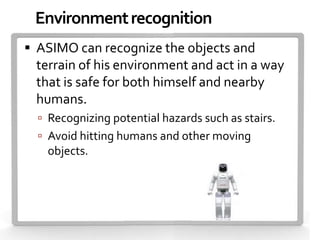
Environment recognition
 ASIMO can recognize the objects and
 terrain of his environment and act in a way
 that is safe for both himself and nearby
 humans.
   Recognizing potential hazards such as stairs.
   Avoid hitting humans and other moving
   objects.
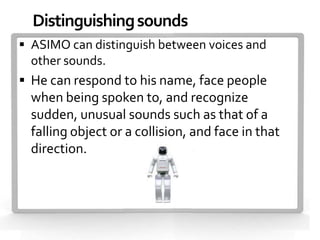
Distinguishing sounds
 ASIMO can distinguish between voices and
  other sounds.
 He can respond to his name, face people
  when being spoken to, and recognize
  sudden, unusual sounds such as that of a
  falling object or a collision, and face in that
  direction.
Facial recognition

 ASIMO has the ability to
  recognize faces, even when
  ASIMO or the human being is
  moving.
 It can individually recognize
  approximately 10 different
  faces. Once they are registered
  it can address them by name.
Demo

 ASIMO working as a Bartender.
Conclusion
 Robots are taking over tasks which are deemed dull, dirty
  and dangerous
 The idea of robots with greater intelligence than humans
  is at least 50 years away, and may never come
 It's not the robots we need to worry about; it's the people
  who program them.
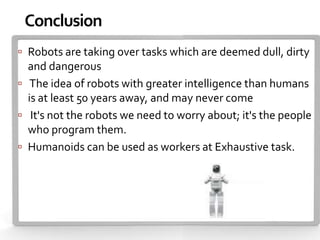
 Humanoids can be used as workers at Exhaustive task.
References
1.    http://asimo.honda.com/asimo_specifications.html
2.    http://world.honda.com/ASIMO/video/2002/tech-
      recog-mov-obj-1/index.html
3.    http://www.popularmechanics.com/technology/engine
      ering/robots/4264593
 Y. Sakagami, R. Watanabe, C. Aoyama, S. Matsunaga, N.
     Higaki, and K. Fujimura. The intelli-gent Asimo: system
     overview and integration. In Intelligent Robots and
     Systems, 2002.
 Honda Motor Co. Ltd. "History of the Humanoids: E0
     (1986)", Retrieved 2008-07-
     01.
Thank you!!

Humanoid robots

  • 1.
    Humanoid Robots :ASIMO Guided by : Presented By: Tejas Rajgure Prof. S. A. Deshpande Roll no. 48
  • 2.
    Outline  What isa robot?  History of robots  Our Times  Why Humanoid Robots?  ASIMO  Recognition Technology in ASIMO  Conclusion  References
  • 3.
    What is Robot?? “A reprogrammable, multifunctional manipulator designed to move material, parts, tools, or specialized devices through various programmed motions for the performance of a variety of tasks." - Robot Institute of America, 1979  An Intelligent robot is a mechanical creature which can function autonomously”
  • 4.
    History  Early Stages  The notion of putting machines to work can be credited to great thinkers like Aristotle.  Westinghouse Electric Corp. creates two of the first robots that use the electric motor for entire body motion.
  • 5.
    History (cont.)  1968…’Shakey’build at Stanford Research Institute.  Shakey could perform tasks that required planning, route-finding, and the rearranging of simple objects.
  • 6.
    Our Times  In1997 the P1 robot was produced by Honda which was more human like.  Capabilities:-  Walk around  Climb stairs  Carry things  Pick things up  Push things  Position it self accurately
  • 7.
    Our Times (cont.) In 2000 Honda incorporated the P3 technology into its dancing robot ASIMO.
  • 8.
    Why Humanoids??  Arethere any good reasons for doing research on humanoid robots?  Work in dangerous environments  Exhaustive and repetitive tasks.  Division of labor with humans in cooperative tasks  Anthropomorphism  Embodiment  Interaction and Communication
  • 9.
    Why Humanoids??  Anthropomorphism  Humans have built complex environments, tools and equipment's very much adapted to our selves.  Robots with human-like morphology and motion capabilities have a greater potential acting in living environments created for humans, than e.g. wheeled robots.
  • 10.
    Why Humanoids??  Embodiment  The form of our bodies is critical to the representations that we develop and use for both our internal thought and our language.  If we are to build a robot with human like intelligence then it must have a human like body in order to be able to develop similar sorts of representations.
  • 11.
    Why Humanoids??  Importantaspects of being human are interaction and communication with other humans.  Humanoids can communicate in a manner that supports the natural communication modalities of humans. Examples include: facial expression, body posture, gesture, gaze direction, and voice.  If a robot has humanoid form, then it will be both easy and natural for humans to interact with it in a humanlike way.
  • 12.
    Who is ASIMO? ASIMO is a humanoid robot created in 2000 by Honda.  ASIMO stands for  Advanced Step in Innovative Mobility  11th in line of successive bipedal humanoid model’s by Honda.  It is the 4th man like humanoid robot.
  • 13.
    Specifications Weight: 52 kilograms RunningSpeed: 6 km/h Walking speed: 2.7 km/h Walking speed while carrying objects: 1.6 km/h Height: 130 cm Width: 45 cm Depth: 44 cm Continuous operating time: 40 min – 1 hr. Degrees of Freedom: 34
  • 14.
    Why was ASIMOcreated?
  • 15.
    Why was ASIMOcreated?
  • 16.
    Why Legs forHumanoids ?  Potentially less weight  Better handling of rough terrains  Only about a half of the world’s land mass is accessible by current man built vehicles  Do less damage to terrains (environmentally conscious)  More energy-efficient  Use of isolated footholds that optimize support and traction (i.e. ladder)  Active suspension  Decouples the path of body from the path of feet  Exploit discrete footholds
  • 17.
    Why Bipeds?  Why2 legs? 4 or 6 legs give more stability, don’t they?  A biped robot body can be made shorter along the walking direction and can turn around in small areas  Light weight  More efficient due to less number of actuators needed  Everything around us is built to be comfortable for use by human form  Social interaction with robots and our perception  Our instinctive desire to create a replica of ourselves
  • 18.
    Walking vs. Running Motion of a legged system is called walking if in all instances at least one leg is supporting the body  If there are instances where no legs are on the ground, it is called running  Walking can be statically or dynamically stable  Running is always dynamically stable  Airborne time for ASIMO 0.08 sec.
  • 19.
    Honda’s Dynamic StabilityController  Keep foot flat on the ground (fully actuated)  Estimate danger of foot roll by measuring ground reaction forces  Carefully design desired trajectories via optimization  Keep knees bent (avoid singularity)  Adaptive trajectory tracking control (high feedback gains)
  • 20.
    Walking - furtherchallenges  Can’t compete with humans in terms of: – Speed (0.44 m/s top speed) – Efficiency (uses roughly 20x as much energy per unit weight, per distance moved)  Robustness (Cant perform fast actions as humans)  DC electric motor runs Hot
  • 21.
    Recognition Technology  With2000's ASIMO model Honda added many features, labeled "Intelligence Technology", that enable ASIMO to interact better with humans. These features fall under 5 categories: 1. Recognition of moving objects 2. Posture/gesture recognition 3. Environment recognition 4. Sound recognition 5. Face recognition.
  • 22.
    Recognition of movingobjects  ASIMO can detect movement of multiple objects, assessing distance and direction using the visual info. captured by the camera.  Featured served by this application are  Follow the movements of people  Follow a person  Yield to pedestrians in its path.  Greet a person when he or she approaches.
  • 23.
    Recognition of posturesand gestures  Positioning and movement of a hand, recognizing postures and gestures.  Can react and be directed to both voice commands and natural movements of human being.  Recognize when a handshake is offered.  A person waving at it.  Movement directions.
  • 24.
    Environment recognition  ASIMOcan recognize the objects and terrain of his environment and act in a way that is safe for both himself and nearby humans.  Recognizing potential hazards such as stairs.  Avoid hitting humans and other moving objects.
  • 25.
    Distinguishing sounds  ASIMOcan distinguish between voices and other sounds.  He can respond to his name, face people when being spoken to, and recognize sudden, unusual sounds such as that of a falling object or a collision, and face in that direction.
  • 26.
    Facial recognition  ASIMOhas the ability to recognize faces, even when ASIMO or the human being is moving.  It can individually recognize approximately 10 different faces. Once they are registered it can address them by name.
  • 27.
    Demo  ASIMO workingas a Bartender.
  • 28.
    Conclusion  Robots aretaking over tasks which are deemed dull, dirty and dangerous  The idea of robots with greater intelligence than humans is at least 50 years away, and may never come  It's not the robots we need to worry about; it's the people who program them.  Humanoids can be used as workers at Exhaustive task.
  • 29.
    References 1. http://asimo.honda.com/asimo_specifications.html 2. http://world.honda.com/ASIMO/video/2002/tech- recog-mov-obj-1/index.html 3. http://www.popularmechanics.com/technology/engine ering/robots/4264593  Y. Sakagami, R. Watanabe, C. Aoyama, S. Matsunaga, N. Higaki, and K. Fujimura. The intelli-gent Asimo: system overview and integration. In Intelligent Robots and Systems, 2002.  Honda Motor Co. Ltd. "History of the Humanoids: E0 (1986)", Retrieved 2008-07- 01.
  • 30.