Application of Nano TiO2 as
Antimicrobial Agents
Megha R
ESBE Self Study
Nano TiO2
• Photocatalytic properties, high photoreactivity
• Food grade
• Antimicrobial properties
• Strong oxidising power in UV light
• Applications
– White pigment in paint and food colouring
– Effluent treatment
– Coating on PV cells
Antimicrobial properties
• Act against Gram positive and gram negative
strains of bacteria as well as fungi
• Non-toxic, environment friendly and possess
non contact biocidal properties
• Inhibits reproduction ability of bacteria by
arresting growth in lag phase
• Can also decompose phospholipid part of cell
walls and completely degrade microbial cells
Antimicrobial properties
• Also decreases the expression of co-enzyme
related activities
• Lowers the ability to transport iron and
phosphorous
• Damages DNA with hydroxyl ions
Applications
Food Packaging Material
• TiO2 nanoparticles coated on plastics can be used as
packaging material for foods and other sterile coverings
• Due to antimicrobial and non contact properties
• Successful in extending shelf, quality and safety assurance
• Can be coated or adsorbed onto polymer films or used as
sachets
Applications
Coatings and Paints
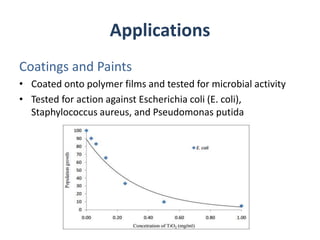
• Coated onto polymer films and tested for microbial activity
• Tested for action against Escherichia coli (E. coli),
Staphylococcus aureus, and Pseudomonas putida
Applications
Coatings and Paints
• Can be coated onto high and low density polyethylene (LDPE
and HDPE)
• Forms stable nanocomposite without altering properties of
either polymer or nanomaterial
• Can also be doped with metals such Ag and Cu to increase
bacteriocidal properties and wavelength range
• New antimicrobial interior paints developed – coated on walls
and absorb light from fluorescent bulbs and undermines
bacterial growth
Applications
Photoinduced hydrophilic coatings and
self-cleaning devices
• High hydrophilcity - self cleaning effect
• Photo-catalysis helps in breaking down accumulated dirt and
organic matter removing colouration and odour
• Biocidal properties prevent build-up algae, fungus and mould
• Gens Nano TiO2 coating - special coating developed for wall
exteriors
• Used in self cleaning textiles
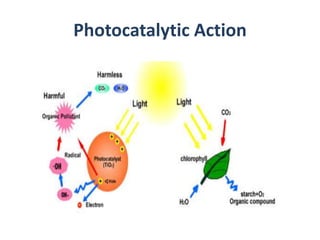
Photocatalytic Action
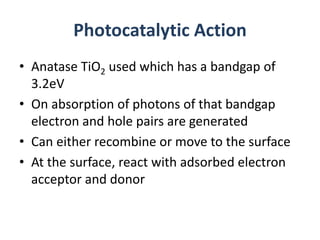
• Anatase TiO2 used which has a bandgap of
3.2eV
• On absorption of photons of that bandgap
electron and hole pairs are generated
• Can either recombine or move to the surface
• At the surface, react with adsorbed electron
acceptor and donor
Photocatalytic Action
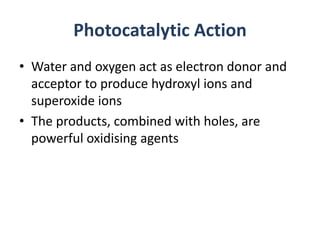
• Water and oxygen act as electron donor and
acceptor to produce hydroxyl ions and
superoxide ions
• The products, combined with holes, are
powerful oxidising agents
References
• Understanding the antimicrobial mechanism
of TiO2-based nanocomposite films in a
pathogenic bacterium
• http://www.mchnanosolutions.com/
• http://www.sciencedirect.com/
• Antimicrobial Activity of TiO2 Nanoparticle-
Coated Film for Potential Food Packaging
Applications

Nano Titanium oxide as antimicrobial agent

  • 1.
    Application of NanoTiO2 as Antimicrobial Agents Megha R ESBE Self Study
  • 2.
    Nano TiO2 • Photocatalyticproperties, high photoreactivity • Food grade • Antimicrobial properties • Strong oxidising power in UV light • Applications – White pigment in paint and food colouring – Effluent treatment – Coating on PV cells
  • 3.
    Antimicrobial properties • Actagainst Gram positive and gram negative strains of bacteria as well as fungi • Non-toxic, environment friendly and possess non contact biocidal properties • Inhibits reproduction ability of bacteria by arresting growth in lag phase • Can also decompose phospholipid part of cell walls and completely degrade microbial cells
  • 4.
    Antimicrobial properties • Alsodecreases the expression of co-enzyme related activities • Lowers the ability to transport iron and phosphorous • Damages DNA with hydroxyl ions
  • 5.
    Applications Food Packaging Material •TiO2 nanoparticles coated on plastics can be used as packaging material for foods and other sterile coverings • Due to antimicrobial and non contact properties • Successful in extending shelf, quality and safety assurance • Can be coated or adsorbed onto polymer films or used as sachets
  • 6.
    Applications Coatings and Paints •Coated onto polymer films and tested for microbial activity • Tested for action against Escherichia coli (E. coli), Staphylococcus aureus, and Pseudomonas putida
  • 7.
    Applications Coatings and Paints •Can be coated onto high and low density polyethylene (LDPE and HDPE) • Forms stable nanocomposite without altering properties of either polymer or nanomaterial • Can also be doped with metals such Ag and Cu to increase bacteriocidal properties and wavelength range • New antimicrobial interior paints developed – coated on walls and absorb light from fluorescent bulbs and undermines bacterial growth
  • 8.
    Applications Photoinduced hydrophilic coatingsand self-cleaning devices • High hydrophilcity - self cleaning effect • Photo-catalysis helps in breaking down accumulated dirt and organic matter removing colouration and odour • Biocidal properties prevent build-up algae, fungus and mould • Gens Nano TiO2 coating - special coating developed for wall exteriors • Used in self cleaning textiles
  • 9.
  • 10.
    Photocatalytic Action • AnataseTiO2 used which has a bandgap of 3.2eV • On absorption of photons of that bandgap electron and hole pairs are generated • Can either recombine or move to the surface • At the surface, react with adsorbed electron acceptor and donor
  • 11.
    Photocatalytic Action • Waterand oxygen act as electron donor and acceptor to produce hydroxyl ions and superoxide ions • The products, combined with holes, are powerful oxidising agents
  • 12.
    References • Understanding theantimicrobial mechanism of TiO2-based nanocomposite films in a pathogenic bacterium • http://www.mchnanosolutions.com/ • http://www.sciencedirect.com/ • Antimicrobial Activity of TiO2 Nanoparticle- Coated Film for Potential Food Packaging Applications