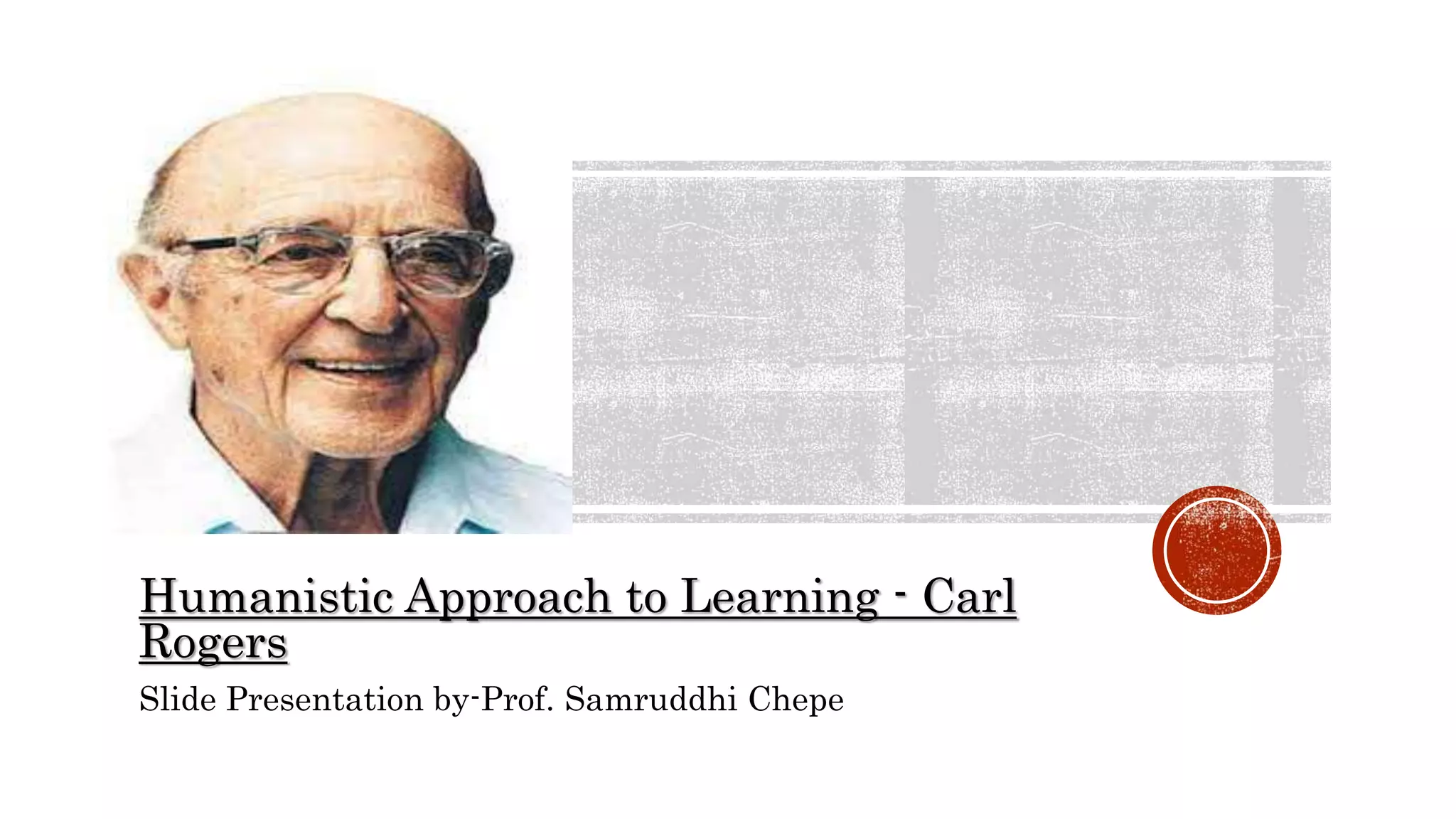
Humanistic Approach to Learning - Carl
Rogers
Slide Presentation by-Prof. Samruddhi Chepe
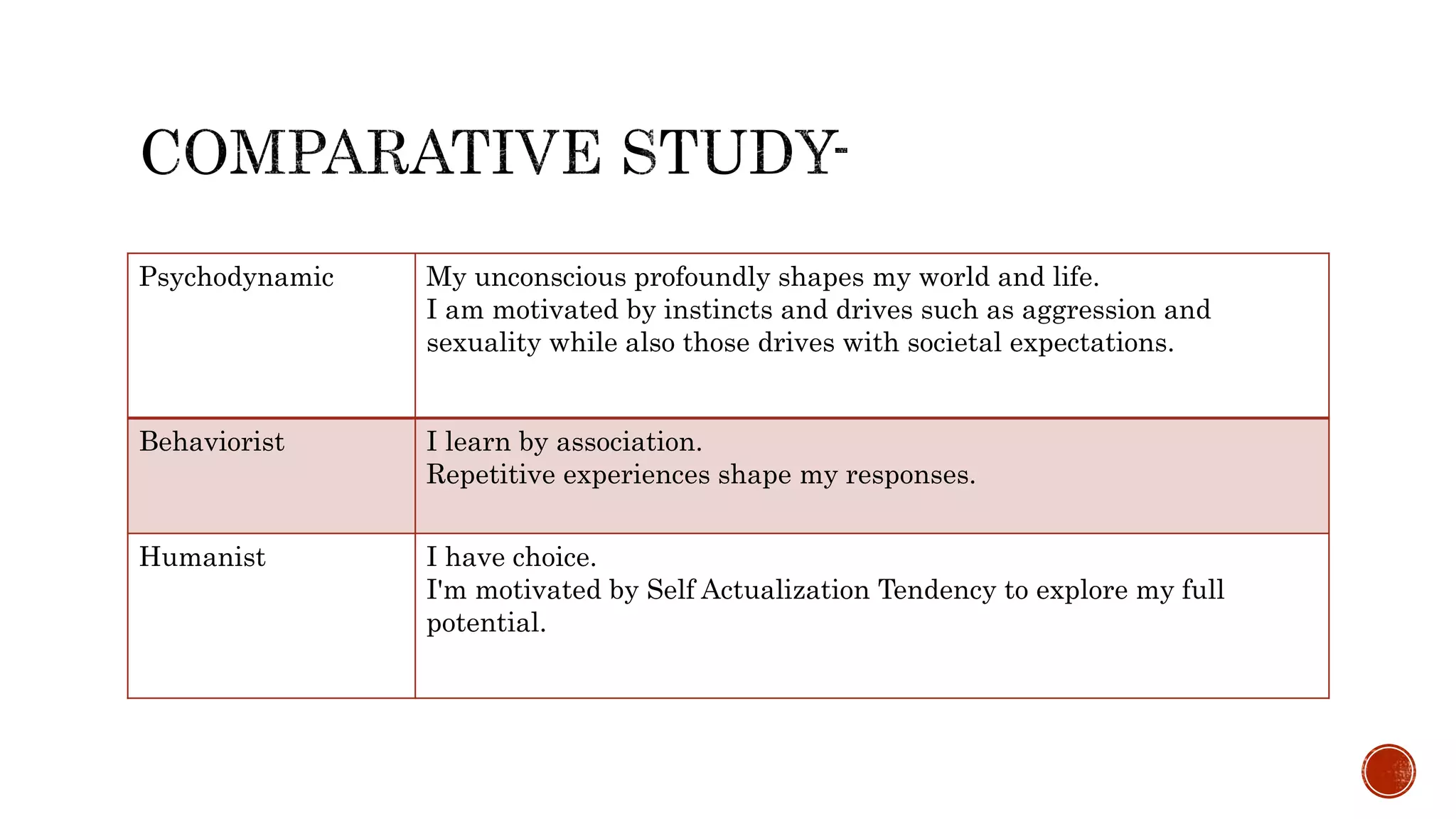
Psychodynamic My unconscious profoundly shapes my world and life.
I am motivated by instincts and drives such as aggression and
sexuality while also those drives with societal expectations.
Behaviorist I learn by association.
Repetitive experiences shape my responses.
Humanist I have choice.
I'm motivated by Self Actualization Tendency to explore my full
potential.
 Born in 1902, Carl grew up on a farm in Illinois, developing an interest in biology agriculture.
 Expressing emotions was not allowed in the Rogers household it took its toll on Carl who
developed an ulcer at 15.
 Rogers went to the University of Wisconsin to study agriculture in 1919.
 He changed careers becoming interested in religious studies. He finished his degree and left for
Union Theological Seminary in NY to become a minister.
 Rogers view of humanistic psychology was at odds with Freudian theory behaviorism.
 He gained recognition when he won the APA award for distinguished scientific contribution in
1956.
 In 1963, he moved to LaJolla, California. Developed the Centre for Studies of the Person.
 He continued his scientific efforts, writing, holding workshops, etc. until he died in 1987.
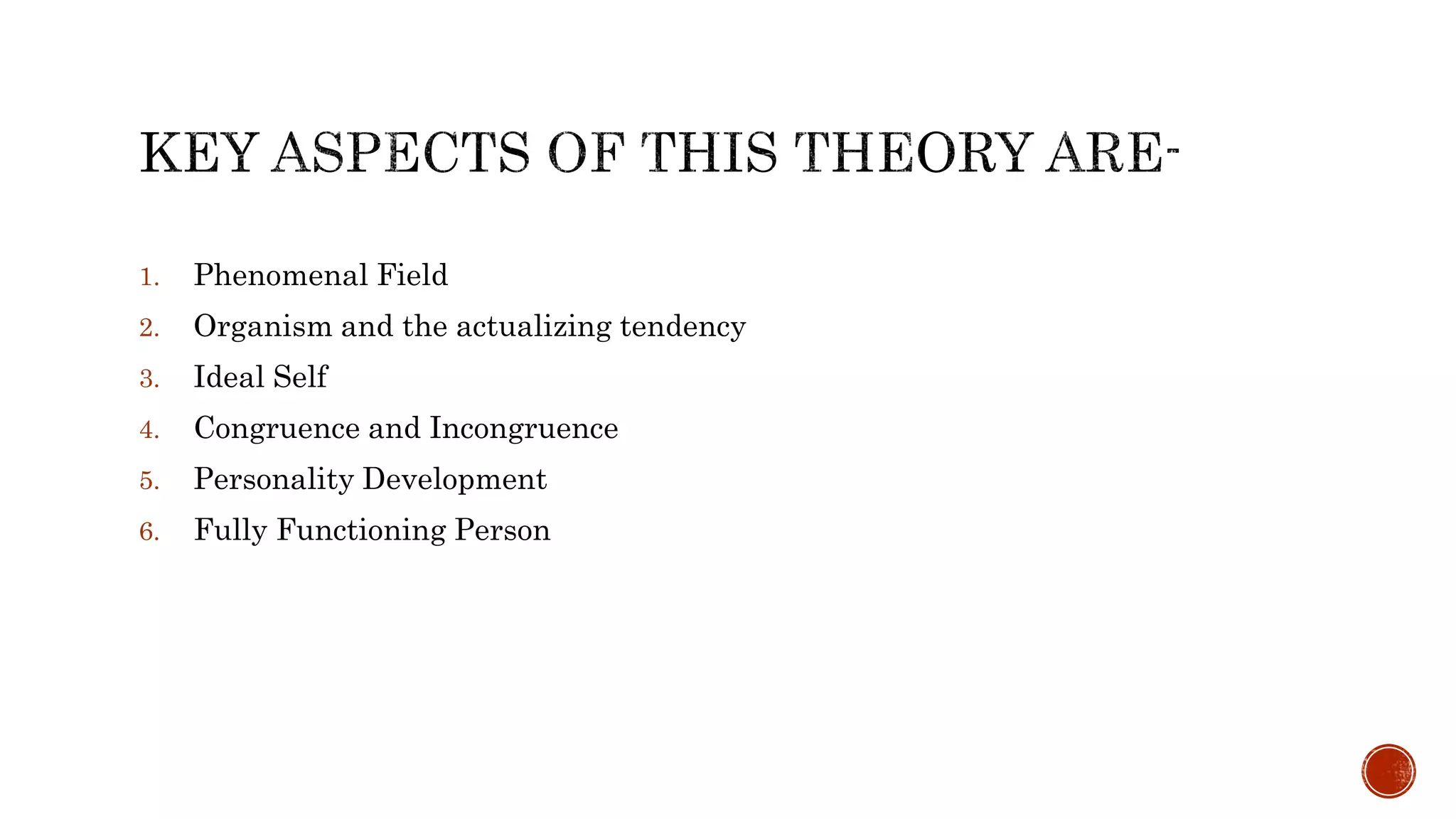
1. Phenomenal Field
2. Organism and the actualizing tendency
3. Ideal Self
4. Congruence and Incongruence
5. Personality Development
6. Fully Functioning Person
 the phenomenal self represents that
subset of self-knowledge—including
beliefs, values, attitudes, self-ascribed
traits, feelings of self-worth,
autobiographical memories,
interpersonal relationship knowledge,
and goals and plans—that is currently
in consciousness.
 For example, a person who is made
self-aware by being placed before a
mirror is more likely to behave in ways
that are consistent with his or her
traits than if he or she were not self-
aware.
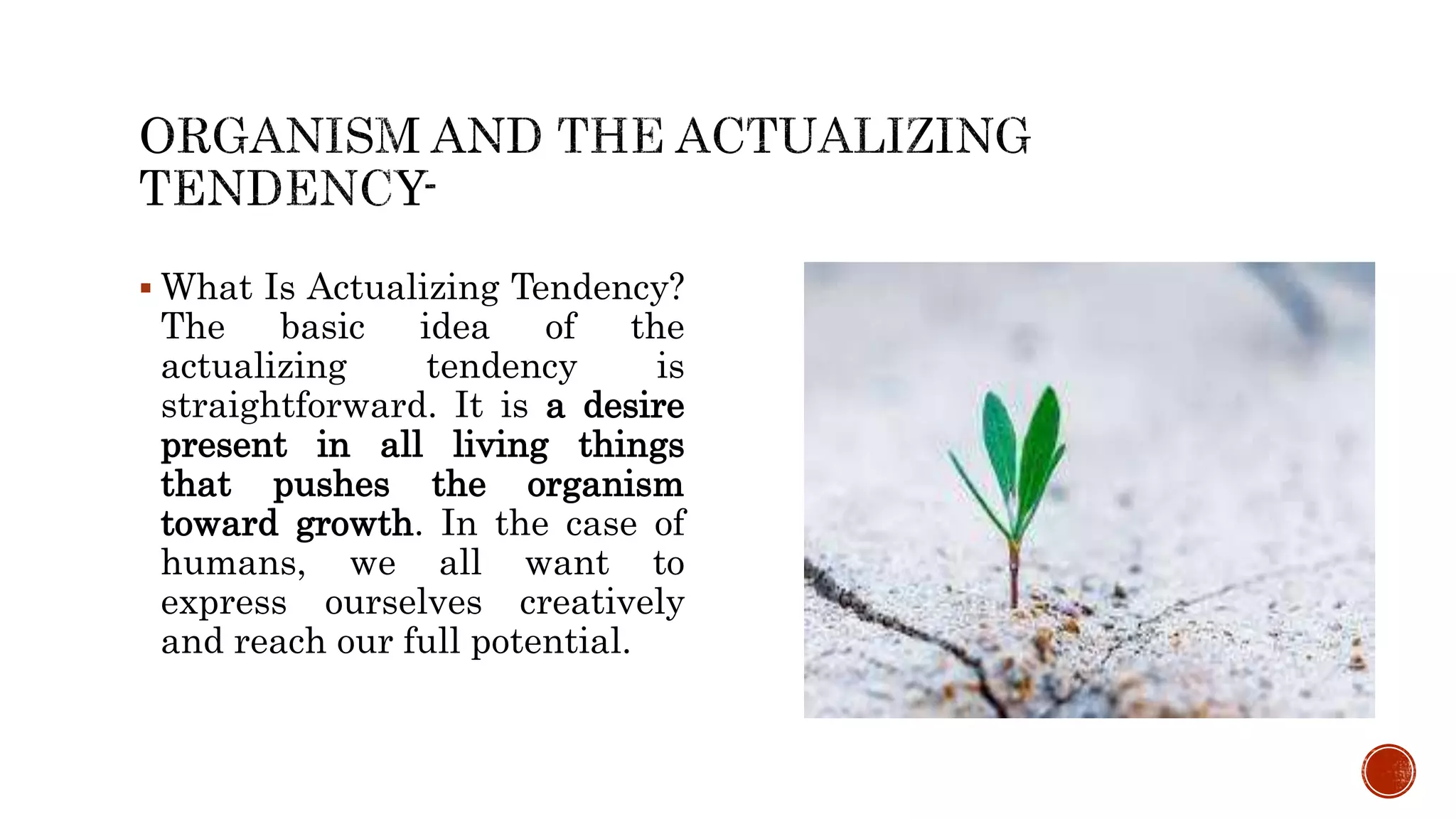
 What Is Actualizing Tendency?
The basic idea of the
actualizing tendency is
straightforward. It is a desire
present in all living things
that pushes the organism
toward growth. In the case of
humans, we all want to
express ourselves creatively
and reach our full potential.
 Self-concept How I see myself
 The ideal self is the person that you
would like to be; the real self is the
person you actually are.
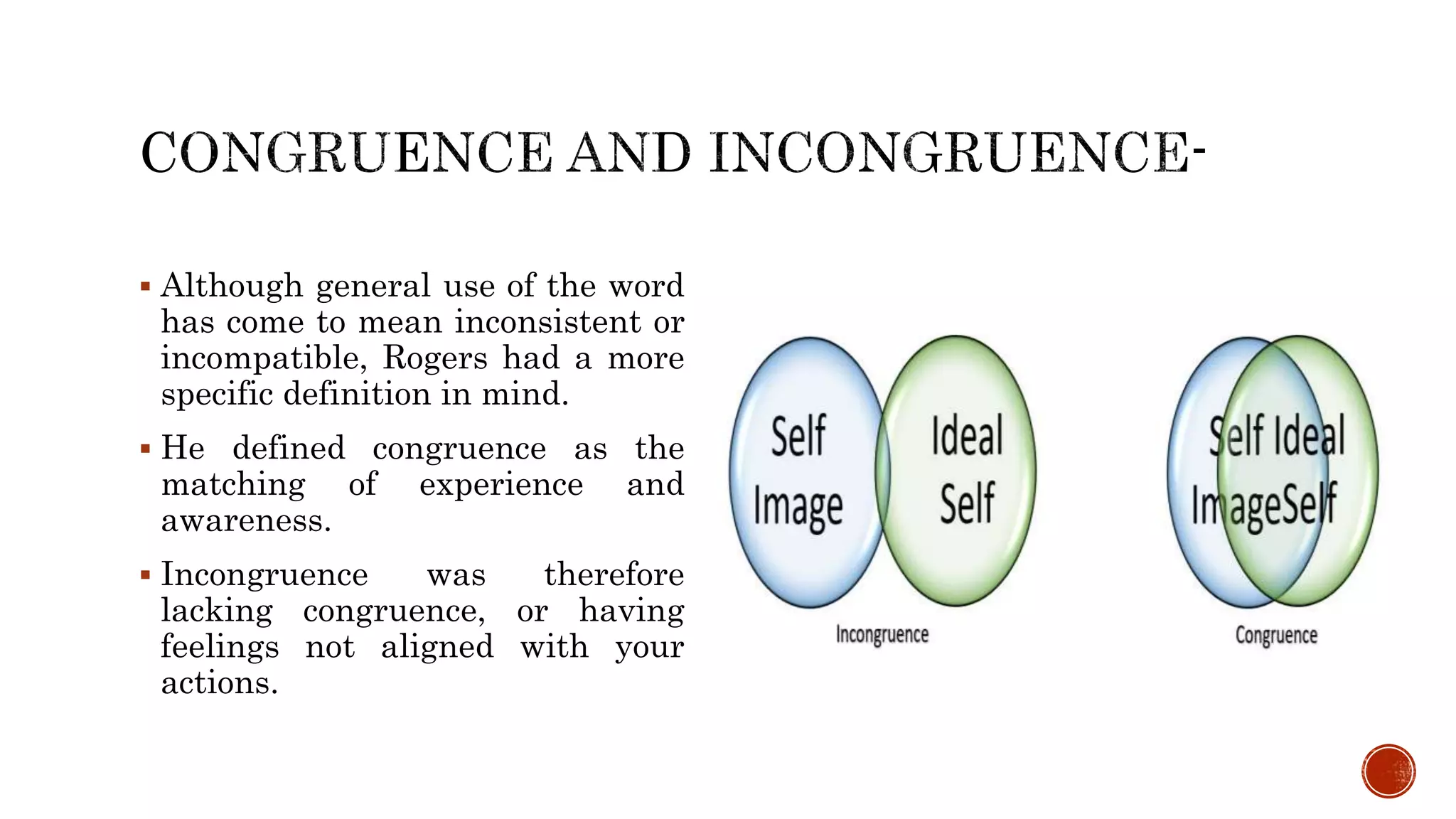
 Although general use of the word
has come to mean inconsistent or
incompatible, Rogers had a more
specific definition in mind.
 He defined congruence as the
matching of experience and
awareness.
 Incongruence was therefore
lacking congruence, or having
feelings not aligned with your
actions.
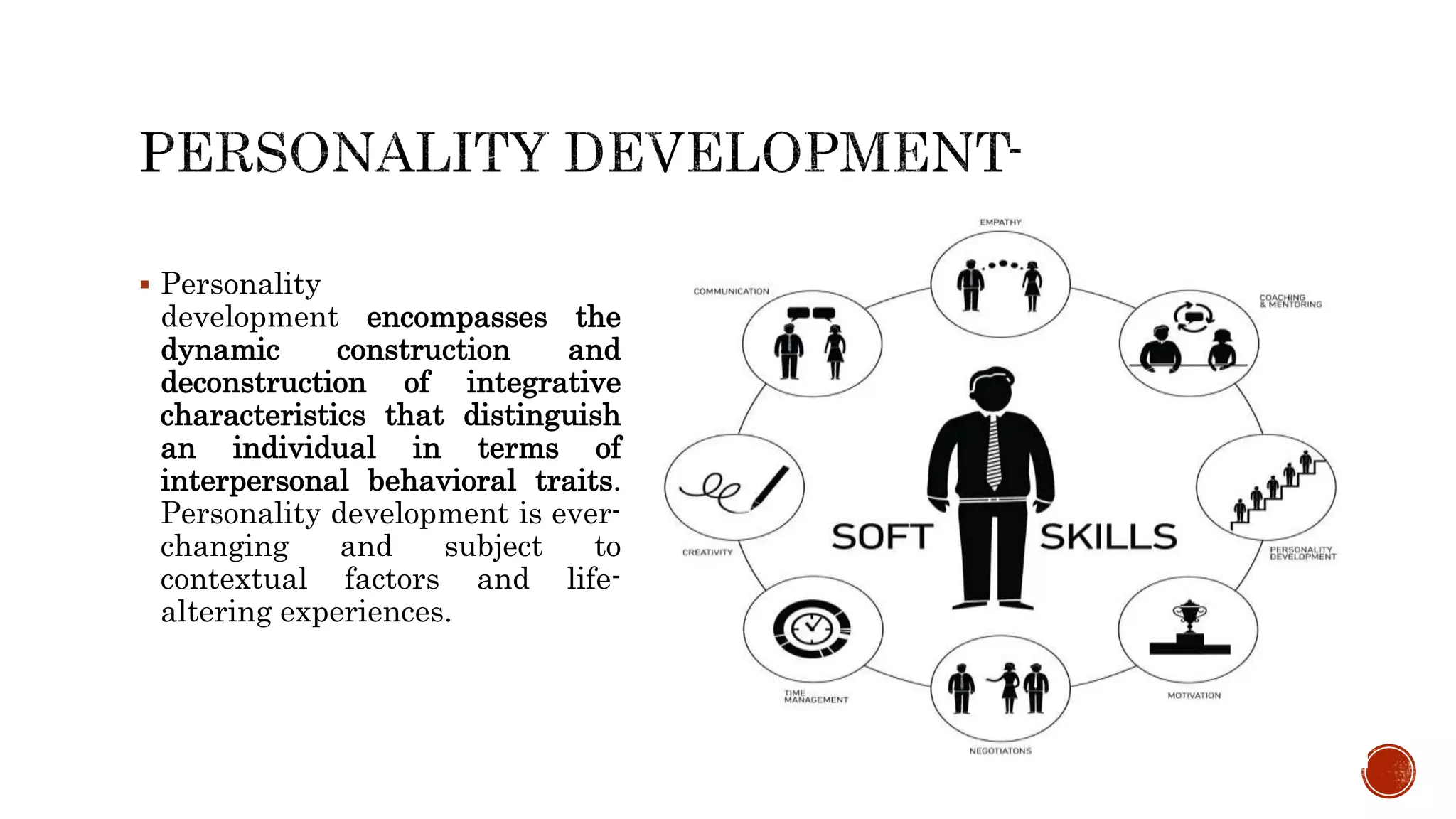
 Personality
development encompasses the
dynamic construction and
deconstruction of integrative
characteristics that distinguish
an individual in terms of
interpersonal behavioral traits.
Personality development is ever-
changing and subject to
contextual factors and life-
altering experiences.
 A fully functioning person is one who is
continually working toward becoming
self-actualized.
 They are also capable of expressing
feelings and are fully open to life's many
experiences.
 Awareness of all experiences
 Live fully in the moment
 Trust own behavior and experience
 Sense of freedom in decision making
 Creative, flexible to change
 Recognition that difficulties will
inevitably
arise.
 Research in psychotherapy.
 First to refer to the person as Client instead of patient.
 Growth model was given.
 Emphasis on developing self-concept in personality.
 Conditions necessary for therapy accepted and used in many other schools of
therapy.
 Developed the Person Centered Therapy.
 Concept of Congruence.
 Represents a shift from medical model to growth model.
Free Will
Self-
discovery
Achieving
Full
Potential
Humanist
ic
Approach
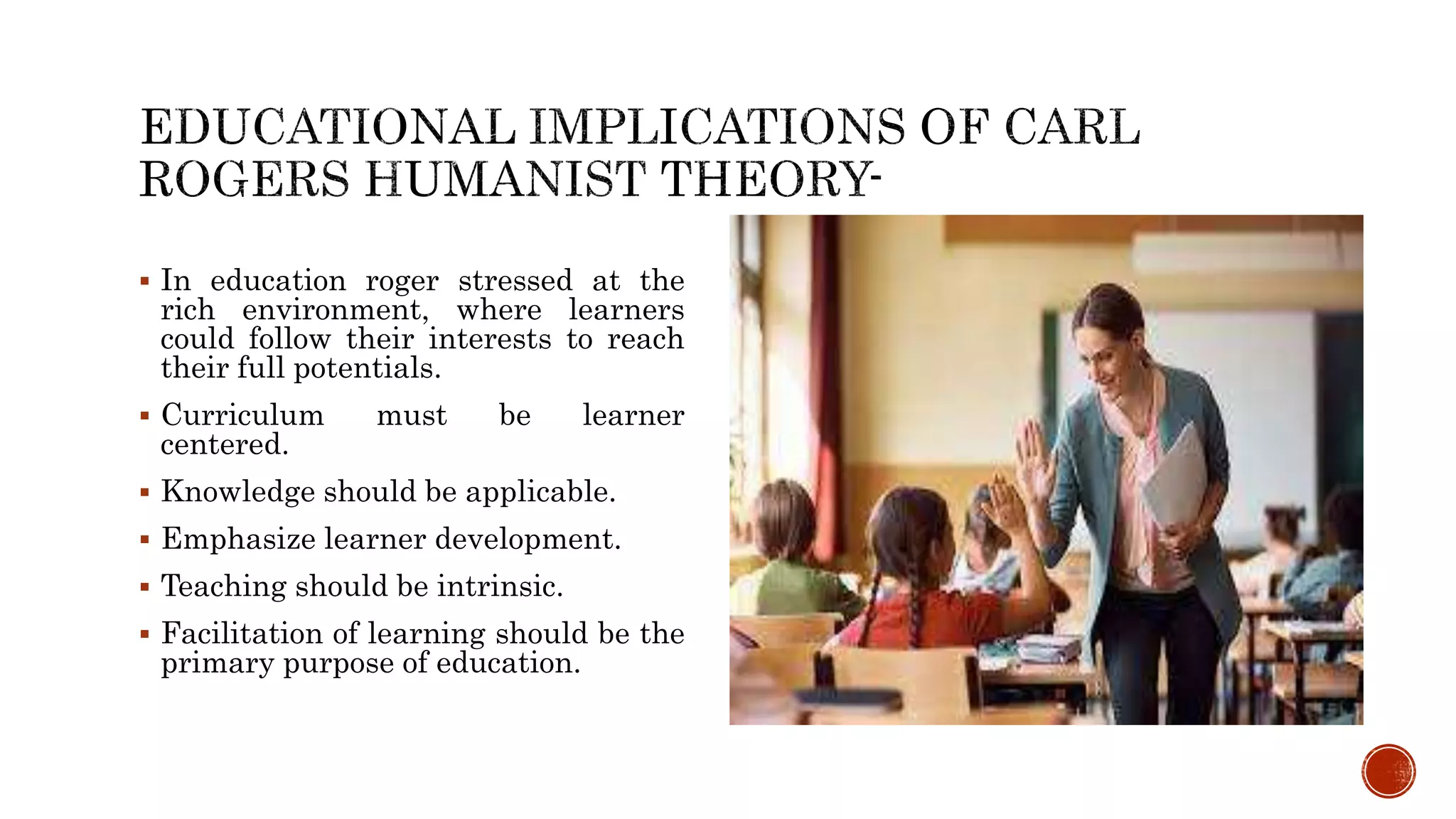
 In education roger stressed at the
rich environment, where learners
could follow their interests to reach
their full potentials.
 Curriculum must be learner
centered.
 Knowledge should be applicable.
 Emphasize learner development.
 Teaching should be intrinsic.
 Facilitation of learning should be the
primary purpose of education.
 Ignores aspects of personality that client may be unaware of, but that still
influence clients behaviour.
 Ambiguous concepts Self-actualizing tendency
 Rogers assumes that core of humans is positivity. But victims of violent crimes
may disagree.
 Rogers also believed humans are Trustworthy Organisms.
 Actualization is it always achieved??
Humanist Theory of Learning.pptx

Humanist Theory of Learning.pptx

  • 1.
    Humanistic Approach toLearning - Carl Rogers Slide Presentation by-Prof. Samruddhi Chepe
  • 2.
    Psychodynamic My unconsciousprofoundly shapes my world and life. I am motivated by instincts and drives such as aggression and sexuality while also those drives with societal expectations. Behaviorist I learn by association. Repetitive experiences shape my responses. Humanist I have choice. I'm motivated by Self Actualization Tendency to explore my full potential.
  • 3.
     Born in1902, Carl grew up on a farm in Illinois, developing an interest in biology agriculture.  Expressing emotions was not allowed in the Rogers household it took its toll on Carl who developed an ulcer at 15.  Rogers went to the University of Wisconsin to study agriculture in 1919.  He changed careers becoming interested in religious studies. He finished his degree and left for Union Theological Seminary in NY to become a minister.  Rogers view of humanistic psychology was at odds with Freudian theory behaviorism.  He gained recognition when he won the APA award for distinguished scientific contribution in 1956.  In 1963, he moved to LaJolla, California. Developed the Centre for Studies of the Person.  He continued his scientific efforts, writing, holding workshops, etc. until he died in 1987.
  • 4.
    1. Phenomenal Field 2.Organism and the actualizing tendency 3. Ideal Self 4. Congruence and Incongruence 5. Personality Development 6. Fully Functioning Person
  • 5.
     the phenomenalself represents that subset of self-knowledge—including beliefs, values, attitudes, self-ascribed traits, feelings of self-worth, autobiographical memories, interpersonal relationship knowledge, and goals and plans—that is currently in consciousness.  For example, a person who is made self-aware by being placed before a mirror is more likely to behave in ways that are consistent with his or her traits than if he or she were not self- aware.
  • 6.
     What IsActualizing Tendency? The basic idea of the actualizing tendency is straightforward. It is a desire present in all living things that pushes the organism toward growth. In the case of humans, we all want to express ourselves creatively and reach our full potential.
  • 7.
     Self-concept HowI see myself  The ideal self is the person that you would like to be; the real self is the person you actually are.
  • 8.
     Although generaluse of the word has come to mean inconsistent or incompatible, Rogers had a more specific definition in mind.  He defined congruence as the matching of experience and awareness.  Incongruence was therefore lacking congruence, or having feelings not aligned with your actions.
  • 9.
     Personality development encompassesthe dynamic construction and deconstruction of integrative characteristics that distinguish an individual in terms of interpersonal behavioral traits. Personality development is ever- changing and subject to contextual factors and life- altering experiences.
  • 10.
     A fullyfunctioning person is one who is continually working toward becoming self-actualized.  They are also capable of expressing feelings and are fully open to life's many experiences.  Awareness of all experiences  Live fully in the moment  Trust own behavior and experience  Sense of freedom in decision making  Creative, flexible to change  Recognition that difficulties will inevitably arise.
  • 11.
     Research inpsychotherapy.  First to refer to the person as Client instead of patient.  Growth model was given.  Emphasis on developing self-concept in personality.  Conditions necessary for therapy accepted and used in many other schools of therapy.  Developed the Person Centered Therapy.  Concept of Congruence.  Represents a shift from medical model to growth model.
  • 12.
  • 13.
     In educationroger stressed at the rich environment, where learners could follow their interests to reach their full potentials.  Curriculum must be learner centered.  Knowledge should be applicable.  Emphasize learner development.  Teaching should be intrinsic.  Facilitation of learning should be the primary purpose of education.
  • 14.
     Ignores aspectsof personality that client may be unaware of, but that still influence clients behaviour.  Ambiguous concepts Self-actualizing tendency  Rogers assumes that core of humans is positivity. But victims of violent crimes may disagree.  Rogers also believed humans are Trustworthy Organisms.  Actualization is it always achieved??