Skill of Probing
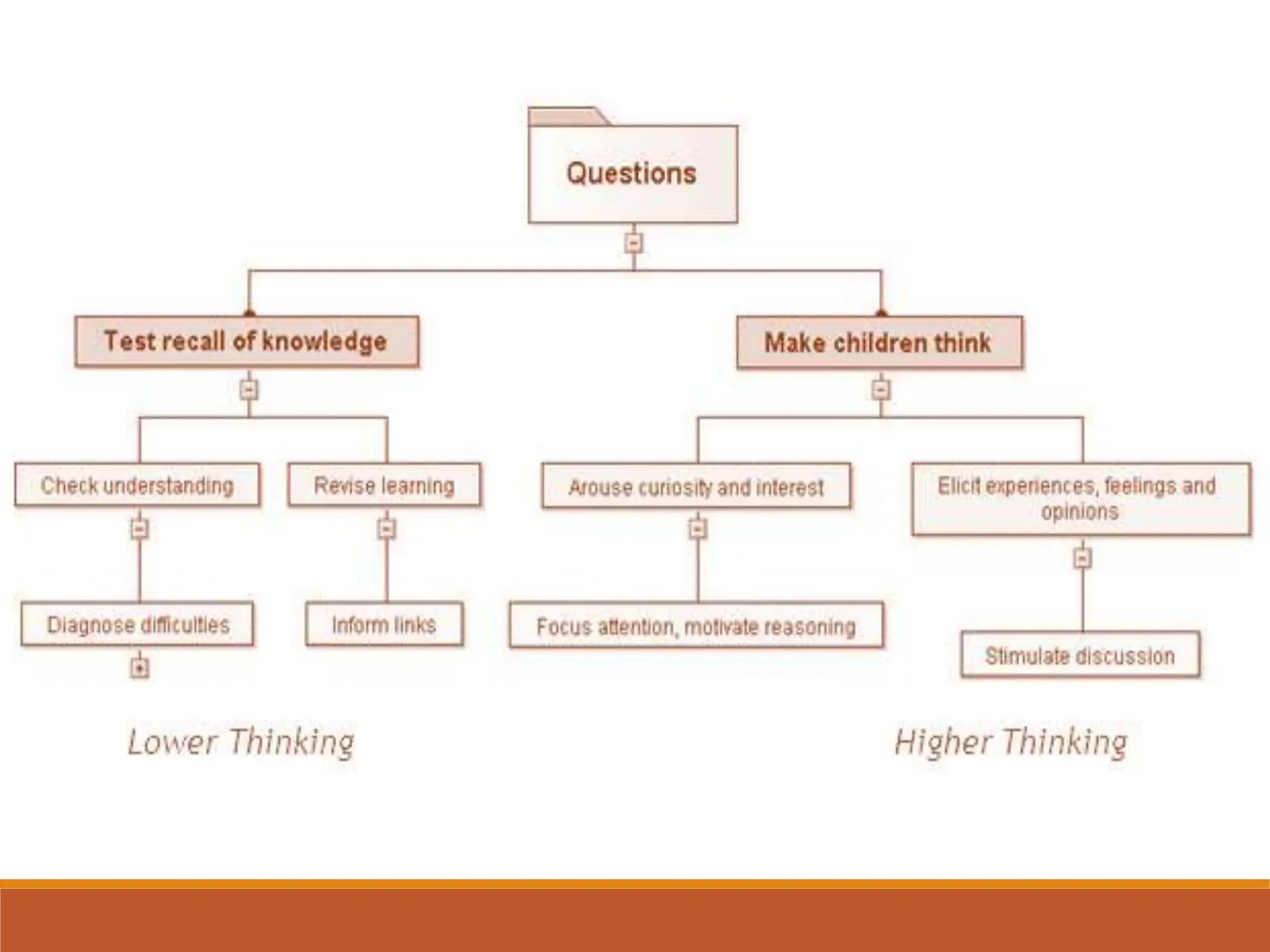
Questions
SAMRUDDHI CHEPE
Questioning to promote higher-
order Thinking
To open new ideas and creative mental habits
An open-ended- Which encourage divergent thinking
Nurturing educational environment strengthens the brain
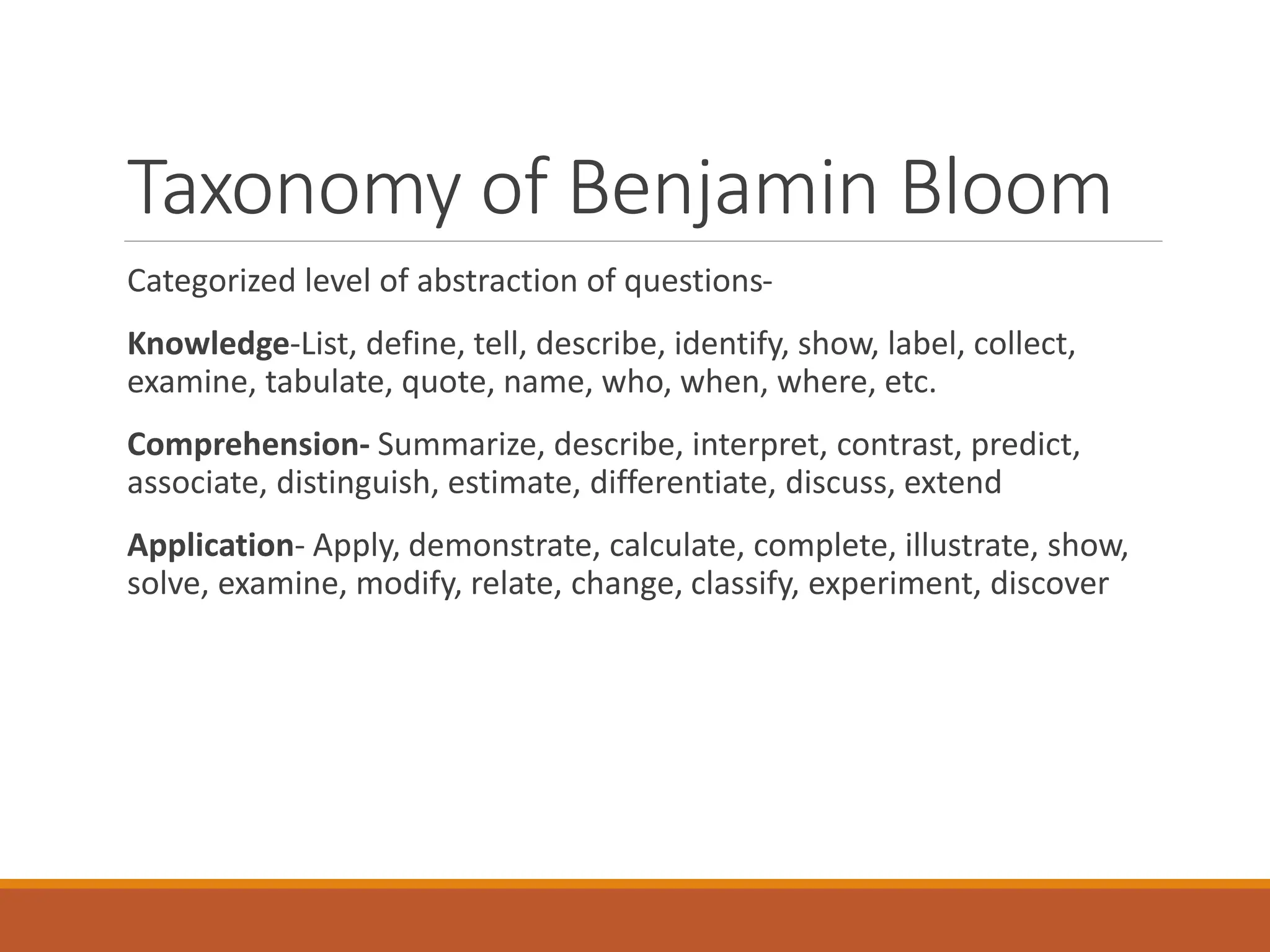
Taxonomy of Benjamin Bloom
Categorized level of abstraction of questions-
Knowledge-List, define, tell, describe, identify, show, label, collect,
examine, tabulate, quote, name, who, when, where, etc.
Comprehension- Summarize, describe, interpret, contrast, predict,
associate, distinguish, estimate, differentiate, discuss, extend
Application- Apply, demonstrate, calculate, complete, illustrate, show,
solve, examine, modify, relate, change, classify, experiment, discover
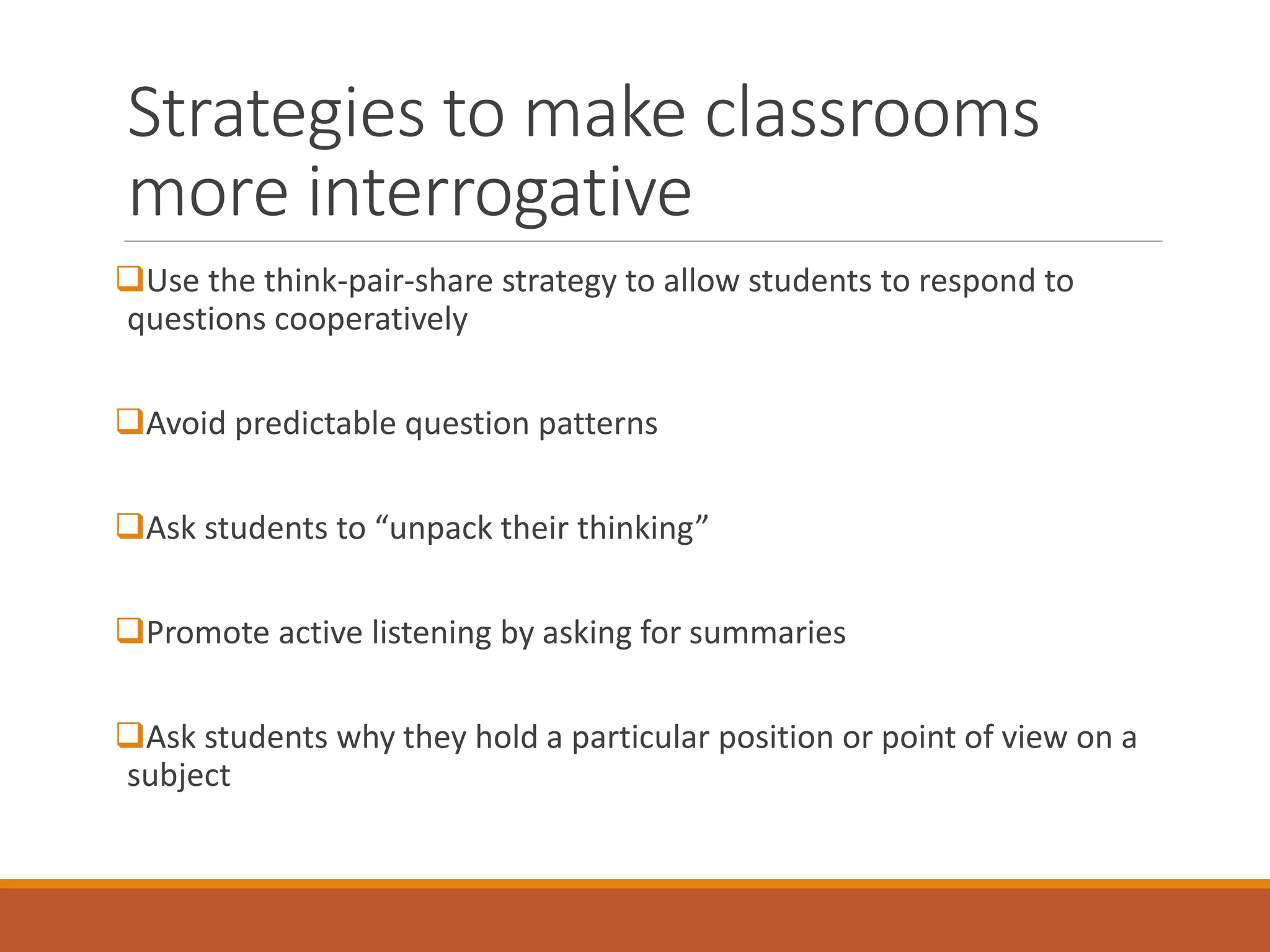
Strategies to make classrooms
more interrogative
Use the think-pair-share strategy to allow students to respond to
questions cooperatively
Avoid predictable question patterns
Ask students to “unpack their thinking”
Promote active listening by asking for summaries
Ask students why they hold a particular position or point of view on a
subject
Survey the class
Encourage student-constructed questions
Use hypothetical thinking
Employ reversals
Apply different symbol
Use analogies
Analyze points of view
Questioning skill
Structure-
a) Grammatically correct
b) Relevant
c) Specific
d) Concise
Process-
a) Speed of asking questions
b) Voice
c) Unnecessary repetition of questions as well as students’ answers
d) Distribution
Product-
a) Interest created, attentiveness
b) Rapport built
c) Previous knowledge of pupils
d) Maturity level of pupils
e) Difficulty level of questions
Avoid
1. Questions requiring yes or no answers
2. Leading, suggestive questions
3. Double barreled questions
4. Elliptical questions
5. General/ambiguous questions
6. Terms beyond the understanding of
students
7. Rhetorical questions
8. Unnecessary repetition of questions
9. Unnecessary repetition of answers
given by students
10. Answering your own
11. Showing anger, impatience, ridicule for
wrong, inadequate or slow answer
12. Asking only the recall/memory based
questions
Responses
No response
Wrong response
Partially correct response
Incomplete response
Correct (criterion) response
The components of skill of probing
questions
1. Prompting- No response, a partially correct response or wrong
response
2. Seeking further information- When response obtained from the
student is incomplete
3. Refocusing- Correct response, to view students responses in relation
to other similar situations
4. Increasing Critical Awareness-To increase student ability to look at
situations deeply, critically
5. Criterion Response- To clear ideas and to get correct response
Guidelines……
1. Questions were grammatically correct
2. Questions were relevant to the top
3. Questions were specific
4. Questions were concise
5. Questions were put with paper pause
6. Questions were followed by proper pause
7. Questions were put with proper voice
probing questions.pptx

probing questions.pptx

  • 2.
  • 3.
    Questioning to promotehigher- order Thinking To open new ideas and creative mental habits An open-ended- Which encourage divergent thinking Nurturing educational environment strengthens the brain
  • 4.
    Taxonomy of BenjaminBloom Categorized level of abstraction of questions- Knowledge-List, define, tell, describe, identify, show, label, collect, examine, tabulate, quote, name, who, when, where, etc. Comprehension- Summarize, describe, interpret, contrast, predict, associate, distinguish, estimate, differentiate, discuss, extend Application- Apply, demonstrate, calculate, complete, illustrate, show, solve, examine, modify, relate, change, classify, experiment, discover
  • 7.
    Strategies to makeclassrooms more interrogative Use the think-pair-share strategy to allow students to respond to questions cooperatively Avoid predictable question patterns Ask students to “unpack their thinking” Promote active listening by asking for summaries Ask students why they hold a particular position or point of view on a subject
  • 8.
    Survey the class Encouragestudent-constructed questions Use hypothetical thinking Employ reversals Apply different symbol Use analogies Analyze points of view
  • 9.
    Questioning skill Structure- a) Grammaticallycorrect b) Relevant c) Specific d) Concise Process- a) Speed of asking questions b) Voice c) Unnecessary repetition of questions as well as students’ answers d) Distribution
  • 10.
    Product- a) Interest created,attentiveness b) Rapport built c) Previous knowledge of pupils d) Maturity level of pupils e) Difficulty level of questions
  • 11.
    Avoid 1. Questions requiringyes or no answers 2. Leading, suggestive questions 3. Double barreled questions 4. Elliptical questions 5. General/ambiguous questions 6. Terms beyond the understanding of students 7. Rhetorical questions 8. Unnecessary repetition of questions 9. Unnecessary repetition of answers given by students 10. Answering your own 11. Showing anger, impatience, ridicule for wrong, inadequate or slow answer 12. Asking only the recall/memory based questions
  • 12.
    Responses No response Wrong response Partiallycorrect response Incomplete response Correct (criterion) response
  • 13.
    The components ofskill of probing questions 1. Prompting- No response, a partially correct response or wrong response 2. Seeking further information- When response obtained from the student is incomplete 3. Refocusing- Correct response, to view students responses in relation to other similar situations 4. Increasing Critical Awareness-To increase student ability to look at situations deeply, critically 5. Criterion Response- To clear ideas and to get correct response
  • 14.
    Guidelines…… 1. Questions weregrammatically correct 2. Questions were relevant to the top 3. Questions were specific 4. Questions were concise 5. Questions were put with paper pause 6. Questions were followed by proper pause 7. Questions were put with proper voice