UNIT 3 : ASSESSMENT AND VARIOUS
ASPECTS OF EVALUATION
Syllabus of Unit 3-
• 3.2.1- Evaluation of different aspects of Human being
• 3.2.2 – Models of Evaluation
• 3.2.3 - Evaluation for Mastery Learning
• 3.2.4 - Feedback Techniques
• 3.2.5 – Role of Educator as an Evaluator
3.2.1- Evaluation of different aspects of
Human being
1. Attitude Test
2. Intelligence Test
3. Interest Inventory
4. Aptitude Assessment
5. Creativity Test
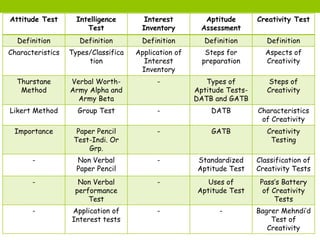
Attitude Test Intelligence
Test
Interest
Inventory
Aptitude
Assessment
Creativity Test
Definition Definition Definition Definition Definition
Characteristics Types/Classifica
tion
Application of
Interest
Inventory
Steps for
preparation
Aspects of
Creativity
Thurstane
Method
Verbal Worth-
Army Alpha and
Army Beta
- Types of
Aptitude Tests-
DATB and GATB
Steps of
Creativity
Likert Method Group Test - DATB Characteristics
of Creativity
Importance Paper Pencil
Test-Indi. Or
Grp.
- GATB Creativity
Testing
- Non Verbal
Paper Pencil
- Standardized
Aptitude Test
Classification of
Creativity Tests
- Non Verbal
performance
Test
- Uses of
Aptitude Test
Pass’s Battery
of Creativity
Tests
- Application of
Interest tests
- - Bagrer Mehndi’d
Test of
Creativity
Attitude Test-
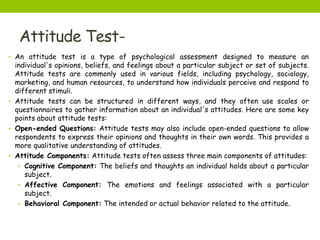
• An attitude test is a type of psychological assessment designed to measure an
individual's opinions, beliefs, and feelings about a particular subject or set of subjects.
Attitude tests are commonly used in various fields, including psychology, sociology,
marketing, and human resources, to understand how individuals perceive and respond to
different stimuli.
• Attitude tests can be structured in different ways, and they often use scales or
questionnaires to gather information about an individual's attitudes. Here are some key
points about attitude tests:
• Open-ended Questions: Attitude tests may also include open-ended questions to allow
respondents to express their opinions and thoughts in their own words. This provides a
more qualitative understanding of attitudes.
• Attitude Components: Attitude tests often assess three main components of attitudes:
• Cognitive Component: The beliefs and thoughts an individual holds about a particular
subject.
• Affective Component: The emotions and feelings associated with a particular
subject.
• Behavioral Component: The intended or actual behavior related to the attitude.
Thurstone Method-
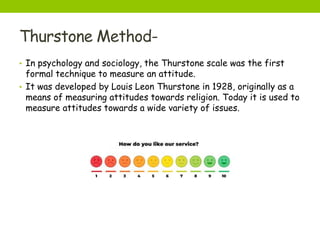
• In psychology and sociology, the Thurstone scale was the first
formal technique to measure an attitude.
• It was developed by Louis Leon Thurstone in 1928, originally as a
means of measuring attitudes towards religion. Today it is used to
measure attitudes towards a wide variety of issues.
Likert Scales-
• Here individuals rate their agreement or disagreement with a series of
statements. For example, respondents might be asked to indicate how strongly
they agree or disagree with statements such as "I enjoy working in a team" or
"I feel confident in my abilities."
• The Likert scale is used to measure the intensity of an individual's agreement
or disagreement with a particular statement or set of statements.
• Named after its creator, psychologist Rensis Likert, this scale is designed to
capture the strength and direction of a person's attitude towards a given
subject.
• Scale Structure:
• Respondents are presented with a series of statements related to the topic
of interest.
• Each statement is accompanied by a scale of response options, typically
ranging from "Strongly Disagree" to "Strongly Agree."
• Overall, the Likert scale is a versatile and widely used tool for assessing
attitudes in various fields, including psychology, sociology, education, and
business. Its simplicity and ease of use make it a popular choice for both
researchers and practitioners.
Importance of Attitude Scale-
Attitude tests are used in various contexts, such as
• Employee assessments
• Market research
• Social studies
• Academic research
• Used for survey
• Identify sample
• To understand the person in a better manner.
• Professional use
Intelligence Test-
• Intelligence tests are assessments designed to measure a person's intellectual abilities in various domains
such as problem-solving, reasoning, memory, and comprehension. These tests are widely used in
psychology, education, and employment settings to gauge cognitive abilities and provide insights into an
individual's intellectual strengths and weaknesses.
• Here are some key points about intelligence tests:
• Purpose:
• Intelligence tests aim to quantify an individual's cognitive abilities and provide a numerical score that reflects their
intellectual capacity.
• Types of Intelligence Tests:
• Stanford-Binet Intelligence Scales: Developed by Alfred Binet and Theodore Simon, this was one of the earliest
intelligence tests. It has undergone several revisions and is still in use today.
• Wechsler Intelligence Scales: The Wechsler Adult Intelligence Scale (WAIS) and Wechsler Intelligence Scale for
Children (WISC) are widely used. They provide separate scores for different cognitive abilities and an overall IQ score.
• Raven's Progressive Matrices: This non-verbal test assesses abstract reasoning and is often used to measure fluid
intelligence.
• Components:
• Intelligence tests typically measure different components of cognitive abilities, including verbal comprehension, working
memory, perceptual reasoning, and processing speed.
• Scoring:
• Scores on intelligence tests are often standardized, with a mean (average) score set at 100. Scores above 100 indicate
above-average intelligence, while scores below 100 indicate below-average intelligence.
• Validity and Reliability:
• Intelligence tests are designed to be reliable and valid. Reliability ensures that the test produces consistent results over
time, while validity ensures that the test measures what it claims to measure.
• IQ (Intelligence Quotient):
• IQ is a numerical representation of an individual's intelligence relative to the average population. An IQ score of 100 is
considered average, and scores are distributed along a bell curve.
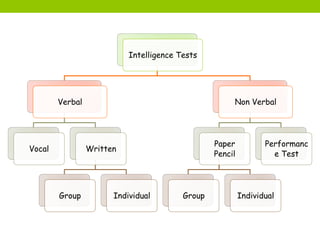
Intelligence Tests
Verbal
Vocal Written
Group Individual
Non Verbal
Paper
Pencil
Group Individual
Performanc
e Test
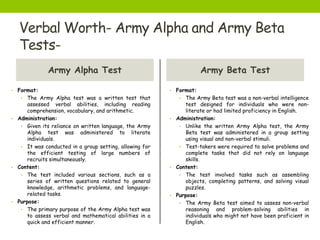
Verbal Worth- Army Alpha and Army Beta
Tests-
Army Alpha Test
• Format:
• The Army Alpha test was a written test that
assessed verbal abilities, including reading
comprehension, vocabulary, and arithmetic.
• Administration:
• Given its reliance on written language, the Army
Alpha test was administered to literate
individuals.
• It was conducted in a group setting, allowing for
the efficient testing of large numbers of
recruits simultaneously.
• Content:
• The test included various sections, such as a
series of written questions related to general
knowledge, arithmetic problems, and language-
related tasks.
• Purpose:
• The primary purpose of the Army Alpha test was
to assess verbal and mathematical abilities in a
quick and efficient manner.
Army Beta Test
• Format:
• The Army Beta test was a non-verbal intelligence
test designed for individuals who were non-
literate or had limited proficiency in English.
• Administration:
• Unlike the written Army Alpha test, the Army
Beta test was administered in a group setting
using visual and non-verbal stimuli.
• Test-takers were required to solve problems and
complete tasks that did not rely on language
skills.
• Content:
• The test involved tasks such as assembling
objects, completing patterns, and solving visual
puzzles.
• Purpose:
• The Army Beta test aimed to assess non-verbal
reasoning and problem-solving abilities in
individuals who might not have been proficient in
English.
The Application of Army Alpha and Army Beta
Tests-
• The Army Alpha and Army Beta tests were intelligence tests developed
by the United States Army during World War I to assess the intellectual
abilities of large groups of recruits quickly. These tests were part of a
broader effort to classify and assign soldiers to appropriate roles based
on their cognitive abilities.
• Both tests, Alpha and Beta, were part of a broader intelligence testing
program during World War I.
• The tests helped the military identify the cognitive strengths and
weaknesses of recruits and make informed decisions about their
assignments within the armed forces.
• It's important to note that the use of intelligence tests has evolved over
time, and there are now more sophisticated and culturally fair
assessments in place.
• Verbal Intelligence Tests:
• Vocal Tests:
• Definition: Tests that involve spoken language or oral communication.
• Example: Oral interviews, where an individual's ability to express thoughts and ideas
verbally is assessed.
• Written Tests:
• Definition: Tests that involve written language and may include reading comprehension,
writing, and other written tasks.
• Examples: Standardized written exams, essay tests, and assessments of reading and
writing skills.
• Group Written Tests:
• Administered to a group of individuals simultaneously, often in a classroom setting.
• Individual Written Tests:
• Administered to one person at a time, allowing for more personalized assessment.
• Non-Verbal Intelligence Tests:
• Paper-Pencil Tests:
• Definition: Tests where individuals respond to questions or tasks on paper, using pencils or
pens.
• Group Paper-Pencil Tests:
• Administered to a group of individuals simultaneously.
• Individual Paper-Pencil Tests:
• Administered to one person at a time.
• Performance Tests:
• Definition: Tests that assess an individual's ability to perform specific tasks or solve
problems.
• Example: Raven's Progressive Matrices, which assesses abstract reasoning and is a
common non-verbal performance test.
Uses-
• educational admission
• clinical assessments
• neuropsychological evaluations, and
• employment screenings.
• Educational Classification
• Measure student progress
• Student Graph
• Useful for Student Guidance
• Career Guidance
• Educational Guidance
• Intelligence testing aims to provide a comprehensive
understanding of cognitive abilities, considering various aspects
of mental functioning.
Limitations-
• They provide a snapshot of cognitive abilities at a
particular point in time and may not capture the full
range of a person's talents or potential.
• careful design,
• consideration of cultural factors,
• consideration of socio-economic factors
• proper administration.
Interest Inventory-
• An interest inventory is a tool used in career counseling and educational
settings to assess an individual's preferences, likes, An interest inventory is a
self-assessment tool designed to help individuals identify and understand
their preferences, likes, and dislikes in various areas of life. These inventories
are commonly used in educational and career counseling to guide individuals in
making informed decisions about academic pursuits, career choices, and
personal development. Here are some key features and considerations related
to interest inventories:
• Purpose:
• Interest inventories aim to uncover an individual's preferences, passions,
and inclinations in specific domains, such as careers, hobbies, and academic
subjects.
• Types:
• Career Interest Inventories
• Academic Interest Inventories
Structure, Uses and Limitations-
• Structure:
• Interest inventories typically consist of a series of questions,
statements, or activities that assess preferences in different areas.
• Respondents express their level of interest or preference for each
item, often using a Likert scale or other response format.
• Application:
• Career Counseling: Assists individuals in exploring and choosing careers
that align with their interests and values.
• Academic Guidance: Helps students identify suitable academic majors
or courses based on their interests.
• Self-Discovery: Supports individuals in understanding themselves
better and making decisions aligned with their preferences.
• When using an interest inventory, it's important to consider the context,
interpret the results thoughtfully, and use them as a starting point for
further exploration and decision-making.
Aptitude Assessment-
• An aptitude assessment is a type of test designed to measure an individual's potential to develop
skills and abilities in specific areas. Unlike achievement tests, which assess what a person has learned
or accomplished, aptitude tests focus on assessing a person's capacity to learn or perform certain
tasks. Aptitude assessments are commonly used in educational and employment settings to predict an
individual's ability to succeed in particular domains. Here are some key aspects of aptitude
assessments:
• Purpose:
• Aptitude assessments aim to predict an individual's ability to acquire skills and perform tasks in
areas such as academic subjects, vocational skills, or job-related tasks.
• Application:
• Educational Settings: Aptitude tests may be used in educational contexts to identify students'
strengths and guide academic and career counseling.
• Employment Settings: Employers use aptitude assessments for hiring and placement to predict an
individual's suitability for specific job roles.
• Training and Development: Aptitude assessments can inform training programs by identifying
areas where individuals may excel or need additional support.
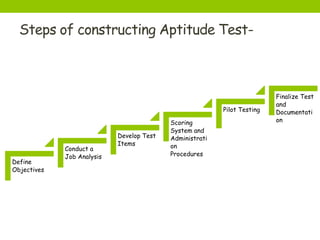
Steps of constructing Aptitude Test-
Define
Objectives
Conduct a
Job Analysis
Develop Test
Items
Scoring
System and
Administrati
on
Procedures
Pilot Testing
Finalize Test
and
Documentati
on
Differential Aptitude Test Battery (DATB)-
• Purpose:
• The DAT series is designed to measure specific aptitudes or abilities in
individuals.
• The test is often used in educational and career counseling to assess a person's
strengths and weaknesses in different areas.
• Structure:
• DAT includes various subtests that measure different aptitudes, such as verbal
reasoning, numerical ability, abstract reasoning, mechanical reasoning, and
spatial relations.
• Administration:
• Typically administered in a standardized manner to ensure consistency across
test-takers.
• Results help individuals and counselors identify areas of interest and potential
career paths.
• Scoring:
• Scores are often presented in percentile ranks, indicating how an individual's
performance compares to a normative group.
General Aptitude Test Battery (GATB)-
• Purpose:
• GATB is a battery of aptitude tests developed by the U.S. Employment Service
in collaboration with the U.S. Department of Labor.
• Primarily used for vocational guidance and personnel selection, especially in the
context of employment and career placement.
• Structure:
• The GATB consists of various tests assessing aptitudes such as general learning
ability, verbal aptitude, numerical aptitude, spatial aptitude, clerical perception,
and motor coordination.
• Administration:
• Originally developed for pencil-and-paper administration, but computerized
versions are also available.
• Used in employment settings to assist with job placement and personnel
selection.
• Scoring:
• Like DAT, GATB scores are often presented in percentiles, providing
information about an individual's aptitude relative to a reference group.
Commonalities and Differences-
• Both DAT and GATB are aptitude tests designed to assess an individual's
capabilities in various areas.
• They provide valuable information for career guidance, educational
planning, and job placement.
• The specific aptitudes measured may vary between the two, reflecting
differences in their development and intended use.
• It's important to note that while these tests have been widely used, the
field of assessment has evolved, and there are now many other aptitude
tests and assessments available.
• Additionally, advancements in technology have led to the development of
computerized adaptive testing (CAT) and other innovative approaches to
measuring aptitudes. Always consider the relevance, reliability, and
validity of any aptitude test in the specific context in which it is being
used.
Creativity and its Tests-
• Creativity is a multifaceted concept that involves fluency, flexibility,
originality, and elaboration of thought.
• Creativity is not limited to specific domains or disciplines. It can be
expressed in the arts, sciences, business, technology, education, and
everyday problem-solving.
• Moreover, creativity is a dynamic process that involves different stages,
including preparation, incubation, illumination (insight), evaluation, and
elaboration.
• Creativity is valued for its contributions to innovation, progress, and
human expression.
• It plays a crucial role in various aspects of life, from fostering individual
growth to driving societal advancements.
• Cultivating creativity involves creating an environment that encourages
exploration, embraces diversity of thought, and supports the
development of original and meaningful ideas.
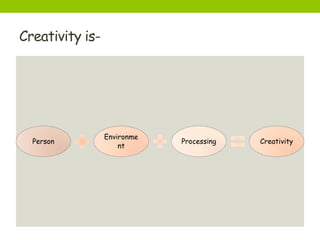
Creativity is-
Person
Environme
nt
Processing Creativity
Steps of Creativity-
1. Preparation:
1. Definition: This stage involves gathering information, acquiring knowledge, and immersing
oneself in the subject matter.
2. Activities: Research, exploration, learning, and seeking inspiration.
3. Importance: Adequate preparation provides a foundation for creative thinking by expanding
one's knowledge base.
2. Incubation:
1. Definition: After the preparation phase, individuals allow the information to simmer in their
minds without actively focusing on the problem.
2. Activities: Taking a break, engaging in unrelated activities, or letting the mind wander.
3. Importance: Incubation allows for subconscious processing and the formation of new
connections.
3. Illumination (or Insight):
1. Definition: The "aha" moment when a novel idea or solution emerges.
2. Activities: Sudden realizations, unexpected connections, and flashes of inspiration.
3. Importance: Illumination is the moment of breakthrough, where the solution becomes apparent.
4. Verification:
1. Definition: Confirming the validity and effectiveness of the creative solution through testing or
experimentation.
2. Activities: Prototyping, testing, seeking feedback, and making necessary adjustments.
3. Importance: Verification ensures that the creative solution meets the intended objectives and
is functional in the intended context.
Aspects of Creativity-
Creativity is a complex and multifaceted construct that involves various cognitive,
emotional, and environmental factors. Different scholars and researchers highlight
different aspects of creativity, but several key dimensions are commonly discussed.
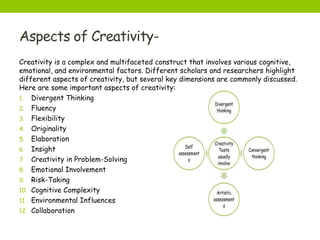
Here are some important aspects of creativity:
1. Divergent Thinking
2. Fluency
3. Flexibility
4. Originality
5. Elaboration
6. Insight
7. Creativity in Problem-Solving
8. Emotional Involvement
9. Risk-Taking
10. Cognitive Complexity
11. Environmental Influences
12. Collaboration
Passi’s Battery of Creativity Test-
A standardized Indian test called the Passi Test of Creativity is used
to gauge creativity. B.K. Passi created it and had it standardized in
1972. The test's objective is to gauge a person's creativity. The test
is intended for school students to gauge their comprehension of issues
pertaining to the operation of straightforward and practical objects.
Both Hindi and English versions are offered.
This test consists of six subjects:
1. The Seeing Problem Test
2. The Uncommon Problem Test
3. The Consequence Test
4. Test of Inquisitiveness
5. Square Puzzle Test
6. Block Test
Bager Mehndi’s Test of Creativity-
Bager Mehdi- The verbal test includes four subsets namely-
1. consequences test
2. unusual uses test
3. similarity test and
4. product improvement.
Each of these four sub- tests cover the three dimensions of
creative thinking ability: fluency, flexibility and originality.
Uses and Limitations-
• Application:
• Creativity tests are used in education to identify and nurture creative potential
in students.
• In organizational settings, they may be used for employee selection, team
building, and innovation initiatives.
• Researchers use creativity tests to study the cognitive processes involved in
creative thinking.
• Challenges and Subjectivity:
• Assessing creativity can be challenging due to its subjective nature.
• Some argue that creativity tests may not capture the full complexity of
creative thinking and that a combination of methods is needed for a
comprehensive assessment.
• Ethical Considerations:
• Ethical considerations are important, especially when creativity tests are used
in employment contexts.
• It's essential to ensure fairness, avoid biases, and use creativity assessments
as part of a broader evaluation process.
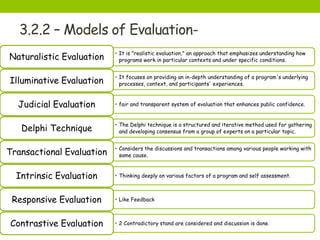
3.2.2 – Models of Evaluation-
• It is "realistic evaluation," an approach that emphasizes understanding how
programs work in particular contexts and under specific conditions.
Naturalistic Evaluation
• It focuses on providing an in-depth understanding of a program's underlying
processes, context, and participants' experiences.
Illuminative Evaluation
• fair and transparent system of evaluation that enhances public confidence.
Judicial Evaluation
• The Delphi technique is a structured and iterative method used for gathering
and developing consensus from a group of experts on a particular topic.
Delphi Technique
• Considers the discussions and transactions among various people working with
same cause.
Transactional Evaluation
• Thinking deeply on various factors of a program and self assessment.
Intrinsic Evaluation
• Like Feedback
Responsive Evaluation
• 2 Contradictory stand are considered and discussion is done.
Contrastive Evaluation
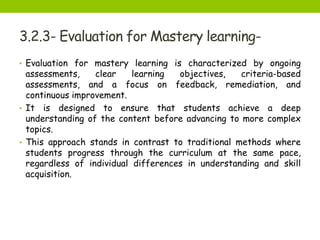
3.2.3- Evaluation for Mastery learning-
• Evaluation for mastery learning is characterized by ongoing
assessments, clear learning objectives, criteria-based
assessments, and a focus on feedback, remediation, and
continuous improvement.
• It is designed to ensure that students achieve a deep
understanding of the content before advancing to more complex
topics.
• This approach stands in contrast to traditional methods where
students progress through the curriculum at the same pace,
regardless of individual differences in understanding and skill
acquisition.
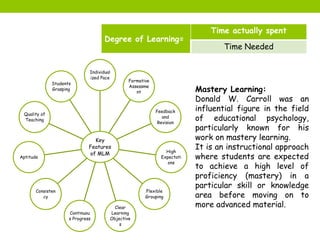
Key
Features
of MLM
Individual
ized Pace
Formative
Assessme
nt
Feedback
and
Revision
High
Expectati
ons
Flexible
Grouping
Clear
Learning
Objective
s
Continuou
s Progress
Consisten
cy
Aptitude
Quality of
Teaching
Students
Grasping
Degree of Learning=
Time actually spent
Time Needed
Mastery Learning:
Donald W. Carroll was an
influential figure in the field
of educational psychology,
particularly known for his
work on mastery learning.
It is an instructional approach
where students are expected
to achieve a high level of
proficiency (mastery) in a
particular skill or knowledge
area before moving on to
more advanced material.
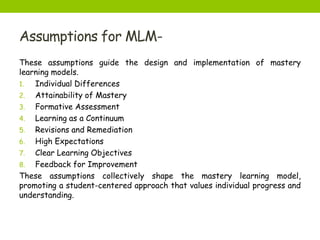
Assumptions for MLM-
These assumptions guide the design and implementation of mastery
learning models.
1. Individual Differences
2. Attainability of Mastery
3. Formative Assessment
4. Learning as a Continuum
5. Revisions and Remediation
6. High Expectations
7. Clear Learning Objectives
8. Feedback for Improvement
These assumptions collectively shape the mastery learning model,
promoting a student-centered approach that values individual progress and
understanding.
Various Techniques for Evaluation-
• 1. Formative Assessment.
• 2. Clear Learning Objectives
• 3. Criteria-Based Assessment
• 4. Varied Assessment Methods
• 5. Feedback and Remediation
• 6. Self-Paced Learning
• 7. Reassessment Opportunities
• 8. Data-Informed Instruction
• 9. Summative Assessment
• 10. Technology Integration
• 11. Reflection and Goal Setting
• 12. Record of Achievement
• 13. Continuous Improvement
Advantages and Limitations of MLM-
• Mastery learning offers a student-centered and adaptive
approach that aims to maximize individual learning outcomes. By
focusing on understanding and mastery rather than time-based
progression, it addresses the diverse needs of learners and
promotes a more effective and equitable education system.
• It's important to note that the success of mastery learning depends on
effective implementation and ongoing support. Addressing these
limitations may involve professional development for educators, providing
adequate resources, and carefully considering the unique needs of the
student population and educational context.
3.2.4- Feedback Techniques-
• Feedback is information provided to an individual or a group
regarding their performance, behavior, or efforts, with the aim
of facilitating learning, improvement, or development.
• Feedback can take various forms and can be delivered in
different contexts, such as education, the workplace, or personal
development.
• Whether in educational, professional, or personal settings,
feedback plays a crucial role in guiding individuals toward success.
• Plenty of Research done in the field of Feedback in Education wrt
Teacher, Student, Educational Institution, Pedagogy, Evaluation,
etc.
key elements and characteristics of
feedback:
1. Specificity
2. Constructive Nature
3. Relevance
4. Balanced
5. Goal-Oriented
6. Two-Way Communication
7. Adaptability
8. Encouragement
9. Continuous Process
10. Respectful
11. Focused on Behavior
12. Timelines
Benefits of Feedback-
1. Continuous feedback increases the efficiency of the
employee and the effectiveness of the job well done.
2. Continuous feedback gets the employee on the right
track, before he completes his task.
3. Continuous feedback boosts the employees to give their
best.
4. It also holds up the employees’ morale, by which they
remain loyal to their work and to their organization.
5. Continuous feedback minimizes the time taken to
complete a given task/project.
6. It gives well trained and groomed employees to the
organization.
7. Enhances the productivity of the organization.
8. Helps maintain a friendly atmosphere and culture in the
organization.
3.2.5- Role of Teacher as an Evaluator-
The role of a teacher as an evaluator is a crucial aspect of the educational
process. Evaluating student performance provides valuable feedback to both
students and educators, contributing to the overall learning experience. Here
are key aspects of the teacher's role as an evaluator:
1. Decides Teaching Strategy as per the student needs
2. Understands the level of dev. Of each student and develops each student
as per the requirement.
3. Keeps students engaged
4. Motivation is given constantly
5. Diagnostic and Remedial Functions
6. School also develops as per the teacher’s efficiency.
7. Halo Effect is to be checked.
8. Effective evaluation can be done only after the Teacher, Friends and self
evaluation are done.
In summary, the teacher's role as an evaluator is multifaceted, involving the
design and implementation of assessments, the delivery of constructive
feedback, and the use of assessment data to inform instruction and promote
student learning and development. A thoughtful and student-centered approach
to evaluation is essential for fostering a positive and effective learning
environment.
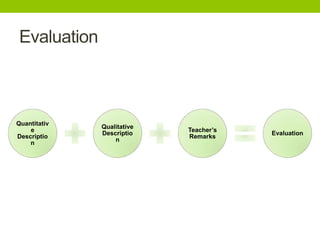
Evaluation
Quantitativ
e
Descriptio
n
Qualitative
Descriptio
n
Teacher’s
Remarks
Evaluation
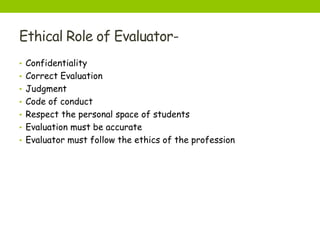
Ethical Role of Evaluator-
• Confidentiality
• Correct Evaluation
• Judgment
• Code of conduct
• Respect the personal space of students
• Evaluation must be accurate
• Evaluator must follow the ethics of the profession
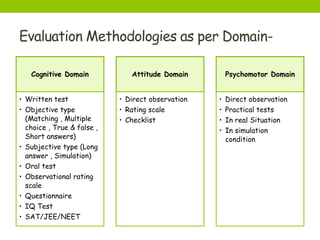
Evaluation Methodologies as per Domain-
Cognitive Domain
• Written test
• Objective type
(Matching , Multiple
choice , True & false ,
Short answers)
• Subjective type (Long
answer , Simulation)
• Oral test
• Observational rating
scale
• Questionnaire
• IQ Test
• SAT/JEE/NEET
Attitude Domain
• Direct observation
• Rating scale
• Checklist
Psychomotor Domain
• Direct observation
• Practical tests
• In real Situation
• In simulation
condition
Questions for Self Study-
1. Explain the need and importance of assessment of various
dimensions of students?
2. Explain in detail various models of evaluation and do a
comparative study of the same.
3. Explain the concept of Mastery Learning in detail.
4. Give the benefits of Feedback Technique.
5. Explain the role of teacher as an evaluator.

Unit 3.pptx

  • 1.
    UNIT 3 :ASSESSMENT AND VARIOUS ASPECTS OF EVALUATION
  • 2.
    Syllabus of Unit3- • 3.2.1- Evaluation of different aspects of Human being • 3.2.2 – Models of Evaluation • 3.2.3 - Evaluation for Mastery Learning • 3.2.4 - Feedback Techniques • 3.2.5 – Role of Educator as an Evaluator
  • 3.
    3.2.1- Evaluation ofdifferent aspects of Human being 1. Attitude Test 2. Intelligence Test 3. Interest Inventory 4. Aptitude Assessment 5. Creativity Test
  • 4.
    Attitude Test Intelligence Test Interest Inventory Aptitude Assessment CreativityTest Definition Definition Definition Definition Definition Characteristics Types/Classifica tion Application of Interest Inventory Steps for preparation Aspects of Creativity Thurstane Method Verbal Worth- Army Alpha and Army Beta - Types of Aptitude Tests- DATB and GATB Steps of Creativity Likert Method Group Test - DATB Characteristics of Creativity Importance Paper Pencil Test-Indi. Or Grp. - GATB Creativity Testing - Non Verbal Paper Pencil - Standardized Aptitude Test Classification of Creativity Tests - Non Verbal performance Test - Uses of Aptitude Test Pass’s Battery of Creativity Tests - Application of Interest tests - - Bagrer Mehndi’d Test of Creativity
  • 5.
    Attitude Test- • Anattitude test is a type of psychological assessment designed to measure an individual's opinions, beliefs, and feelings about a particular subject or set of subjects. Attitude tests are commonly used in various fields, including psychology, sociology, marketing, and human resources, to understand how individuals perceive and respond to different stimuli. • Attitude tests can be structured in different ways, and they often use scales or questionnaires to gather information about an individual's attitudes. Here are some key points about attitude tests: • Open-ended Questions: Attitude tests may also include open-ended questions to allow respondents to express their opinions and thoughts in their own words. This provides a more qualitative understanding of attitudes. • Attitude Components: Attitude tests often assess three main components of attitudes: • Cognitive Component: The beliefs and thoughts an individual holds about a particular subject. • Affective Component: The emotions and feelings associated with a particular subject. • Behavioral Component: The intended or actual behavior related to the attitude.
  • 6.
    Thurstone Method- • Inpsychology and sociology, the Thurstone scale was the first formal technique to measure an attitude. • It was developed by Louis Leon Thurstone in 1928, originally as a means of measuring attitudes towards religion. Today it is used to measure attitudes towards a wide variety of issues.
  • 7.
    Likert Scales- • Hereindividuals rate their agreement or disagreement with a series of statements. For example, respondents might be asked to indicate how strongly they agree or disagree with statements such as "I enjoy working in a team" or "I feel confident in my abilities." • The Likert scale is used to measure the intensity of an individual's agreement or disagreement with a particular statement or set of statements. • Named after its creator, psychologist Rensis Likert, this scale is designed to capture the strength and direction of a person's attitude towards a given subject. • Scale Structure: • Respondents are presented with a series of statements related to the topic of interest. • Each statement is accompanied by a scale of response options, typically ranging from "Strongly Disagree" to "Strongly Agree." • Overall, the Likert scale is a versatile and widely used tool for assessing attitudes in various fields, including psychology, sociology, education, and business. Its simplicity and ease of use make it a popular choice for both researchers and practitioners.
  • 8.
    Importance of AttitudeScale- Attitude tests are used in various contexts, such as • Employee assessments • Market research • Social studies • Academic research • Used for survey • Identify sample • To understand the person in a better manner. • Professional use
  • 9.
    Intelligence Test- • Intelligencetests are assessments designed to measure a person's intellectual abilities in various domains such as problem-solving, reasoning, memory, and comprehension. These tests are widely used in psychology, education, and employment settings to gauge cognitive abilities and provide insights into an individual's intellectual strengths and weaknesses. • Here are some key points about intelligence tests: • Purpose: • Intelligence tests aim to quantify an individual's cognitive abilities and provide a numerical score that reflects their intellectual capacity. • Types of Intelligence Tests: • Stanford-Binet Intelligence Scales: Developed by Alfred Binet and Theodore Simon, this was one of the earliest intelligence tests. It has undergone several revisions and is still in use today. • Wechsler Intelligence Scales: The Wechsler Adult Intelligence Scale (WAIS) and Wechsler Intelligence Scale for Children (WISC) are widely used. They provide separate scores for different cognitive abilities and an overall IQ score. • Raven's Progressive Matrices: This non-verbal test assesses abstract reasoning and is often used to measure fluid intelligence. • Components: • Intelligence tests typically measure different components of cognitive abilities, including verbal comprehension, working memory, perceptual reasoning, and processing speed. • Scoring: • Scores on intelligence tests are often standardized, with a mean (average) score set at 100. Scores above 100 indicate above-average intelligence, while scores below 100 indicate below-average intelligence. • Validity and Reliability: • Intelligence tests are designed to be reliable and valid. Reliability ensures that the test produces consistent results over time, while validity ensures that the test measures what it claims to measure. • IQ (Intelligence Quotient): • IQ is a numerical representation of an individual's intelligence relative to the average population. An IQ score of 100 is considered average, and scores are distributed along a bell curve.
  • 10.
    Intelligence Tests Verbal Vocal Written GroupIndividual Non Verbal Paper Pencil Group Individual Performanc e Test
  • 11.
    Verbal Worth- ArmyAlpha and Army Beta Tests- Army Alpha Test • Format: • The Army Alpha test was a written test that assessed verbal abilities, including reading comprehension, vocabulary, and arithmetic. • Administration: • Given its reliance on written language, the Army Alpha test was administered to literate individuals. • It was conducted in a group setting, allowing for the efficient testing of large numbers of recruits simultaneously. • Content: • The test included various sections, such as a series of written questions related to general knowledge, arithmetic problems, and language- related tasks. • Purpose: • The primary purpose of the Army Alpha test was to assess verbal and mathematical abilities in a quick and efficient manner. Army Beta Test • Format: • The Army Beta test was a non-verbal intelligence test designed for individuals who were non- literate or had limited proficiency in English. • Administration: • Unlike the written Army Alpha test, the Army Beta test was administered in a group setting using visual and non-verbal stimuli. • Test-takers were required to solve problems and complete tasks that did not rely on language skills. • Content: • The test involved tasks such as assembling objects, completing patterns, and solving visual puzzles. • Purpose: • The Army Beta test aimed to assess non-verbal reasoning and problem-solving abilities in individuals who might not have been proficient in English.
  • 12.
    The Application ofArmy Alpha and Army Beta Tests- • The Army Alpha and Army Beta tests were intelligence tests developed by the United States Army during World War I to assess the intellectual abilities of large groups of recruits quickly. These tests were part of a broader effort to classify and assign soldiers to appropriate roles based on their cognitive abilities. • Both tests, Alpha and Beta, were part of a broader intelligence testing program during World War I. • The tests helped the military identify the cognitive strengths and weaknesses of recruits and make informed decisions about their assignments within the armed forces. • It's important to note that the use of intelligence tests has evolved over time, and there are now more sophisticated and culturally fair assessments in place.
  • 13.
    • Verbal IntelligenceTests: • Vocal Tests: • Definition: Tests that involve spoken language or oral communication. • Example: Oral interviews, where an individual's ability to express thoughts and ideas verbally is assessed. • Written Tests: • Definition: Tests that involve written language and may include reading comprehension, writing, and other written tasks. • Examples: Standardized written exams, essay tests, and assessments of reading and writing skills. • Group Written Tests: • Administered to a group of individuals simultaneously, often in a classroom setting. • Individual Written Tests: • Administered to one person at a time, allowing for more personalized assessment. • Non-Verbal Intelligence Tests: • Paper-Pencil Tests: • Definition: Tests where individuals respond to questions or tasks on paper, using pencils or pens. • Group Paper-Pencil Tests: • Administered to a group of individuals simultaneously. • Individual Paper-Pencil Tests: • Administered to one person at a time. • Performance Tests: • Definition: Tests that assess an individual's ability to perform specific tasks or solve problems. • Example: Raven's Progressive Matrices, which assesses abstract reasoning and is a common non-verbal performance test.
  • 14.
    Uses- • educational admission •clinical assessments • neuropsychological evaluations, and • employment screenings. • Educational Classification • Measure student progress • Student Graph • Useful for Student Guidance • Career Guidance • Educational Guidance • Intelligence testing aims to provide a comprehensive understanding of cognitive abilities, considering various aspects of mental functioning.
  • 15.
    Limitations- • They providea snapshot of cognitive abilities at a particular point in time and may not capture the full range of a person's talents or potential. • careful design, • consideration of cultural factors, • consideration of socio-economic factors • proper administration.
  • 16.
    Interest Inventory- • Aninterest inventory is a tool used in career counseling and educational settings to assess an individual's preferences, likes, An interest inventory is a self-assessment tool designed to help individuals identify and understand their preferences, likes, and dislikes in various areas of life. These inventories are commonly used in educational and career counseling to guide individuals in making informed decisions about academic pursuits, career choices, and personal development. Here are some key features and considerations related to interest inventories: • Purpose: • Interest inventories aim to uncover an individual's preferences, passions, and inclinations in specific domains, such as careers, hobbies, and academic subjects. • Types: • Career Interest Inventories • Academic Interest Inventories
  • 17.
    Structure, Uses andLimitations- • Structure: • Interest inventories typically consist of a series of questions, statements, or activities that assess preferences in different areas. • Respondents express their level of interest or preference for each item, often using a Likert scale or other response format. • Application: • Career Counseling: Assists individuals in exploring and choosing careers that align with their interests and values. • Academic Guidance: Helps students identify suitable academic majors or courses based on their interests. • Self-Discovery: Supports individuals in understanding themselves better and making decisions aligned with their preferences. • When using an interest inventory, it's important to consider the context, interpret the results thoughtfully, and use them as a starting point for further exploration and decision-making.
  • 18.
    Aptitude Assessment- • Anaptitude assessment is a type of test designed to measure an individual's potential to develop skills and abilities in specific areas. Unlike achievement tests, which assess what a person has learned or accomplished, aptitude tests focus on assessing a person's capacity to learn or perform certain tasks. Aptitude assessments are commonly used in educational and employment settings to predict an individual's ability to succeed in particular domains. Here are some key aspects of aptitude assessments: • Purpose: • Aptitude assessments aim to predict an individual's ability to acquire skills and perform tasks in areas such as academic subjects, vocational skills, or job-related tasks. • Application: • Educational Settings: Aptitude tests may be used in educational contexts to identify students' strengths and guide academic and career counseling. • Employment Settings: Employers use aptitude assessments for hiring and placement to predict an individual's suitability for specific job roles. • Training and Development: Aptitude assessments can inform training programs by identifying areas where individuals may excel or need additional support.
  • 19.
    Steps of constructingAptitude Test- Define Objectives Conduct a Job Analysis Develop Test Items Scoring System and Administrati on Procedures Pilot Testing Finalize Test and Documentati on
  • 20.
    Differential Aptitude TestBattery (DATB)- • Purpose: • The DAT series is designed to measure specific aptitudes or abilities in individuals. • The test is often used in educational and career counseling to assess a person's strengths and weaknesses in different areas. • Structure: • DAT includes various subtests that measure different aptitudes, such as verbal reasoning, numerical ability, abstract reasoning, mechanical reasoning, and spatial relations. • Administration: • Typically administered in a standardized manner to ensure consistency across test-takers. • Results help individuals and counselors identify areas of interest and potential career paths. • Scoring: • Scores are often presented in percentile ranks, indicating how an individual's performance compares to a normative group.
  • 21.
    General Aptitude TestBattery (GATB)- • Purpose: • GATB is a battery of aptitude tests developed by the U.S. Employment Service in collaboration with the U.S. Department of Labor. • Primarily used for vocational guidance and personnel selection, especially in the context of employment and career placement. • Structure: • The GATB consists of various tests assessing aptitudes such as general learning ability, verbal aptitude, numerical aptitude, spatial aptitude, clerical perception, and motor coordination. • Administration: • Originally developed for pencil-and-paper administration, but computerized versions are also available. • Used in employment settings to assist with job placement and personnel selection. • Scoring: • Like DAT, GATB scores are often presented in percentiles, providing information about an individual's aptitude relative to a reference group.
  • 22.
    Commonalities and Differences- •Both DAT and GATB are aptitude tests designed to assess an individual's capabilities in various areas. • They provide valuable information for career guidance, educational planning, and job placement. • The specific aptitudes measured may vary between the two, reflecting differences in their development and intended use. • It's important to note that while these tests have been widely used, the field of assessment has evolved, and there are now many other aptitude tests and assessments available. • Additionally, advancements in technology have led to the development of computerized adaptive testing (CAT) and other innovative approaches to measuring aptitudes. Always consider the relevance, reliability, and validity of any aptitude test in the specific context in which it is being used.
  • 23.
    Creativity and itsTests- • Creativity is a multifaceted concept that involves fluency, flexibility, originality, and elaboration of thought. • Creativity is not limited to specific domains or disciplines. It can be expressed in the arts, sciences, business, technology, education, and everyday problem-solving. • Moreover, creativity is a dynamic process that involves different stages, including preparation, incubation, illumination (insight), evaluation, and elaboration. • Creativity is valued for its contributions to innovation, progress, and human expression. • It plays a crucial role in various aspects of life, from fostering individual growth to driving societal advancements. • Cultivating creativity involves creating an environment that encourages exploration, embraces diversity of thought, and supports the development of original and meaningful ideas.
  • 24.
  • 25.
    Steps of Creativity- 1.Preparation: 1. Definition: This stage involves gathering information, acquiring knowledge, and immersing oneself in the subject matter. 2. Activities: Research, exploration, learning, and seeking inspiration. 3. Importance: Adequate preparation provides a foundation for creative thinking by expanding one's knowledge base. 2. Incubation: 1. Definition: After the preparation phase, individuals allow the information to simmer in their minds without actively focusing on the problem. 2. Activities: Taking a break, engaging in unrelated activities, or letting the mind wander. 3. Importance: Incubation allows for subconscious processing and the formation of new connections. 3. Illumination (or Insight): 1. Definition: The "aha" moment when a novel idea or solution emerges. 2. Activities: Sudden realizations, unexpected connections, and flashes of inspiration. 3. Importance: Illumination is the moment of breakthrough, where the solution becomes apparent. 4. Verification: 1. Definition: Confirming the validity and effectiveness of the creative solution through testing or experimentation. 2. Activities: Prototyping, testing, seeking feedback, and making necessary adjustments. 3. Importance: Verification ensures that the creative solution meets the intended objectives and is functional in the intended context.
  • 26.
    Aspects of Creativity- Creativityis a complex and multifaceted construct that involves various cognitive, emotional, and environmental factors. Different scholars and researchers highlight different aspects of creativity, but several key dimensions are commonly discussed. Here are some important aspects of creativity: 1. Divergent Thinking 2. Fluency 3. Flexibility 4. Originality 5. Elaboration 6. Insight 7. Creativity in Problem-Solving 8. Emotional Involvement 9. Risk-Taking 10. Cognitive Complexity 11. Environmental Influences 12. Collaboration
  • 27.
    Passi’s Battery ofCreativity Test- A standardized Indian test called the Passi Test of Creativity is used to gauge creativity. B.K. Passi created it and had it standardized in 1972. The test's objective is to gauge a person's creativity. The test is intended for school students to gauge their comprehension of issues pertaining to the operation of straightforward and practical objects. Both Hindi and English versions are offered. This test consists of six subjects: 1. The Seeing Problem Test 2. The Uncommon Problem Test 3. The Consequence Test 4. Test of Inquisitiveness 5. Square Puzzle Test 6. Block Test
  • 28.
    Bager Mehndi’s Testof Creativity- Bager Mehdi- The verbal test includes four subsets namely- 1. consequences test 2. unusual uses test 3. similarity test and 4. product improvement. Each of these four sub- tests cover the three dimensions of creative thinking ability: fluency, flexibility and originality.
  • 29.
    Uses and Limitations- •Application: • Creativity tests are used in education to identify and nurture creative potential in students. • In organizational settings, they may be used for employee selection, team building, and innovation initiatives. • Researchers use creativity tests to study the cognitive processes involved in creative thinking. • Challenges and Subjectivity: • Assessing creativity can be challenging due to its subjective nature. • Some argue that creativity tests may not capture the full complexity of creative thinking and that a combination of methods is needed for a comprehensive assessment. • Ethical Considerations: • Ethical considerations are important, especially when creativity tests are used in employment contexts. • It's essential to ensure fairness, avoid biases, and use creativity assessments as part of a broader evaluation process.
  • 30.
    3.2.2 – Modelsof Evaluation- • It is "realistic evaluation," an approach that emphasizes understanding how programs work in particular contexts and under specific conditions. Naturalistic Evaluation • It focuses on providing an in-depth understanding of a program's underlying processes, context, and participants' experiences. Illuminative Evaluation • fair and transparent system of evaluation that enhances public confidence. Judicial Evaluation • The Delphi technique is a structured and iterative method used for gathering and developing consensus from a group of experts on a particular topic. Delphi Technique • Considers the discussions and transactions among various people working with same cause. Transactional Evaluation • Thinking deeply on various factors of a program and self assessment. Intrinsic Evaluation • Like Feedback Responsive Evaluation • 2 Contradictory stand are considered and discussion is done. Contrastive Evaluation
  • 31.
    3.2.3- Evaluation forMastery learning- • Evaluation for mastery learning is characterized by ongoing assessments, clear learning objectives, criteria-based assessments, and a focus on feedback, remediation, and continuous improvement. • It is designed to ensure that students achieve a deep understanding of the content before advancing to more complex topics. • This approach stands in contrast to traditional methods where students progress through the curriculum at the same pace, regardless of individual differences in understanding and skill acquisition.
  • 32.
    Key Features of MLM Individual ized Pace Formative Assessme nt Feedback and Revision High Expectati ons Flexible Grouping Clear Learning Objective s Continuou sProgress Consisten cy Aptitude Quality of Teaching Students Grasping Degree of Learning= Time actually spent Time Needed Mastery Learning: Donald W. Carroll was an influential figure in the field of educational psychology, particularly known for his work on mastery learning. It is an instructional approach where students are expected to achieve a high level of proficiency (mastery) in a particular skill or knowledge area before moving on to more advanced material.
  • 33.
    Assumptions for MLM- Theseassumptions guide the design and implementation of mastery learning models. 1. Individual Differences 2. Attainability of Mastery 3. Formative Assessment 4. Learning as a Continuum 5. Revisions and Remediation 6. High Expectations 7. Clear Learning Objectives 8. Feedback for Improvement These assumptions collectively shape the mastery learning model, promoting a student-centered approach that values individual progress and understanding.
  • 34.
    Various Techniques forEvaluation- • 1. Formative Assessment. • 2. Clear Learning Objectives • 3. Criteria-Based Assessment • 4. Varied Assessment Methods • 5. Feedback and Remediation • 6. Self-Paced Learning • 7. Reassessment Opportunities • 8. Data-Informed Instruction • 9. Summative Assessment • 10. Technology Integration • 11. Reflection and Goal Setting • 12. Record of Achievement • 13. Continuous Improvement
  • 35.
    Advantages and Limitationsof MLM- • Mastery learning offers a student-centered and adaptive approach that aims to maximize individual learning outcomes. By focusing on understanding and mastery rather than time-based progression, it addresses the diverse needs of learners and promotes a more effective and equitable education system. • It's important to note that the success of mastery learning depends on effective implementation and ongoing support. Addressing these limitations may involve professional development for educators, providing adequate resources, and carefully considering the unique needs of the student population and educational context.
  • 36.
    3.2.4- Feedback Techniques- •Feedback is information provided to an individual or a group regarding their performance, behavior, or efforts, with the aim of facilitating learning, improvement, or development. • Feedback can take various forms and can be delivered in different contexts, such as education, the workplace, or personal development. • Whether in educational, professional, or personal settings, feedback plays a crucial role in guiding individuals toward success. • Plenty of Research done in the field of Feedback in Education wrt Teacher, Student, Educational Institution, Pedagogy, Evaluation, etc.
  • 37.
    key elements andcharacteristics of feedback: 1. Specificity 2. Constructive Nature 3. Relevance 4. Balanced 5. Goal-Oriented 6. Two-Way Communication 7. Adaptability 8. Encouragement 9. Continuous Process 10. Respectful 11. Focused on Behavior 12. Timelines
  • 38.
    Benefits of Feedback- 1.Continuous feedback increases the efficiency of the employee and the effectiveness of the job well done. 2. Continuous feedback gets the employee on the right track, before he completes his task. 3. Continuous feedback boosts the employees to give their best. 4. It also holds up the employees’ morale, by which they remain loyal to their work and to their organization. 5. Continuous feedback minimizes the time taken to complete a given task/project. 6. It gives well trained and groomed employees to the organization. 7. Enhances the productivity of the organization. 8. Helps maintain a friendly atmosphere and culture in the organization.
  • 39.
    3.2.5- Role ofTeacher as an Evaluator- The role of a teacher as an evaluator is a crucial aspect of the educational process. Evaluating student performance provides valuable feedback to both students and educators, contributing to the overall learning experience. Here are key aspects of the teacher's role as an evaluator: 1. Decides Teaching Strategy as per the student needs 2. Understands the level of dev. Of each student and develops each student as per the requirement. 3. Keeps students engaged 4. Motivation is given constantly 5. Diagnostic and Remedial Functions 6. School also develops as per the teacher’s efficiency. 7. Halo Effect is to be checked. 8. Effective evaluation can be done only after the Teacher, Friends and self evaluation are done. In summary, the teacher's role as an evaluator is multifaceted, involving the design and implementation of assessments, the delivery of constructive feedback, and the use of assessment data to inform instruction and promote student learning and development. A thoughtful and student-centered approach to evaluation is essential for fostering a positive and effective learning environment.
  • 40.
  • 41.
    Ethical Role ofEvaluator- • Confidentiality • Correct Evaluation • Judgment • Code of conduct • Respect the personal space of students • Evaluation must be accurate • Evaluator must follow the ethics of the profession
  • 42.
    Evaluation Methodologies asper Domain- Cognitive Domain • Written test • Objective type (Matching , Multiple choice , True & false , Short answers) • Subjective type (Long answer , Simulation) • Oral test • Observational rating scale • Questionnaire • IQ Test • SAT/JEE/NEET Attitude Domain • Direct observation • Rating scale • Checklist Psychomotor Domain • Direct observation • Practical tests • In real Situation • In simulation condition
  • 43.
    Questions for SelfStudy- 1. Explain the need and importance of assessment of various dimensions of students? 2. Explain in detail various models of evaluation and do a comparative study of the same. 3. Explain the concept of Mastery Learning in detail. 4. Give the benefits of Feedback Technique. 5. Explain the role of teacher as an evaluator.