Skill of Reinforcement
12/30/2023
1
Prof. S.S. Chepe
Need
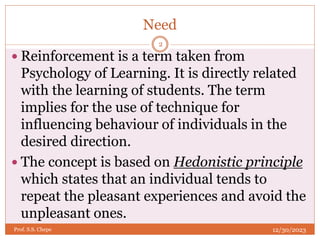
 Reinforcement is a term taken from
Psychology of Learning. It is directly related
with the learning of students. The term
implies for the use of technique for
influencing behaviour of individuals in the
desired direction.
 The concept is based on Hedonistic principle
which states that an individual tends to
repeat the pleasant experiences and avoid the
unpleasant ones.
12/30/2023
2
Prof. S.S. Chepe
Thorndike’s Laws of Learning
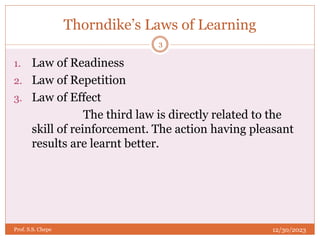
1. Law of Readiness
2. Law of Repetition
3. Law of Effect
The third law is directly related to the
skill of reinforcement. The action having pleasant
results are learnt better.
12/30/2023
3
Prof. S.S. Chepe
Importance
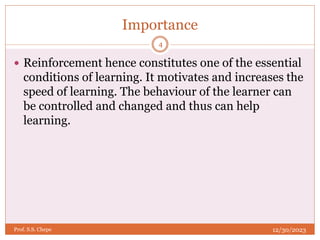
 Reinforcement hence constitutes one of the essential
conditions of learning. It motivates and increases the
speed of learning. The behaviour of the learner can
be controlled and changed and thus can help
learning.
12/30/2023
4
Prof. S.S. Chepe
Related Study ….
 Pavlov
 Skinner
12/30/2023
5
Prof. S.S. Chepe
Pavlov’s Classical conditioning
12/30/2023
Prof. S.S. Chepe
6
Skinner’s Operant conditioning
12/30/2023
Prof. S.S. Chepe
7
Objectives
1. To arrest the attention of the pupils and increase
pupil’s verbal /nonverbal participation during
teaching-learning process.
2. To use reinforcers selectively.
3. To motivate the pupils.
4. To control the destructive behaviour of pupils.
5. To provide feedback about the appropriateness of
the feedback of the pupil.
12/30/2023
8
Prof. S.S. Chepe
Reinforcers
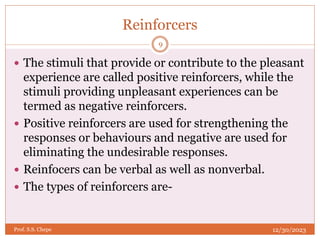
 The stimuli that provide or contribute to the pleasant
experience are called positive reinforcers, while the
stimuli providing unpleasant experiences can be
termed as negative reinforcers.
 Positive reinforcers are used for strengthening the
responses or behaviours and negative are used for
eliminating the undesirable responses.
 Reinfocers can be verbal as well as nonverbal.
 The types of reinforcers are-
12/30/2023
9
Prof. S.S. Chepe
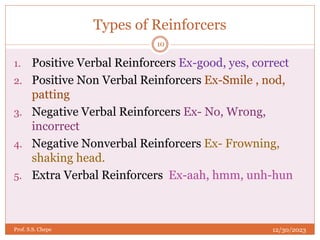
Types of Reinforcers
1. Positive Verbal Reinforcers Ex-good, yes, correct
2. Positive Non Verbal Reinforcers Ex-Smile , nod,
patting
3. Negative Verbal Reinforcers Ex- No, Wrong,
incorrect
4. Negative Nonverbal Reinforcers Ex- Frowning,
shaking head.
5. Extra Verbal Reinforcers Ex-aah, hmm, unh-hun
12/30/2023
10
Prof. S.S. Chepe
Desirable Components
1. Acceptance
2. Supportive Denial
3. Praise
4. Acceptance with Personal Reference
5. Positive Non- Verbal Cues
12/30/2023
11
Prof. S.S. Chepe
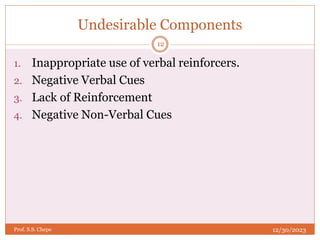
Undesirable Components
1. Inappropriate use of verbal reinforcers.
2. Negative Verbal Cues
3. Lack of Reinforcement
4. Negative Non-Verbal Cues
12/30/2023
12
Prof. S.S. Chepe
Thank You 
12/30/2023
13
Prof. S.S. Chepe

Reinforcement.pptx

  • 1.
  • 2.
    Need  Reinforcement isa term taken from Psychology of Learning. It is directly related with the learning of students. The term implies for the use of technique for influencing behaviour of individuals in the desired direction.  The concept is based on Hedonistic principle which states that an individual tends to repeat the pleasant experiences and avoid the unpleasant ones. 12/30/2023 2 Prof. S.S. Chepe
  • 3.
    Thorndike’s Laws ofLearning 1. Law of Readiness 2. Law of Repetition 3. Law of Effect The third law is directly related to the skill of reinforcement. The action having pleasant results are learnt better. 12/30/2023 3 Prof. S.S. Chepe
  • 4.
    Importance  Reinforcement henceconstitutes one of the essential conditions of learning. It motivates and increases the speed of learning. The behaviour of the learner can be controlled and changed and thus can help learning. 12/30/2023 4 Prof. S.S. Chepe
  • 5.
    Related Study …. Pavlov  Skinner 12/30/2023 5 Prof. S.S. Chepe
  • 6.
  • 7.
  • 8.
    Objectives 1. To arrestthe attention of the pupils and increase pupil’s verbal /nonverbal participation during teaching-learning process. 2. To use reinforcers selectively. 3. To motivate the pupils. 4. To control the destructive behaviour of pupils. 5. To provide feedback about the appropriateness of the feedback of the pupil. 12/30/2023 8 Prof. S.S. Chepe
  • 9.
    Reinforcers  The stimulithat provide or contribute to the pleasant experience are called positive reinforcers, while the stimuli providing unpleasant experiences can be termed as negative reinforcers.  Positive reinforcers are used for strengthening the responses or behaviours and negative are used for eliminating the undesirable responses.  Reinfocers can be verbal as well as nonverbal.  The types of reinforcers are- 12/30/2023 9 Prof. S.S. Chepe
  • 10.
    Types of Reinforcers 1.Positive Verbal Reinforcers Ex-good, yes, correct 2. Positive Non Verbal Reinforcers Ex-Smile , nod, patting 3. Negative Verbal Reinforcers Ex- No, Wrong, incorrect 4. Negative Nonverbal Reinforcers Ex- Frowning, shaking head. 5. Extra Verbal Reinforcers Ex-aah, hmm, unh-hun 12/30/2023 10 Prof. S.S. Chepe
  • 11.
    Desirable Components 1. Acceptance 2.Supportive Denial 3. Praise 4. Acceptance with Personal Reference 5. Positive Non- Verbal Cues 12/30/2023 11 Prof. S.S. Chepe
  • 12.
    Undesirable Components 1. Inappropriateuse of verbal reinforcers. 2. Negative Verbal Cues 3. Lack of Reinforcement 4. Negative Non-Verbal Cues 12/30/2023 12 Prof. S.S. Chepe
  • 13.