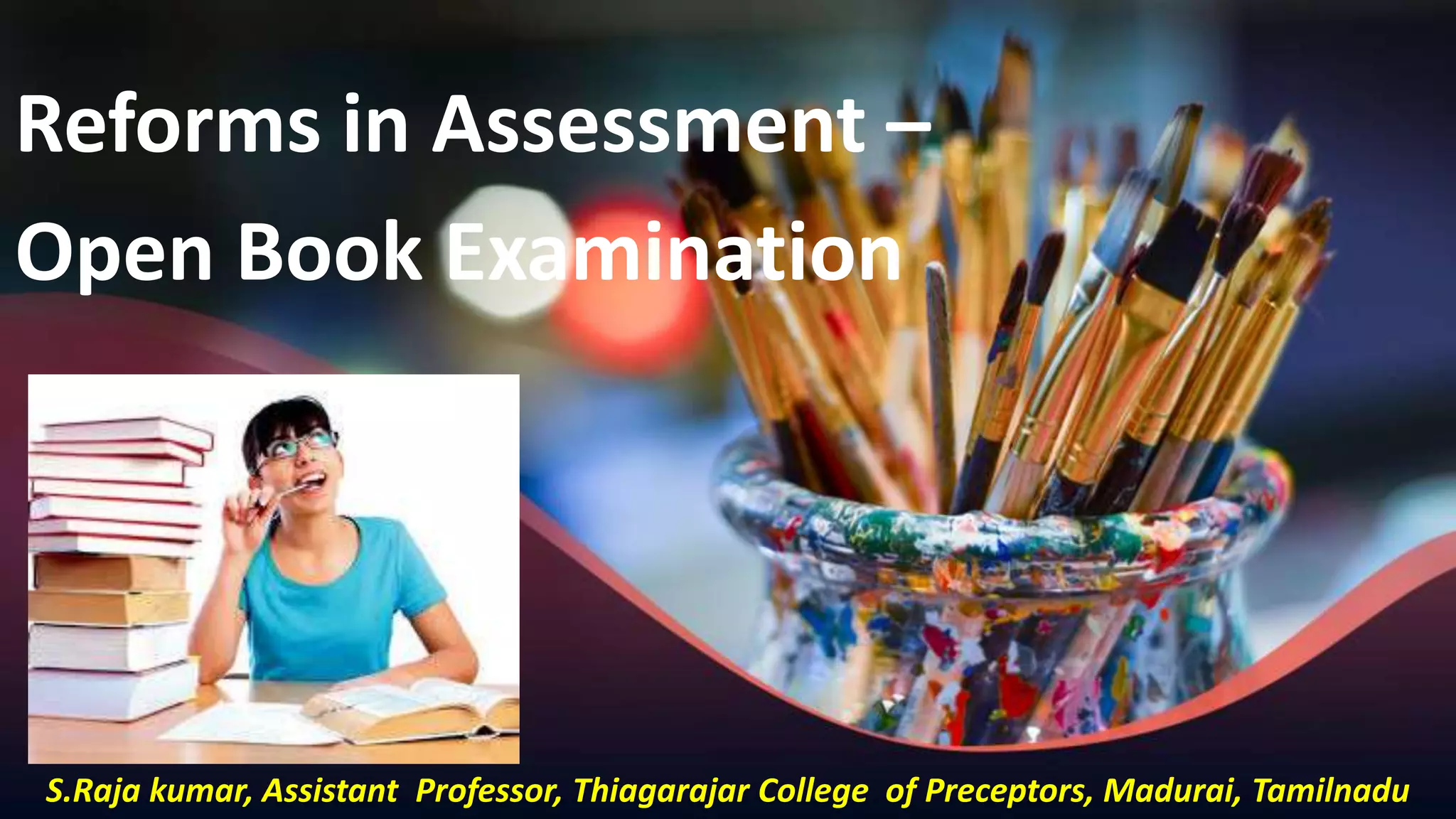
Reforms in Assessment –
Open Book Examination
S.Raja kumar, Assistant Professor, Thiagarajar College of Preceptors, Madurai, Tamilnadu
Assessment
• Assessment is the most crucial
and important component in the
teaching learning process
Assessment is the process of determining
• To what extent the educational objectives
are actually being realized.
• The effectiveness of the learning
experiences provided in the classroom.
• How well the goals of education have
been accomplished.
Drawbacks of the existing system.
• The present system of examination encourages students to utilize
and exhibit their memory rather than their intelligence and grasp
of subject. .
It reduces the learning process to a part-time activity.
It reduces the teaching to the coverage of a particular portion.
It encourages students to prepare only for passing examinations.
Question papers are not valid, reliable and objective.
Non-cognitive learning outcomes are neither tested continuously
nor comprehensively.
Open book exams
Open book exams allow you to take notes. texts
or resource materials into an exam hall.
They test the student’s ability to find and apply
information and knowledge. so are often
used in subjects requiring direct reference to
written materials like law students. statistics
or acts to govt. rules.
Forms of open book exam
• Traditional sit down and limited time
exams.
• Take-home exams open book exams you
do at home. Questions are handed out.
answers are returned within a specified
period of time (often the next day).
Kinds of material used In open-book
exam
• Reading,
• Reference materials.
• Textbooks.
• Your notes
• Materials used in open book exams are usually unrestricted.
• Restriction in the open-book exam is ’you must attempt
them by yourself without any help from others'.
• CBSE is planning to introduce open book exams for 9th and
11th std students.
Kinds of questions in open book exams
• Open books exams don't test your
memory.
• They test your ability to fund and use the
information for problem-solving, and to
deliver well .
• structured and well-presented arguments
and solutions.
• Open book exam questions usually
require you to apply knowledge and they
may be essay-style questions or involve
problem-solving or delivering solutions.
• The style of the question depends on the
faculty or school setting the exam.
• There is no direct question,
Misconception
• Very easy to succeed
• No previous reading is require.
• Using the information from books as such
is possible.
• More number of books taken to the
examination hall more will be the marks
obtained.
Advantages of open-book exams
• These exams don't test your memory. Hence students ‘
need not cram a lot of facts and figures.
• Provides a chance for students to acquire knowledge
during the preparation process of gathering suitable
learning materials.
• Enhances information retrieval skills of students through
funding efficient ways to get the necessary information
and data from books and other resources.
• Enhances the comprehension and synthesizing skills of
students because they need to reduce the content of
books. ‘
• Increased curiosity and increase the productivity level of
Disadvantages of open-book exam
• Students are not equally equipped regarding
books they bring to exam because the library
books are limited and some books are costly to
buy.
• More desk space is needed for‘ students during
the examination to refer to books.
• Sometimes students may spend too much of
time on searching for an item.
• A lot of students are unfamiliar with open book
examinations.
• Students are not expected to remember
everything of the reference books.
Acknowledgement
• FPPT.Com
• Google slides
• Slideshare
• Google images
• https://www.newcastle.edu.au/__data/asset
s/pdf_file/0006/268980/Open-Book-
Exams.pdf
• Assessment for learning- Sri ram Publication
and Everest Publishers
Thank you

Open Book Examination

  • 1.
    Reforms in Assessment– Open Book Examination S.Raja kumar, Assistant Professor, Thiagarajar College of Preceptors, Madurai, Tamilnadu
  • 2.
    Assessment • Assessment isthe most crucial and important component in the teaching learning process
  • 3.
    Assessment is theprocess of determining • To what extent the educational objectives are actually being realized. • The effectiveness of the learning experiences provided in the classroom. • How well the goals of education have been accomplished.
  • 4.
    Drawbacks of theexisting system. • The present system of examination encourages students to utilize and exhibit their memory rather than their intelligence and grasp of subject. . It reduces the learning process to a part-time activity. It reduces the teaching to the coverage of a particular portion. It encourages students to prepare only for passing examinations. Question papers are not valid, reliable and objective. Non-cognitive learning outcomes are neither tested continuously nor comprehensively.
  • 5.
    Open book exams Openbook exams allow you to take notes. texts or resource materials into an exam hall. They test the student’s ability to find and apply information and knowledge. so are often used in subjects requiring direct reference to written materials like law students. statistics or acts to govt. rules.
  • 6.
    Forms of openbook exam • Traditional sit down and limited time exams. • Take-home exams open book exams you do at home. Questions are handed out. answers are returned within a specified period of time (often the next day).
  • 7.
    Kinds of materialused In open-book exam • Reading, • Reference materials. • Textbooks. • Your notes • Materials used in open book exams are usually unrestricted. • Restriction in the open-book exam is ’you must attempt them by yourself without any help from others'. • CBSE is planning to introduce open book exams for 9th and 11th std students.
  • 8.
    Kinds of questionsin open book exams • Open books exams don't test your memory. • They test your ability to fund and use the information for problem-solving, and to deliver well . • structured and well-presented arguments and solutions.
  • 9.
    • Open bookexam questions usually require you to apply knowledge and they may be essay-style questions or involve problem-solving or delivering solutions. • The style of the question depends on the faculty or school setting the exam. • There is no direct question,
  • 10.
    Misconception • Very easyto succeed • No previous reading is require. • Using the information from books as such is possible. • More number of books taken to the examination hall more will be the marks obtained.
  • 11.
    Advantages of open-bookexams • These exams don't test your memory. Hence students ‘ need not cram a lot of facts and figures. • Provides a chance for students to acquire knowledge during the preparation process of gathering suitable learning materials. • Enhances information retrieval skills of students through funding efficient ways to get the necessary information and data from books and other resources. • Enhances the comprehension and synthesizing skills of students because they need to reduce the content of books. ‘ • Increased curiosity and increase the productivity level of
  • 12.
    Disadvantages of open-bookexam • Students are not equally equipped regarding books they bring to exam because the library books are limited and some books are costly to buy. • More desk space is needed for‘ students during the examination to refer to books. • Sometimes students may spend too much of time on searching for an item. • A lot of students are unfamiliar with open book examinations. • Students are not expected to remember everything of the reference books.
  • 13.
    Acknowledgement • FPPT.Com • Googleslides • Slideshare • Google images • https://www.newcastle.edu.au/__data/asset s/pdf_file/0006/268980/Open-Book- Exams.pdf • Assessment for learning- Sri ram Publication and Everest Publishers
  • 14.