Origin
• Not inEducational technology but in
Psychology.
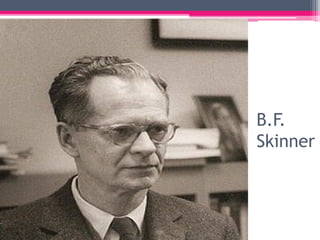
• Application of operant conditioning learning
theory to teaching learning situation.
• Skinner has contributed in developing
Programmed Learning in 1954.
• In India It was started in 1963 at Allahabad
Central Pedagogical Institute.
• In 1965 started at Advanced Student Learning
Centre at Baroda.
4.
Operant Conditioning
• Operantconditioning forms an association
between a behavior and a consequence. (It is
also called response-stimulus or RS conditioning
because it forms an association between the
animal's response [behavior] and the stimulus
that follows [consequence])
5.
Definition Of ProgrammedLearning
• The learning performed by a teaching machine or
programmed textbook is referred to as programmed
learning.
-General Definition
• It is a method of giving individualized instruction, in
which the student is active and proceeds at his own
pace & is provided with immediate knowledge of
results. The teacher is not physically present. The
programmer ,while developing programmed material
has to follow the laws of behavior & validate his
strategy in terms of student learning.
-Gulati & Gulati(1976)
6.
We can alsodeduce that-
▪Programmed Learning is a systematically
planned, empirically established and effectively
controlled , self instructional technique for
providing individualized instruction to the
learner through logically sequenced small
segments of the subject matter by using the
principles of operant conditioning and schedules
of reinforcement.
7.
Definition-
• “The arrangementof tiny bits of knowledge into
logical sequence is called programmed and its
process is called Programmed Learning.”
8.
Characteristics Of ProgrammedLearning
▪It is not an audio-visual device but is a part of
educational technology.
▪It is not a test but a new strategy of teaching-
learning.
▪It is not a solution of educational problem but a
new strategy for the modification of behaviour of
pupil.
▪It cannot replace teacher from the field of teaching
because an effective teacher can only prepare a
good programme.
▪Requires more creativity and efforts to develop
highly individualized instruction.
9.
Fundamental Principles
• Principleof Small Steps
• Principle of Active Responding
• Principle of Immediate Reinforcement
• Principle of Self-Pacing
• Principle of Student-Testing
These principles are functional in
nature and explain the procedure of
Programmed Learning Strategy.
10.
Principle of SmallSteps
▪The subject matter is broken down into a
sequence of small steps.
▪The student can take a step at a time.
▪He has to read a small step by being active.
▪Each piece of information is called as Frame.
11.
Principle of ActiveResponding
▪The student learns that he has to respond actively
as he learns.
▪Active response thus becomes integral part of
learning.
▪Every frame becomes a challenge to the students.
▪Learning can occur only when pupil responds
actively.
▪Not only learning material is presented but
sustained activity is induced.
▪Learner becomes busy. Overt as well as covert
response.
12.
Principle of ImmediateReinforcement
• The student learns best if he confirms his
response immediately.
• The confirmation provides reinforcement to
learner.
• Learning accompanied by success and
satisfaction is likely to be more permanent.
• 2 main reasons are
• Avoiding wild guess of the learner &
• When the learner is unsure of his response he
needs confirmation or correction.
13.
Principle of Self-Pacing
•The important principle of programming is self
pacing.
• The learner proceeds at his own pace when he
works through a lesson.
• The learner is not forced to move with the other
members of the class.
• This strategy has hence incorporated the
principle of individual differences in the
teaching-learning process.
14.
Principle of Student-Testing
•The teacher can regularly assess the progress of
the student.
• The student can evaluate his performance on
the basis of programme.
• If the student fails to answer record is kept .
• If any concept is not understood more
explanation is given.
Characteristics of GoodFrame
• Sentences are clear and in ambiguous.
• Language accurate.
• Enough provision of revision frames.
• Every frame should have provision of response.
• Difficulty level as per child’s age and knowledge.
• Use of multimedia.
19.
Advantages
✔Learning as percapacity.
✔Instant feedback hence self evaluation.
✔Develops ability of critical thinking.
✔Develops active responding.
✔Motivating technique.
✔Long term retention of knowledge.
✔Student remains curious.
✔Helpful for slow learners.
✔Personal attention is given.
✔Education is carried on though the teacher is
physically absent.
20.
Limitations
• Not possiblefor all topics of all the subjects.
• No scope for interaction.
• Requires experts and resources.
• Costly affair.
• Emotional development cannot take place.
• Activity is not involved.
• Against traditional process.
• Student may get boredom.
• Teacher’s impact is missing.
• Student may first see the correct responses.
21.
Topic : SquareAnd Rectangle
• The square has _______ sides.


![Operant Conditioning
• Operant conditioning forms an association
between a behavior and a consequence. (It is
also called response-stimulus or RS conditioning
because it forms an association between the
animal's response [behavior] and the stimulus
that follows [consequence])](https://image.slidesharecdn.com/programmedlearning-250404064053-a83423ff/85/Programmed-Learning-for-B-Ed-Students-by-S-S-Chepe-pptx-4-320.jpg)