Human Resource Information
System (HRIS)
&
Human Resource Planning (HRP)
HRM Process
Organization goals
& strategies
Staffing
Employee
needs
Appraisal
Rewards &
Relations
Development
Performance
HR Information
HRIS
• A database system that keeps
important information about
employees in a central and
accessible location.
• Feeds information into HR
policy and planning as well as
other HR decision process.
Why HRIS?
• HRIS can significantly improve the
efficiency of the HR operation and
therefore a company’s bottom line.
• Help increase in number and variety
of HR reports produced.
• Help shift HR’s attention from
transaction-processing to strategic
HR.
Input Data
• Personal information
• Organization
• Occupation history
• Performance & potential assessment
• Qualifications, training & competency
• Salaries & benefits
• Development & succession plans
• Others (disciplinary, medical, references,
absenteeism)
Output Data
• Skill inventory
• Training & development report
• Compensation report
• Employee benefit record
• Turnover & absenteeism report
• Human resource plans
Human Resource Planning
Man is the key to our problems, not
money. Competent people can work
miracles even with small resources and
draw wealth out of barren land.
What is HRP?
• Human resource planning is a systematic
approach to ensure that the right people will be
in the right place at the right time.
• It is a process of deciding what positions the firm
will have to fill, and how to fill them.
• It is a process of determining HR needs of the
organization in the context of its strategic
planning.
The Need for HRP
• To ensure that HR is available: provide the information
and data to an organization on when, where and how
many employees need to be recruited.
• To assess the future supplies of and demands for HR:
reduce shocks and disturbances within the employment
patterns of large organizations.
• To match supplies and demands, making them
compatible with the achievement of the organization’s
future goals.
Needs determined by
• Assessing current human resources
• Analyzing corporate plans
• Forecasting staffing level and categories
in the light of corporate objectives
• Assessing availability of HR
• Determining HR needs
• Formulating HR programs to address the
needs.
Steps in HRP
1. Assessing Current Human
Resources
2. Demand Forecasting
3. Supply Forecasting
4. Matching demand and supply
5. Action Plan
Step 1: Assessing Current HR
1. HR Inventory (details of workforce:
something like CV or personal history form)
2. Job Analysis (details of jobs, resulting in JD
and JS)
Step 2: Demand Forecasting
• Estimates the number of people required in
future and their capacity.
To forecast personnel needs:
– Project the demand for the product or
service
– Project sales and revenues
– Plan the volume of production or activity
level to meet the planned sales, revenue or
activity requirements
– Estimate the size of the staff required to
achieve it
How to forecast personnel needs?
• Staffing plans also must reflect:
Projected turnover of staff
Quality and skills of employees in relation to
the changing needs of the organization
Strategic decisions (eg. Upgrade quality,
enhance productivity, enter into new markets)
Technological and other changes resulting in
increased productivity
Financial resources
HR Forecasting Methods
• Trend analysis
– Study the past staffing needs over a period of years to predict future
needs.
• Ratio analysis
– Use of ratios between one or more business factors and staffing level
as well as between different staff categories if the current year to
forecast future needs.
• Ratio trend analysis
– Use of ratios of the past years to predict needs
• Managerial judgement
– A big role
– Trends, ratios and relationships unlikely to continue unchanged
– Judgement needed to modify the forecast based on the factors that are
likely or should be changed
Step 3: Supply Forecasting
1. Internal supply forecasts
2. External supply forecasts
Forecasting Internal Supply
• Qualifications inventories
– Manual or computerized records listing
employees’ education, career and
development interests, languages, special
skills etc to be used in selecting inside
candidates for promotion
• Personnel inventory and development
– Information is complied about each
employee manually and recorded.
Forecasting Internal Supply
• Personnel replacement charts
– Company records showing present
performance and promotability of inside
candidates for the most important positions
• Position replacement card
– A card prepared for each position in a
company to show possible replacement
candidates and their qualifications
Forecasting External Supply
• Monitoring general economic conditions
• Local market conditions
• Occupational market conditions
Step 4: Matching demand & supply
• To determine future shortages or
surpluses
– Additional staff will be needed to meet the
shortage
– Retrenchment will be needed for surplus
staff
Step 5: Action Plan
Concerned with the preparation of action
plans to deal with shortages and
surpluses of human resource
Recruitment plan
Training and Development plan
Retention plan
Promotion plan
Redeployment plan
Redundancy plan
Transfer plan
Succession plan
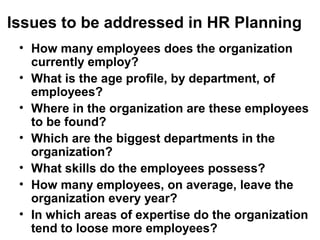
Issues to be addressed in HR Planning
• How many employees does the organization
currently employ?
• What is the age profile, by department, of
employees?
• Where in the organization are these employees
to be found?
• Which are the biggest departments in the
organization?
• What skills do the employees possess?
• How many employees, on average, leave the
organization every year?
• In which areas of expertise do the organization
tend to loose more employees?
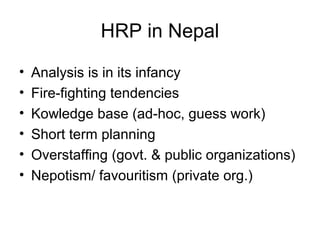
HRP in Nepal
• Analysis is in its infancy
• Fire-fighting tendencies
• Kowledge base (ad-hoc, guess work)
• Short term planning
• Overstaffing (govt. & public organizations)
• Nepotism/ favouritism (private org.)

Human Resource Information System and Human Resource Planning

  • 1.
    Human Resource Information System(HRIS) & Human Resource Planning (HRP)
  • 2.
    HRM Process Organization goals &strategies Staffing Employee needs Appraisal Rewards & Relations Development Performance HR Information
  • 3.
    HRIS • A databasesystem that keeps important information about employees in a central and accessible location. • Feeds information into HR policy and planning as well as other HR decision process.
  • 4.
    Why HRIS? • HRIScan significantly improve the efficiency of the HR operation and therefore a company’s bottom line. • Help increase in number and variety of HR reports produced. • Help shift HR’s attention from transaction-processing to strategic HR.
  • 5.
    Input Data • Personalinformation • Organization • Occupation history • Performance & potential assessment • Qualifications, training & competency • Salaries & benefits • Development & succession plans • Others (disciplinary, medical, references, absenteeism)
  • 6.
    Output Data • Skillinventory • Training & development report • Compensation report • Employee benefit record • Turnover & absenteeism report • Human resource plans
  • 7.
    Human Resource Planning Manis the key to our problems, not money. Competent people can work miracles even with small resources and draw wealth out of barren land.
  • 8.
    What is HRP? •Human resource planning is a systematic approach to ensure that the right people will be in the right place at the right time. • It is a process of deciding what positions the firm will have to fill, and how to fill them. • It is a process of determining HR needs of the organization in the context of its strategic planning.
  • 9.
    The Need forHRP • To ensure that HR is available: provide the information and data to an organization on when, where and how many employees need to be recruited. • To assess the future supplies of and demands for HR: reduce shocks and disturbances within the employment patterns of large organizations. • To match supplies and demands, making them compatible with the achievement of the organization’s future goals.
  • 10.
    Needs determined by •Assessing current human resources • Analyzing corporate plans • Forecasting staffing level and categories in the light of corporate objectives • Assessing availability of HR • Determining HR needs • Formulating HR programs to address the needs.
  • 11.
    Steps in HRP 1.Assessing Current Human Resources 2. Demand Forecasting 3. Supply Forecasting 4. Matching demand and supply 5. Action Plan
  • 12.
    Step 1: AssessingCurrent HR 1. HR Inventory (details of workforce: something like CV or personal history form) 2. Job Analysis (details of jobs, resulting in JD and JS)
  • 13.
    Step 2: DemandForecasting • Estimates the number of people required in future and their capacity. To forecast personnel needs: – Project the demand for the product or service – Project sales and revenues – Plan the volume of production or activity level to meet the planned sales, revenue or activity requirements – Estimate the size of the staff required to achieve it
  • 14.
    How to forecastpersonnel needs? • Staffing plans also must reflect: Projected turnover of staff Quality and skills of employees in relation to the changing needs of the organization Strategic decisions (eg. Upgrade quality, enhance productivity, enter into new markets) Technological and other changes resulting in increased productivity Financial resources
  • 15.
    HR Forecasting Methods •Trend analysis – Study the past staffing needs over a period of years to predict future needs. • Ratio analysis – Use of ratios between one or more business factors and staffing level as well as between different staff categories if the current year to forecast future needs. • Ratio trend analysis – Use of ratios of the past years to predict needs • Managerial judgement – A big role – Trends, ratios and relationships unlikely to continue unchanged – Judgement needed to modify the forecast based on the factors that are likely or should be changed
  • 16.
    Step 3: SupplyForecasting 1. Internal supply forecasts 2. External supply forecasts
  • 17.
    Forecasting Internal Supply •Qualifications inventories – Manual or computerized records listing employees’ education, career and development interests, languages, special skills etc to be used in selecting inside candidates for promotion • Personnel inventory and development – Information is complied about each employee manually and recorded.
  • 18.
    Forecasting Internal Supply •Personnel replacement charts – Company records showing present performance and promotability of inside candidates for the most important positions • Position replacement card – A card prepared for each position in a company to show possible replacement candidates and their qualifications
  • 19.
    Forecasting External Supply •Monitoring general economic conditions • Local market conditions • Occupational market conditions
  • 20.
    Step 4: Matchingdemand & supply • To determine future shortages or surpluses – Additional staff will be needed to meet the shortage – Retrenchment will be needed for surplus staff
  • 21.
    Step 5: ActionPlan Concerned with the preparation of action plans to deal with shortages and surpluses of human resource Recruitment plan Training and Development plan Retention plan Promotion plan Redeployment plan Redundancy plan Transfer plan Succession plan
  • 22.
    Issues to beaddressed in HR Planning • How many employees does the organization currently employ? • What is the age profile, by department, of employees? • Where in the organization are these employees to be found? • Which are the biggest departments in the organization? • What skills do the employees possess? • How many employees, on average, leave the organization every year? • In which areas of expertise do the organization tend to loose more employees?
  • 23.
    HRP in Nepal •Analysis is in its infancy • Fire-fighting tendencies • Kowledge base (ad-hoc, guess work) • Short term planning • Overstaffing (govt. & public organizations) • Nepotism/ favouritism (private org.)