Performance Management
        System
Performance Management System
   It is an organization - wide management program
    that provides a structured approach to:
   Communicate business strategy
   Establish a shared understanding of what is to be
    achieved and how it is to be achieved
   Facilitate management of self and others
   Measure and motivate performance
     (organizational and individual)
Contd…


   Performance Management – A management
    process for ensuring employees are focusing their
    work efforts in ways that contribute to achieving
    the agency’s mission. It consists of three phases:
    (a) setting expectations for employee
    performance, (b) maintaining a dialogue between
    supervisor and employee to keep performance on
    track, and
    (c) measuring actual performance relative to
    performance expectations.
PMS Consists of…
   A process for communicating employee performance
    expectations, maintaining ongoing performance dialogue,
    and conducting annual performance appraisals;
   A procedure for addressing employee performance that
    falls below expectations;
   A procedure for encouraging and facilitating employee
    development;
   Training in managing performance and administering the
    system; and
   A procedure for resolving performance pay disputes.
WHY MEASURE PERFORMANCE ?

Because
 What you cannot measure you cannot improve.

 If you cannot improve you cannot grow.

 Measurement helps in objectively differentiating

  between performers and non performers.
 Pay for performance is possible only through

  metrics.
Objective of PMS
   To confirm the services of probationary employees upon
    their completing the probationary period satisfactorily
   To check the effective & efficiency of individuals, teams
    & organization
   To effect promotions based on competence and
    performance
   To access the training and development needs of the
    employees
   To decide upon the pay rise
   PM can be used to determine whether HR programmes
    such as selection, training, and transfer have been effective
    or not.
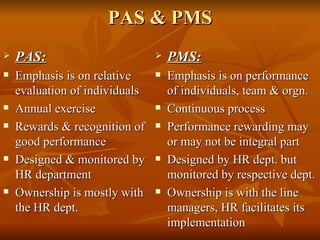
PAS & PMS
   PAS:                           PMS:
   Emphasis is on relative        Emphasis is on performance
    evaluation of individuals       of individuals, team & orgn.
   Annual exercise                Continuous process
   Rewards & recognition of       Performance rewarding may
    good performance                or may not be integral part
   Designed & monitored by        Designed by HR dept. but
    HR department                   monitored by respective dept.
   Ownership is mostly with       Ownership is with the line
    the HR dept.                    managers, HR facilitates its
                                    implementation
PMS Includes…
   Work plan – A document that describes the work
    to be completed by an employee within the
    performance cycle, the performance expected, and
    how the performance will be measured.

   Corrective action plan – A short-term action plan
    that is initiated when an employee’s performance
    fails to meet expectations. Its purpose is to achieve
    an improvement in performance.
Contd…


   Individual development plan – An action plan for
    enhancing an employee’s level of performance in
    order to excel in the current job or prepare for new
    responsibilities.

   Performance appraisal – A confidential document
    that includes the employee’s performance
    expectations, a summary of the employee’s actual
    performance relative to those expectations, an overall
    rating of the employee’s performance, and the
    supervisor’s and employee’s signatures.
Contd…


   Performance documentation – A letter, memo,
    completed form, or note on which the supervisor
    indicates the extent to which the employee is currently
    meeting expectations and provides evidence to
    support that conclusion.

   Fair appraisal – Appraising employees in a manner
    that accurately reflects how they performed relative to
    the expectations defined in their work plan and in a
    manner that is not influenced by factors irrelevant to
    performance.
HIGHLIGHTS OF THE SYSTEM

   The appraiser and the appraisee jointly set the Key
    Result Areas (KRA’s) and assign mutually agreed
    weightage expressed as a percentage
   Simple mathematical relationship between set
    weightage and accomplishment gives a final
    numerical score on KRA’s
   To evaluate all management personnel on company
    values and leadership attributes a new section has
    been added entitled “Values in Action”
WHAT IS A KEY RESULT AREA ?
   A KRA refers to a target that needs to be achieved by
    the appraisee in a given time
   KRA’s are the set of performance expectations from
    the appraisee
   The focus is on tangible outputs. However this does
    not mean that tasks that have a qualitative output
    cannot form a KRA
   The focus is on tangible outputs. However this does
    not mean that tasks that have a qualitative output
    cannot form a KRA
Setting KRA in case of a Functional
            Reporting Relationship
   Functional reporting cases will require input from the
    functional superior in setting KRAs for the appraisee.
   The appraiser , the appraisee and the functional superior
    will have to mutually agree upon the KRAs for the
    appraisee.
   In case of a disagreement , it will be the functional
    superior’s responsibility to convince the administrative
    superior to reach an agreement on the KRAs and
    communicate the same to the appraisee.
   In some cases, functional goals could be super-ordinate
    to business goals.
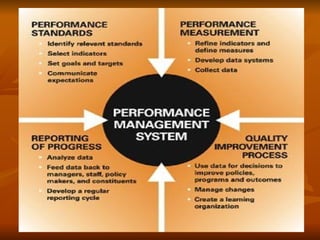
Components of PMS

   Performance Standards - establishment of
    organizational or system performance standards,
    targets and goals and relevant indicators to improve
    public health practice

   Performance Measures - application and use of
    performance indicators and measures
Contd…


   Reporting of Progress - documentation and
    reporting of progress in meeting standards and
    targets and sharing of such information through
    feedback

   Quality Improvement - establishment of a program
    or process to manage change and achieve quality
    improvement in public health policies, programs or
    infrastructure based on performance standards,
    measurements and reports.
Importance of PMS
   A Performance Management System enables a
    business to sustain profitability and performance
    by linking the employees' pay to competency and
    contribution .
   It provides opportunities for concerted personal
    development and career growth .
   It brings all the employees under a single strategic
    umbrella .
Contd…


   Most importantly, it gives supervisors and
    subordinates an equal opportunity to express
    themselves under structured conditions
   Organizations can effectively manage the
    performance appraisal process with our online
    performance management system
   It calls for a high level of co-ordination, channeled
    information flow, and timely review
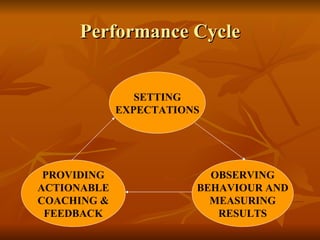
Performance Cycle


                SETTING
             EXPECTATIONS


 PROVIDING                OBSERVING
ACTIONABLE              BEHAVIOUR AND
COACHING &                MEASURING
 FEEDBACK                  RESULTS
Appraise Need For Further
                Discussion
   The reviewer meets the appraiser to investigate the
    point of disagreement.
   The reviewer decides to meet the appraisee to hear
    his / her views.
   The reviewer examines the case and communicates
    his / her decision to the appraiser.
   The appraiser communicates the decision of the
    reviewer to the appraisee.
FURTHER LINKS EMERGING
         FROM THE PMS

   Rewards and Recognition

   Training and Development

   Potential Appraisal

   Career and Succession Planning
THANK YOU

Performance management system

  • 1.
  • 2.
    Performance Management System  It is an organization - wide management program that provides a structured approach to:  Communicate business strategy  Establish a shared understanding of what is to be achieved and how it is to be achieved  Facilitate management of self and others  Measure and motivate performance (organizational and individual)
  • 3.
    Contd…  Performance Management – A management process for ensuring employees are focusing their work efforts in ways that contribute to achieving the agency’s mission. It consists of three phases: (a) setting expectations for employee performance, (b) maintaining a dialogue between supervisor and employee to keep performance on track, and (c) measuring actual performance relative to performance expectations.
  • 4.
    PMS Consists of…  A process for communicating employee performance expectations, maintaining ongoing performance dialogue, and conducting annual performance appraisals;  A procedure for addressing employee performance that falls below expectations;  A procedure for encouraging and facilitating employee development;  Training in managing performance and administering the system; and  A procedure for resolving performance pay disputes.
  • 5.
    WHY MEASURE PERFORMANCE? Because  What you cannot measure you cannot improve.  If you cannot improve you cannot grow.  Measurement helps in objectively differentiating between performers and non performers.  Pay for performance is possible only through metrics.
  • 6.
    Objective of PMS  To confirm the services of probationary employees upon their completing the probationary period satisfactorily  To check the effective & efficiency of individuals, teams & organization  To effect promotions based on competence and performance  To access the training and development needs of the employees  To decide upon the pay rise  PM can be used to determine whether HR programmes such as selection, training, and transfer have been effective or not.
  • 7.
    PAS & PMS  PAS:  PMS:  Emphasis is on relative  Emphasis is on performance evaluation of individuals of individuals, team & orgn.  Annual exercise  Continuous process  Rewards & recognition of  Performance rewarding may good performance or may not be integral part  Designed & monitored by  Designed by HR dept. but HR department monitored by respective dept.  Ownership is mostly with  Ownership is with the line the HR dept. managers, HR facilitates its implementation
  • 8.
    PMS Includes…  Work plan – A document that describes the work to be completed by an employee within the performance cycle, the performance expected, and how the performance will be measured.  Corrective action plan – A short-term action plan that is initiated when an employee’s performance fails to meet expectations. Its purpose is to achieve an improvement in performance.
  • 9.
    Contd…  Individual development plan – An action plan for enhancing an employee’s level of performance in order to excel in the current job or prepare for new responsibilities.  Performance appraisal – A confidential document that includes the employee’s performance expectations, a summary of the employee’s actual performance relative to those expectations, an overall rating of the employee’s performance, and the supervisor’s and employee’s signatures.
  • 10.
    Contd…  Performance documentation – A letter, memo, completed form, or note on which the supervisor indicates the extent to which the employee is currently meeting expectations and provides evidence to support that conclusion.  Fair appraisal – Appraising employees in a manner that accurately reflects how they performed relative to the expectations defined in their work plan and in a manner that is not influenced by factors irrelevant to performance.
  • 11.
    HIGHLIGHTS OF THESYSTEM  The appraiser and the appraisee jointly set the Key Result Areas (KRA’s) and assign mutually agreed weightage expressed as a percentage  Simple mathematical relationship between set weightage and accomplishment gives a final numerical score on KRA’s  To evaluate all management personnel on company values and leadership attributes a new section has been added entitled “Values in Action”
  • 12.
    WHAT IS AKEY RESULT AREA ?  A KRA refers to a target that needs to be achieved by the appraisee in a given time  KRA’s are the set of performance expectations from the appraisee  The focus is on tangible outputs. However this does not mean that tasks that have a qualitative output cannot form a KRA  The focus is on tangible outputs. However this does not mean that tasks that have a qualitative output cannot form a KRA
  • 13.
    Setting KRA incase of a Functional Reporting Relationship  Functional reporting cases will require input from the functional superior in setting KRAs for the appraisee.  The appraiser , the appraisee and the functional superior will have to mutually agree upon the KRAs for the appraisee.  In case of a disagreement , it will be the functional superior’s responsibility to convince the administrative superior to reach an agreement on the KRAs and communicate the same to the appraisee.  In some cases, functional goals could be super-ordinate to business goals.
  • 14.
    Components of PMS  Performance Standards - establishment of organizational or system performance standards, targets and goals and relevant indicators to improve public health practice  Performance Measures - application and use of performance indicators and measures
  • 15.
    Contd…  Reporting of Progress - documentation and reporting of progress in meeting standards and targets and sharing of such information through feedback  Quality Improvement - establishment of a program or process to manage change and achieve quality improvement in public health policies, programs or infrastructure based on performance standards, measurements and reports.
  • 17.
    Importance of PMS  A Performance Management System enables a business to sustain profitability and performance by linking the employees' pay to competency and contribution .  It provides opportunities for concerted personal development and career growth .  It brings all the employees under a single strategic umbrella .
  • 18.
    Contd…  Most importantly, it gives supervisors and subordinates an equal opportunity to express themselves under structured conditions  Organizations can effectively manage the performance appraisal process with our online performance management system  It calls for a high level of co-ordination, channeled information flow, and timely review
  • 19.
    Performance Cycle SETTING EXPECTATIONS PROVIDING OBSERVING ACTIONABLE BEHAVIOUR AND COACHING & MEASURING FEEDBACK RESULTS
  • 20.
    Appraise Need ForFurther Discussion  The reviewer meets the appraiser to investigate the point of disagreement.  The reviewer decides to meet the appraisee to hear his / her views.  The reviewer examines the case and communicates his / her decision to the appraiser.  The appraiser communicates the decision of the reviewer to the appraisee.
  • 21.
    FURTHER LINKS EMERGING FROM THE PMS  Rewards and Recognition  Training and Development  Potential Appraisal  Career and Succession Planning
  • 22.