CHAPTER 2
HUMAN RESOURCE PLANNING
Human Resource Planning
Importance of HRP
Factors Affecting HRP
The Planning Process
Forecasting Techniques
HR Plan Implementation
Downsizing Plan
Managerial Succession Planning
Requisite for HRP
Lecture Overview
Human Resource Planning
“Human Resource Planning is the process by which an
organization ensures that it has the right number and
kind of people, at the right place, at the right time,
capable of effectively and efficiently completing those
tasks that will help the organization achieve its overall
objectives.”
- HRP is a process
- It involves determination of needs
- It also takes into account the manpower availability at
a future period.
HUMAN RESOURCE PLANNING
• Human Resource Planning
“HRP is process of forecasting firm's future demand
and supply of the right type of people in the right
numbers”
 HRM department should initiate the recruitment and selection
process after HRP
IMPORTANCE OF HRP
Importance of HRP can be highlighted by following
points
1. Future Personnel Needs
• Planning helps to determine future personnel
needs
• Surplus or shortage in staff is due to poor human
resource planning
• Public sector organizations facing problem of
over staffing
• Public sector organizations offering voluntary
retirement scheme (VRS)
IMPORTANCE OF HRP
2. PART OF STRATEGIC PLANNING
• All activities of HRM like HRP, hiring, remuneration,
training must be matched with strategic
management
• HRP can facilitate strategic planning at two ends
• At the start, it provides information for strategy formulation
like kind of skills, and numbers of people available to
organization to pursue organization strategy
• At the end, it assist in making resource allocation decisions,
creating structure, process and determine human resource
need
IMPORTANCE OF HRP
3 Creating Highly Talented Personnel
• Now a days organizations need knowledge workers
and professionals for intellectual jobs
• Technical and knowledge worker most often switch
their job creating workforce shortages
• Adoption of new technology creates demand for
technical and trained workers at the same time
resulting into excess of non technical staff
• Management succession planning helps to decide who
will replace/substitute the chief executive/top
management?
IMPORTANCE OF HRP
• 4. International Growth Strategies
• Global expansion strategy relies on HRP. From
where to recruit employees (foreign, local, or
reassignment) to fill key jobs
• HRP integrate HR plan with organization external &
internal situations (cultural consideration, labor and
employment laws)
• HR department often need to fill key jobs with
expatriates, therefore, need to motivate, train, and
compensate them.
IMPORTANCE OF HRP
• 5. Foundation for Personnel Functions
• HRP provides essential information in development
and implementation of personnel functions like
recruitment, selection, transfer, postings,
promotions, layoff, compensation, and training
IMPORTANCE OF HRP
• 6. Increasing Investment in Human Resources
• Investment perspective of human resource highlights the need
of proper HRP
• Human Resources Planning help to make right investment
decision in company's human resources
IMPORTANCE OF HRP
7. Resistance to Change and Move
• Employee resist to change and move
• HRP assists to plan well ahead employees'
transfer/posting and movement from one place to
other in smooth way
• Dedication, commitment and loyalty of employees
can be assured
OTHER BENEFITS
• Top management has a better view of influence and
impact of business decisions on HR dimensions
• HR cost can be lessen if human resource needs are
known before time
• Enough time available to locate talent from market
• Inclusion of women and minorities
• Training and Development plans can be made well
before time
FACTORS AFFECTING HRP
1 Type and strategy of an organization
2 Organizational growth cycle and planning
3 Environmental uncertainties
4 Time horizon
5 Type and quality of forecasting information
6 Nature of job being filled
7 Outsourcing
FACTORS EFFECTING HRP
1 Type and strategy of an organization
• Global expansion strategy mean hiring of employees
whereas mergers and acquisition strategy means
downsizing/layoff
• The decision whether to be proactive or reactive in
HRP
2 Organizational Growth Cycle
• Small organization at the start of business may not
have HRP
• In growth stage focus is on recruitment
• In declining phase HRP is reactive in nature and focus
is on retirement, and layoff
FACTORS EFFECTING HRP
3 Environmental Uncertainties
Degree of uncertainty determines focus and time
span of HRP
4 Time Horizon
Short term and long term personnel plans depend
upon level of uncertainty
5 Quality of Information
HRIS and Job analysis information need to be in
place that provide accurate and timely data for
HRP
6 Nature of Jobs being filled
Job vacancies exist due to retirement, separation,
job hoping, promotion, and growth
Managerial and technical positions are difficult to fill
in
Sufficient lead time is required to hire suitable
candidates of vacant position
7 Outsourcing
Sub contracting or outsourcing critical business
activities limits new hiring in this case HRP is not
much required
FACTORS EFFECTING HRP
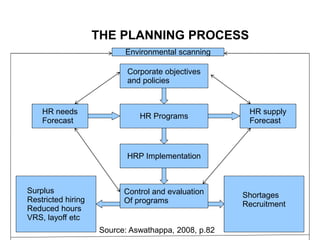
THE PLANNING PROCESS
HR needs
Forecast
HR supply
Forecast
Corporate objectives
and policies
HR Programs
HRP Implementation
Control and evaluation
Of programs
Surplus
Restricted hiring
Reduced hours
VRS, layoff etc
Shortages
Recruitment
Source: Aswathappa, 2008, p.82
Environmental scanning
THE PLANNING PROCESS
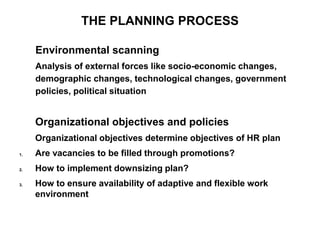
Environmental scanning
Analysis of external forces like socio-economic changes,
demographic changes, technological changes, government
policies, political situation
Organizational objectives and policies
Organizational objectives determine objectives of HR plan
1. Are vacancies to be filled through promotions?
2. How to implement downsizing plan?
3. How to ensure availability of adaptive and flexible work
environment
THE PLANNING PROCESS
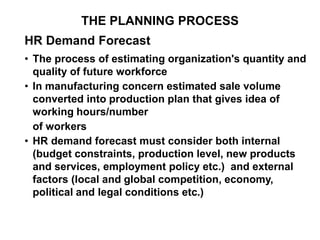
HR Demand Forecast
• The process of estimating organization's quantity and
quality of future workforce
• In manufacturing concern estimated sale volume
converted into production plan that gives idea of
working hours/number
of workers
• HR demand forecast must consider both internal
(budget constraints, production level, new products
and services, employment policy etc.) and external
factors (local and global competition, economy,
political and legal conditions etc.)
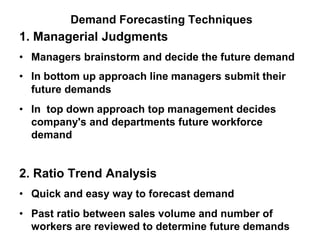
Demand Forecasting Techniques
1. Managerial Judgments
• Managers brainstorm and decide the future demand
• In bottom up approach line managers submit their
future demands
• In top down approach top management decides
company's and departments future workforce
demand
2. Ratio Trend Analysis
• Quick and easy way to forecast demand
• Past ratio between sales volume and number of
workers are reviewed to determine future demands
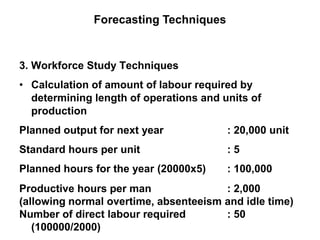
3. Workforce Study Techniques
• Calculation of amount of labour required by
determining length of operations and units of
production
Planned output for next year : 20,000 unit
Standard hours per unit : 5
Planned hours for the year (20000x5) : 100,000
Productive hours per man : 2,000
(allowing normal overtime, absenteeism and idle time)
Number of direct labour required : 50
(100000/2000)
Forecasting Techniques
3. Workforce Study Techniques
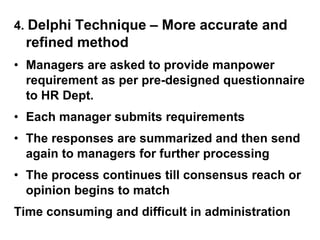
4. Delphi Technique – More accurate and
refined method
• Managers are asked to provide manpower
requirement as per pre-designed questionnaire
to HR Dept.
• Each manager submits requirements
• The responses are summarized and then send
again to managers for further processing
• The process continues till consensus reach or
opinion begins to match
Time consuming and difficult in administration
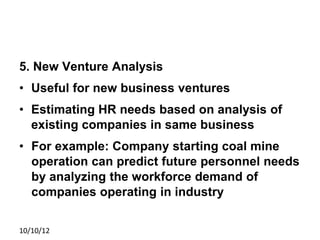
5. New Venture Analysis
• Useful for new business ventures
• Estimating HR needs based on analysis of
existing companies in same business
• For example: Company starting coal mine
operation can predict future personnel needs
by analyzing the workforce demand of
companies operating in industry
10/10/12
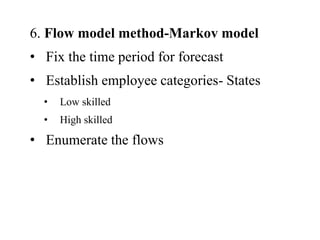
6. Flow model method-Markov model
• Fix the time period for forecast
• Establish employee categories- States
• Low skilled
• High skilled
• Enumerate the flows
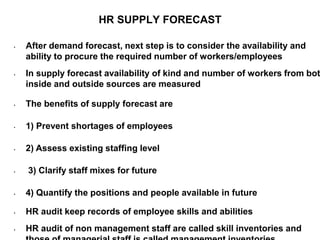
HR SUPPLY FORECAST
• After demand forecast, next step is to consider the availability and
ability to procure the required number of workers/employees
• In supply forecast availability of kind and number of workers from bot
inside and outside sources are measured
• The benefits of supply forecast are
• 1) Prevent shortages of employees
• 2) Assess existing staffing level
• 3) Clarify staff mixes for future
• 4) Quantify the positions and people available in future
• HR audit keep records of employee skills and abilities
• HR audit of non management staff are called skill inventories and
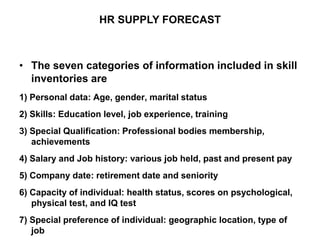
• The seven categories of information included in skill
inventories are
1) Personal data: Age, gender, marital status
2) Skills: Education level, job experience, training
3) Special Qualification: Professional bodies membership,
achievements
4) Salary and Job history: various job held, past and present pay
5) Company date: retirement date and seniority
6) Capacity of individual: health status, scores on psychological,
physical test, and IQ test
7) Special preference of individual: geographic location, type of
job
HR SUPPLY FORECAST
MANAGEMENT INVENTORIES
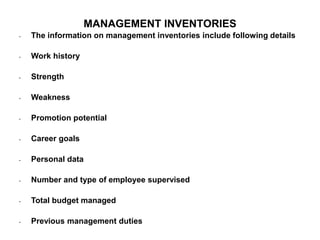
• The information on management inventories include following details
• Work history
• Strength
• Weakness
• Promotion potential
• Career goals
• Personal data
• Number and type of employee supervised
• Total budget managed
• Previous management duties
INTERNAL SUPPLY
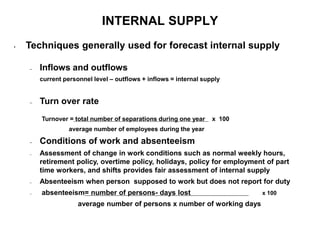
• Techniques generally used for forecast internal supply
– Inflows and outflows
current personnel level – outflows + inflows = internal supply
– Turn over rate
Turnover = total number of separations during one year x 100
average number of employees during the year
– Conditions of work and absenteeism
– Assessment of change in work conditions such as normal weekly hours,
retirement policy, overtime policy, holidays, policy for employment of part
time workers, and shifts provides fair assessment of internal supply
– Absenteeism when person supposed to work but does not report for duty
– absenteeism= number of persons- days lost x 100
average number of persons x number of working days
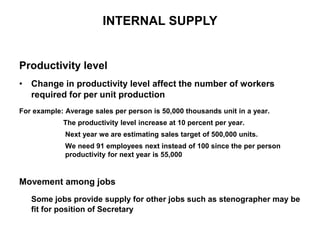
Productivity level
• Change in productivity level affect the number of workers
required for per unit production
For example: Average sales per person is 50,000 thousands unit in a year.
The productivity level increase at 10 percent per year.
Next year we are estimating sales target of 500,000 units.
We need 91 employees next instead of 100 since the per person
productivity for next year is 55,000
Movement among jobs
Some jobs provide supply for other jobs such as stenographer may be
fit for position of Secretary
INTERNAL SUPPLY
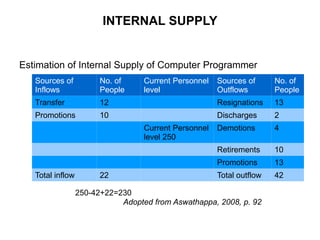
Estimation of Internal Supply of Computer Programmer
INTERNAL SUPPLY
Sources of
Inflows
No. of
People
Current Personnel
level
Sources of
Outflows
No. of
People
Transfer 12 Resignations 13
Promotions 10 Discharges 2
Current Personnel
level 250
Demotions 4
Retirements 10
Promotions 13
Total inflow 22 Total outflow 42
Adopted from Aswathappa, 2008, p. 92
250-42+22=230
EXTERNAL SUPPLY
• External sources important for several reasons such
as
1. New blood and new experience will be available
2. Organization needs to replenish lost personnel
3. Organization growth and diversification
HR PROGRAMING
After forecasting personnel demand and supply, the
two must be reconciled or balanced in order to fill
vacancies by the right people at the right time
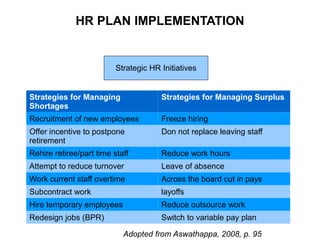
HR PLAN IMPLEMENTATION
• Converting HR plan into actions
• A series of actions are taken as HR plan
implementation such as recruitment,
promotion, placement, training and
development, retention plan, downsizing
plan, and succession plan
HR PLAN IMPLEMENTATION
Strategies for Managing
Shortages
Strategies for Managing Surplus
Recruitment of new employees Freeze hiring
Offer incentive to postpone
retirement
Don not replace leaving staff
Rehire retiree/part time staff Reduce work hours
Attempt to reduce turnover Leave of absence
Work current staff overtime Across the board cut in pays
Subcontract work layoffs
Hire temporary employees Reduce outsource work
Redesign jobs (BPR) Switch to variable pay plan
Strategic HR Initiatives
Adopted from Aswathappa, 2008, p. 95
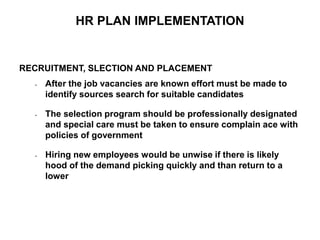
RECRUITMENT, SLECTION AND PLACEMENT
• After the job vacancies are known effort must be made to
identify sources search for suitable candidates
• The selection program should be professionally designated
and special care must be taken to ensure complain ace with
policies of government
• Hiring new employees would be unwise if there is likely
hood of the demand picking quickly and than return to a
lower
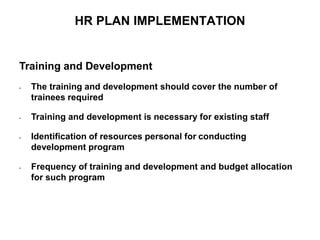
HR PLAN IMPLEMENTATION
Training and Development
• The training and development should cover the number of
trainees required
• Training and development is necessary for existing staff
• Identification of resources personal for conducting
development program
• Frequency of training and development and budget allocation
for such program
Retraining and Redeployment
• New skills are to be imparted to existing staff when
technology changes
• When a product line is discontinued its employees are to
be retrained or redeveloped to other where they could be
gainfully employed
HR PLAN IMPLEMENTATION
Retention Plan
• Retention plan covers action which would help, reduce
avoidable separation of employees
• Important actions can be done
– Compensation plan: increasing pay level, Improving pay
structure
– Performance appraisal: asses performance periodically
– Employees leaving in search of green pastures: Provide
better career development opportunities
– Employees Leaving because of conflict: manage conflict
– Induction crises: right person for right job
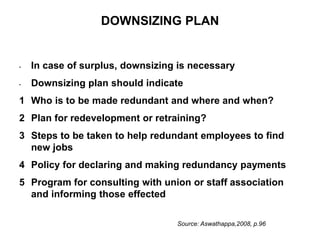
DOWNSIZING PLAN
• In case of surplus, downsizing is necessary
• Downsizing plan should indicate
1 Who is to be made redundant and where and when?
2 Plan for redevelopment or retraining?
3 Steps to be taken to help redundant employees to find
new jobs
4 Policy for declaring and making redundancy payments
5 Program for consulting with union or staff association
and informing those effected
Source: Aswathappa,2008, p.96
MANAGERIAL SUCCESSION PLANNING
• Managerial succession plan include training programs at series
of job assignment leading to top positions
• A typical succession planning involve following activities
1 Audit of existing executive, projection of likely future supply
from internal and external sources
2 Accelerated promotion
3 Performance related training and development prepare
individuals for future roles as well as current responsibilities
Barriers to effective Human resource
Planning
1. Improper Linkage between HRP and
Corporate Strategy
2. Inadequate Appreciation of HRP
3. Rigidity in Attitudes
4. Environmental Uncertainty
5. Inappropriate HR Information System
6. Lack of coordination with other Functions
REQUISITS FOR SUCCESSFUL HRP
Requisites for successful HRP
1 HRP must be recognized as integral part of corporate
planning
2 Backing of top management for HRP is absolutely
essential
3 HRP responsibilities should be centralized
4 Personal record must be complete ,up to date and
available
REQUISITS FOR SUCCESSFUL HRP
5 The time horizon of the plan must be long enough to
permit any remedial action
6 Data collection and analysis techniques and plan needs
to constantly revised and improved
Source: Aswathappa,2008, p.97

Unit 2 HRP.pptx

  • 1.
  • 2.
    Human Resource Planning Importanceof HRP Factors Affecting HRP The Planning Process Forecasting Techniques HR Plan Implementation Downsizing Plan Managerial Succession Planning Requisite for HRP Lecture Overview
  • 3.
    Human Resource Planning “HumanResource Planning is the process by which an organization ensures that it has the right number and kind of people, at the right place, at the right time, capable of effectively and efficiently completing those tasks that will help the organization achieve its overall objectives.” - HRP is a process - It involves determination of needs - It also takes into account the manpower availability at a future period.
  • 4.
    HUMAN RESOURCE PLANNING •Human Resource Planning “HRP is process of forecasting firm's future demand and supply of the right type of people in the right numbers”  HRM department should initiate the recruitment and selection process after HRP
  • 5.
    IMPORTANCE OF HRP Importanceof HRP can be highlighted by following points 1. Future Personnel Needs • Planning helps to determine future personnel needs • Surplus or shortage in staff is due to poor human resource planning • Public sector organizations facing problem of over staffing • Public sector organizations offering voluntary retirement scheme (VRS)
  • 6.
    IMPORTANCE OF HRP 2.PART OF STRATEGIC PLANNING • All activities of HRM like HRP, hiring, remuneration, training must be matched with strategic management • HRP can facilitate strategic planning at two ends • At the start, it provides information for strategy formulation like kind of skills, and numbers of people available to organization to pursue organization strategy • At the end, it assist in making resource allocation decisions, creating structure, process and determine human resource need
  • 7.
    IMPORTANCE OF HRP 3Creating Highly Talented Personnel • Now a days organizations need knowledge workers and professionals for intellectual jobs • Technical and knowledge worker most often switch their job creating workforce shortages • Adoption of new technology creates demand for technical and trained workers at the same time resulting into excess of non technical staff • Management succession planning helps to decide who will replace/substitute the chief executive/top management?
  • 8.
    IMPORTANCE OF HRP •4. International Growth Strategies • Global expansion strategy relies on HRP. From where to recruit employees (foreign, local, or reassignment) to fill key jobs • HRP integrate HR plan with organization external & internal situations (cultural consideration, labor and employment laws) • HR department often need to fill key jobs with expatriates, therefore, need to motivate, train, and compensate them.
  • 9.
    IMPORTANCE OF HRP •5. Foundation for Personnel Functions • HRP provides essential information in development and implementation of personnel functions like recruitment, selection, transfer, postings, promotions, layoff, compensation, and training
  • 10.
    IMPORTANCE OF HRP •6. Increasing Investment in Human Resources • Investment perspective of human resource highlights the need of proper HRP • Human Resources Planning help to make right investment decision in company's human resources
  • 11.
    IMPORTANCE OF HRP 7.Resistance to Change and Move • Employee resist to change and move • HRP assists to plan well ahead employees' transfer/posting and movement from one place to other in smooth way • Dedication, commitment and loyalty of employees can be assured
  • 12.
    OTHER BENEFITS • Topmanagement has a better view of influence and impact of business decisions on HR dimensions • HR cost can be lessen if human resource needs are known before time • Enough time available to locate talent from market • Inclusion of women and minorities • Training and Development plans can be made well before time
  • 13.
    FACTORS AFFECTING HRP 1Type and strategy of an organization 2 Organizational growth cycle and planning 3 Environmental uncertainties 4 Time horizon 5 Type and quality of forecasting information 6 Nature of job being filled 7 Outsourcing
  • 14.
    FACTORS EFFECTING HRP 1Type and strategy of an organization • Global expansion strategy mean hiring of employees whereas mergers and acquisition strategy means downsizing/layoff • The decision whether to be proactive or reactive in HRP 2 Organizational Growth Cycle • Small organization at the start of business may not have HRP • In growth stage focus is on recruitment • In declining phase HRP is reactive in nature and focus is on retirement, and layoff
  • 15.
    FACTORS EFFECTING HRP 3Environmental Uncertainties Degree of uncertainty determines focus and time span of HRP 4 Time Horizon Short term and long term personnel plans depend upon level of uncertainty 5 Quality of Information HRIS and Job analysis information need to be in place that provide accurate and timely data for HRP
  • 16.
    6 Nature ofJobs being filled Job vacancies exist due to retirement, separation, job hoping, promotion, and growth Managerial and technical positions are difficult to fill in Sufficient lead time is required to hire suitable candidates of vacant position 7 Outsourcing Sub contracting or outsourcing critical business activities limits new hiring in this case HRP is not much required FACTORS EFFECTING HRP
  • 17.
    THE PLANNING PROCESS HRneeds Forecast HR supply Forecast Corporate objectives and policies HR Programs HRP Implementation Control and evaluation Of programs Surplus Restricted hiring Reduced hours VRS, layoff etc Shortages Recruitment Source: Aswathappa, 2008, p.82 Environmental scanning
  • 18.
    THE PLANNING PROCESS Environmentalscanning Analysis of external forces like socio-economic changes, demographic changes, technological changes, government policies, political situation Organizational objectives and policies Organizational objectives determine objectives of HR plan 1. Are vacancies to be filled through promotions? 2. How to implement downsizing plan? 3. How to ensure availability of adaptive and flexible work environment
  • 19.
    THE PLANNING PROCESS HRDemand Forecast • The process of estimating organization's quantity and quality of future workforce • In manufacturing concern estimated sale volume converted into production plan that gives idea of working hours/number of workers • HR demand forecast must consider both internal (budget constraints, production level, new products and services, employment policy etc.) and external factors (local and global competition, economy, political and legal conditions etc.)
  • 20.
    Demand Forecasting Techniques 1.Managerial Judgments • Managers brainstorm and decide the future demand • In bottom up approach line managers submit their future demands • In top down approach top management decides company's and departments future workforce demand 2. Ratio Trend Analysis • Quick and easy way to forecast demand • Past ratio between sales volume and number of workers are reviewed to determine future demands
  • 21.
    3. Workforce StudyTechniques • Calculation of amount of labour required by determining length of operations and units of production Planned output for next year : 20,000 unit Standard hours per unit : 5 Planned hours for the year (20000x5) : 100,000 Productive hours per man : 2,000 (allowing normal overtime, absenteeism and idle time) Number of direct labour required : 50 (100000/2000) Forecasting Techniques 3. Workforce Study Techniques 3. Workforce Study Techniques
  • 22.
    4. Delphi Technique– More accurate and refined method • Managers are asked to provide manpower requirement as per pre-designed questionnaire to HR Dept. • Each manager submits requirements • The responses are summarized and then send again to managers for further processing • The process continues till consensus reach or opinion begins to match Time consuming and difficult in administration
  • 23.
    5. New VentureAnalysis • Useful for new business ventures • Estimating HR needs based on analysis of existing companies in same business • For example: Company starting coal mine operation can predict future personnel needs by analyzing the workforce demand of companies operating in industry 10/10/12
  • 24.
    6. Flow modelmethod-Markov model • Fix the time period for forecast • Establish employee categories- States • Low skilled • High skilled • Enumerate the flows
  • 25.
    HR SUPPLY FORECAST •After demand forecast, next step is to consider the availability and ability to procure the required number of workers/employees • In supply forecast availability of kind and number of workers from bot inside and outside sources are measured • The benefits of supply forecast are • 1) Prevent shortages of employees • 2) Assess existing staffing level • 3) Clarify staff mixes for future • 4) Quantify the positions and people available in future • HR audit keep records of employee skills and abilities • HR audit of non management staff are called skill inventories and
  • 26.
    • The sevencategories of information included in skill inventories are 1) Personal data: Age, gender, marital status 2) Skills: Education level, job experience, training 3) Special Qualification: Professional bodies membership, achievements 4) Salary and Job history: various job held, past and present pay 5) Company date: retirement date and seniority 6) Capacity of individual: health status, scores on psychological, physical test, and IQ test 7) Special preference of individual: geographic location, type of job HR SUPPLY FORECAST
  • 27.
    MANAGEMENT INVENTORIES • Theinformation on management inventories include following details • Work history • Strength • Weakness • Promotion potential • Career goals • Personal data • Number and type of employee supervised • Total budget managed • Previous management duties
  • 28.
    INTERNAL SUPPLY • Techniquesgenerally used for forecast internal supply – Inflows and outflows current personnel level – outflows + inflows = internal supply – Turn over rate Turnover = total number of separations during one year x 100 average number of employees during the year – Conditions of work and absenteeism – Assessment of change in work conditions such as normal weekly hours, retirement policy, overtime policy, holidays, policy for employment of part time workers, and shifts provides fair assessment of internal supply – Absenteeism when person supposed to work but does not report for duty – absenteeism= number of persons- days lost x 100 average number of persons x number of working days
  • 29.
    Productivity level • Changein productivity level affect the number of workers required for per unit production For example: Average sales per person is 50,000 thousands unit in a year. The productivity level increase at 10 percent per year. Next year we are estimating sales target of 500,000 units. We need 91 employees next instead of 100 since the per person productivity for next year is 55,000 Movement among jobs Some jobs provide supply for other jobs such as stenographer may be fit for position of Secretary INTERNAL SUPPLY
  • 30.
    Estimation of InternalSupply of Computer Programmer INTERNAL SUPPLY Sources of Inflows No. of People Current Personnel level Sources of Outflows No. of People Transfer 12 Resignations 13 Promotions 10 Discharges 2 Current Personnel level 250 Demotions 4 Retirements 10 Promotions 13 Total inflow 22 Total outflow 42 Adopted from Aswathappa, 2008, p. 92 250-42+22=230
  • 31.
    EXTERNAL SUPPLY • Externalsources important for several reasons such as 1. New blood and new experience will be available 2. Organization needs to replenish lost personnel 3. Organization growth and diversification
  • 32.
    HR PROGRAMING After forecastingpersonnel demand and supply, the two must be reconciled or balanced in order to fill vacancies by the right people at the right time
  • 33.
    HR PLAN IMPLEMENTATION •Converting HR plan into actions • A series of actions are taken as HR plan implementation such as recruitment, promotion, placement, training and development, retention plan, downsizing plan, and succession plan
  • 34.
    HR PLAN IMPLEMENTATION Strategiesfor Managing Shortages Strategies for Managing Surplus Recruitment of new employees Freeze hiring Offer incentive to postpone retirement Don not replace leaving staff Rehire retiree/part time staff Reduce work hours Attempt to reduce turnover Leave of absence Work current staff overtime Across the board cut in pays Subcontract work layoffs Hire temporary employees Reduce outsource work Redesign jobs (BPR) Switch to variable pay plan Strategic HR Initiatives Adopted from Aswathappa, 2008, p. 95
  • 35.
    RECRUITMENT, SLECTION ANDPLACEMENT • After the job vacancies are known effort must be made to identify sources search for suitable candidates • The selection program should be professionally designated and special care must be taken to ensure complain ace with policies of government • Hiring new employees would be unwise if there is likely hood of the demand picking quickly and than return to a lower HR PLAN IMPLEMENTATION
  • 36.
    HR PLAN IMPLEMENTATION Trainingand Development • The training and development should cover the number of trainees required • Training and development is necessary for existing staff • Identification of resources personal for conducting development program • Frequency of training and development and budget allocation for such program
  • 37.
    Retraining and Redeployment •New skills are to be imparted to existing staff when technology changes • When a product line is discontinued its employees are to be retrained or redeveloped to other where they could be gainfully employed HR PLAN IMPLEMENTATION HR PLAN IMPLEMENTATION
  • 38.
    HR PLAN IMPLEMENTATION RetentionPlan • Retention plan covers action which would help, reduce avoidable separation of employees • Important actions can be done – Compensation plan: increasing pay level, Improving pay structure – Performance appraisal: asses performance periodically – Employees leaving in search of green pastures: Provide better career development opportunities – Employees Leaving because of conflict: manage conflict – Induction crises: right person for right job
  • 39.
    DOWNSIZING PLAN • Incase of surplus, downsizing is necessary • Downsizing plan should indicate 1 Who is to be made redundant and where and when? 2 Plan for redevelopment or retraining? 3 Steps to be taken to help redundant employees to find new jobs 4 Policy for declaring and making redundancy payments 5 Program for consulting with union or staff association and informing those effected Source: Aswathappa,2008, p.96
  • 40.
    MANAGERIAL SUCCESSION PLANNING •Managerial succession plan include training programs at series of job assignment leading to top positions • A typical succession planning involve following activities 1 Audit of existing executive, projection of likely future supply from internal and external sources 2 Accelerated promotion 3 Performance related training and development prepare individuals for future roles as well as current responsibilities
  • 41.
    Barriers to effectiveHuman resource Planning 1. Improper Linkage between HRP and Corporate Strategy 2. Inadequate Appreciation of HRP 3. Rigidity in Attitudes 4. Environmental Uncertainty 5. Inappropriate HR Information System 6. Lack of coordination with other Functions
  • 42.
    REQUISITS FOR SUCCESSFULHRP Requisites for successful HRP 1 HRP must be recognized as integral part of corporate planning 2 Backing of top management for HRP is absolutely essential 3 HRP responsibilities should be centralized 4 Personal record must be complete ,up to date and available
  • 43.
    REQUISITS FOR SUCCESSFULHRP 5 The time horizon of the plan must be long enough to permit any remedial action 6 Data collection and analysis techniques and plan needs to constantly revised and improved Source: Aswathappa,2008, p.97