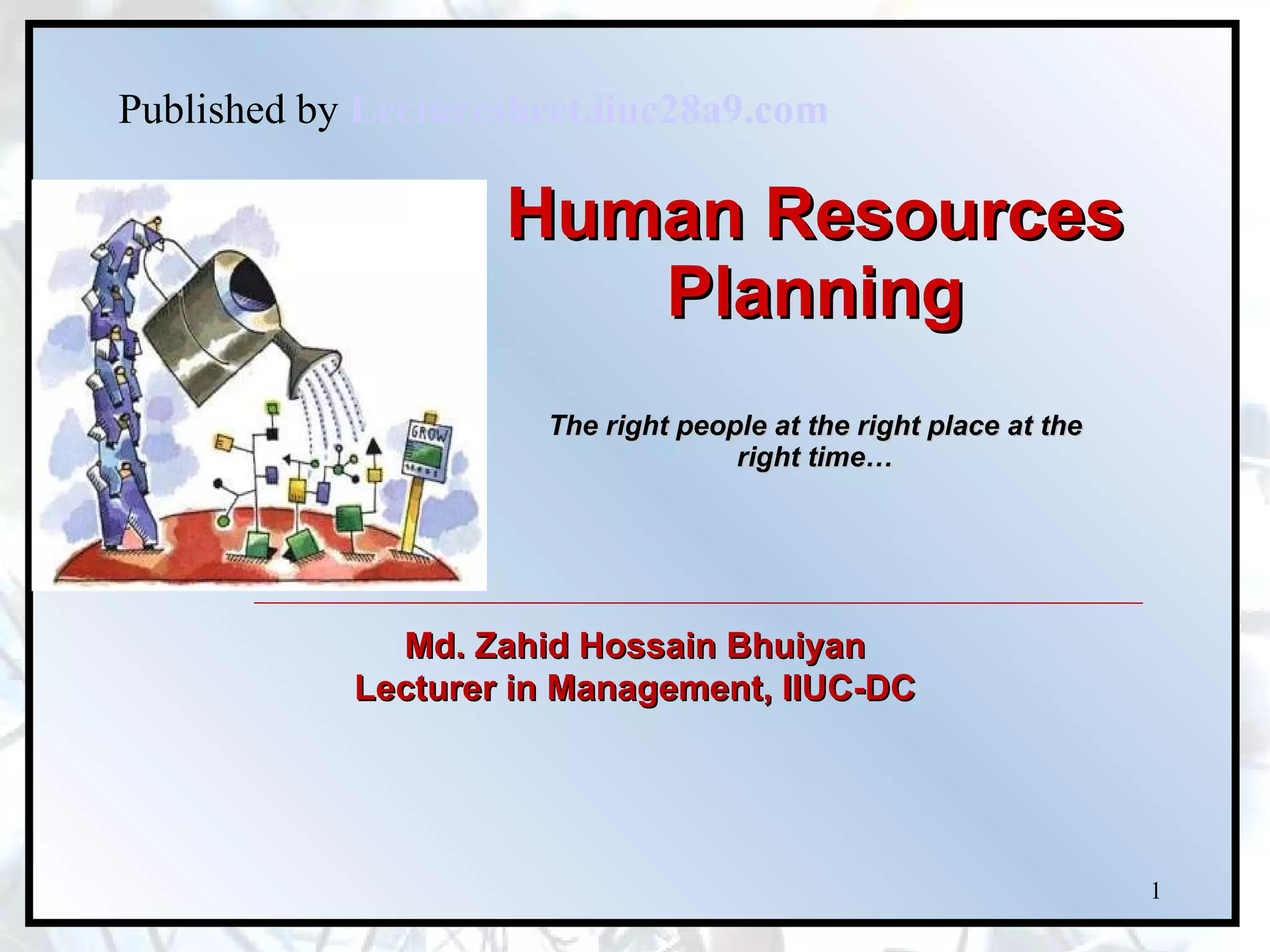
Human Resources Planning   The right people at the right place at the  right time… Md. Zahid Hossain Bhuiyan Lecturer in Management, IIUC-DC Published by  Lecturesheet.iiuc28a9.com
Emerging HR Issues   Finding specialized technical talent  Finding seasoned managers  Developing fair HR management practices Devising fair workable layoff policies  Improving productivity  Managing career development opportunities
HR Planning Human Resource planning is a systematic approach to anticipating staffing needs and determining what actions should be taken. This multisteps involves:  1. Gaining a thorough understanding of your current Human Resource;  2. Envisioning the operating environment that will most likely exist in the future;  3. Identifying the competencies that will move the organization forward to overcome challenges, seize opportunities, and thrive in what will undoubtedly be a new world of work.  4. Developing strategies and implementing tactics for building this Human Resource.
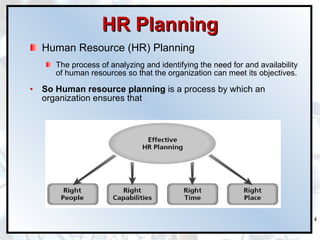
HR Planning Human Resource (HR) Planning The process of analyzing and identifying the need for and availability of human resources so that the organization can meet its objectives. So Human resource planning  is a process by which an organization ensures that
Purpose of HRP Reduces personnel costs Provides a better basis for planning employee development Improves the overall strategic plan Promotes awareness of HR planning at all levels Provides tools for evaluation Creates more opportunities for women and minority groups in work plans
HR Planning Considerations… Organizational growth New products, services, areas, industries New skills required Organizational stage Organizational structure change Budget
Importance of Planning Deal with change -- technological , social, regulatory, and environmental   Objectives "if you don't know where you are going, any road will get  you there."
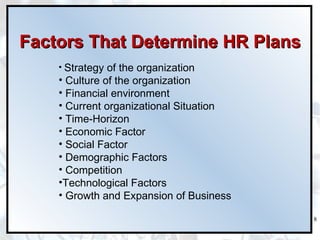
Factors That Determine HR Plans Strategy of the organization Culture of the organization Financial environment Current organizational Situation Time-Horizon Economic Factor Social Factor Demographic Factors Competition Technological Factors Growth and Expansion of Business
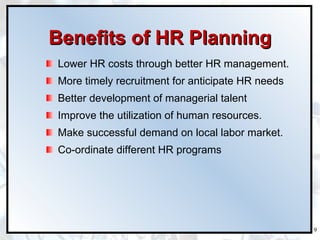
Benefits of HR Planning Lower HR costs through better HR management. More timely recruitment for anticipate HR needs Better development of managerial talent Improve the utilization of human resources. Make successful demand on local labor market. Co-ordinate different HR programs
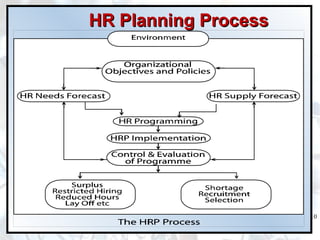
HR Planning Process                                                                                                                      
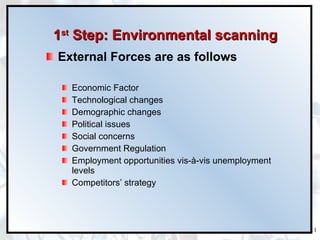
1 st  Step: Environmental scanning External Forces are as follows   Economic Factor Technological changes Demographic changes Political issues Social concerns Government Regulation Employment opportunities vis-à-vis unemployment levels Competitors’ strategy
1 st  Step: Environmental scanning Internal Changes in Organizational Environment   Product mix and capacity utilization. Acquisition and merger. Activities of expansion operations and technological up gradation. Wages revision and bonus payment. Working environment and conditions. Changes in ownership and Boards of Directors. Morale and motivation of new managers. Reorganization and induction of new managers.
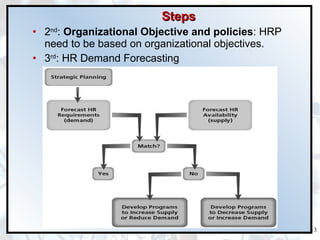
Steps 2 nd :  Organizational Objective and policies : HRP need to be based on organizational objectives.  3 rd : HR Demand Forecasting
Forecasting the Demand for Human Resources Demand forecasting  is the process of estimating the quantity and quality of people required to meet future needs of the organization   Forecasting Methods Trend Analysis:  Study of firms past employment needs over a period of years to predict future needs.  Judgmental Estimates — asking managers’ opinions, top-down or bottom-up Rules of thumb —using  general guidelines Delphi technique — asking a group of experts Nominal groups —reaching a group consensus in open discussion Mathematical Statistical regression analysis —   Productivity ratios — units produced per employee Staffing ratios — estimates of indirect labor needs Ratio Analysis:  A forecasting technique for determining future staff needs by using rating between production/ sale and employee needed.
4 th : HR Supply Forecasting The supply analysis covers  Existing human resources:  Internal sources of supply External sources of supply Present Employees: Skills Inventory: Audit of Non managers. Include-personal data, skill, salary & job, company data, capacity of individual etc. Management Inventory: Audit of Managers. It includes-Work history, strength & weakness, carrier goal, personal data, previous duties etc. Internal Sources: The techniques generally used for the purpose are: Inflow and outflow Productivity level Movement among jobs External Supply:  University, college, Recruiting agency, open job market, Experienced employee market. individuals after early retirement. Ex-Army Etc.
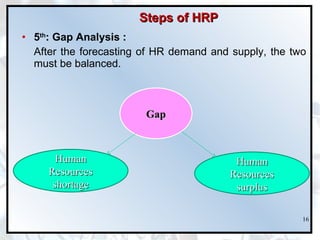
Steps of HRP 5 th : Gap Analysis : After the forecasting of HR demand and supply, the two must be balanced. Gap Human Resources shortage Human Resources surplus
Steps of HRP 6 th : Solution Analysis: Solution analysis is the development of strategies for closing the gaps through applying different startegies like: Recruitment & selection Placement, Training and development Retention activities,  Downsizing plan etc..
6 th : HR Plan Implementation Managerial Succession Planning:  Succession planning is the process of ensuring a suitable supply of successors for current and future senior or key jobs. It refers to the process of deciding how to fill the most important executive posts in the organization.  Succession planning   includes the development of  replacement charts   portray middle-to-upper level management positions that may become vacant in the near future  lists information about individuals who might qualify to fill the positions
Successful HRP  —  the role of HR HR personnel to understand the role of HRP processes Top management to be supportive Not to start with an overly complex system Healthy communications between HR personnel and line managers HR plan to be integrated with the organisation’s strategic plan Balance between qualitative and quantitative approaches
Summary An effective HRP is required for an organisation to be effective A complex system is not what’s required Measure of success of the system: if the right people are available at the right time HRP needs to be fully in integrated to the organisation’s business plan HR managers must be able to demonstrate the success of HRP processes
? Thanks

Chapter 2.hr planning

  • 1.
    Human Resources Planning The right people at the right place at the right time… Md. Zahid Hossain Bhuiyan Lecturer in Management, IIUC-DC Published by Lecturesheet.iiuc28a9.com
  • 2.
    Emerging HR Issues Finding specialized technical talent Finding seasoned managers Developing fair HR management practices Devising fair workable layoff policies Improving productivity Managing career development opportunities
  • 3.
    HR Planning HumanResource planning is a systematic approach to anticipating staffing needs and determining what actions should be taken. This multisteps involves:  1. Gaining a thorough understanding of your current Human Resource; 2. Envisioning the operating environment that will most likely exist in the future; 3. Identifying the competencies that will move the organization forward to overcome challenges, seize opportunities, and thrive in what will undoubtedly be a new world of work. 4. Developing strategies and implementing tactics for building this Human Resource.
  • 4.
    HR Planning HumanResource (HR) Planning The process of analyzing and identifying the need for and availability of human resources so that the organization can meet its objectives. So Human resource planning is a process by which an organization ensures that
  • 5.
    Purpose of HRPReduces personnel costs Provides a better basis for planning employee development Improves the overall strategic plan Promotes awareness of HR planning at all levels Provides tools for evaluation Creates more opportunities for women and minority groups in work plans
  • 6.
    HR Planning Considerations…Organizational growth New products, services, areas, industries New skills required Organizational stage Organizational structure change Budget
  • 7.
    Importance of PlanningDeal with change -- technological , social, regulatory, and environmental Objectives "if you don't know where you are going, any road will get you there."
  • 8.
    Factors That DetermineHR Plans Strategy of the organization Culture of the organization Financial environment Current organizational Situation Time-Horizon Economic Factor Social Factor Demographic Factors Competition Technological Factors Growth and Expansion of Business
  • 9.
    Benefits of HRPlanning Lower HR costs through better HR management. More timely recruitment for anticipate HR needs Better development of managerial talent Improve the utilization of human resources. Make successful demand on local labor market. Co-ordinate different HR programs
  • 10.
    HR Planning Process                                                                                                                     
  • 11.
    1 st Step: Environmental scanning External Forces are as follows Economic Factor Technological changes Demographic changes Political issues Social concerns Government Regulation Employment opportunities vis-à-vis unemployment levels Competitors’ strategy
  • 12.
    1 st Step: Environmental scanning Internal Changes in Organizational Environment Product mix and capacity utilization. Acquisition and merger. Activities of expansion operations and technological up gradation. Wages revision and bonus payment. Working environment and conditions. Changes in ownership and Boards of Directors. Morale and motivation of new managers. Reorganization and induction of new managers.
  • 13.
    Steps 2 nd: Organizational Objective and policies : HRP need to be based on organizational objectives. 3 rd : HR Demand Forecasting
  • 14.
    Forecasting the Demandfor Human Resources Demand forecasting is the process of estimating the quantity and quality of people required to meet future needs of the organization Forecasting Methods Trend Analysis: Study of firms past employment needs over a period of years to predict future needs. Judgmental Estimates — asking managers’ opinions, top-down or bottom-up Rules of thumb —using general guidelines Delphi technique — asking a group of experts Nominal groups —reaching a group consensus in open discussion Mathematical Statistical regression analysis — Productivity ratios — units produced per employee Staffing ratios — estimates of indirect labor needs Ratio Analysis: A forecasting technique for determining future staff needs by using rating between production/ sale and employee needed.
  • 15.
    4 th :HR Supply Forecasting The supply analysis covers Existing human resources: Internal sources of supply External sources of supply Present Employees: Skills Inventory: Audit of Non managers. Include-personal data, skill, salary & job, company data, capacity of individual etc. Management Inventory: Audit of Managers. It includes-Work history, strength & weakness, carrier goal, personal data, previous duties etc. Internal Sources: The techniques generally used for the purpose are: Inflow and outflow Productivity level Movement among jobs External Supply: University, college, Recruiting agency, open job market, Experienced employee market. individuals after early retirement. Ex-Army Etc.
  • 16.
    Steps of HRP5 th : Gap Analysis : After the forecasting of HR demand and supply, the two must be balanced. Gap Human Resources shortage Human Resources surplus
  • 17.
    Steps of HRP6 th : Solution Analysis: Solution analysis is the development of strategies for closing the gaps through applying different startegies like: Recruitment & selection Placement, Training and development Retention activities, Downsizing plan etc..
  • 18.
    6 th :HR Plan Implementation Managerial Succession Planning: Succession planning is the process of ensuring a suitable supply of successors for current and future senior or key jobs. It refers to the process of deciding how to fill the most important executive posts in the organization. Succession planning includes the development of replacement charts portray middle-to-upper level management positions that may become vacant in the near future lists information about individuals who might qualify to fill the positions
  • 19.
    Successful HRP — the role of HR HR personnel to understand the role of HRP processes Top management to be supportive Not to start with an overly complex system Healthy communications between HR personnel and line managers HR plan to be integrated with the organisation’s strategic plan Balance between qualitative and quantitative approaches
  • 20.
    Summary An effectiveHRP is required for an organisation to be effective A complex system is not what’s required Measure of success of the system: if the right people are available at the right time HRP needs to be fully in integrated to the organisation’s business plan HR managers must be able to demonstrate the success of HRP processes
  • 21.

Editor's Notes

  • #5 HRM Developed by N. Zaidi
  • #9 HRM Developed by N. Zaidi
  • #10 HRM Developed by N. Zaidi
  • #11 HRM Developed by N. Zaidi
  • #14 HRM Developed by N. Zaidi
  • #15 HRM Developed by N. Zaidi
  • #16 HRM Developed by N. Zaidi
  • #19 HRM Developed by N. Zaidi