SELECTION
Selection
• The process of choosing from a group of
applicants the individual best suited for a
particular position and an organization
• Goal of the selection process is to
properly match people with jobs and the
organization
• Individuals overqualified, underqualified,
or do not fit either the job or the
organization’s culture, will probably leave
the firm
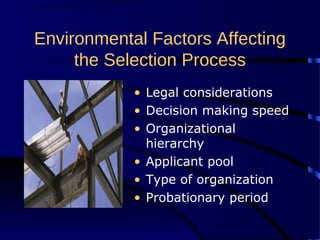
Environmental Factors Affecting
the Selection Process
• Legal considerations
• Decision making speed
• Organizational
hierarchy
• Applicant pool
• Type of organization
• Probationary period
Legal Considerations
• Human resource management is
greatly influenced by legislation,
executive orders, and court
decisions
• Hiring managers must have
extensive knowledge of the legal
aspects of selection
Speed of Decision Making
• At times, speed is crucial and a few
phone calls and two brief interviews
may constitute the entire selection
procedure
• Conducting a national search to select
a chief executive officer may take
months
• In bureaucracies, the selection
process often requires a considerable
amount of time
Organizational Hierarchy
• Extensive background checks and
interviewing are conducted for the
executive position
• An applicant for a clerical position
would most likely take a word
processing test and perhaps have
a short employment interview
Applicant Pool
• Selection Ratio - The number of
people hired for a particular job
compared to the individuals in the
applicant pool
• A selection ratio of 1:10 indicates
that there is only one applicant
hired out of 10 applicants.
• The common rule selection ratio is
1:3 i.e. to hire 1 person the pool of
candidates should be 3.
Type of Organization
• Prospective employees in private sector
are screened with regard to how they
can help achieve profit goals
• Government civil service systems
typically identify qualified applicants
through competitive examinations
• Individuals being considered for
positions in non-profit organizations
must not only be qualified but also
dedicated to this type work
Probationary Period
• Practice may be to check on the validity
of the process.
• If an individual can successfully perform
the job during the probationary period,
other selection tools are not needed
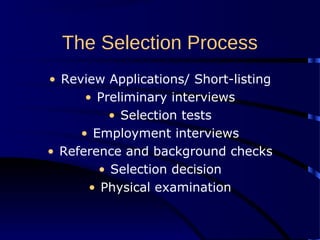
The Selection Process
• Review Applications/ Short-listing
• Preliminary interviews
• Selection tests
• Employment interviews
• Reference and background checks
• Selection decision
• Physical examination
Review of Applications
• Each person completes an application
to determine if there is a match
between individual and the position
• Essential information included and
presented in a standardized format
• Certification that everything on the
form is true
• Checking of Qualification/ training/
job experience/ reference etc.
Preliminary Interview
• Removes obviously unqualified
individuals
• Ask a few straightforward questions
• May qualify to work in other open
positions
• Telephone interviews
• Videotaped interviews
• Computer interviews
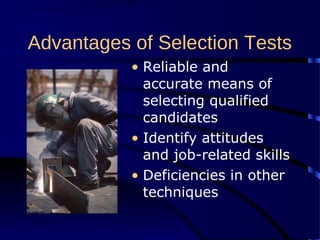
Advantages of Selection Tests
• Reliable and
accurate means of
selecting qualified
candidates
• Identify attitudes
and job-related skills
• Deficiencies in other
techniques
Choose the Tests
– Psychological
– Intellectual
– Technical
– Aptitude
– Interest inventories
– Clerical skills test
– Service ability tests
– Management aptitude test
– Team skills test
– Sales ability test
Available tests include:
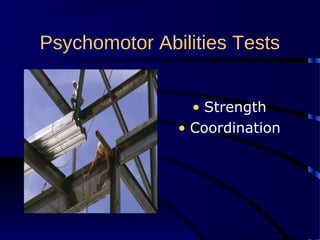
Psychomotor Abilities Tests
• Strength
• Coordination
Job Knowledge Tests
• Measure a candidate's
knowledge of the duties of
the position for which he or
she is applying.
Work-Sample (Simulation)
• Tests that require an applicant to
perform a task or set of tasks
representative of the job
• Such tests by their nature are job
related
• Produces a high predictive validity,
reduces adverse impact, and is
more acceptable to applicants
Vocational Interests
• Indicate the occupation in which a
person is most interested and is
most likely to be satisfied with
Personality Tests
• Traits
• Temperaments
• Dispositions
(Nature/Character)
Genetic Testing
• Determines whether a person
carries the gene transformation for
certain diseases, including heart
disease, Hypertension, cancer TB
etc.
End of Section I
The Employment Interview
Goal-oriented conversation
in which interviewer and
applicant exchange
information
The Employment Interview
Basic Rules
–Interview planning
–Content of the interview
Interview Planning
• Compare application and resume with
job requirements
• Develop questions related to qualities
sought
• Step-by-step plan to present position,
company, division, and department
• Determine how to ask for examples of
past applicant behavior, not what future
behavior might be
Content of the Interview
• Occupational experience
• Academic achievement
• Interpersonal skills
• Personal qualities
• Organizational fit
• Candidate’s objectives
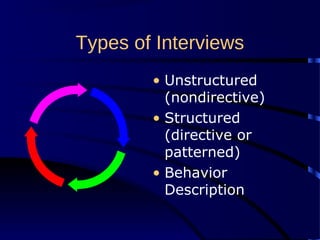
Types of Interviews
• Unstructured
(nondirective)
• Structured
(directive or
patterned)
• Behavior
Description
Unstructured (Nondirective)
Interview
• Asks probing, open-ended
questions
• Encourages applicant to do
much of the talking
• Often time-consuming
• Different information from
different candidates
• Potential legal woes
Structured (Directive) Interview
• Situational questions
• Job knowledge
questions
• Job-sample simulation
questions
• Worker requirements
questions
Behavior Description Interview
• Find knowledge, skills, abilities and
behaviors (STAR) important for job
success
• Determine which behavioral questions to
ask about particular job to elicit desired
behaviors
• Develop structured format tailored for
each job
• Set benchmark responses - examples of
good, average and bad answers
• Train interviewers
Methods of Interviewing
• One-on-one interview - Applicant meets
one-on-one with an interviewer
• Group interview - Several applicants
interact in the presence of one or more
company representatives
• Board interview - Several of the firm’s
representatives interview one candidate
• Stress interview - Anxiety is intentionally
created
• Realistic job previews - Job information is
conveyed to the applicant in an unbiased
manner
Potential Interviewing
Problems
• Inappropriate questions
• Premature judgments
• Interviewer domination
• Inconsistent questions
• Central tendency
Potential Interviewing Problems
(Continued)
• Halo error – like me
tendency
• Interviewer bias
• Lack of training
• Nonverbal communication
Assessment Centers
• Candidates subjected to exercises that
simulate actual job tasks
• In-basket exercises
• Management games
• Leaderless discussion groups
• Mock interviews
• Measures candidates’ skills in
prioritizing, delegating and decision-
making
Personal Reference Checks
• Provides additional insight
into applicant information
• Verification of accuracy
• Applicant often required to
provide names of several
references
• More emphasis on previous
employment investigations
Professional References and
Background Investigations
• Previous employment
• Education verification
• Personal reference check
• Criminal history
• Driving record
• Civil litigation
• Workers’ compensation history
• Credit history
• Social security number verification
Negligent Hiring and Retention
• Negligent Hiring - Liability incurs when
no reasonable investigation of
applicant’s background is made and
potentially dangerous person is
assigned to the position where he or
she can inflict harm
• Negligent Retention - Keeping persons
on payroll whose records indicate strong
potential for wrongdoing
The Selection Decision
• Most critical step of all
• Person whose qualifications
(knowledge, skills, competence)
most closely conform to the
requirements of the open position
should be selected
Physical Examination
• Determine whether
applicant is physically
capable of working
– Medical Examination
– Fitness Certificate
Notification to Candidates
• Results should be made known to
candidates as soon as possible
• Delay may result in firm losing
prime candidate
• Unsuccessful candidates should
also be promptly notified

Employee Selection

  • 1.
  • 2.
    Selection • The processof choosing from a group of applicants the individual best suited for a particular position and an organization • Goal of the selection process is to properly match people with jobs and the organization • Individuals overqualified, underqualified, or do not fit either the job or the organization’s culture, will probably leave the firm
  • 3.
    Environmental Factors Affecting theSelection Process • Legal considerations • Decision making speed • Organizational hierarchy • Applicant pool • Type of organization • Probationary period
  • 4.
    Legal Considerations • Humanresource management is greatly influenced by legislation, executive orders, and court decisions • Hiring managers must have extensive knowledge of the legal aspects of selection
  • 5.
    Speed of DecisionMaking • At times, speed is crucial and a few phone calls and two brief interviews may constitute the entire selection procedure • Conducting a national search to select a chief executive officer may take months • In bureaucracies, the selection process often requires a considerable amount of time
  • 6.
    Organizational Hierarchy • Extensivebackground checks and interviewing are conducted for the executive position • An applicant for a clerical position would most likely take a word processing test and perhaps have a short employment interview
  • 7.
    Applicant Pool • SelectionRatio - The number of people hired for a particular job compared to the individuals in the applicant pool • A selection ratio of 1:10 indicates that there is only one applicant hired out of 10 applicants. • The common rule selection ratio is 1:3 i.e. to hire 1 person the pool of candidates should be 3.
  • 8.
    Type of Organization •Prospective employees in private sector are screened with regard to how they can help achieve profit goals • Government civil service systems typically identify qualified applicants through competitive examinations • Individuals being considered for positions in non-profit organizations must not only be qualified but also dedicated to this type work
  • 9.
    Probationary Period • Practicemay be to check on the validity of the process. • If an individual can successfully perform the job during the probationary period, other selection tools are not needed
  • 10.
    The Selection Process •Review Applications/ Short-listing • Preliminary interviews • Selection tests • Employment interviews • Reference and background checks • Selection decision • Physical examination
  • 11.
    Review of Applications •Each person completes an application to determine if there is a match between individual and the position • Essential information included and presented in a standardized format • Certification that everything on the form is true • Checking of Qualification/ training/ job experience/ reference etc.
  • 12.
    Preliminary Interview • Removesobviously unqualified individuals • Ask a few straightforward questions • May qualify to work in other open positions • Telephone interviews • Videotaped interviews • Computer interviews
  • 13.
    Advantages of SelectionTests • Reliable and accurate means of selecting qualified candidates • Identify attitudes and job-related skills • Deficiencies in other techniques
  • 14.
    Choose the Tests –Psychological – Intellectual – Technical – Aptitude – Interest inventories – Clerical skills test – Service ability tests – Management aptitude test – Team skills test – Sales ability test Available tests include:
  • 15.
    Psychomotor Abilities Tests •Strength • Coordination
  • 16.
    Job Knowledge Tests •Measure a candidate's knowledge of the duties of the position for which he or she is applying.
  • 17.
    Work-Sample (Simulation) • Teststhat require an applicant to perform a task or set of tasks representative of the job • Such tests by their nature are job related • Produces a high predictive validity, reduces adverse impact, and is more acceptable to applicants
  • 18.
    Vocational Interests • Indicatethe occupation in which a person is most interested and is most likely to be satisfied with
  • 19.
    Personality Tests • Traits •Temperaments • Dispositions (Nature/Character)
  • 20.
    Genetic Testing • Determineswhether a person carries the gene transformation for certain diseases, including heart disease, Hypertension, cancer TB etc.
  • 21.
  • 22.
    The Employment Interview Goal-orientedconversation in which interviewer and applicant exchange information
  • 23.
    The Employment Interview BasicRules –Interview planning –Content of the interview
  • 24.
    Interview Planning • Compareapplication and resume with job requirements • Develop questions related to qualities sought • Step-by-step plan to present position, company, division, and department • Determine how to ask for examples of past applicant behavior, not what future behavior might be
  • 25.
    Content of theInterview • Occupational experience • Academic achievement • Interpersonal skills • Personal qualities • Organizational fit • Candidate’s objectives
  • 26.
    Types of Interviews •Unstructured (nondirective) • Structured (directive or patterned) • Behavior Description
  • 27.
    Unstructured (Nondirective) Interview • Asksprobing, open-ended questions • Encourages applicant to do much of the talking • Often time-consuming • Different information from different candidates • Potential legal woes
  • 28.
    Structured (Directive) Interview •Situational questions • Job knowledge questions • Job-sample simulation questions • Worker requirements questions
  • 29.
    Behavior Description Interview •Find knowledge, skills, abilities and behaviors (STAR) important for job success • Determine which behavioral questions to ask about particular job to elicit desired behaviors • Develop structured format tailored for each job • Set benchmark responses - examples of good, average and bad answers • Train interviewers
  • 30.
    Methods of Interviewing •One-on-one interview - Applicant meets one-on-one with an interviewer • Group interview - Several applicants interact in the presence of one or more company representatives • Board interview - Several of the firm’s representatives interview one candidate • Stress interview - Anxiety is intentionally created • Realistic job previews - Job information is conveyed to the applicant in an unbiased manner
  • 31.
    Potential Interviewing Problems • Inappropriatequestions • Premature judgments • Interviewer domination • Inconsistent questions • Central tendency
  • 32.
    Potential Interviewing Problems (Continued) •Halo error – like me tendency • Interviewer bias • Lack of training • Nonverbal communication
  • 33.
    Assessment Centers • Candidatessubjected to exercises that simulate actual job tasks • In-basket exercises • Management games • Leaderless discussion groups • Mock interviews • Measures candidates’ skills in prioritizing, delegating and decision- making
  • 34.
    Personal Reference Checks •Provides additional insight into applicant information • Verification of accuracy • Applicant often required to provide names of several references • More emphasis on previous employment investigations
  • 35.
    Professional References and BackgroundInvestigations • Previous employment • Education verification • Personal reference check • Criminal history • Driving record • Civil litigation • Workers’ compensation history • Credit history • Social security number verification
  • 36.
    Negligent Hiring andRetention • Negligent Hiring - Liability incurs when no reasonable investigation of applicant’s background is made and potentially dangerous person is assigned to the position where he or she can inflict harm • Negligent Retention - Keeping persons on payroll whose records indicate strong potential for wrongdoing
  • 37.
    The Selection Decision •Most critical step of all • Person whose qualifications (knowledge, skills, competence) most closely conform to the requirements of the open position should be selected
  • 38.
    Physical Examination • Determinewhether applicant is physically capable of working – Medical Examination – Fitness Certificate
  • 39.
    Notification to Candidates •Results should be made known to candidates as soon as possible • Delay may result in firm losing prime candidate • Unsuccessful candidates should also be promptly notified