HUMAN RESOURCE PLANNING
• Human Resource Planning
• Importance of HRP
• Factors Affecting HRP
• The Planning Process
• Forecasting Techniques
• HR Plan Implementation
• Downsizing Plan
• Managerial Succession Planning
• Requisite for HRP
Lecture Overview
HUMAN RESOURCE PLANNING
Human Resource Planning (HRP) is process of forecasting
organization's future demand and supply of the right type of
people in the right numbers at the right time”
Human resource planning defined
As defined by Bulla and Scott (1994), human resource planning is ‘the process
for ensuring that the human resource requirements of an organization are
identified and plans are made for satisfying those requirements’. Reilly (2003)
defined workforce planning as: ‘A process in which an organization attempts to
estimate the demand for labour and evaluate the size, nature and sources of
supply which will be required to meet the demand.’
definition
• Process by which a company decides how an
organization should move from its current
manpower position to its desired manpower
position.
IMPORTANCE OF HRP
Importance of HRP can be highlighted by following points
1. Future Personnel Needs
• Planning helps to determine future personnel needs
• Surplus or shortage in staff is due to poor human
resource planning
• Public sector organizations facing problem of over
staffing
• Public sector organizations offering voluntary retirement
scheme (VRS)
IMPORTANCE OF HRP
2. PART OF STRATEGIC PLANNING
• All activities of HRM like HRP, hiring, remuneration, training
must be matched with strategic management
• HRP can facilitate strategic planning at two ends
• At the start, it provides information for strategy formulation
like kind of skills, and numbers of people available to
organization to pursue organization strategy
• At the end, it assist in making resource allocation decisions,
creating structure, process and determine human resource
need
3. Creating Highly Talented Personnel
• Nowadays organizations need knowledge workers and
professionals for intellectual jobs
• Technical and knowledge worker most often switch their job
creating workforce shortages
• Adoption of new technology creates demand for technical
and trained workers at the same time resulting into excess
of non technical staff
• Management succession planning helps to decide who will
replace/substitute the chief executive/top management?
IMPORTANCE OF HRP
IMPORTANCE OF HRP
4. International Growth Strategies
• Global expansion strategy relies on HRP. From where to
recruit employees (foreign, local, or reassignment) to fill key
jobs
• HRP integrate HR plan with organization external & internal
situations (cultural consideration, labor and employment
laws)
• HR department often need to fill key jobs with expatriates,
therefore, need to motivate, train, and compensate them.
5. Foundation for Personnel Functions
• HRP provides essential information in development and
implementation of personnel functions like recruitment,
selection, transfer, postings, promotions, layoff,
compensation, and training
IMPORTANCE OF HRP
6. Increasing Investment in Human Resources
• Investment perspective of human resource highlights the
need of proper HRP
• Human Resources Planning help to make right
investment decision in company's human resources
7. Unite the Perspective of Line and Staff Managers
• HRP will identify and harmonize the purpose of HR staff
and line managers
• For HRP, HR staff require input from Line manager as
unit managers knows better the human resource need of
their department
• Effective communication between line and HR managers
critical for successful HRP
IMPORTANCE OF HRP
FACTORS AFFECTING HRP
1. Type and strategy of an organization
2. Organizational growth cycle and planning
3. Environmental uncertainties
4. Time horizon
5. Type and quality of forecasting information
6. Nature of job being filled
7. Outsourcing
FACTORS AFFECTING HRP
Type and strategy of an organization
• Global expansion strategy mean hiring of employees
whereas mergers and acquisition strategy means
downsizing/layoff
• The decision whether to be proactive or reactive in HRP
Organizational Growth Cycle
• Small organizations at the start of business may not have
HRP
• In growth stage focus is on recruitment
• In declining phase HRP is reactive in nature and focus is on
retirement, and layoff
FACTORS AFFECTING HRP
3 Environmental Uncertainties
Degree of uncertainty determines focus and time span
of HRP
4 Time Horizon
Short term and long term personnel plans depend upon
level of uncertainty
5 Quality of Information
HRIS and Job analysis information need to be in place
that provide accurate and timely data for HRP
6 Nature of Jobs being filled
Job vacancies exist due to retirement, separation, job
hoping, promotion, and growth
Managerial and technical positions are difficult to fill in
Sufficient lead time is required to hire suitable candidates
of vacant position
7 Outsourcing
Sub contracting or outsourcing critical business activities
limits new hiring in this case HRP is not much required
FACTORS AFFECTING HRP
15
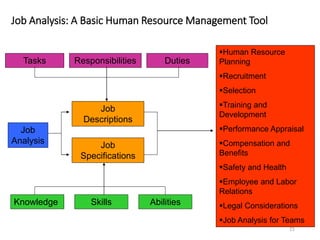
Job Analysis: A Basic Human Resource Management Tool
Tasks Responsibilities Duties
Job
Analysis
Job
Descriptions
Job
Specifications
Knowledge Skills Abilities
Human Resource
Planning
Recruitment
Selection
Training and
Development
Performance Appraisal
Compensation and
Benefits
Safety and Health
Employee and Labor
Relations
Legal Considerations
Job Analysis for Teams
16
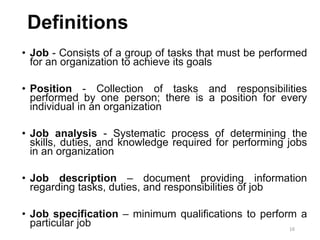
Definitions
• Job - Consists of a group of tasks that must be performed
for an organization to achieve its goals
• Position - Collection of tasks and responsibilities
performed by one person; there is a position for every
individual in an organization
• Job analysis - Systematic process of determining the
skills, duties, and knowledge required for performing jobs
in an organization
• Job description – document providing information
regarding tasks, duties, and responsibilities of job
• Job specification – minimum qualifications to perform a
particular job
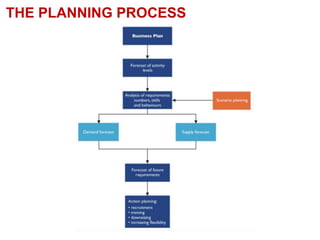
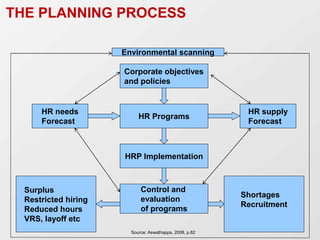
THE PLANNING PROCESS
HR needs
Forecast
HR supply
Forecast
Corporate objectives
and policies
HR Programs
HRP Implementation
Control and
evaluation
of programs
Surplus
Restricted hiring
Reduced hours
VRS, layoff etc
Shortages
Recruitment
Source: Aswathappa, 2008, p.82
Environmental scanning
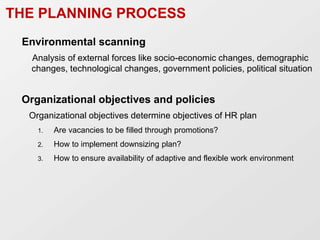
THE PLANNING PROCESS
Environmental scanning
Analysis of external forces like socio-economic changes, demographic
changes, technological changes, government policies, political situation
Organizational objectives and policies
Organizational objectives determine objectives of HR plan
1. Are vacancies to be filled through promotions?
2. How to implement downsizing plan?
3. How to ensure availability of adaptive and flexible work environment
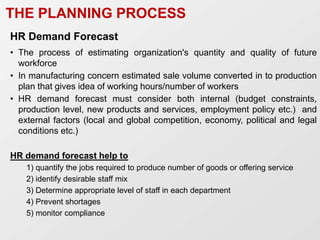
HR Demand Forecast
• The process of estimating organization's quantity and quality of future
workforce
• In manufacturing concern estimated sale volume converted in to production
plan that gives idea of working hours/number of workers
• HR demand forecast must consider both internal (budget constraints,
production level, new products and services, employment policy etc.) and
external factors (local and global competition, economy, political and legal
conditions etc.)
HR demand forecast help to
1) quantify the jobs required to produce number of goods or offering service
2) identify desirable staff mix
3) Determine appropriate level of staff in each department
4) Prevent shortages
5) monitor compliance
THE PLANNING PROCESS
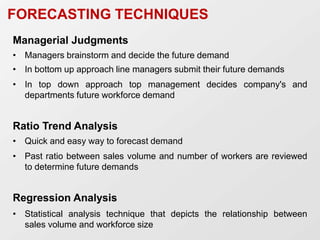
FORECASTING TECHNIQUES
Managerial Judgments
• Managers brainstorm and decide the future demand
• In bottom up approach line managers submit their future demands
• In top down approach top management decides company's and
departments future workforce demand
Ratio Trend Analysis
• Quick and easy way to forecast demand
• Past ratio between sales volume and number of workers are reviewed
to determine future demands
Regression Analysis
• Statistical analysis technique that depicts the relationship between
sales volume and workforce size
FORECASTING TECHNIQUES
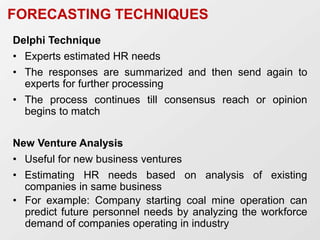
Delphi Technique
• Experts estimated HR needs
• The responses are summarized and then send again to
experts for further processing
• The process continues till consensus reach or opinion
begins to match
New Venture Analysis
• Useful for new business ventures
• Estimating HR needs based on analysis of existing
companies in same business
• For example: Company starting coal mine operation can
predict future personnel needs by analyzing the workforce
demand of companies operating in industry
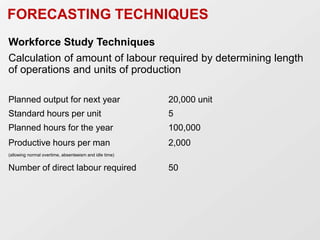
Workforce Study Techniques
Calculation of amount of labour required by determining length
of operations and units of production
Planned output for next year 20,000 unit
Standard hours per unit 5
Planned hours for the year 100,000
Productive hours per man 2,000
(allowing normal overtime, absenteeism and idle time)
Number of direct labour required 50
FORECASTING TECHNIQUES
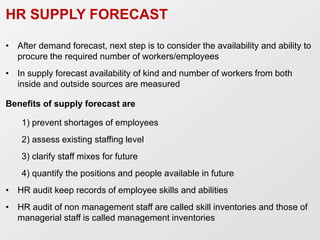
HR SUPPLY FORECAST
• After demand forecast, next step is to consider the availability and ability to
procure the required number of workers/employees
• In supply forecast availability of kind and number of workers from both
inside and outside sources are measured
Benefits of supply forecast are
1) prevent shortages of employees
2) assess existing staffing level
3) clarify staff mixes for future
4) quantify the positions and people available in future
• HR audit keep records of employee skills and abilities
• HR audit of non management staff are called skill inventories and those of
managerial staff is called management inventories
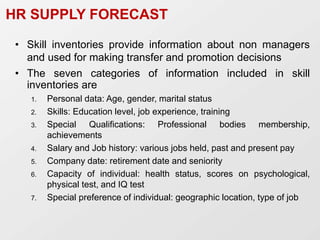
• Skill inventories provide information about non managers
and used for making transfer and promotion decisions
• The seven categories of information included in skill
inventories are
1. Personal data: Age, gender, marital status
2. Skills: Education level, job experience, training
3. Special Qualifications: Professional bodies membership,
achievements
4. Salary and Job history: various jobs held, past and present pay
5. Company date: retirement date and seniority
6. Capacity of individual: health status, scores on psychological,
physical test, and IQ test
7. Special preference of individual: geographic location, type of job
HR SUPPLY FORECAST
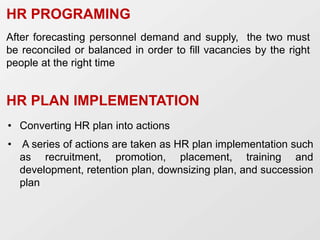
HR PROGRAMING
After forecasting personnel demand and supply, the two must
be reconciled or balanced in order to fill vacancies by the right
people at the right time
HR PLAN IMPLEMENTATION
• Converting HR plan into actions
• A series of actions are taken as HR plan implementation such
as recruitment, promotion, placement, training and
development, retention plan, downsizing plan, and succession
plan
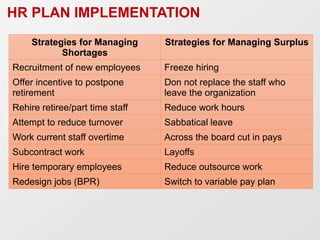
HR PLAN IMPLEMENTATION
Strategies for Managing
Shortages
Strategies for Managing Surplus
Recruitment of new employees Freeze hiring
Offer incentive to postpone
retirement
Don not replace the staff who
leave the organization
Rehire retiree/part time staff Reduce work hours
Attempt to reduce turnover Sabbatical leave
Work current staff overtime Across the board cut in pays
Subcontract work Layoffs
Hire temporary employees Reduce outsource work
Redesign jobs (BPR) Switch to variable pay plan
28
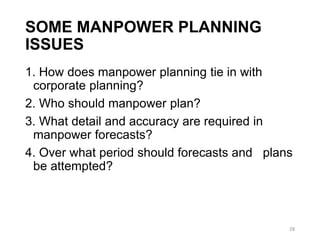
SOME MANPOWER PLANNING
ISSUES
1. How does manpower planning tie in with
corporate planning?
2. Who should manpower plan?
3. What detail and accuracy are required in
manpower forecasts?
4. Over what period should forecasts and plans
be attempted?
29
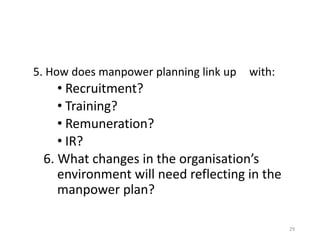
5. How does manpower planning link up with:
• Recruitment?
• Training?
• Remuneration?
• IR?
6. What changes in the organisation’s
environment will need reflecting in the
manpower plan?
Thank you

Hr planning

  • 1.
  • 2.
    • Human ResourcePlanning • Importance of HRP • Factors Affecting HRP • The Planning Process • Forecasting Techniques • HR Plan Implementation • Downsizing Plan • Managerial Succession Planning • Requisite for HRP Lecture Overview
  • 3.
    HUMAN RESOURCE PLANNING HumanResource Planning (HRP) is process of forecasting organization's future demand and supply of the right type of people in the right numbers at the right time” Human resource planning defined As defined by Bulla and Scott (1994), human resource planning is ‘the process for ensuring that the human resource requirements of an organization are identified and plans are made for satisfying those requirements’. Reilly (2003) defined workforce planning as: ‘A process in which an organization attempts to estimate the demand for labour and evaluate the size, nature and sources of supply which will be required to meet the demand.’
  • 4.
    definition • Process bywhich a company decides how an organization should move from its current manpower position to its desired manpower position.
  • 5.
    IMPORTANCE OF HRP Importanceof HRP can be highlighted by following points 1. Future Personnel Needs • Planning helps to determine future personnel needs • Surplus or shortage in staff is due to poor human resource planning • Public sector organizations facing problem of over staffing • Public sector organizations offering voluntary retirement scheme (VRS)
  • 6.
    IMPORTANCE OF HRP 2.PART OF STRATEGIC PLANNING • All activities of HRM like HRP, hiring, remuneration, training must be matched with strategic management • HRP can facilitate strategic planning at two ends • At the start, it provides information for strategy formulation like kind of skills, and numbers of people available to organization to pursue organization strategy • At the end, it assist in making resource allocation decisions, creating structure, process and determine human resource need
  • 7.
    3. Creating HighlyTalented Personnel • Nowadays organizations need knowledge workers and professionals for intellectual jobs • Technical and knowledge worker most often switch their job creating workforce shortages • Adoption of new technology creates demand for technical and trained workers at the same time resulting into excess of non technical staff • Management succession planning helps to decide who will replace/substitute the chief executive/top management? IMPORTANCE OF HRP
  • 8.
    IMPORTANCE OF HRP 4.International Growth Strategies • Global expansion strategy relies on HRP. From where to recruit employees (foreign, local, or reassignment) to fill key jobs • HRP integrate HR plan with organization external & internal situations (cultural consideration, labor and employment laws) • HR department often need to fill key jobs with expatriates, therefore, need to motivate, train, and compensate them.
  • 9.
    5. Foundation forPersonnel Functions • HRP provides essential information in development and implementation of personnel functions like recruitment, selection, transfer, postings, promotions, layoff, compensation, and training IMPORTANCE OF HRP 6. Increasing Investment in Human Resources • Investment perspective of human resource highlights the need of proper HRP • Human Resources Planning help to make right investment decision in company's human resources
  • 10.
    7. Unite thePerspective of Line and Staff Managers • HRP will identify and harmonize the purpose of HR staff and line managers • For HRP, HR staff require input from Line manager as unit managers knows better the human resource need of their department • Effective communication between line and HR managers critical for successful HRP IMPORTANCE OF HRP
  • 11.
    FACTORS AFFECTING HRP 1.Type and strategy of an organization 2. Organizational growth cycle and planning 3. Environmental uncertainties 4. Time horizon 5. Type and quality of forecasting information 6. Nature of job being filled 7. Outsourcing
  • 12.
    FACTORS AFFECTING HRP Typeand strategy of an organization • Global expansion strategy mean hiring of employees whereas mergers and acquisition strategy means downsizing/layoff • The decision whether to be proactive or reactive in HRP Organizational Growth Cycle • Small organizations at the start of business may not have HRP • In growth stage focus is on recruitment • In declining phase HRP is reactive in nature and focus is on retirement, and layoff
  • 13.
    FACTORS AFFECTING HRP 3Environmental Uncertainties Degree of uncertainty determines focus and time span of HRP 4 Time Horizon Short term and long term personnel plans depend upon level of uncertainty 5 Quality of Information HRIS and Job analysis information need to be in place that provide accurate and timely data for HRP
  • 14.
    6 Nature ofJobs being filled Job vacancies exist due to retirement, separation, job hoping, promotion, and growth Managerial and technical positions are difficult to fill in Sufficient lead time is required to hire suitable candidates of vacant position 7 Outsourcing Sub contracting or outsourcing critical business activities limits new hiring in this case HRP is not much required FACTORS AFFECTING HRP
  • 15.
    15 Job Analysis: ABasic Human Resource Management Tool Tasks Responsibilities Duties Job Analysis Job Descriptions Job Specifications Knowledge Skills Abilities Human Resource Planning Recruitment Selection Training and Development Performance Appraisal Compensation and Benefits Safety and Health Employee and Labor Relations Legal Considerations Job Analysis for Teams
  • 16.
    16 Definitions • Job -Consists of a group of tasks that must be performed for an organization to achieve its goals • Position - Collection of tasks and responsibilities performed by one person; there is a position for every individual in an organization • Job analysis - Systematic process of determining the skills, duties, and knowledge required for performing jobs in an organization • Job description – document providing information regarding tasks, duties, and responsibilities of job • Job specification – minimum qualifications to perform a particular job
  • 17.
  • 18.
    THE PLANNING PROCESS HRneeds Forecast HR supply Forecast Corporate objectives and policies HR Programs HRP Implementation Control and evaluation of programs Surplus Restricted hiring Reduced hours VRS, layoff etc Shortages Recruitment Source: Aswathappa, 2008, p.82 Environmental scanning
  • 19.
    THE PLANNING PROCESS Environmentalscanning Analysis of external forces like socio-economic changes, demographic changes, technological changes, government policies, political situation Organizational objectives and policies Organizational objectives determine objectives of HR plan 1. Are vacancies to be filled through promotions? 2. How to implement downsizing plan? 3. How to ensure availability of adaptive and flexible work environment
  • 20.
    HR Demand Forecast •The process of estimating organization's quantity and quality of future workforce • In manufacturing concern estimated sale volume converted in to production plan that gives idea of working hours/number of workers • HR demand forecast must consider both internal (budget constraints, production level, new products and services, employment policy etc.) and external factors (local and global competition, economy, political and legal conditions etc.) HR demand forecast help to 1) quantify the jobs required to produce number of goods or offering service 2) identify desirable staff mix 3) Determine appropriate level of staff in each department 4) Prevent shortages 5) monitor compliance THE PLANNING PROCESS
  • 21.
    FORECASTING TECHNIQUES Managerial Judgments •Managers brainstorm and decide the future demand • In bottom up approach line managers submit their future demands • In top down approach top management decides company's and departments future workforce demand Ratio Trend Analysis • Quick and easy way to forecast demand • Past ratio between sales volume and number of workers are reviewed to determine future demands Regression Analysis • Statistical analysis technique that depicts the relationship between sales volume and workforce size
  • 22.
    FORECASTING TECHNIQUES Delphi Technique •Experts estimated HR needs • The responses are summarized and then send again to experts for further processing • The process continues till consensus reach or opinion begins to match New Venture Analysis • Useful for new business ventures • Estimating HR needs based on analysis of existing companies in same business • For example: Company starting coal mine operation can predict future personnel needs by analyzing the workforce demand of companies operating in industry
  • 23.
    Workforce Study Techniques Calculationof amount of labour required by determining length of operations and units of production Planned output for next year 20,000 unit Standard hours per unit 5 Planned hours for the year 100,000 Productive hours per man 2,000 (allowing normal overtime, absenteeism and idle time) Number of direct labour required 50 FORECASTING TECHNIQUES
  • 24.
    HR SUPPLY FORECAST •After demand forecast, next step is to consider the availability and ability to procure the required number of workers/employees • In supply forecast availability of kind and number of workers from both inside and outside sources are measured Benefits of supply forecast are 1) prevent shortages of employees 2) assess existing staffing level 3) clarify staff mixes for future 4) quantify the positions and people available in future • HR audit keep records of employee skills and abilities • HR audit of non management staff are called skill inventories and those of managerial staff is called management inventories
  • 25.
    • Skill inventoriesprovide information about non managers and used for making transfer and promotion decisions • The seven categories of information included in skill inventories are 1. Personal data: Age, gender, marital status 2. Skills: Education level, job experience, training 3. Special Qualifications: Professional bodies membership, achievements 4. Salary and Job history: various jobs held, past and present pay 5. Company date: retirement date and seniority 6. Capacity of individual: health status, scores on psychological, physical test, and IQ test 7. Special preference of individual: geographic location, type of job HR SUPPLY FORECAST
  • 26.
    HR PROGRAMING After forecastingpersonnel demand and supply, the two must be reconciled or balanced in order to fill vacancies by the right people at the right time HR PLAN IMPLEMENTATION • Converting HR plan into actions • A series of actions are taken as HR plan implementation such as recruitment, promotion, placement, training and development, retention plan, downsizing plan, and succession plan
  • 27.
    HR PLAN IMPLEMENTATION Strategiesfor Managing Shortages Strategies for Managing Surplus Recruitment of new employees Freeze hiring Offer incentive to postpone retirement Don not replace the staff who leave the organization Rehire retiree/part time staff Reduce work hours Attempt to reduce turnover Sabbatical leave Work current staff overtime Across the board cut in pays Subcontract work Layoffs Hire temporary employees Reduce outsource work Redesign jobs (BPR) Switch to variable pay plan
  • 28.
    28 SOME MANPOWER PLANNING ISSUES 1.How does manpower planning tie in with corporate planning? 2. Who should manpower plan? 3. What detail and accuracy are required in manpower forecasts? 4. Over what period should forecasts and plans be attempted?
  • 29.
    29 5. How doesmanpower planning link up with: • Recruitment? • Training? • Remuneration? • IR? 6. What changes in the organisation’s environment will need reflecting in the manpower plan?
  • 30.