Learning Outcomes
After studying this lesson successfully, you
should be able to
⮚ Define what HRP is
⮚ Explain why HRP is important for an organization
⮚ Understand the HRP process
⮚ Explain the causes of future HR demand and HR supply
⮚ Identify Strategies to be taken for surplus condition
and shortage condition
Definition
1.HRP is the process of determining future employee
needs and deciding steps or strategies to achieve
those needs for the purpose of accomplishing
organization goals and objectives.
H.H.D.N.P. Opatha
Significance of HRP
⮚ To determine future employee needs
⮚ To utilize HR more efficiency and effectively
⮚ To control employee cost
⮚ To develop high talent employees
⮚ To formulate and implement strategic plans
To determine future employee needs
An organization wants to know future employee needs. What
type of employees are needed? How many employees are
needed for the next month or next year? To get answers for
the two questions correctly it is essential to do HRP. Without
doing HRP the organization will not be able to determine
employee needs for future.
To utilize HR more efficiency and effectively
Careful analysis of all HRM activities shows that their
effectiveness and efficiency, which results in increased
productivity, depends on HRP
To control employee cost
Through HRP it is possible to know in advance employee
surpluses or shortages which may occur in future. Hence it is
possible for the organization to get prepared in advance in
order to prevent from occurring surpluses or shortage of
employees.
To develop high talent employees
Generally there is a scarcity of highly competent/ talented
employees in the market. The lead time that is required to
procure, train and develop such employees is long. Successful
HRP provides an adequate lead time for the procurement,
training and development of such employees.
To formulate and implement strategic plans
Modern competitive organizations engage in strategic
planning which results in strategy that is the organization's
long term plan. In fact strategic plan involves long- term
decisions to achieve the organization’s vision, mission and
strategic objectives. HRP provides information inputs for
strategic planning efforts. It will show human resource
strength and weaknesses which will be useful for developing
the long term plan.
Reasons for some organization not engaged in HRP
⮚ Lack of understanding about the purposes of HRP
⮚ Non – availability of experts in HRM within the organization
or inability of procuring such experts to the organization
⮚ Attitude that doing HRP is unnecessary for organizations in a
country like Sri Lanka as it has a high rate of unemployment
⮚ Habit of doing staffing field according to human resource
needs which arise on day to day basis
⮚ Lack of financial resources
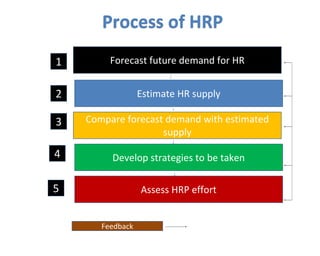
Process of HRP
1
2
3
4
5
Forecast future demand for HR
Estimate HR supply
Compare forecast demand with estimated
supply
Develop strategies to be taken
Assess HRP effort
Feedback
1.Forecasting Demand for HR
Forecasting employee requirements for the
organization comes under this step. Forecasting
demand for human resources involves estimating the
types and numbers of employees needed for future
Factors affecting future demand for HR
⮚Demand for the product
⮚Goals and strategic plans of the organization
⮚Production methods
⮚Retirements
⮚Resignations
⮚Deaths
⮚Leave of absence
⮚Termination
⮚External factors
Forecasting Techniques
1. Informal Forecast
This is the easiest way of forecasting future
demand for human resources. Under this
technique, future demand for human
resources is determined without a
systematic base and it is done quickly and
randomly. Generally this technique may be
good only for small organizations but cannot
be recommended as a good method for
large organizations to apply.
2. Formal Expert survey
Systematically future demand for human
resources is estimated by conducting a
survey among experts. A better method is
for planners to survey managers, who are
experts about their department’s future
employments needs; and centralization of
this information permits formal plans that
identify the organization’s future demands.
Data collection can be done by using a
questionnaire or conducting interviews
3. Delphi method
This is a special kind of expert survey. It is more sophisticated
than the formal expert survey. The Delphi technique is to
solicit estimates from a group of experts, usually managers
and HR managers and HR department planner acts as an
intermediary. Its purpose is to obtain the most reliable
consensus of opinion of a group of experts; it consists of
intensive questioning of each expert, through a series of
questionnaires, to obtain data that can be used to make “
educated” forecast; and the procedures are designed to avoid
direct meetings between the experts in order to maximize
independent thinking. Thus, the technique attempts to
obtain independent judgments from a panel of experts.
Five steps in the Delphi technique
1. An issue, question, or problem is identified
2. A small group or panel of ten or fewer experts is
identified
3. Independent judgments about the issue are
obtained from each expert through a
questionnaire or structured interview
4. An intermediary or facilitator collects, analyze
and feeds back information from the first
questionnaire or interview to each expert
5. Steps 3 and 4 are repeated until there is a
consensus on the issue or problem
4. Unit Forecasting
Unit forecasting method is a broad approach
to human resource forecasting and it uses a
“ bottom up” approach.
5.Extrapolation
Extrapolation involves extending past rates of
change into future . It is based on past data
and an attempt is made to find a trend or a
pattern that might continue into the future.
6. Indexation
This is another approach that mean making
forecast based on the ratio between (1)
some casual factor(like sales volume) and (2)
number of employee required
Staffing table/ Manning table
A staffing table lists the future emplacement
needs for each type of job. This listing may
be a specific number or an approximate
range of needs, depending on the accuracy
of the underlying forecast. These estimates
allow personnel specialists to match short-
range demand and supply.
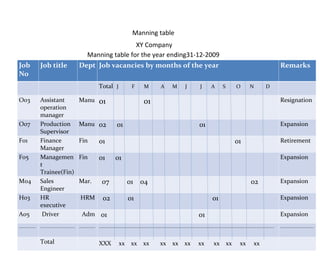
Manning table
XY Company
Manning table for the year ending31-12-2009
Job
No
Job title Dept Job vacancies by months of the year Remarks
Total J F M A M J J A S O N D
O03 Assistant
operation
manager
Manu 01 01 Resignation
O07 Production
Supervisor
Manu 02 01 01 Expansion
F01 Finance
Manager
Fin 01 01 Retirement
F05 Managemen
t
Trainee(Fin)
Fin 01 01 Expansion
M04 Sales
Engineer
Mar. 07 01 04 02 Expansion
H03 HR
executive
HRM 02 01 01 Expansion
A05 Driver Adm 01 01 Expansion
….............. .................................. …………….. ……………………………………………………………………………………………………………………………………………………………….. ……………………………..
Total XXX xx xx xx xx xx xx xx xx xx xx xx
02.Estimate HR supply
⮚ Internal Supply
Internal supply consists of current employees who can be
promoted and transferred to meet forecast needs or fill job
vacancies which are in the staffing table.
⮚ External supply
External supply consist of people who are working for other
organizations in industries and job seekers who are
unemployed. They are the people who are in the employee
market.
Steps in HR supply
1.Auditing current HR
This mean assessing education, experience and
competencies of all the current employees in
the organization. In this context HR audit is a
systematic attempt to summarize each
employee’s education, experience and
competencies.
The audit results in preparing two documents
1.Skill inventories
2.Management inventories
Skill inventories- The audits of non managers
are called skill inventories
A skill inventory should contain the following information accurately:
⮚ Identification information of the employee(name, address, sex, age, etc.)
⮚ Identification information of the current job( job title, job location etc.)
⮚ Education ( academic and professional)
⮚ Experiences including previous jobs held
⮚ Seniority
⮚ Special competencies
⮚ Trainings
⮚ Current and past job performance evaluations
⮚ Promotability
⮚ Weaknesses
⮚ Preferences
Management inventories- audits of managers
are called management inventories.
In addition to the above, a management
inventory includes the following matters;
⮚Number of subordinates supervised
⮚Jobs and duties of the subordinates
⮚Total budget managed
⮚Management training received
⮚Management systems developed and
implemented
⮚Creative works and innovations
02.Identifying and arranging possible
replacements( succession planning)
By comparing HR audit information ( skills and management
inventories) with the job analysis information ( job description and
job specification), it requires identifying and deciding the most
appropriate person from the current employees to fill the job
vacancies. These replacements or tentative assignments can be
recorded on replacements charts.
Replacements chart/ succession planning
A replacement chart is a visual representation of who will replace,
whom in the event of a job opening
03.Compare forecast demand with estimated supply
The third step of the process of HRP is to compare forecast demand
with estimated supply. Here calculating net employee
requirements for the relevant period of planning should be done. It
is possible to calculate net employee requirements by subtracting
estimated/ projected supply( replacements) from forecast HR
demand. Its involves determining net employee requirements and
identifying shortages and surpluses of HR
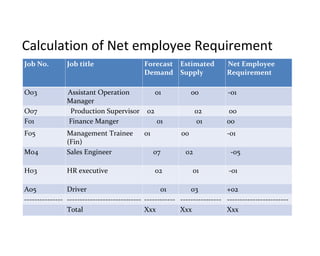
Calculation of Net employee Requirement
Job No. Job title Forecast
Demand
Estimated
Supply
Net Employee
Requirement
O03 Assistant Operation
Manager
01 00 -01
O07 Production Supervisor 02 02 00
F01 Finance Manger 01 01 00
F05 Management Trainee
(Fin)
01 00 -01
M04 Sales Engineer 07 02 -05
H03 HR executive 02 01 -01
A05 Driver 01 03 +02
--------------- ----------------------------- ------------ ---------------- ------------------------
Total Xxx Xxx Xxx
04.Develop strategies to be taken
Strategies in surplus conditions:
⮚ Hiring freeze
⮚ Attrition ( Voluntary departures)
⮚ Encouragement of leaves of absence
⮚ Early retirement on voluntary basis
⮚ Reduction of reward expenditure
⮚ Lay off
⮚ Formal outplacement facilities
⮚ Termination
Strategies in shortage conditions
⮚Have current employees work overtime
⮚Sub contract work to other firms
⮚Provide opportunities for learners for a
period of time
⮚Hire part- time employees
⮚Hire casual employees
⮚Hire temporary employees
⮚Hire permanent full-time employees
⮚Capital substitution
05 Assess HRP effort
HRP effort has to be assessed in order to determine its
impact on accomplishing organizational goals and
objectives.

human_resource_planning (1).pptx

  • 2.
    Learning Outcomes After studyingthis lesson successfully, you should be able to ⮚ Define what HRP is ⮚ Explain why HRP is important for an organization ⮚ Understand the HRP process ⮚ Explain the causes of future HR demand and HR supply ⮚ Identify Strategies to be taken for surplus condition and shortage condition
  • 3.
    Definition 1.HRP is theprocess of determining future employee needs and deciding steps or strategies to achieve those needs for the purpose of accomplishing organization goals and objectives. H.H.D.N.P. Opatha
  • 4.
    Significance of HRP ⮚To determine future employee needs ⮚ To utilize HR more efficiency and effectively ⮚ To control employee cost ⮚ To develop high talent employees ⮚ To formulate and implement strategic plans
  • 5.
    To determine futureemployee needs An organization wants to know future employee needs. What type of employees are needed? How many employees are needed for the next month or next year? To get answers for the two questions correctly it is essential to do HRP. Without doing HRP the organization will not be able to determine employee needs for future. To utilize HR more efficiency and effectively Careful analysis of all HRM activities shows that their effectiveness and efficiency, which results in increased productivity, depends on HRP
  • 6.
    To control employeecost Through HRP it is possible to know in advance employee surpluses or shortages which may occur in future. Hence it is possible for the organization to get prepared in advance in order to prevent from occurring surpluses or shortage of employees. To develop high talent employees Generally there is a scarcity of highly competent/ talented employees in the market. The lead time that is required to procure, train and develop such employees is long. Successful HRP provides an adequate lead time for the procurement, training and development of such employees.
  • 7.
    To formulate andimplement strategic plans Modern competitive organizations engage in strategic planning which results in strategy that is the organization's long term plan. In fact strategic plan involves long- term decisions to achieve the organization’s vision, mission and strategic objectives. HRP provides information inputs for strategic planning efforts. It will show human resource strength and weaknesses which will be useful for developing the long term plan.
  • 8.
    Reasons for someorganization not engaged in HRP ⮚ Lack of understanding about the purposes of HRP ⮚ Non – availability of experts in HRM within the organization or inability of procuring such experts to the organization ⮚ Attitude that doing HRP is unnecessary for organizations in a country like Sri Lanka as it has a high rate of unemployment ⮚ Habit of doing staffing field according to human resource needs which arise on day to day basis ⮚ Lack of financial resources
  • 9.
    Process of HRP 1 2 3 4 5 Forecastfuture demand for HR Estimate HR supply Compare forecast demand with estimated supply Develop strategies to be taken Assess HRP effort Feedback
  • 10.
    1.Forecasting Demand forHR Forecasting employee requirements for the organization comes under this step. Forecasting demand for human resources involves estimating the types and numbers of employees needed for future
  • 11.
    Factors affecting futuredemand for HR ⮚Demand for the product ⮚Goals and strategic plans of the organization ⮚Production methods ⮚Retirements ⮚Resignations ⮚Deaths ⮚Leave of absence ⮚Termination ⮚External factors
  • 12.
    Forecasting Techniques 1. InformalForecast This is the easiest way of forecasting future demand for human resources. Under this technique, future demand for human resources is determined without a systematic base and it is done quickly and randomly. Generally this technique may be good only for small organizations but cannot be recommended as a good method for large organizations to apply.
  • 13.
    2. Formal Expertsurvey Systematically future demand for human resources is estimated by conducting a survey among experts. A better method is for planners to survey managers, who are experts about their department’s future employments needs; and centralization of this information permits formal plans that identify the organization’s future demands. Data collection can be done by using a questionnaire or conducting interviews
  • 14.
    3. Delphi method Thisis a special kind of expert survey. It is more sophisticated than the formal expert survey. The Delphi technique is to solicit estimates from a group of experts, usually managers and HR managers and HR department planner acts as an intermediary. Its purpose is to obtain the most reliable consensus of opinion of a group of experts; it consists of intensive questioning of each expert, through a series of questionnaires, to obtain data that can be used to make “ educated” forecast; and the procedures are designed to avoid direct meetings between the experts in order to maximize independent thinking. Thus, the technique attempts to obtain independent judgments from a panel of experts.
  • 15.
    Five steps inthe Delphi technique 1. An issue, question, or problem is identified 2. A small group or panel of ten or fewer experts is identified 3. Independent judgments about the issue are obtained from each expert through a questionnaire or structured interview 4. An intermediary or facilitator collects, analyze and feeds back information from the first questionnaire or interview to each expert 5. Steps 3 and 4 are repeated until there is a consensus on the issue or problem
  • 16.
    4. Unit Forecasting Unitforecasting method is a broad approach to human resource forecasting and it uses a “ bottom up” approach.
  • 17.
    5.Extrapolation Extrapolation involves extendingpast rates of change into future . It is based on past data and an attempt is made to find a trend or a pattern that might continue into the future.
  • 18.
    6. Indexation This isanother approach that mean making forecast based on the ratio between (1) some casual factor(like sales volume) and (2) number of employee required
  • 19.
    Staffing table/ Manningtable A staffing table lists the future emplacement needs for each type of job. This listing may be a specific number or an approximate range of needs, depending on the accuracy of the underlying forecast. These estimates allow personnel specialists to match short- range demand and supply.
  • 20.
    Manning table XY Company Manningtable for the year ending31-12-2009 Job No Job title Dept Job vacancies by months of the year Remarks Total J F M A M J J A S O N D O03 Assistant operation manager Manu 01 01 Resignation O07 Production Supervisor Manu 02 01 01 Expansion F01 Finance Manager Fin 01 01 Retirement F05 Managemen t Trainee(Fin) Fin 01 01 Expansion M04 Sales Engineer Mar. 07 01 04 02 Expansion H03 HR executive HRM 02 01 01 Expansion A05 Driver Adm 01 01 Expansion ….............. .................................. …………….. ……………………………………………………………………………………………………………………………………………………………….. …………………………….. Total XXX xx xx xx xx xx xx xx xx xx xx xx
  • 21.
    02.Estimate HR supply ⮚Internal Supply Internal supply consists of current employees who can be promoted and transferred to meet forecast needs or fill job vacancies which are in the staffing table. ⮚ External supply External supply consist of people who are working for other organizations in industries and job seekers who are unemployed. They are the people who are in the employee market.
  • 22.
    Steps in HRsupply 1.Auditing current HR This mean assessing education, experience and competencies of all the current employees in the organization. In this context HR audit is a systematic attempt to summarize each employee’s education, experience and competencies. The audit results in preparing two documents 1.Skill inventories 2.Management inventories
  • 23.
    Skill inventories- Theaudits of non managers are called skill inventories A skill inventory should contain the following information accurately: ⮚ Identification information of the employee(name, address, sex, age, etc.) ⮚ Identification information of the current job( job title, job location etc.) ⮚ Education ( academic and professional) ⮚ Experiences including previous jobs held ⮚ Seniority ⮚ Special competencies ⮚ Trainings ⮚ Current and past job performance evaluations ⮚ Promotability ⮚ Weaknesses ⮚ Preferences
  • 24.
    Management inventories- auditsof managers are called management inventories. In addition to the above, a management inventory includes the following matters; ⮚Number of subordinates supervised ⮚Jobs and duties of the subordinates ⮚Total budget managed ⮚Management training received ⮚Management systems developed and implemented ⮚Creative works and innovations
  • 25.
    02.Identifying and arrangingpossible replacements( succession planning) By comparing HR audit information ( skills and management inventories) with the job analysis information ( job description and job specification), it requires identifying and deciding the most appropriate person from the current employees to fill the job vacancies. These replacements or tentative assignments can be recorded on replacements charts. Replacements chart/ succession planning A replacement chart is a visual representation of who will replace, whom in the event of a job opening
  • 26.
    03.Compare forecast demandwith estimated supply The third step of the process of HRP is to compare forecast demand with estimated supply. Here calculating net employee requirements for the relevant period of planning should be done. It is possible to calculate net employee requirements by subtracting estimated/ projected supply( replacements) from forecast HR demand. Its involves determining net employee requirements and identifying shortages and surpluses of HR
  • 27.
    Calculation of Netemployee Requirement Job No. Job title Forecast Demand Estimated Supply Net Employee Requirement O03 Assistant Operation Manager 01 00 -01 O07 Production Supervisor 02 02 00 F01 Finance Manger 01 01 00 F05 Management Trainee (Fin) 01 00 -01 M04 Sales Engineer 07 02 -05 H03 HR executive 02 01 -01 A05 Driver 01 03 +02 --------------- ----------------------------- ------------ ---------------- ------------------------ Total Xxx Xxx Xxx
  • 28.
    04.Develop strategies tobe taken Strategies in surplus conditions: ⮚ Hiring freeze ⮚ Attrition ( Voluntary departures) ⮚ Encouragement of leaves of absence ⮚ Early retirement on voluntary basis ⮚ Reduction of reward expenditure ⮚ Lay off ⮚ Formal outplacement facilities ⮚ Termination
  • 29.
    Strategies in shortageconditions ⮚Have current employees work overtime ⮚Sub contract work to other firms ⮚Provide opportunities for learners for a period of time ⮚Hire part- time employees ⮚Hire casual employees ⮚Hire temporary employees ⮚Hire permanent full-time employees ⮚Capital substitution
  • 30.
    05 Assess HRPeffort HRP effort has to be assessed in order to determine its impact on accomplishing organizational goals and objectives.