



> > > > > > > >
INTRODUCTION TO HUMAN
RESOURCE PLANNING :
THE EMERGING CONTEXT
Prof. Preeti Bhaskar
Symbiosis Centre for Management Studies, Noida
HUMAN RESOURCE PLANNING (HRP)
• Meaning and definition HRP
• Importance of HRP
• Factors affecting HRP
• HRP Process
• Barriers for successful HRP
> > > > > > > >
INTRODUCTION
HUMAN RESOURCE PLANNING
Human Resource Planning is a process by which
the management of an organization determines
its future human resource requirement and how
the existing human resource can be effectively
utilized to fulfill the requirements.
HUMAN RESOURCE PLANNING
HRP is the process by which an organization
ensures that it has the right number & kind of
people at the right place and at the right time ,
capable of effectively and efficiently completing
those tasks that help the organization achieve its
overall objectives.
HUMAN RESOURCE PLANNING
1. Forecast HR requirement.
2. Cope-up with the change — in market conditions,
technologies, products, government regulations and
policies, etc.
3. Use existing HR productivity.
4. Promote employees in a systematic manner.
5. Creation of talent.
6. Prepares people for future.
7. Expand or contract.
8. Cut cost
9. Succession planning
HUMAN RESOURCE PLANNING
> > > > > > > >
WHY IS HUMAN RESOURCE
PLANNING IMPORTANT?
HUMAN RESOURCE PLANNING
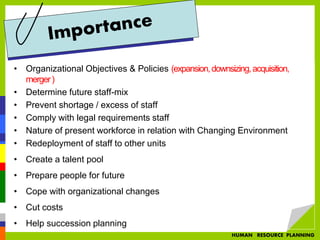
• Organizational Objectives & Policies (expansion,downsizing,acquisition,
merger)
• Determine future staff-mix
• Prevent shortage / excess of staff
• Comply with legal requirements staff
• Nature of present workforce in relation with Changing Environment
• Redeployment of staff to other units
• Create a talent pool
• Prepare people for future
• Cope with organizational changes
• Cut costs
• Help succession planning
HUMAN RESOURCE PLANNING
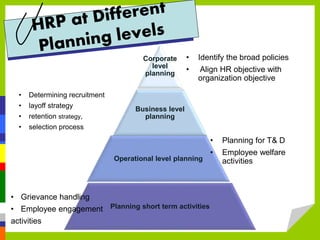
Corporate
level
planning
Business level
planning
Operational level planning
Planning short term activities
• Identify the broad policies
• Align HR objective with
organization objective
• Determining recruitment
• layoff strategy
• retention strategy,
• selection process
• Planning for T& D
• Employee welfare
activities
• Grievance handling
• Employee engagement
activities
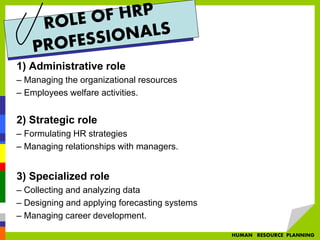
1) Administrative role
– Managing the organizational resources
– Employees welfare activities.
2) Strategic role
– Formulating HR strategies
– Managing relationships with managers.
3) Specialized role
– Collecting and analyzing data
– Designing and applying forecasting systems
– Managing career development.
HUMAN RESOURCE PLANNING
> > > > > > > >
HUMAN RESOURCE
PLANNING PROCESS
HUMAN RESOURCE PLANNING
> > > > > > > >
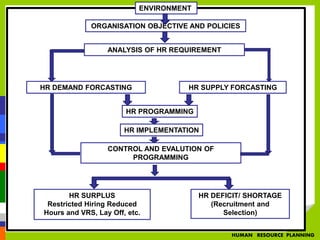
ENVIRONMENT
ORGANISATION OBJECTIVE AND POLICIES
HR DEMAND FORCASTING HR SUPPLY FORCASTING
HR PROGRAMMING
HR IMPLEMENTATION
CONTROL AND EVALUTION OF
PROGRAMMING
HR SURPLUS
Restricted Hiring Reduced
Hours and VRS, Lay Off, etc.
HR DEFICIT/ SHORTAGE
(Recruitment and
Selection)
HUMAN RESOURCE PLANNING
ANALYSIS OF HR REQUIREMENT
> > > > > > > >
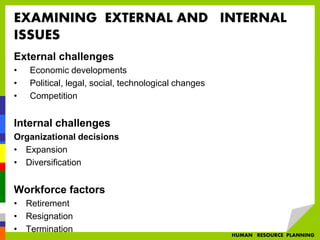
External challenges
• Economic developments
• Political, legal, social, technological changes
• Competition
Internal challenges
Organizational decisions
• Expansion
• Diversification
Workforce factors
• Retirement
• Resignation
• Termination
EXAMINING EXTERNAL AND INTERNAL
ISSUES
HUMAN RESOURCE PLANNING
• Organizational Objectives & Policies
(expansion, downsizing, acquisition, merger )
process of estimating future quantity and quality of
manpower required for an organization .
HUMAN RESOURCE PLANNING
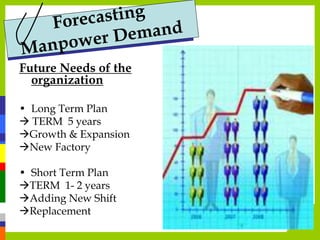
Future Needs of the
organization
• Long Term Plan
 TERM 5 years
Growth & Expansion
New Factory
• Short Term Plan
TERM 1- 2 years
Adding New Shift
Replacement
process of estimating future quantity and
quality of manpower available internally &
externally to an organization.
HUMAN RESOURCE PLANNING
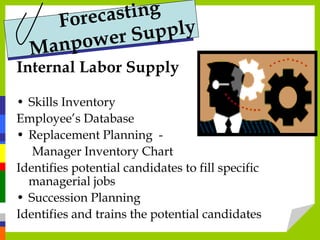
Internal Labor Supply
• Skills Inventory
Employee’s Database
• Replacement Planning -
Manager Inventory Chart
Identifies potential candidates to fill specific
managerial jobs
• Succession Planning
Identifies and trains the potential candidates
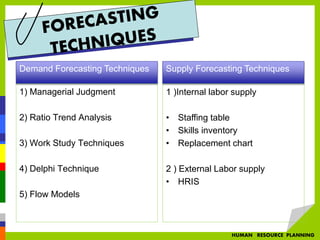
1) Managerial Judgment
2) Ratio Trend Analysis
3) Work Study Techniques
4) Delphi Technique
5) Flow Models
Demand Forecasting Techniques Supply Forecasting Techniques
1 )Internal labor supply
• Staffing table
• Skills inventory
• Replacement chart
2 ) External Labor supply
• HRIS
HUMAN RESOURCE PLANNING
> > > > > > > >
Demand forcasting
In this technique the managers sit
together,discuss and arrive at a figure which
would be thefuture demand for labour.The
technique mayinvolve ‘bottom-up’ or ‘ top
down’ approach
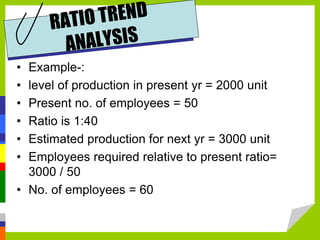
• Example-:
• level of production in present yr = 2000 unit
• Present no. of employees = 50
• Ratio is 1:40
• Estimated production for next yr = 3000 unit
• Employees required relative to present ratio=
3000 / 50
• No. of employees = 60
• This technique can be used when it is possibleto apply
work measurement to calculate thelength of operations
and the amount of labour required.
• Planned output for Next year- 50,000 Units
• Standard hours per unit -2
• Planned hours required 50,000*2=1,00,000
• Productive hours per worker in the year=2,000
• Number of workers required= 1,00,000/2,000=50
• It seek estimates of personnel needs from
a group of experts. The HRP experts act
as intermediaries, summarize the various
responses and report the findings back to
the experts. Summaries and surveys are
repeated until the experts opinion begin to
agree. the agreement reached is the
forecast of the personnel needs. No
Interaction among experts
> > > > > > > >
5-8
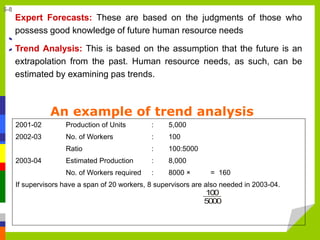
Expert Forecasts: These are based on the judgments of those who
possess good knowledge of future human resource needs
Trend Analysis: This is based on the assumption that the future is an
extrapolation from the past. Human resource needs, as such, can be
estimated by examining pas trends.
An example of trend analysis
2001-02 Production of Units : 5,000
2002-03 No. of Workers : 100
Ratio : 100:5000
2003-04 Estimated Production : 8,000
No. of Workers required : 8000 × = 160
If supervisors have a span of 20 workers, 8 supervisors are also needed in 2003-04.
100
5000
> > > > > > > >
Supply Forecasting
manpower inventory in terms of the size
and quality of personnel available (their age,
sex, education, training, experience, job
performance, etc) is usually prepared by HR
departments.
Several techniques are used while
ascertaining the internal supply of
manpower (a supply of employees to fill
projected vacancies can come from within
the firm or from new hires )
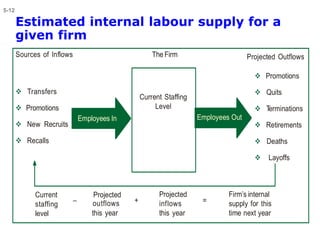
5-12
Estimated internal labour supply for a
given firm
The Firm
Sources of Inflows
 Transfers
 Promotions
 New Recruits
 Recalls
 Promotions
 Quits
 Terminations
 Retirements
 Deaths
 Layoffs
Employees In Employees Out
Current
staffing
level
Projected
outflows
this year
Projected
inflows
this year
Firm’s internal
supply for this
time next year
– + =
Projected Outflows
Current Staffing
Level
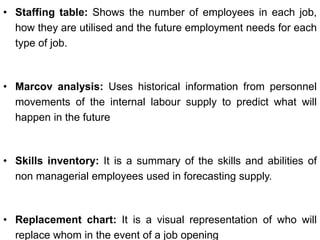
• Staffing table: Shows the number of employees in each job,
how they are utilised and the future employment needs for each
type of job.
• Marcov analysis: Uses historical information from personnel
movements of the internal labour supply to predict what will
happen in the future
• Skills inventory: It is a summary of the skills and abilities of
non managerial employees used in forecasting supply.
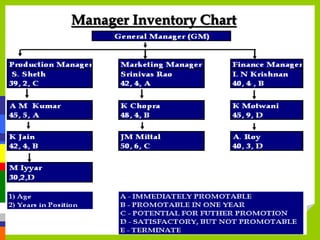
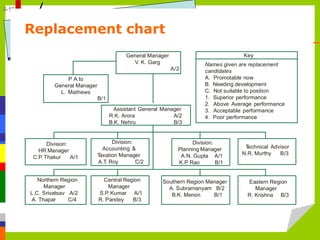
• Replacement chart: It is a visual representation of who will
replace whom in the event of a job opening
> > > > > > > >
Manager Inventory Chart
5-18
Replacement chart
General Manager
V. K. Garg
A/2
Key
Names given are replacement
candidates
A. Promotable now
B. Needing development
C. Not suitable to position
1. Superior performance
2. Above Average performance
3. Acceptable performance
4. Poor performance
P A to
General Manager
L. Mathews
B/1
Assistant General Manager
R.K. Arora A/2
B.K. Nehru B/3
Division:
HR Manager
C.P
. Thakur A/1
Division:
Accounting &
T
axation Manager
A.T
. Roy C/2
Division:
Planning Manager
A.N. Gupta A/1
K.P
. Rao B/1
T
echnical Advisor
N.R. Murthy B/3
Northern Region
Manager
L.C. Srivatsav A/2
A. Thapar C/4
Central Region
Manager
S.P
. Kumar A/1
R. Pandey B/3
Southern Region Manager
A. Subramanyam B/2
B.K. Menon B/1
Eastern Region
Manager
R. Krishna B/3
• External hires need to be contacted when
suitable internal replacements are not available
• . A growing number of firms are now using
computerised human resource information
systems to track the qualifications of hundreds
or thousands of employees.
• HRIS can provide managers with a listing of
candidates with required qualifications after
scanning the data base.
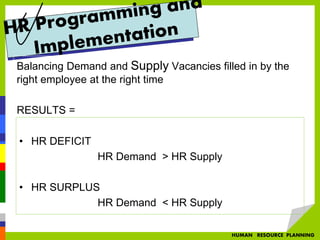
Balancing Demand and Supply Vacancies filled in by the
right employee at the right time
RESULTS =
HUMAN RESOURCE PLANNING
• HR DEFICIT
HR Demand > HR Supply
• HR SURPLUS
HR Demand < HR Supply
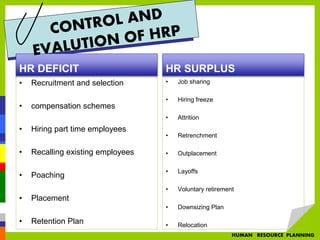
HR DEFICIT
• Recruitment and selection
• compensation schemes
• Hiring part time employees
• Recalling existing employees
• Poaching
• Placement
• Retention Plan
HR SURPLUS
• Job sharing
• Hiring freeze
• Attrition
• Retrenchment
• Outplacement
• Layoffs
• Voluntary retirement
• Downsizing Plan
• Relocation
HUMAN RESOURCE PLANNING
• Comparison between standard human resource
planning and actual implemented program
• To check and evaluate whether organization was
able to achieve its objective or not?
• To take corrective and necessary steps, if
organization is deviated from its objective.
HUMAN RESOURCE PLANNING
• Time Consuming
• Expensive
• Probability of inaccuracy /Uncertainties
• Financial forecasting takes precedence
over HRP
• Non-involvement of operating managers
• Inadequate Information system
• Trade unions
• Employers and employee resistance
> > > > > > > >
HUMAN RESOURCE
MANAGEMENT SYSTEM
(HRMS)
OR
HUMAN RESOURCE
INFORMATION SYSTEM
(HRIS)
• Human Resource Information System provides a
method by which an organization collects,
maintains, analyses and reports
information on people and jobs.
• The information contained in the HRIS serves as
a guide to recruiters, trainers, career planners
and other human resource specialists. It applies
to information needs at macro level as well as to
the micro level.
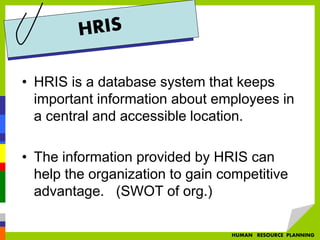
• HRIS is a database system that keeps
important information about employees in
a central and accessible location.
• The information provided by HRIS can
help the organization to gain competitive
advantage. (SWOT of org.)
HUMAN RESOURCE PLANNING
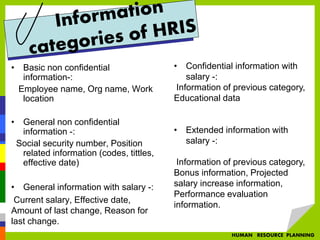
• Basic non confidential
information-:
Employee name, Org name, Work
location
• General non confidential
information -:
Social security number, Position
related information (codes, tittles,
effective date)
• General information with salary -:
Current salary, Effective date,
Amount of last change, Reason for
last change.
HUMAN RESOURCE PLANNING
• Confidential information with
salary -:
Information of previous category,
Educational data
• Extended information with
salary -:
Information of previous category,
Bonus information, Projected
salary increase information,
Performance evaluation
information.
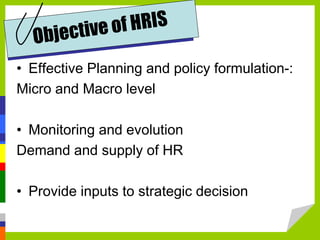
• Effective Planning and policy formulation-:
Micro and Macro level
• Monitoring and evolution
Demand and supply of HR
• Provide inputs to strategic decision
5-16
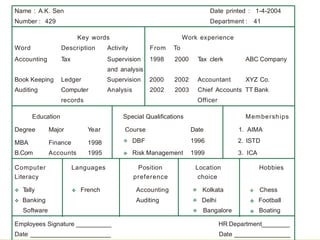
Skills inventory: an example
Name : A.K. Sen Date printed : 1-4-2004
Number : 429 Department : 41
Key words Work experience
Word Description Activity From To
Accounting Tax Supervision 1998 2000 T
ax clerk ABC Company
and analysis
Book Keeping Ledger Supervision 2000 2002 Accountant XYZ Co.
Auditing Computer Analysis 2002 2003 Chief Accounts TT Bank
records Officer
Education Special Qualifications Memberships
Degree Major Year Course Date 1. AIMA
MBA Finance 1998 DBF 1996 2. ISTD
B.Com Accounts 1995 Risk Management 1999 3. ICA
Computer Languages Position Location Hobbies
Literacy preference choice
 T
ally French Accounting Kolkata Chess
 Banking Auditing Delhi Football
Software Bangalore Boating
Employees Signature __________ HR Department________
Date _______________________ Date ________________
> > > > > > > >
HUMAN RESOURCE PLANNING

Human resource planning

  • 1.
    > > >> > > > > INTRODUCTION TO HUMAN RESOURCE PLANNING : THE EMERGING CONTEXT Prof. Preeti Bhaskar Symbiosis Centre for Management Studies, Noida
  • 2.
    HUMAN RESOURCE PLANNING(HRP) • Meaning and definition HRP • Importance of HRP • Factors affecting HRP • HRP Process • Barriers for successful HRP
  • 3.
    > > >> > > > > INTRODUCTION HUMAN RESOURCE PLANNING
  • 4.
    Human Resource Planningis a process by which the management of an organization determines its future human resource requirement and how the existing human resource can be effectively utilized to fulfill the requirements. HUMAN RESOURCE PLANNING
  • 5.
    HRP is theprocess by which an organization ensures that it has the right number & kind of people at the right place and at the right time , capable of effectively and efficiently completing those tasks that help the organization achieve its overall objectives. HUMAN RESOURCE PLANNING
  • 6.
    1. Forecast HRrequirement. 2. Cope-up with the change — in market conditions, technologies, products, government regulations and policies, etc. 3. Use existing HR productivity. 4. Promote employees in a systematic manner. 5. Creation of talent. 6. Prepares people for future. 7. Expand or contract. 8. Cut cost 9. Succession planning HUMAN RESOURCE PLANNING
  • 7.
    > > >> > > > > WHY IS HUMAN RESOURCE PLANNING IMPORTANT? HUMAN RESOURCE PLANNING
  • 8.
    • Organizational Objectives& Policies (expansion,downsizing,acquisition, merger) • Determine future staff-mix • Prevent shortage / excess of staff • Comply with legal requirements staff • Nature of present workforce in relation with Changing Environment • Redeployment of staff to other units • Create a talent pool • Prepare people for future • Cope with organizational changes • Cut costs • Help succession planning HUMAN RESOURCE PLANNING
  • 9.
    Corporate level planning Business level planning Operational levelplanning Planning short term activities • Identify the broad policies • Align HR objective with organization objective • Determining recruitment • layoff strategy • retention strategy, • selection process • Planning for T& D • Employee welfare activities • Grievance handling • Employee engagement activities
  • 10.
    1) Administrative role –Managing the organizational resources – Employees welfare activities. 2) Strategic role – Formulating HR strategies – Managing relationships with managers. 3) Specialized role – Collecting and analyzing data – Designing and applying forecasting systems – Managing career development. HUMAN RESOURCE PLANNING
  • 11.
    > > >> > > > > HUMAN RESOURCE PLANNING PROCESS HUMAN RESOURCE PLANNING
  • 12.
    > > >> > > > > ENVIRONMENT ORGANISATION OBJECTIVE AND POLICIES HR DEMAND FORCASTING HR SUPPLY FORCASTING HR PROGRAMMING HR IMPLEMENTATION CONTROL AND EVALUTION OF PROGRAMMING HR SURPLUS Restricted Hiring Reduced Hours and VRS, Lay Off, etc. HR DEFICIT/ SHORTAGE (Recruitment and Selection) HUMAN RESOURCE PLANNING ANALYSIS OF HR REQUIREMENT
  • 13.
    > > >> > > > > External challenges • Economic developments • Political, legal, social, technological changes • Competition Internal challenges Organizational decisions • Expansion • Diversification Workforce factors • Retirement • Resignation • Termination EXAMINING EXTERNAL AND INTERNAL ISSUES HUMAN RESOURCE PLANNING
  • 14.
    • Organizational Objectives& Policies (expansion, downsizing, acquisition, merger )
  • 15.
    process of estimatingfuture quantity and quality of manpower required for an organization . HUMAN RESOURCE PLANNING
  • 16.
    Future Needs ofthe organization • Long Term Plan  TERM 5 years Growth & Expansion New Factory • Short Term Plan TERM 1- 2 years Adding New Shift Replacement
  • 17.
    process of estimatingfuture quantity and quality of manpower available internally & externally to an organization. HUMAN RESOURCE PLANNING
  • 18.
    Internal Labor Supply •Skills Inventory Employee’s Database • Replacement Planning - Manager Inventory Chart Identifies potential candidates to fill specific managerial jobs • Succession Planning Identifies and trains the potential candidates
  • 19.
    1) Managerial Judgment 2)Ratio Trend Analysis 3) Work Study Techniques 4) Delphi Technique 5) Flow Models Demand Forecasting Techniques Supply Forecasting Techniques 1 )Internal labor supply • Staffing table • Skills inventory • Replacement chart 2 ) External Labor supply • HRIS HUMAN RESOURCE PLANNING
  • 20.
    > > >> > > > > Demand forcasting
  • 21.
    In this techniquethe managers sit together,discuss and arrive at a figure which would be thefuture demand for labour.The technique mayinvolve ‘bottom-up’ or ‘ top down’ approach
  • 22.
    • Example-: • levelof production in present yr = 2000 unit • Present no. of employees = 50 • Ratio is 1:40 • Estimated production for next yr = 3000 unit • Employees required relative to present ratio= 3000 / 50 • No. of employees = 60
  • 23.
    • This techniquecan be used when it is possibleto apply work measurement to calculate thelength of operations and the amount of labour required. • Planned output for Next year- 50,000 Units • Standard hours per unit -2 • Planned hours required 50,000*2=1,00,000 • Productive hours per worker in the year=2,000 • Number of workers required= 1,00,000/2,000=50
  • 24.
    • It seekestimates of personnel needs from a group of experts. The HRP experts act as intermediaries, summarize the various responses and report the findings back to the experts. Summaries and surveys are repeated until the experts opinion begin to agree. the agreement reached is the forecast of the personnel needs. No Interaction among experts
  • 25.
    > > >> > > > > 5-8 Expert Forecasts: These are based on the judgments of those who possess good knowledge of future human resource needs Trend Analysis: This is based on the assumption that the future is an extrapolation from the past. Human resource needs, as such, can be estimated by examining pas trends. An example of trend analysis 2001-02 Production of Units : 5,000 2002-03 No. of Workers : 100 Ratio : 100:5000 2003-04 Estimated Production : 8,000 No. of Workers required : 8000 × = 160 If supervisors have a span of 20 workers, 8 supervisors are also needed in 2003-04. 100 5000
  • 26.
    > > >> > > > > Supply Forecasting
  • 27.
    manpower inventory interms of the size and quality of personnel available (their age, sex, education, training, experience, job performance, etc) is usually prepared by HR departments. Several techniques are used while ascertaining the internal supply of manpower (a supply of employees to fill projected vacancies can come from within the firm or from new hires )
  • 28.
    5-12 Estimated internal laboursupply for a given firm The Firm Sources of Inflows  Transfers  Promotions  New Recruits  Recalls  Promotions  Quits  Terminations  Retirements  Deaths  Layoffs Employees In Employees Out Current staffing level Projected outflows this year Projected inflows this year Firm’s internal supply for this time next year – + = Projected Outflows Current Staffing Level
  • 29.
    • Staffing table:Shows the number of employees in each job, how they are utilised and the future employment needs for each type of job. • Marcov analysis: Uses historical information from personnel movements of the internal labour supply to predict what will happen in the future • Skills inventory: It is a summary of the skills and abilities of non managerial employees used in forecasting supply. • Replacement chart: It is a visual representation of who will replace whom in the event of a job opening
  • 30.
    > > >> > > > > Manager Inventory Chart
  • 31.
    5-18 Replacement chart General Manager V.K. Garg A/2 Key Names given are replacement candidates A. Promotable now B. Needing development C. Not suitable to position 1. Superior performance 2. Above Average performance 3. Acceptable performance 4. Poor performance P A to General Manager L. Mathews B/1 Assistant General Manager R.K. Arora A/2 B.K. Nehru B/3 Division: HR Manager C.P . Thakur A/1 Division: Accounting & T axation Manager A.T . Roy C/2 Division: Planning Manager A.N. Gupta A/1 K.P . Rao B/1 T echnical Advisor N.R. Murthy B/3 Northern Region Manager L.C. Srivatsav A/2 A. Thapar C/4 Central Region Manager S.P . Kumar A/1 R. Pandey B/3 Southern Region Manager A. Subramanyam B/2 B.K. Menon B/1 Eastern Region Manager R. Krishna B/3
  • 32.
    • External hiresneed to be contacted when suitable internal replacements are not available • . A growing number of firms are now using computerised human resource information systems to track the qualifications of hundreds or thousands of employees. • HRIS can provide managers with a listing of candidates with required qualifications after scanning the data base.
  • 33.
    Balancing Demand andSupply Vacancies filled in by the right employee at the right time RESULTS = HUMAN RESOURCE PLANNING • HR DEFICIT HR Demand > HR Supply • HR SURPLUS HR Demand < HR Supply
  • 34.
    HR DEFICIT • Recruitmentand selection • compensation schemes • Hiring part time employees • Recalling existing employees • Poaching • Placement • Retention Plan HR SURPLUS • Job sharing • Hiring freeze • Attrition • Retrenchment • Outplacement • Layoffs • Voluntary retirement • Downsizing Plan • Relocation HUMAN RESOURCE PLANNING
  • 35.
    • Comparison betweenstandard human resource planning and actual implemented program • To check and evaluate whether organization was able to achieve its objective or not? • To take corrective and necessary steps, if organization is deviated from its objective. HUMAN RESOURCE PLANNING
  • 36.
    • Time Consuming •Expensive • Probability of inaccuracy /Uncertainties • Financial forecasting takes precedence over HRP • Non-involvement of operating managers • Inadequate Information system • Trade unions • Employers and employee resistance
  • 37.
    > > >> > > > > HUMAN RESOURCE MANAGEMENT SYSTEM (HRMS) OR HUMAN RESOURCE INFORMATION SYSTEM (HRIS)
  • 38.
    • Human ResourceInformation System provides a method by which an organization collects, maintains, analyses and reports information on people and jobs. • The information contained in the HRIS serves as a guide to recruiters, trainers, career planners and other human resource specialists. It applies to information needs at macro level as well as to the micro level.
  • 39.
    • HRIS isa database system that keeps important information about employees in a central and accessible location. • The information provided by HRIS can help the organization to gain competitive advantage. (SWOT of org.) HUMAN RESOURCE PLANNING
  • 40.
    • Basic nonconfidential information-: Employee name, Org name, Work location • General non confidential information -: Social security number, Position related information (codes, tittles, effective date) • General information with salary -: Current salary, Effective date, Amount of last change, Reason for last change. HUMAN RESOURCE PLANNING • Confidential information with salary -: Information of previous category, Educational data • Extended information with salary -: Information of previous category, Bonus information, Projected salary increase information, Performance evaluation information.
  • 41.
    • Effective Planningand policy formulation-: Micro and Macro level • Monitoring and evolution Demand and supply of HR • Provide inputs to strategic decision
  • 42.
    5-16 Skills inventory: anexample Name : A.K. Sen Date printed : 1-4-2004 Number : 429 Department : 41 Key words Work experience Word Description Activity From To Accounting Tax Supervision 1998 2000 T ax clerk ABC Company and analysis Book Keeping Ledger Supervision 2000 2002 Accountant XYZ Co. Auditing Computer Analysis 2002 2003 Chief Accounts TT Bank records Officer Education Special Qualifications Memberships Degree Major Year Course Date 1. AIMA MBA Finance 1998 DBF 1996 2. ISTD B.Com Accounts 1995 Risk Management 1999 3. ICA Computer Languages Position Location Hobbies Literacy preference choice  T ally French Accounting Kolkata Chess  Banking Auditing Delhi Football Software Bangalore Boating Employees Signature __________ HR Department________ Date _______________________ Date ________________
  • 44.
    > > >> > > > > HUMAN RESOURCE PLANNING