


4-1 © 2003 Prentice Hall, Inc.
Recruitment
© 2003 Prentice Hall, Inc.4-2
Recruitment
The process of attracting
individuals on a timely basis, in
sufficient numbers, and with
appropriate qualifications, skills &
competence, and encouraging
them to apply for jobs with an
organization
© 2003 Prentice Hall, Inc.4-3
HR Challenges in
Recruiting and Selecting
Employees
 What are advantages / disadvantages of
internal and external recruiting?
 What are steps in the selection process?
 What are the available sources and methods to
be followed?
 How can Recruitment decisions minimize
hiring / promotion of the wrong people?
 What are some legal constraints of the hiring
process?
© 2003 Prentice Hall, Inc.4-4
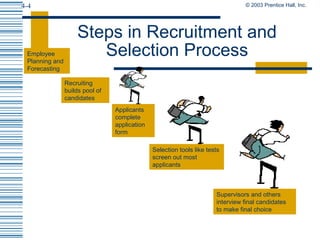
Steps in Recruitment and
Selection Process
Applicants
complete
application
form
Selection tools like tests
screen out most
applicants
Supervisors and others
interview final candidates
to make final choice
Employee
Planning and
Forecasting
Recruiting
builds pool of
candidates
© 2003 Prentice Hall, Inc.4-5
Recruitment Process
 Human Resource Planning
 Alternatives to Recruitment
 Use Internal Sources and
Methods
 Use External Sources and
Methods
 Recruitment of people
© 2003 Prentice Hall, Inc.4-6
Internal Sources of
Candidates
 Knowing a candidate’s strengths and
weaknesses
 Inside candidates may be more
committed to the company and can
increase morale
 Can backfire
 Can promote inbreeding
© 2003 Prentice Hall, Inc.4-7
Finding Candidates
 Job posting
 Publicizing the open job to employees and
listing its attributes like qualifications,
supervisor, work schedule, and pay rate
 Rehiring former employees
 An option today due to the tight labor market
© 2003 Prentice Hall, Inc.4-8
Finding Internal Candidates
 Succession planning: ensuring a suitable
supply of successors for future senior jobs
 Planning includes:
 Determine projected need
 Audit current talent
 Planning career paths
 Career counseling
 Accelerated /Fast-track promotions
 Performance related training
© 2003 Prentice Hall, Inc.4-9
Outside Sources of Candidates
1. Job Markets
2. Employee Referrals
3. Competitors’ Organizations
4. University / College Graduates
• Job Fairs
• College Recruitments
© 2003 Prentice Hall, Inc.4-10
Outside Sources of
Candidates
 Advertising – the
advertising media and ad
content
 Select the best media –
local paper, TV, or
internet depending on the
position
© 2003 Prentice Hall, Inc.4-11
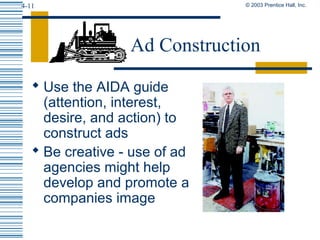
 Use the AIDA guide
(attention, interest,
desire, and action) to
construct ads
 Be creative - use of ad
agencies might help
develop and promote a
companies image
Ad Construction
© 2003 Prentice Hall, Inc.4-12
Employment Agencies
Types of agencies:
 Public agencies and
non profit
 Private agencies
Bikalpa, ODC, Real Solutions,
SynergyPlus, J&T Associates, etc
© 2003 Prentice Hall, Inc.4-13
How to Avoid Problems With
Employment Agencies
 Provide full and accurate job description
 Specify the screening tools to use
 Review data on candidates accepted or
rejected by your firm and by the agency
 Develop a long-term relationships with
one or more agencies
 Screen the agency
© 2003 Prentice Hall, Inc.4-14
 Headhunters
 Special employment agencies used to seek
out top management and technical talent
 Internet databases have shortened time
required to find talent
 Online executive recruiting firm
Executive Recruiters
futurestep
© 2003 Prentice Hall, Inc.4-15
Outside Hiring - Method
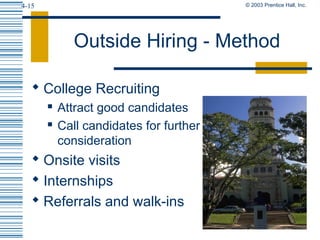
 College Recruiting
 Attract good candidates
 Call candidates for further
consideration
 Onsite visits
 Internships
 Referrals and walk-ins
© 2003 Prentice Hall, Inc.4-16
Recruiting on the Net
•Many companies are turning to the Internet as a recruiting
tool
• Corporate and employment web pages are one approach
• Internet recruiting is cost effective and timely
careerbuilder
JobsNepal.com, BMjobs.com.np, Monster.com etc
© 2003 Prentice Hall, Inc.4-17
Application forms provide 4 types of info:
Developing Application
Forms
1. Does candidate have the necessary education or
experience ?
2. Provides applicants previous progress and
growth
3. Provides previous work record to assess the
applicants suitability
4-18 © 2003 Prentice Hall, Inc.
End

Recruitment

  • 1.
    4-1 © 2003Prentice Hall, Inc. Recruitment
  • 2.
    © 2003 PrenticeHall, Inc.4-2 Recruitment The process of attracting individuals on a timely basis, in sufficient numbers, and with appropriate qualifications, skills & competence, and encouraging them to apply for jobs with an organization
  • 3.
    © 2003 PrenticeHall, Inc.4-3 HR Challenges in Recruiting and Selecting Employees  What are advantages / disadvantages of internal and external recruiting?  What are steps in the selection process?  What are the available sources and methods to be followed?  How can Recruitment decisions minimize hiring / promotion of the wrong people?  What are some legal constraints of the hiring process?
  • 4.
    © 2003 PrenticeHall, Inc.4-4 Steps in Recruitment and Selection Process Applicants complete application form Selection tools like tests screen out most applicants Supervisors and others interview final candidates to make final choice Employee Planning and Forecasting Recruiting builds pool of candidates
  • 5.
    © 2003 PrenticeHall, Inc.4-5 Recruitment Process  Human Resource Planning  Alternatives to Recruitment  Use Internal Sources and Methods  Use External Sources and Methods  Recruitment of people
  • 6.
    © 2003 PrenticeHall, Inc.4-6 Internal Sources of Candidates  Knowing a candidate’s strengths and weaknesses  Inside candidates may be more committed to the company and can increase morale  Can backfire  Can promote inbreeding
  • 7.
    © 2003 PrenticeHall, Inc.4-7 Finding Candidates  Job posting  Publicizing the open job to employees and listing its attributes like qualifications, supervisor, work schedule, and pay rate  Rehiring former employees  An option today due to the tight labor market
  • 8.
    © 2003 PrenticeHall, Inc.4-8 Finding Internal Candidates  Succession planning: ensuring a suitable supply of successors for future senior jobs  Planning includes:  Determine projected need  Audit current talent  Planning career paths  Career counseling  Accelerated /Fast-track promotions  Performance related training
  • 9.
    © 2003 PrenticeHall, Inc.4-9 Outside Sources of Candidates 1. Job Markets 2. Employee Referrals 3. Competitors’ Organizations 4. University / College Graduates • Job Fairs • College Recruitments
  • 10.
    © 2003 PrenticeHall, Inc.4-10 Outside Sources of Candidates  Advertising – the advertising media and ad content  Select the best media – local paper, TV, or internet depending on the position
  • 11.
    © 2003 PrenticeHall, Inc.4-11  Use the AIDA guide (attention, interest, desire, and action) to construct ads  Be creative - use of ad agencies might help develop and promote a companies image Ad Construction
  • 12.
    © 2003 PrenticeHall, Inc.4-12 Employment Agencies Types of agencies:  Public agencies and non profit  Private agencies Bikalpa, ODC, Real Solutions, SynergyPlus, J&T Associates, etc
  • 13.
    © 2003 PrenticeHall, Inc.4-13 How to Avoid Problems With Employment Agencies  Provide full and accurate job description  Specify the screening tools to use  Review data on candidates accepted or rejected by your firm and by the agency  Develop a long-term relationships with one or more agencies  Screen the agency
  • 14.
    © 2003 PrenticeHall, Inc.4-14  Headhunters  Special employment agencies used to seek out top management and technical talent  Internet databases have shortened time required to find talent  Online executive recruiting firm Executive Recruiters futurestep
  • 15.
    © 2003 PrenticeHall, Inc.4-15 Outside Hiring - Method  College Recruiting  Attract good candidates  Call candidates for further consideration  Onsite visits  Internships  Referrals and walk-ins
  • 16.
    © 2003 PrenticeHall, Inc.4-16 Recruiting on the Net •Many companies are turning to the Internet as a recruiting tool • Corporate and employment web pages are one approach • Internet recruiting is cost effective and timely careerbuilder JobsNepal.com, BMjobs.com.np, Monster.com etc
  • 17.
    © 2003 PrenticeHall, Inc.4-17 Application forms provide 4 types of info: Developing Application Forms 1. Does candidate have the necessary education or experience ? 2. Provides applicants previous progress and growth 3. Provides previous work record to assess the applicants suitability
  • 18.
    4-18 © 2003Prentice Hall, Inc. End

Editor's Notes

  • #5 1. Decide what positions you’ll have to fill, by engaging in personnel planning and forecasting. 2. Build a pool of candidates for theses jobs by recruiting internal or external candidates. 3. Have applicants complete application forms and perhaps undergo an initial screening interview. 4. Use selection techniques like tests, background investigations, and physical exams to identify viable candidates. 5. Finally, decide who to make an offer to, by having the supervisor and (perhaps) others on the team interview the final candidates.
  • #7 Page 99 It is often therefore safer to promote employees from within, since you’re likely to have a more accurate view of the person’s skills than you would an outsider’s. Inside candidates may also be more committed to the company. Morale may rise, to the extent that employees see promotions as rewards for loyalty and competence. Inside candidates may also require less orientation and training than outsiders. Employees who apply for jobs and don’t get them may become discontented; telling unsuccessful applicants why they were rejected and what remedial actions they might take to be more successful in the future is thus crucial. When all managers come up through the ranks, they may have a tendency to maintain the status quo, when a new direction is what’s required.
  • #8 Page 99 Job Posting Personnel records are also important. An examination of personnel records (including application forms) may reveal employees who are working in jobs below their educational or skill levels. It may also reveal persons who have potential for further training or who already have the right background for the open job. Rehiring Today.thanks partly to high turnover in some high-tech occupations.rehiring former employees is back in style. For example, with many former employees finding that the life of a start-up entrepreneur is not all they’d hoped it would be, EDS executive Troy Todd in Plano, Texas, says his company rehired over 500 “boomerang” employees just between January and July 2000.
  • #9 Page 100 Succession planning typically includes activities like these: Determining the projected need for managers and professionals by company level, function, and skill Auditing current executive talent to project the likely future supply from internal sources Planning individual career paths based on objective estimates of future needs and assessments of potential Career counseling in the context of the future needs of the firm, as well as those of the individual Accelerated promotions, with development to prepare individuals for future roles as well as current responsibilities Performance-related training and development to prepare individuals for future roles as well as current responsibilities Planned strategic recruitment to fill short-term needs and to provide people to meet future needs Actually filling the positionsvia recruiters, promotion from within, and so on.
  • #10 Instructor’s Note: Use this slide to visit professional journals and view and discuss job postings.
  • #12 Page 101 Jerry Holder’s ongoing recruiting efforts for the workers he needs in the two Allegra Print and Imaging locations he manages in Tulsa begin with help wanted advertising. Holder places “friendly” newspaper ads, written in warm, welcoming language, to attract candidates for sales, production, and quality-control positions. The ads’ message is, “Let’s see if it fits. Come in and see the place.” Holder then offers each prospect a shop tour and introductions to key employees.
  • #13 Page 103 Instructor’s Note: Ask students - Why turn to an agency? Reasons include: 1. Your firm doesn’t have its own HR department and is not geared to doing recruiting and screening. 2. Your firm has found it difficult in the past to generate a pool of qualified applicants. 3. You must fill a particular opening quickly. 4. There is a perceived need to attract a greater number of minority or female applicants. 5. You want to reach currently employed individuals, who might feel more comfortable dealing with agencies than with competing companies. 6. You want to cut down on the time you’re devoting to interviewing.
  • #14 Page 104 Job description – The better the employment agency understands the job to be filled, the greater the likelihood it will produce a reasonable pool of applicants. Screening tools – Tests, application blanks, and interviews should be a proven part of the employer’s selection process. Periodic candidate review – will server as a check on the effectiveness and fairness of the agency’s process. Agency relationship – It may also make sense to designate one person to serve as the liaison between the employer and the agency. Agency screening – Check with other managers or HR people to find out which agencies have been the most effective at filling the sorts of positions you need filled.
  • #15 Page 107 Recruiters They fill jobs in the $60,000-and-up category, although $80,000 is often the lower limit. The percentage of your firm’s positions filled by these services might be small. However, these jobs would include crucial executive and technical positions. For executive positions, headhunters may be your only source of candidates. The employer always pays their fees. Two trends.technology and specialization.are changing the executive search business. Most recruiting firms are therefore establishing Internet-linked computerized databases the aim of which, according to one senior recruiter, is “to create a long list by pushing a button. Executive recruiters are also becoming more specialized, and the large ones are creating new businesses aimed specifically at specialized functions or industries.
  • #16 Page 109 College Recruiting Goals The campus recruiter has two main goals. The main one is determining whether a candidate is worthy of further consideration. The other aim is to attract good candidates. A sincere and informal attitude, respect for the applicant as an individual, and prompt follow-up letters can help sell the employer to the interviewee. There are two main problems with on-campus recruiting. First, it is expensive and time consuming. Second, as mentioned earlier, recruiters themselves are sometimes ineffective, or worse. On-Site Visits Employers generally invite good candidates to the employer’s office or plant for an on-site visit. The invitation letter should be warm and friendly but businesslike, and should give the person a choice of dates to visit the company. Assign someone to meet the applicant, preferably at the airport or at his or her hotel, and to act as host. A package describing the applicant’s schedule as well as other information regarding the company.such as annual reports and employee benefits.should be waiting. Internships Internships can be winwin situations for both students and employers. For students, it may mean being able to hone business skills, check out potential employers, and learn more about their likes (and dislikes) when it comes to choosing careers. And employers, of course, can use the interns to make useful contributions while evaluating them as possible full-time employees. Referrals and Walk-Ins The firm posts announcements of openings and requests for referrals in its bulletin and on its wallboards and intranet; prizes or cash rewards are offered for referrals that culminate in hirings. Employee referrals have been the source of almost half of all hires at AmeriCredit since the firm kicked off its “you’ve got friends, we want to meet them” employee referrals program.
  • #17 Page 112 A large and fast-growing proportion of employers use the Internet as a recruiting tool. The percentage of Fortune 500 companies recruiting via the Internet jumped from 10% in 1997 to 75% in 2000.
  • #18 Page 119 – 120 A filled-in form provides four types of information. First, you can make judgments on substantive matters, such as whether the applicant has the education and experience to do the job. Second, you can draw conclusions about the applicant’s previous progress and growth, a trait that is especially important for management candidates. Third, you can draw tentative conclusions regarding the applicant’s stability based on previous work record. Fourth, you may be able to use the data in the application to predict which candidates will succeed on the job and which will not.