This document discusses the levels of organization in the human body from cells to organisms. It defines key terms like cells, tissues, organs, and organ systems. It explains that cells make up tissues, tissues make up organs, and organs work together in organ systems. Some key organ systems mentioned are the digestive system, circulatory system, and respiratory system. The relationship between cells, tissues, organs, systems and organisms is illustrated through a flow chart. The document provides a high-level overview of the hierarchical structure of the human body.
From Cells toOr
ganisms
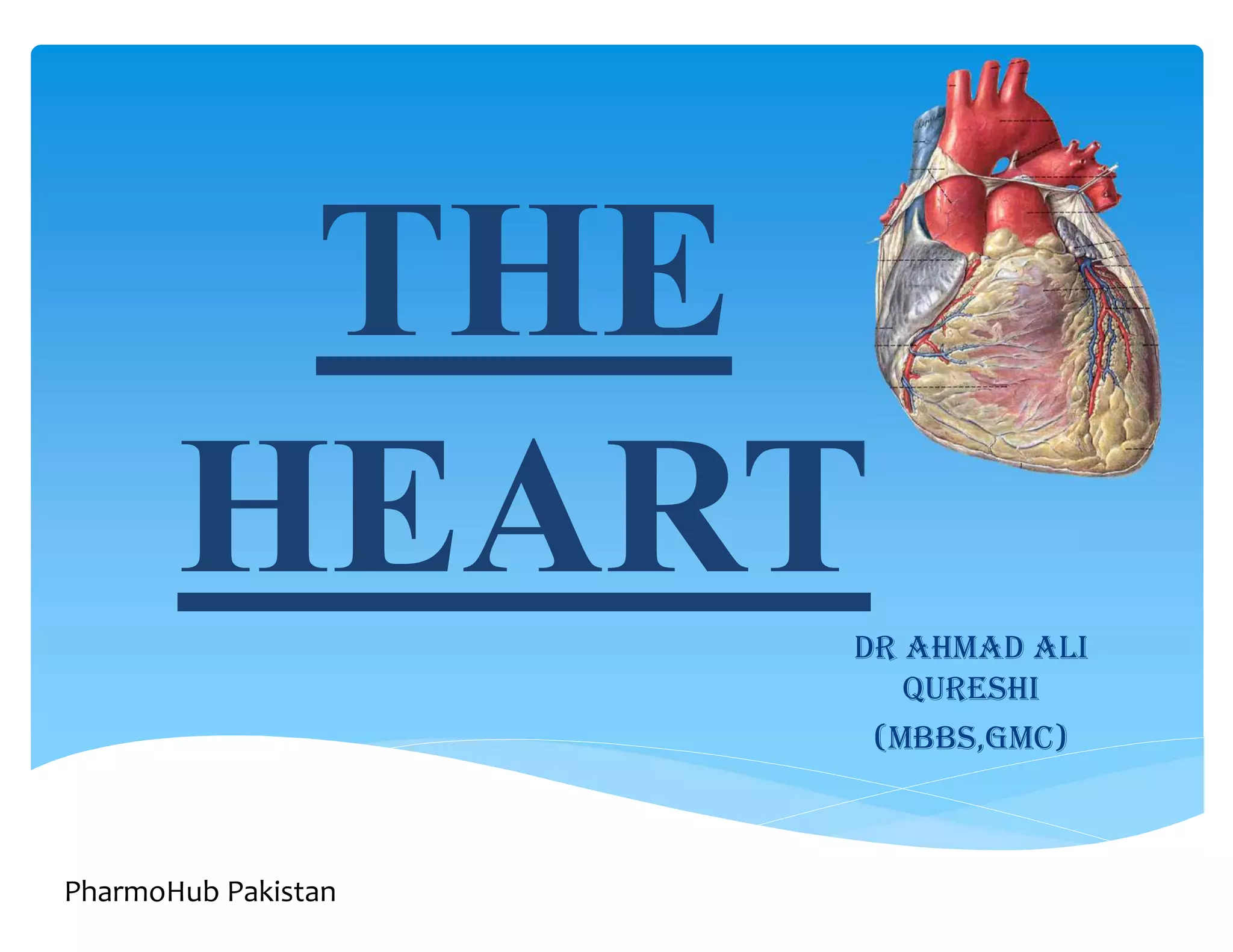
Dr Ahmad Ali Qureshi
(MBBS,GMC)
PharmoHub Pakistan
3.
1. Define: Cell,Tissue, organ, and organ sys
tem (DK).
2. Describe two types of tissue (DK)
3. Describe two types of organs (DK)
4. Create a flow chart illustrating relationshi
p between cells, tissues, organs, systems an
d organisms (PK)
Lesson Objectives
4.
Levels of Organization
Cell—Basic unit of structure and function in orga
nisms.
Some organisms, like bacteria and protists, are
unicellular (made entirely of one cell).
Some organisms, like fungi, plants, and animal
s, are multicellular (made of many cells).
In multicellular organisms, cells exhibit cell spe
cialisation. They take on specific jobs and loo
k different from each other.
The cells also exhibit division of labor. They spli
t up the work of the organism.
6.
Levels of Organization
Tissues—Groups of similar cells that work to
gether to perform a specific function.
4 major tissue types in animals
Epithelial tissue
Connective tissue
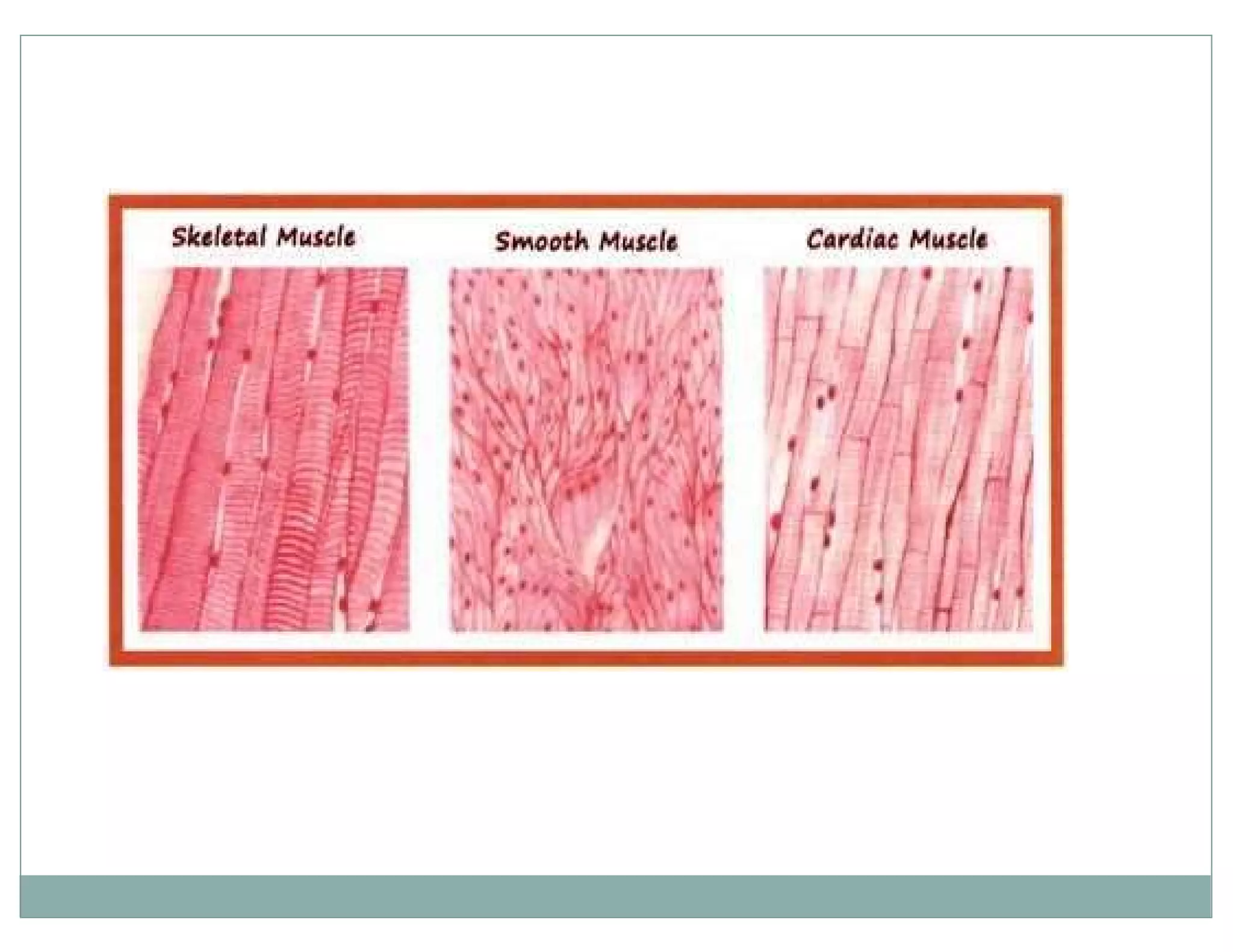
Muscle tissue
Nervous tissue
7.
Levels of Organization
Organs—structures made of different types of
tissues that work together to perform a specifi
c function.
Examples
Heart
Lungs
Stomach
Small intestine
Liver
Large Intestine
Gall Bladder
Plant Roots
Plant Stems
Plant Leaves
8.
Levels of Organization
Organ Systems—Groups of organs that w
ork together to perform a specific functio
n.
Examples:
Digestive system
Circulatory system
Respiratory system
Nervous system
Muscular system
Skeletal system
Integumentary system (skin)
Vascular system in plants
9.
Levels of Organization
Organism—A complete, individual living t
hing.
Examples:
A single person
A single plant
A single bacterium
A single protist
11.
Write your answersin complete sentences
Q 1: A (tissue, organ, system) is a group of the same kinds of cells that work together.
Choose the right answer.
system
organ
tissue
Q 2: Some tissues and organs work together like the members of the team. The parts
that work together are called a _____________.
cell
system
group
Q 3: The mouth, teeth, tongue, stomach and intestines all work together. Therefore th
ey are called the important parts of __________________.
digestive system
circulatory system
muscular system
Q 4: Brain, heart and lungs are some of the important _______________ in a body.
organs
tissues
cells
system
Q 5: Different tissues work together to form _________ .
cells
system
organs
Q 6: Different systems work together to form organs. True or false?
false
true
12.
11
Organization of VertebrateBo
dy
Tissues are groups of cells that are sim
ilar in structure and function
In humans, there are four primary tiss
ues:
-Epithelial, connective, muscle and
nerve
13.
12
Organization of VertebrateBo
dy
Organs are combinations of different tissues
that form a structural and functional unit
Organ systems are groups of organs that co
operate to perform the major activities of
the body
-The human body contains 11 principal or
gan systems
14.
Organ Systems
Thefive main organ systems that we will b
e focusing on in this unit are:
The Respiratory System
The Circulatory System
The Reproductive System
The Digestive System
The Excretory System
16
Circulatory System
NO Thank
you!
Thesystem that carries ox
ygen and nutrients to all
cells in the body and tak
es wastes away from the
cells; it consists of the he
art, blood vessels and blo
od.
18.
17
Respiratory System
NO
Thank you!
Thesystem involved in th
e inhalation of and diffusi
on of oxygen into the blo
od stream, and the remo
val of carbon dioxide fro
m the body via exhalatio
n
19.
Excretory System
The systemresp
onsible for the r
emoval of exce
ss water and w
aste from cell r
eactions in the
body
20.
Reproductive System
The maleand female reproductive systems are responsi
ble for the production of sperm and ova (eggs), the fertil
isation of ova by sperm, and the gestation of a fertilised
ova into a foetus (unborn baby)
Human Anatomy:
Its isdefined in various ways :-
“It is the study of structure of human body”
23.
c) Its isdefined as an important scientific
discipline which is concerned with the i
nvestigation of biological structure by :
i) Dissection ;
ii) Microdissection ;
iii) Light microscopy ;
iv)Electron microscopy ;
v) Radiology ;
24.
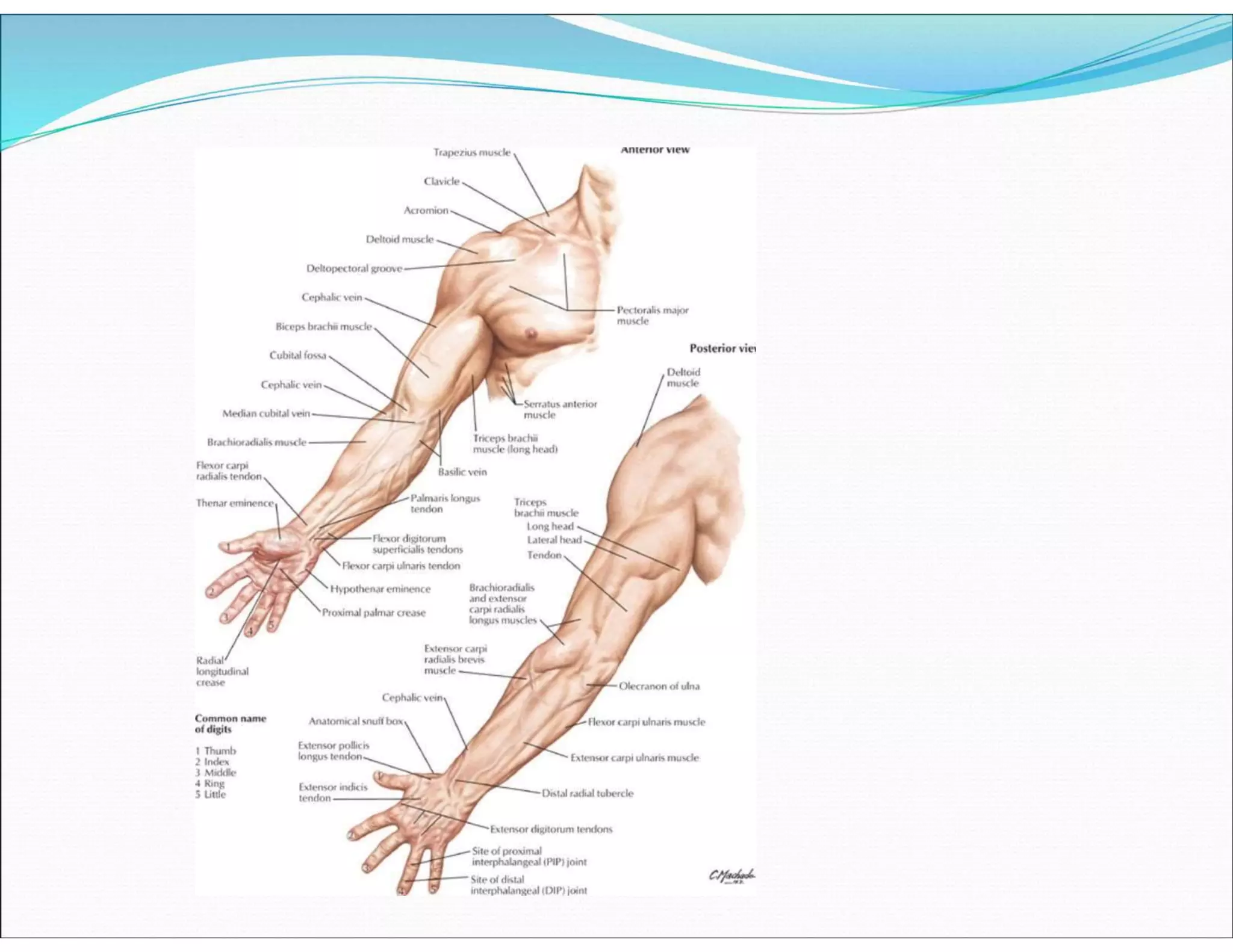
Regional anatomy :
Itsdeals with anatomy of various structures as they
lie in relationship with one another in different re
gion of the body . It is valuable for surgeons.
.
26.
invisible
Surface anatomy:
It dealswith the study and identification
of various structures in the living person
by methods of inspection and palpation
It helps to enhance the knowledge acqui
red through dissection of the cadaver by
either of line of study, Regional or syste
matic. It is helpful both in health and di
sease and is daily used in medical practi
ce.
28.
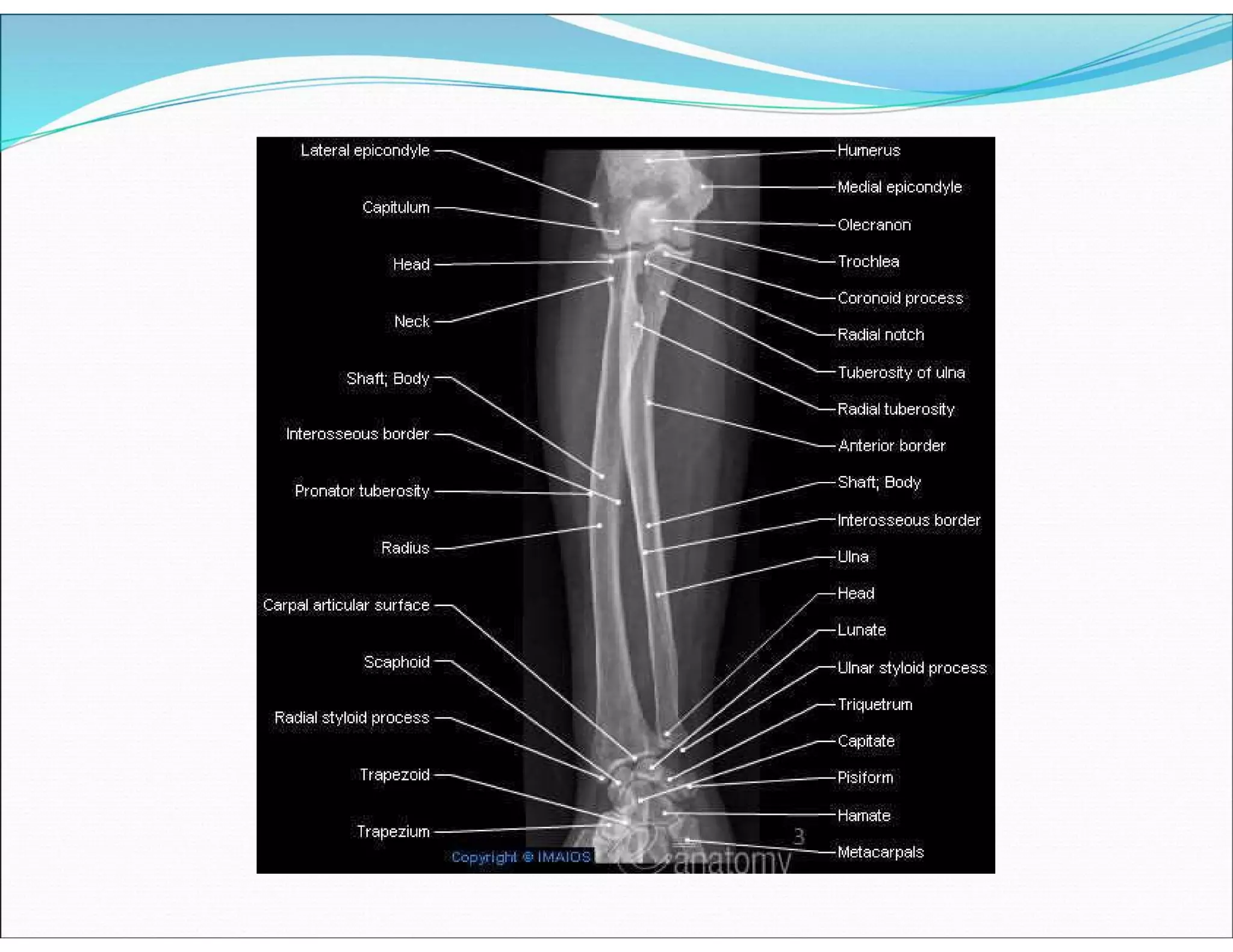
Radiological Anatomy
It dealswith the study of structure of hu
man body with the aid of X-Rays. It helps
to investigate the anatomical facts which
cannot be understood by any other meth
od. It is very useful both in health and di
sease and is in current use in modern m
edical practice.
30.
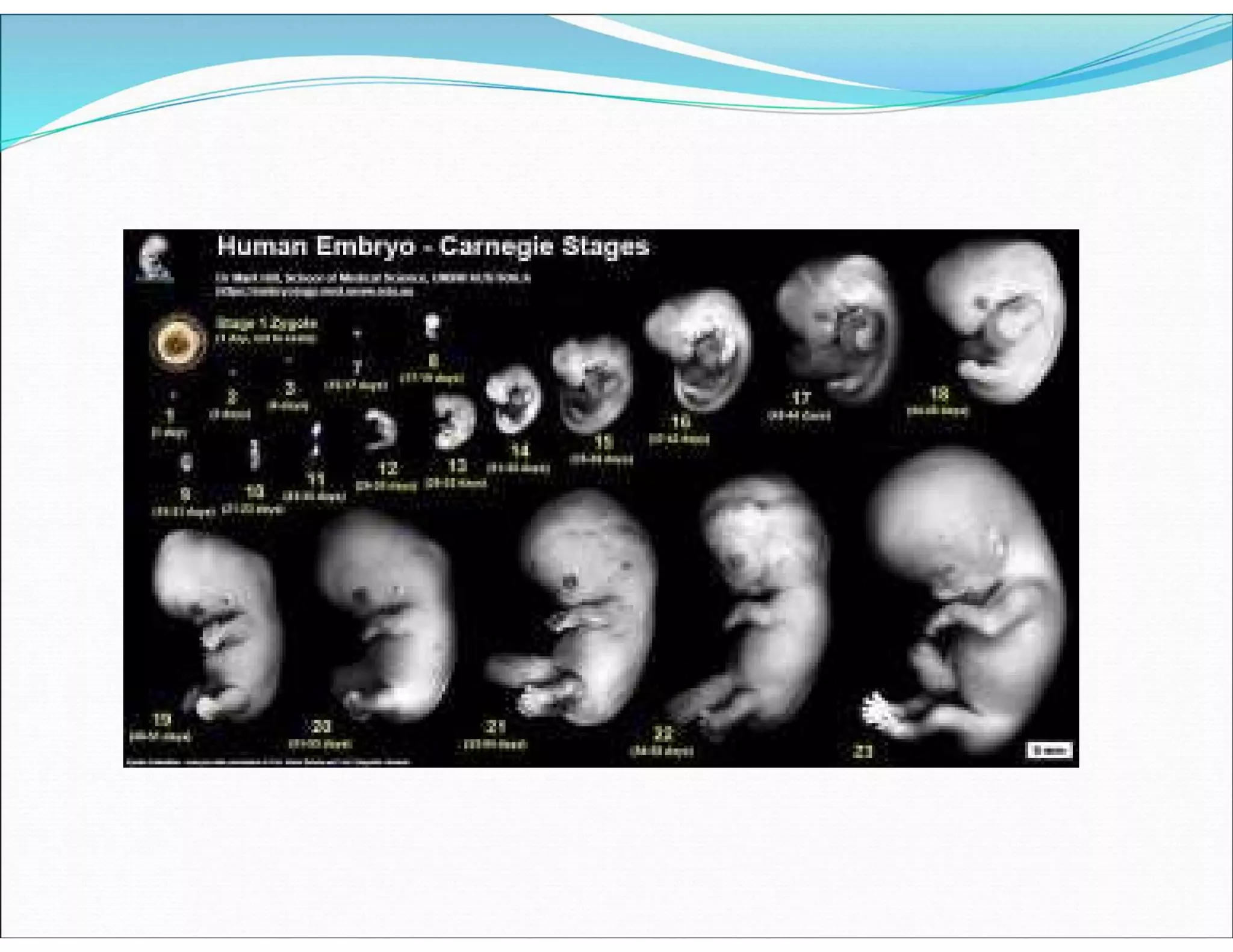
Embryology
It is thestudy of various changes in the developing orga
nism from the fertilization of ovum up to the birth of t
he baby.
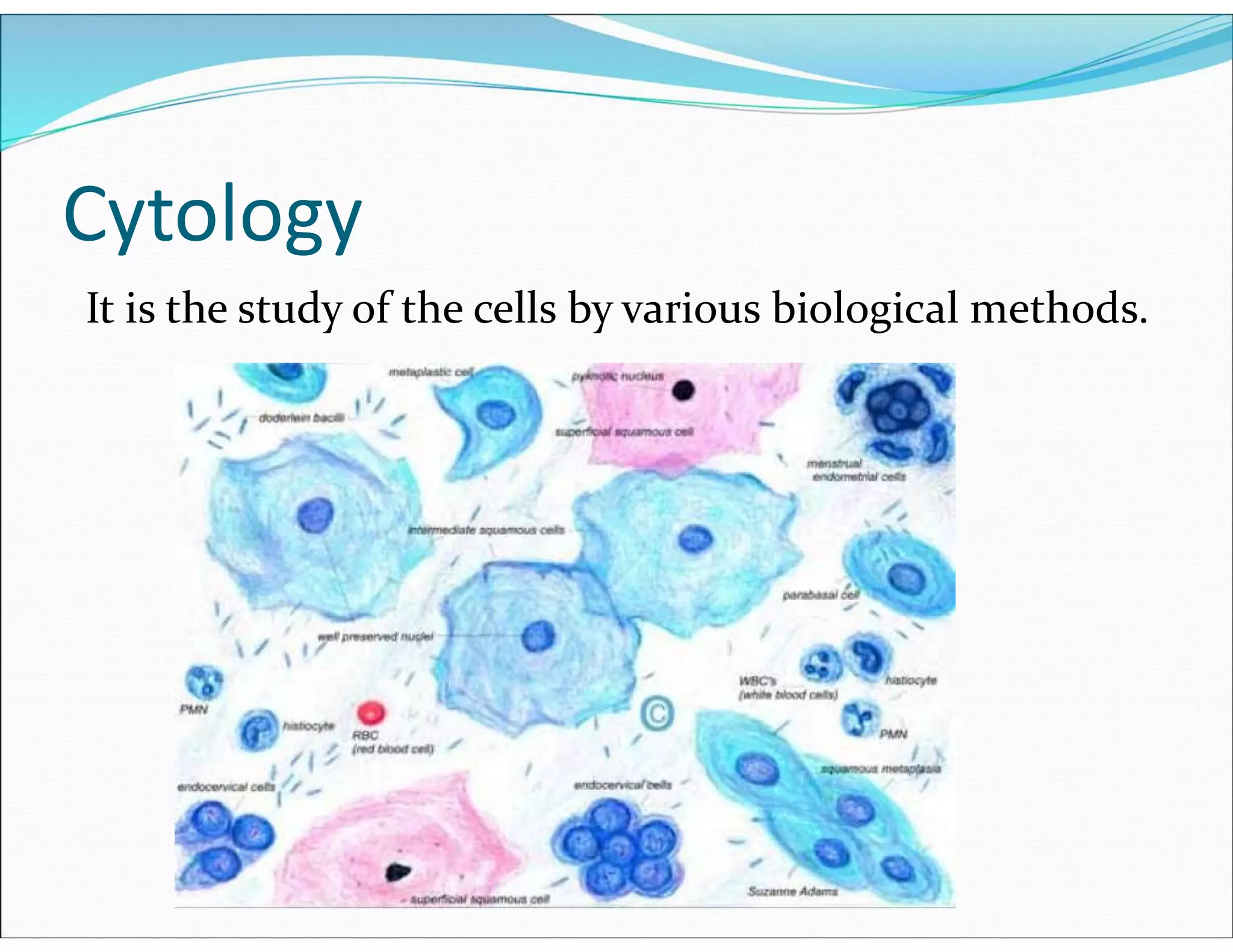
Histology
It is thestudy of various tissues by various scientific met
hod (microscopy ; histochemistry etc.).
34.
Applied / ClinicalAnatomy
It is the direct application of facts of human anatomy to
medicine and surgery. The students are advised to lay t
he stress on applied aspects while they are studying gr
oss anatomy in dissection hall.
35.
Systemic Anatomy
The descriptionof several systems of organs separately a
nd in logical order comes under the head of systematic
anatomy. The several parts of each system not only sho
w a certain similarity of structure but are also associate
d in specialized functions.
36.
Anatomical
Terminologies
Anatomic positionis a specific
body position in which an indi
vidual stands upright with the
feet parallel and flat on the fl
oor.
The head is level, and the eye
s look forward toward the obs
erver.
The arms are at either side of
the body with the palms facin
g forward and the thumbs poi
nting away from the body.
37.
Anatomical Terminology
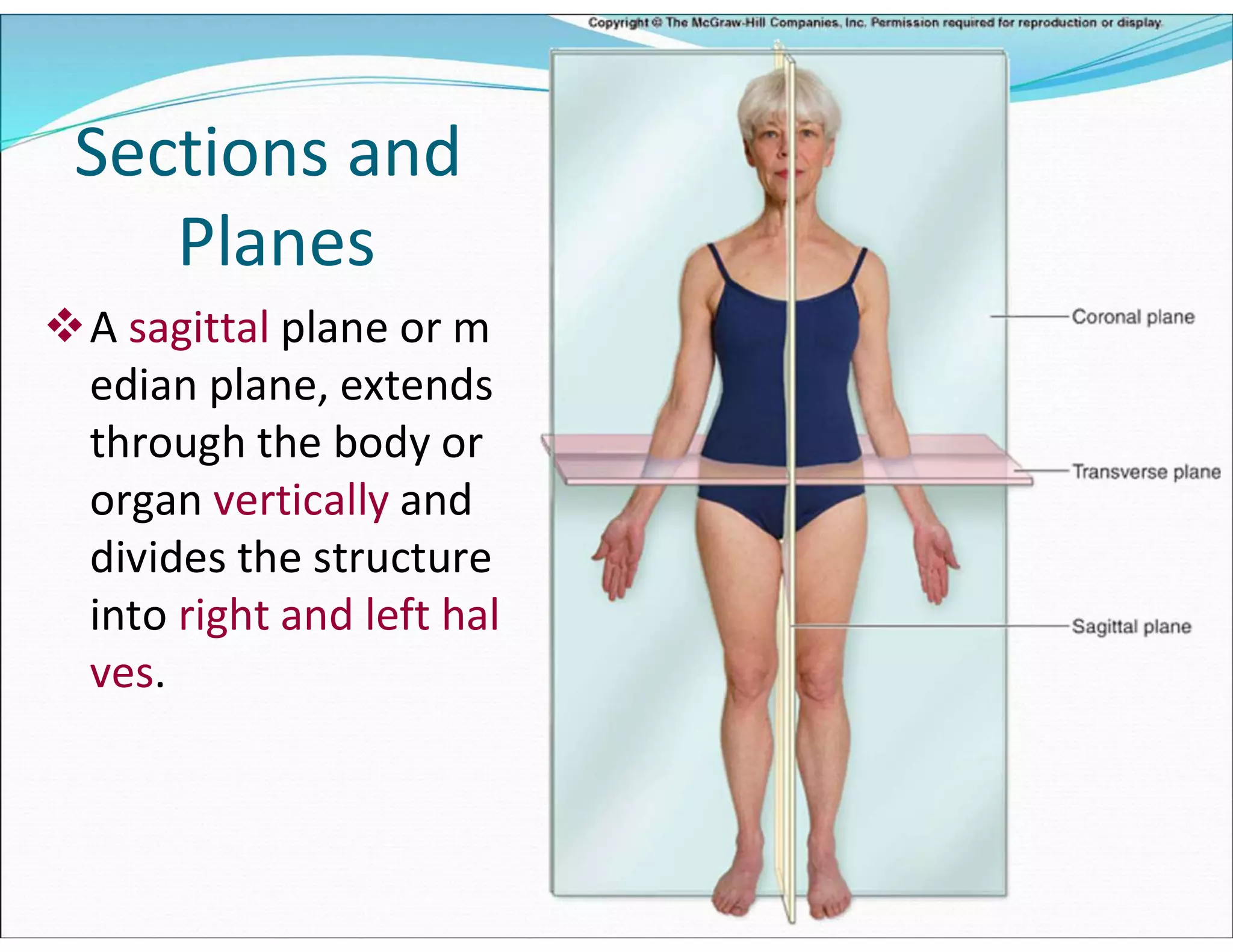
A planeis an imaginary surface that slices t
he body into specific sections.
The three major anatomic planes of referen
ce are the coronal, transverse, and sagittal
planes.
39.
Sections and
Planes
A coronalplane, also ca
lled a frontal plane, is a
vertical plane that divid
es the body into anterio
r (front) and posterior (
back) parts.
40.
Sections and
Planes
Atransverse plane, also cal
led a cross-sectional plane
or horizontal plane, cuts p
erpendicularly along the lo
ng axis of the body or orga
n separating it into both su
perior (upper) and inferior
(lower) parts.
41.
Sections and
Planes
A sagittalplane or m
edian plane, extends
through the body or
organ vertically and
divides the structure
into right and left hal
ves.
42.
Sections and Planes
Asagittal plane in the body midline is a midsagitta
l plane.
A plane that is parallel to the midsagittal plane, b
ut either to the left or the right of it, is termed a p
arasagittal (or sagittal) plane.
A minor plane, called the oblique plane, passes th
rough the specimen at an angle.
43.
Directional Terms ofthe Bod
y
Directional terms are precise and brief, and
for most of them there is a correlative term
that means just the opposite.
44.
Relative and DirectionalTerms of
the Body
Relative to front (belly side) or back (
back side) of the body :
Anterior = In front of; towar
d the front surface
Posterior = In back of; towa
rd the back surface
Dorsal =At the back side of
the human body
Ventral = At the belly side o
f the human body
45.
Relative and DirectionalTerms of
the Body
Relative to the head or t
ail of the body:
Superior = Toward the head o
r above
Inferior = Toward feet not he
ad
Caudal = At the rear or tail en
d
Cranial = At the head end
46.
Relative and DirectionalTerms of
the Body
Relative to the midline or center of th
e body:
Medial = Toward the midlin
e of the body
Lateral = Away from the mi
dline of the body
Deep = On the inside, under
neath another structure
Superficial = On the outside
47.
Relative and DirectionalTerms of
the Body
Relative to point of atta
chment of the appenda
ge:
Proximal = Closest to
point of attachment t
o trunk
Distal = Furthest fro
m point of attachme
nt to trunk
49.
Body Regions
The humanbody is partitioned into two ma
in regions, called the axial and appendicular
regions.
the axial region includes the head, neck, and tr
unk which comprise the main vertical axis of o
ur body
our limbs, or appendages, attach to the body’s
axis and make up the appendicular region
50.
7-30
Skeletal System
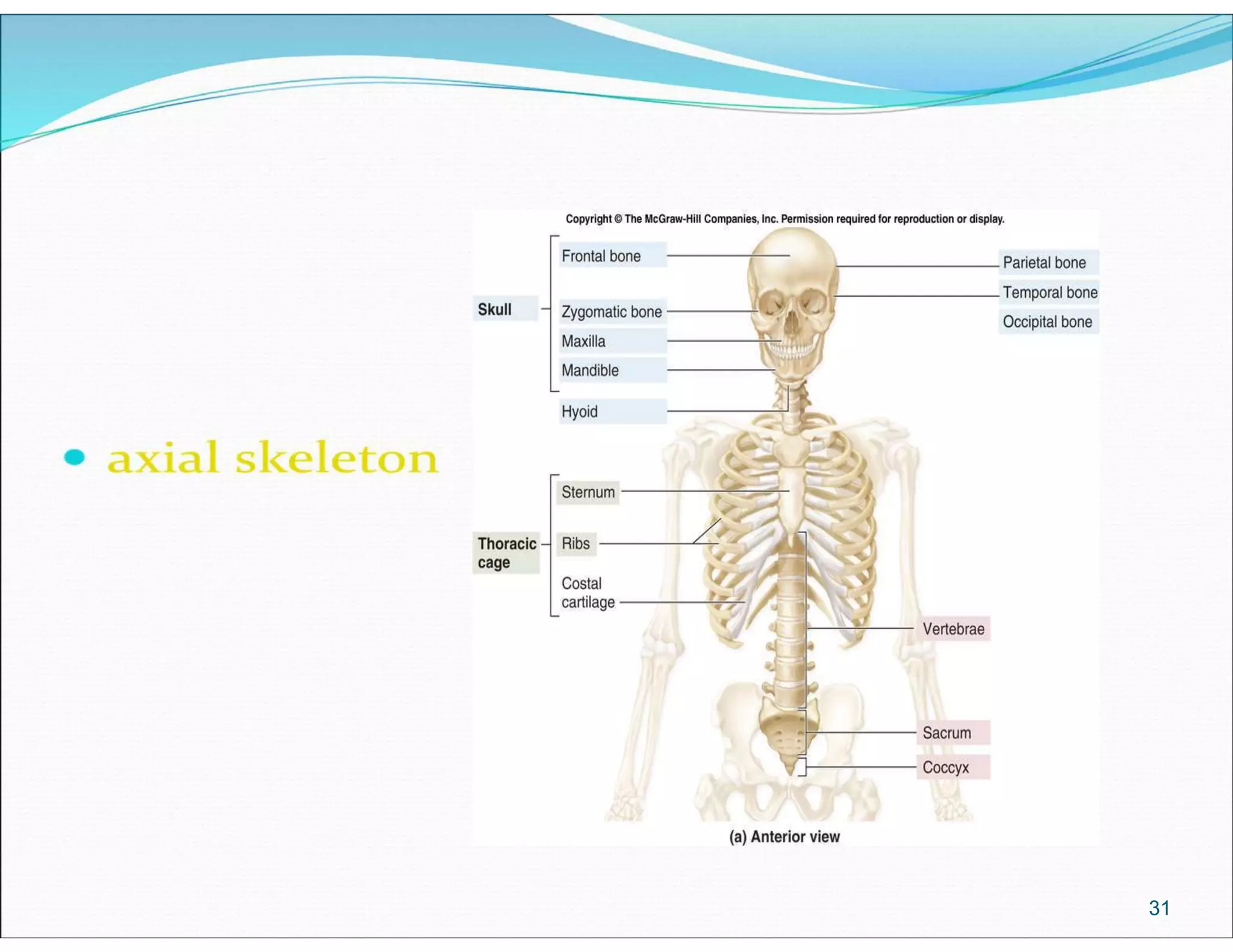
Theaxial skeleton is composed of the bones along the ce
ntral axis of the body,
the skull
the vertebral column
the thoracic cage
The appendicular skeleton consists of the bones of the a
ppendages
upper and lower limbs
the bones that hold the limbs to the trunk of the body.
CELL STRUCTURE
Cell formthe basic structural and functional
unit of human body. These are of two types
1:somatic cells
2:sex cells
56.
CELL mEmbRANE
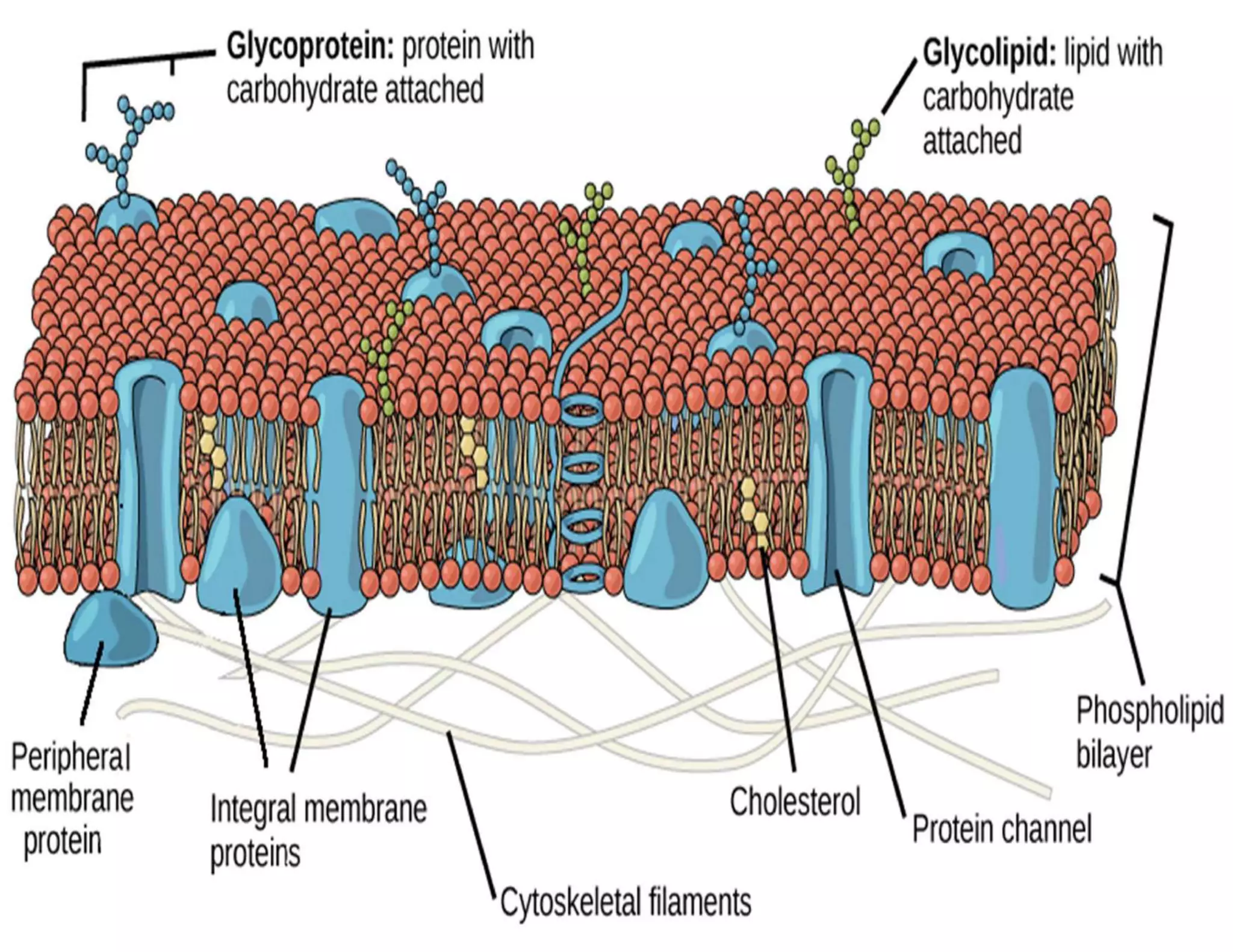
The cellmembrane is a biological membrane
that separates the interior of all cells from the
outside environment which protects the cell
from its environment. The cell membrane
consists of a lipid bilayer, including cholesterols
that sit between phospholipids to maintain
their fluidity at various temperatures.
59.
FUNCTIONS OF CELLmEmbRANE
● 1_ it forms cell boundaries and acts as a barrier between
cytoplasm and extracellular fluid environment.
2_ through it substances are exchanged between cell
and its environment.compounds of high molecular weight
are exchanged by special processes known as
endocytosis and exocytosis.
3_ it plays an important role in the maintainance of cell
shape.
4_ in certain cells it acts as a medium for conduction of
electrical impulses.
NUCLEUS
It contains thegenetic materials and has a direct
influence on metabolic activities of cytoplasm. It is
surrounded by a membrane called NUCLEAR
ENVELOPE. There are one or more rounded darkly
staining bodies called NUCLEOLI. A semi fluid
material called the nuclear ground substance or
NUCLEAR SAP fills the space within the nucleus.
NUCLEAR ENVELOPE consists of two
closely apposed membranes. At numerous points there
are openings in envelope also known as NUCLEAR
PORES. These serve as channels through which
substances pass into and out of the nucleus.
62.
●CHROmATIN which isthe granules and
particles of a basophilic material consists of DNA and
associated basic proteins. DNA exists in the form of
flexible rod like structures called CHROMOSOMES. The
number and characteristics of chromosomes encountered
in an individual is known as karyotype.
NUCLEOLIare rounded dense well defined
bodies not curcumscribed by a membrane. It is composed
of ribonucleic acid RNA and associated proteins.
64.
CYTOPLASm
● Most ofthe metabolic processes of cell occurr in
cytoplasm. It is often divided in three parts
1: centrosome
2: endoplasm
3: ectoplasm
the term CYTOSOL are used for the component
of cytoplasm which occupies space between
organelles inclusions and elements of cytoplasm.
65.
ORGANELLES
● The termorganelle literally means little organs. They carry out various special functions essential to life and metabolism of cell.
1_ mITOCHONDRIA
mitochondrion is bounded by two unit membranes. The inner one is
thrown into folds called CRISTAE. The inner surface of internal
membrane as well as cristae is lined by elemantary particles which are
connected to membrane by means of a slender stalk.
FUNCTIONS OF mITOCHONDRIA
these are the major energy source of the cell. They transform
chemical energy of metabolites present in the cytoplasm into
available energy easily accessible to the cell.
68.
GOLGI APPARATUS
● GOLGIAPPARATUS appears as a number of curved
stacks of closely packed membranous cisternae
associated with small vesicles and large vacuoles. These
are completely devoid of ribosomes. Their chief function
is the concentration and packing of secretory products of
the cell.
● RIbOSOmES are small bodies present in all
animal cells except mature RBCs. These are the sites
where amino acids are incorporated into polypeptides
and
70.
LYSOSOmES
●are small roughlyspherical bodies limited by a single
membrane. These contain hydrolytic enzymes which are
capable of degrading almost all types of biological
macromolecules. These carry out intracellular digestion.
●
CYTOPLASmIC INCLUSIONS
1: LIPIDS
2:GLYCOGEN
3:PIGMENTS
4:CRYSTALS
5:SECETORY GRANULES
71.
CYTOSKELETON
●consists of acomplex network of filaments and
microtubules. It plays an important role in
maintenance of cell shape, stabilization of cell
attachments and cellular movements.
FILAMENTS include thick, thin and intermediate
filaments.
MICROTUBULES are long hollow cylindrical
structures which do not branch. They are formed by
polymerization of a protein called tubulin.
Polymerization occurs at microtubules organizing
centers.
73.
VACUOLE
● A vacuoleis a membrane-bound cell organelle.
In animal cells, vacuoles are generally small and
help sequester waste products. In plant
cells, vacuoles help maintain water balance.
Sometimes a single vacuole can take up most of
the interior space of the plant cell.
74.
ENDOPLASmIC RETICULUm
● Theendoplasmic reticulum (ER) is a
large organelle made of membranous sheets
and tubules that begin near the nucleus and
extend across the cell. The endoplasmic
reticulum creates, packages, and secretes many
of the products created by a cell. Ribosomes,
which create proteins, line a portion of the
endoplasmic reticulum.
75.
Rough Endoplasmic Reticulum(RER) Smooth Endoplasmic Reticulum
(SER)
It possesses ribosomes attached to its
membrane.
It does not have ribosomes on its
membrane.
Formed of cisternae and a few tubules. Formed of vesicles and tubules.
It participates in the synthesis of
enzymes and proteins.
Synthesises glycogen, lipids and
steroids.
It helps in the formation of lysosomes. Gives rise to
Spherosomes/ Oleosomes
It is internal and connected with the
nuclear envelope.
It is peripheral and may be connected
to plasmalemma.
Ribophorins are present and help
ribosomes attach to ER
Devoid of Ribophorins.
It might develop from the nuclear
envelope
Develops from Rough Endoplasmic
Reticulum.
Provides proteins and lipids for Golgi
apparatus.
Provides vesicles for cis-face of Golgi
apparatus.
Dr AhmadAli Qureshi
(MBBS,GMC)
PharmoHub Pakistan
80.
As humanbody develops from
single to multicellular, cells
specialize.
Body is interdependent system,
malfunction of one group of cells
is catastrophic.
Cells specialize into types of
tissues, then interspersed into
organs.
81.
Epithelium
◦ Coverings
◦Linings of
surfaces
Connective
◦ Support
◦ Bone, ligaments,
fat
Muscle
◦ Movement
Nervous
◦ Control
◦ Brain, nerves,
spinal cord
Protection
◦ Skinprotects from sunlight & bacteria & physical
damage.
Absorption
◦ Lining of small intestine, absorbing nutrients into
blood
Filtration
◦ Lining of Kidney tubules filtering wastes from
blood plasma
Secretion
◦ Different glands produce perspiration, oil,
digestive enzymes and mucus
84.
Form continuoussheets (fit like tiles)
Apical Surface
◦ All epithelial cells have a top surface that borders
an open space – known as a lumen
Basement Membrane
◦ Underside of all epithelial cells which anchors them
to connective tissue
Avascularity (a = without)
◦ Lacks blood vessels
◦ Nourished by connective tissue
Regenerate & repair quickly
85.
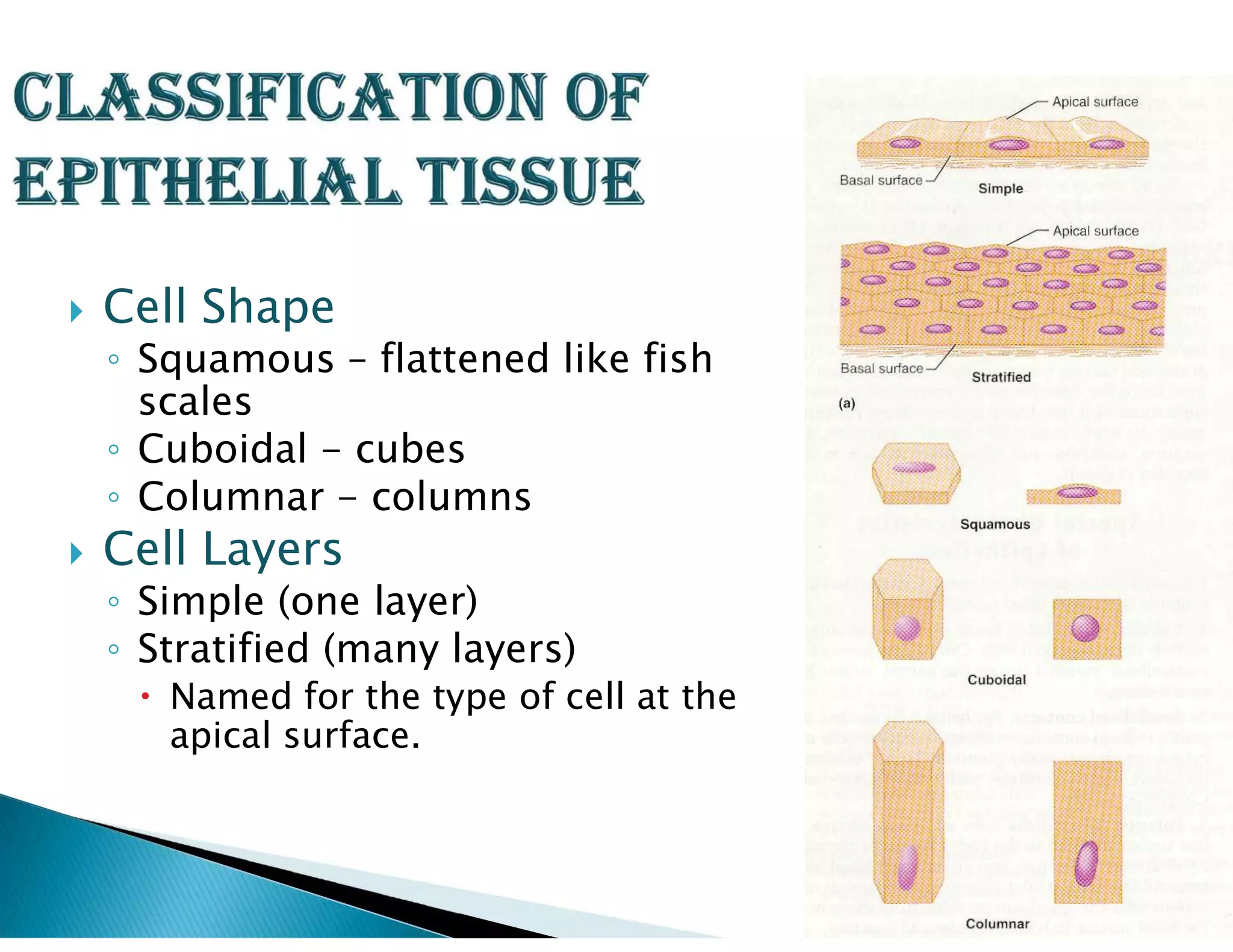
Cell Shape
◦Squamous – flattened like fish
scales
◦ Cuboidal - cubes
◦ Columnar - columns
Cell Layers
◦ Simple (one layer)
◦ Stratified (many layers)
Named for the type of cell at the
apical surface.
86.
Structure
◦ SingleLayer of flattened cells
Function
◦ Absorption, and filtration
◦ Not effective protection – single layer of cells.
Location
◦ Walls of capillaries, air sacs in lungs
◦ Form serous membranes in body cavity
88.
Structure
◦ Singlelayer of cube shaped cells
Function
◦ Secretion and transportation in glands, filtration in
kidneys
Location
◦ Glands and ducts (pancreas & salivary), kidney
tubules, covers ovaries
90.
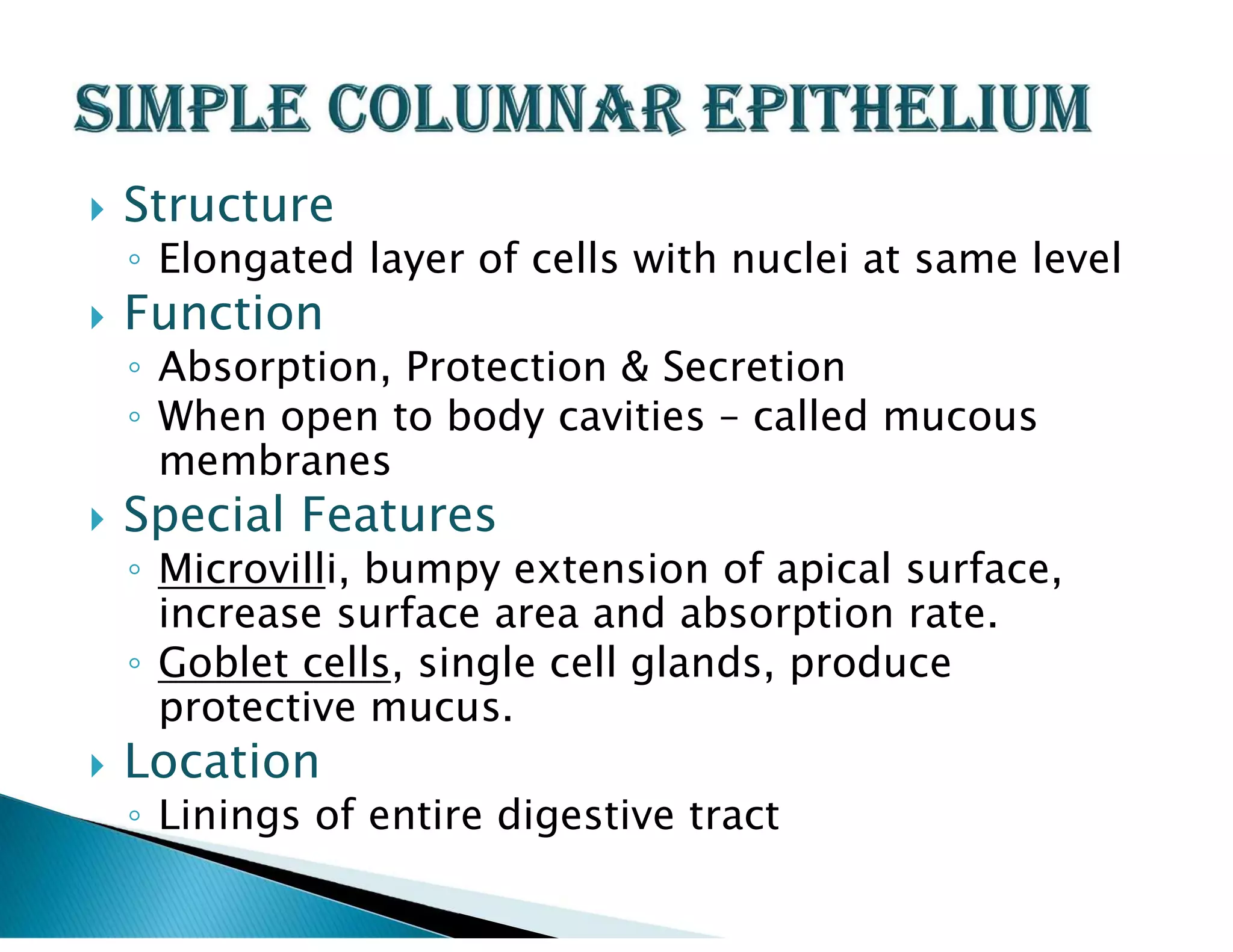
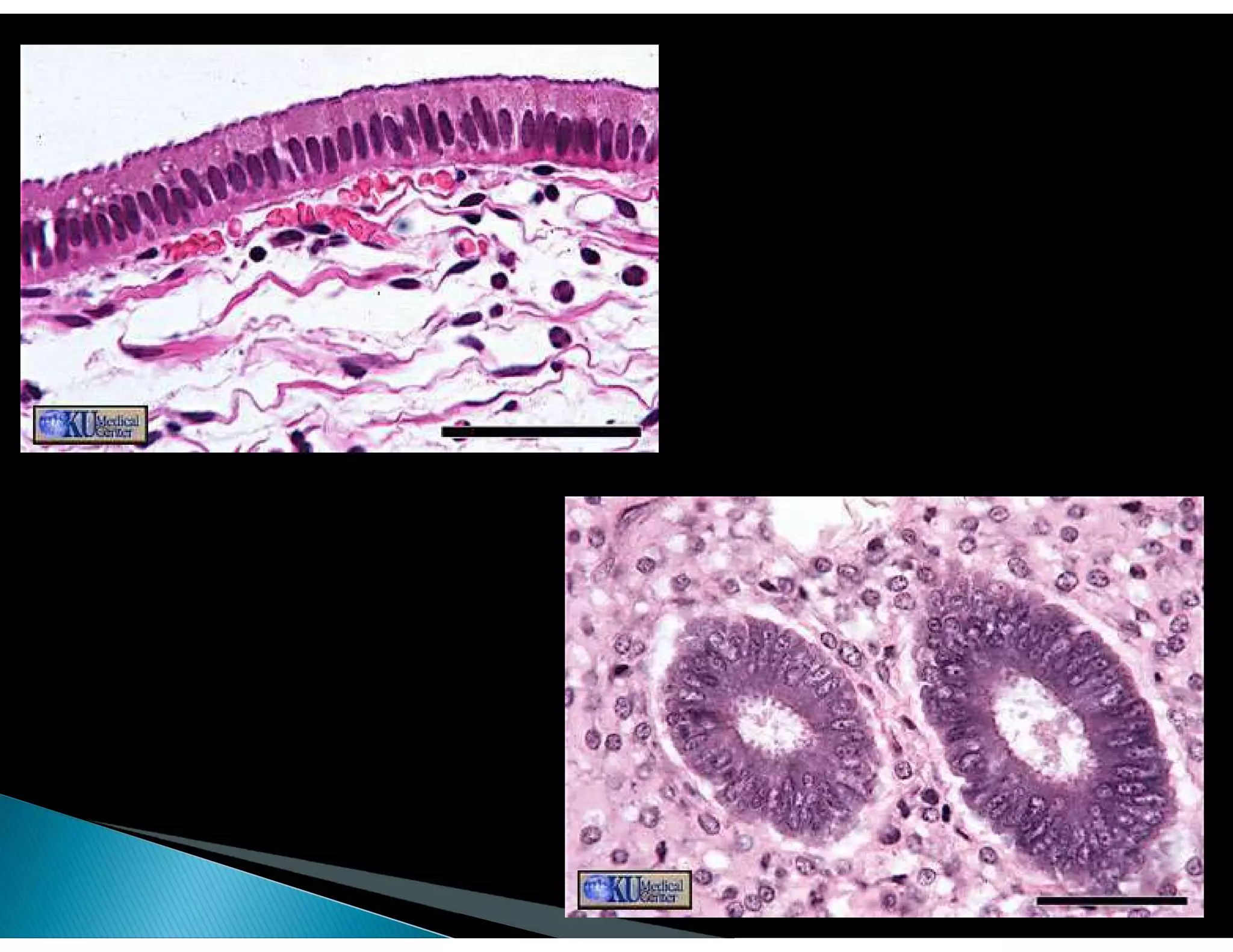
Structure
◦ Elongatedlayer of cells with nuclei at same level
Function
◦ Absorption, Protection & Secretion
◦ When open to body cavities – called mucous
membranes
Special Features
◦ Microvilli, bumpy extension of apical surface,
increase surface area and absorption rate.
◦ Goblet cells, single cell glands, produce
protective mucus.
Location
◦ Linings of entire digestive tract
92.
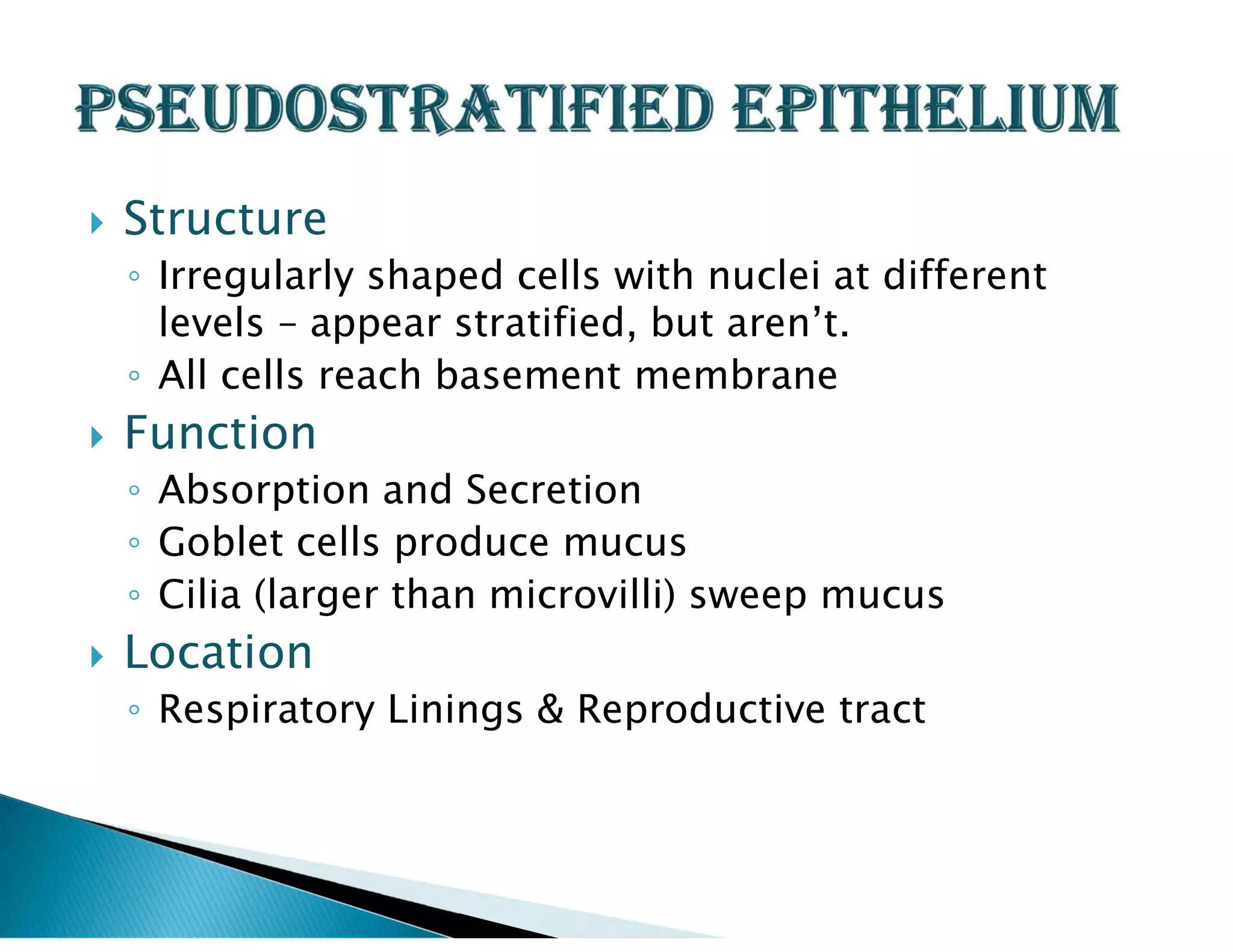
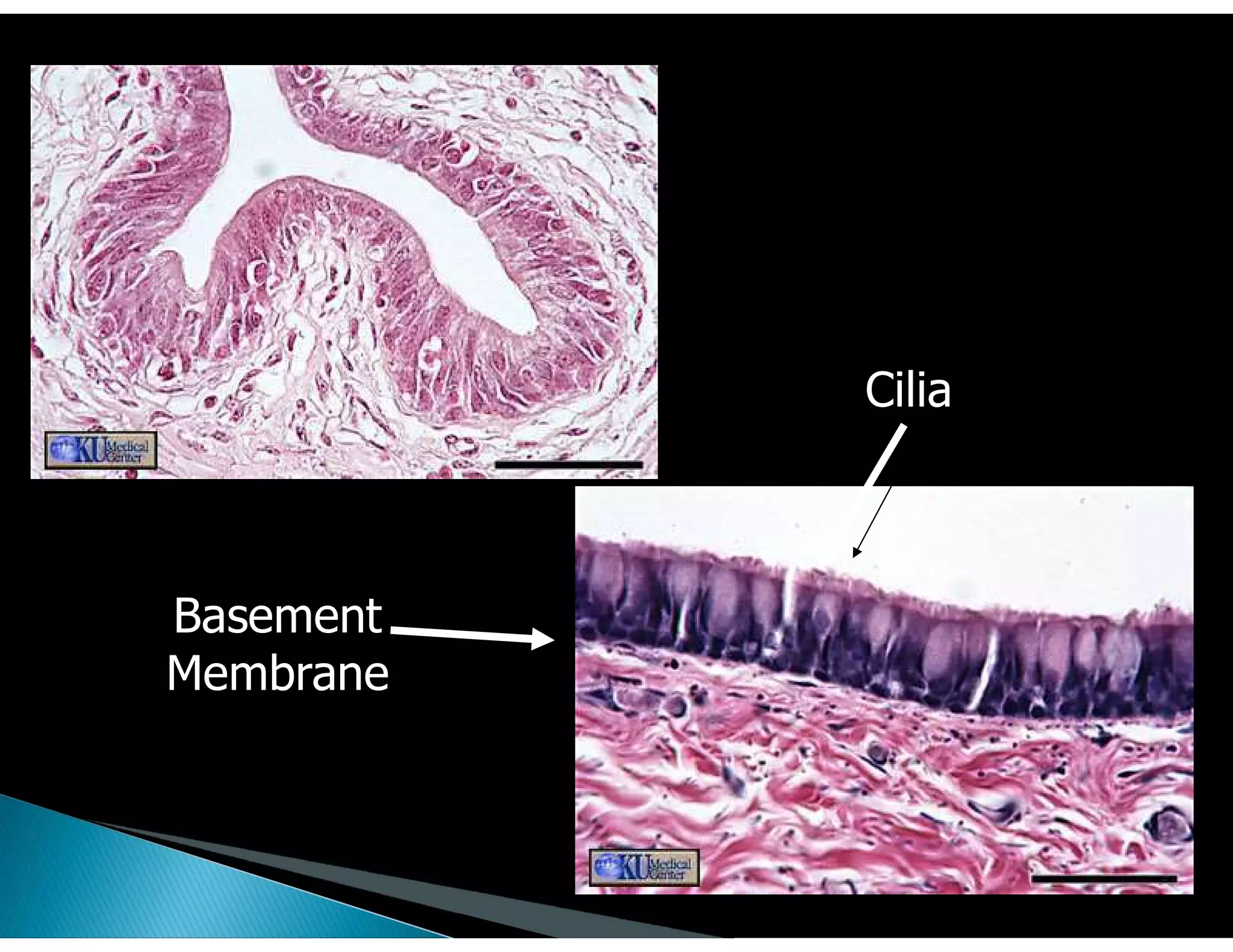
Structure
◦ Irregularlyshaped cells with nuclei at different
levels – appear stratified, but aren’t.
◦ All cells reach basement membrane
Function
◦ Absorption and Secretion
◦ Goblet cells produce mucus
◦ Cilia (larger than microvilli) sweep mucus
Location
◦ Respiratory Linings & Reproductive tract
Structure
◦ Manylayers (usually cubodial/columnar at bottom
and squamous at top)
Function
◦ Protection
◦ Keratin (protein) is accumulated in older cells near
the surface – waterproofs and toughens skin.
Location
◦ Skin (keratinized), mouth & throat
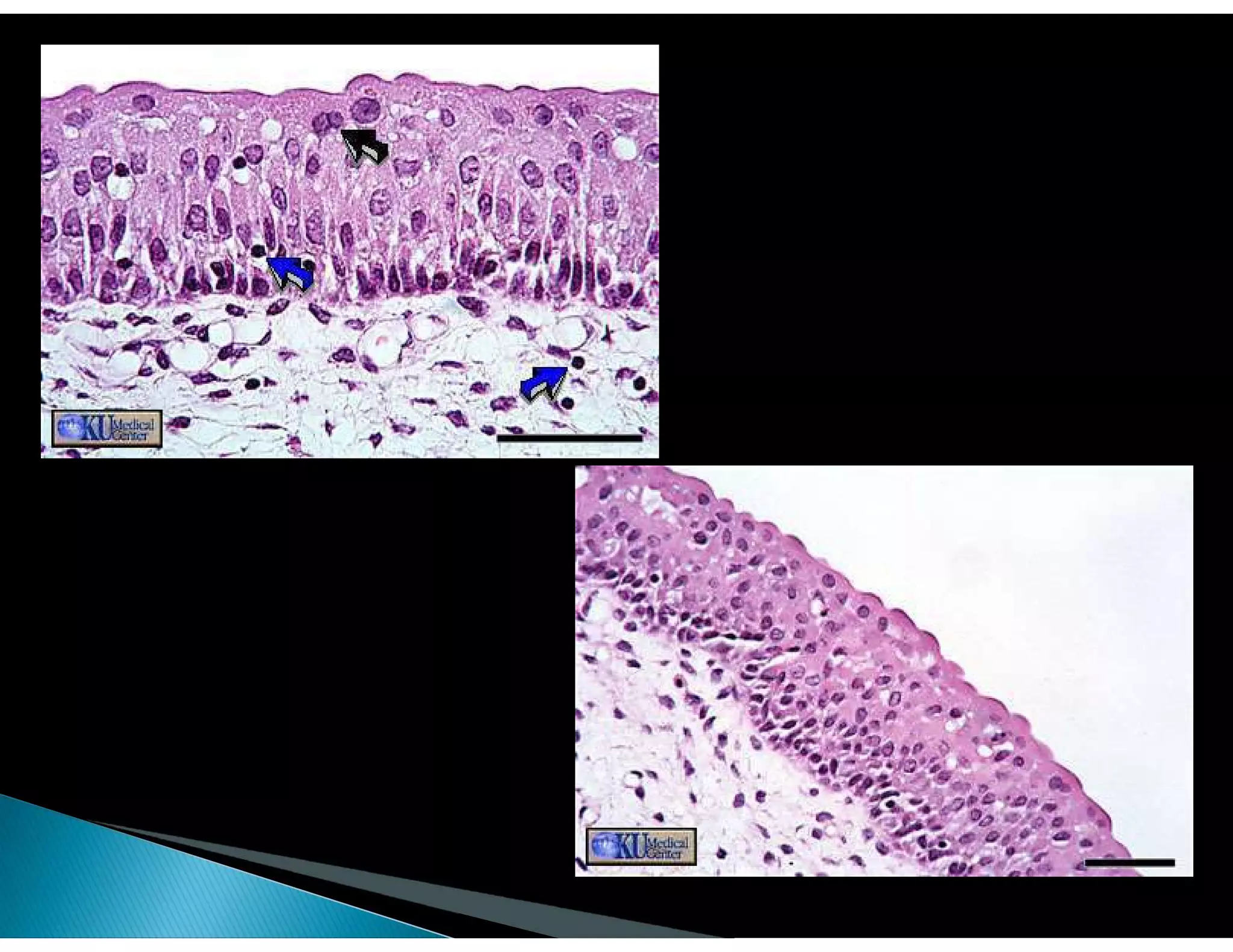
Structure
◦ Manylayers
◦ Very specialized – cells at base are cuboidal or
columnar, at surface will vary.
◦ Change between stratified & simple as tissue is
stretched out.
Function
◦ Allows stretching (change size)
Location
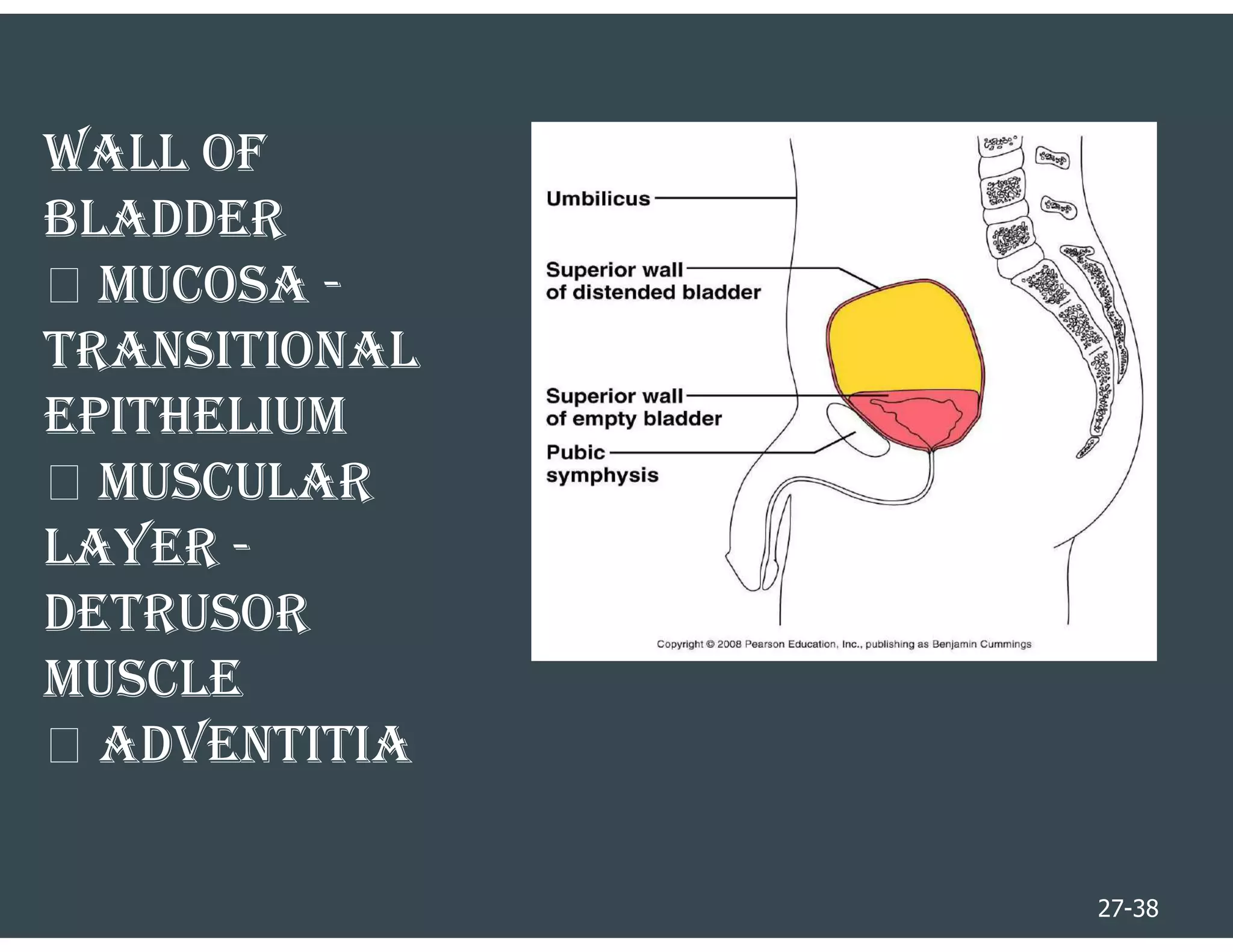
◦ Urinary bladder, ureters & urethra
101.
One ormore cells that make and secrete a
product.
Secretion = protein in aqueous solution:
hormones, acids, oils.
Endocrine glands
◦ No duct, release secretion into blood vessels
◦ Often hormones
◦ Thyroid, adrenal and pituitary glands
Exocrine glands
◦ Contain ducts, empty onto epithelial surface
◦ Sweat, Oil glands, Salivary glands, Mammary
glands.
102.
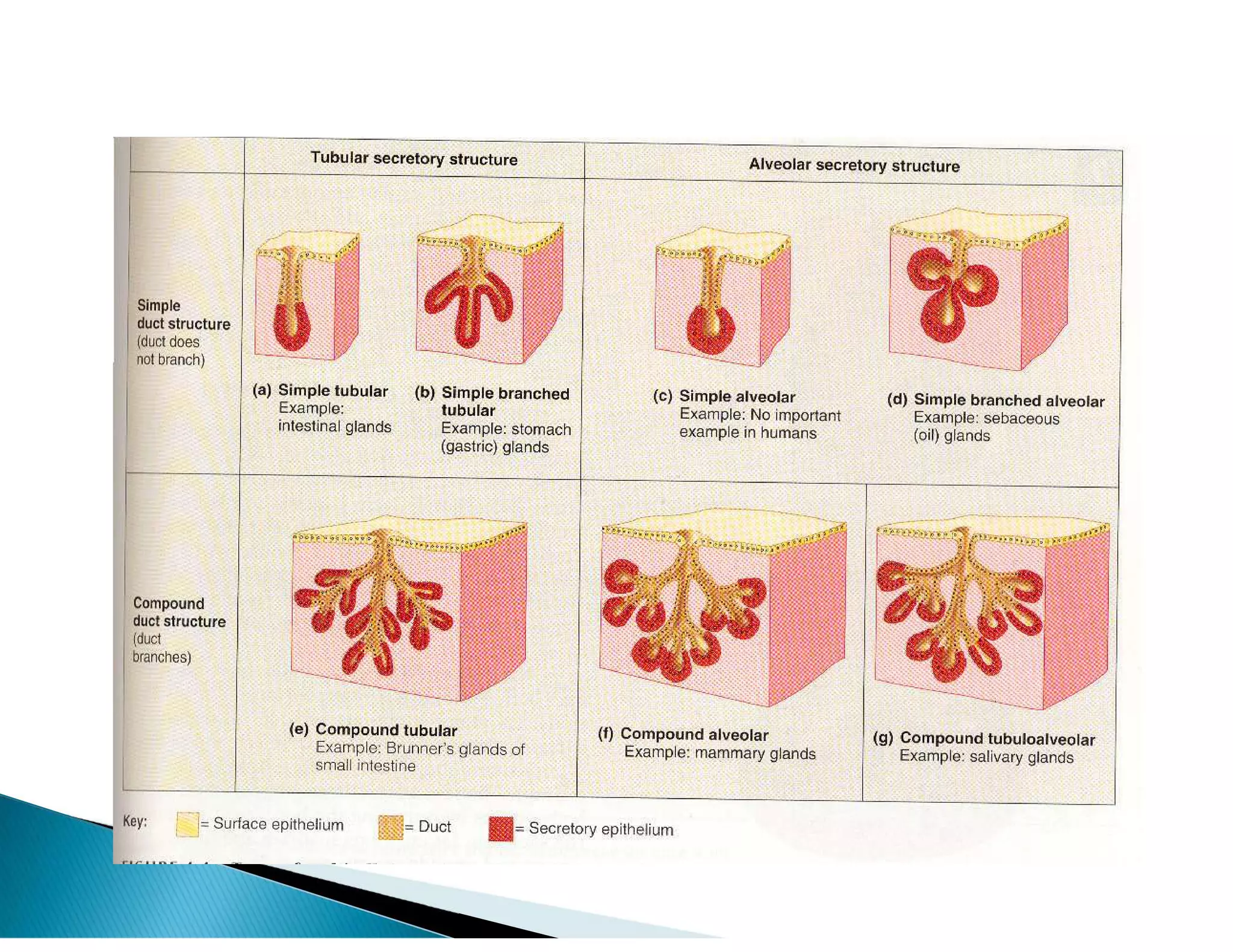
Branching
Simple –single, unbranched duct
Compound – branched.
Shape: tubular or alveolar
Tubular – shaped like a tube
Alveolar – shaped like flasks or sacs
Tubuloalveolar – has both tubes and sacs in
gland
107.
The basementmembrane is a thin, pliable
sheet-like type of extracellular matrix, that
provides cell and tissue support and acts as a
platform for complex signalling.
The basement membrane is composed of
collagen type IV, laminins, entactin/nidogen,
and proteoglycans that the epithelial cells
themselves secrete.
It is a non-cellular structure.
108.
It servesto bind the epithelium with the
underlying or surrounding connective tissue.
It serves as a sieve or ultrafilter i.e passes
small molecules and impedes transport of
large molecules.
It serves as a scaffold during epithelial
regeneration or wound healing.
Plays an important role in cell growth ,
proliferation and differentiation.
Connective Tissue
Function:
-Binds structures together
- Provides support & protection
- Fills spaces
- Produces blood cells
- Stores fat
For energy, insulation, organ protection
113.
Structure:
- Tissuecells are widely separated by
extracellular matrix
- Can be solid, semisolid, or liquid
Matrix of connective tissue determine its
properties
114.
Fibers of theMatrix
White fibers – contain collagen which
gives the fibers flexibility and strength
Yellow fibers – contain elastin more elastic
than collagen but not as strong
Reticular fibers – thin, highly branched
collagenous fibers that provide support
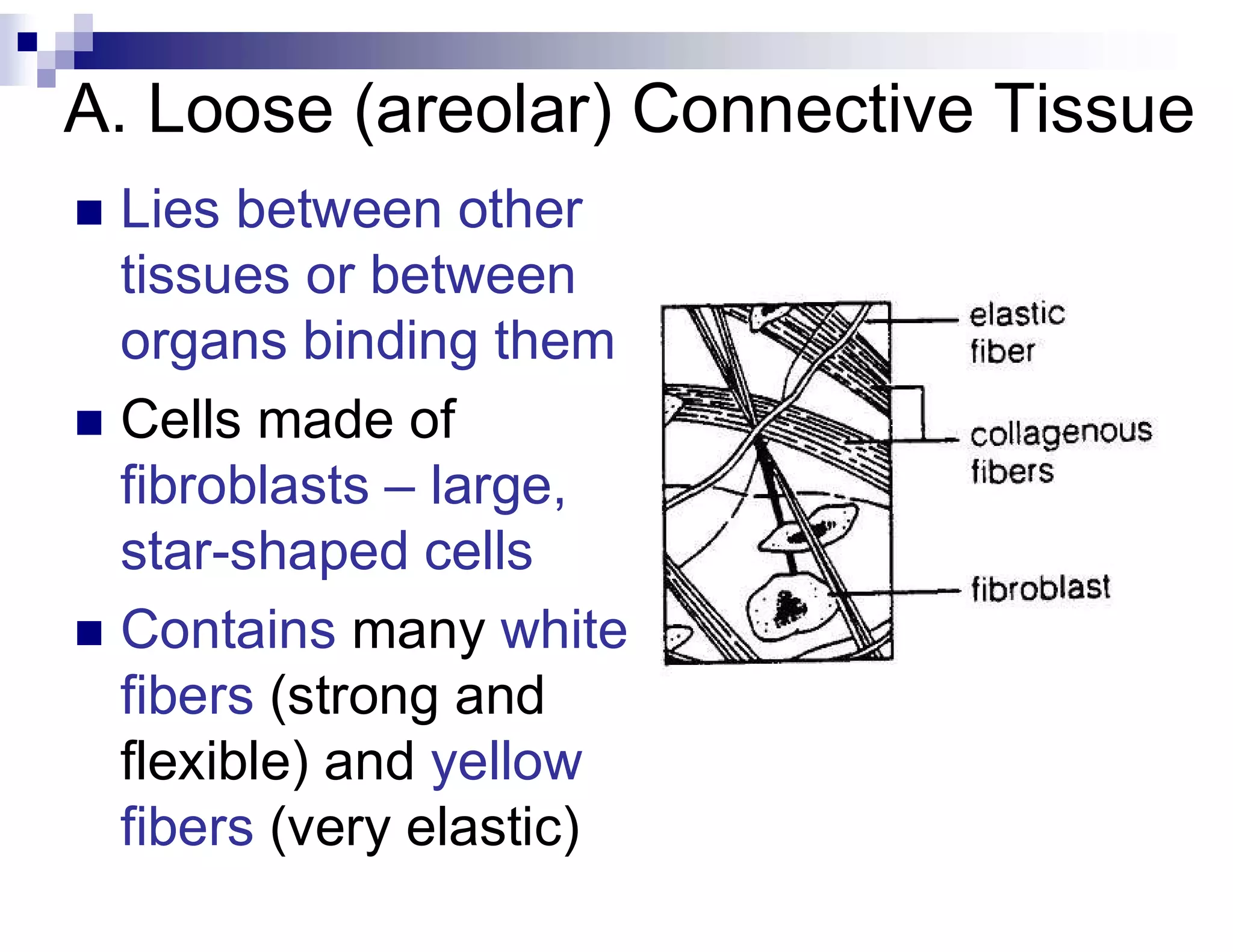
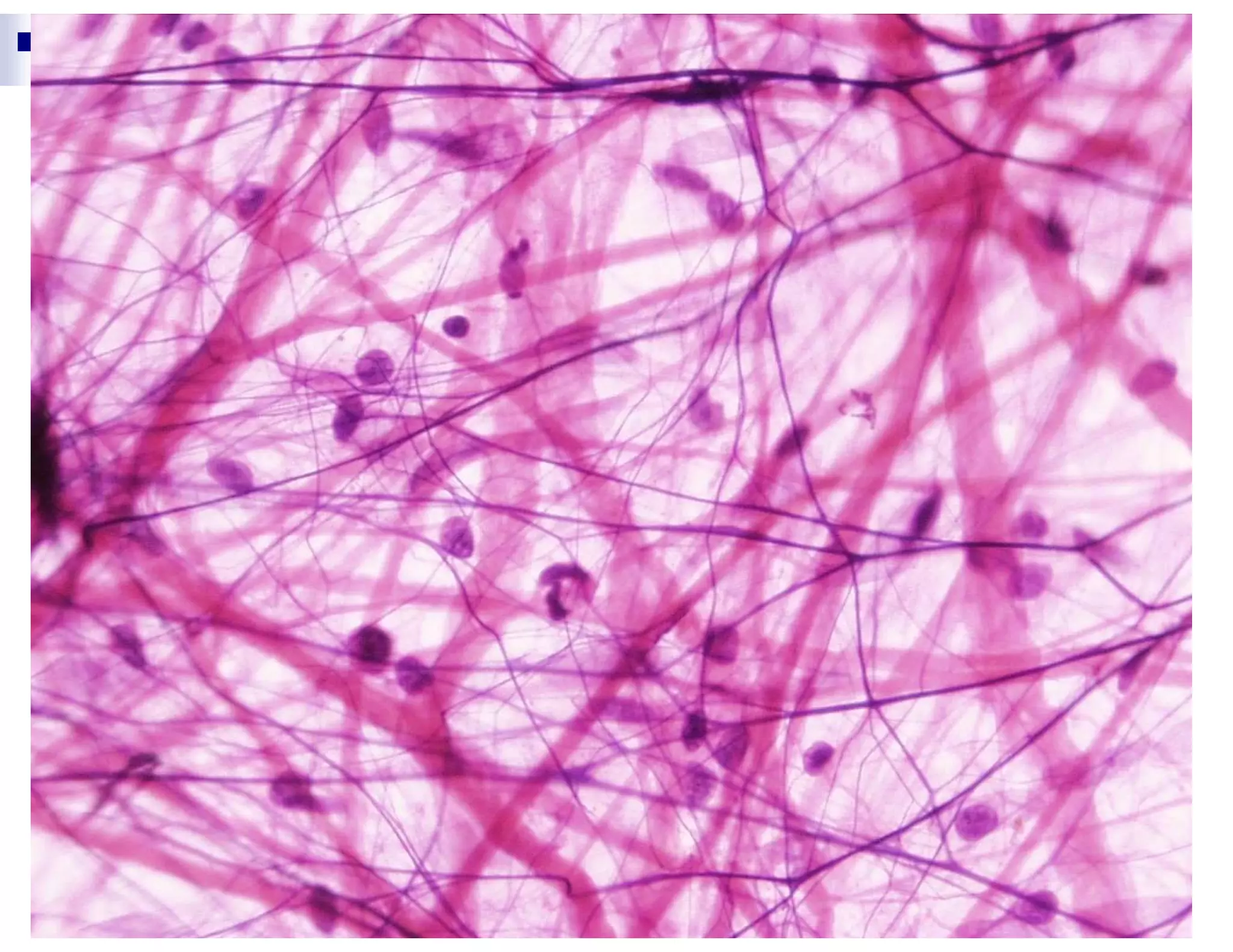
A. Loose (areolar)Connective Tissue
Lies between other
tissues or between
organs binding them
Cells made of
fibroblasts – large,
star-shaped cells
Contains many white
fibers (strong and
flexible) and yellow
fibers (very elastic)
119.
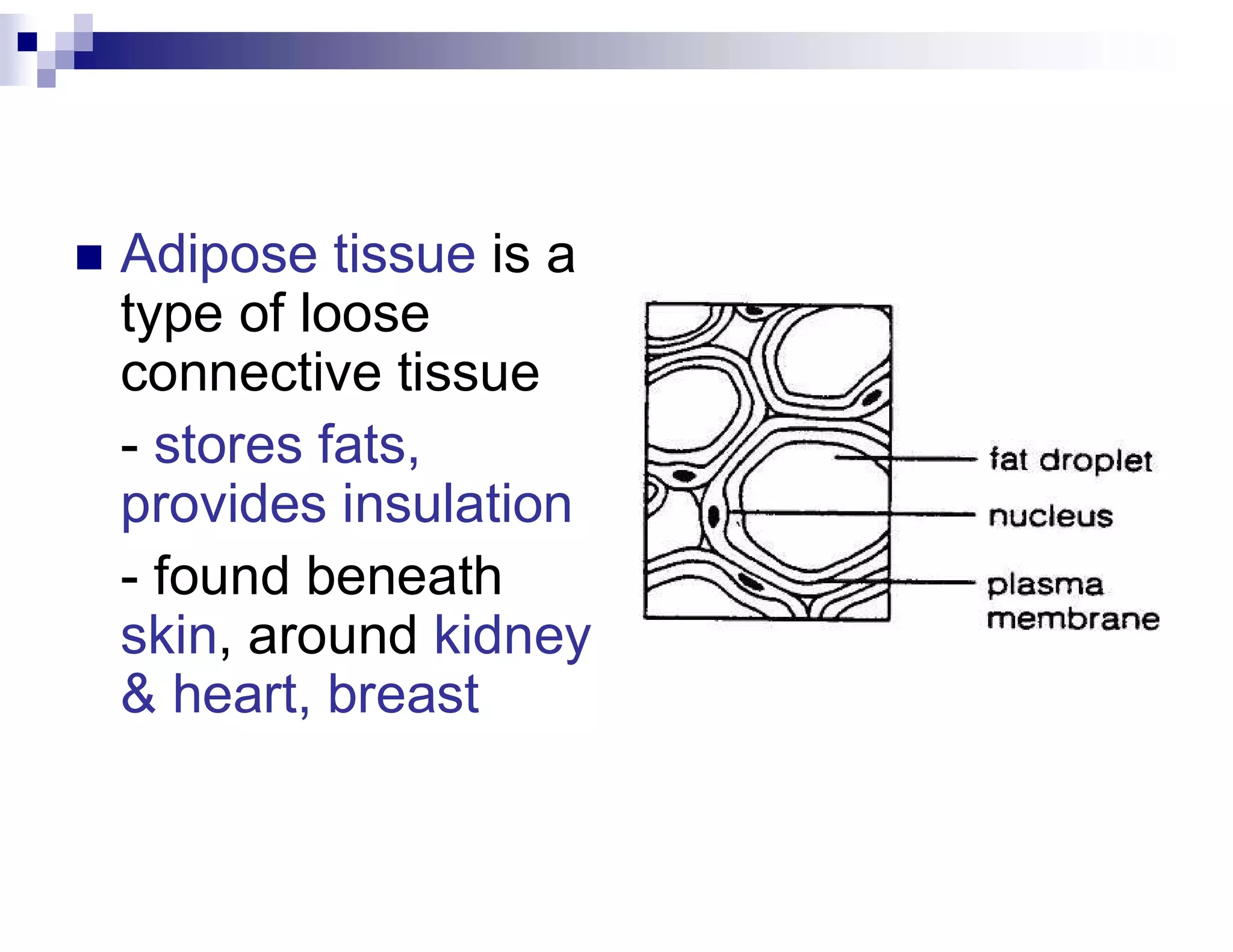
Adipose tissueis a
type of loose
connective tissue
- stores fats,
provides insulation
- found beneath
skin, around kidney
& heart, breast
121.
B. Dense ConnectiveTissue
Regular
Consists of parallel
bundles of
collagenous fibers
Found in tendons &
ligaments
Binds organs together
Irregular
Bundles run in
different direction
Found in inner portion
of skin
C. Reticular Connective
Has reticular cells and
reticular fibers
Also called lymphatic
tissue
Found in lymph nodes,
spleen, thymus, and red
bone marrow
Store and produce white
blood cells
Part of immune system
125.
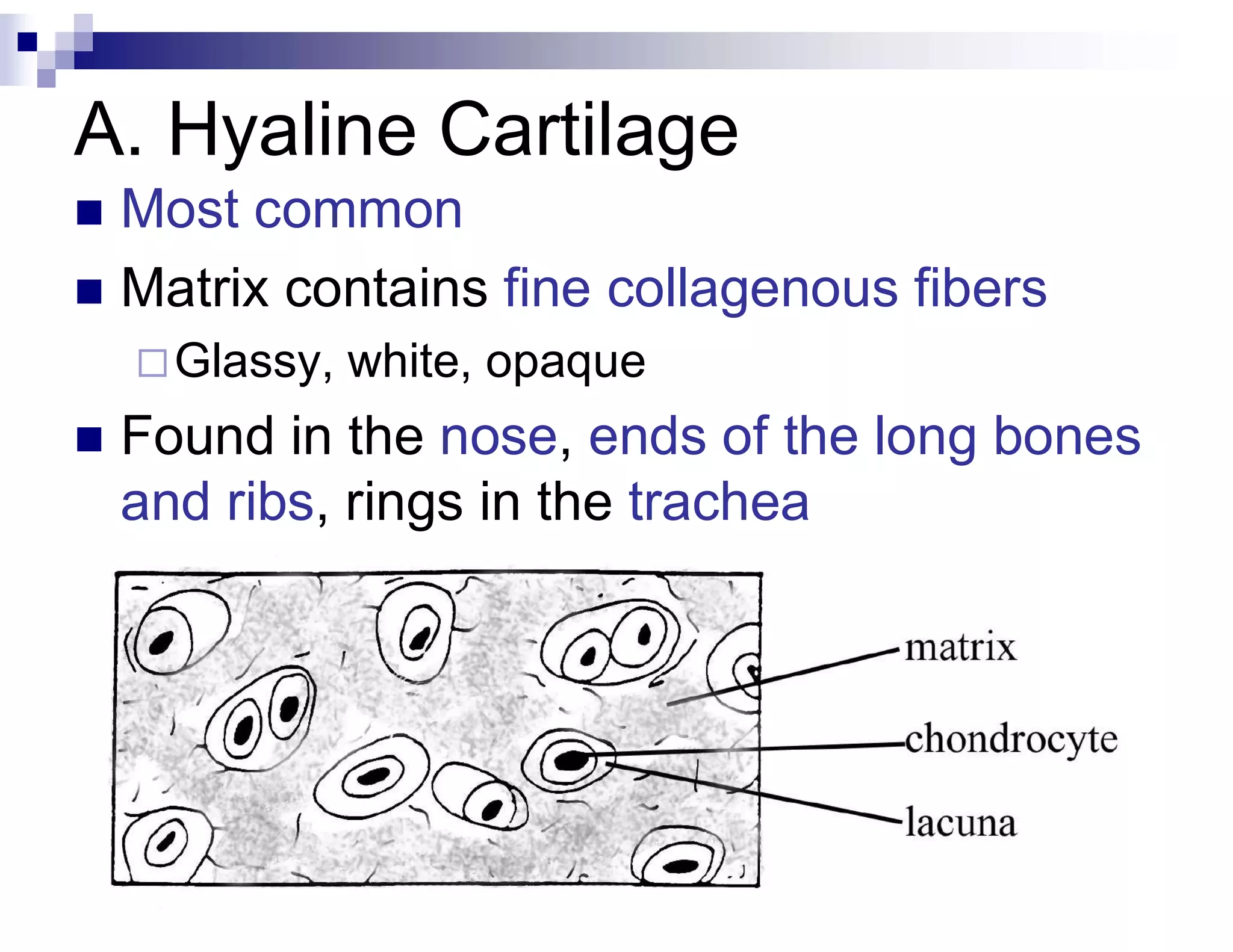
2. Cartilage
Thecell
(chondrocytes)
lies in small
chambers called
lacunae
Matrix is solid yet
flexible
Lacks direct
blood supply, as
a result, it heals
slowly
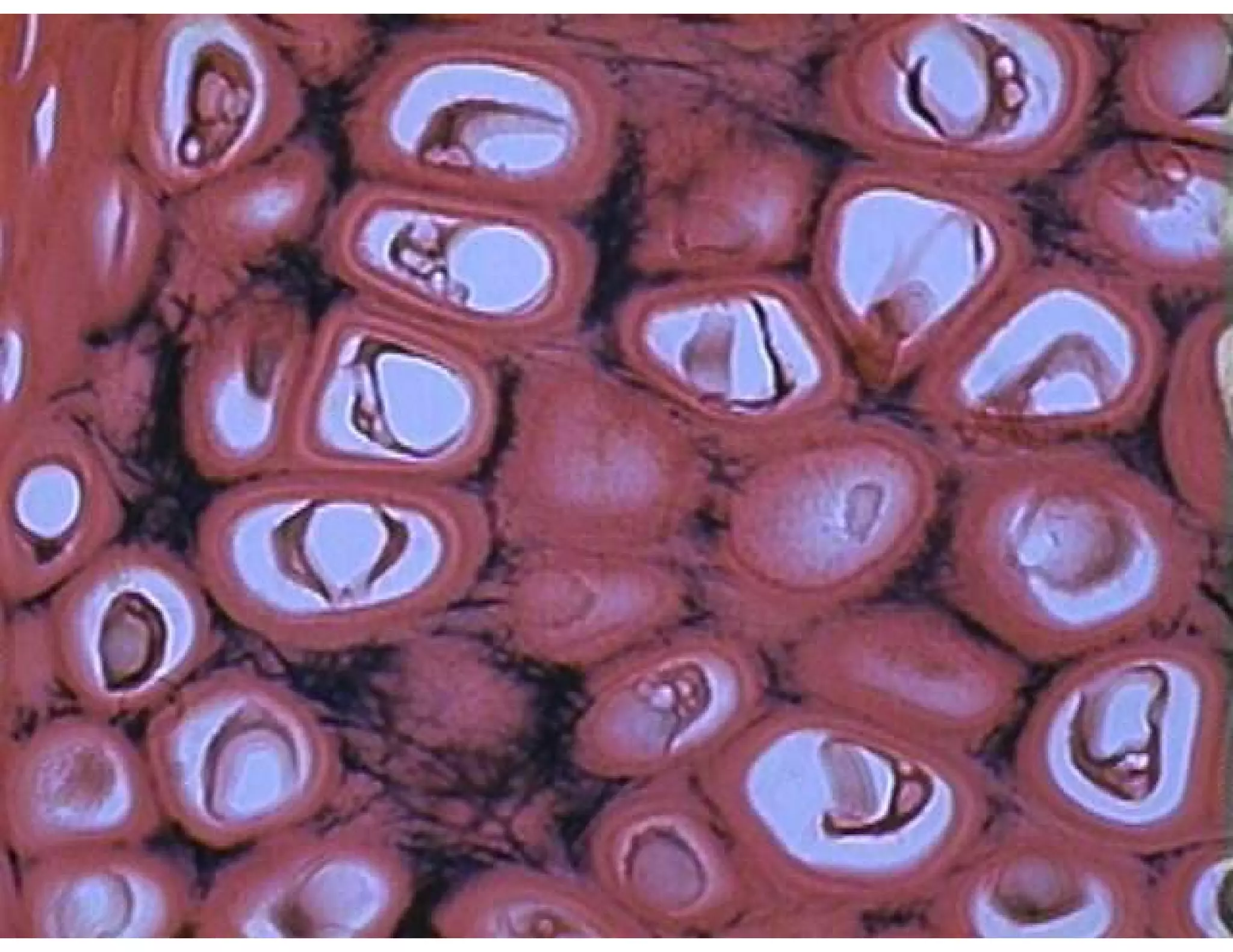
A. Hyaline Cartilage
Most common
Matrix contains fine collagenous fibers
Glassy, white, opaque
Found in the nose, ends of the long bones
and ribs, rings in the trachea
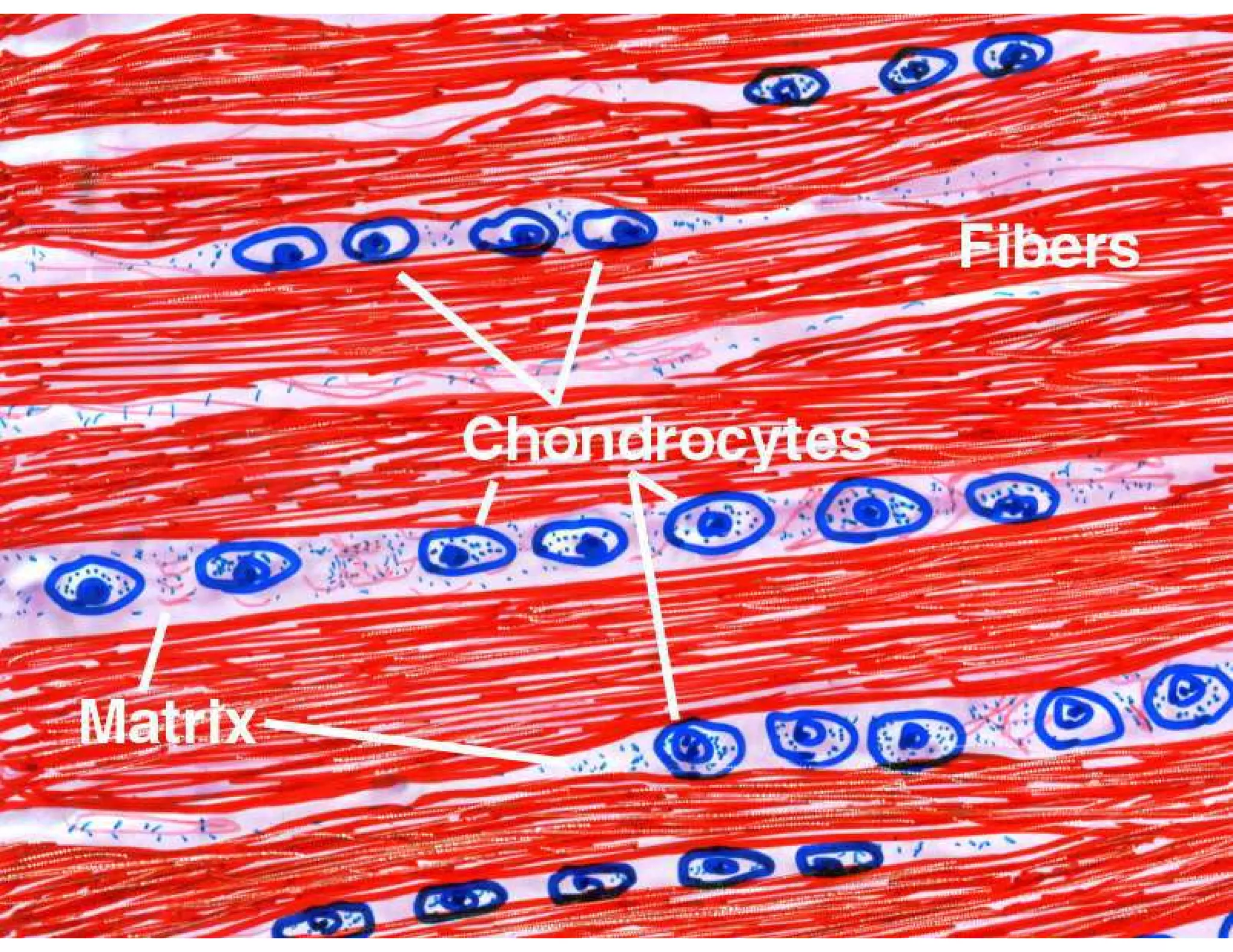
C. Fibrocartilage
Matrixcontains strong
collagenous fibers
Function: absorbs
shocks and reduces
friction between joints
Found in the pads
between the
vertebrae and knee
joints
Definition of Bone...
“Boneis the substance that forms the skeleton of the body. It is
composed chiefly of calcium phosphate and calcium carbonate”
funCtions of Bone…
The human skeleton serves six major functions
Support
Movement
Protection
Production of blood cells
Storage of iron
Endocrine regulation
137.
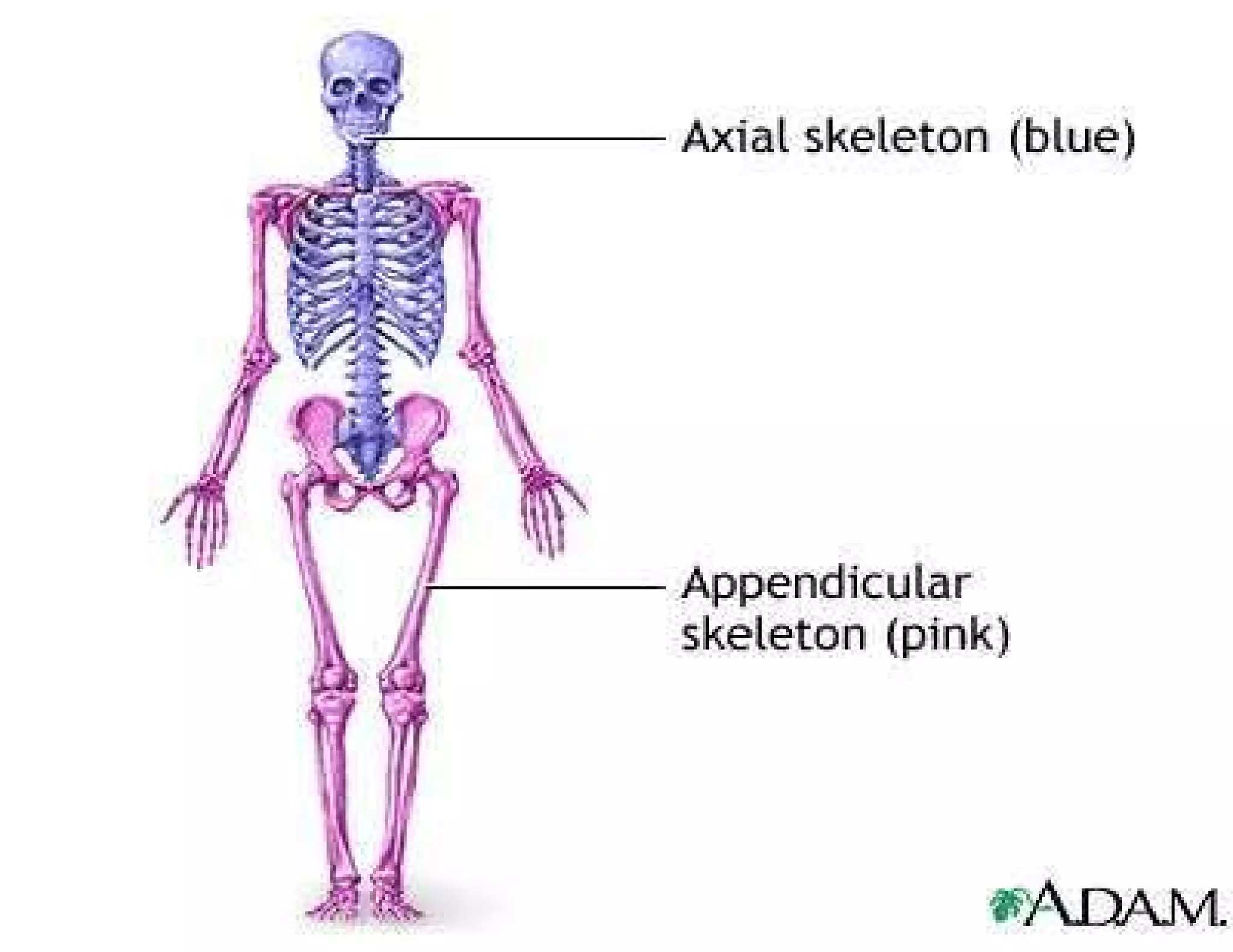
(1) What arethe Bone Regions?
Axial
Down the center of body
Skull, vertebral column, rib cage, center pelvis
Appendicular
Off the sides of body
Upper and lower limbs, shoulder and hip bones
139.
Axial Skeleton(Head + Neck +Trunk)
SKULL 22 Bones
Ear Ossicle (3+3) 6 Bones
Hyoid 1 Bone
Vertebral coloumn 33 Bones
Ribs (12+12) 24 Bones
Sternum 1 bones
Total = 80 Bones
Appendicular Skeleton (upper lim+lower limb)
Upper limb (Right 32+ Left 32) 64 Bones
Lower limb (Right 31+ Left 31) 62 Bones
Total = 126 Bones
GrAnD totAl 80+126=206 Bones
140.
DeveloPmentAl ClAssifiCAtion
memBrAneBones…
Bone formed directly in connective tissue, i.e. by intramembranous
ossification, rather than by replacing cartilage (compare cartilage bone). Small
areas of membrane become jelly-like and attract calcium salts
Examples = Some face bones, skull bones, and part of the clavicle
are membrane bones.
CArtilAGenous BoBes…
Intracartilaginous ossification • In intra cartilaginous ossification →
cartilaginous model is formed which is closely resemble the bone to be formed.
•This cartilage is subsequently replaced by (not converted into) bone. eg.
Almost all of the long bones.
memBrAnoCArtilAGenous Bones…
These bones develop partly in membranes and partly in cartilage.
Example=Occipital,Temporal,sphenoid bones of the skull, mandible, clavicle
141.
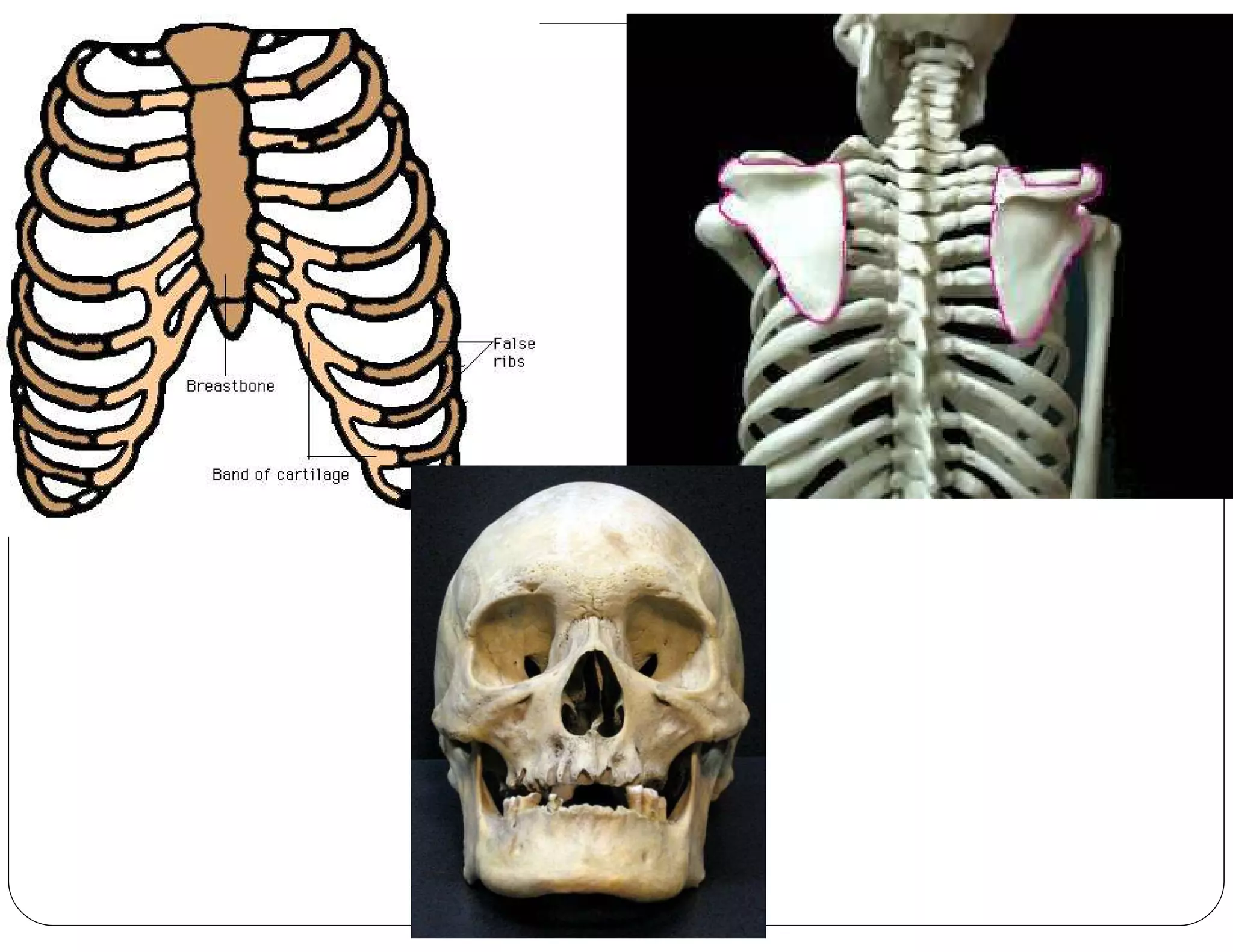
(2) What arethe types of Bones?
Long
Short
Flat
Irregular
143.
(3) Long Bones
Longer than they are wide
Has a shaft and 2 ends
Weight bearing bones (like steel beams)
Provide the greatest structure and support
Examples:
All limb bones
Except…. Kneecap,Wrist and Ankle bones
145.
(4) Short Bones
Nearly same length,width,thickness but shape irregularly
Allow for wider range of movement
Examples:
Wrist (carpals)
Ankle (tarsals)
(6) Irregular Bones
Complicated, unusual shapes
Muscles, tendons, ligaments usually attach to these
Examples:
Vertebrae
Hip bones
151.
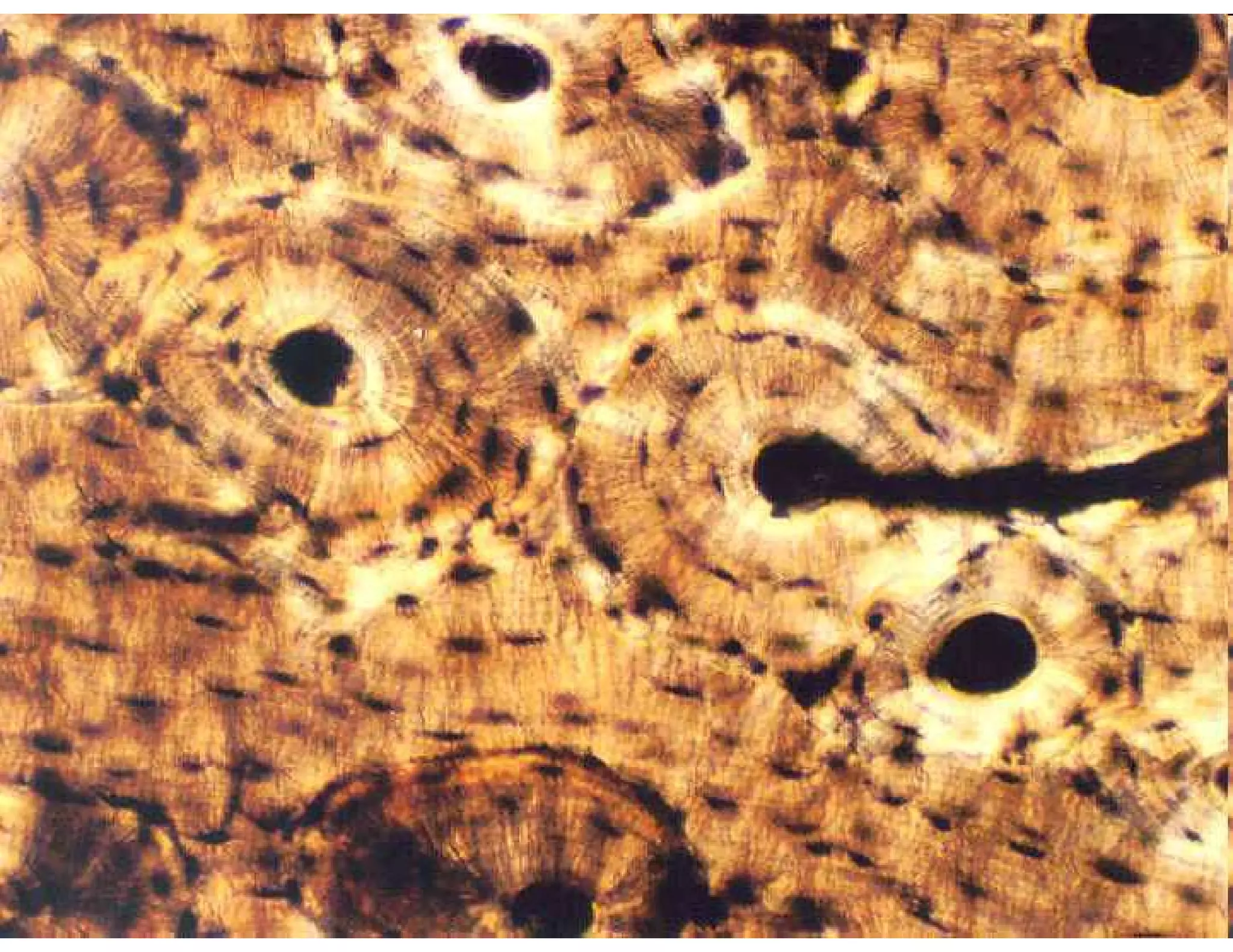
(8) Bone Structure
Unique based on location + bone type.
Compact Bone (Outer Layer):
Dense
Smooth and Solid to naked eye
Spongy Bone (Inner Layer):
Hole-y (like a honeycomb)
Made of small needle-like, flat pieces called “trabeculae”
Open spaces between trabeculae are filled with red or yellow bone marrow
153.
(9) Structure ofa Long Bone
Diaphysis:
Center, main shaft
Long part of bone
Made of very thick compact bone surrounding a central marrow cavity
Epiphysis:
Ends of bone
Wider than diaphysis
Made of compact bone which surrounds spongy bone.
Joint surface of each epiphysis is covered with hyaline cartilage
154.
Epiphyseal Line:
Remnant of Epiphyseal Plate
Found in adult bones
Shows amount of cartilage growth during adolescence
Membranes:
Periosteum = Around the outside
Richly supplied with nerve fibers, lymphatic vessels and blood vessels
Provides anchoring points for tendons and ligaments
Endosteum = Around the inside
Surrounds the spongy bone
156.
(12) Chemical Compositionof Bone
Contains organic & inorganic components
Organic:
Cells (osteoblasts, osteocytes, osteoclasts)
Osteoid
Made of glycoproteins and collagen fibers
Secreted by osteoblasts
“filler matrix” around cells
Contribute to flexibility and tensile strength
Inorganic:
Mineral Salts (calcium phosphates)
Contribute to hardness of bone (allowing for compression resistance)
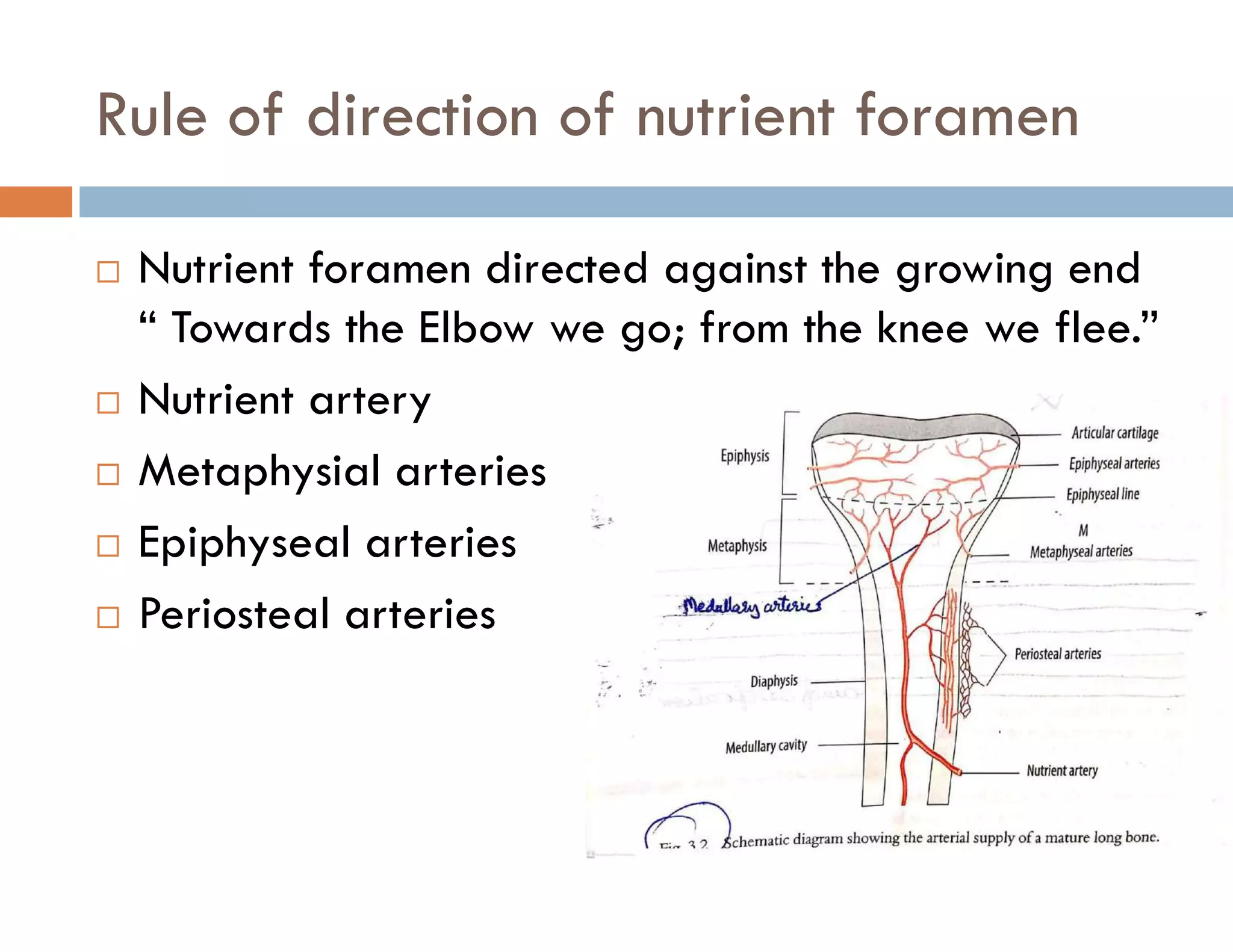
Rule of directionof nutrient foramen
Nutrient foramen directed against the growing end
“ Towards the Elbow we go; from the knee we flee.”
Nutrient artery
Metaphysial arteries
Epiphyseal arteries
Periosteal arteries
163.
Venous Drainage
Venoussinus in centre of
medullary cavity
Receives blood from medullary
sinusoids from end arterial loops
Diaphyseal vein
Periosteal veins
Metaphyseal veins
Epiphyseal veins
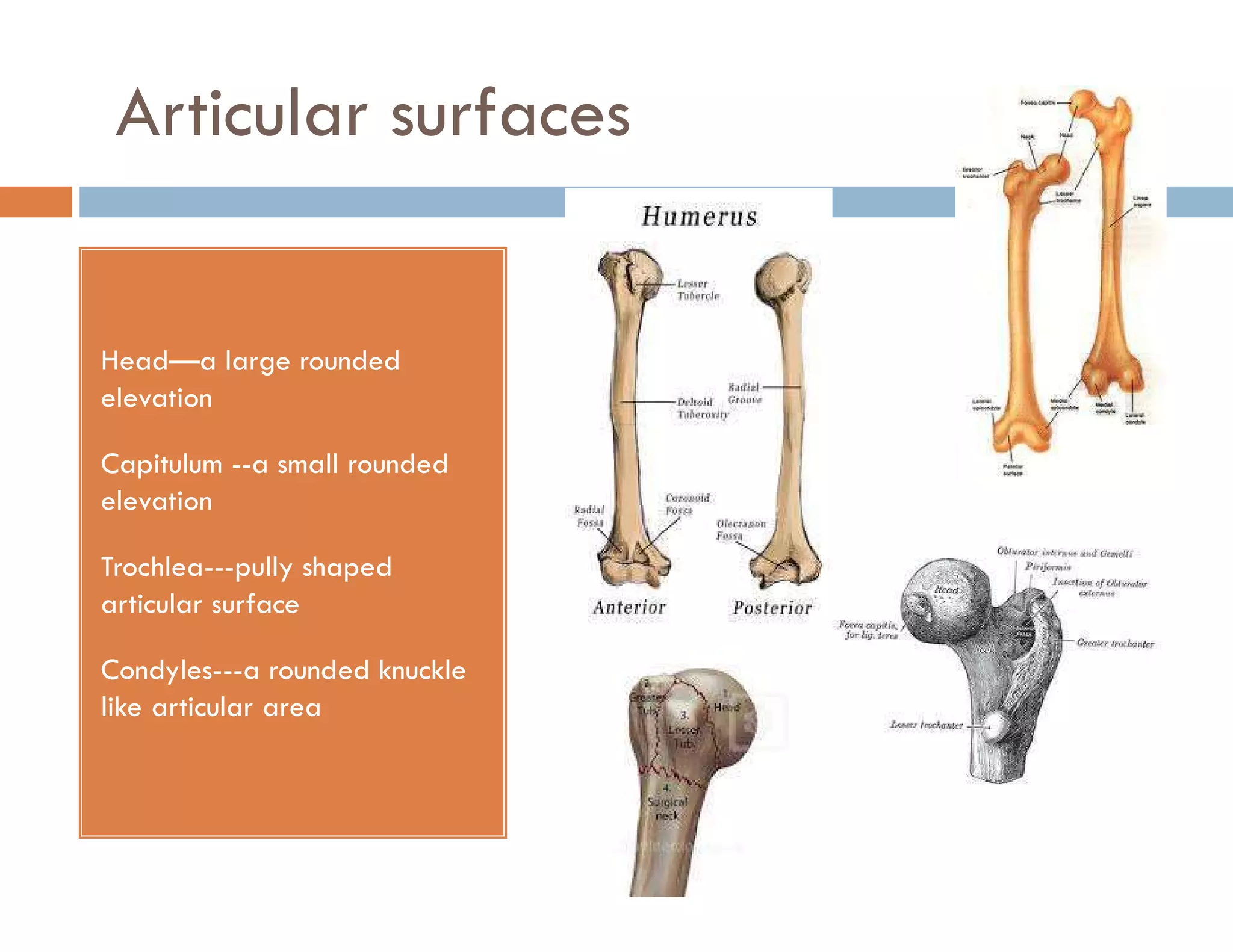
Articular surfaces
Head—a largerounded
elevation
Capitulum --a small rounded
elevation
Trochlea---pully shaped
articular surface
Condyles---a rounded knuckle
like articular area
166.
Non articular surfaces
Processes
any prominent projection
Trochenter
Large blunt process
Tuberosities
Large rounded eminence
Tubercle
Small rounded eminence
Malleolus
A small rounded process
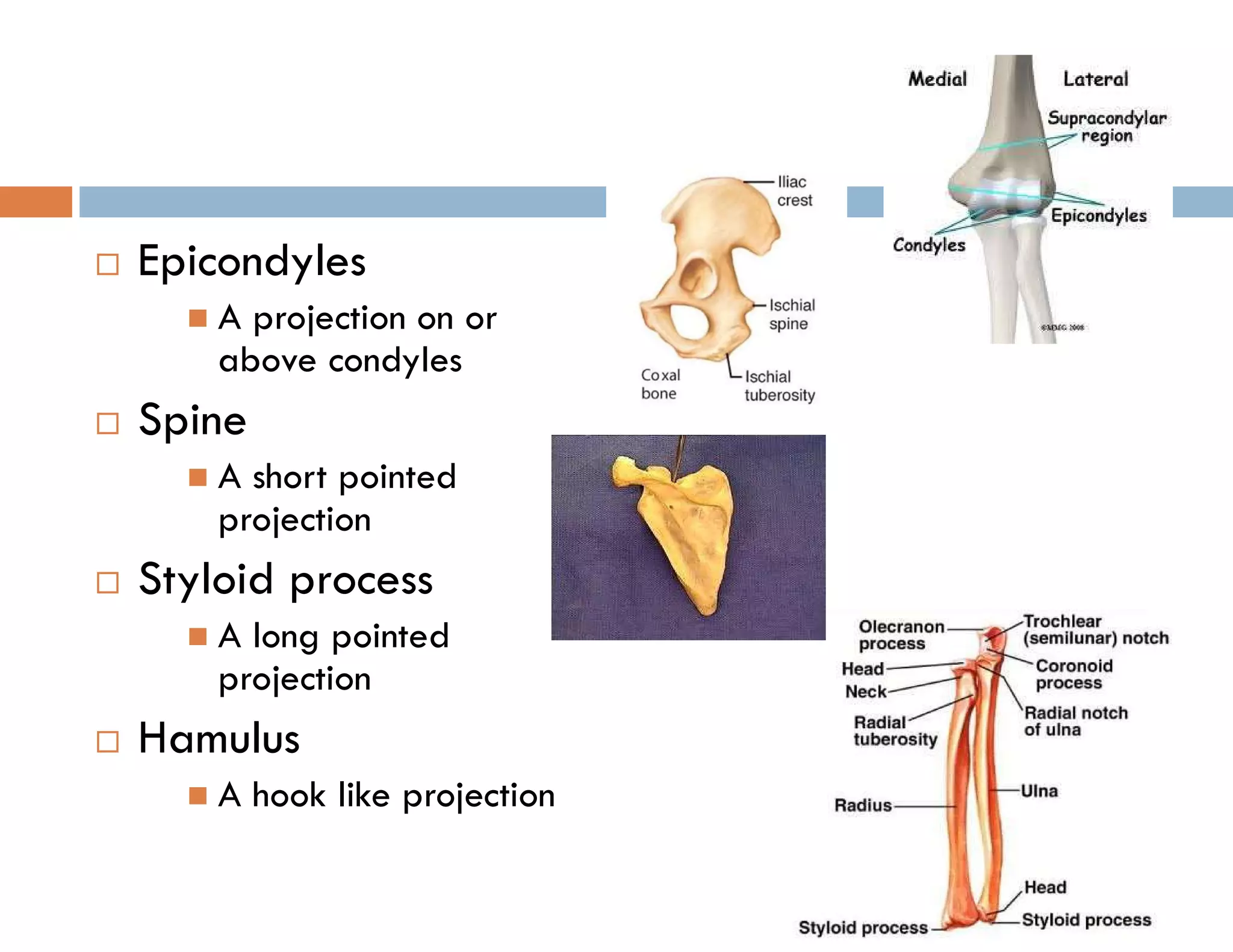
167.
Epicondyles
Aprojection on or
above condyles
Spine
A short pointed
projection
Styloid process
A long pointed
projection
Hamulus
A hook like projection
168.
Line
Aslight ridge
Crest
A prominent border or
ridge
Fovea
A small shallow
depression
Notch
Indentation in edge of
bone
Nerve supply ofbones
Periosteum at ends-----nerve supplying overlaying
muscle
Periosteum of subcutaneous bone-----nerve
supplying overlaying skin
Enter with nutrient artery-----supply bone tissue
Periosteum is most sensitive region of bone
Spongy bone more sensitive as compared to
compact bone
171.
Rule of directionof nutrient foramen
Growing end of bone
Nutrient foramen directed against the growing end
Towards the elbow we go
Growing ends away from elbow
From the knee we flee
Growing ends towards the knee
172.
QUEsTION
Which arteryenter
through the nutient
foramina
Periosteal
Diaphysial*
metaphysial
Endosteal
cortical
SEQ’S
Briefly explain the
blood supply of
mature long bone?
Unused bones,such as in a paralyzed limb, atrophy
(decrease in size).
Bone may be absorbed, which occurs in the
mandible when teeth are extracted.
Bones hypertrophy (enlarge) when they support
increased weight for a long period.
175.
Trauma toa bone break it.
Open fracture
Close fracture
Healing of fracture the broken ends must be
brought together, approximating their normal
position. This is called
reduction of a fracture.
Fracture of bone
176.
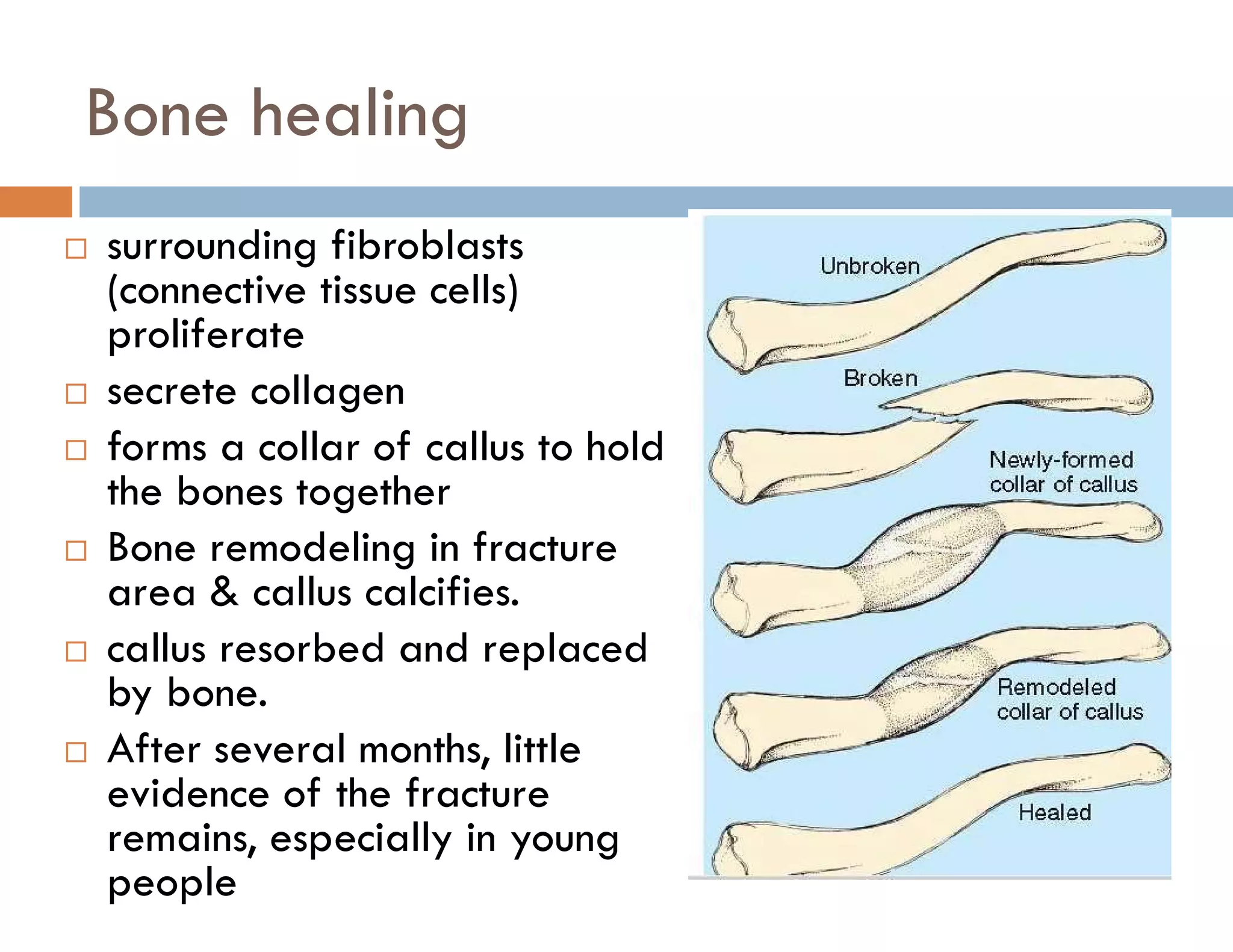
Bone healing
surroundingfibroblasts
(connective tissue cells)
proliferate
secrete collagen
forms a collar of callus to hold
the bones together
Bone remodeling in fracture
area & callus calcifies.
callus resorbed and replaced
by bone.
After several months, little
evidence of the fracture
remains, especially in young
people
177.
OsTEOPOROsIs
aging process
organic and inorganic components
of bone decrease
resulting in osteoporosis,
reduction in the quantity of bone,
atrophy of skeletal tissue
bones become brittle, lose their
elasticity, and fracture easily.
Bone scanning is an imaging
method used to assess normal and
diminished bone mass
178.
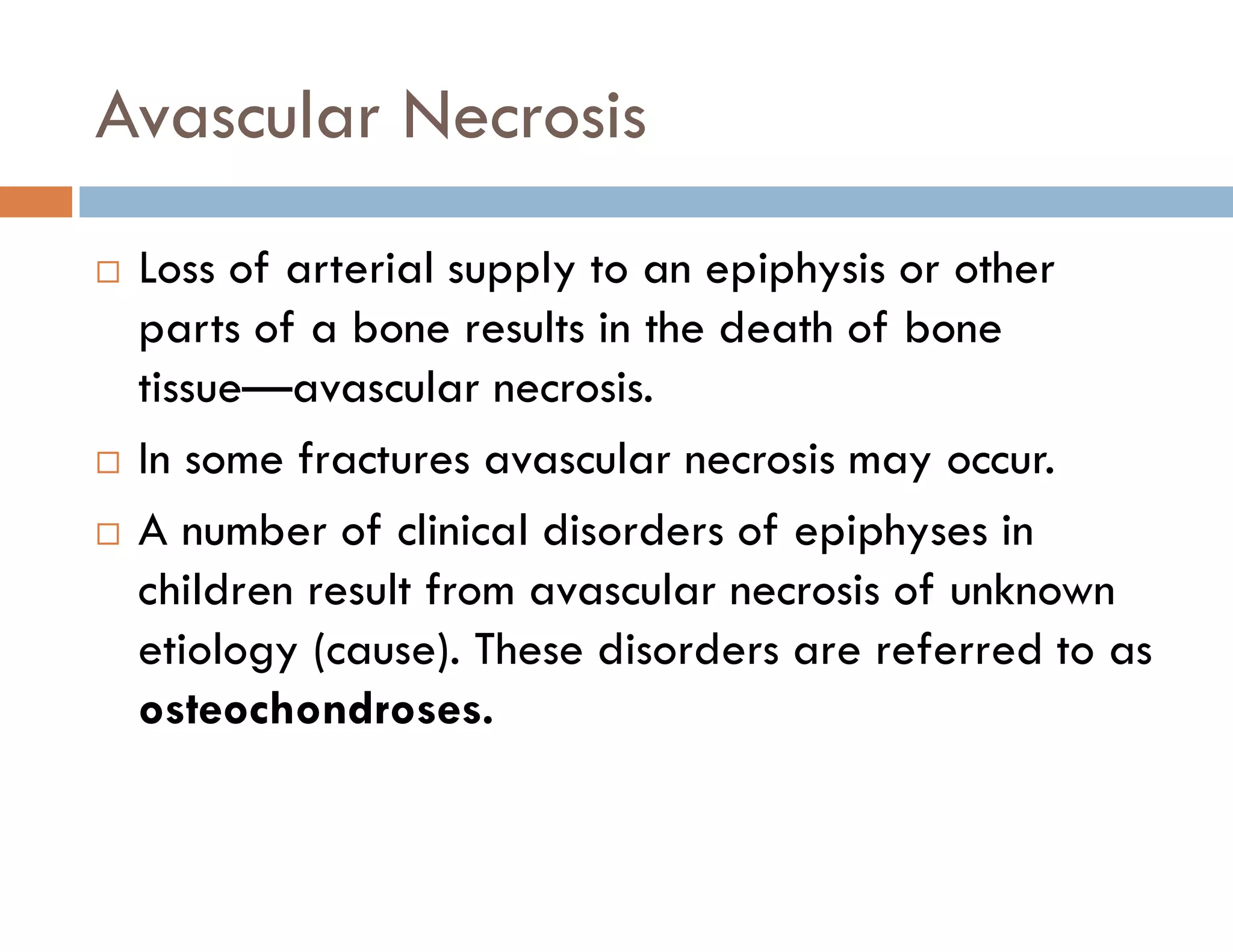
Loss ofarterial supply to an epiphysis or other
parts of a bone results in the death of bone
tissue—avascular necrosis.
In some fractures avascular necrosis may occur.
A number of clinical disorders of epiphyses in
children result from avascular necrosis of unknown
etiology (cause). These disorders are referred to as
osteochondroses.
Avascular Necrosis
179.
many ofbreaks in bones are greenstick fractures
(incomplete breaks caused by bending of the bones).
Fractures in growing bones heal faster than those in
adult bones.
Greenstick fractures
180.
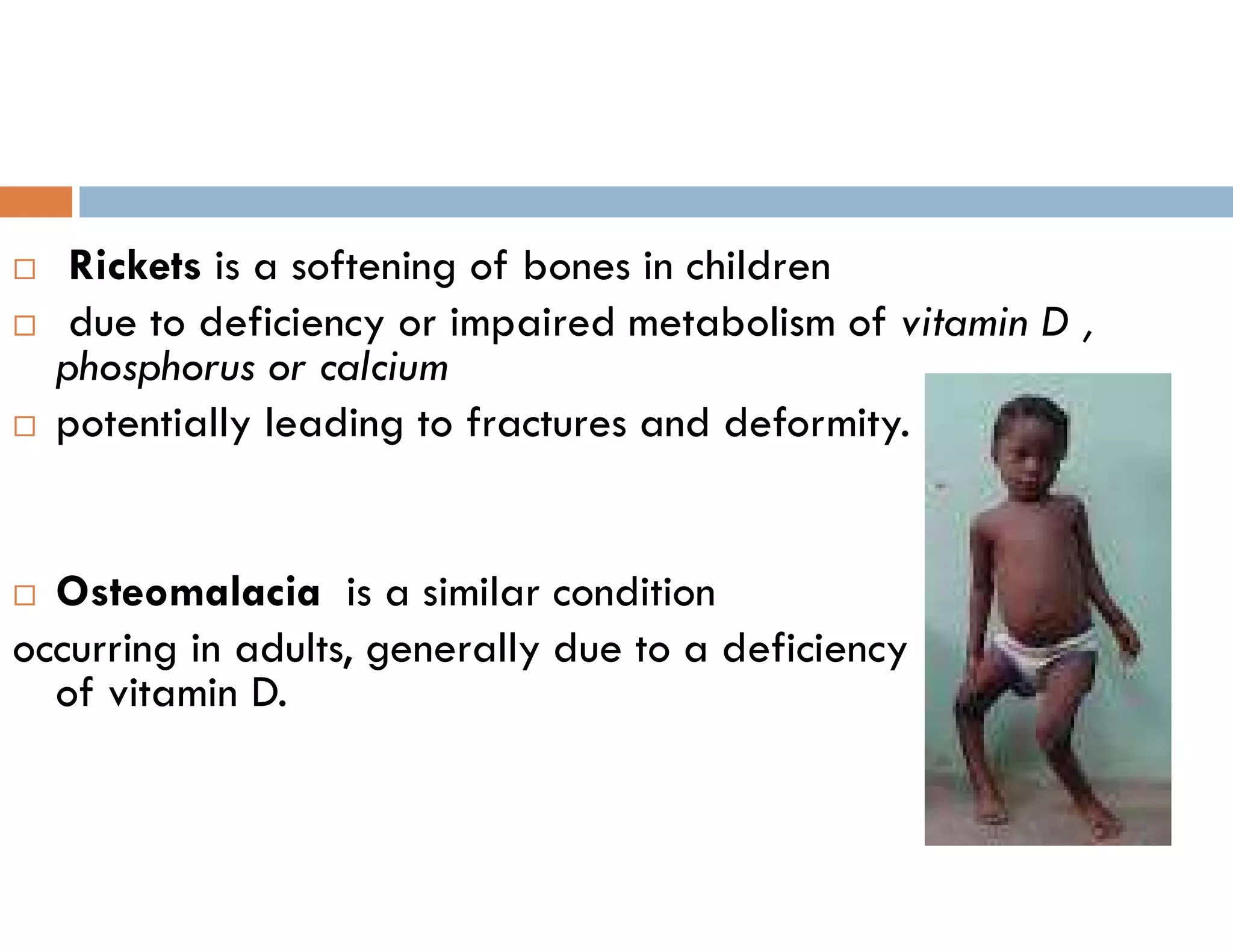
Rickets isa softening of bones in children
due to deficiency or impaired metabolism of vitamin D ,
phosphorus or calcium
potentially leading to fractures and deformity.
Osteomalacia is a similar condition
occurring in adults, generally due to a deficiency
of vitamin D.
The skeleton
Thestudy of bones is termed
osteology.
The adult is composed of
approximately 206 bones. Each
bone is an organ of the skeletal
system. Start at 270 at birth,
decreases with fusion.
For the convenience of study, the
skeleton is divided into axial and
appendicular parts.
185.
The axial skeleton
Theaxial skeleton
consists of 80 bones that
form the axis of the body
and which supports and
protects the organs of the
head, neck, and trunk.
Skull
Auditory ossicles
Hyoid bone
Vertebral column
Thoracic cage
186.
The appendicular
skeleton
The appendicularskeleton is composed of
126 bones of the upper and lower limbs and
the bony girdles, which anchor the
appendages to the axial skeleton.
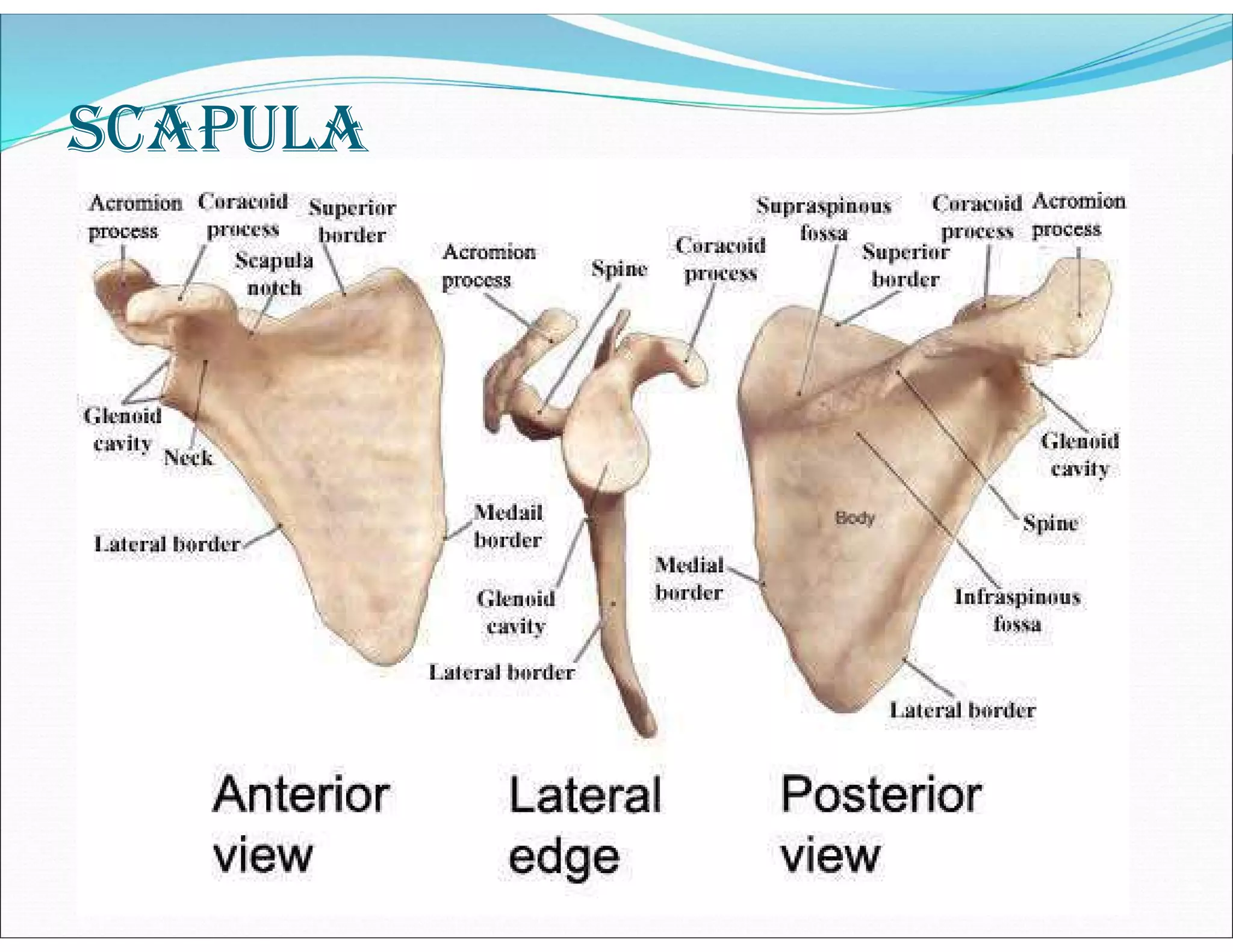
The shoulder girdle (the scapula
and clavicle)
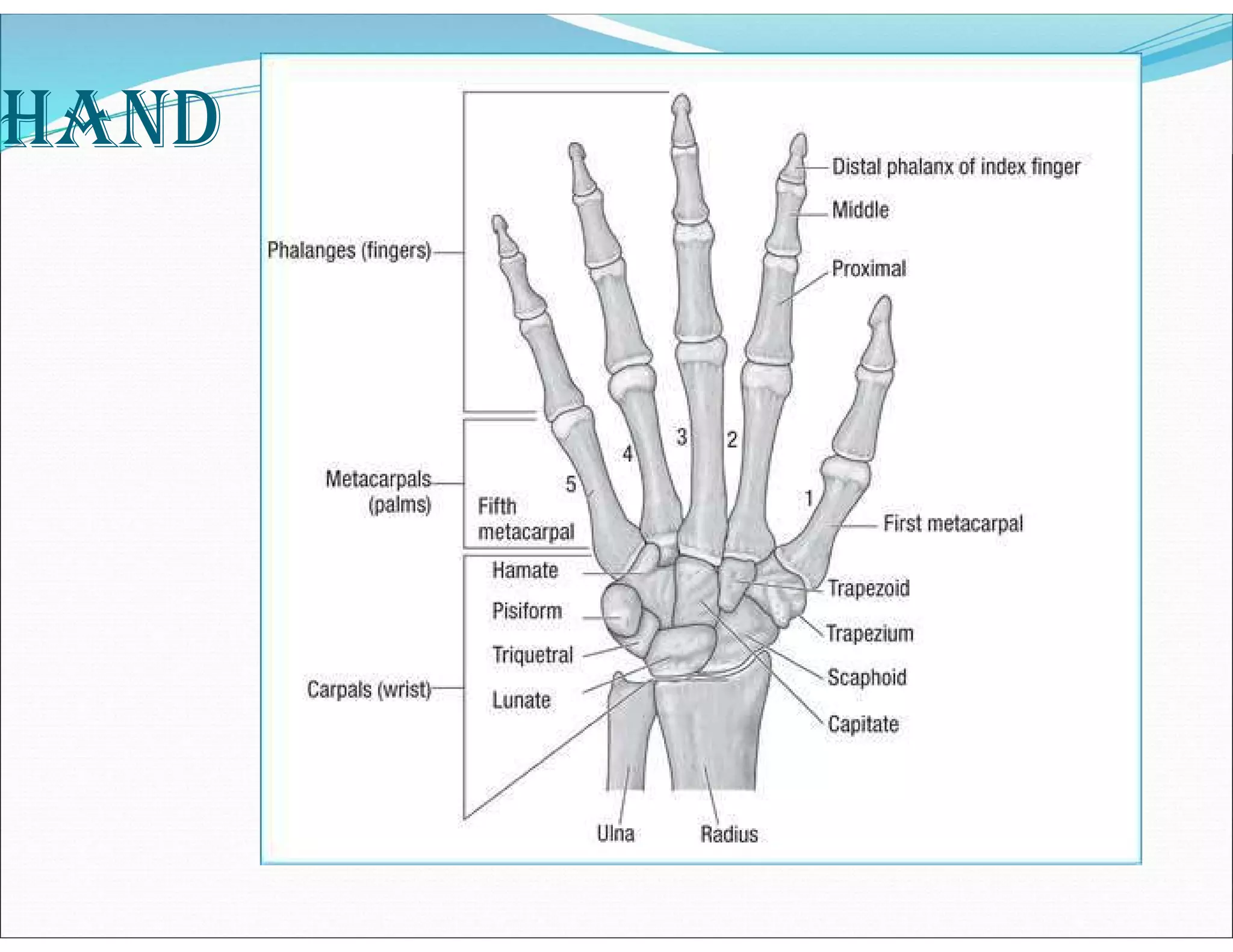
The upper limb (the humerus,
ulna, radius and bones of the
hand)
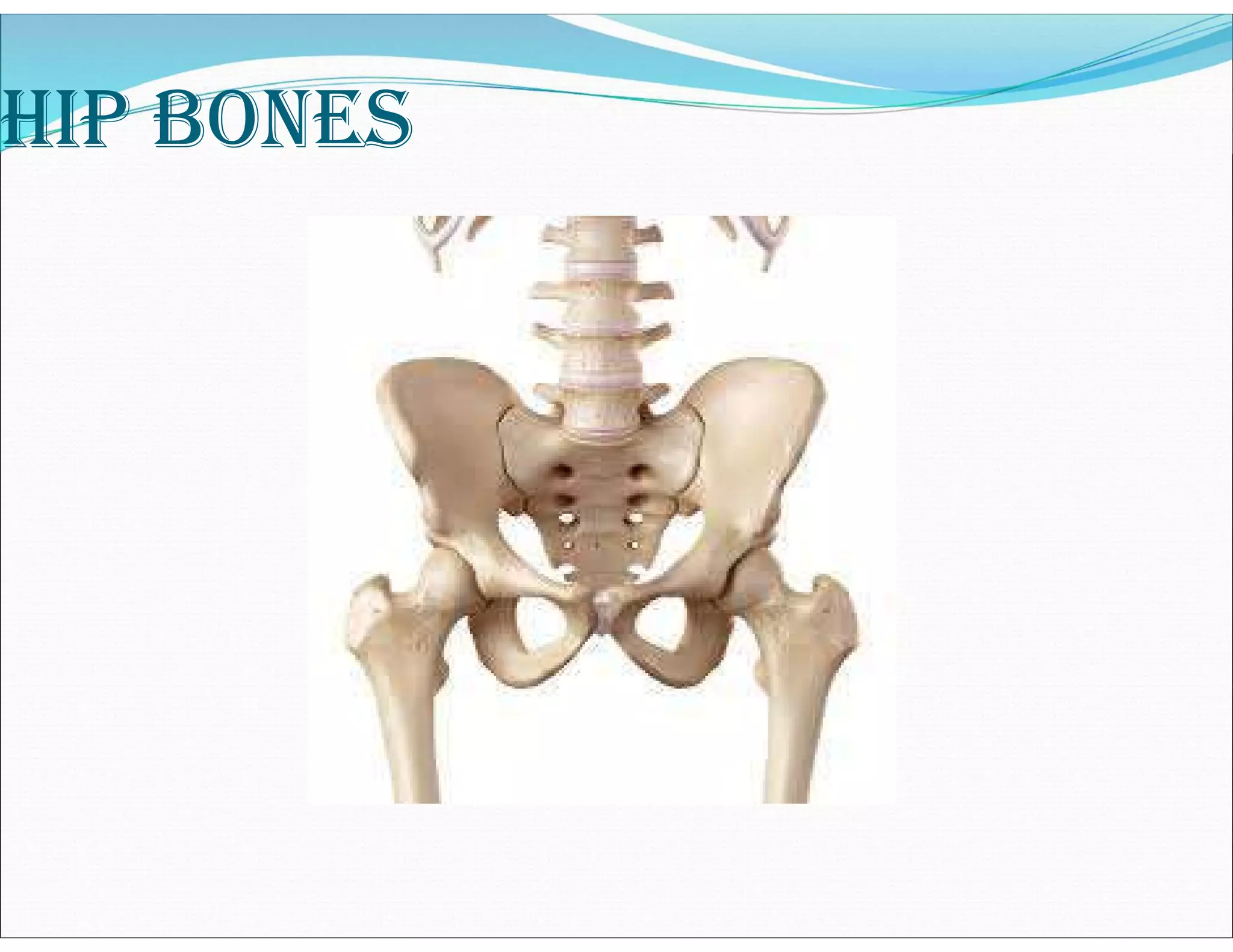
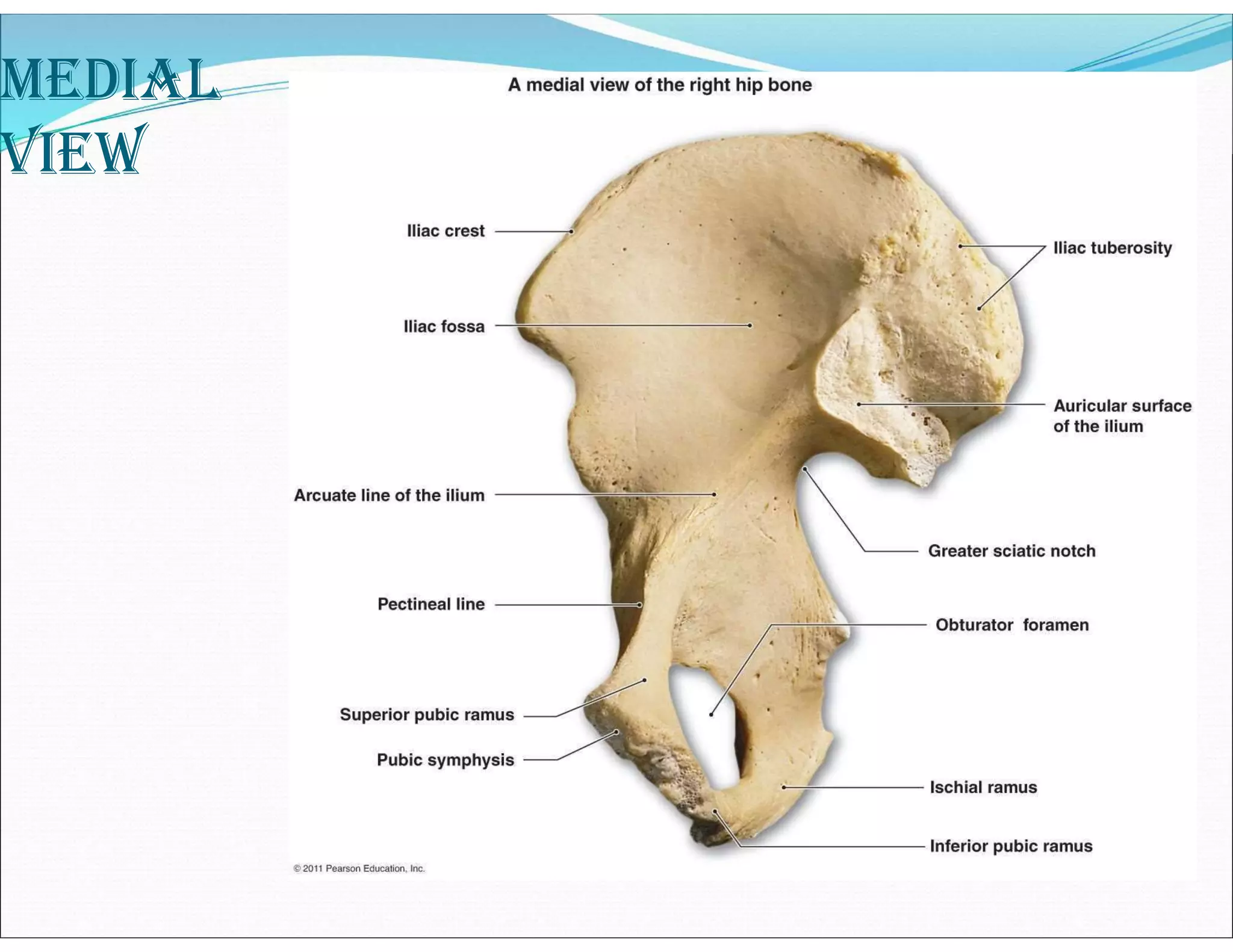
The pelvic girdle (the hip bone)
The lower limb (the femur, tibia,
fibula and bones of the foot)
187.
Functions of theskeleton
Biological functions
Mechanical functions
Classification of bones
Tubularbones
a) Long tubular bones
humerus,
radius, ulna,
femur,
tibia, fibula
b) Short tubular bones
metacarpal,
metatarsal bones and phalanges
191.
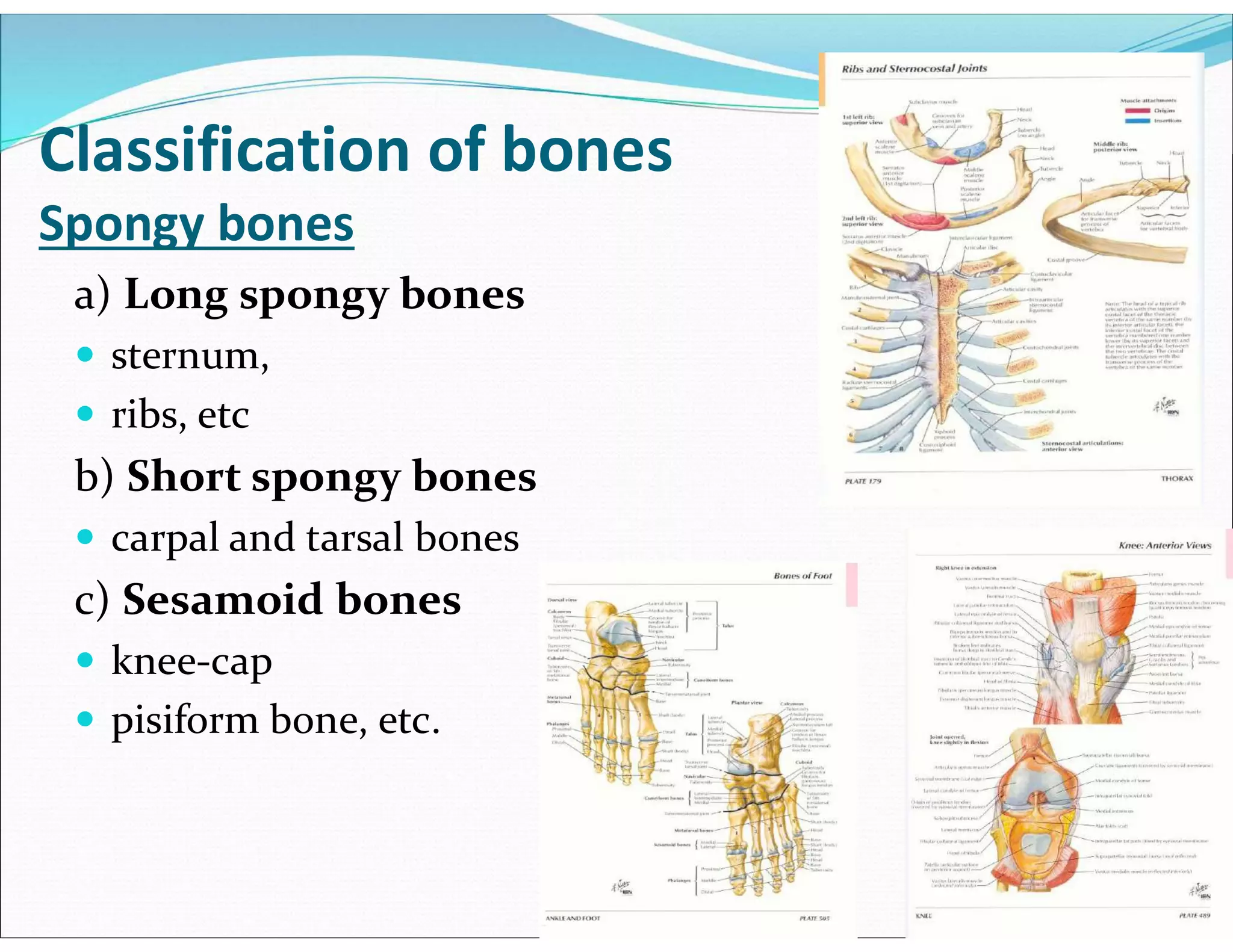
Classification of bones
Spongybones
a) Long spongy bones
sternum,
ribs, etc
b) Short spongy bones
carpal and tarsal bones
c) Sesamoid bones
knee-cap
pisiform bone, etc.
192.
Classification of bones
Flatbones
Skull bones
Bones of the vault of the
skull
Girdle bones
The scapula
The hip bone, etc.
193.
Classification of bones
Mixedbones
The vertebrae are mixed, or
irregular bones (their
bodies are referred to
spongy bones, but their
arches and processes are
referred to flat bones).
194.
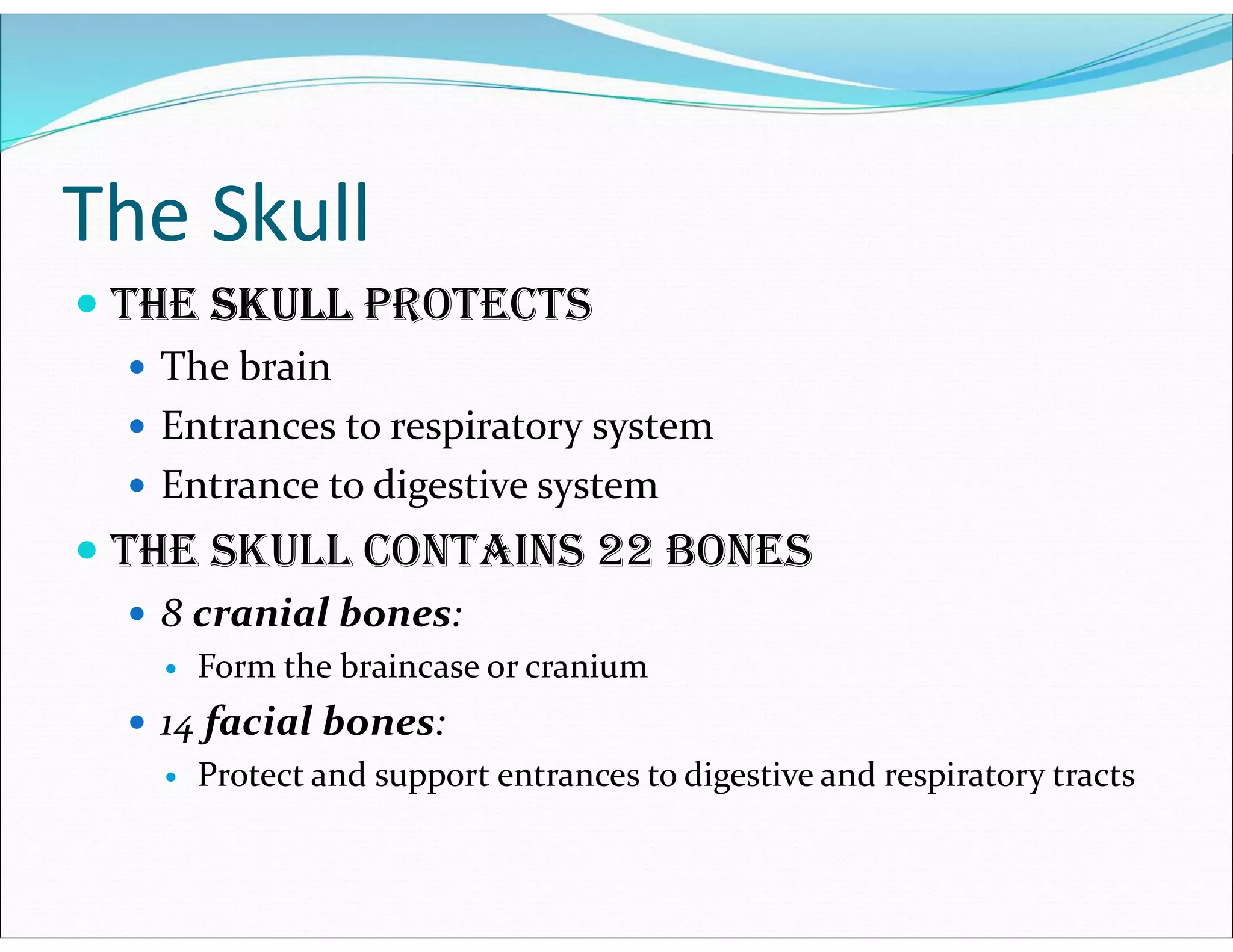
The Skull
Theskull proTeCTs
The brain
Entrances to respiratory system
Entrance to digestive system
The skull ConTAins 22 Bones
8 cranial bones:
Form the braincase or cranium
14 facial bones:
Protect and support entrances to digestive and respiratory tracts
195.
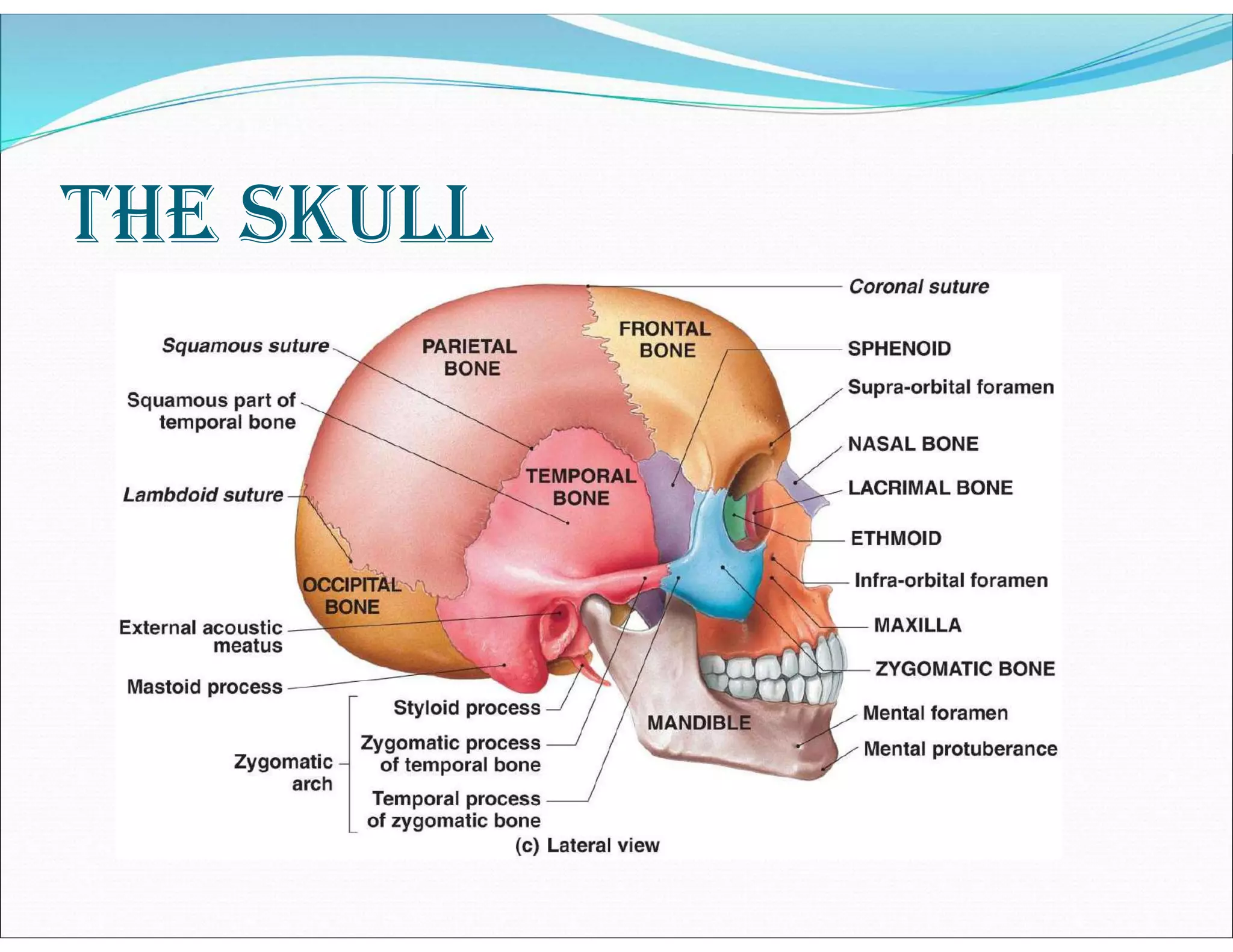
There AreeiGhT CrAniAl Bones, eACh wiTh A
uniQue shApe:
Frontal bone (1). This is the flat bone that makes up
your forehead. ...
Parietal bones (2). This a pair of flat bones located on
either side of your head, behind the frontal bone.
Temporal bones(2) ...
Occipital bone(1) ...
Sphenoid bone(1) ...
Ethmoid bone(1).
The mAjorsuTures of The skull inCluDe The
followinG:
Metopic suture. This extends from the top of the head
down the middle of the forehead, toward the nose. ...
Coronal suture. This extends from ear to ear. ...
Sagittal suture. ...
Lambdoid suture.
200.
CrAniAl fossA
3basins that comprise the cranial floor or base
anterior fossa holds the frontal lobe of the brain
middle fossa holds the temporal lobes of the brain
posterior fossa contains the cerebellum
Swelling of the brain may force tissue through foramen
magnum resulting in death
8-19
203.
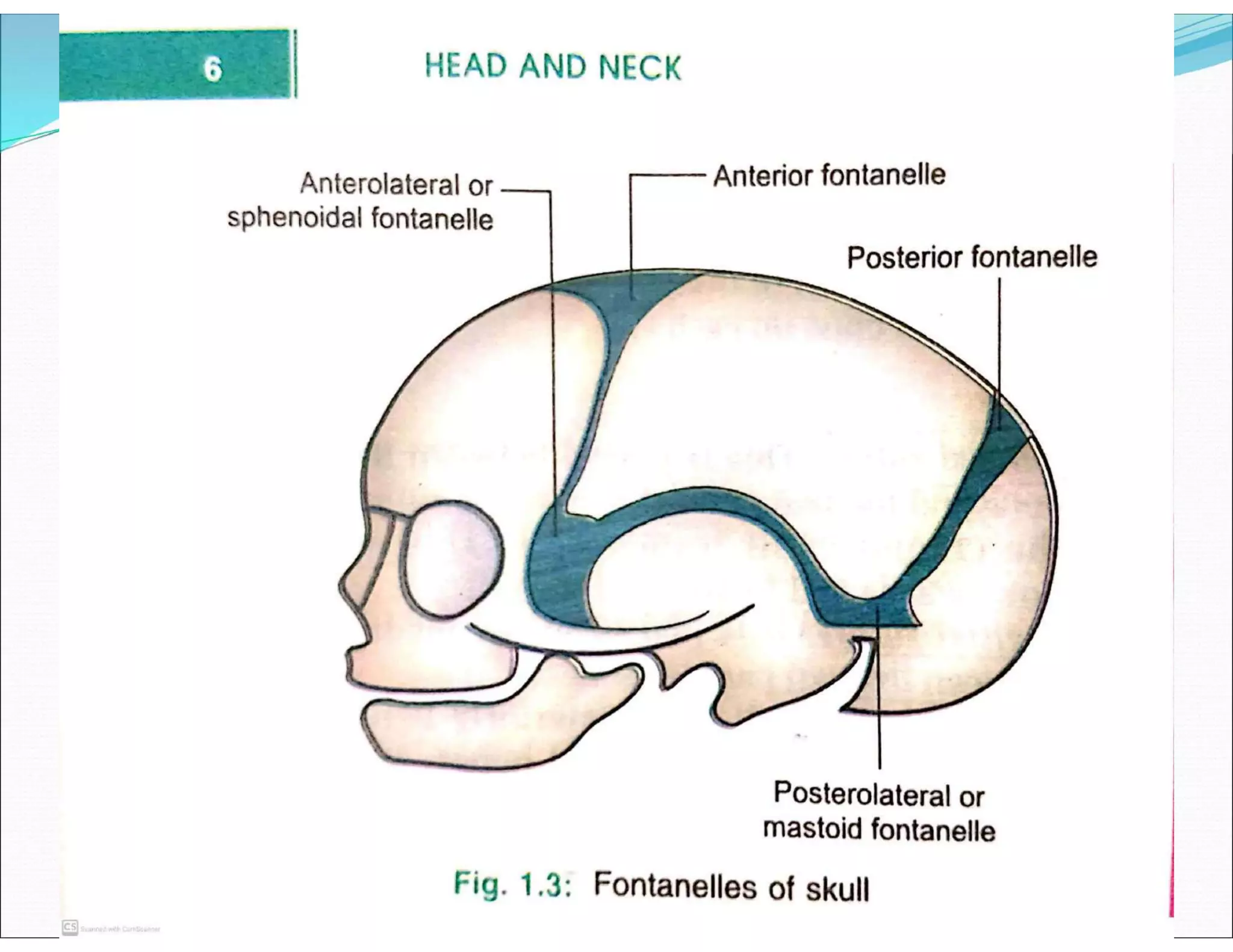
A fonTAnelle (orfontanel) (colloquially, soft spot) is an
anatomical feature of the infant human skull comprising
any of the soft membranous gaps (sutures) between the
cranial bones that make up the calvaria of a fetus or an
infant.
The fonTAnelle allows the skull to deform during birth
to ease its passage through the birth canal and for expansion
of the brain after birth. The anterior fontanelle typically
closes between the ages of 12 and 18 months.
At theend of lectures student should able to
Define arthrology
Define joints
Know the various types (classification) of
joints.
Classify the fixed joints
Classify slightly moveable joints
Classify highly moveable joints
JOINT/ ARTHROSES
A joint is the location at which two or more
Bones/ cartilage make contact.
They are constructed to allow movement
and provide mechanical support
224.
Mobility ofjoints depends on following
factors..
The shape of articulating surfaces
Arrangement of various structure which unite
them
Stucture of joint is index of its functional
activity.i.e; movement
226.
Synarthroses orimmovable/
Solid joint/ non cavitated joint
Amphiarthroses or slightly
movable
Diarthroses or freely movable/
Cavitated joint
227.
The surfacesof the bones are in almost
direct contact
Fastened together by intervening
connective tissue or hyaline cartilage
and in which there is no appreciable
motion, as in the joints between the bones
of the skull
An immovablejunction between two bones,
such as those of the skull. E.g…
In a SERRATE SUTURE, the edges are saw like
e.g Sagittal suture.
A DENTICULATE SUTURE has small tooth like
processes e.g Lambdoid suture.
In a SQUAMOUS SUTURE reciprocally bevelled
bone margins overlap each other e.g
Temporoparietal suture.
In a PLANE SUTURE there is simple apposition
of relatively flat bones e.g intermaxillary
suture.
234.
A gomphosis isa fibrous mobile peg-and-
socket joint. The roots of the teeth (the
pegs) fit into their sockets in the mandible
and maxilla and are the only examples of this
type of joint.
235.
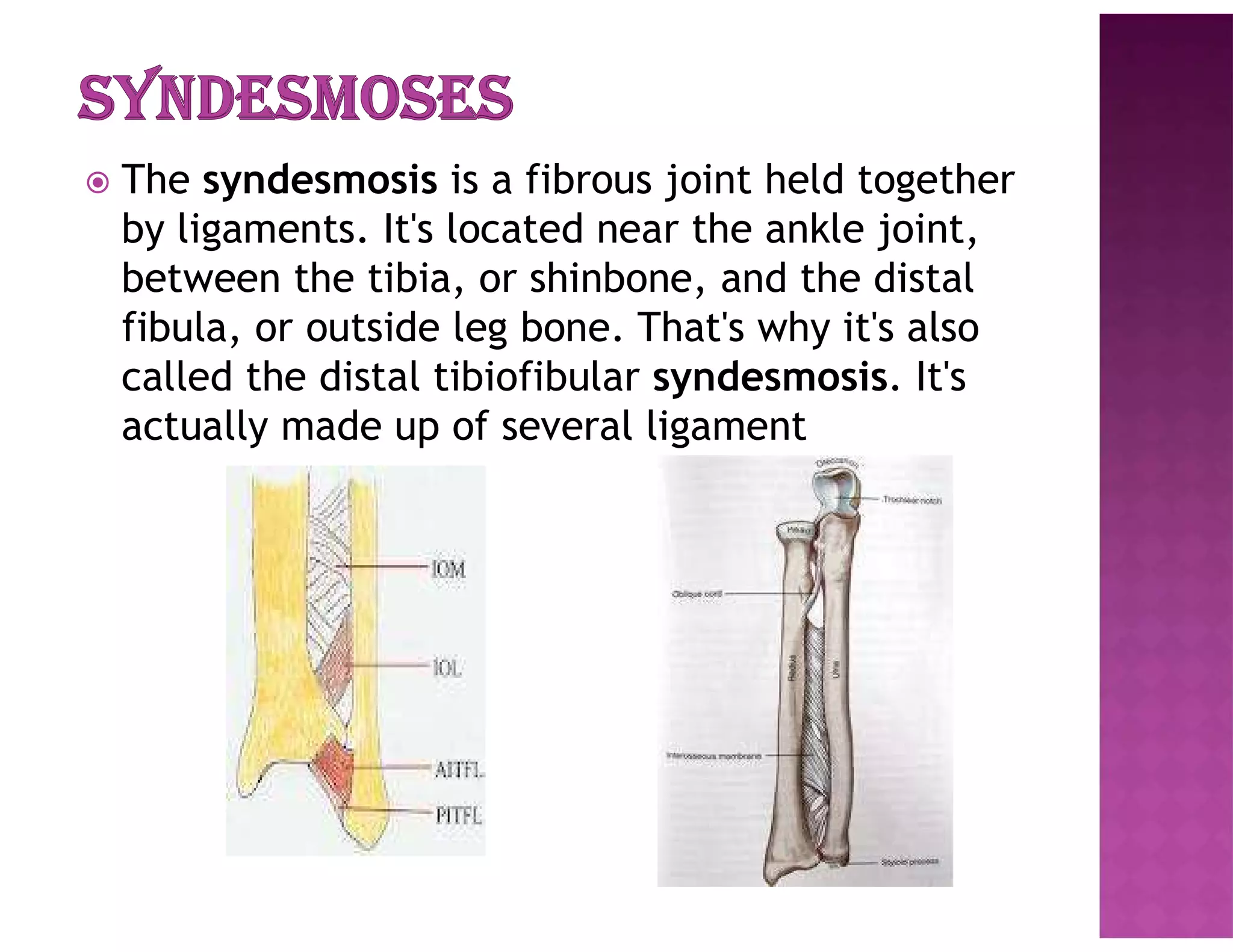
The syndesmosisis a fibrous joint held together
by ligaments. It's located near the ankle joint,
between the tibia, or shinbone, and the distal
fibula, or outside leg bone. That's why it's also
called the distal tibiofibular syndesmosis. It's
actually made up of several ligament
236.
TEMPORARY/ Primary (synchondroses)
They show intra cartilagenous method of
ossification. They remain in Hyaline cartilage
till completion of growth of bone.
Strong & immobile
Sternales
Epipysial plate
1st sternocostalis
237.
Intra articularfibrocartilagenous disc
Slight movement due to deformation of disc
In median plane of body
Intermediate stage of
evolution
FIBROCARTILAGE WITH CAVITIES
WITHOUT CAVITY
242.
Define suture?Classify various types of
sutures with one example .
Classify non- cavitated joints
243.
Define sutures
Give example of serrate suture
What do you mean by syndesmosis?
How we differentiate between primary &
secondary cartilaginous joints
244.
Diarthrosis. Afreely mobile joint is classified
as a diarthrosis. These types
of joints include all synovial joints of the
body, which provide the majority of body
movements. Most diarthrotic joints are found
in the appendicular skeleton and thus give
the limbs a wide range of motion.
Lets have a look on Articular cartilage,
Fibrous Capsule, Ligaments, Synovial
membrane, Synovial fluid,Articular discs.
245.
ArtiCulAr CArtilAGe: the bones of a synovial joint are
covered by this layer of Hyaline cartilage that lines the epiphyses
of joint end of bone with a smooth, slippery surface that does not
bind them together; articular cartilage functions to absorb shock
and reduce friction during movement.
FiBrous CApsule : the fibrous capsule, continuous with the
periosteum of articulating bones, surrounds the diarthrosis and
unites the articulating bones; the joint capsule consists of two
layers - (1) the oute rfibrous membrane that may contain
ligaments and (2) the inner synovial membrane that secretes the
lubricating, shock absorbing, and joint-nourishing synovial fluid;
the joint capsule is highly innervated, but without blood and
lymph vessels, and receives nutrition from the surrounding blood
supply via either diffusion (a slow process) or by convection, a far
more efficient process achieved through exercise.
liGAments : Ligaments are a type of connective tissue and are
tough, fibrous and slightly elastic. They connect bone to bone and
help keep the joint together. They stabilise the joints during
movement and prevent dislocation by restricting actions outside
the normal joint range.
246.
A synoviAlmemBrAne (or synovium) is the soft tissue found
between the articular capsule (joint capsule) and the joint cavity
of synovial joints.
synoviAl FluiD is the clear, viscid, lubricating fluid secreted
by synovial membranes. The morphology of synovial
membranes may vary, but it often consists of two layers. Volume
of synovial fluid is 0.5 ml in knees.
Egg albumin like fluid present in joint cavities, bursa and tendon
sheath
PH- alkaline, turns to acidic
0.5ml volume
Hyluronic acid
Proteins
Cells – macrophages, lymphocytes, neutrophils, synovial cell
ArtiCulAr DisC - the fibrocartilage pads between opposing
surfaces in a joint
OBJECTIVES
At theend of lecture you should able to;
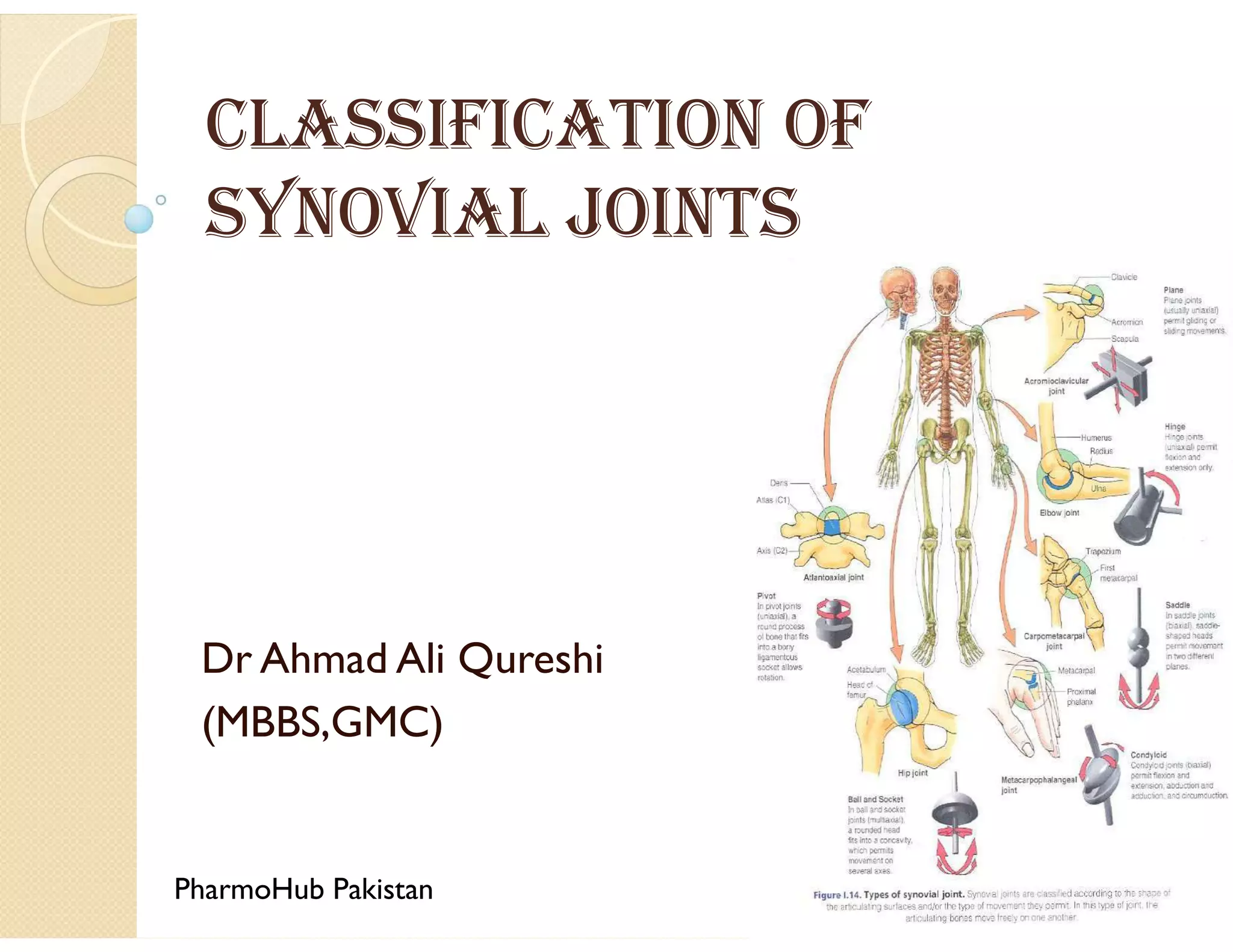
Classify various types of synovial joints.
Identify the synovial joints according to
the structures.
Classify joints according to their
articulating surfaces.
Classify joints according to complexity of
organization
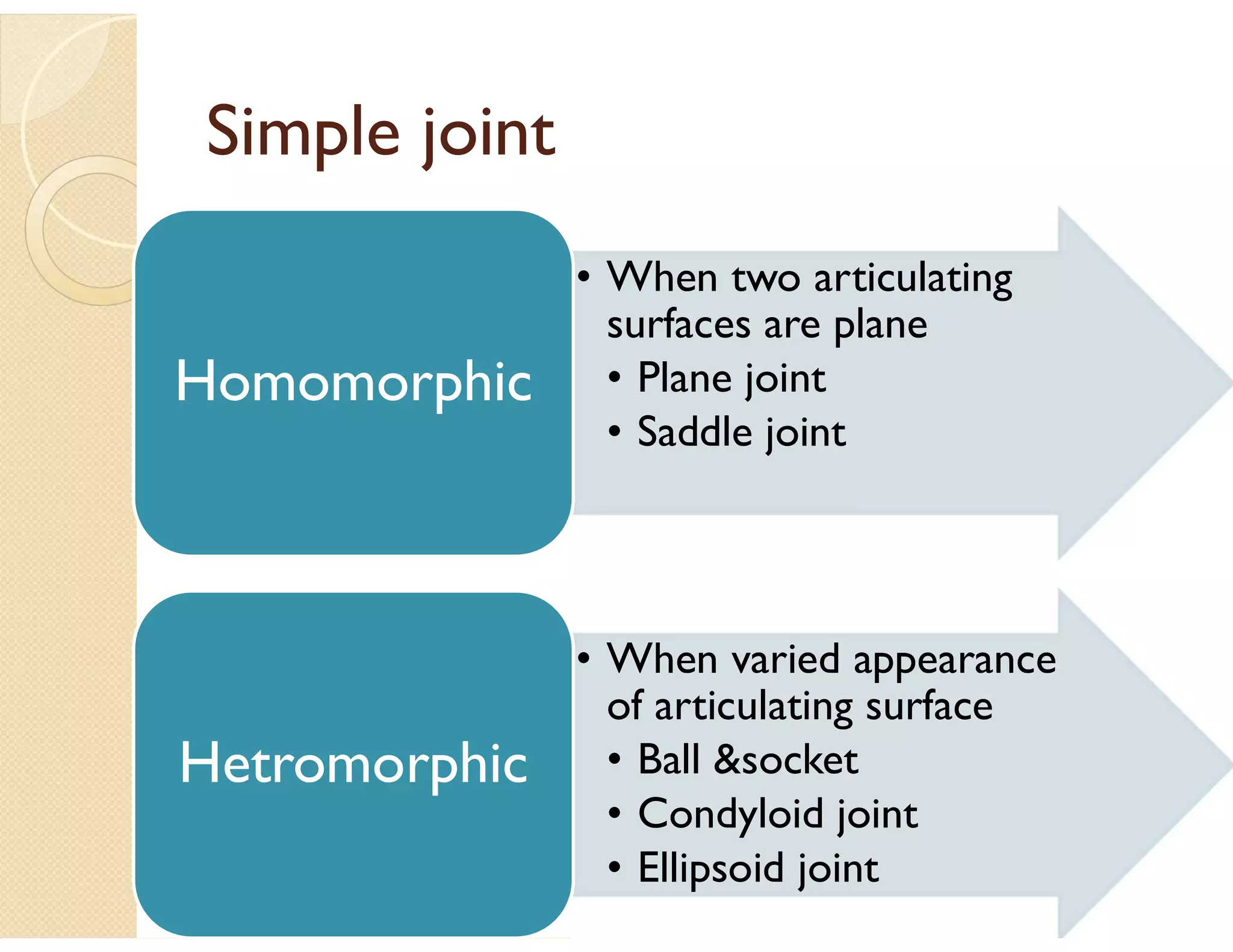
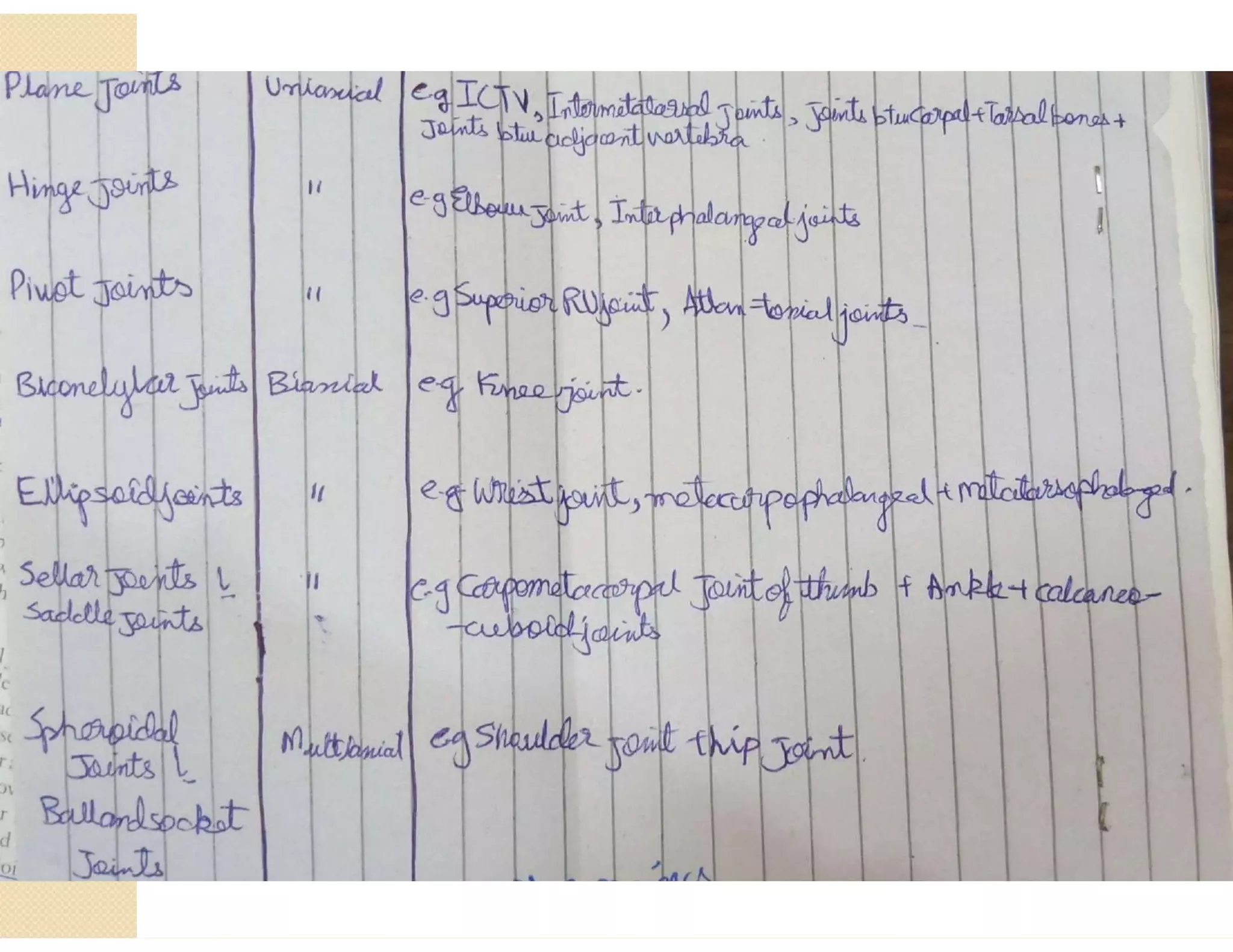
I. PLANE JOINT/ANTHROIDAL
JOINT
• Bone surfaces are slightly curved/ almost flat.
• Side to side movement/ gliding only
• Rotation prevented by
ligaments
• Examples:
- Intercarpal
- intertarsal joints
- sternoclavicular joint
259.
HINGE JOINT/ GINGLYMOID
•Convex surface of bone fits in concave surface of
2nd bone
• like a door hinge
• Examples:
- Knee, elbow,
- interphalangeal
Uniaxial
• Movements produced:
- flexion
- Extension
- To and fro
260.
PIVOT / ROTATORY/TROCHOID
JOINT
• Rounded surface of bone articulates with the ring
formed by the 2nd bone & ligament
Monoaxial
• since it only allows rotation around longitudinal axis
• Examples:
Pivot rotates inside
stationary osseofibrous ring
proximal radioulnar
Ring rotates around stationary
pivot
atlanto-axial joint
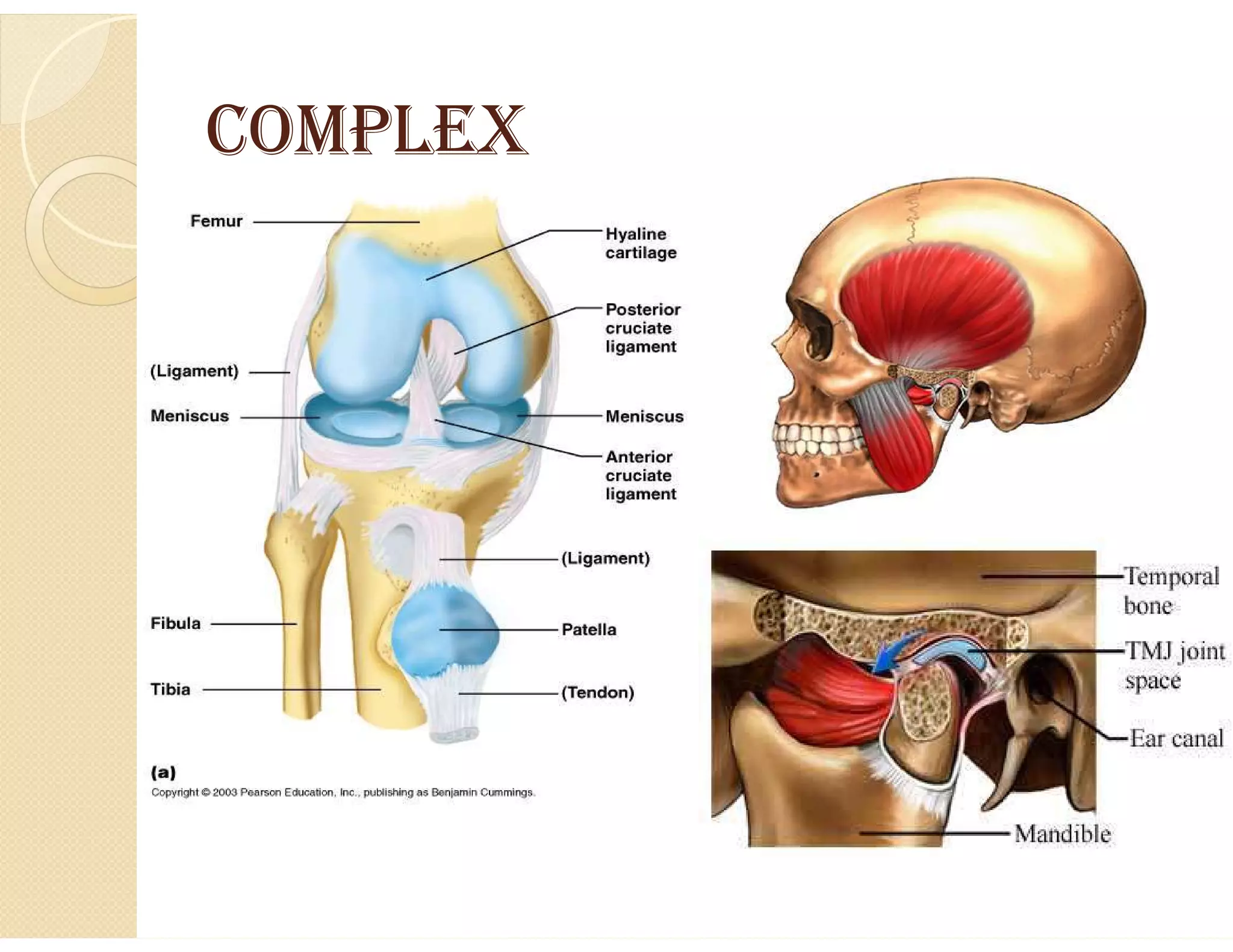
BICONDYLAR JOINT
Twoconvex surfaces articulate with two
concave surfaces
Uniaxial
Two subtypes
Both condyles present on single capsule
◦ Knee joint
Both condyles lie at a distance and each
having a separate capsule
◦ Temporomandibular joint
263.
SADDLE/ SELLER/ RECEPTIVE
•One bone saddle-shaped, other bone fits like a
person riding on the saddle
Biaxial
• Examples:
- Trapezium of carpus and metacarple of
thumb
264.
BALL & SOCKET/SPHEROIDAL
• Ball fitting into a cup-like depression
• Multiaxial
- flexion/extension
- abduction/adduction
- rotation
• Examples:
- shoulder joint
- hip joint
265.
ELLIPSOID
Oval convaxsurface fix into elliptical
concavity
Biaxial
Example
Wrist joint
DEPENDING UPON COMPLEXITY
OFORGANIzATION
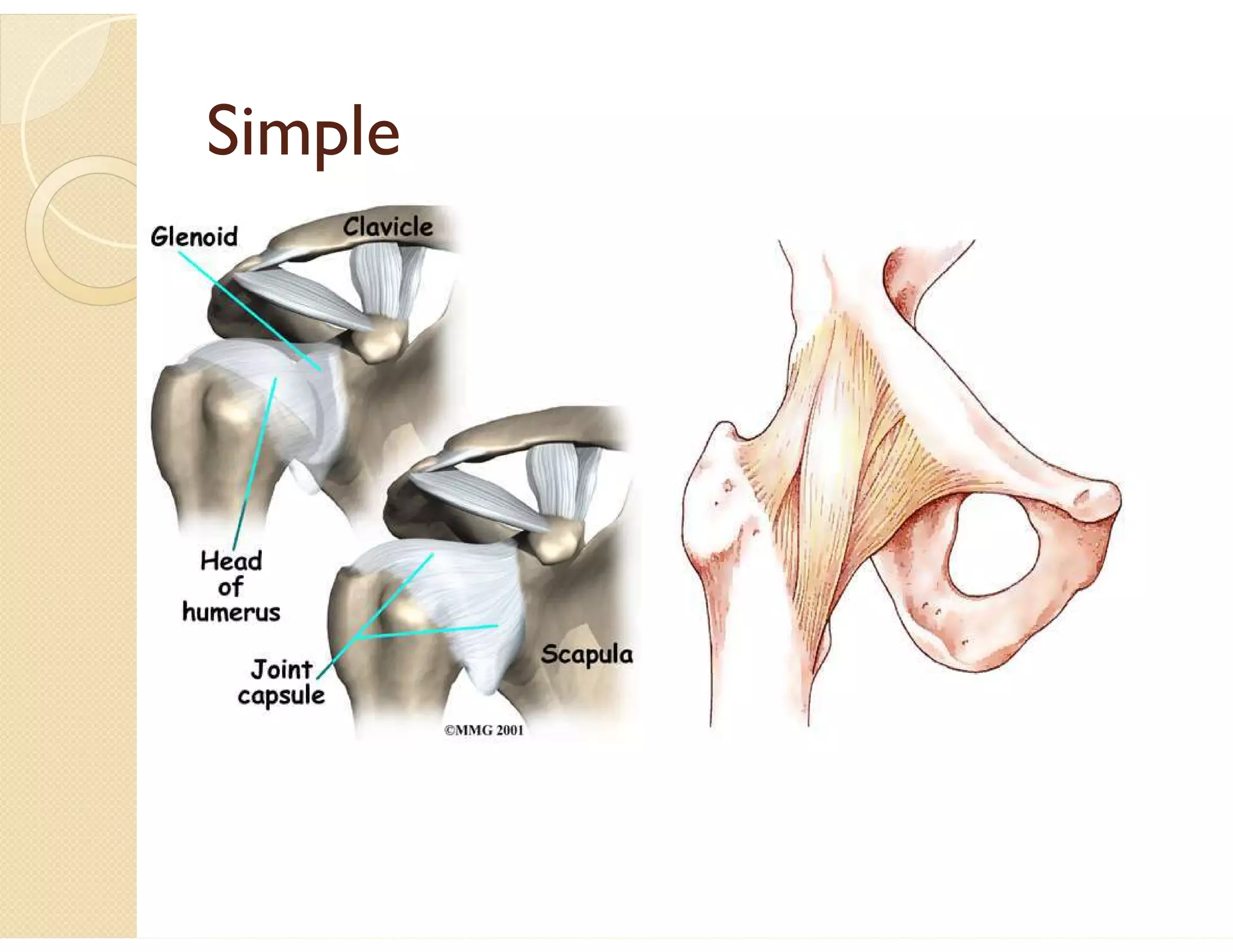
SIMPLE :When two bones participating
COMPOUND : More than two bones
COMPLEX : Intra articular disc or menisci
present
NERVE SUPPLY OFJOINTS
(HILTON’S LAw)
Hilton’s Law; joints are innervated with
the nerve of supply to the muscles, which
act on them
Motor nerve to the muscle acting on
joints tend to give branch to
Capsule of that joint
Skin covering that joint
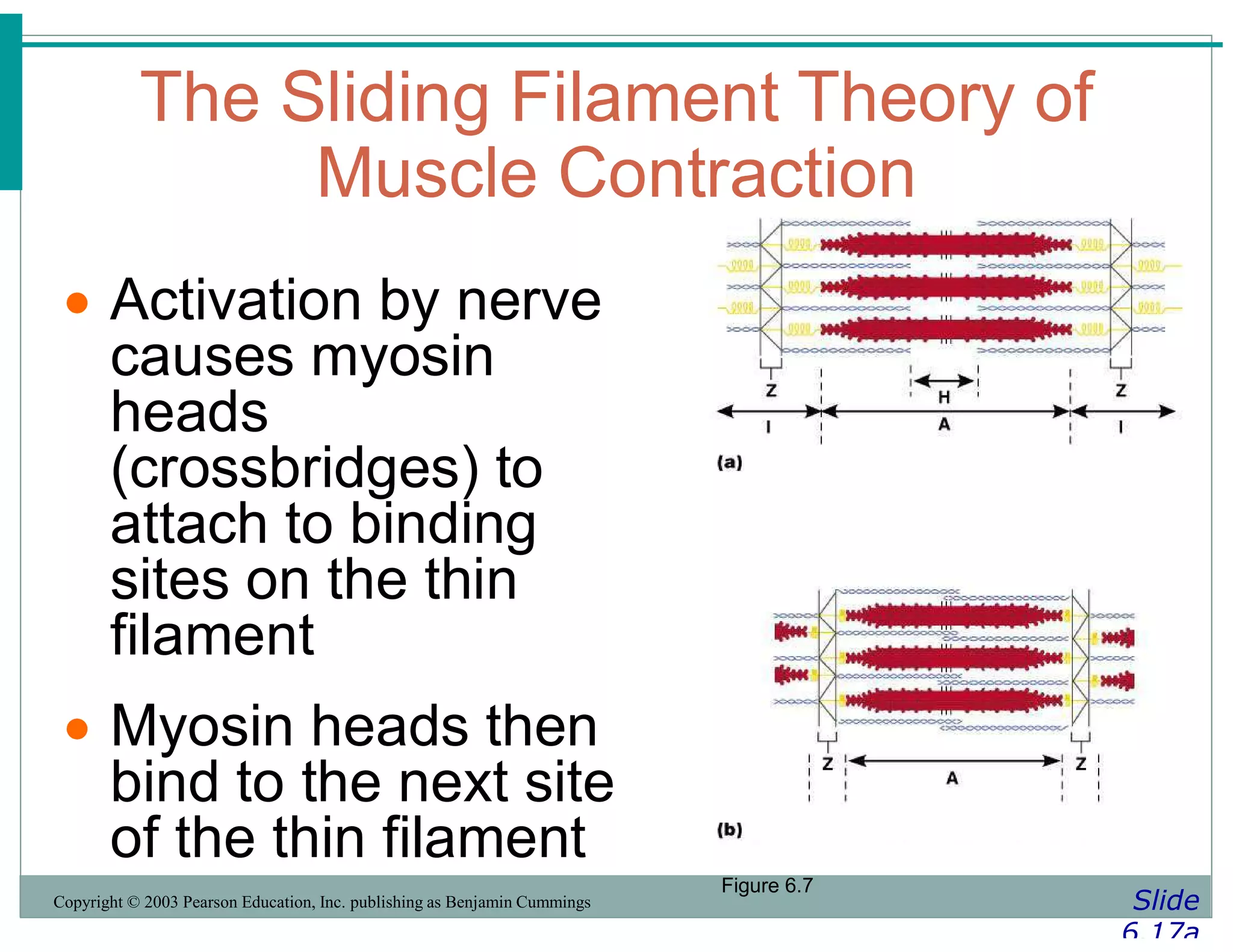
Muscle cONTracTiON
TONIC (normalmuscle tone)
PHASIC (It is of 2 types i.e ISOTONIC and
ISOMETRIC )
Isotonic (Length changes , tension same)
Isometric ( Length same , tension changes )
Isotonic is further of two types i.e CONCENTRIC
and ECCENTRIC.
REFLEXIVE (spontaneous movement due to O2 or
CO2 concentrations e.g knee reflex)
317.
cONceNTric MOveMeNT…
Movement occurs by
shortening of muscles.
Eg biceps brachi.
ecceNTric MOveMeNT…
Movement occurs by
contraction of muscles.
Eg Lowering a weight
during a shoulder press.
The downward motion of
squatting.
The downward motion of a
push-up.
Lowering the body during a
crunch.
Lowering the body during a
pull-up.
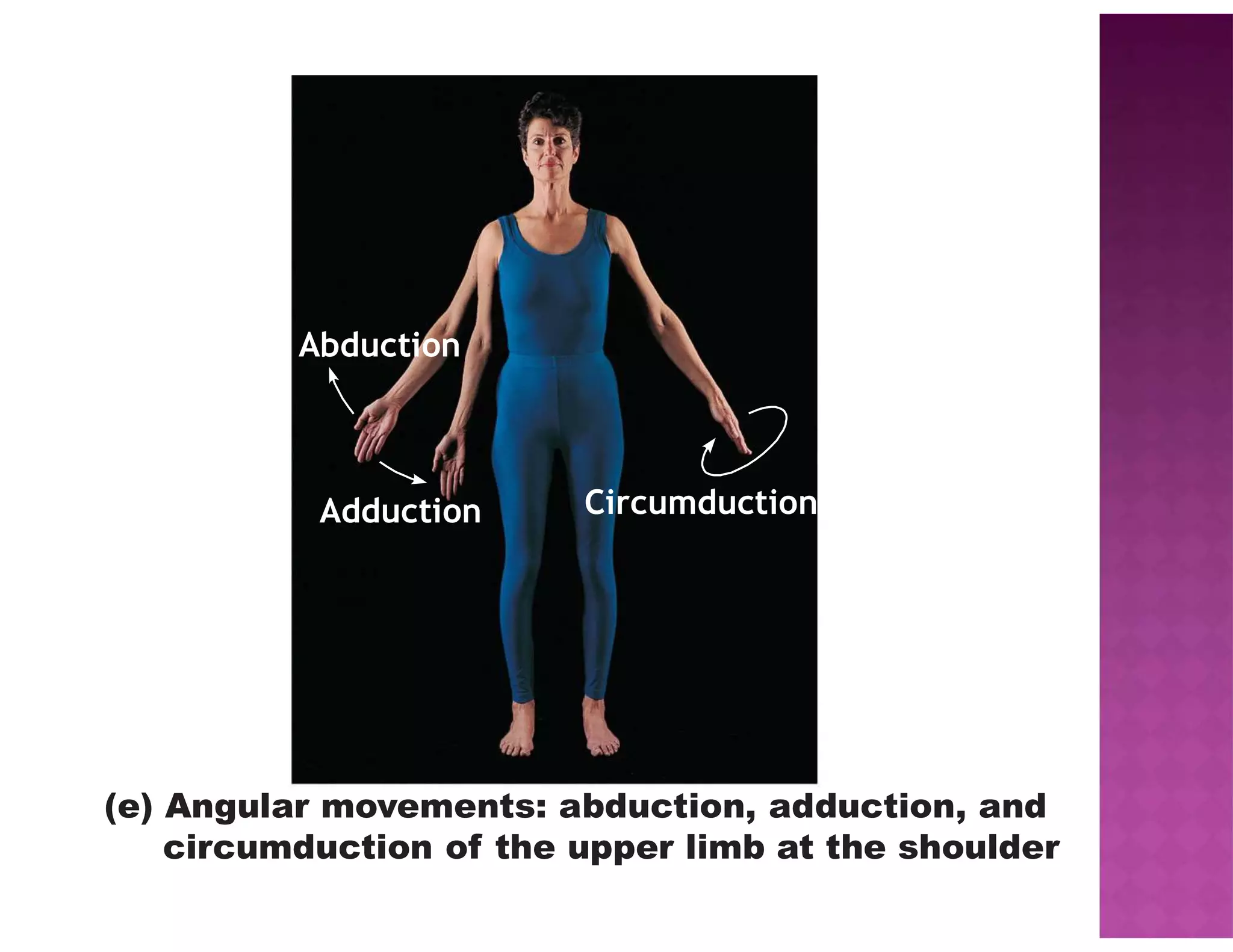
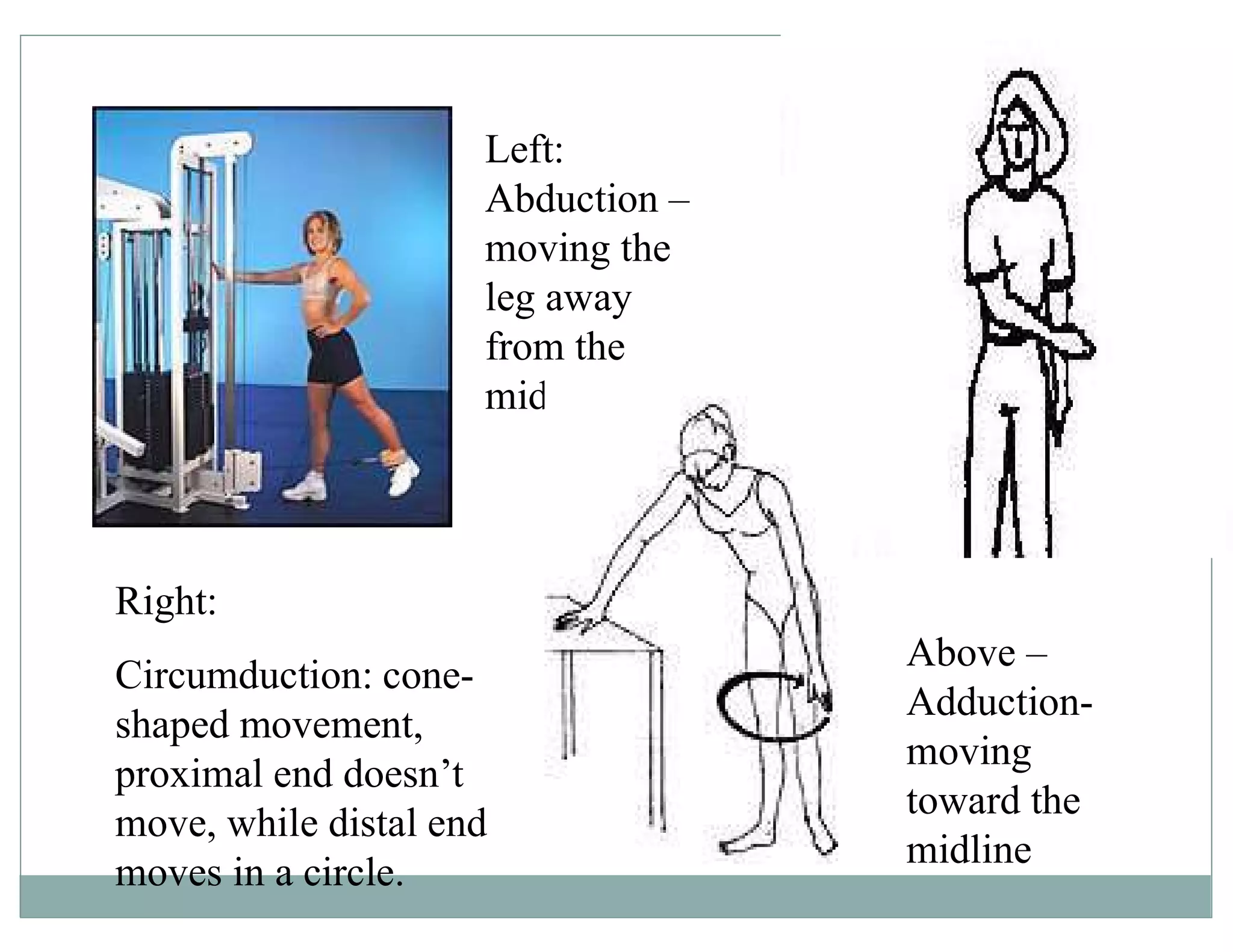
Left:
Abduction –
moving the
legaway
from the
midline
Above –
Adduction-
moving
toward the
midline
Right:
Circumduction: cone-
shaped movement,
proximal end doesn’t
move, while distal end
moves in a circle.
D U RI N G F O R E A R M F L EX I O N, F O R E X A MP L E L I F T I NG
A C U P , A MU S C L E C A L L ED T H E B I C E P S B R A C HI I I S
T H E PR I M E MO V E R . B E C A U S E I T C A N B E A S S I S T ED
B Y T H E B R A C H I A L I S , T HE B R A C H I A L I S I S C A L L E D
A S Y N E R G I S T I N T H I S A C T I O N ( F I G U R E 1 1 . 1 . 1 ) .
A S Y N E R G I S T C A N A L S O B E A F I X A T O R T H A T
S T A B I L I Z E S T HE M U S C L E' S O R I G I N .
327.
DisOrDers relaTiNG TOThe Muscular
sysTeM
Muscular Dystrophy: inherited, muscle enlarge due
to increased fat and connective tissue, but fibers
degenerate and atrophy
Duchenne MD: lacking a protein to maintain the
sarcolemma
Myasthemia Gravis: progressive weakness due to a
shortage of acetylcholine receptors
the sKin
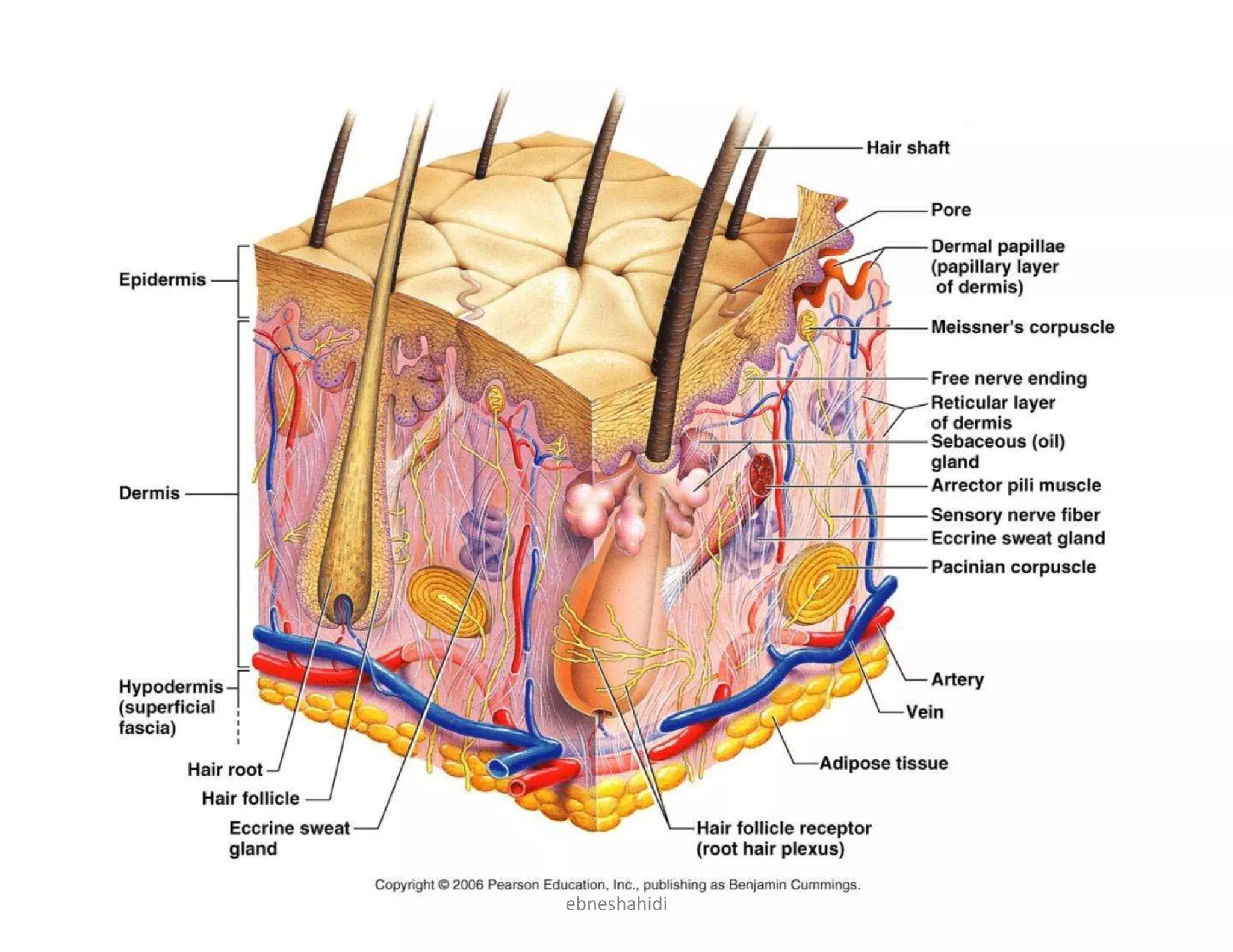
• Theintegumentary system consists of the skin
(cutaneous membrane) and its accessory organs.
• The skin is composed of three layers of tissue: the
outer epidermis (made of stratified squamous
epithelium ), the middle dermis (made of fibrous
connective tissue ), and the inner subcutaneous layer
or hypodermis (made of adipose tissue and loose
connective tissue).
• Accessory organs include the hair (hair root and hair
shaft) , hair follicle , pili arrector muscle, sebaceous
gland , sudoriferous gland , nails , and mammary
gland.
ebneshahidi
FunCtiOns OF theinteGumentAry
ssystemystem
1. protection
a) chemical factors in the skin:
Sebum (or oil) from the sebaceous glands is slightly
acidic, retarding bacterial colonization on the skin
surface.
Sweat from the sudoriferous glands is slightly
hypertonic and can flush off most bacteria on the skin
surface.
Melanin (skin pigment ) from melonocytes avoids
excessive ultraviolet radiation from penetrating the
skin layers . ebneshahidi
338.
b) physical factorsin the skin:
Stratified squamous epithelium in the epidermis
layer provides a large number of layers of cells,
preventing most bacteria invasion.
Keratinized cells in the stratum corneum layer of
the epidermis provides a physical barrier against
most invasion.
c) biological factor in the skin:
White blood cells such as macrophages destroy
most invaded bacteria and other foreign
substances.
ebneshahidi
339.
2. Excretion
waste materialssuch as ammonia , urea , and excessive
salt are eliminated from sweating .
3. Body temperature regulation
Sweating by the sweat glands promotes evaporation ,
resulting in a loss of excessive body heat.
Vasoconstriction by arterioles (small arteries ) in the
dermis layer provides a smaller surface area in the
blood vessels, resulting in less heat loss .
Vasodilatation by arterioles in the dermis layer
provides a larger surface area in the blood vessels ,
resulting in greater heat loss .
ebneshahidi
340.
4. Cutaneous sensation
Nervereceptors in the dermis layers detect
sensations such as heat, cold, pain, pressure, and
touch, allowing the body to be aware of these
stimuli.
5. Vitamin D synthesis
Ultraviolet radiation in the sunlight activates a
series of chemical reactions in the epidermis
layer, resulting in the synthesis of vitamin D
from the modification of cholesterol for the
absorption of calcium.
ebneshahidi
341.
FunCtiOns OF thesKin
• maintains homeostasis.
• prevents the body from the penetration of harmful
substances.
• Prevents water loss(desiccation) .
• help to regulate body temperature .
• contains nerve receptors for various sensations .
• synthesizes chemical substances such as keratin,
melanin, and vitamin D.
• excretes waste materials such as ammonia , urea , and
salts.
• produces skin pigment (melanin) in the epidermis and
hair to avoid excessive penetration of UV radiation .
ebneshahidi
342.
ePiDermis
• Being madeof stratified squamous epithelium , there is no blood
vessels to supply nutrients to its cells.
• Nutrients from the arterioles in the dermis layer diffuse upward
into the epidermis layer, especially to the stratum basale and
spinosum layers.
• Cuboidal cells at the stratum basale (stratum germinativum)
layer receive most of the nourishment . These cells reproduce
rapidly using mitosis . New daughter cells will be pushed upward
into higher layers , and they become flattened as they move
upward .
• Squamous cells moving upward in the epidermis receive less and
less nutrients as diffusion distance increases. By the time they
form stratum corneum , the cells are dead and will be shed off
from the skin .
ebneshahidi
343.
• Epidermal cellsin stratum granulosum and stratum corneum
undergo “keratinization " to produce a protein called keratin,
allowing these cells to be tough and waterproof. These cells are
now called " karatinocytes " where they develop desmosomes
between the cells and allow the epidermis to become a stronger
physical barrier .
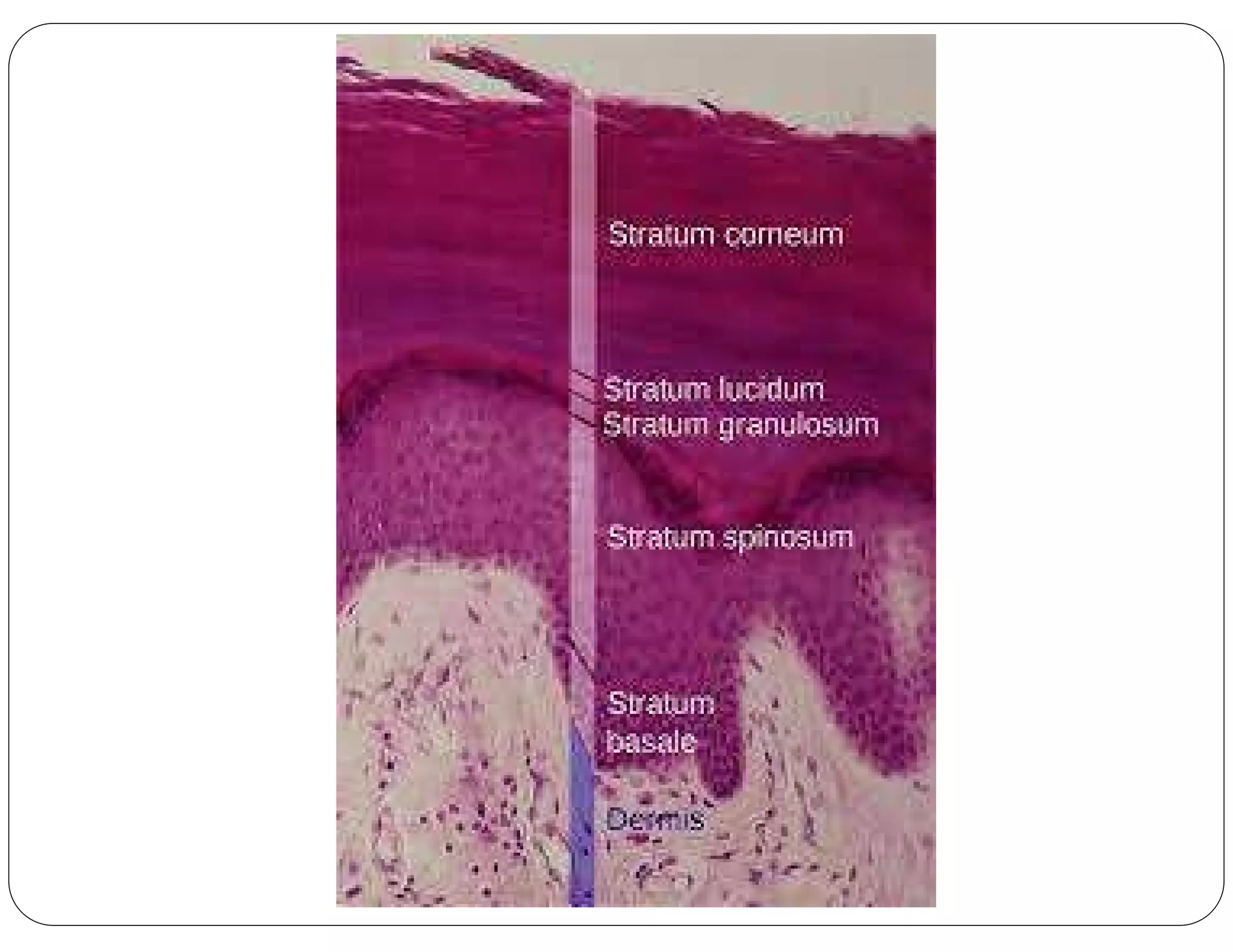
• F i v e layer of cells are found in the epidermis of the body
stratum basale , stratum spinosum , stratum granulosum , and
stratum corneum. In the palms and soles , an extra layer beneath
stratum coruneum is formed , called stratum Lucidum.
• Specialized cells called melanocytes in the stratum basale layer
produce the skin pigment, melanin. The number of melanocytes
and the amount of melanin production are genetically inherited .
ebneshahidi
lAyers OF ePiDermis
The 5 Layers of Your Skin
Stratum Basale or Basal Layer.The deepest layer of the
epidermis is called the stratum basale, sometimes called the
stratum germinativum. ...
Stratum Spinosum or the Spiny layer.This layer gives
the epidermis its strength. ...
Stratum Granulosum or the Granular Layer. ...
Stratum Lucidum. ...
Stratum Corneum.
NEMONIC : (CLG-SB)
348.
Dermis
• made offibrous connective tissue that contains
arterioles for supplying nutrients (i.e. oxygen ,
glucose , water , and ions ) to its structures and to the
epidermis .
• also contains pilo-errector muscles (made of skeletal
muscle, under involuntary control) to wrinkle the skin
and erect the hairs .
• contains nerves and nerve receptors to detect the
sensations of heat, cold, pressure, touch, and pain .
• also contains hair follicles to develop the hair .
• contains sebaceous gland to secrete sebum onto skin
surface, and sudoriferous glands to secrete sweat.
ebneshahidi
349.
hyPODermis
– Made ofadipose tissue and loose connective
tissue.
– Collagen and elastic fibers in the loose connective
tissue are continuous with the fibers in the dermis
layer.
– Adipose tissue serves as a heat insulator against
cold climate and as a fat storage.
– Loose connective tissue allows the skin to be
bound with underlying muscles.
– Also contains large blood vessels (arteries and
veins).
ebneshahidi
ACCessOry struCtures OFthe sKin
1. Hair
– produced by epithelial cells at the hair papilla .
– made of keratinized cells .
– consists two regions: hair root (in the hair follicle
, embedded in the dermis layer), and hair shaft
(protruded through the epidermis to the outside).
– Hair pigment (melanin) is produced by
melonocyets in hair papilla .
– Hair growth is affected by nutrition and hormones
(i.e. testosterone).
ebneshahidi
2. Pili erreCtOrmusCle
• made of skeletal muscle ,
but under involuntary
control.
• attached to each hair
follicle, for erecting the
hair.
• situations such as extreme
emotions or extreme
temperatures can activate
its involuntary contraction
, resulting in hair erection
or skin wrinkling.
ebneshahidi
356.
3. seBACeOus GlAnD
•Oil gland that is made of
modified cuboidal epithelium.
• Occurs all over the body
except in the palm and sole.
• Attached to each hair follicle,
so that sebum can be secreted
into the hair root and diffuse
upward .
• Sebum helps the skin and hair
to be waterproof, and retards
bacterial growth on skin
surface(due to its acidity).
ebneshahidi
357.
4. suDOriFerOus GlAnD
•sweat gland that secretes
sweat to promote
evaporation.
• found all over the body
except the lips, nipples,
and external genitalia.
• referred to as "tubular
gland" where it is a long
tubule coiled in the
dermis layer , and uses a
long duct to release
sweat onto skin surface
through a pore.
ebneshahidi
358.
5. nAils
• scalelike
modification of
epithelial cells in the
epidermis.
• made of keratin.
• Protect ends of fingers
and toes and prevent
over sensitization of
the never receptors in
extremities.
• Growing cells are
derived form a region
at base of nail called
"lunula".
ebneshahidi
360.
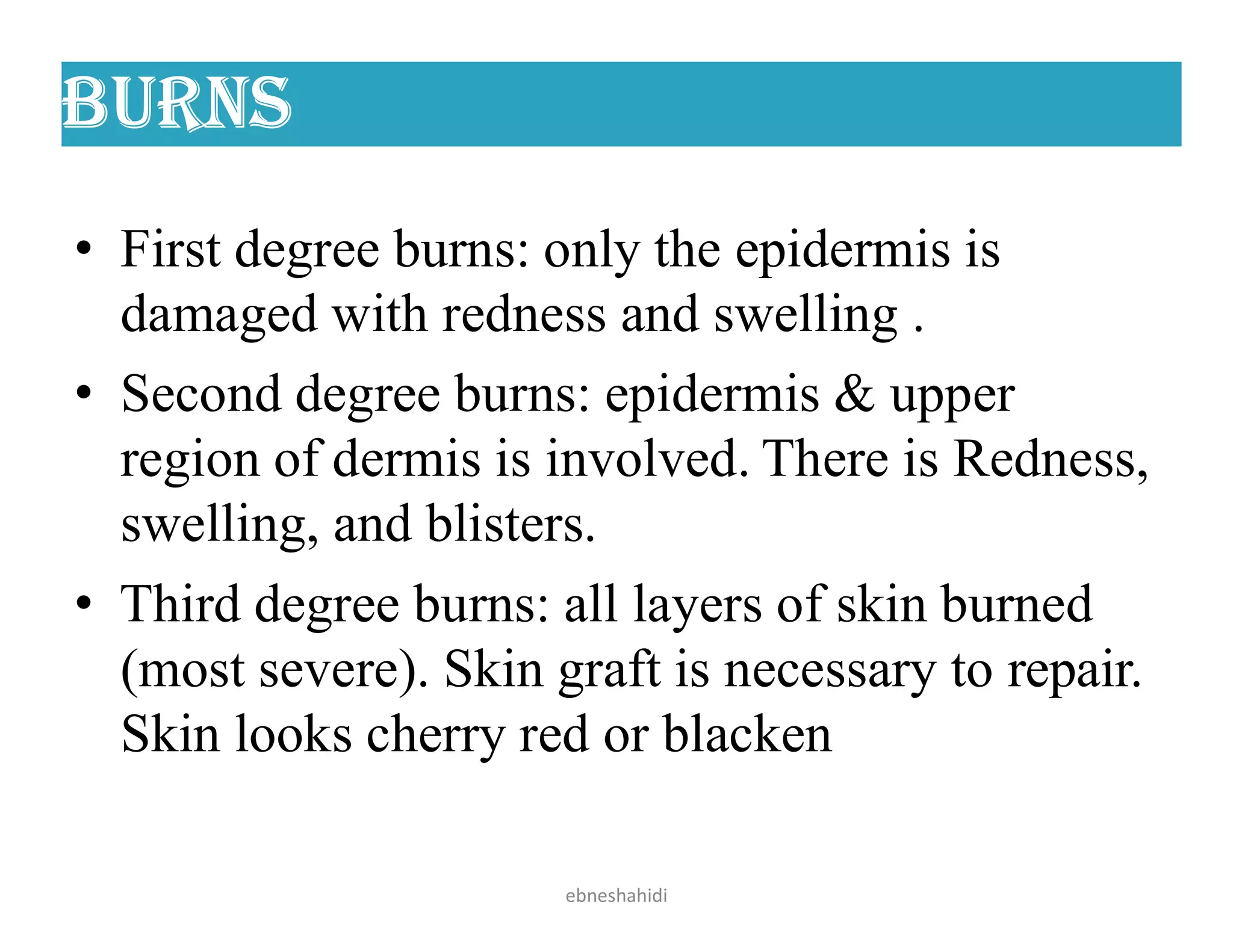
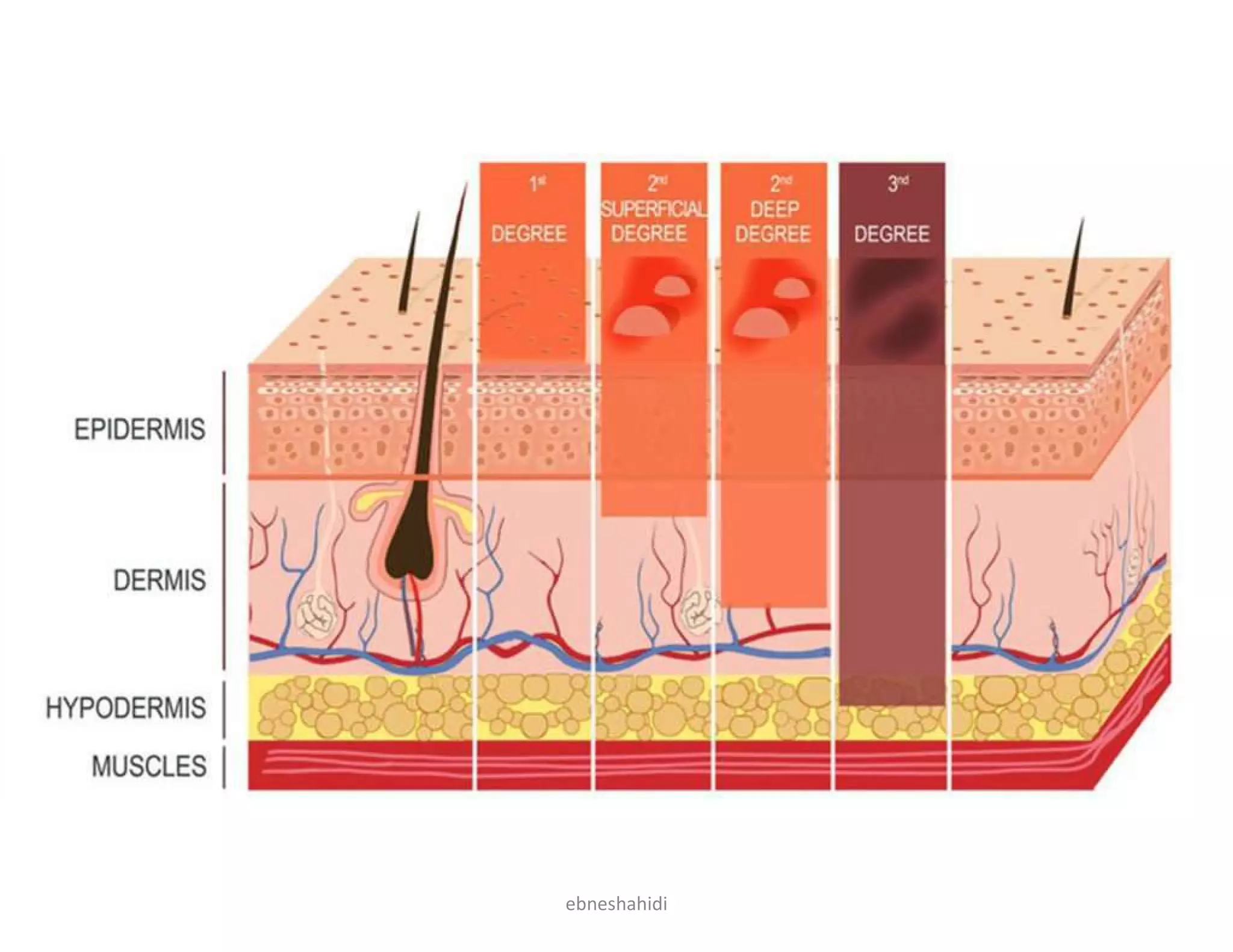
Burns
• First degreeburns: only the epidermis is
damaged with redness and swelling .
• Second degree burns: epidermis & upper
region of dermis is involved. There is Redness,
swelling, and blisters.
• Third degree burns: all layers of skin burned
(most severe). Skin graft is necessary to repair.
Skin looks cherry red or blacken
ebneshahidi
sKin CAnCer
• Mostskin tumors are benign
• Cause of cancer is unknown, but probably due to
overexposure to ultraviolet radiation in the sunlight .
• Three main types of skin cancer :
• Basal cell carcinoma
• The most common type of skin tumor; usually benign.
• Cells of stratum basale are affected , as a result they
cannot form keratin and begin to invade into the
dermis.
• Surgical removal (given that early detection is done)
is 99% successful .
ebneshahidi
364.
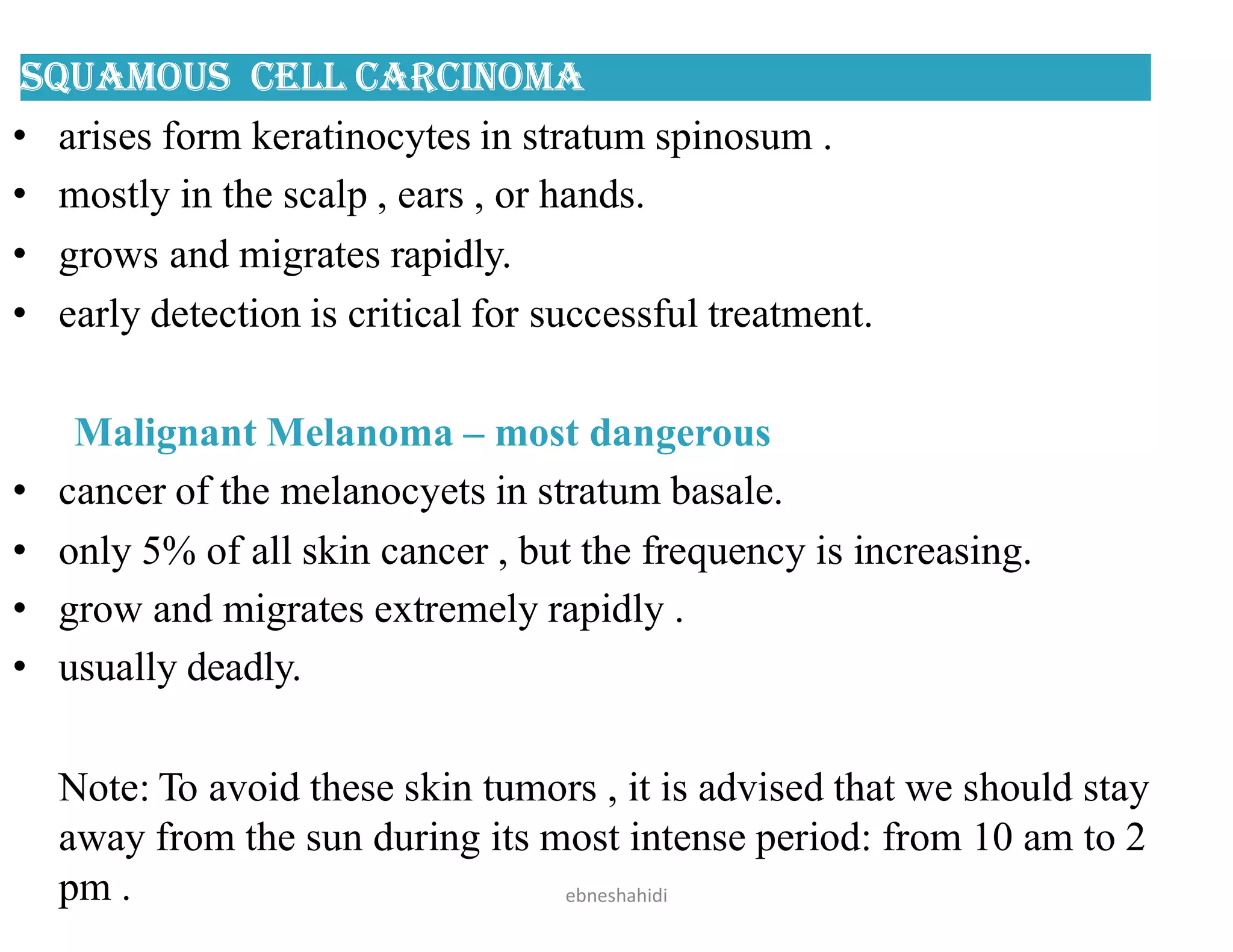
sQuAmOus Cell CArCinOmA
•arises form keratinocytes in stratum spinosum .
• mostly in the scalp , ears , or hands.
• grows and migrates rapidly.
• early detection is critical for successful treatment.
Malignant Melanoma – most dangerous
• cancer of the melanocyets in stratum basale.
• only 5% of all skin cancer , but the frequency is increasing.
• grow and migrates extremely rapidly .
• usually deadly.
Note: To avoid these skin tumors , it is advised that we should stay
away from the sun during its most intense period: from 10 am to 2
pm . ebneshahidi
365.
CliniCAl terms
• Albinism– inherited, melanocytes do not produce melanin.
• Boils and carbuncles – inflammation of hair follicles and
sebaceous glands, infection spread to dermis .
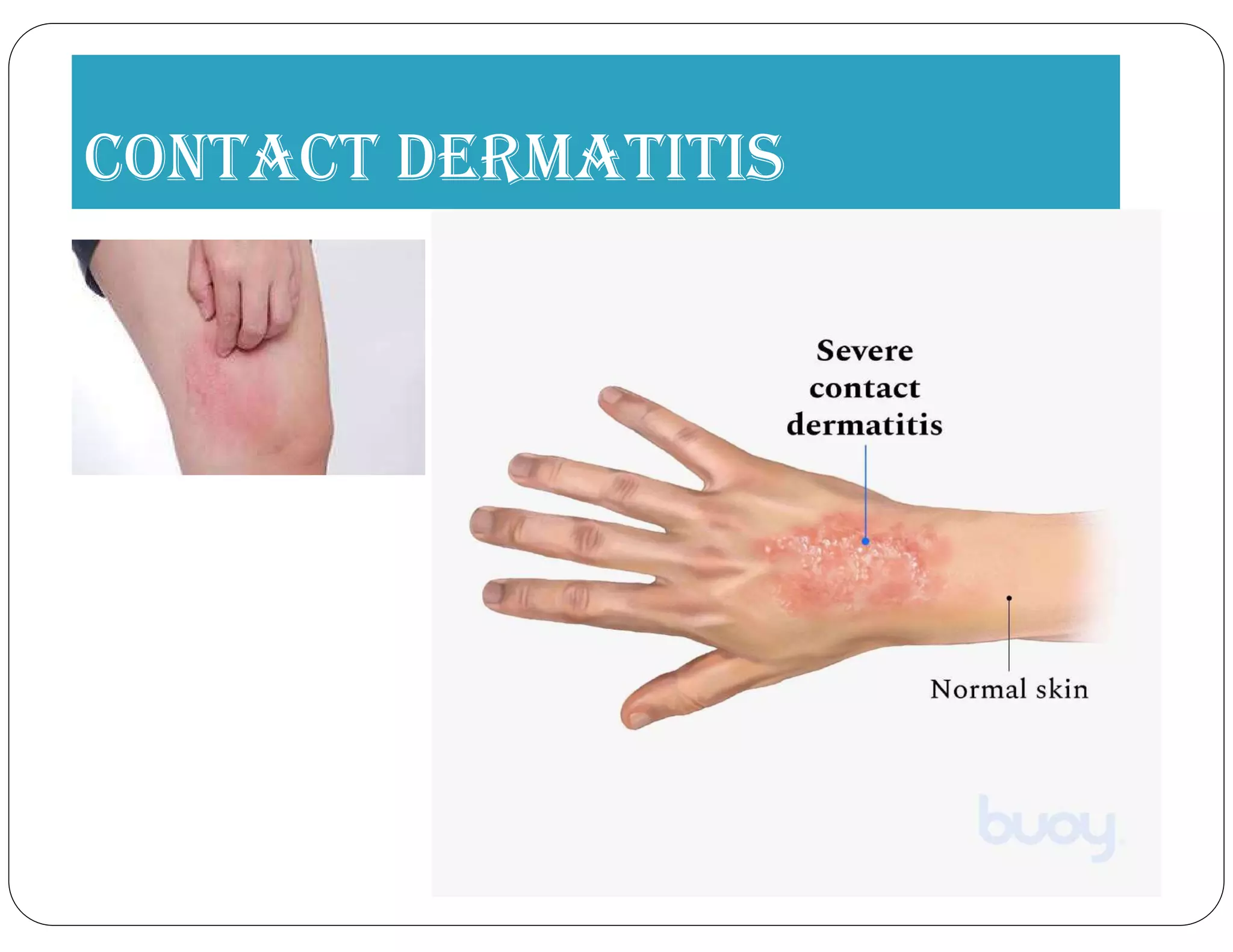
• Contact dermatitis – itching and redness and swelling forming
blisters. It is caused by chemical burns.
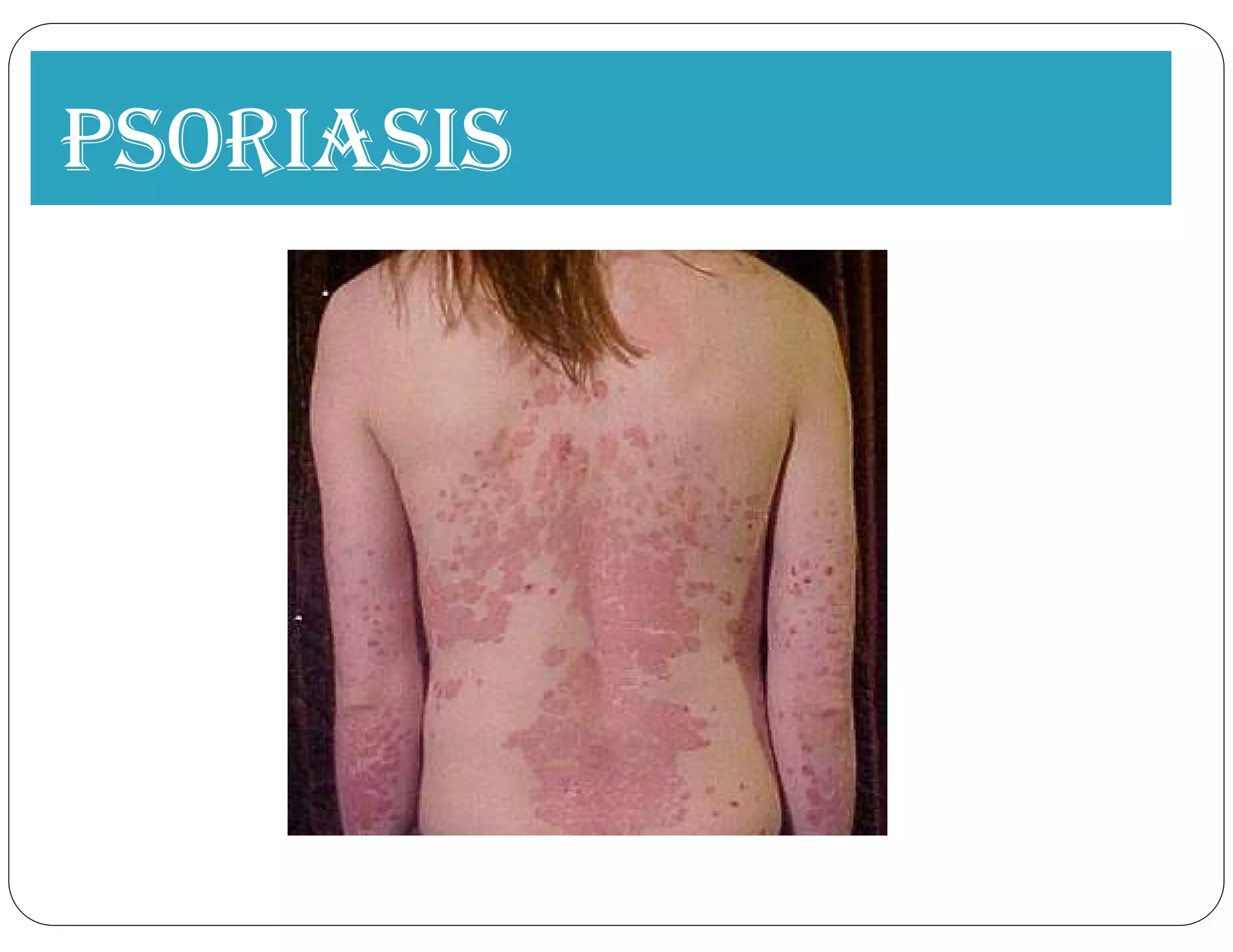
• Psoriasis : characterized by reddened epidermal lesions
covered by dry silvery scales.
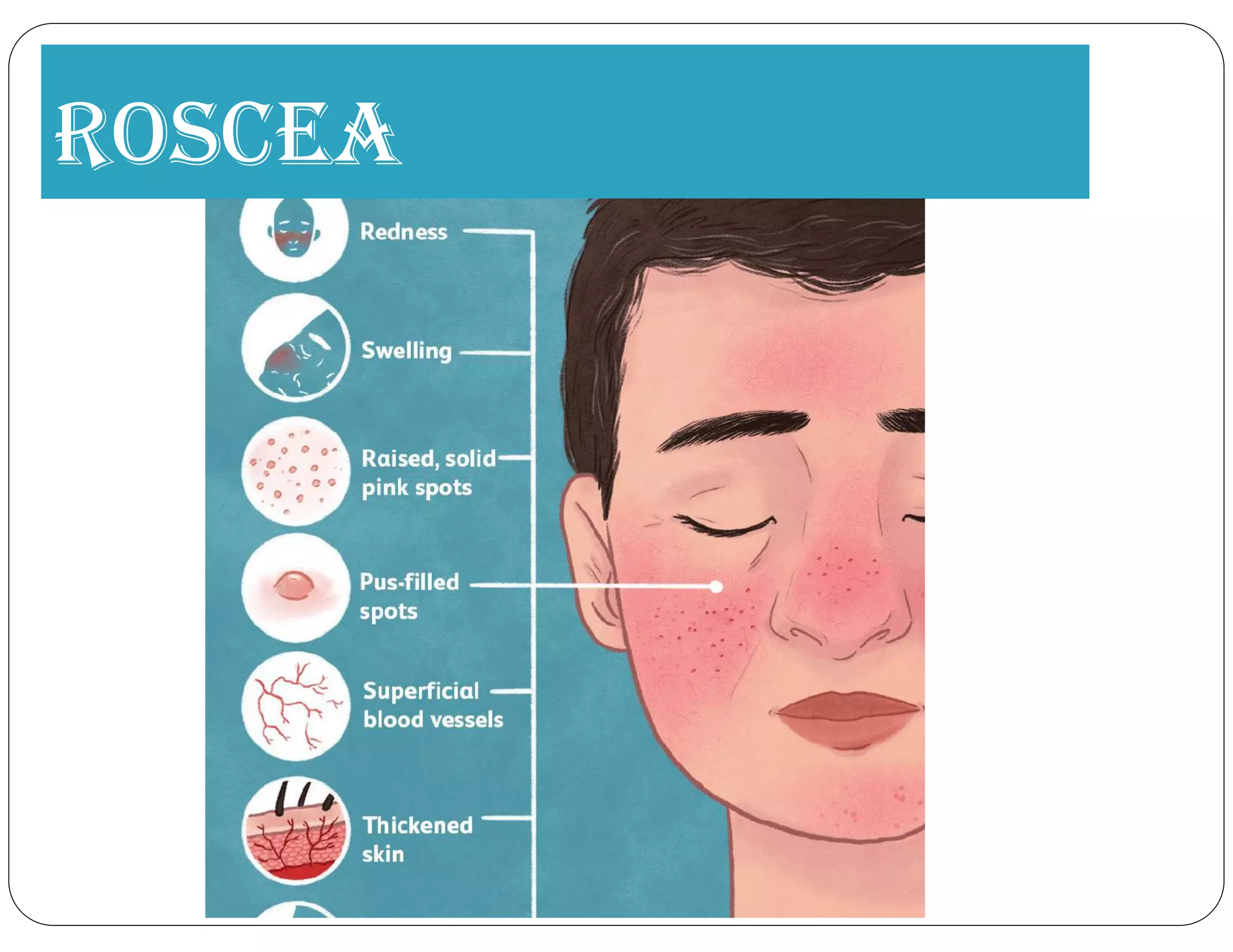
• Roscea : redness of skin around eyes and nose accompanied by
rash – like lesions, It gets worse with alcohol , hot H2O, and
spicy food .
• Vitiligo : skin pigmentation disorder caused by loss of melan-
octyts and uneven dispersal of melanin (unpigmented skin
surrounded by normally pigmented areas) .
ebneshahidi
OUTLINE
Introduction tothe Digestive System
Divisions
Alimentary Canal
Accessory Organs
Organs
Location
Functions
THE ROLE OF COMPUTERS IN MEDICAL PHYSICS. VICTOR EKPO. CMUL - LAGOS
377.
INTRODUCTION
The Digestive Systemis a group of
organs working together to
convert food into energy and
basic nutrients to feed/nourish the
body.
ANATOMY OF THE DIGESTIVE SYSTEM. VICTOR EKPO. CMUL - LAGOS
378.
Fig: Anterior viewof the Digestive System
ANATOMY OF THE DIGESTIVE SYSTEM. VICTOR EKPO. CMUL - LAGOS
379.
DIVISIONS
The Digestive Systemconsists of 2 parts: the
Alimentary Canal, and their Accessory Organs.
The alimentary canal is also called the digestive tract
OR gastrointestinal tract GIT (though GIT is
technically stomach + intestines only).
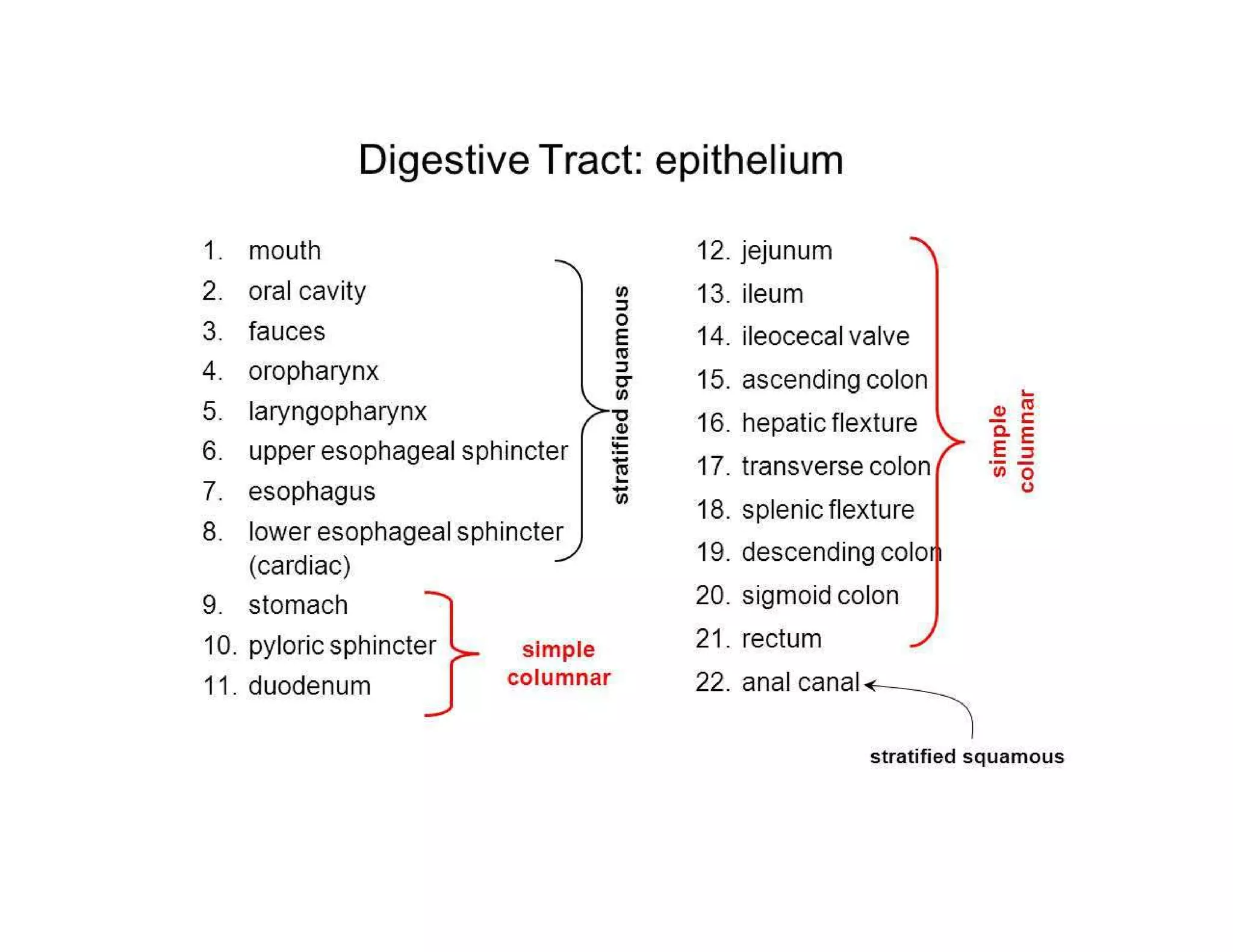
The alimentary canal is the long tube that runs from
the mouth through to the anus.
ANATOMY OF THE DIGESTIVE SYSTEM. VICTOR EKPO. CMUL - LAGOS
380.
ALIMENTARY CANAL
The mainparts of the Alimentary Canal are:
* Mouth (Oral cavity)
* Pharynx (Throat) * Oesophagus (also esophagus)
* Stomach * Small intestine
* Large intestine * Rectum and anal canal (anus).
382.
ACCESSory orGAnS
The AccessoryOrgans include other organs (mainly glands) that aid
digestion. These include:
Tongue, salivary glands and tonsils (for mouth)
Tubular mucous glands (for pharynx, oesophagus, large intestine)
Liver, Gallbladder, and Pancreas (for small intestine);
Epiglottis: which tips posteriorly at the pharynx to prevent food
from entering the larynx/respiratory tract.
Mesentery* (newly discovered organ that helps hold the intestines
to the posterior abdominal cavity).
383.
Digestion starts inthe mouth, where food is chewed and
mixed with saliva to form a bolus.
The bolus produced is then swallowed down the pharynx and
oesophagus via peristaltic contractions and into the stomach.
In the stomach, it is mixed with gastric juice to form a
semifluid substance called chyme, then moved to the
duodenum (small intestine).
Most of the digestion takes place in the stomach and
duodenum of the small intestine.
Water and some minerals are reabsorbed in the colon of the
large intestine. The chyme is turned to faeces. The faeces is
defecated from the anus via the rectum.
ANATOMY OF THE DIGESTIVE SYSTEM. VICTOR EKPO. CMUL - LAGOS
ABDomInAl SurfACE AnAtomyCAn BE DESCrIBED whEn VIEwED from In
front of thE ABDomEn In 2 wAyS: DIVIDED Into 9 rEGIonS By two VErtICAl
AnD two horIzontAl ImAGInAry PlAnES. DIVIDED Into 4 QuADrAntS By
SInGlE VErtICAl AnD horIzontAl ImAGInAry PlAnES.
386.
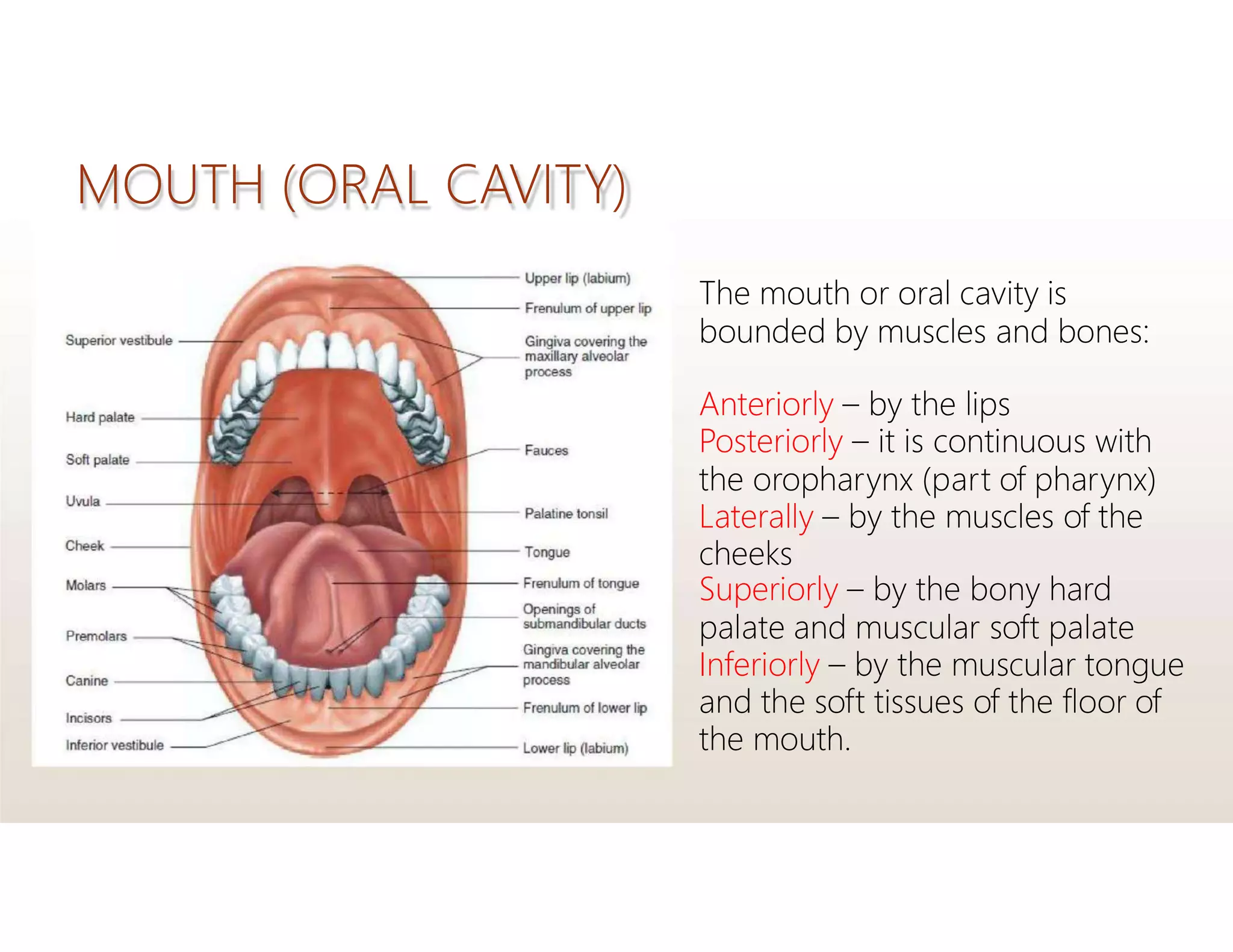
MOUTH (ORAL CAVITY)
Themouth or oral cavity is
bounded by muscles and bones:
Anteriorly – by the lips
Posteriorly – it is continuous with
the oropharynx (part of pharynx)
Laterally – by the muscles of the
cheeks
Superiorly – by the bony hard
palate and muscular soft palate
Inferiorly – by the muscular tongue
and the soft tissues of the floor of
the mouth.
387.
SAlIVAry GlAnDS
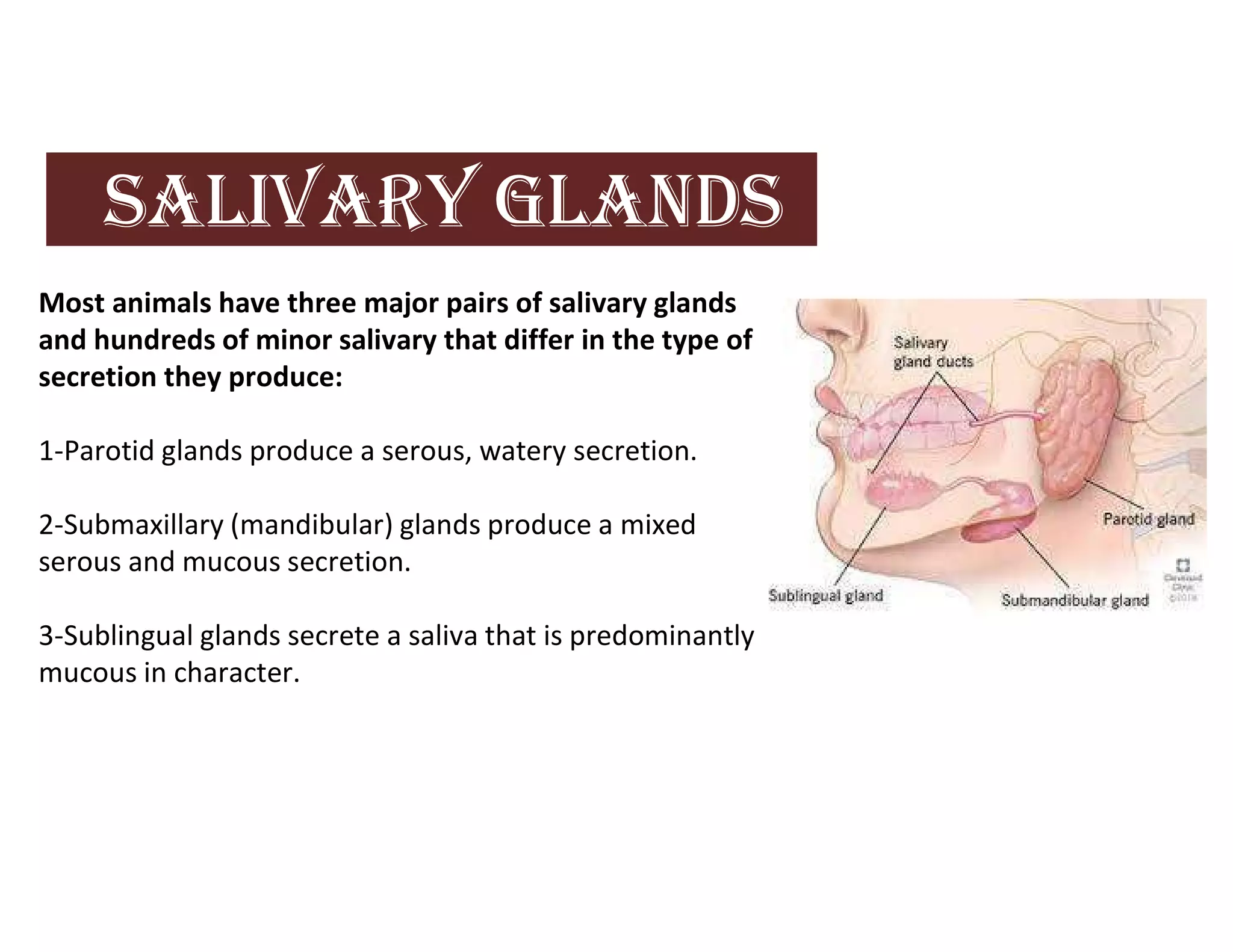
Most animalshave three major pairs of salivary glands
and hundreds of minor salivary that differ in the type of
secretion they produce:
1-Parotid glands produce a serous, watery secretion.
2-Submaxillary (mandibular) glands produce a mixed
serous and mucous secretion.
3-Sublingual glands secrete a saliva that is predominantly
mucous in character.
388.
TONGUE
The tongue isa large, muscular organ
that occupies most of the oral cavity.
It is attached by its base to the hyoid
bone, and by thin fold of tissue called the
frenulum, to the floor of the mouth.
A groove called the terminal sulcus
divides the tongue into two parts.
• Anterior: covered by papillae (contains
some taste buds).
• Posterior: contains few small glands
and a large amount of lymphoid tissue,
the lingual tonsil. Fig: Dorsal surface of tongue & tonsils
389.
tonGuE PAPPIlAE
Papillae arethe tiny raised protrusions on the
tongue that contain taste buds. The three types of
papillae are:
1-Fungiform (mushroom like)
2-Filiform (filum - thread like)
3-Crcumvallate.
4-Folliate
Except for the filiform, these papillae allow us to
differentiate between sweet, salty, bitter, sour, and
umami (or savory) flavors.
390.
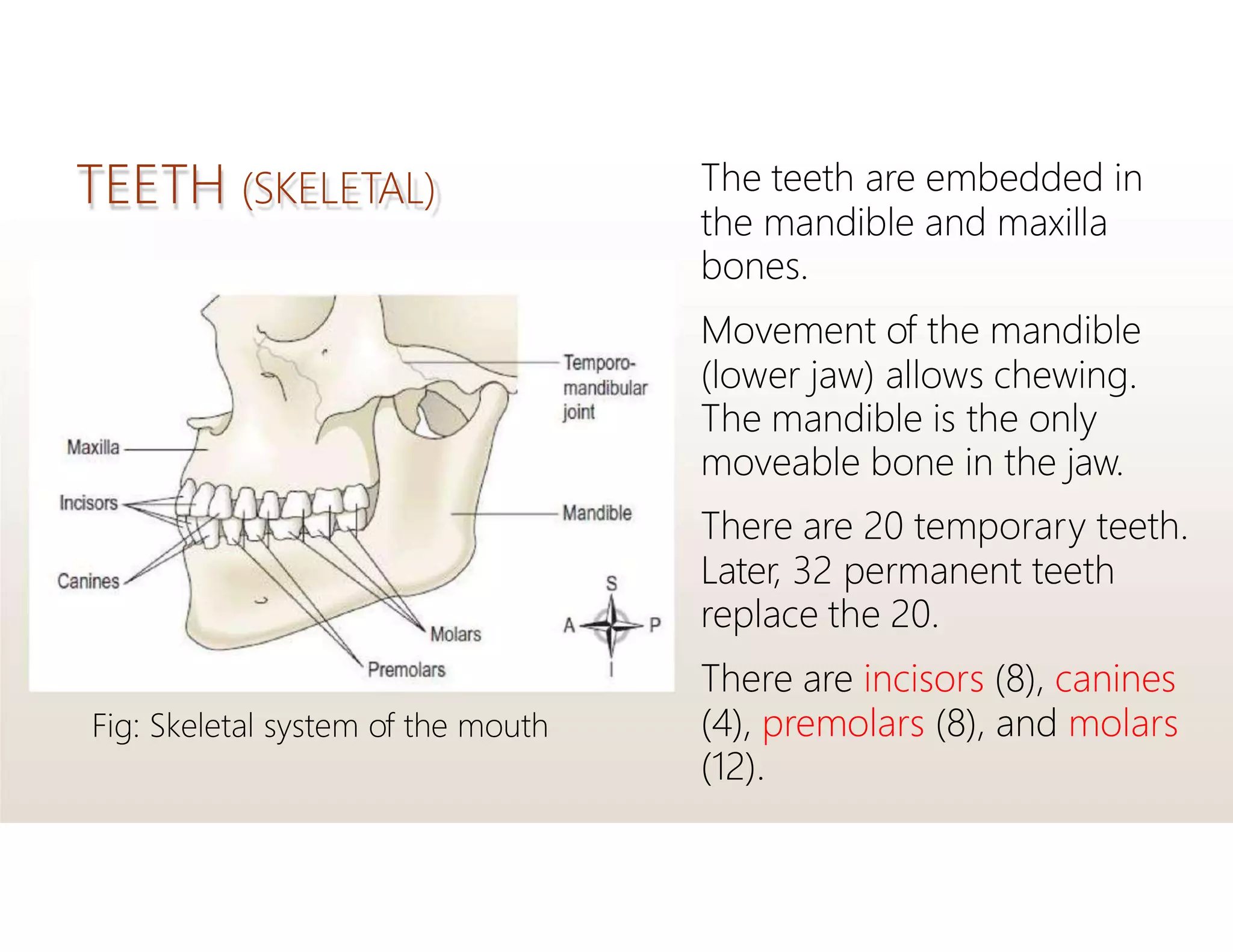
TEETH (SKELETAL) Theteeth are embedded in
the mandible and maxilla
bones.
Movement of the mandible
(lower jaw) allows chewing.
The mandible is the only
moveable bone in the jaw.
There are 20 temporary teeth.
Later, 32 permanent teeth
replace the 20.
There are incisors (8), canines
(4), premolars (8), and molars
(12).
Fig: Skeletal system of the mouth
391.
PHARYNX
It connects tothe oral cavity anteriorly, and is continuous
with the oesophagus. Food passes from the oral cavity into
the pharynx then to the oesophagus below it.
The pharynx consists of three parts:
nasopharynx,
oropharynx, and the
laryngopharynx.
It prevents food from entering the nasal cavity (by the soft
palate) and the lower respiratory tract (by the epiglottis).
OESOPHAGUS
Also called gulletor esophagus, it
is an organ through which food
passes from the pharynx to the
stomach, aided by peristaltic
contractions, of its musculature.
It is about 25 cm long and 2 cm in
diameter, and lies in the median
plane (mediasternum) in the
thorax, anterior to the spinal
column, but posterior to the
trachea.
394.
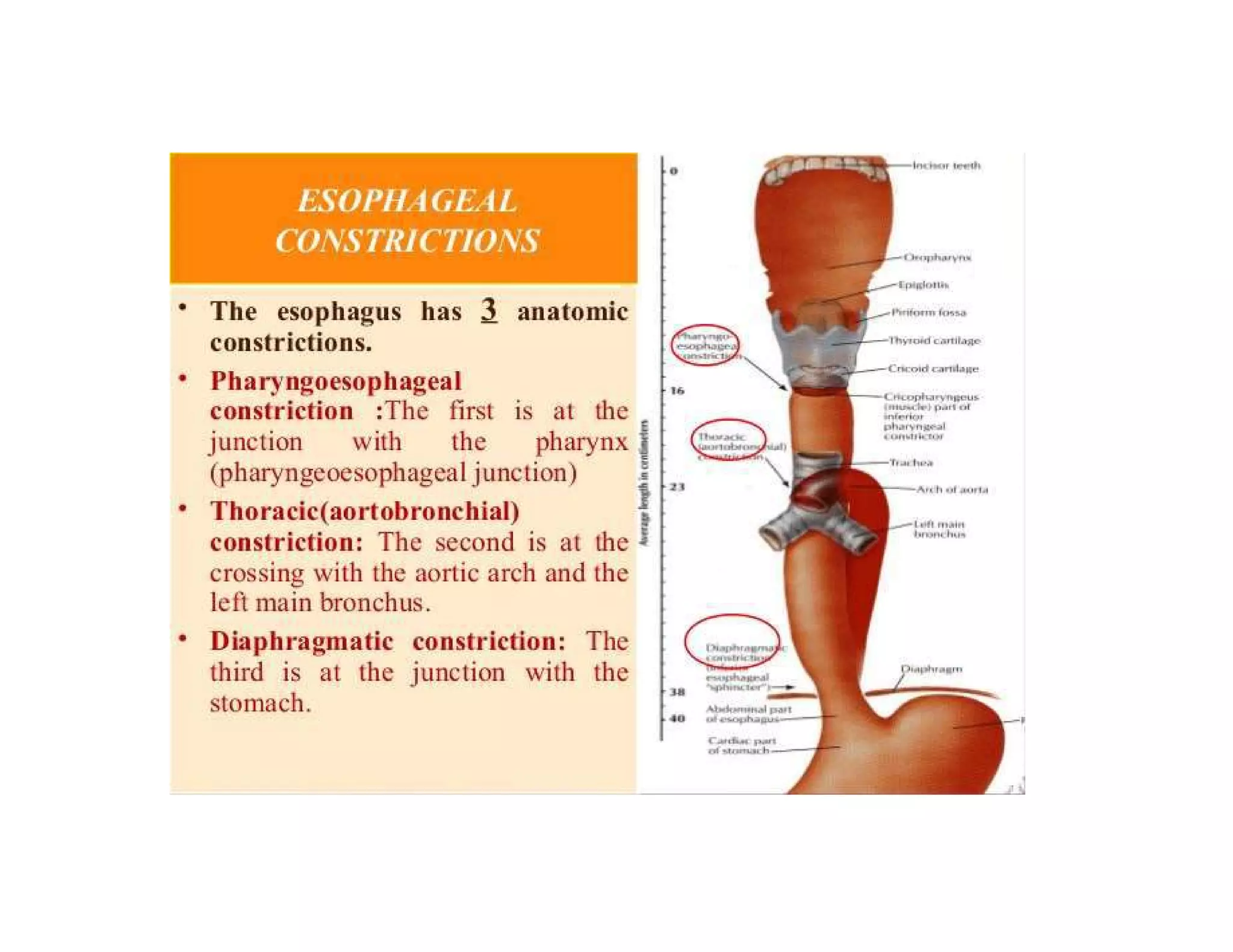
CONSTRICTIONS OF THEOESOPHAGUS
The oesophagus follows the curvature of the
vertebral column.
It also has 3 constrictions (narrowing), where
adjacent structures produce impressions:
1. Cervical Constriction (Upper Oesophageal
Sphincter) – where Pharynx meets
Oesophagus.
2. Thoracic (Broncho-Aortic) Constriction –
where it is first crossed by arch of aorta.
3. Diaphragmatic Constriction: where it
passes through the oesophageal hiatus of
the diaphragm at t10, before entering the
stomach.
397.
OESOPHAGUS (contd.)
Immediately theoesophagus has
passed through the esophageal
hiatus (opening) of the diaphragm, it
curves upwards before opening into
the stomach.
This sharp angle, as well as the
sphincters at each end (e.g. cardiac
sphincter), prevents the regurgitation
(backflow) of gastric contents into the
oesophagus.
The oesophagus has thick walls consisting of the four layers/tunics common
to the digestive tract: mucosa (innermost), submucosa, muscularis, and
serosa/adventitia (outermost).
LOCATION OF THESTOMACH
It is the enlarged hollow part of
the digestive tract specialized in
the accumulation of ingested
food, and also acts as food
blender.
It is located between the
oesophagus and the small
intestine.
It is located in the epigastric,
umbilical & left hypochondriac
regions of the abdominal cavity. Gastroenterology deals with the study of
diseases of the stomach and intestines
and their associated organs
400.
PARTS OF THESTOMACH
The stomach has four (4) parts:
Cardiac
Fundus
Body
Pylorus
The stomach is continuous with the
oesophagus at the Cardiac Sphincter,
and with the Duodenum at the Pyloric
Sphincter.
The Pyloric Sphincter guards the opening between the stomach and the
duodenum. When the stomach is inactive, the pyloric sphincter is relaxed and
open, and when the stomach contains food, the sphincter is closed.
401.
CEllS In StomACh
Fourdifferent types of cells make up the gastric
glands:
1-Mucous cells … secrete an alkaline mucus that
protects the epithelium against shear stress and acid.
2-Parietal cells … secrete hydrochloric acid and
INTRINSIC FACTOR.
3-Chief cells … secrete pepsin, a proteolytic enzyme.
4-G cells … which are endocrine cells that synthesize
and secrete the hormone gastrin.
403.
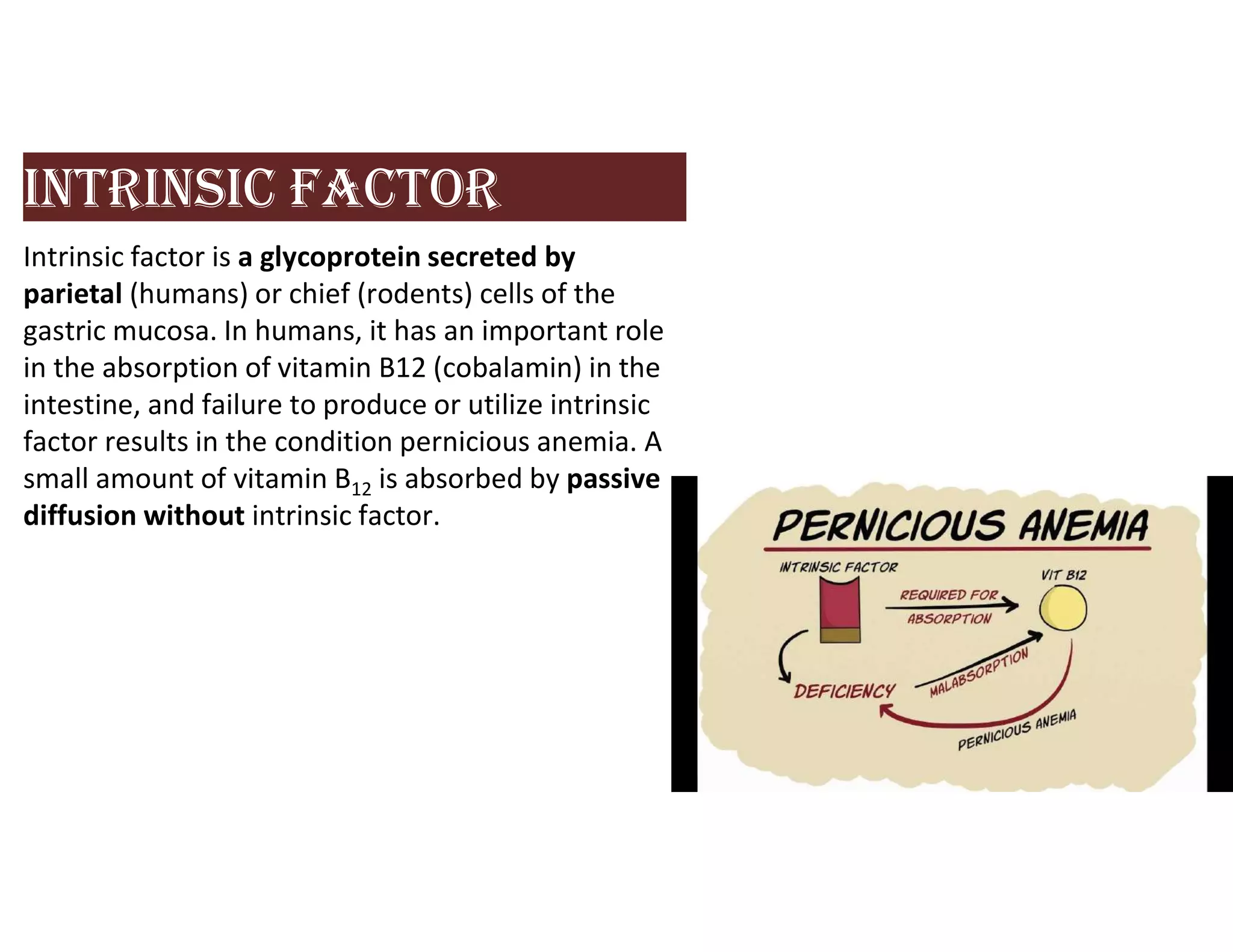
IntrInSIC fACtor
Intrinsic factoris a glycoprotein secreted by
parietal (humans) or chief (rodents) cells of the
gastric mucosa. In humans, it has an important role
in the absorption of vitamin B12 (cobalamin) in the
intestine, and failure to produce or utilize intrinsic
factor results in the condition pernicious anemia. A
small amount of vitamin B12 is absorbed by passive
diffusion without intrinsic factor.
405.
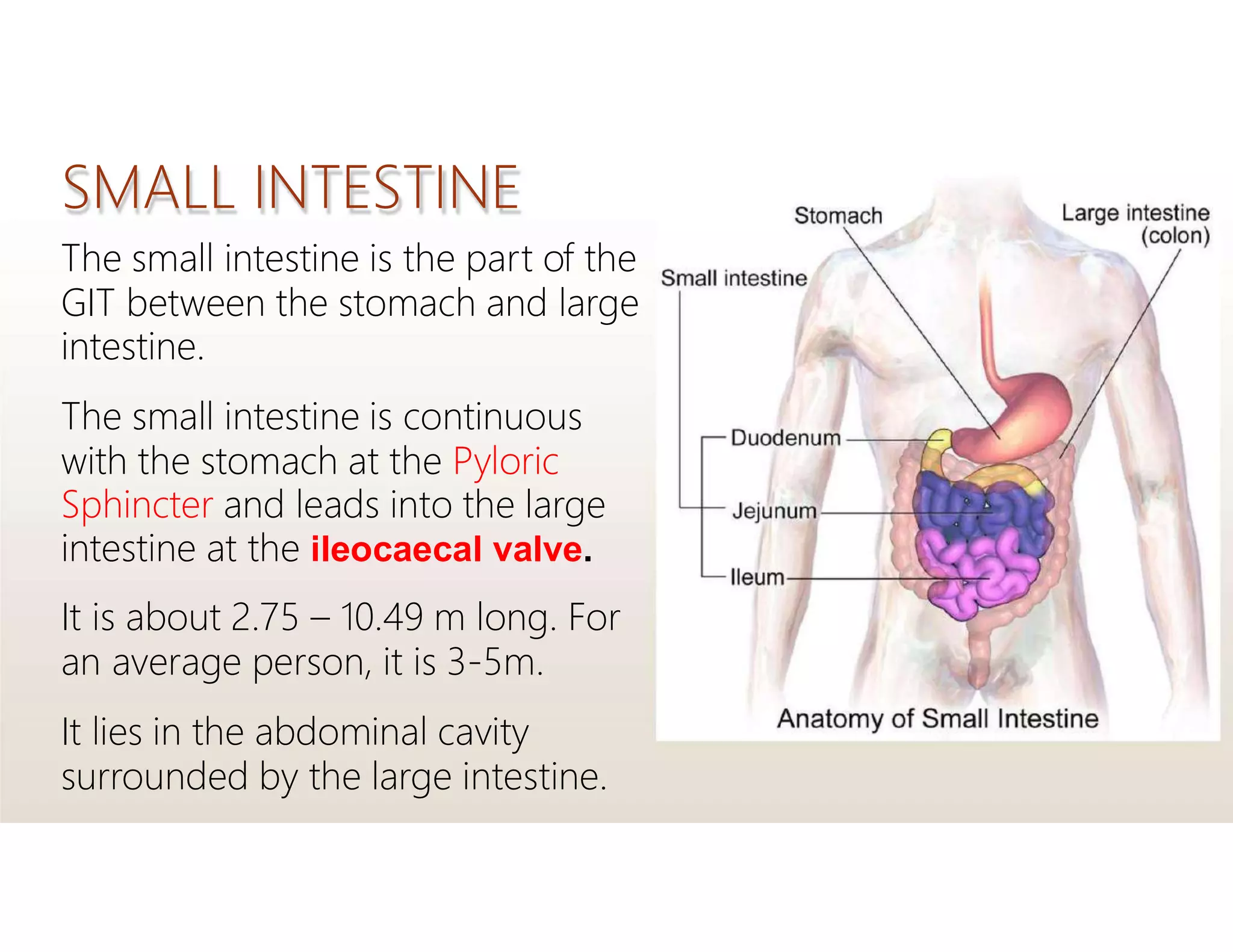
SMALL INTESTINE
The smallintestine is the part of the
GIT between the stomach and large
intestine.
The small intestine is continuous
with the stomach at the Pyloric
Sphincter and leads into the large
intestine at the ileocaecal valve.
It is about 2.75 – 10.49 m long. For
an average person, it is 3-5m.
It lies in the abdominal cavity
surrounded by the large intestine.
406.
PARTS OF SMALLINTESTINE
There are 3 parts of the Small Intestine:
Duodenum: First, shortest, widest and
most fixed part (0.25m long).
Jejunum: This is the middle section of
the small intestine (about 2.5m long) –
about 2/5th
Ileum: Joins the large intestine at the
Ileocecal Junction
(3- 3.5m long) – about 3/5th
The mesentery, a double layer of peritoneum, supports and attaches the
jejunum and ileum (small intestine) to the posterior abdominal wall.
408.
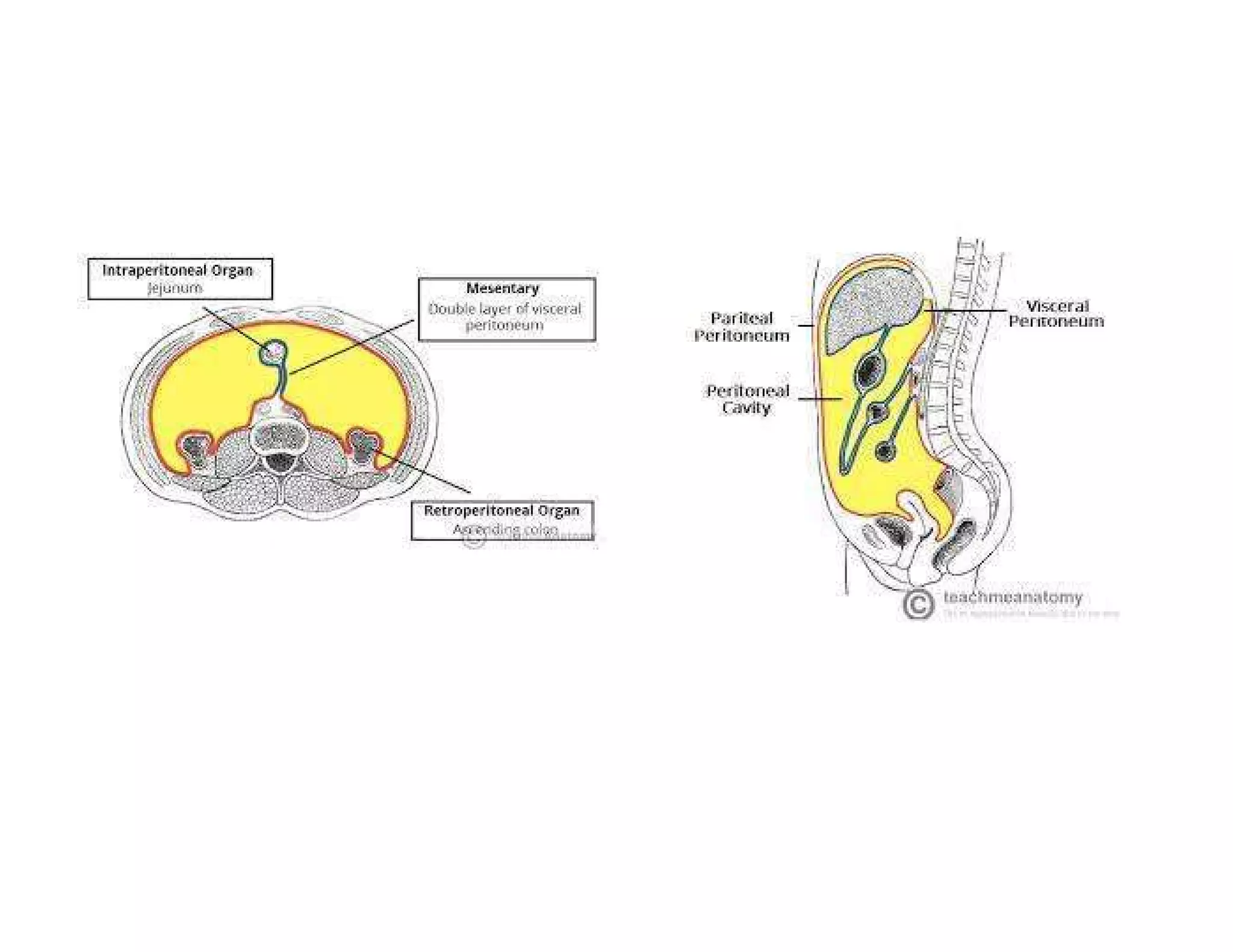
PERITONEUM & MESENTERY
Theperitoneum (yellow portion) is the largest
serous membrane of the body. It is a closed sac,
containing a small amount of serous fluid, within
the abdominal cavity.
It provides attachment to organs of the GIT, and
acts as a physical barrier to localize spread of
infection.
It invaginates the stomach, small intestine, liver,
pancreas, kidney, spleen, and other pelvic
organs.
The mesentery associated with the small
Intestine is sometimes called the Mesentery Proper. There are mesenteries of
other parts, e.g. of the colon: transverse mesocolon.
409.
The structures withinthe intraperitoneal space are called "intraperitoneal" (e.g., the stomach
and intestines),
the structures in the abdominal cavity that are located behind the intraperitoneal space are
called "retroperitoneal" (e.g., the kidneys).
The term subperitoneal refers to tissue that is deep to the peritoneum and includes the
extraperitoneal space, the ligaments and the mesenteries and their suspended organs . Organs
whose surfaces are covered by peritoneum are therefore subperitoneal.
411.
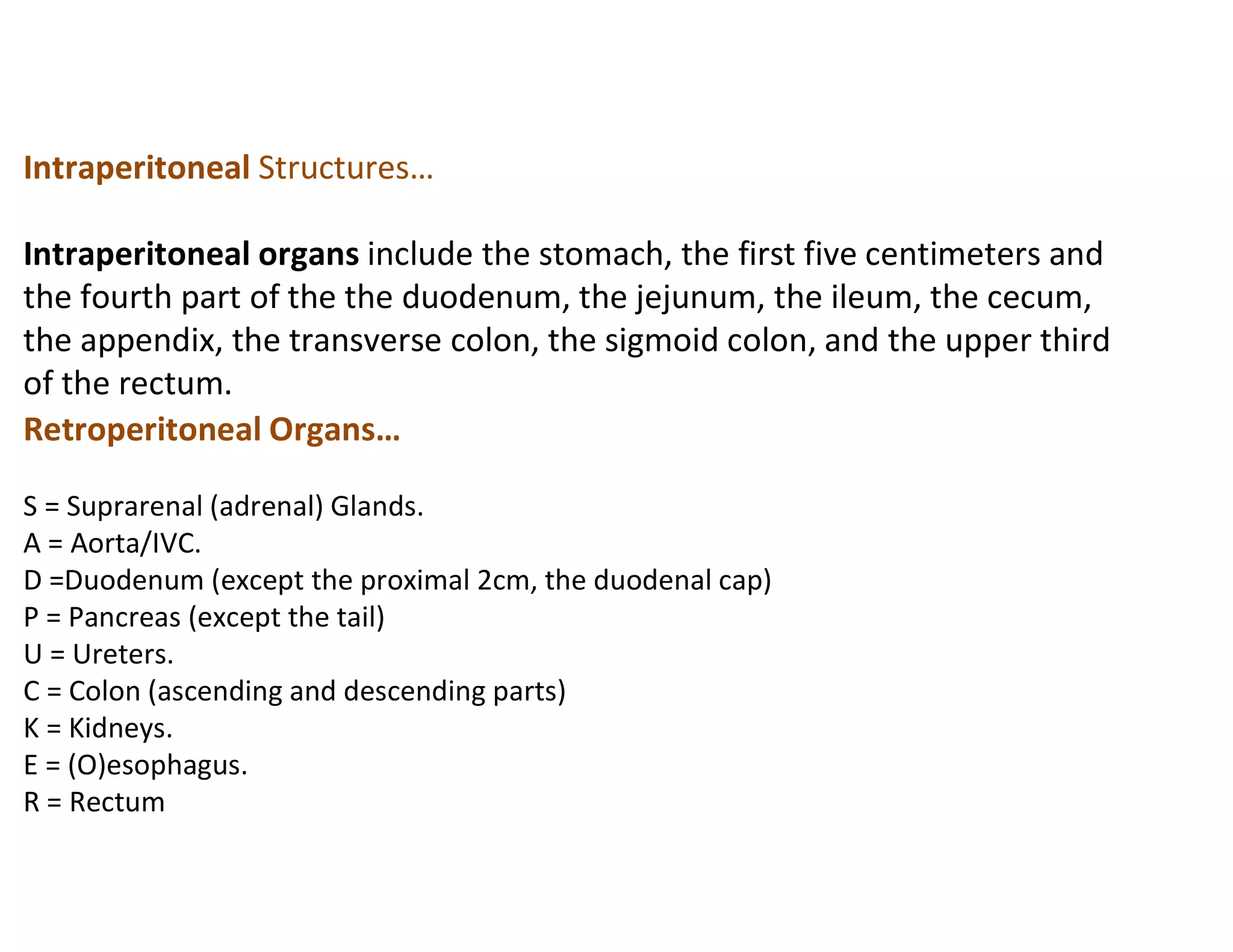
Intraperitoneal Structures…
Intraperitoneal organsinclude the stomach, the first five centimeters and
the fourth part of the the duodenum, the jejunum, the ileum, the cecum,
the appendix, the transverse colon, the sigmoid colon, and the upper third
of the rectum.
Retroperitoneal Organs…
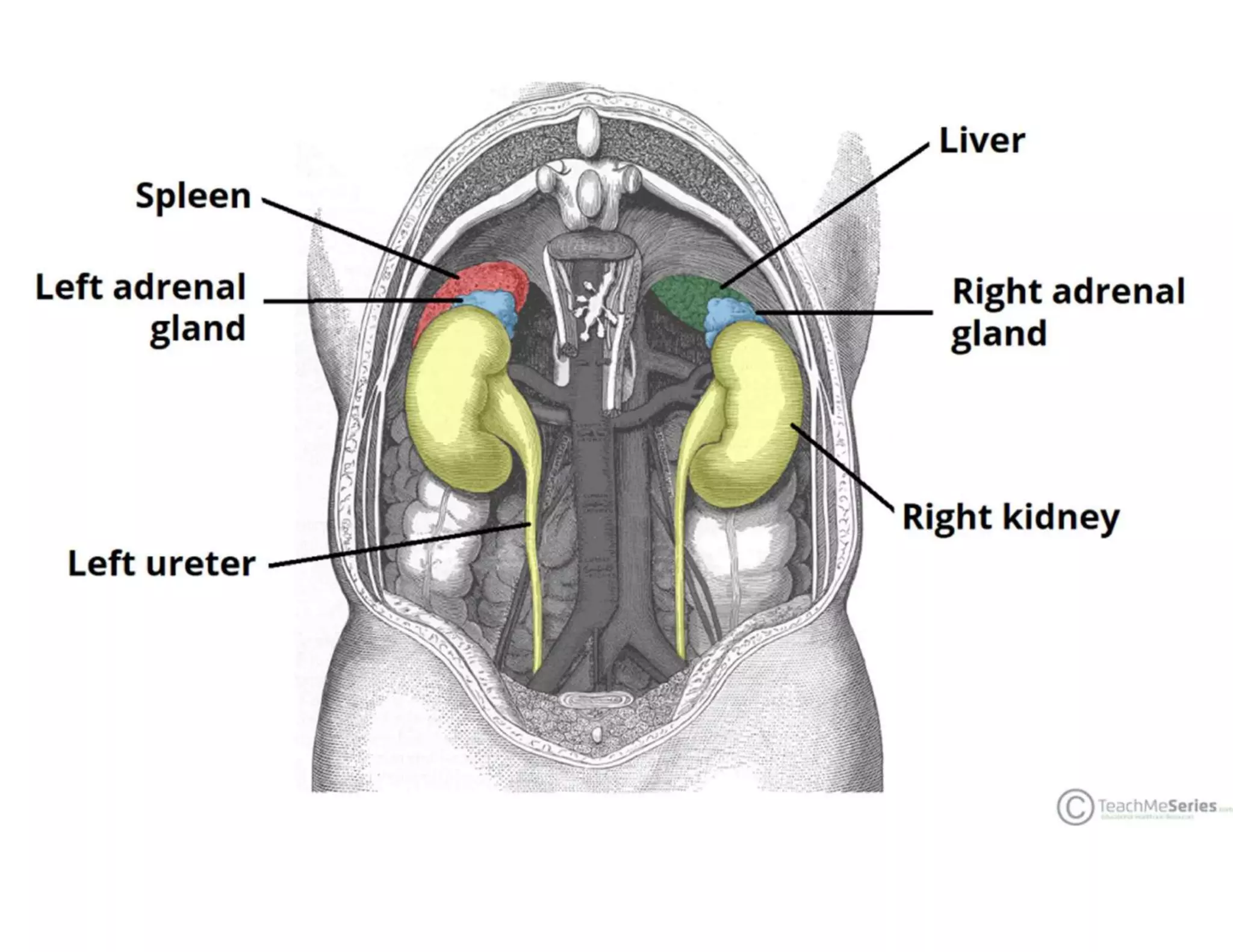
S = Suprarenal (adrenal) Glands.
A = Aorta/IVC.
D =Duodenum (except the proximal 2cm, the duodenal cap)
P = Pancreas (except the tail)
U = Ureters.
C = Colon (ascending and descending parts)
K = Kidneys.
E = (O)esophagus.
R = Rectum
412.
LIVER & GALLBLADDER
The liver is an accessory digestive gland,
and largest internal organ.
It is involved in the:
• Synthesis of glucose from amino acid
• Breaking down of carbohydrates
• Synthesis of cholesterol
• Production of fat, through lipogenesis.
• Production of bile.
The bile produced is stored in the gall bladder, and secreted to the small
intestine during food digestion. The gallbladder is a saclike structure on the
inferior surface of the liver that is about 8 cm long and 4 cm wide.
413.
PANCREAS
The pancreas isa pale grey
gland weighing about 60g. It is
about 12–15 cm long and is
situated in the
epigastric and left
hypochondriac regions of the
abdominal cavity.
It consists of a broad head, a
body and a narrow tail.
It secrets pancreatic juice
(exocrine pancreas), and insulin
and glucagon (endocrine
pancreas).
414.
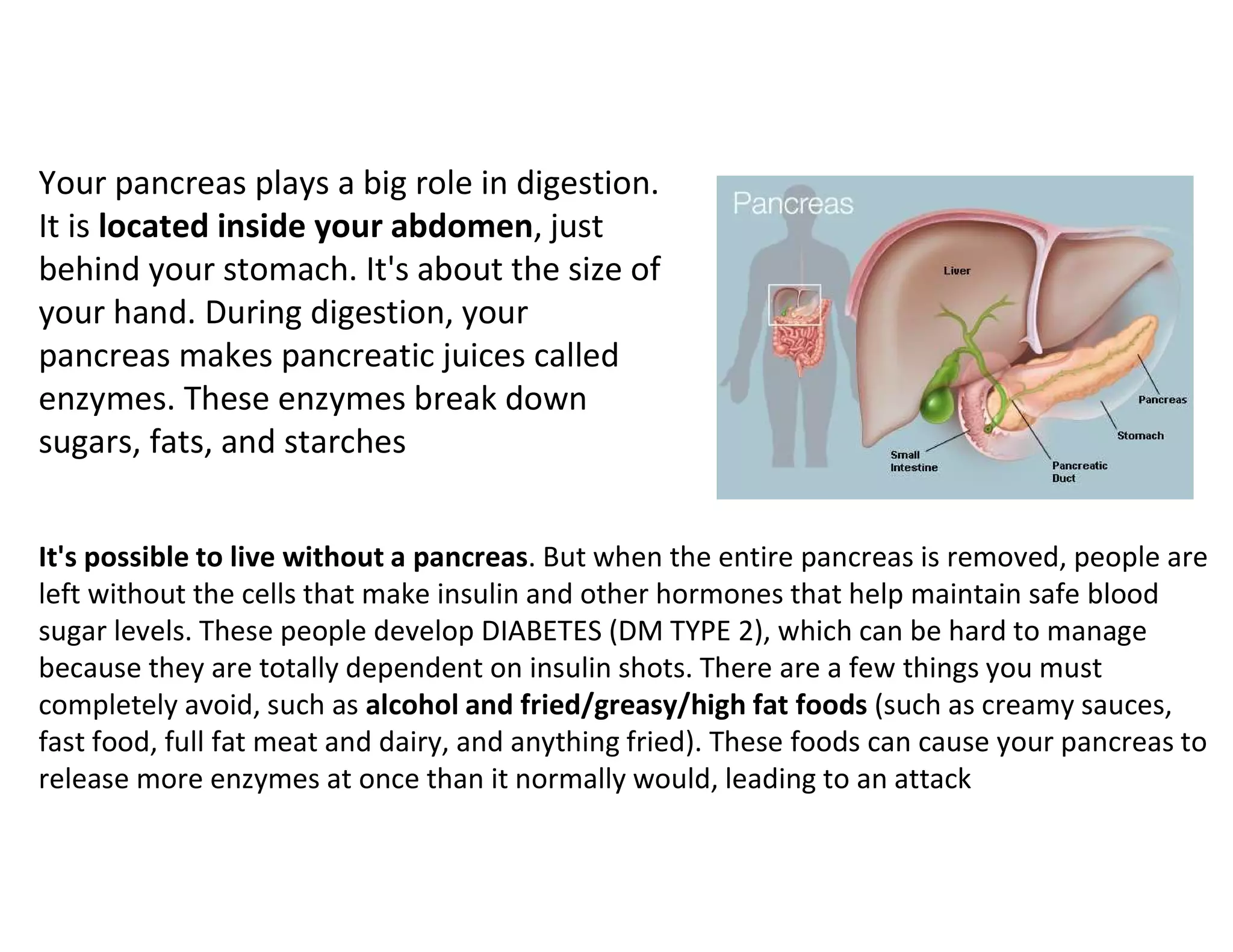
Your pancreas playsa big role in digestion.
It is located inside your abdomen, just
behind your stomach. It's about the size of
your hand. During digestion, your
pancreas makes pancreatic juices called
enzymes. These enzymes break down
sugars, fats, and starches
It's possible to live without a pancreas. But when the entire pancreas is removed, people are
left without the cells that make insulin and other hormones that help maintain safe blood
sugar levels. These people develop DIABETES (DM TYPE 2), which can be hard to manage
because they are totally dependent on insulin shots. There are a few things you must
completely avoid, such as alcohol and fried/greasy/high fat foods (such as creamy sauces,
fast food, full fat meat and dairy, and anything fried). These foods can cause your pancreas to
release more enzymes at once than it normally would, leading to an attack
416.
LARGE INTESTINE
The LargeIntestine meets the Small
Intestine at the ileocaecal valve,
then continues to the anal canal.
It is about 1.5m long and 6.5cm
wide (Small Intestine: 2.5cm).
It consists of the
Cecum (proximal end),
Appendix
Colon (ascending, descending,
sigmoid, transverse),
Rectum,
Anal canal (distal end)
Fig: Parts of the Large Intestine
417.
SPECIAl StruCturES oflArGE IntEStInE
Three features are unique to the large intestine…
Teniae coli
Haustra
Epiploic appendages
The teniae coli are three bands of smooth muscle that make up the longitudinal
muscle layer of the muscularis of the large intestine, except at its terminal end.
The haustra refer to the small segmented pouches of bowel separated by the
haustral folds. They are formed by circumferential contraction of the inner
muscular layer of the colon. Epiploic appendages are peritoneal structures that
arise from the outer serosal surface of the bowel wall towards the peritoneal
pouch. They are filled with adipose tissue and contain a vascular
stalk. Epiploic appendagitis is a rare cause of acute lower abdominal pain.
419.
funCtIonS of thEDIGEStIVE
SyStEm
Ingestion,
Mastication,
Propulsion,
Mixing,
Secretion,
Digestion,
Absorption, and
Elimination.
420.
ORGAN FUNCTIONS
Ingestion, T
aste,Mastication, Digestion,
Swallowing, Communication, Protection.
Mouth
Swallowing, Breathing, Protection
Propulsion, Protection.
Pharynx
Oesophagus
Storage, Digestion, Absorption, Mixing and
Propulsion, Protection.
Stomach
Neutralization, Digestion, Absorption, Mixing and
Propulsion, Excretion, Protection.
Absorption, Storage, Mixing and Propulsion,
Protection, Excretion.
Small Intestine
Large Intestine
LIVER
The liveris
located in the upper
right-hand portion
of the abdominal
cavity, beneath the
diaphragm, and on
top of the stomach,
right kidney, and
intestines. Shaped
like a cone, the liver
is a dark reddish-
brown organ that
weighs about 3
pounds.
431.
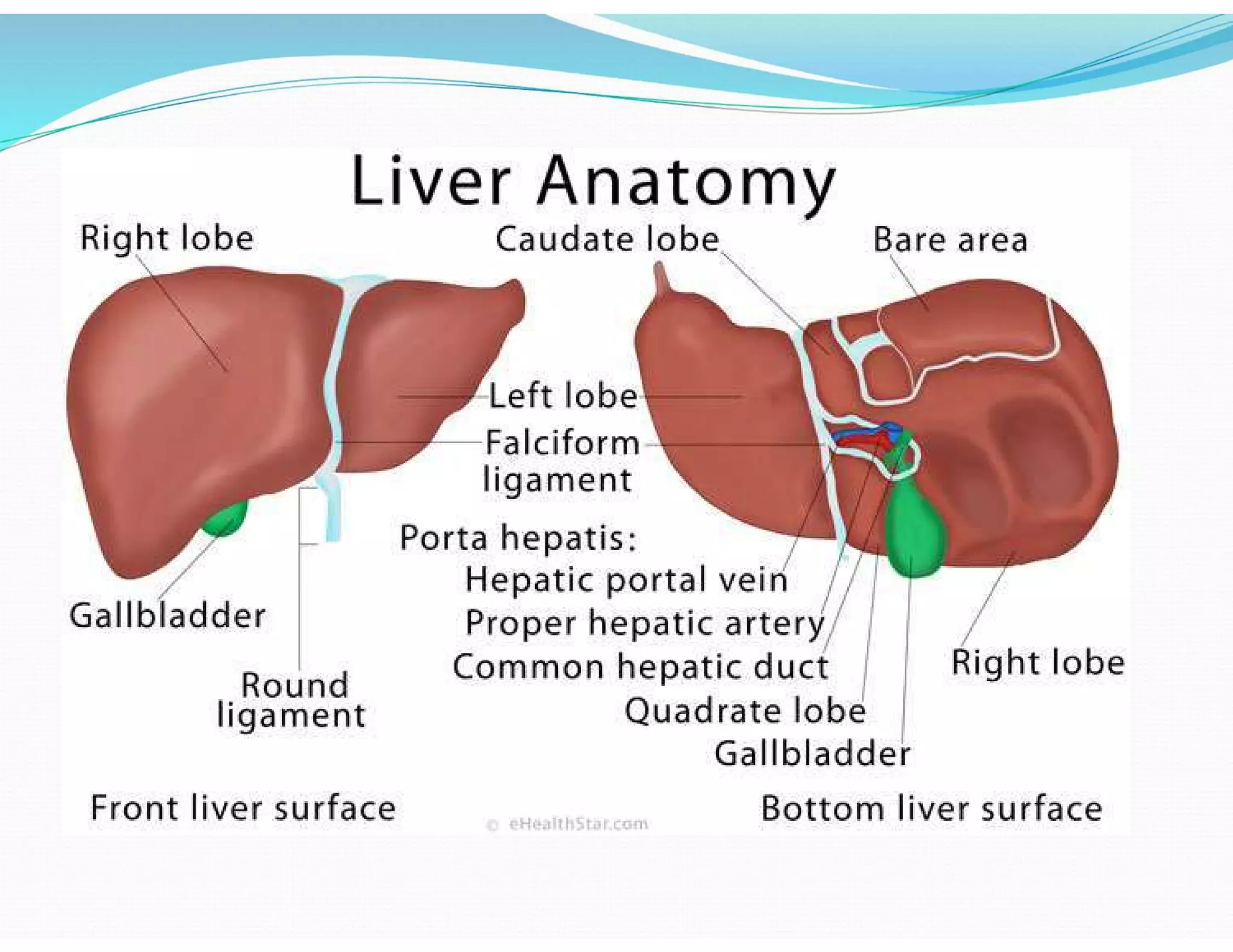
PORTA HEPATIS
Theporta hepatis is a deep fissure in the inferior
surface of the liver through which all the neurovascular
structures (except hepatic veins) and hepatic ducts enter or
leave the liver 1. It runs in the hepatoduodenal ligament
and contains: right and left hepatic ducts. right and left
branches of hepatic artery. CONTENTS :
The portal vein (RT and LT branches)
The hepatic artery (RT and LT branches)
The hepatic ducts (RT and LT branches)
The hepatic nervous plexus
The lymphatic vessels
433.
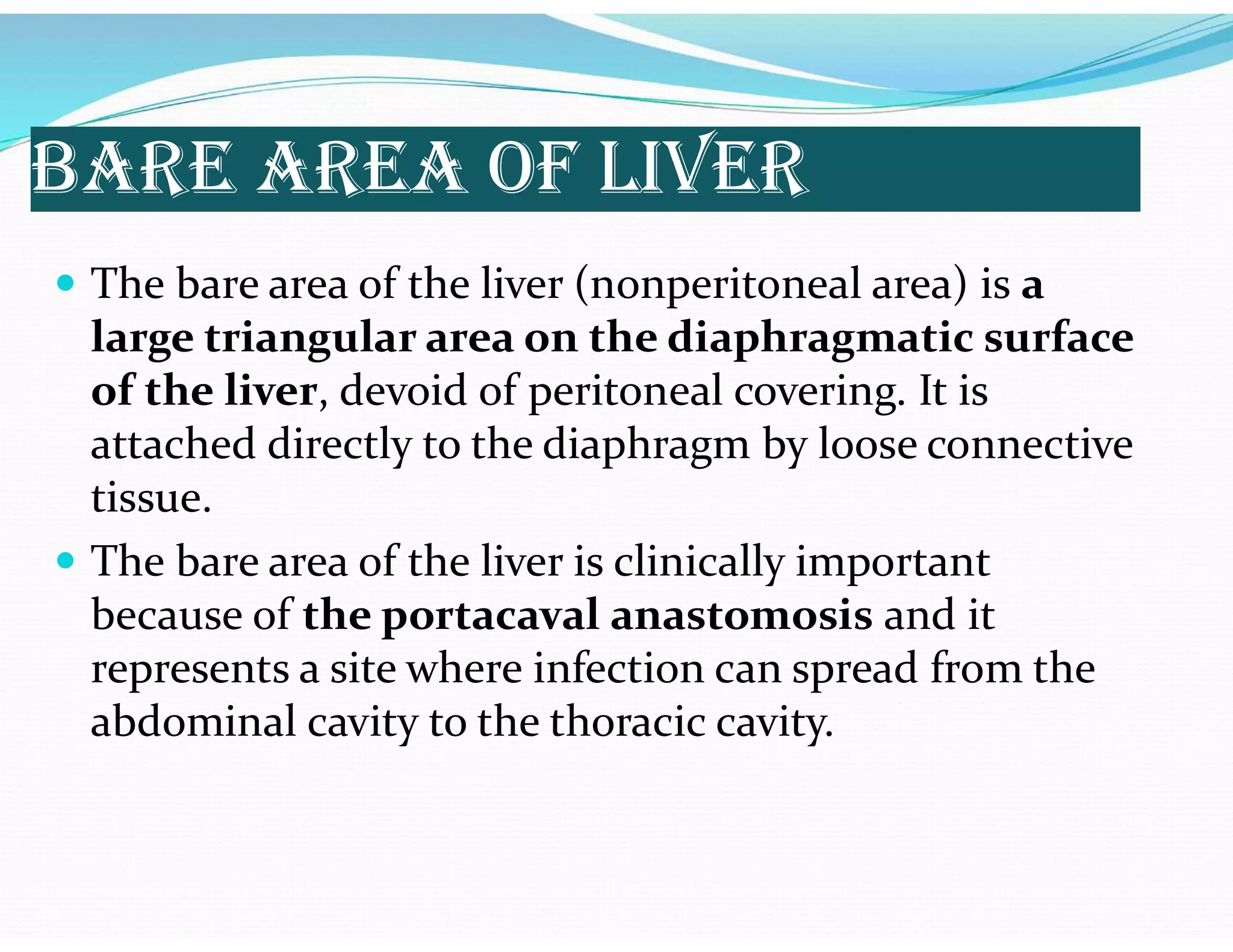
BARE AREA OFLIVER
The bare area of the liver (nonperitoneal area) is a
large triangular area on the diaphragmatic surface
of the liver, devoid of peritoneal covering. It is
attached directly to the diaphragm by loose connective
tissue.
The bare area of the liver is clinically important
because of the portacaval anastomosis and it
represents a site where infection can spread from the
abdominal cavity to the thoracic cavity.
435.
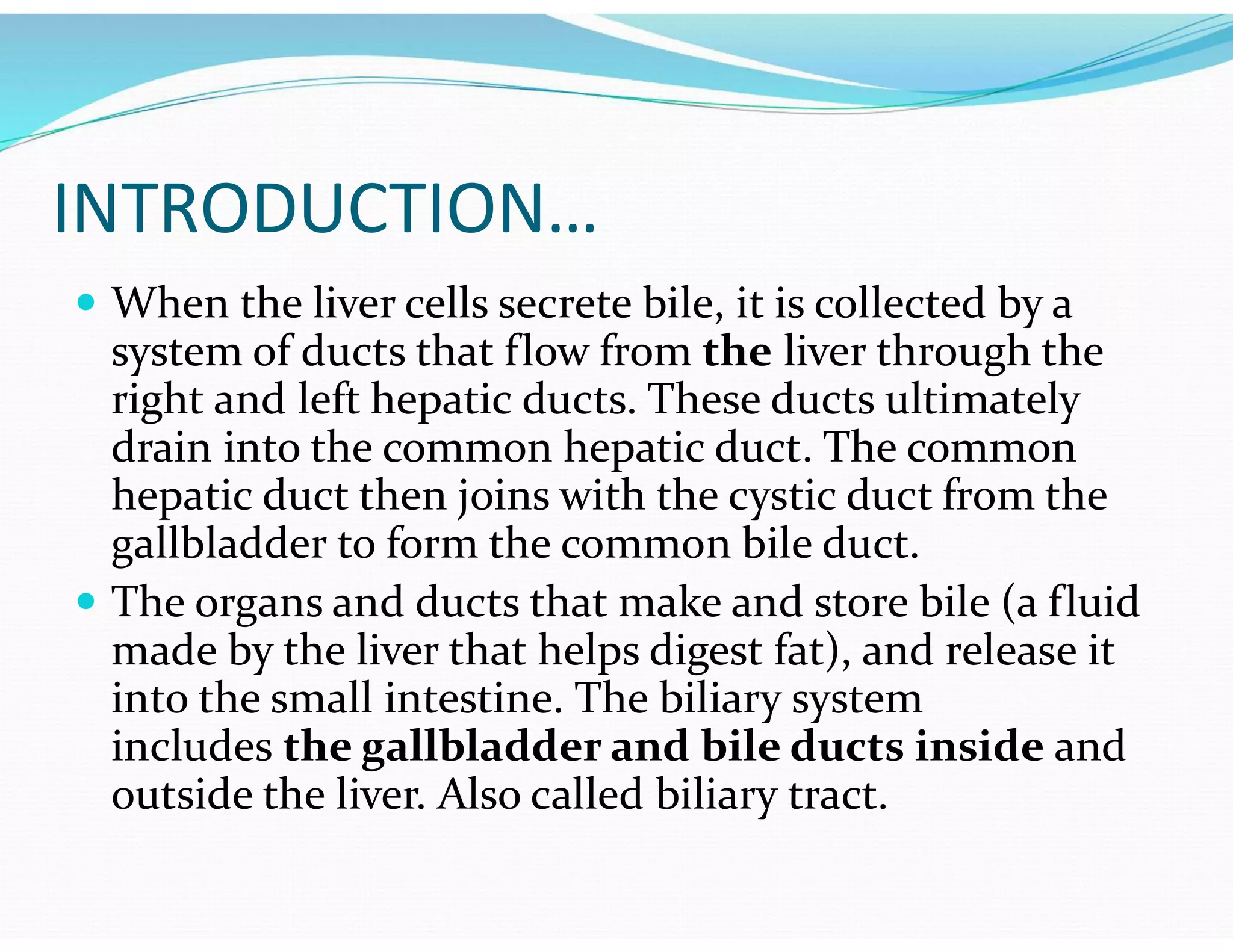
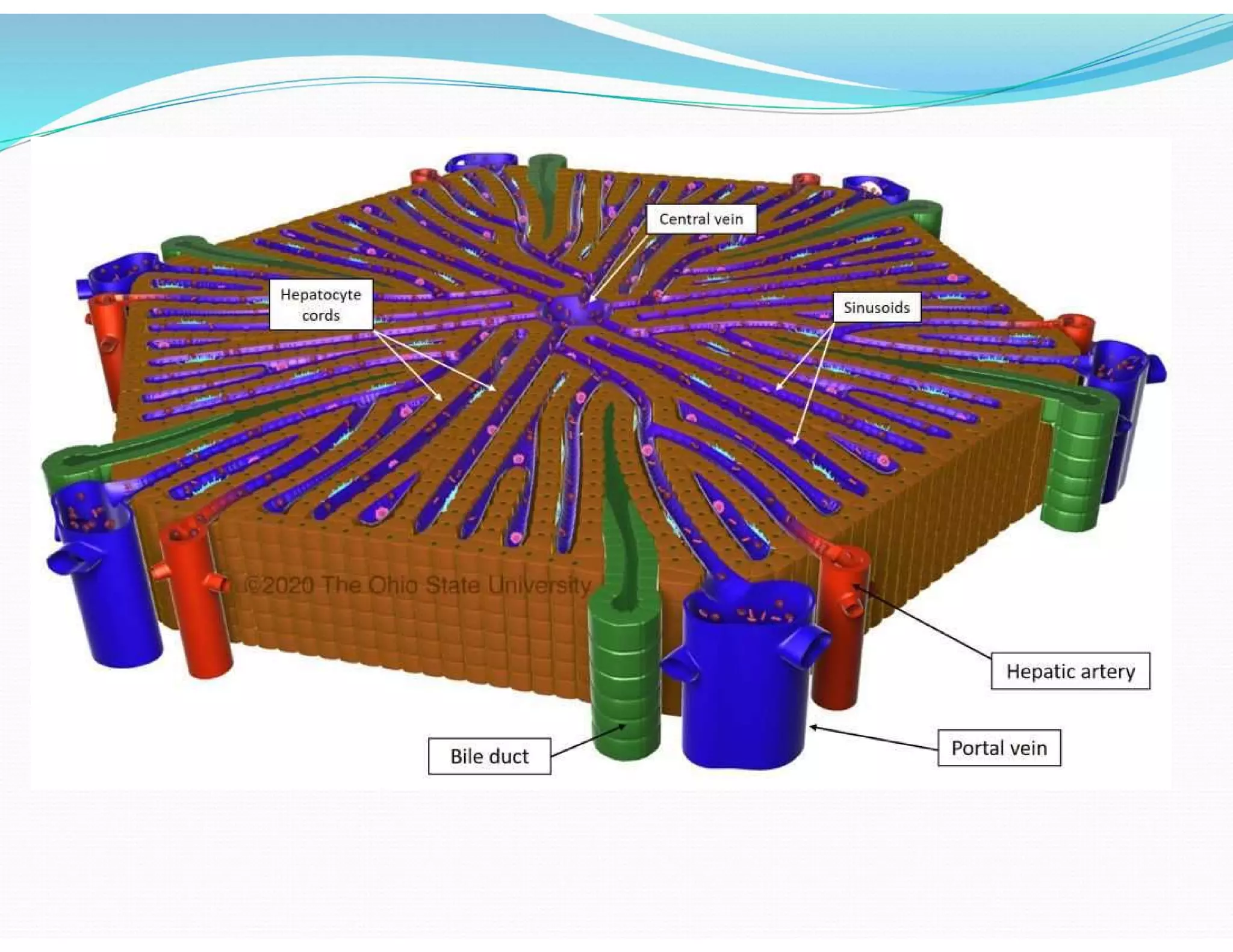
INTRODUCTION…
When theliver cells secrete bile, it is collected by a
system of ducts that flow from the liver through the
right and left hepatic ducts. These ducts ultimately
drain into the common hepatic duct. The common
hepatic duct then joins with the cystic duct from the
gallbladder to form the common bile duct.
The organs and ducts that make and store bile (a fluid
made by the liver that helps digest fat), and release it
into the small intestine. The biliary system
includes the gallbladder and bile ducts inside and
outside the liver. Also called biliary tract.
436.
BILE CANALICULI…
Bilecanaliculi are tiny, 1- to 2-μm wide tissue spaces
formed by the apical membranes of adjacent
hepatocytes.
Bile canaliculi also known as bile capillaries are thin
tubes that receive bile secreted by hepatocytes. The
bile canaliculi eventually merge and form bile
ductules. The bile passes through canaliculi to the
hepatic bile ducts and then into the common hepatic
duct which drains directly into the duodenum.
438.
BILE…
Bile is afluid that is made and released by the liver and stored in
the gallbladder. Bile helps with digestion. It breaks down fats into
fatty acids, which can be taken into the body by the digestive tract. ...
Bile acids (also called bile salts) Bilirubin (a breakdown product or red
blood cells)
Hepatocytes produce bile by secreting conjugated bilirubin, bile
salts, cholesterol, phospholipids, proteins, ions, and water into their
canaliculi (thin tubules between adjacent hepatocytes that eventually
join to form bile ducts
Bile is usually yellow or green.
Bile is secreted into the small intestine where it has two effects:
it neutralises the acid - providing the alkaline conditions needed in the
small intestine.
it emulsifies fats - providing a larger surface area over which the lipase
enzymes can work.
439.
COMPONENTS OF BILIARYSYSTEM
The biliary system consists of the organs and ducts
(bile ducts, gallbladder, and associated
structures) that are involved in the production and
transportation of bile.
From the right and left hepatic ducts, bile then flows
into the common hepatic duct. The common hepatic
duct joins the cystic duct, where the bile then flows.
The cystic duct is connected to the gallbladder. Bile
flows from the cystic duct into the common bile duct.
440.
EXTRAHEPATIC BILIARY
SYSTEM
RThepatic duct
LT hepatic duct
Common hepatic duct
Cystic duct
Common bile duct
Gallblader
443.
PORTAL TRIAD
Theportal triad is a
TRIANGULAR area at the
liver named after its
triangular shape and its
three major
components: the hepatic
artery, the hepatic portal
vein, and the hepatic
ducts, or bile ducts. The
term, however, can be
considered a misnomer,
since it contains other
structures as well.
449.
BILIARY TREE…
Thebiliary tree is a system of vessels that directs
these secretions from the liver, gallbladder and
pancreas through a series of ducts into the
duodenum
The ampulla of Vater is a small opening that enters
into the first portion of the small intestine, known
as the duodenum. The ampulla of Vater is the spot
where the pancreatic and bile ducts release their
secretions into the intestines.
451.
CALLOT`S TRIANGLE
Thetriangle of Calot is an important landmark whose
boundaries include the common hepatic duct medially,
the cystic duct laterally, and the inferior edge of the
liver superiorly.
SIGNIFICANCE :
This triangular space is dissected to allow the surgeon
to identify, divide, and ligate the cystic duct and artery.
453.
HEPATOCYSTIC TRIANGLE
SUPERIORLY… theinferior border of
liver.
LATERALY… the cystic duct and the neck
of the gallbladder.
MEDIALLY… the common hepatic duct.
455.
Symptoms of possiblebiliary
disease
Jaundice (yellowing of the skin and whites of the eyes)
Abdominal pain, especially in the upper right side of
the abdomen under the rib cage.
Nausea or vomiting.
Loss of appetite, which may result in weight loss.
Fatigue.
Fever or chills.
Itching.
Light brown urine.
456.
DISEASES OF BILIARYSYSTEM
Gallstones and Cholecystitis
Gallbladder Tumors
Choledocholithiasis
Acute cholangitis
457.
Gallstones and Cholecystitis
Gallbladder stones are an extremely common disorder
and are usually asymptomatic. Some patients
experience biliary colic, an intermittent and often
severe pain in the epigastrium or right upper quadrant,
and at times between the scapula because of
temporary obstruction of the cystic duct with a
gallstone. If the cystic duct obstruction persists, the
gallbladder becomes inflamed and the patient
develops cholecystitis, an acute inflammation and
infection of the gallbladder.
459.
ACUTE CHOLANGITIS…
CHOLANGIOCYTESare the epithelial cells of the
bile duct.
Acute cholangitis is bacterial infection of the extra-
hepatic biliary system. As it is caused by gallstones
blocking the common bile duct in most of the
cases, its prevalence is greater in ethnicities with high
prevalence of gallstones.
GENERAl STRUCTURE ANDFUNCTIoNS
oF ThE URINARY SYSTEM
● The urinary system, also known as the renal system
● The urinary system refers to the structures that produce and conduct
urine to the point of excretion.
■ Organs of the Urinary System:
■ Kidneys (2)
■ Ureters (2)
■ Urinary Bladder
■ Urethra
■ Primary organs: kidneys
■ filter waste products from the bloodstream
■ convert the filtrate into urine.
■ The Urinary Tract:
■ Includes:
■ ureters
■ urinary bladder
■ urethra
They transport the urine out of the body.
467.
27-7
KIDNEYS: GRoSS ANDSECTIoNAl
ANAToMY
■ Retroperitoneal
■ Anterior surface covered with peritoneum
■ Posterior surface against posterior abdominal
wall
■ Superior pole: T-12
■ Inferior pole: L-3
■ Right kidney ~ 2cm lower than left due to
left lobe of liver.
■ Adrenal glands on superior pole
27-12
KIDNEYS: GRoSS ANDSECTIoNAl
ANAToMY
■ Sectioned on a coronal plane:
■ Renal Cortex
■ Renal Medulla
■ Divided into renal pyramids
■ 8 to 15 per kidney
■ Base against cortex
■ Apex called renal papilla
473.
27-13
KIDNEYS: GRoSS ANDSECTIoNAl
ANAToMY
■ Minor calyx:
■ Funnel shaped
■ Receives renal papilla
■ 8 to 15 per kidney, one per pyramid
■ Major calyx
■ Fusion of minor calyces
■ 2 to 3 per kidney
■ Major calyces merge to form renal pelvis
■ Renal Lobe
■ Pyramid plus some cortical tissue
■ 8 to 15 per kidney
BlooD SUPPlY ToThE
KIDNEY
■ The efferent arterioles branch into one of two
types of capillary networks:
■ peritubular capillaries
■ vasa recta
■ these capillary networks are responsible for
the actual exchange of gases and nutrients
■ Peritubular capillaries: primarily in cortex
■ Vasa recta: surround the thin tubes that
project into the medulla.
480.
27-20
NEPhRoNS
■ The functionalfiltration unit in the kidney.
■ Consists of the following:
■ Renal corpuscle
■ Glomerulus
■ Glomerular capsule (Bowman’s capsule)
■ Proximal convoluted tubule (PCT)
■ Nephron loop (loop of Henle)
■ Ascending loop of Henle
■ Descending loop of Henle
■ Distal convoluted tubule (DCT)
■ collectively called the renal tubule
■ In both kidneys: approximately 2.5 million nephrons.
■ Are microscopic: measure about 5 centimeters in
length.
481.
27-21
NEPhRoNS
■ Cortical Nephrons
■Near peripheral edge of cortex
■ Short nephron loops
■ Have peritubular capillaries
■ Juxtamedullary nephrons
■ Near corticomedullary border
■ Long nephron loops
■ Have vasa recta
482.
27-22
URINE FoRMATIoN
■ Threeprocesses
■ Filtration
■ Renal corpuscle: forms filtrate
■ From blood to tubule
■ Reabsorption
■ Mostly PCT
■ Water and salt: rest of nephron
■ From tubule to blood
■ Secretion
■ From blood to tubule
483.
RENAL CORPUSLE
27-23
● Composedof a glomerulus and the Bowman's capsule.
● The renal corpuscle is the beginning of the nephron.
● It is the nephron's initial filtering component.
● The glomerulus is a capillary tuft that receives its blood supply from an
afferent arteriole of the renal circulation.
● The glomerular blood pressure provides the driving force for water and
solutes to be filtered out of the blood and into the space made
byBowman's capsule.
● The remainder of the blood passes into the efferent arteriole.
● The diameter of efferent arterioles is smaller than that of afferent
arterioles, increasing the hydrostatic pressure in the glomerulus.
484.
● The Bowman'scapsule, also called the glomerular capsule.
● surrounds the glomerulus.
● It is composed of a visceral inner layer formed by specialized cells
called podocytes.
● Parietal outer layer composed of simple squamous epithelium
● Fluids from blood in the glomerulus are filtered through the
visceral layer of podocytes, resulting in the glomerular filtrate.
27-24
Renal tubule
● Leads from glomerular capsule
● Ends at tip of medullary pyramid
● ~3 cm long
● Four major regions
● Proximal convoluted tubule
● Nephron loop
● Distal convoluted tubule
● Collecting duct
26
27-28
PRoxIMAl CoNvolUTED TUBUlE
●Arises from glomerular capsule
● Longest, most coiled region
● lies in cortex
● lined by simple cuboidal epithelium with brush
borders which help to increase the area of absorption
greatly.
● Prominent microvilli
● Function in absorption
489.
27-29
NEPhRoN looP (looPoF hENlE)
■ originates at end of proximal convoluted tubule
■ projects toward and/or into the medulla.
■ Each loop has two limbs.
■ descending limb:
■ from cortex toward and/or into the medulla
■ ascending limb:
■ returns back to the renal cortex
490.
ASCENDING lIMB oFlooP oF
hENlE
● The ascending limb of loop of Henle is divided into 2 segments:
● Lower end of ascending limb is very thin and is lined by simple squamous
epithelium.
● The distal portion of ascending limb is thick and is lined by simple cuboidal
epithelium.
● Thin ascending limb of loop of Henle
● Thick ascending limb of loop of Henle (enters cortex and becomes DCT-distal
convoluted tubule.)
● Thick segments
Active transport of salts
High metabolism, many mitochondria
● Thin segments
Permeable to water
Low metabolism
491.
DISTAl CoNvolUTED TUBUlE
(DCT)
● Coiled, distal to nephron loop
● Shorter than PCT
● Less coiled than PCT
● Very few microvilli
● Contacts afferent and efferent arterioles
● Contact with peritubular capillaries
31
492.
CollECTING DUCT
● DCTsof several nephrons empty into a
collecting duct
● Passes into medulla
● Several merge into papillary duct (~30
per papilla)
● Drain into minor calyx
32
493.
27-33
INNERvATIoN oF ThEKIDNEY
■ Innervated by a mass of autonomic nervous system
fibers
■ called the renal plexus.
■ The renal plexus
■ accompanies each renal artery
■ enters the kidney through the hilum.
27-35
URETERS
■ long, fibromusculartubes
■ conduct urine from the kidneys to the urinary
bladder.
■ average 25 centimeters in length
■ retroperitoneal.
■ ureters originate at the renal pelvis
■ extend inferiorly to enter the posterolateral wall of
the base of the urinary bladder.
■ wall is composed of three concentric tunics.
■ mucosa
■ muscularis
■ adventitia.
27-37
URINARY BlADDER
■ Theurinary bladder:
■ expandable, muscular container
■ serves as a reservoir for urine
■ positioned immediately superior and posterior to the pubic
symphysis.
■ in females
■ the urinary bladder is in contact with the uterus posterosuperiorly
and with the vagina posteroinferiorly.
■ in males
■ it is in contact with the rectum posterosuperiorly and is
immediately superior to the prostate gland.
■ is a retroperitoneal organ.
■ when empty exhibits an upside-down pyramidal shape and lies
in pelvic region
■ Filling with urine distends it superiorly until it assumes an oval
shape and lies in abdomen
TRIGONE
A triangular body
partspecifically a
smooth triangular area
on the inner surface of
the bladder limited by
the apertures of the
ureters and urethra.
39
500.
27-40
MICTURITIoN (URINATIoN)
● Urination(micturition)
● ~200 ml of urine held
● Distension initiates desire to void
● Internal sphincter relaxes involuntarily
● Smooth muscle
● External sphincter voluntarily relaxes
● Skeletal muscle
● Poor control in infants
● Bladder muscle contracts
● Urine forces through urethra
501.
WhAT ARE ThESTEPS oF MICTURATIoN?
● Normal urination (micturition) occurs in the following
stages:
● Urine is made in the kidneys.
● Urine is stored in the bladder.
● The sphincter muscles relax.
● The bladder muscle (detrusor) contracts.
● The bladder is emptied through the urethra and urine is
removed from the body.
41
27-43
UREThRA
● Conveysurine from body
● Internal urethral sphincter
Retains urine in bladder
Smooth muscle, involuntary
● External urethral sphincter
Provides voluntary control over voiding
of urine
504.
FEMAlE UREThRA
■ Hasa single function:
■ to transport urine from the urinary bladder to the vestibule,
an external space immediately internal to the labia minora
■ 3 to 5 centimeters long, and opens to the outside of
the body at the external urethral orifice located in the
female perineum.
MAlE UREThRA
■ Urinaryand reproductive functions:
■ passageway for both urine and semen
■ Approximately 18 to 20 centimeters long.
■ Partitioned into three segments:
PRoSTATIC UREThRA 2.5 cm long, urinary bladder to
prostate.
MEMBRANoUS UREThRA is the shortest 0.5 cm, passes
through floor of pelvic cavity
PENIlE UREThRA 15 cm long, passes through penis
6
MONS PuBIS
● Thetriangular mound of fatty tissue that
covers the pubic bone
● It protects the pubic symphysis
● During adolescence sex hormones trigger the
growth of pubic hair on the mons pubis
● The female pubic hair is horizontal straight in
its upper Border and The male pubic hair is
triangular in its upper border
8
LABIA MAJORA
● Thelabia Majora are two rounded, folds of tissue
that extended from the mons pubis to the perineum
● Referred to as the outer lips
● They have a darker pigmentation
● The Labia Majora:
● Protect the introitus (vaginal and urethral openings)
● Are covered with hair and sebaceous glands
● Tend to be smooth, moist, and hairless
10
LABIA MINORA
● Referredto as the “inner lips”
● Made up of erectile, connective tissue that
darkens and swells during sexual arousal
● Located inside the labia majora
● They are more sensitive and responsive to
touch than the labia majora
● The labia minora tightens during intercourse
12
CLITORIS
● Highly sensitiveorgan composed of nerves,
blood vessels, and erectile tissue
● Located under the prepuce
● It is made up of a shaft and a glans
● Becomes engorged with blood during sexual
stimulation
● Key to sexual pleasure for most women
● Urethral opening is located directly below clitoris
14
vAGINAL OPENING (INTROITuS)
●Opening may be covered by a thin sheath
called the hymen
● Using the presence of an intact hymen for
determining virginity is erroneous
● Some women are born without hymens
● The hymen can be perforated by many
dIffERENT events.S
525.
15
PERINEuM
● The muscleand tissue located between the
vaginal opening and anal canal
● It supports and surrounds the lower parts of the
urinary and digestive tracts
● The perinium contains an abundance of nerve
endings that make it sensitive to touch
● An episiotomy is an incision of the perinium used
during childbirth for widening the vaginal opening
HYMEN
17
The hymen isa remnant tissue just
inside the opening of the vagina that's
left over from how the vagina forms
during embryonic development. It's
commonly seen as a small amount of
extra tissue in a crescent-shape or ring-
like configuration (1mm) around the
edge of the vaginal opening.
528.
REASONS Of
hyMEN
BREAkING…
● Thehymen can stretch
or even tear during
many intense physical
activities like cycling,
swimming, horse riding,
etc. Use of tampons
and inserting something
in your vagina (fingers,
sex toys, etc) can also
stretch the hymen.
18
529.
hOw dO I
kNOwIf My
hyMEN IS
BROkEN…??
● Your hymen does not
completely cover your
vaginal opening – a hole
is normal. When you
have sex, your hymen
does not 'break or pop'
– it stretches, which
may cause a small tear.
You cannot tell by
looking at a hymen
whether sex has
occurred (consensual or
non-consensual)
19
23
vAGINA
● The vaginaconnects the cervix to the external genitals
● It is located between the bladder and rectum
● It functions :
● As a passageway for the menstrual flow
● For uterine secretions to pass down through the introitus
● As the birth canal during labor
● With the help of two Bartholin’s glands becomes
lubricated during Sexual intercourse
534.
24
● The cervixconnects the uterus to the vagina
● The cervical opening to the vagina is small
● This acts as a safety precaution against foreign
bodies entering the uterus
● During childbirth, the cervix dilates to accommodate
the passage of the fetus
● This dilation is a sign that labor has begun
28
uTERuS
● Commonly referredto as the womb
● A pear shaped organ about the size of a clenched fist
● It is made up of the endometrium, myometrium and
perimetrium
● Consists of blood-enriched tissue that sloughs off
each month during menstrual cycle
● The powerful muscles of the uterus expand to
accommodate a growing fetus and push it through
the birth canal
Layers of
uterus
● Theendometrium is the
inner layer that lines the
uterus. It is made up of
glandular cells that
make secretions.
● The myometrium is the
middle and thickest
layer of the uterus wall.
It is made up mostly of
smooth muscle.
● The perimetrium is the
outer serous layer of the
uterus.
30
32
fALLOPIAN TuBES
● Serveas a pathway for the ovum to the uterus
● Are the site of fertilization by the male sperm
● Often referred to as the oviducts or uterine
tubes
● Fertilized egg takes approximately 6 to 10
days to travel through the fallopian tube to
implant in the uterine lining
36
OvARIES
● The femalegonads or sex glands
● They develop and expel an ovum each month
● A woman is born with approximately 400,000 immature
eggs called follicles
● During a lifetime a woman release @ 400 to 500 fully
matured eggs for fertilization
● The follicles in the ovaries produce the female sex
hormones, progesterone and estrogen
● These hormones prepare the uterus for implantation of
the fertilized egg
41
BREASTS
● Organs ofsexual arousal
● Contain mammary glands
● Consist of connective tissue that
serves as support
● Each breast contain 15-25 clusters
called lobes
● Each lobule is connected by ducts
that open into the nipples
● The nipples are made up of erectile
tissue
● The pigmented around the nipples
are called the areola
● Breast size is determined primarily
by heredity
● Size also depends on the existing
fat and glandular tissue
● Breasts may exhibit cyclical
changes, including increased
swelling and tenderness prior to
menstruation
● Benign breast changes refer to
fibrocystic disease
● Lumps or masses that are
noncancerous
intRoduction…
• The malereproductive system is mostly located
outside of the body. These external organs include:
• Penis
• Scrotum
• Testicles
• Internal organs include:
• Vas deferens
• Prostate
• Urethra
• The male reproductive system is responsible for sexual
function, as well as urination.
559.
FunctionS oF Male
RepRoductiveSySteM
• They produce, maintain and transport sperm
(the male reproductive cells) and semen (the
protective fluid around sperm).
• They discharge sperm into the female
reproductive tract.
• They produce and secrete male sex hormones.
how do theteSteS deScend?
Testicles form in the abdomen during fetal
development. During the last couple of months of
normal fetal development, the testicles gradually
descend from the abdomen through a tube-like
passageway in the groin (inguinal canal) into the
scrotum. With an undescended testicle, that
process stops or is delayed
581.
acceSSoRy GlandS
The maleaccessory glands synthesize and secrete a complex
mixture of proteins, carbohydrates, lipids, and amino acids
that are transferred to the female during copulation. The
primary function of the accessory gland products is to
facilitate sperm transfer to the female.
Accessory glands are specialized structures found in males
that produce fluids essential for the motility, nourishment and
protection of sperm
The accessory glands of the male reproductive system are
the seminal vesicles, prostate gland, and the bulbourethral
glands. These glands secrete fluids that enter the urethra.
584.
THE PROSTATE ISLOCATED JUST BELOW THE
BLADDER AND IN FRONT OF THE RECTUM. IT
IS ABOUT THE SIZE OF A WALNUT AND
SURROUNDS THE URETHRA (THE TUBE THAT
EMPTIES URINE FROM THE BLADDER).
The inferior vesical artery is the major blood
supply for the prostate, and it also receives blood
supply from the middle rectal and internal
pudendal arteries. Veins around the prostate form
the prostatic plexus which drains into internal iliac
veins
Endocrinology…
● Endocrinology isa branch of biology and medicine focusing on the
endocrine system and its secretion of hormones
● There are 2 types of glands
● Endocrine glands are ductless glands of the endocrine system that
secrete their products, hormones, directly into the blood. The major
glands of the endocrine system include the pineal gland, pituitary
gland, pancreas, ovaries, testes, thyroid gland, parathyroid gland,
hypothalamus and adrenal glands.
● Exocrine gland - A gland that makes substances such as sweat,
tears, saliva, milk, and digestive juices, and releases them through a
duct or opening to a body surface. Examples of exocrine glands
include sweat glands, lacrimal glands, salivary glands, mammary
glands, and digestive glands in the stomach, pancreas, and
intestines.
594.
HormonEs…
● Hormones arechemical substances that act like messenger
molecules in the body. After being made in one part of the
body, they travel to other parts of the
● There are three major types of hormones.
● Protein hormones (or polypeptide hormones) are made of
chains of amino acids. An example is ADH (antidiuretic
hormone) which decreases blood pressure.
● Steroid hormones are derived from lipids....
● Amine hormones are derived from amino acids
HyPotHalamUs &
PitUitary gland
location:Small but complex appendage that
sits at the base of the brain – in the sella
turcica – most median depression in the
medial cranial fossa of the sphenoid bone.
• Pituitary lies just inferior to hypothalamus.
• Hypothalamus and Pituitary connected by
stalk containing nerve fibers and blood
vessels.
• Pituitary composed of two lobes: ANTERIOR
PITUITARY and POSTERIOR PITUITARY.
597.
Pituitary gland (hypophysis)is a round
organ about the size of a pea (~1 cm in
diameter), located behind the bridge of
the nose at the base of the brain
Divided into a posterior and anterior
portion.
Posterior pituitary is also known as the
neurohypophysis, because it is
continuous with the brain.
Anterior pituitary is also known as the
adenohypophysis, because it acts more
as a gland
601.
Pituitary gland revealsthat it composed
of two distinctive parts:
● The anterior pituitary or adenohypophysis is a
classical gland composed predominantly of cells that
secrete protein hormones.
● The posterior pituitary or neurohypophysis is not a
separate organ, but an extension of the
hypothalamus. It is composed largely of the axons of
hypothalamic neurons which extend downward as a
large bundle behind the anterior pituitary. It also
forms the so-called pituitary stalk, which appears to
suspend the anterior gland from the hypothalamus.
● The hypophysis is made of two parts: the
adenohypophysis contains the anterior and
intermediate lobes, and the neurohypophysis
contains the posterior lobe
605.
HyPotHalamUs & PitUitarygland
Embryological Derivation:
• Hypothalamus is an outgrowth of brain,
neural ectoderm.
• Posterior Pituitary is an outgrowth of
hypothalamus, neural ectoderm.
• Anterior Pituitary develops as a superiorly
directed outgrowth of roof of mouth,
endoderm.
606.
Definition of Rathke'spouch
A pouch of ectoderm that grows out from the upper surface
of the embryonic stomodeum and gives rise to the
adenohypophysis of the pituitary gland
607.
HYPOTHALAMUS & PITUITARYGLAND
Innervation: Part of brain or very close to it in
case of pituitary. Some hypothalamic
neurons secrete neurohormones – they pass
down connecting stalk to terminate close to
the capillaries serving posterior pituitary.
artErial sUPPly: the superior hypophyseal
artery (a branch of the internal carotid artery)
vEnoUs drainagE: cavernous venous sinus
and the adjacent dural venous sinuses
611.
HYPOTHALAMUS HORMONES
(FUNCTION)
• Hypothalamichormones enclosed in
vesicles that move down axon and
accumulate near terminal ends that are close
to the posterior pituitary’s capillaries.
• In response to an action potential–
hormones are released from vesicles (much
like a neurotransmitter), in this case into
venous capillaries.
612.
HYPOTHALAMUS HORMONES (FUNCTION)
Mosthormonal interactions of the hypothalamus-
pituitary complex follow a common pattern:
1. A hypothalamic hormone effects control over the
secretion of an anterior pituitary hormone;
1. The corresponding anterior pituitary hormone
controls secretion of the hormone of another
endocrine gland; and
1. That secretion of that gland affects other target
tissues/organs.
613.
HYPOTHALAMUS HORMONES (FUNCTION)
So...
Hypothalamichormones can have effect of
stimulating or inhibiting the release of
anterior pituitary hormones.
Called RELEASING HORMONES (“RH”) or
INHIBITING HORMONES (“IH”) respectively.
614.
HYPOTHALAMIC HORMONES (FUNCTIONS)
Includestwo peptide hormones: OXYTOCIN and
VASOPRESSIN (also called antidiuretic hormone, or ADH).
OXYTOCIN –
initiates labor
stimulates mammary glands to release milk
Stimulates uterine contractions in activities other than labor
VASOPRESSIN (ADH) – decreases urine output.
RELEASING HORMONES – stimulate release of anterior
pituitary hormones.
INHIBITING HORMONES – inhibit release of anterior pituitary
hormones.
615.
POSTERIOR PITUITARY GLANDHORMONES
Oxytocin and Vasopressin are manufactured in the
hypothalamus, but released in the posterior pituitary.
616.
ANTERIOR PITUITARY GLANDHORMONES
GROWTH HORMONE (GH) – regulates growth; affects protein, fat and
carbohydrate metabolism.
THYROID STIMULATING HORMONE (TSH) – controls secretion of
thyroxin.
ADRENOCORTICOTROPIC HORMONE (ACTH) – controls secretion of
hormones released by adrenal cortex.
FOLLICLE-STIMULATING HORMONE (FSH) – in females, stimulates
magturation of egg cells and estrogen secretion by ovaries.
LUTENIZING HORMONE (LH) – in males, stimulates secretion of
testosterone and sperm production by testes. In females, stimulates
release of ovum by ovary.
MELANOCYTE-STIMULATING HORMONE (MSH) – along with ACTH,
affects pigment release in skin.
PROLACTIN (PRL) – stimulates milk production.
HyPotHalamic HyPoPHysEal Portal
systEm…
●The hypothalamic–hypophysial portal system is the conduit that
connects the brain to the anterior pituitary. The portal system is made
up of two capillary beds, one in the median eminence and the other in
the anterior pituitary
● Its main function is the transport and exchange of hormones to allow a
fast communication between both glands
● In response to signals from the same hypothalamic neurons, the
hormones are released from the axon terminals into the bloodstream.
● Oxytocin. ...
● Antidiuretic Hormone (ADH) ...
● Growth Hormone. ...
● Thyroid-Stimulating Hormone. ...
● Adrenocorticotropic Hormone. ...
● Follicle-Stimulating Hormone and Luteinizing Hormone. ...
● Prolactin.
620.
● The hypophysealportal system is a system of
blood vessels in the microcirculation at the base
of the brain, connecting the hypothalamus with
the anterior pituitary. Its main function is to
quickly transport and exchange hormones
between the hypothalamus arcuate nucleus and
anterior pituitary gland
Anatomical Location…
● Thethyroid gland is located in the anterior neck
and spans the C5-T1 vertebrae. It consists of two
lobes (left and right), which are connected by a
central isthmus anteriorly – this produces a
butterfly-shape appearance.
● The lobes of the thyroid gland are wrapped around
the cricoid cartilage and superior rings of
the trachea. The gland is located within
the visceral compartment of the neck (along with
the trachea, esophagus and pharynx). This
compartment is bound by the pretracheal fascia.
The thyroid glandconsists of two lobes connected by a central
isthmus. It is wrapped around the cricoid cartilage and trachea
anteriorly.
628.
Development of thyroidgland…
● The thyroid gland is the first of the body's endocrine
glands to develop, on approximately the 24th day of
gestation. This occurs under the influence of fibroblast
growth factor signaling pathways. The thyroid originates
from two main structures: the primitive pharynx and the
neural crest
629.
Anatomical Relations…
● Thethyroid gland is closely associated with
numerous other structures in the anterior neck:
● Anteriorly – infrahyoid muscles
● Laterally – carotid sheath
● Medially –
○ Organs – larynx, pharynx, trachea and
oesophagus
○ Nerves – external laryngeal and recurrent
laryngeal
630.
Arterial Supply
● Thearterial supply to the thyroid gland is via two
main arteries:
● Superior thyroid artery – arises as the first branch
of the external carotid artery.
● Inferior thyroid artery – arises from the
thyrocervical trunk (a branch of the subclavian
artery).
● In a small proportion of people (around 10%) there is
an additional artery present – the thyroid ima artery.
It arises from the brachiocephalic trunk and supplies
the anterior surface and isthmus of the thyroid gland
631.
Venous Drainage…
● Venousdrainage is carried by the superior,
middle, and inferior thyroid veins, which
form a venous plexus around the thyroid
gland.
● The superior and middle veins drain into
the internal jugular vein.
● The inferior empties into the
brachiocephalic vein.
634.
● nErvE sUPPly
●The gland
receives sympathetic
nerve supply from the
superior, middle and
inferior cervical ganglion of
the sympathetic trunk. The
gland receives
parasympathetic nerve
supply from the superior
laryngeal nerve and the
recurrent laryngeal nerve
(Branches of vagus nervs)
● lymPHatic
drainagE
● The lymphatic
drainage of the
thyroid is to
the paratracheal a
nd deep cervical
nodes.
636.
Functions of thyroidgland…
● The thyroid gland is a vital hormone gland: It plays a major role
in the metabolism, growth and development of the human
body. It helps to regulate many body functions by constantly
releasing a steady amount of thyroid hormones into the
bloodstream.
● The thyroid gland produces hormones that regulate the body's
metabolic rate controlling heart, muscle and digestive
function, brain development and bone maintenance. Its
correct functioning depends on a good supply of iodine from
the diet.
● The thyroid gland releases triiodothyronine (T3) and thyroxine
(T4) and Calcitonin. These hormones play an important role in
regulation of your weight, energy levels, internal temperature,
skin, hair, nail growth, and more.
638.
Clinical Information…
● RecurrentLaryngeal Nerve
● The left and right recurrent laryngeal nerves lie in close proximity
to the thyroid gland and care must be taken not to damage them
during thyroid surgery.
● They branch from their respective vagus nerve within the chest and
hook around the right subclavian artery (right RL nerve), or the arch
of aorta (left RL nerve).
● The recurrent laryngeal nerve then travels back up the neck,
running between the trachea and oesophagus in
the tracheoesophageal groove. It then passes underneath
the thyroid gland to innervate the larynx.
● The parathyroidglands are
endocrine glands located in
the anterior neck.
● They are responsible for the
production of parathyroid
hormone (PTH), which acts to
increase the level of serum
calcium.
641.
Anatomical Location
● Theparathyroid glands are usually located on the
posterior aspect of the thyroid gland. They are flattened
and oval in shape – situated external to the thyroid gland
itself but within the pretracheal fascia.
● Most individuals have four parathyroid glands, although
variation in number (from two to six) is common:
● sUPErior ParatHyroid glands (x2) – derived from
the fourth pharyngeal pouch. They are located at the
middle of the posterior border of each thyroid lobe.
● infErior ParatHyroid glands (x2) – derived from
the third pharyngeal pouch. The inferior parathyroid
glands are usually found near the inferior poles of the
thyroid gland.
643.
VASCULATURE…
● The vascularsupply is similar to that of the thyroid
gland.
● Arterial supply is chiefly via the inferior thyroid artery (as
this artery supplies the posterior aspect of the thyroid
gland – where the parathyroids are located). Collateral
arterial supply is from the superior thyroid artery and
thyroid ima artery.
● Venous drainage is into the superior, middle, and inferior
thyroid veins
644.
Nerves…
The parathyroid glandshave an extensive
supply of sympathetic nerves derived
from thyroid branches of the
cervical ganglia.
Note: these nerves are vasomotor, not
secretomotor – endocrine secretion of
parathyroid hormone is under hormonal
control.
Parathyroid Glands andHypocalcaemia
● Due to their location on the posterior aspect of
thyroid gland, the parathyroid glands are at a
high risk of being damaged or removed
inadvertently during thyroid surgery.
● This can result in an acute drop in serum
calcium – hypocalcaemia. Clinical features
include tetany, muscle cramps and paraesthesia
of the fingers, toes, and mouth.
● Because of this risk, it is usually standard post-
operative practice to check the parathyroid
hormone and serum calcium in all patients
following thyroid surgery.
650.
During surgery onthe thyroid gland, the
parathyroid glands must be identified and
preserved.
Adrenal Gland:
Adrenalglands also known as Supra adrenal
glands
Located at the top of the kidney
Right gland is triangular shape, while left is
semilunar shaped
The of gland is about 4 grms
656.
Anatomical Location andRelations
The adrenal glands are located in the posterior
abdomen, between the superomedial kidney and
the diaphragm. They are retroperitoneal, with
parietal peritoneum covering their anterior surface
only.
Perinephric (or renal) fascia encloses the adrenal
glands and the kidneys. This fascia attaches the
glands to the crura of the diaphragm. They are
separated from the kidneys by the perirenal fat.
657.
Right adrenal glandLeft adrenal gland
Anterior Posterior Anterior Posterior
•Inferior vena
cava
•Right lobe of the
liver
•Right crus of the
diaphragm
•Stomach
•Pancreas
•Spleen
•Left crus of the
diaphragm
659.
Parts of adrenalgland:
Each adrenal gland has two distinct structures
Adrenal cortex – derived from the embryonic
mesoderm.
Adrenal medulla– derived from the ectodermal neural
crest cells.
Both parts produces hormones
660.
Zones of adrenalcortex:
Adrenal cortex is divided into three zones
Zona glomerulosa (which secretes
mineralocorticoids)
Zona fasciculata (which secretes glucocorticoids and
adrenal androgens)
Zona reticularis (which secretes glucocorticoids and
adrenal androgens, but in small quantities)
663.
The medullalies in the centre of the gland, and is
dark brown in colour. It contains chromaffin cells,
which secrete catecholamines (such as adrenaline)
into the bloodstream in response to stress.
These hormones produce a ‘flight-or-fight‘
response. Chromaffin cells also secrete enkephalins
which function in pain control.
Medulla
664.
VASCULATURE…
The adrenalglands have a rich blood supply via three
main arteries:
Superior adrenal artery – arises from the inferior
phrenic artery
Middle adrenal artery – arises from the abdominal
aorta.
Inferior adrenal artery – arises from the renal arteries.
Right and left adrenal veins drain the glands. The right
adrenal vein drains into the inferior vena cava, whereas
the left adrenal vein drains into the left renal vein.
666.
The adrenalglands are
innervated by the coeliac
plexus and greater
splanchnic nerves.
Sympathetic innervation to
the adrenal medulla is via
myelinated pre-synaptic
fibres, mainly from the
T10 to L1 spinal cord
segments.
Lymph drainage is to
the lumbar lymph nodes
by adrenal lymphatic
vessels. These vessels
originate from two
lymphatic plexuses –
one deep to the capsule,
and the other in the
medulla.
Innervation Lymphatic Drainage
667.
According to function:
According to functions adrenocortical hormones can
be divided into three categories
Glucocorticoids
Mineralo-corticoids
Cortical sex hormones
OBJECTIVES
At theend of lecture student should be able to
answer
What is central and peripheral nervous system
How we classify the nervous system.
679.
NERVOUS SYSTEM
Asystem that controls all of the activities of the
body.
The nervous system is made of:
The brain The spinal cord
The nerves The senses
681.
CENTRAL NERVOUS SYSTEM
The Central Nervous System is made of the brain
and the spinal cord.
The Central Nervous System
controls everything in the body.
682.
PERIPHERAL NERVOUS SYSTEM
The Outer Nervous System is made of the nerves,
ganglia and the sense organs.
Nerves Sense organ
NEURONS
excitable nervecell
structural and functional
units of nervous system
responsible for the
conduction of impulses
Concerned with
reception, integration &
transformation of
information received.
composed of
Cell body
Dendrites
Axon
The Neurogliaare a group of supportive cells for the
neurons. Further, they maintain the myelin sheath,
provide nutrient support. Moreover, they also retain
homeostasis. It is within the CNS and PNS.
It offers essential nutrients. It includes oxygen to
neurons.
Next, it also helps create the myelin sheath. The
sheath is important in the functioning of the nervous
system. It promotes and speeds up the electrical
impulse conduction. It does so by wrapping around the
axons.
Further, it also helps to maintain homeostasis within
the neurons. Homeostasis is how a cell maintains a
stable internal environment despite disturbances.
It destroys pathogens. It helps protect the neurons.
Finally, it also provides structural stability. It forms a
support structure that the neurons can inhabit.
689.
ASTROCYTES - PROVIDEFOR THE ENERGY
AND OTHER METABOLIC NEEDS OF NEURONS
AS WELL AS GIVING NERVOUS TISSUE
STRUCTURAL SUPPORT. WHEN NEURONS OF
THE BRAIN OR THE SPINAL CORD ARE
INJURED AND DESTROYED, THEY ARE
REPLACED WITH SCAR TISSUE MADE UP OF
ASTROCYTES (A PROCESS CALLED GLIOSIS).
690.
MICROGLIA - PHAGOCYTICCELLS,
SIMILAR TO MACROPHAGES, THAT
PERFORM A HOUSEKEEPING
FUNCTION BY REMOVING DEAD
CELLULAR MATERIAL AND BACTERIA
FROM THE CNS.
691.
EPENDYMAL CELLS -CELLS THAT LINE
THE CEREBRAL SPINAL FLUID (CSF)
CONTAINING CAVITIES OF THE BRAIN
- THE VENTRICLES. CSF IS
SECRETED BY A SPECIALIZED SUBSET
OF EPENDYMAL CELLS IN THE
WALLS OF THE VENTRICLES OF THE
BRAIN CALLED THE CHOROID PLEXUS.
SCHWANN CELLS -GLIAL CELLS THAT
MYELINATE THE AXONS OF PERIPHERAL
NERVES. THESE CELLS WRAP THEIR
CYTOPLASM IN A SPIRAL FASHION
AROUND SHORT SEGMENTS OF AXONS.
BECAUSE THE MYELIN SHEATH IS
FORMED FROM NUMEROUS SCHWANN
CELLS ARRANGED SEQUENTIALLY
ALONG THE AXON, THERE ARE GAPS
BETWEEN ADJACENT MYELINATING
CELLS PRODUCING MYELIN-FREE AREAS
OF AXON CALLED NODES OF RANVIER.
THESE PLAY AN IMPORTANT ROLE IN
NERVE IMPULSE CONDUCTION.
696.
Oligodendrocytes:
Myelination inCNS
Schwann cells:
myelination in PNS
Astrocytes:
bind neurons to capillaries &
pia matter
Fibrous (in white matter)
Protoplasmic (in grey matter)
Ependymal :
Microglia:
phagocytic, role in immunity &
inflammation
NEUROGLIA
REFLEX
A reflexaction, also known as a reflex, is an
involuntary and nearly instantaneous
movement in response to a stimulus. When a
person accidentally touches a hot object, they
automatically jerk their hand away without
thinking. ... The path taken by the nerve
impulses in a reflex is called a reflex arc.
An automatic reaction that happens without
thinking about it.
A reflex happens quickly in less than a second.
707.
REFLEX ARC
Functionalunit of nervous system.
Components;
Receptors
Affarent neuron or sensory neurons
Reflex center
Efferent neuron or motor neuron
Effectors
Parts Sympathetic Parasympathetic
OriginThoracolumber Craniosacral
Situation of
ganglionic cell
In paravertebral and
prevertebral
sympathetic ganglion
On/ in the organ of
supply
Length of post
ganglionic fibers
Very long Very short
Types of nerve ending Adrenergic Cholenergic
Nature of control Wide spread and
diffuse. Combat acute
emergencies
Discreate and
isolated. Combat long
term emergencies
Metabolic effects Catabolic , energy
consuming
Anabolic, energy
sparing
FUNCTIONAL…
SOMATIC:
controls voluntary activities.
AUTONOMIC
controlsinvoluntary activities
ENTERIC NERVOUS SYSTEM (ENS)/ GUT BRAIN/
MINIBRAIN
Innervation of gut most probably heart and
respiratory system
Neurons present in walls of GIT, pancreas and gall
bladder
Neurons arise from neural crest cell
(2) Peripheral nervoussystem (PNS):
Cranial n. (12 pairs)
Spinal n. (31 pairs)
Visceral n. :
Introduction
Visceral sensory n.
Visceral motor n.:
Sympathetic part
Parasympathetic part
723.
2. Basic terminologyin nervous system:
(1) CNS:
1) Gray matter collection of
nerve cell bodies and their dendrites,
Introduction
the outer layer of gray matter
in cerebrum and cerebellum
A group of nerve cell bodies
which have the same shape
and function.
Cortex
Nucleus
724.
2) White matter
collectionof nerve fibers, white color during fresh condition
Introduction
a central core of white matter
beneath cortex of cerebrum
and cerebellum
a bundle of nerve fibers
which have the same
origin, termination, and
function
Medulla
Fasciculus ( tract ):
725.
3) Reticular formation:
afield of intermingled grey and white matter , and with
larger or smaller groups of nerve cells occupying the meshes.
Introduction
726.
Introduction
(2) PNS
1) Ganglion:
acollection of neuron cell
bodies outside the CNS
2) Nerve:
a bundle of nerve fibers held
together by connective tissue
sheath
The cerebrum isthe
uppermost part of the brain. It
contains two hemispheres split
by a central fissure. The
cerebrum itself contains the
major lobes of the brain and is
responsible for receiving and
giving meaning to information
from the sense organs, as well
as controlling the body.
729.
FUNCTION
The largestpart of the brain, the
cerebrum initiates and
coordinates movement and
regulates temperature. Other
areas of the cerebrum enable
speech, judgment, thinking and
reasoning, problem-solving,
emotions and learning. Other
functions relate to vision, hearing,
touch and other senses
731.
LOBES OF CEREBRUM
Each brain hemisphere (Cerebral cortex) has four
sections, called lobes: frontal, parietal,
temporal and occipital.
Lobes of the Brain and What They Control
Frontal lobe.
Parietal lobe.
Occipital lobe.
Temporal lobe.
733.
Some Terminologies
Ridgescalled Gyri (gyrus)
Shallow grooves called Sulci (sulcus)
Deeper grooves called Fissures
734.
Central sulcus –
separatesthe
frontal and
parietal lobes
Parieto-
occipital
sulcus –
separates the
parietal and
occipital lobes
Lateral sulcus –
separates the
parietal and
temporal lobes
735.
Enables sensation, communication,
memory,understanding, and
voluntary movements
Each hemisphere controls the
opposite (contralateral) side of the
body
Hemispheres are not functionally
equivalent (lateralization or
specialization of cortical functions)
No functional area acts alone -
conscious behavior involves the
entire cortex
737.
Cerebral Cortex
Three kindsof functional areas:
Motor areas – control voluntary
movement
Sensory areas – conscious awareness
of sensation
Association areas – integrate diverse
information, communicate “associate”
with the motor cortex and sensory
association areas to analyze input
743.
Blood supply ofcerebrum
The brain receives blood from two
sources: the internal carotid
arteries, which arise at the point in
the neck where the common carotid
arteries bifurcate, and the vertebral
arteries .The internal carotid arteries
branch to form two major cerebral
arteries, the anterior and middle
cerebral arteries
Basilar artery
Thevertebral arteries of both sides
join to form Basilar artery.
Pontine arteries
Labryinthine arteries
Anterior inferior cerebellar
Superior cerebellar
Posterior cerebral artery
nemonic : PP-LAS
752.
The terminalbranches of the vertebral and internal carotid
arteries all anastomose to form a circular blood vessel,
called the Circle of Willis.
There are three main (paired) constituents of the Circle of Willis:
Anterior cerebral arteries – terminal branches of the internal
carotid arteries.
Internal carotid arteries – located immediately proximal to the
origin of the middle cerebral arteries.
Posterior cerebral arteries – terminal branches of the basilar
artery
To complete the circle, two ‘connecting vessels’ are also present:
Anterior communicating artery – connects the two anterior
cerebral arteries.
Posterior communicating artery – branch of the internal
carotid, this artery connects the ICA to the posterior cerebral
artery
CEREBELLUM
The cerebellum(“little brain”) is a struct
ure that is located at the back of the
brain, underlying the occipital and tem
poral lobes of the cerebral cortex. The c
erebellum is important for making postu
ral adjustments in order to maintain bal
ance.
Cerebellum isthe largest part of the
hindbrain and weighs about 150 g. It
is enshrined in posterior cranial fossa
behind the pons and medulla oblongat
a and separated from these structures
by cavity of fourth ventricle. It is conn
ected to brainstem by three fibre tract
s known as cerebellar peduncles.
774.
There arethree functional areas of the cerebell
um –
Cerebrocerebellum (the largest division) - i
n planning movements and motor learnin
g
Spinocerebellum - coordination of motor
movements and maintenance of muscular
tone.
Vestibulocerebellum - to maintain the sta
bility of the head on the body
775.
Brain Stem
Anatomy
Medullaoblongata
Pons
Midbrain
Functions
Medulla
Relays motor and se
nsory information
Regulates heartbeat,
breathing and blood
vessel dilation
Pons
Control breathing
776.
MEDULLA OBLONGATA
Medullaoblongata is located at the b
ase of your brain, where the brain st
em connects the brain to your spinal c
ord. It plays an essential role in passin
g messages between your spinal cord
and brain. It's also essential for regula
ting your cardiovascular and respirator
y systems.
779.
PONS…
Pons isan essential part of the brain lo
cated above the medulla. It falls in the
category of the hindbrain. Pons is very
important part of brain for the regula
tion and control of a number of vit
al functions. It not only acts as a con
trol center, but also contains nuclei of
some important cranial nerves
780.
An importantfunction of pons and me
dulla is the autonomous control of
the body's vital functions. For exa
mple the cardiovascular (medulla) cent
ers receive sensory inputs from the he
art and blood vessels (mechano-, baro
- and chemoreceptors) via the vagus n
erve and modulates heart rate and blo
od pressure
782.
Protective Coverings
(Meninges)
Duramater
Dense connective tissue
Arachnoid
Nonvascular connective tissue
Pia mater
Highly vascular
Covers surface of the brain and spinal cord and inv
aginates along cortical surface to form perivascular
spaces
• The spinalcord is a tubular bundle of nervous tissue and supporting cells
that extends from the brainstem to the lumbar vertebrae. Together, the
spinal cord and the brain form the central nervous system.
• The spinal cord is a cylindrical structure, greyish-white in colour. It has a
relatively simple anatomical course:
• The spinal cord arises cranially as a continuation of the medulla
oblongata (part of the brainstem).
• It then travels inferiorly within the vertebral canal, surrounded by the
spinal meninges containing cerebrospinal fluid.
• At the L2 vertebral level the spinal cord tapers off, forming the conus
medullaris.
• As a result of the termination of the spinal cord at L2, it occupies around
two thirds of the vertebral canal. The spinal nerves that arise from the end
of the spinal cord are bundled together, forming a structure known as
the cauda equina.
798.
• During thecourse of the spinal cord, there are two points of enlargement.
The cervical enlargement is located proximally, at the C4-T1 level. It
represents the origin of the brachial plexus. Between T11 and L1 is
the lumbar enlargement, representing the origin of the lumbar and sacral
plexi.
• The spinal cord is marked by two depressions on its surface. The anterior
median fissure is a deep groove extending the length of the anterior
surface of the spinal cord. On the posterior aspect there is a slightly
shallower depression – the posterior median sulcus.
802.
Formation of theSpinal Nerves
• The spinal nerves are mixed nerves that originate from the spinal cord,
forming the peripheral nervous system.
• Each spinal nerve begins as an anterior (motor) and a posterior (sensory)
nerve root. These roots arise from the spinal cord, and unite at
the intervertebral foramina, forming a single spinal nerve.
• The spinal nerve then leaves the vertebral canal via the intervertebral
foramina, and then divides into two:
• Posterior rami – supplies nerve fibres to the synovial joints of the
vertebral column, deep muscles of the back, and the overlying skin.
• Anterior rami – supplies nerve fibres to much of the remaining area of the
body, both motor and sensory.
• The nerve roots L2-S5 arise from the distal end of the spinal cord, forming
a bundle of nerves known as the cauda equina.
805.
BLOOD SUPPLY OFSPINAL CORD
• The main blood supply to the spinal cord is via the single
anterior spinal artery (ASA) and the two posterior spinal
arteries (PSA). The anterior spinal artery is formed by the
vertebral arteries which originate from the first part of the
subclavian artery.
• Venous drainage is via three anterior and three
posterior spinal veins. These veins are valveless, and form an
anastamosing network along the surface of the SPINE.
It is formedby the tight junctions between capillary endothelial
cells of the brain and between epithelial cells in the choroid
plexus. This effectively prevents proteins from entering the brain
in adults and slow the penetration of smaller molecules.
Mechanisms of transport:
- Bulk flow.
- Carrier mediated transfer
- Vesicular transport.
823.
Penetration of substancesinto the brain
• Molecules pass easily:H2O, CO2, O2, lipid-soluble free forms of
steroid hormones.
• Molecules not pass: proteins, polypeptides.
• Slow penetration: H+, HCO3-
• Glucose : its passive penetration is slow, but is transported
across brain capillaries by GLUT1
824.
Functions of BBB
•Maintanins the constancy of the environment of the neurons in
the CNS.
• Protection of the brain from endogenous and exogenous toxins.
• Prevent escape of the neurotransmitters into the general
circulation.
825.
Clinical implications
• Somedrugs penetrate BBB with difficulty e.g. antibiotics and
dopamine.
• BBB breaks down in areas of infection, injury, tumors, sudden
increase in blood pressure, and I.V injection of hypertonic fluids.
• Injection of radiolabeled materials help diagnose tumors as BBB
is broken down at tumor site because of increased vascularity
by abnormal vessels.
827.
ANATOMY OF THEEAR
Dr. Ahmad Ali Qureshi
MBBS (GMC)
PharmoHub Pakistan
The External Ear
•Consists of:
– Auricle (pinna)
• Made of elastic
cartilage
• Helix (rim)
• Lobule (ear lobe)
– External auditory
canal
• Lies within temporal
bone & connects to
ear drum (tympanic
memb)
• Contains ceruminous
glands which secrete
ear wax
– Tympanic membrane
• Epithelial & simple
cuboidal
• Changes acoustic
energy into
mechanical energy
• Perforated eardrum =
tear
831.
The Middle Ear
•Auditory Ossicles (smallest
bones in body)
– Malleus
• Attaches to ear drum
• Articulates with incus
– Incus
• Articulates with stapes
– Stapes (stirrup)
• Footplate of stapes fits into
oval window
• Opening to Eustachian tube
832.
Protection by TwoTiny Muscles
• Tensor Tympani
– Attaches to Malleus to
increase tension on ear
drum & prevent damage to
inner ear.
• Stapedius
– Smallest skeletal muscle
– Dampens large vibrations of
stapes to protect oval
window.
stapedius
833.
• Auditory Tube
(Eustachiantube)
– Is a route for pathogens
to travel from nose and
throat to ear causing
Otitis Media
– During swallowing and
yawning it opens to equal
pressure in middle ear. Normal Ear Drum Inflamed Ear Drum
834.
The Inner Ear(Labyrinth)
• Bony labyrinth
– Contains perilymph
– Semicircular canals
• Anterior, posterior, and
lateral
• Lie right angles to each
other
– Vestibule
• Oval portion
– Cochlea
• Looks like a snail
• Converts mechanical energy
into electrical energy
• Membranous labyrinth
– Contains endolymph, high
in K+ ions
835.
The Cochlea
• Dividedinto 3 channels
– Cochlear duct (scala media)
• Contains the Organ of Corti
– Scala vestibuli
• Ends at the oval window
– Scala tympani
• Ends at the round window
837.
Organ of Corti
•The end organ of
hearing
– Contains stereocilia &
receptor hair cells
– Tectorial and Basilar
Membranes
– Cochlear fluids
– Fluid movement causes
deflection of nerve
endings
– Nerve impulses
(electrical energy) are
generated and sent to
the brain
838.
Summary of HowWe Hear
Acoustic energy, in the form of sound
waves, is channeled into the ear canal by
the pinna. Sound waves hit the
tympanic membrane and cause it to
vibrate, like a drum, changing it into
mechanical energy. The malleus, which
is attached to the tympanic membrane,
starts the ossicles into motion. The
stapes moves in and out of the oval
window of the cochlea creating a fluid
motion, or hydraulic energy. The fluid
movement causes membranes in the
Organ of Corti to shear against the hair
cells. This creates an electrical signal
which is sent up the Auditory Nerve
(cochlear nerve) to the brain. The brain
interprets it as sound!
Lecture on Anatomyof the Heart ( drnnamanisamuel@gmail.com)
Kindly recite Drood shareef
867.
Lies withinthe pericardium in middle mediastinum
Behind the body of sternum and the 2nd to 6th costal
cartilages
In front of the 5th to 8th thoracic vertebrae
A third of it lies to the right of median plane and 2/3 to
the left
Anterior to the vertebral column, posterior to the sternum
A hollowmuscular organ, pyramidal in shape , somewhat
larger than a closed fist; consists of four chambers (right and
left atria, right and left ventricles)
Cardiac Apex is formed by left ventricle and is directed
downwards and forwards to the left. It lies at the level of the
fifth left intercostal space, 1~2cm medial to the left
midclavicular line (9cm from the midline)
EXTERNAL CHARACTERISTICS
870.
The apexbeat 【point of maximum impulse (PMI)】,
is the furthermost point outwards (laterally) and
downwards (inferiorly) from the sternum at which the
cardiac impulse can be felt.
Lateral and/or inferior displacement of the apex beat
usually indicates enlargement of the heart, called
cardiomegaly
Approximately the size of your fist
Wt. = 250-300 grams
Cardiac base is formed by the left atrium and to a small
extent by the right atrium. It faces backward, upward
and to the right
EXTERNAL CHARACTERISTICS
871.
Two surfaces
Sternocostalsurface is formed mainly by the right atrium
and right ventricle, and a lesser portion of its left is formed by
the left auricle and ventricle. It is directed forwards and
upwards
Diaphragmatic surface is formed by the ventricles-
chiefly the left ventricle, directed backwards and downwards,
and rests upon the central tendon of the diaphragm
Three borders
Right border-vertical, is formed entirely by right atrium
Left border-round, is mainly formed by the left ventricle
and partly by the left auricle
Inferior border-horizontal, is formed by the right ventricle
and cardiac apex
872.
Four grooves
Coronarysulcus (circular sulcus) which marks the division
between atria and ventricles, contains the trunks of the coronary
vessels and completely encircles the heart
Interatrial groove -separates the two atria and is hidden by
pulmonary trunk and aorta in front
Interventricular grooves - anterior and posterior, mark the
division between ventricles (which separates the RV from the LV),
the two grooves extend from the base of the ventricular portion to a
notch called: the cardiac apical incisure
873.
Pericardium –a double-walled sac around the heart
Composed of:
A superficial fibrous pericardium
A deep two-layer serous pericardium
The parietal layer lines the internal surface of the fibrous
pericardium
The visceral layer or epicardium lines the surface of the heart
They are separated by the fluid-filled pericardial cavity called the
pericardial cavity
Protects and anchors the heart
Prevents overfilling of the heart with blood
Allows for the heart to work in a relatively friction-free environment
COVERING OF THE HEART
874.
Interatrial septum
Locatedbetween right and left atria
Contains fossa ovalis
Interventricular septum Located between right and left ventricles
upper membranous part
thick lower muscular part
Epicardium –visceral pericardium
Myocardium – cardiac muscle layer
forming the bulk of the heart
Endocardium – endothelial layer of the
inner myocardial surface
LAYERS OF THE HEART WALL
Atria -receiving chambers of the heart
Receive venous blood returning to heart
Separated by an interatrial septum (wall)
Foramen ovale - opening in interatrial septum in fetus
Fossa ovalis - remnant of foramen ovale
Each atrium has a protruding auricle
Pectinate muscles mark atrial walls
Pump blood into ventricles
Blood enters right atria from superior and inferior venae cavae and
coronary sinus
Blood enters left atria from pulmonary veins
ATRIA OF THE HEART
881.
Left auricle-projecting tothe
right, pectinate muscles in wall
Four inlets-four orifices of
pulmonary veins open through the
posterior wall
One outlet-left atrioventricular
orifice, blood leaves through left
atrioventricular orifice to left
ventricle
882.
Ventricles arethe discharging chambers of the heart
Papillary muscles and trabeculae carneae muscles mark
ventricular walls
Separated by an interventricular septum
Contains components of the conduction system
Right ventricle pumps blood into the pulmonary trunk
Left ventricle pumps blood into the aorta
Thicker myocardium due to greater work load
Pulmonary circulation supplied by right ventricle is a much low pressure
system requiring less energy output by ventricle
Systemic circulation supplied by left ventricle is a higher pressure system
and thus requires more forceful contractions
VENTRICLE OF THE HEART
884.
It’s wall isthree times thicker
than that of right ventricle
One inlet-left atrioventricular
orifice
One outlet-aortic orifice
Two parts-divided by anterior
cusps of mitral valve
Inflow tract-rough walls
Outflow tract – aortic
vestibule smooth area
leading to aortic orifice
Left ventricle
885.
Interatrial septum
Locatedbetween right and left atria
Contains fossa ovalis
Interventricular septum Located between right and left ventricles
upper membranous part
thick lower muscular part
Fibrous skeleton
Fibrous rings that surround the atrioventricular, pulmonary, and
aortic orifices
Left and right fibrous trigons
SEPTUMS/FIBROUS SKELETON
Heart valvesensure unidirectional blood flow through the heart
Composed of an endocardium with a connective tissue core
Two major types
Atrioventricular valves
Semilunar valves
Atrioventricular (AV) valves lie between the atria and the
ventricles
R-AV valve = tricuspid valve
L-AV valve = bicuspid or mitral valve
AV valves prevent backflow of blood into the atria when ventricles
contract
Chordae tendineae anchor AV valves to papillary muscles of
ventricle wall
Prevent prolapse of valve back into atrium
HEART VALVES
888.
Semilunar valvesprevent backflow of blood into the ventricles
Have no chordae tendinae attachments
Aortic semilunar valve lies between the left ventricle and the aorta
Pulmonary semilunar valve lies between the right ventricle and
pulmonary trunk
Heart sounds (“lub-dup”) due to valves closing
“Lub” - closing of atrioventricular valves
“Dub”- closing of semilunar valves
SEMILUNAR HEART VALVES
889.
Tricuspid valve
Guardsright atrioventricular orifice
Three triangular cusps: anterior, posterior and septal, the base
of cusps are attached to fibrous ring surrounding the
atrioventricular orifice
Chordae tendineae -fine, white, connective tissue cords,
attach margin of cusps to papillary muscles
Mitral valve
Guards left atrioventricular orifice
Two triangular cusps-anterior and posterior with Similar
structures to those of right
890.
Valve of pulmonarytrunk
Guards the orifice of pulmonary trunk
Has three semilunar cusps – each with free border
Cardiac muscletissue has intrinsic ability to:
Generate and conduct impulses
Signal these cells to contract rhythmically
Conducting system
A series of specialized cardiac muscle cells
Sinoatrial (SA) node sets the inherent rate of
contraction
CONDUCTING SYSTEM OF THE
HEART
Heart rateis altered by external controls
Nerves to the heart include:
Visceral sensory fibers
Parasympathetic branches of the vagus
nerve
Sympathetic fibers – from cervical and
upper thoracic chain ganglia
INNERVATION
895.
Sinuatrial node (SAnode)
Called the pacemaker cell (P cell)
Located at the junction of right atrium and superior vena cava,
upper part of the sulcus terminalis, under the epicardium
896.
Atrioventricular node (AVnode)
Located in the lower part of interatrial septum just above the
orifice of coronary sinus, under the endocardium
Lower part related to membranous part of interventricular septum
Atrioventricular bundle (AV bundle)
Passes forward through right fibrous trigon to reach inferior border
of membranous part
Divides into right and left branches at upper border of muscular
part of interventricular septum
897.
Vessels returningblood to the heart include:
Superior and inferior venae cavae
Open into the right atrium
Return deoxygenated blood from body cells
Coronary sinus
Opens into the right atrium
Returns deoxygenated blood from heart muscle (coronary
veins)
Right and left pulmonary veins
Open into the left atrium
Return oxygenated blood from lungs
MAJOR VESSELS OF THE HEART
898.
Vessels conveyingblood away from the heart include:
Pulmonary trunk
Carries deoxygenated blood from right ventricle to lungs
Splits into right and left pulmonary arteries
Ascending aorta
Carries oxygenated blood away from left atrium to body
organs
Three major branches
Brachiocephalic
Left common carotid,
Left subclavian artery
MAJOR VESSELS OF THE HEART
Blood Vessels
Functions
• Distributionof blood
• Exchange of materials withtissues
• Return of blood to the heart
Closed circulatory system
1. Arteries
2. Arterioles
3. Capillaries
4. Venules
5. Veins
6. 3 tunics
7. Lumen
Generalized Structure of Blood Vessels
1. Arteries and veins are composed of three tunics (Tunica
interna, Tunica media, and Tunica externa)
2. Lumen - central blood-containing space surrounded by tunics
912.
3. Capillaries arecomposed of endothelium with sparse basal
lamina
The Anatomy of Blood vessel
Layers:
1. Tunica interna(intima):
• Endothelial layer that lines the lumen of all vessels.
• In vessels larger than 1 mm, a subendothelial connective
tissue basement membrane is present.
2. Tunica media:
• Smooth muscle and elastic fiber layer, regulated by
sympathetic nervous system.
• Controls vasoconstriction/vasodilation of vessels
3. Tunica externa (adventitia):
• Collagen fibers that protect and reinforce vessels
• Larger vessels contain vasa vasorum
General Structure
913.
Arteries: (carry bloodaway from heart)
• Strong & Elastic
• Conduct blood to Capillaries
• Sphincters
Capillaries: (exchange materials with cells, tissue)
Veins: (return blood to heart)
• Valves
914.
Make up ofBlood Vessels:(Arteries and
Arterioles)
• Endothelium
• Elastic tissues
1.rebounds
Types of Bloodvessels:
1. Elastic Arteries:
• Thick-walled arteries near the heart, the aorta and its
major branches.
• Large lumen allows low-resistance conduction of blood.
• Contain lots of elastin in all three tunics
• Walls stretch and recoil to propel blood
• Withstand and regulate large blood pressure fluctuations
• Allow blood to flow fairly continuously through the body
2. Muscular (Distributing) Arteries:
• distal to elastic arteries deliver blood to body
organs
• Have thick tunica media with
muscle and less elastic tissue
• Active in vasoconstriction
3. Arterioles:
more smooth
917.
• smallest arteries;lead to capillary beds
• Control flow into capillary beds via vasodilation
and constriction
Venous System: (veins)
918.
• Veins havemuch lower blood pressure and thinner
walls than arteries
• To return blood to the heart, veins have special
adaptations:
1.Large-diameter lumens, which offer little
resistance to flow
2. Valves (resembling semilunar heart valves),
which prevent backflow of blood
• Venous sinuses - specialized, flattened veins
with extremely thin walls (e.g., coronary
sinus of the heart and Dural sinuses of the
brain)
Make up of Blood Vessels: Veins and
Venules (Contrasted to Arteries)
• Thinner walls
• Larger diameter
• Closer to skin
• Less muscle
919.
• Less elastic
Arterioles(Diameter of 0.3 mm or less)
smallest arteries, lead to capillary beds
close to capillaries - single layer of muscle
spiralling around the endothelial lining
regulates blood flow to Capillaries.
Venous System: Venules
920.
These are formedwhen capillary beds unite
• Allow fluids and WBCS to pass from the
bloodstream to Tissue
Post Capillary Venules:
smallest venules composed of endothelium
and a few pericytes
Large venules:
have one or two layers of smooth muscle
(tunica media)
Venous System: Veins
• Veins are formed when venules
converge
• Composed of three tunics, with a thin
tunica media and a thick tunica
921.
externa consisting ofcollagen fibers
and elastic networks
• Capacitance vessels (blood reservoirs)
that contain 65% of the blood supply
Vascular Anastomoses
• Merging blood vessel are more
common in veins than arteries
• Arterial anastomoses provide
alternate pathways (collateral
channels) for blood to reach a given
region
• If one branch is blocked, the
collateral channel can supply the
area with adequate blood supply
922.
• Thoroughfare channelsare
examples of arteriovenous
anastomoses
Capillaries
• A capillary wall is very thin and
composed of (endothelium only)
• Single layer of cells as it does not
have ability to withstand high internal
pressure.
• A capillary wall is often highly
permeable, partly because it’s very
thin and partly because of holes in
and between cells in some capillaries
(particularly those with high demand
of exchange e.g., endocrine glands)
923.
Capillaries are thesmallest blood
vessels
• walls consisting of a thin tunica
interna, one cell thick
• allow only a single RBC to pass at a
time
• pericytes on the outer surface their
stabilize their walls
There are three structural types of
capillaries: continuous, fenestrated,
and sinusoids
Continuous Capillaries
Continuous capillaries are abundant
in skin and muscles and have:
924.
• endothelial cellsthat provide an
uninterrupted lining
• adjacent cells that are held together
with tight junctions
• intercellular clefts of unjoined
membranes that allow the passage
of fluids
Continuous capillaries of the brain:
• have tight junctions completely
around the endothelium
• constitute the blood-brain barrier
Fenestrated Capillaries
found wherever active capillary
absorption of filtrate formation occurs (,
925.
small intestines endocrineglands, and
kidney's)
Characterized by:
• An endothelium riddled with pores
(fenestrations)
• Greater permeability to solutes and
ions than other capillaries
Sinusoids
• Highly modified, leaky, fenestrated
capillaries with large lumens
• Found in the liver, bone marrow,
lymphoid tissue and in some
endocrine organs
926.
• Allow largemolecules (proteins and
blood cells) to pass between the
blood and surrounding tissue
• Blood flows sluggishly, allowing for
modification in various ways
Capillary Beds
A microcirculation of interwoven
networks of capillaries
Consisting of:
• Vascular shunts- metarteriole-
thoroughfare channel connecting an
arteriole directly with a post capillary
venule
• True capillaries - 10 to 100 per
capillary bed, capillaries branch off
927.
the metarteriole andreturn to the
thoroughfare channel at the distal
end of the bed
Precapillary sphincter
• Cuff of smooth muscle that surrounds
each true capillary
928.
• Regulates bloodflow into the
capillary
Blood flow is regulated by vasomotor
nerves and local chemical conditions, so
it can either bypass or flood the capillary
bed
Blood Flow in Capillaries
Blood moves slowly in capillaries
because there are more capillaries than
arterioles.
This allows time for substances to be
exchanged between the blood and
tissues.
(by#148)