1
Dr. Ahmad Ali
Qureshi
(MBBS,GMC)
Human Anatomy:
Its is defined in various ways :-
“It is the study of structure of human body”
c) Its is defined as an important scientific
discipline which is concerned with the i
nvestigation of biological structure by :
i) Dissection ;
ii) Microdissection ;
iii) Light microscopy ;
iv)Electron microscopy ;
v) Radiology ;
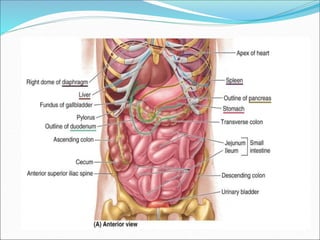
Regional anatomy :
Its deals with anatomy of various structures as they
lie in relationship with one another in different re
gion of the body . It is valuable for surgeons.
.
invisible
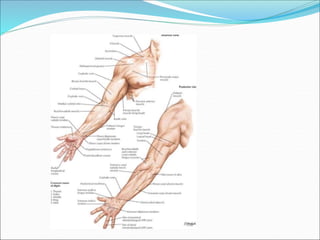
Surface anatomy:
It deals with the study and identification
of various structures in the living person
by methods of inspection and palpation
It helps to enhance the knowledge acqui
red through dissection of the cadaver by
either of line of study, Regional or syste
matic. It is helpful both in health and di
sease and is daily used in medical practi
ce.
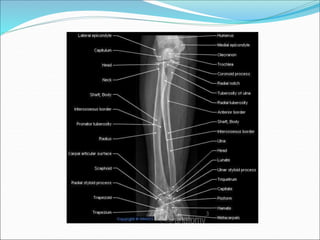
Radiological Anatomy
It deals with the study of structure of hu
man body with the aid of X-Rays. It helps
to investigate the anatomical facts which
cannot be understood by any other meth
od. It is very useful both in health and di
sease and is in current use in modern m
edical practice.
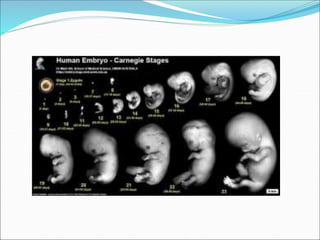
Embryology
It is the study of various changes in the developing orga
nism from the fertilization of ovum up to the birth of t
he baby.
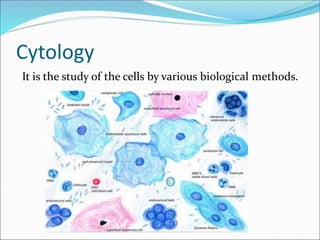
Cytology
It is the study of the cells by various biological methods.
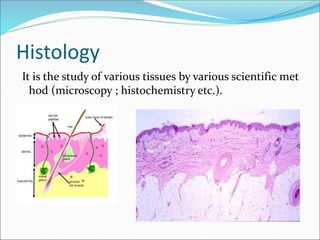
Histology
It is the study of various tissues by various scientific met
hod (microscopy ; histochemistry etc.).
Applied / Clinical Anatomy
It is the direct application of facts of human anatomy to
medicine and surgery. The students are advised to lay t
he stress on applied aspects while they are studying gr
oss anatomy in dissection hall.
Systemic Anatomy
The description of several systems of organs separately a
nd in logical order comes under the head of systematic
anatomy. The several parts of each system not only sho
w a certain similarity of structure but are also associate
d in specialized functions.
Anatomical
Terminologies
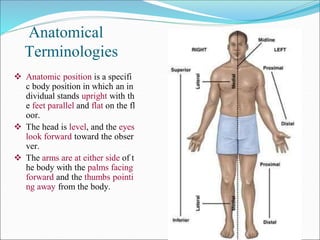
 Anatomic position is a specifi
c body position in which an in
dividual stands upright with th
e feet parallel and flat on the fl
oor.
 The head is level, and the eyes
look forward toward the obser
ver.
 The arms are at either side of t
he body with the palms facing
forward and the thumbs pointi
ng away from the body.
Anatomical Terminology
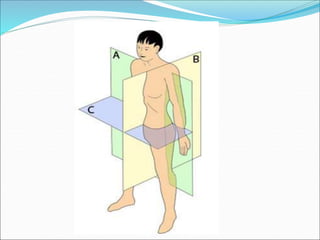
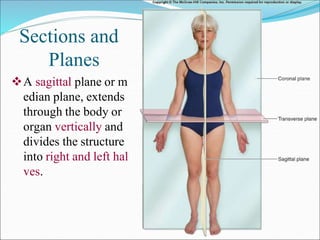
A plane is an imaginary surface that slices t
he body into specific sections.
The three major anatomic planes of referenc
e are the coronal, transverse, and sagittal pla
nes.
Sections and
Planes
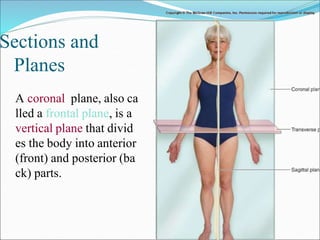
A coronal plane, also ca
lled a frontal plane, is a
vertical plane that divid
es the body into anterior
(front) and posterior (ba
ck) parts.
Sections and
Planes
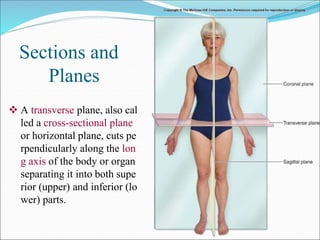
 A transverse plane, also cal
led a cross-sectional plane
or horizontal plane, cuts pe
rpendicularly along the lon
g axis of the body or organ
separating it into both supe
rior (upper) and inferior (lo
wer) parts.
Sections and
Planes
A sagittal plane or m
edian plane, extends
through the body or
organ vertically and
divides the structure
into right and left hal
ves.
Sections and Planes
A sagittal plane in the body midline is a midsagitta
l plane.
A plane that is parallel to the midsagittal plane, bu
t either to the left or the right of it, is termed a para
sagittal (or sagittal) plane.
A minor plane, called the oblique plane, passes thr
ough the specimen at an angle.
Directional Terms of the Bod
y
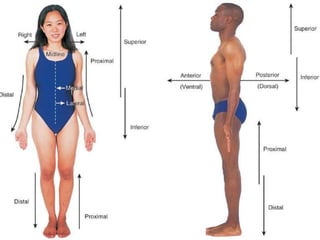
Directional terms are precise and brief, and
for most of them there is a correlative term t
hat means just the opposite.
Relative and Directional Terms o
f the Body
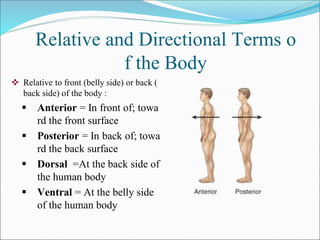
 Relative to front (belly side) or back (
back side) of the body :
 Anterior = In front of; towa
rd the front surface
 Posterior = In back of; towa
rd the back surface
 Dorsal =At the back side of
the human body
 Ventral = At the belly side
of the human body
Relative and Directional Terms o
f the Body
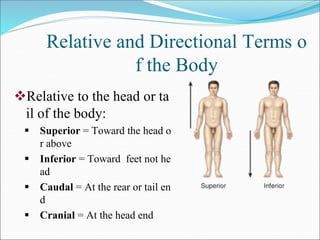
Relative to the head or ta
il of the body:
 Superior = Toward the head o
r above
 Inferior = Toward feet not he
ad
 Caudal = At the rear or tail en
d
 Cranial = At the head end
Relative and Directional Terms o
f the Body
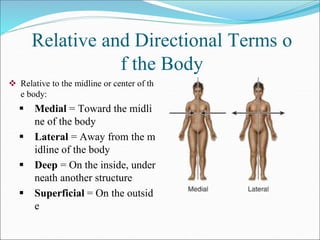
 Relative to the midline or center of th
e body:
 Medial = Toward the midli
ne of the body
 Lateral = Away from the m
idline of the body
 Deep = On the inside, under
neath another structure
 Superficial = On the outsid
e
Relative and Directional Terms o
f the Body
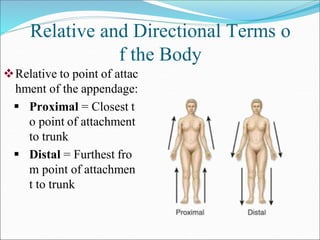
Relative to point of attac
hment of the appendage:
 Proximal = Closest t
o point of attachment
to trunk
 Distal = Furthest fro
m point of attachmen
t to trunk
Body Regions
The human body is partitioned into two mai
n regions, called the axial and appendicular
regions.
 the axial region includes the head, neck, and tr
unk which comprise the main vertical axis of ou
r body
 our limbs, or appendages, attach to the body’s a
xis and make up the appendicular region
7-30
Skeletal System
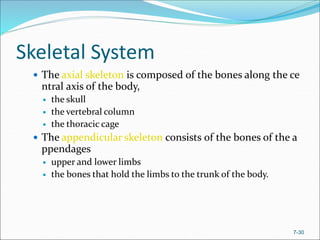
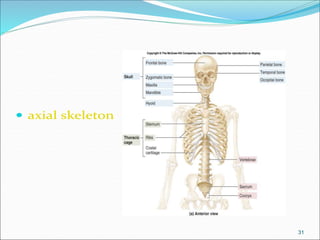
 The axial skeleton is composed of the bones along the ce
ntral axis of the body,
 the skull
 the vertebral column
 the thoracic cage
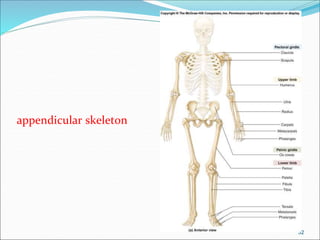
 The appendicular skeleton consists of the bones of the a
ppendages
 upper and lower limbs
 the bones that hold the limbs to the trunk of the body.
31
32
appendicular skeleton

Lec 02 -_Introduction_of_Anatomical_Terminologies

  • 1.
  • 2.
    Human Anatomy: Its isdefined in various ways :- “It is the study of structure of human body”
  • 3.
    c) Its isdefined as an important scientific discipline which is concerned with the i nvestigation of biological structure by : i) Dissection ; ii) Microdissection ; iii) Light microscopy ; iv)Electron microscopy ; v) Radiology ;
  • 4.
    Regional anatomy : Itsdeals with anatomy of various structures as they lie in relationship with one another in different re gion of the body . It is valuable for surgeons. .
  • 6.
    invisible Surface anatomy: It dealswith the study and identification of various structures in the living person by methods of inspection and palpation It helps to enhance the knowledge acqui red through dissection of the cadaver by either of line of study, Regional or syste matic. It is helpful both in health and di sease and is daily used in medical practi ce.
  • 8.
    Radiological Anatomy It dealswith the study of structure of hu man body with the aid of X-Rays. It helps to investigate the anatomical facts which cannot be understood by any other meth od. It is very useful both in health and di sease and is in current use in modern m edical practice.
  • 10.
    Embryology It is thestudy of various changes in the developing orga nism from the fertilization of ovum up to the birth of t he baby.
  • 12.
    Cytology It is thestudy of the cells by various biological methods.
  • 13.
    Histology It is thestudy of various tissues by various scientific met hod (microscopy ; histochemistry etc.).
  • 14.
    Applied / ClinicalAnatomy It is the direct application of facts of human anatomy to medicine and surgery. The students are advised to lay t he stress on applied aspects while they are studying gr oss anatomy in dissection hall.
  • 15.
    Systemic Anatomy The descriptionof several systems of organs separately a nd in logical order comes under the head of systematic anatomy. The several parts of each system not only sho w a certain similarity of structure but are also associate d in specialized functions.
  • 16.
    Anatomical Terminologies  Anatomic positionis a specifi c body position in which an in dividual stands upright with th e feet parallel and flat on the fl oor.  The head is level, and the eyes look forward toward the obser ver.  The arms are at either side of t he body with the palms facing forward and the thumbs pointi ng away from the body.
  • 17.
    Anatomical Terminology A planeis an imaginary surface that slices t he body into specific sections. The three major anatomic planes of referenc e are the coronal, transverse, and sagittal pla nes.
  • 19.
    Sections and Planes A coronalplane, also ca lled a frontal plane, is a vertical plane that divid es the body into anterior (front) and posterior (ba ck) parts.
  • 20.
    Sections and Planes  Atransverse plane, also cal led a cross-sectional plane or horizontal plane, cuts pe rpendicularly along the lon g axis of the body or organ separating it into both supe rior (upper) and inferior (lo wer) parts.
  • 21.
    Sections and Planes A sagittalplane or m edian plane, extends through the body or organ vertically and divides the structure into right and left hal ves.
  • 22.
    Sections and Planes Asagittal plane in the body midline is a midsagitta l plane. A plane that is parallel to the midsagittal plane, bu t either to the left or the right of it, is termed a para sagittal (or sagittal) plane. A minor plane, called the oblique plane, passes thr ough the specimen at an angle.
  • 23.
    Directional Terms ofthe Bod y Directional terms are precise and brief, and for most of them there is a correlative term t hat means just the opposite.
  • 24.
    Relative and DirectionalTerms o f the Body  Relative to front (belly side) or back ( back side) of the body :  Anterior = In front of; towa rd the front surface  Posterior = In back of; towa rd the back surface  Dorsal =At the back side of the human body  Ventral = At the belly side of the human body
  • 25.
    Relative and DirectionalTerms o f the Body Relative to the head or ta il of the body:  Superior = Toward the head o r above  Inferior = Toward feet not he ad  Caudal = At the rear or tail en d  Cranial = At the head end
  • 26.
    Relative and DirectionalTerms o f the Body  Relative to the midline or center of th e body:  Medial = Toward the midli ne of the body  Lateral = Away from the m idline of the body  Deep = On the inside, under neath another structure  Superficial = On the outsid e
  • 27.
    Relative and DirectionalTerms o f the Body Relative to point of attac hment of the appendage:  Proximal = Closest t o point of attachment to trunk  Distal = Furthest fro m point of attachmen t to trunk
  • 29.
    Body Regions The humanbody is partitioned into two mai n regions, called the axial and appendicular regions.  the axial region includes the head, neck, and tr unk which comprise the main vertical axis of ou r body  our limbs, or appendages, attach to the body’s a xis and make up the appendicular region
  • 30.
    7-30 Skeletal System  Theaxial skeleton is composed of the bones along the ce ntral axis of the body,  the skull  the vertebral column  the thoracic cage  The appendicular skeleton consists of the bones of the a ppendages  upper and lower limbs  the bones that hold the limbs to the trunk of the body.
  • 31.
  • 32.