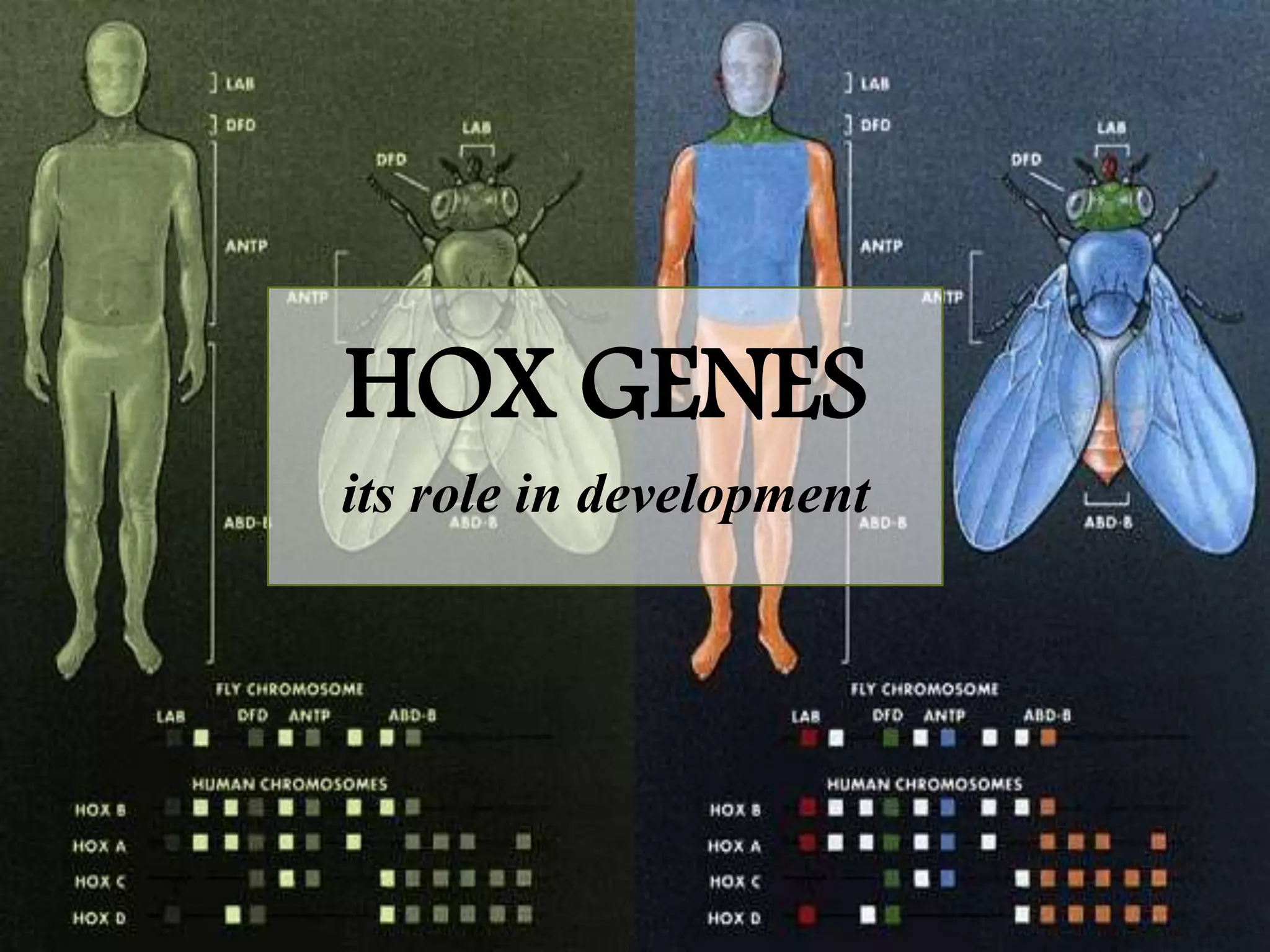
HOX GENES
its role in development
WHAT ARE HOX GENES?
• The term "Hox" is a contraction of homeobox, of which Hox
genes are a subset, in the field of genetics
• a subset of homeotic genes
• group of related genes that control the body plan of an embryo
along the head-tail axis
• the Hox proteins determine the type of appendages (e.g. legs,
antennae, and wings in fruit flies) or the different types of
vertebrae (in humans) that will form on a segment
• confer segmental identity, but do not form the actual segments
themselves
• Each Hox gene contains a well-conserved DNA sequence
known as the homeobox
• Hox genes are thus a subset of the homeobox transcription
factor genes.
DISCOVERY
• Homeotic transformations were first identified and studied by
William Bateson in 1894, who coined the term "homeosis“
• This mutant shows a partial duplication of the thorax and was
therefore named Bithorax (bx). It transforms the third thoracic
segment (T3) toward the second (T2)
• Ed Lewis, Christiane Nüsslein-Volhard and Eric F. Wieschaus
identified and classified 15 genes of key importance in determining
the body plan and the formation of body segments of the fruit fly D.
melanogaster in 1980
• Lewis, Nüsslein-Volhard, and Wieschaus were awarded the Nobel
Prize in Physiology or Medicine in 1995
• In 1983, the homeobox was discovered independently by researchers
in two labs: Ernst Hafen, Michael Levine, and William McGinnis (in
Walter Gehring's lab at the University of Basel, Switzerland) and
Matthew P. Scott and Amy Weiner (in Thomas Kaufman's lab at
Indiana University in Bloomington).
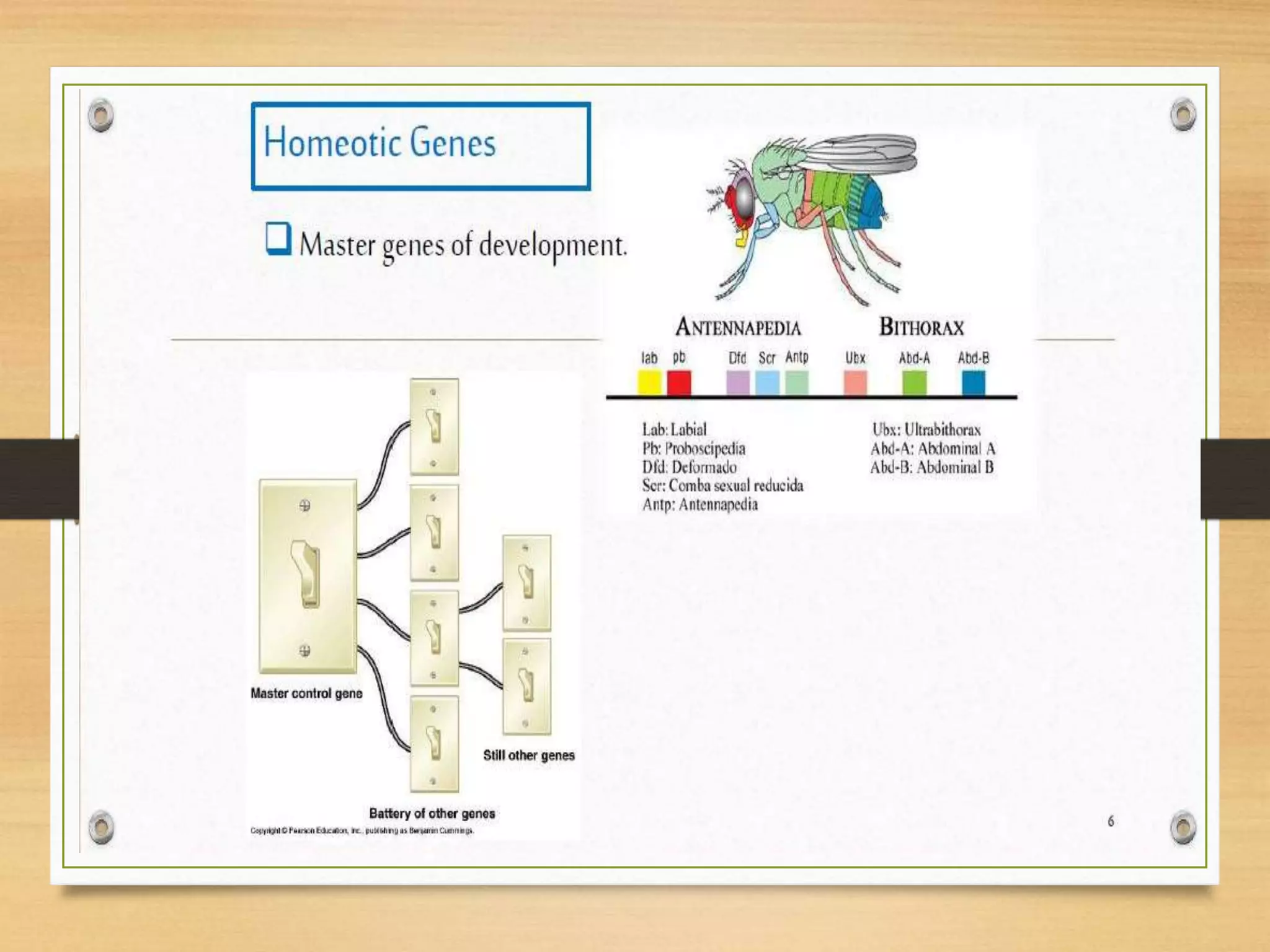
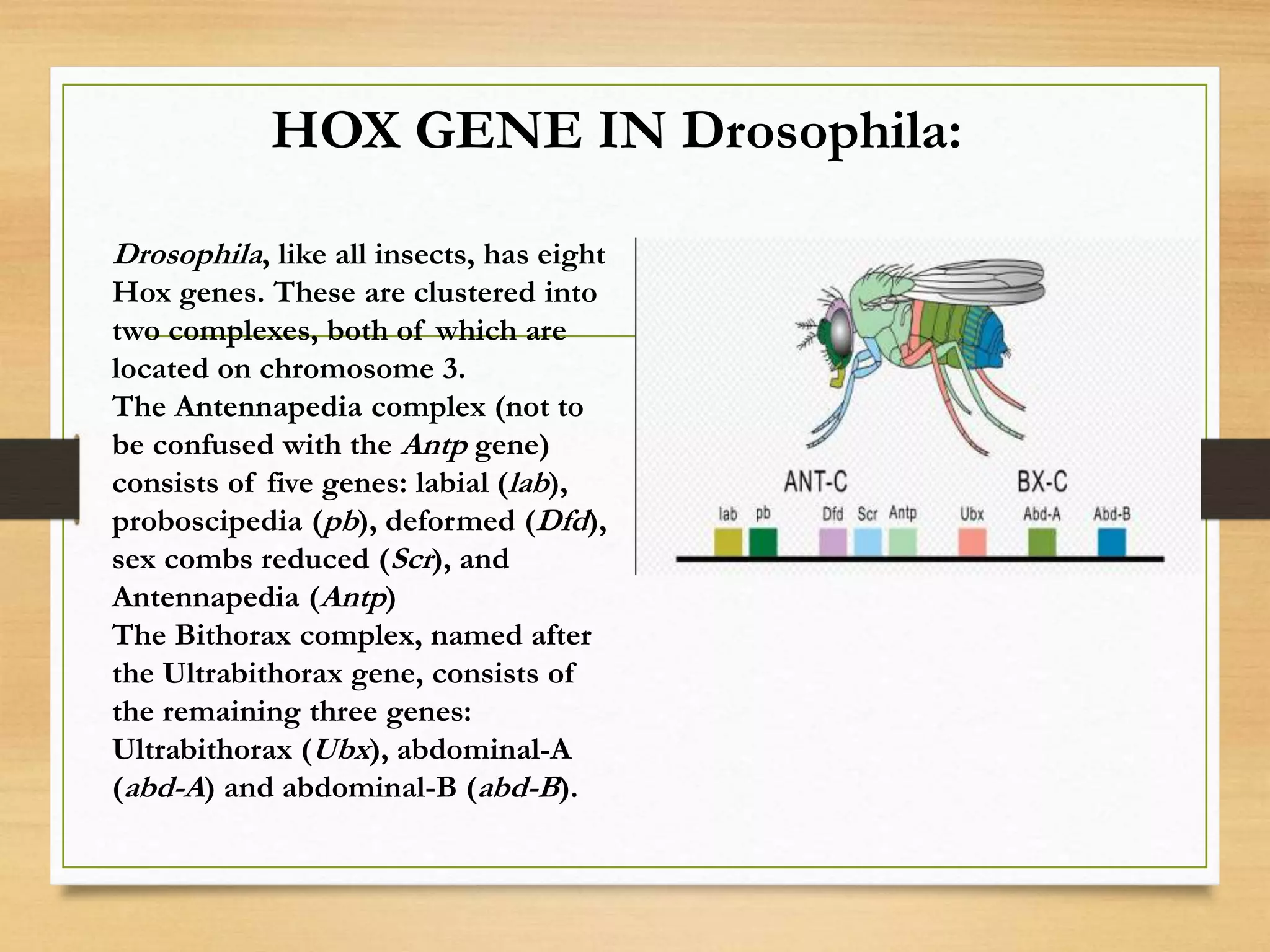
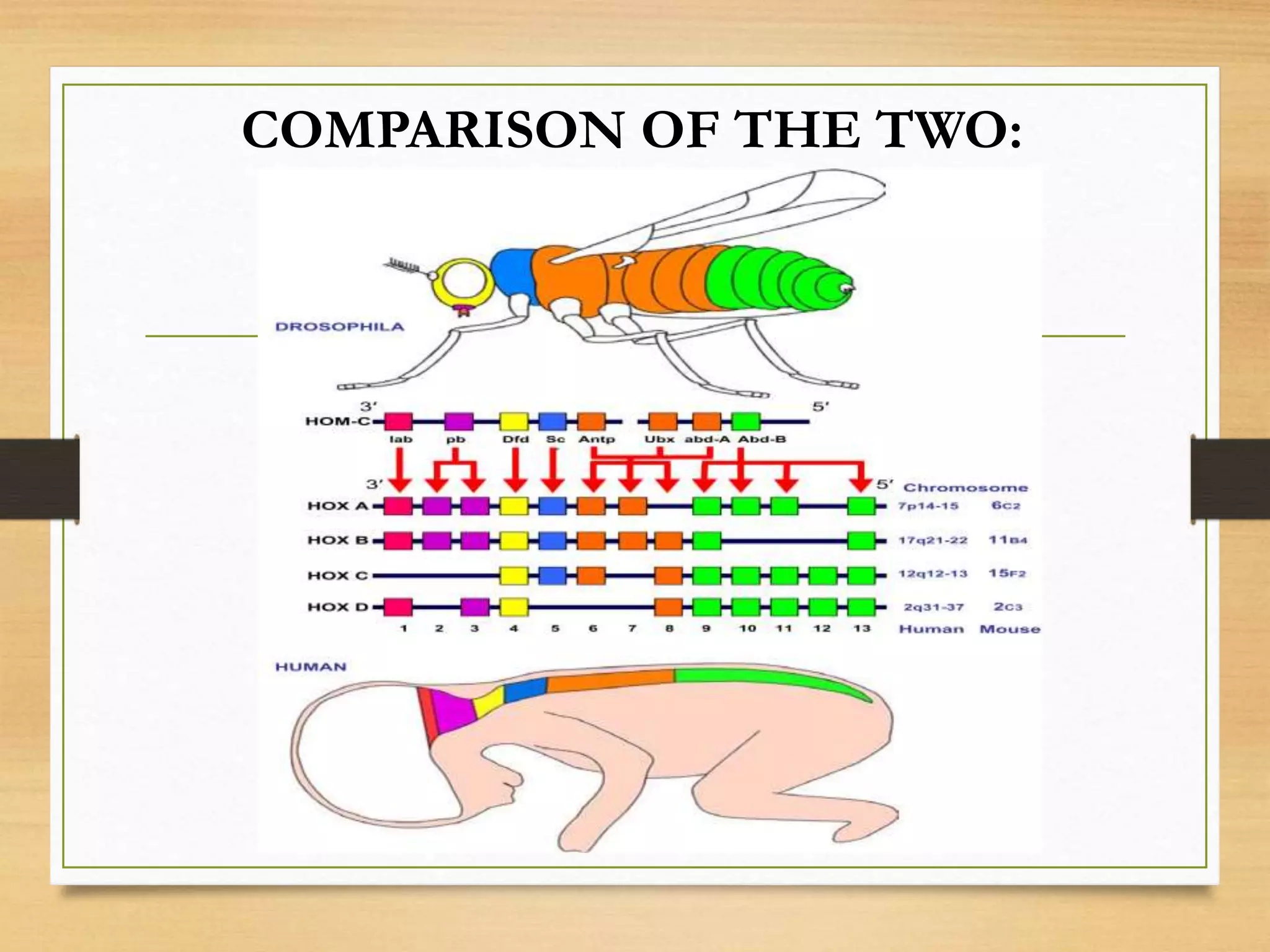
HOX GENE IN Drosophila:
Drosophila, like all insects, has eight
Hox genes. These are clustered into
two complexes, both of which are
located on chromosome 3.
The Antennapedia complex (not to
be confused with the Antp gene)
consists of five genes: labial (lab),
proboscipedia (pb), deformed (Dfd),
sex combs reduced (Scr), and
Antennapedia (Antp)
The Bithorax complex, named after
the Ultrabithorax gene, consists of
the remaining three genes:
Ultrabithorax (Ubx), abdominal-A
(abd-A) and abdominal-B (abd-B).
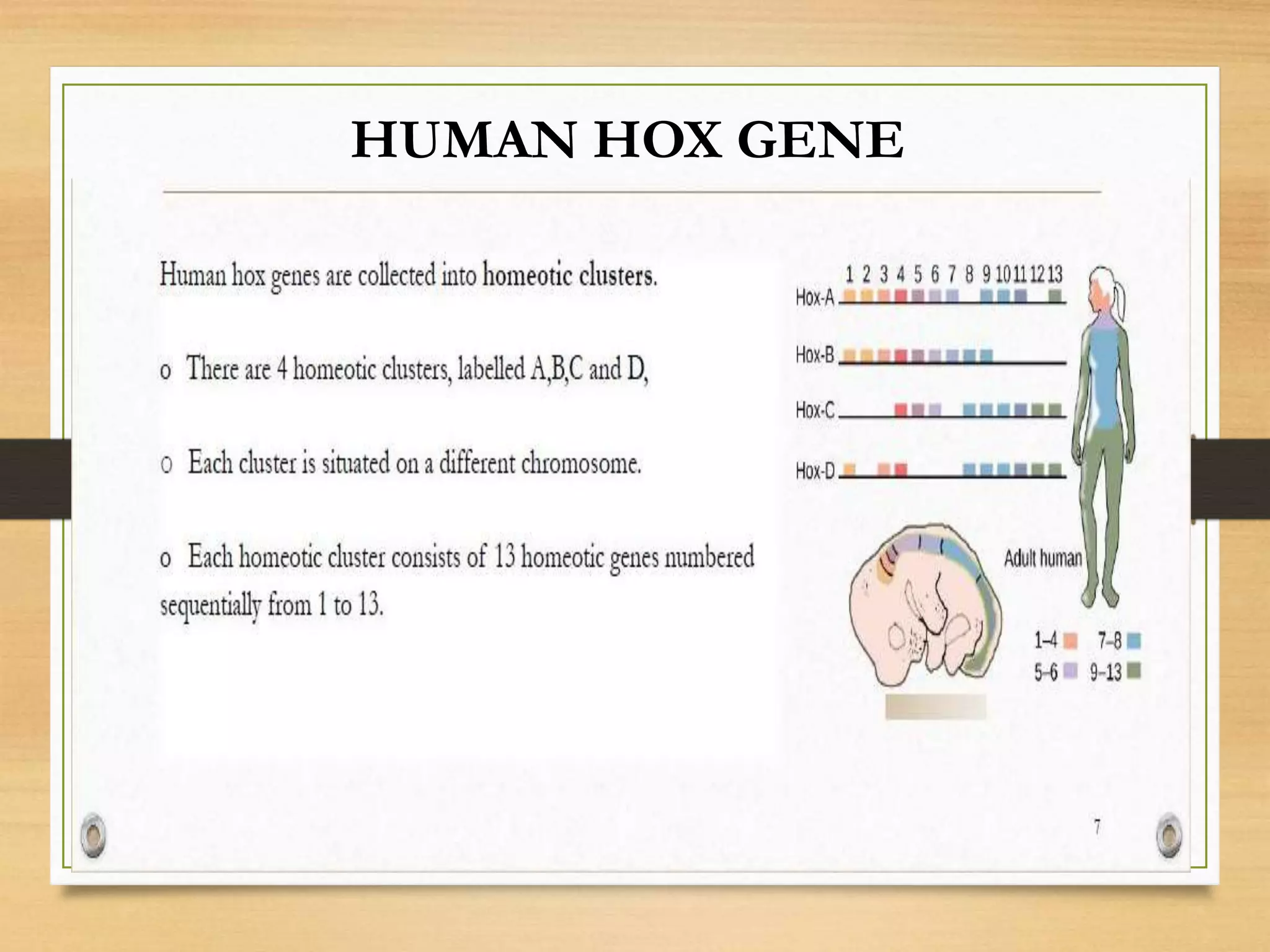
HUMAN HOX GENE
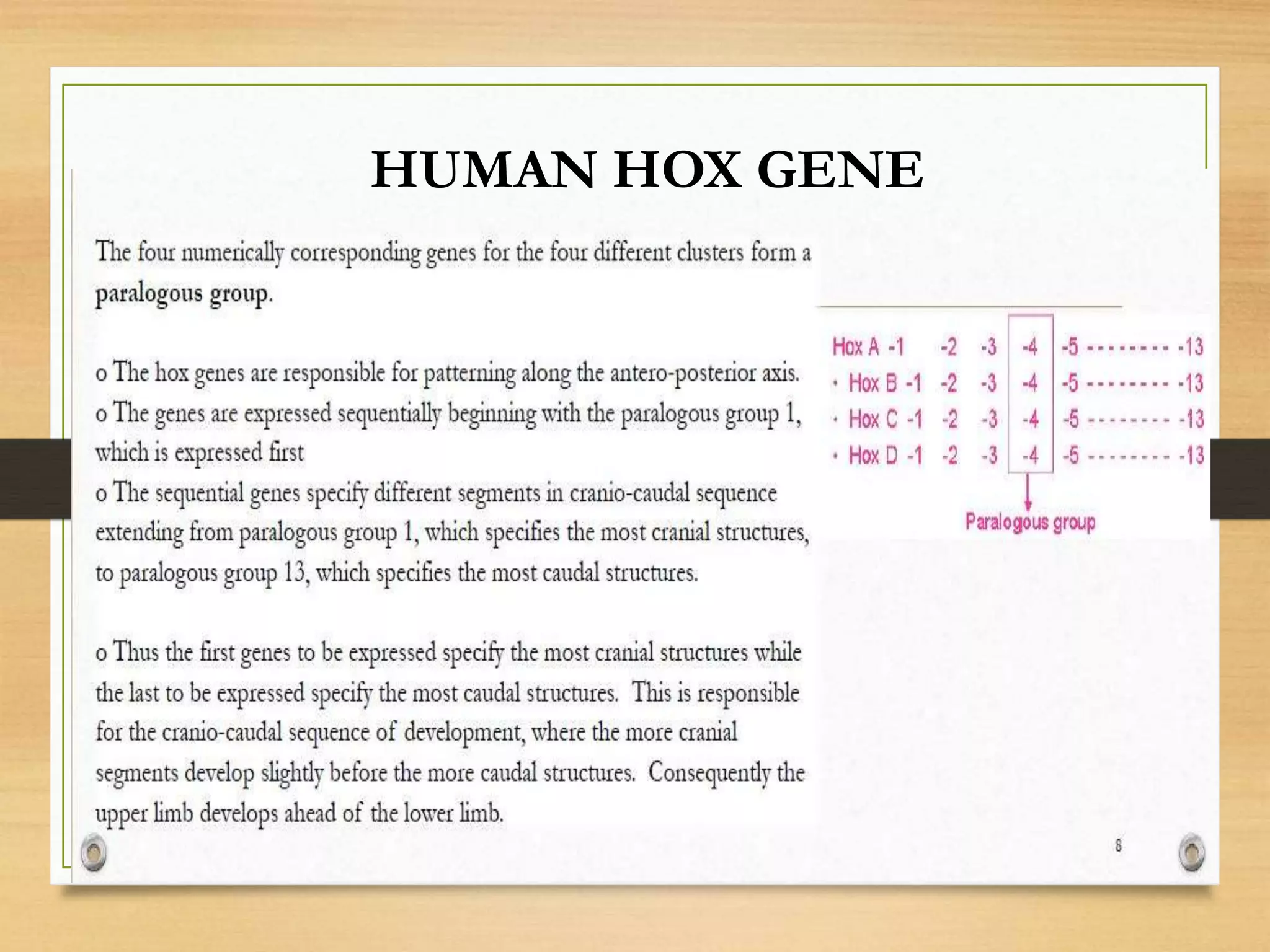
HUMAN HOX GENE
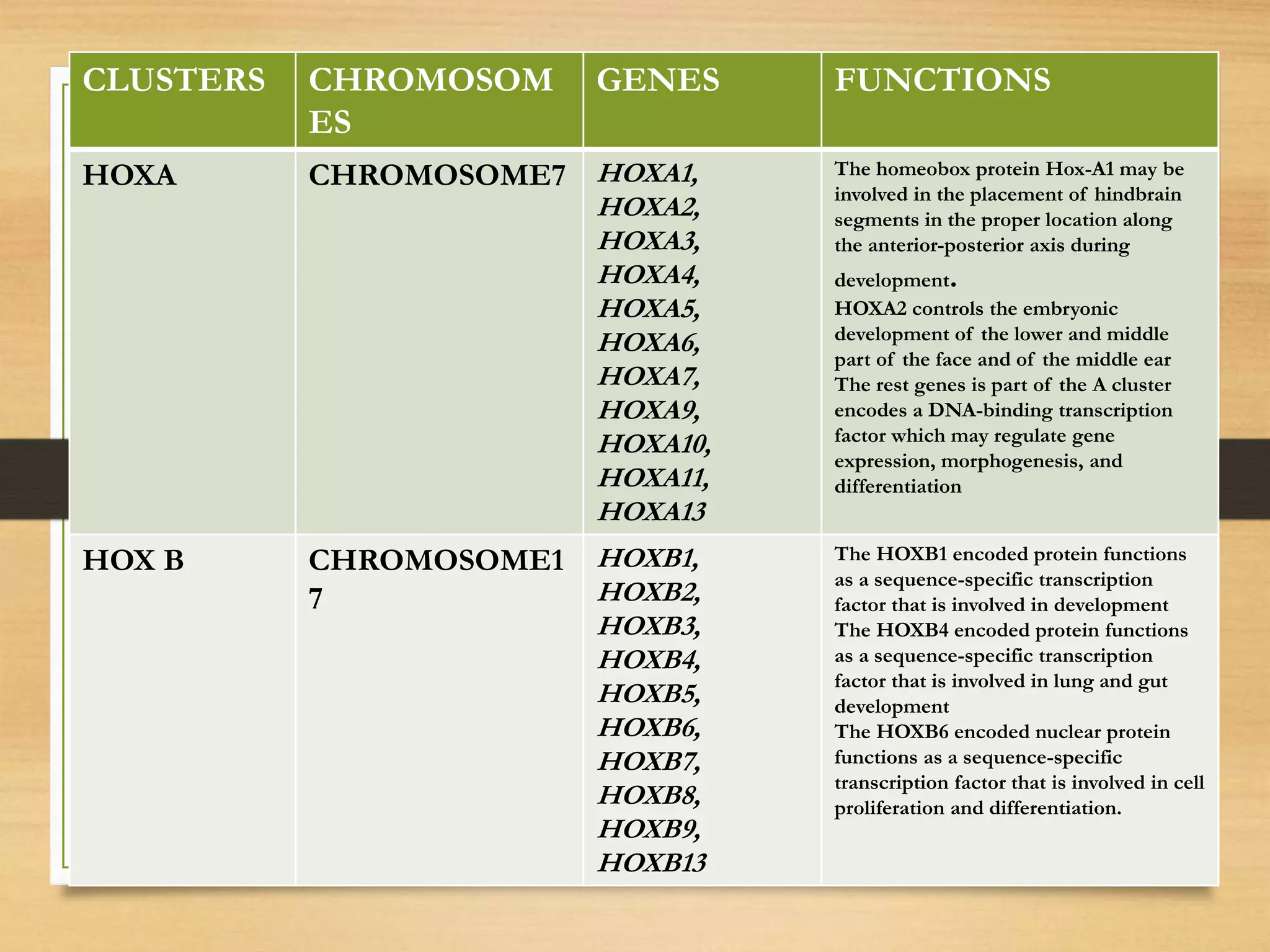
CLUSTERS CHROMOSOM
ES
GENES FUNCTIONS
HOXA CHROMOSOME7 HOXA1,
HOXA2,
HOXA3,
HOXA4,
HOXA5,
HOXA6,
HOXA7,
HOXA9,
HOXA10,
HOXA11,
HOXA13
The homeobox protein Hox-A1 may be
involved in the placement of hindbrain
segments in the proper location along
the anterior-posterior axis during
development.
HOXA2 controls the embryonic
development of the lower and middle
part of the face and of the middle ear
The rest genes is part of the A cluster
encodes a DNA-binding transcription
factor which may regulate gene
expression, morphogenesis, and
differentiation
HOX B CHROMOSOME1
7
HOXB1,
HOXB2,
HOXB3,
HOXB4,
HOXB5,
HOXB6,
HOXB7,
HOXB8,
HOXB9,
HOXB13
The HOXB1 encoded protein functions
as a sequence-specific transcription
factor that is involved in development
The HOXB4 encoded protein functions
as a sequence-specific transcription
factor that is involved in lung and gut
development
The HOXB6 encoded nuclear protein
functions as a sequence-specific
transcription factor that is involved in cell
proliferation and differentiation.
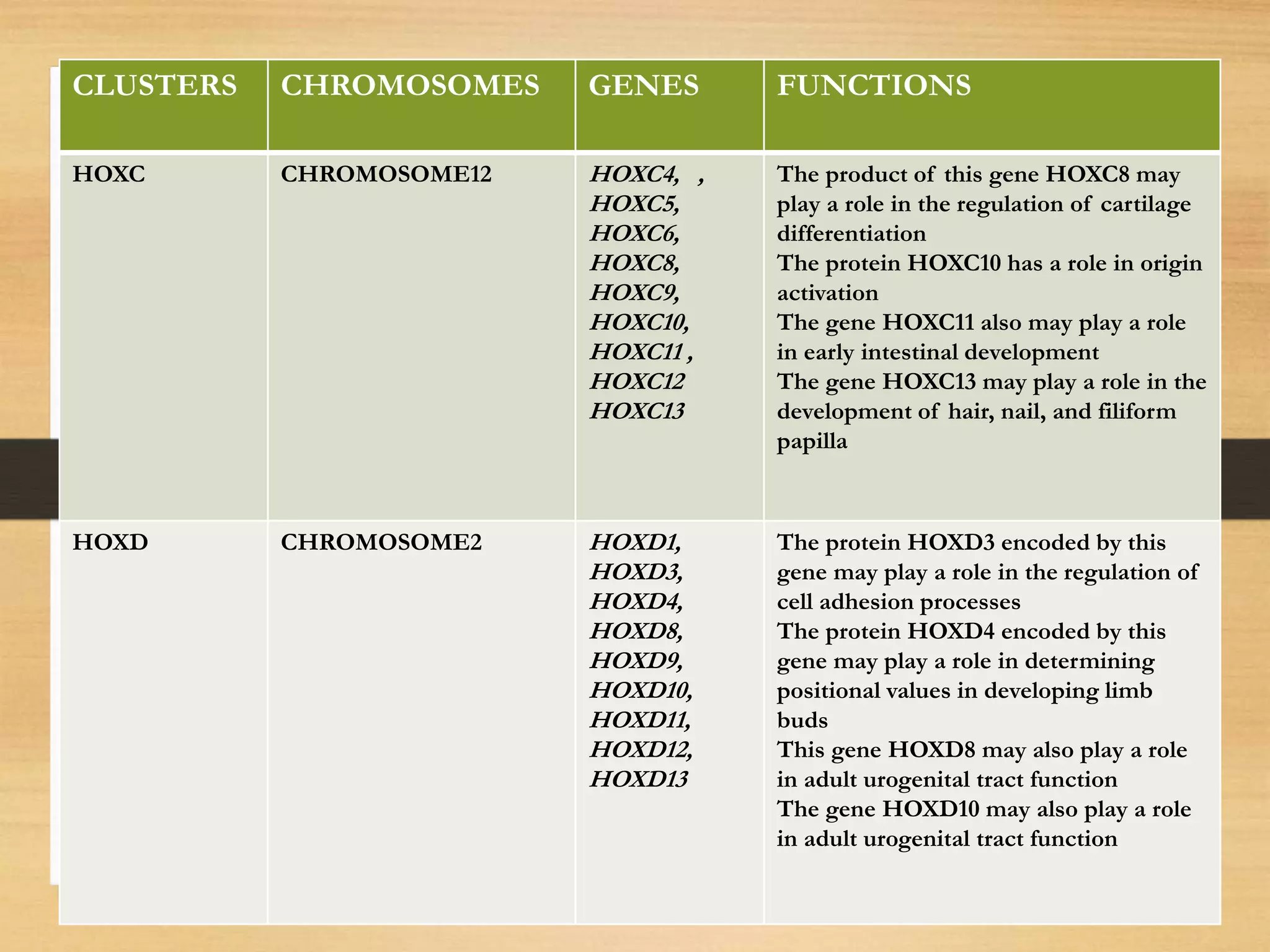
CLUSTERS CHROMOSOMES GENES FUNCTIONS
HOXC CHROMOSOME12 HOXC4, ,
HOXC5,
HOXC6,
HOXC8,
HOXC9,
HOXC10,
HOXC11 ,
HOXC12
HOXC13
The product of this gene HOXC8 may
play a role in the regulation of cartilage
differentiation
The protein HOXC10 has a role in origin
activation
The gene HOXC11 also may play a role
in early intestinal development
The gene HOXC13 may play a role in the
development of hair, nail, and filiform
papilla
HOXD CHROMOSOME2 HOXD1,
HOXD3,
HOXD4,
HOXD8,
HOXD9,
HOXD10,
HOXD11,
HOXD12,
HOXD13
The protein HOXD3 encoded by this
gene may play a role in the regulation of
cell adhesion processes
The protein HOXD4 encoded by this
gene may play a role in determining
positional values in developing limb
buds
This gene HOXD8 may also play a role
in adult urogenital tract function
The gene HOXD10 may also play a role
in adult urogenital tract function
COMPARISON OF THE TWO:
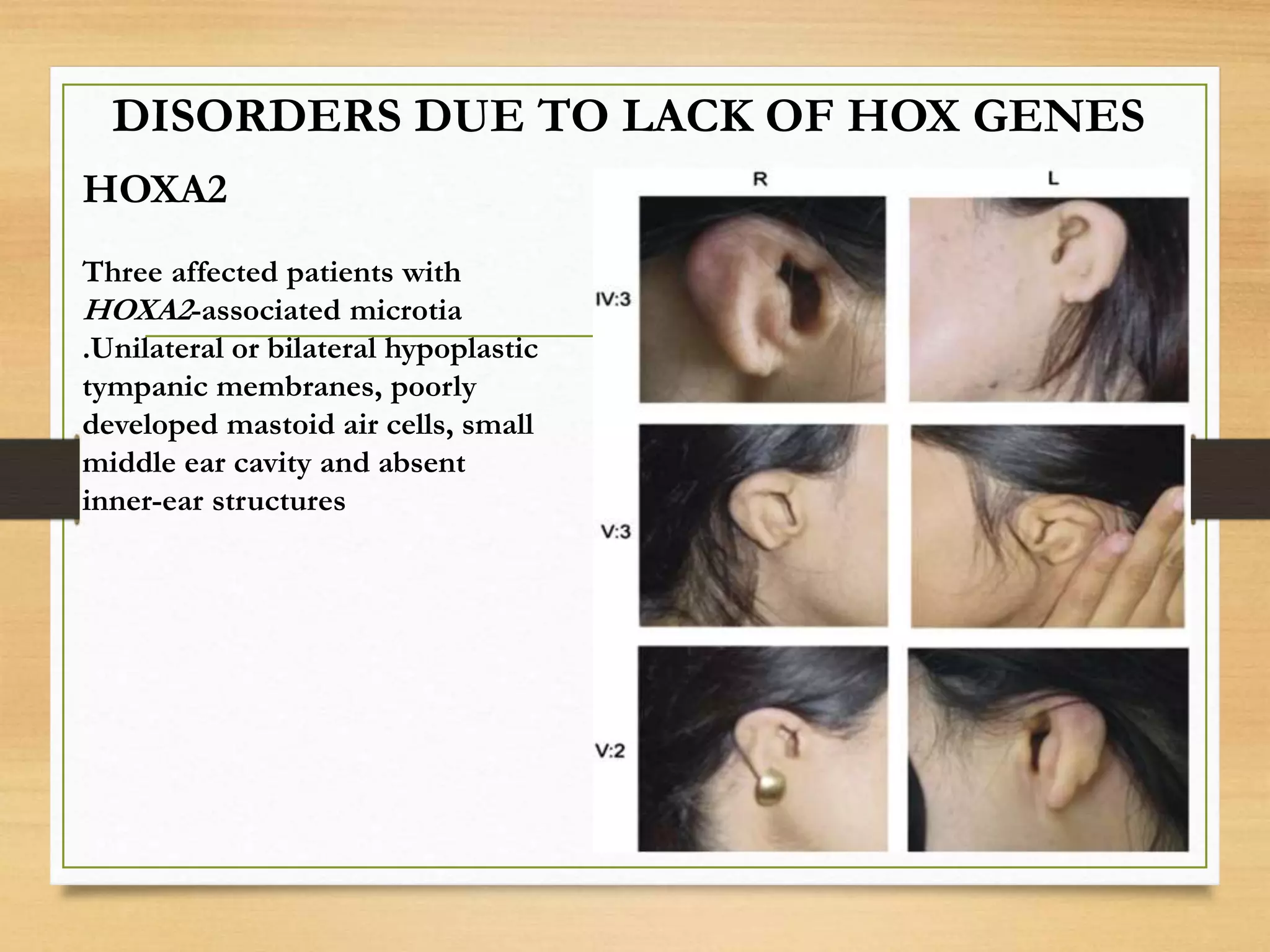
HOXA2
Three affected patients with
HOXA2-associated microtia
.Unilateral or bilateral hypoplastic
tympanic membranes, poorly
developed mastoid air cells, small
middle ear cavity and absent
inner-ear structures
DISORDERS DUE TO LACK OF HOX GENES
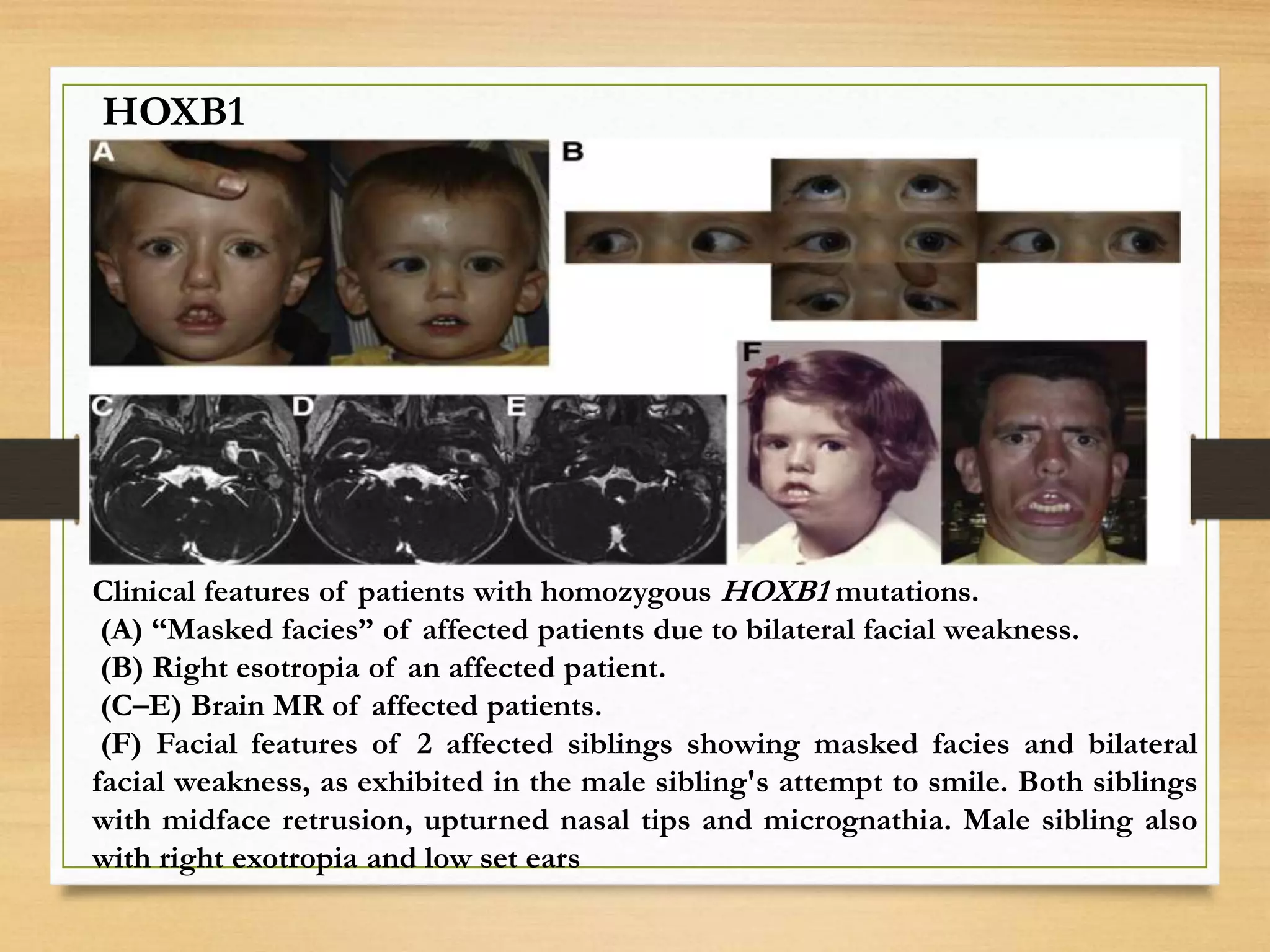
Clinical features of patients with homozygous HOXB1 mutations.
(A) “Masked facies” of affected patients due to bilateral facial weakness.
(B) Right esotropia of an affected patient.
(C–E) Brain MR of affected patients.
(F) Facial features of 2 affected siblings showing masked facies and bilateral
facial weakness, as exhibited in the male sibling's attempt to smile. Both siblings
with midface retrusion, upturned nasal tips and micrognathia. Male sibling also
with right exotropia and low set ears
HOXB1
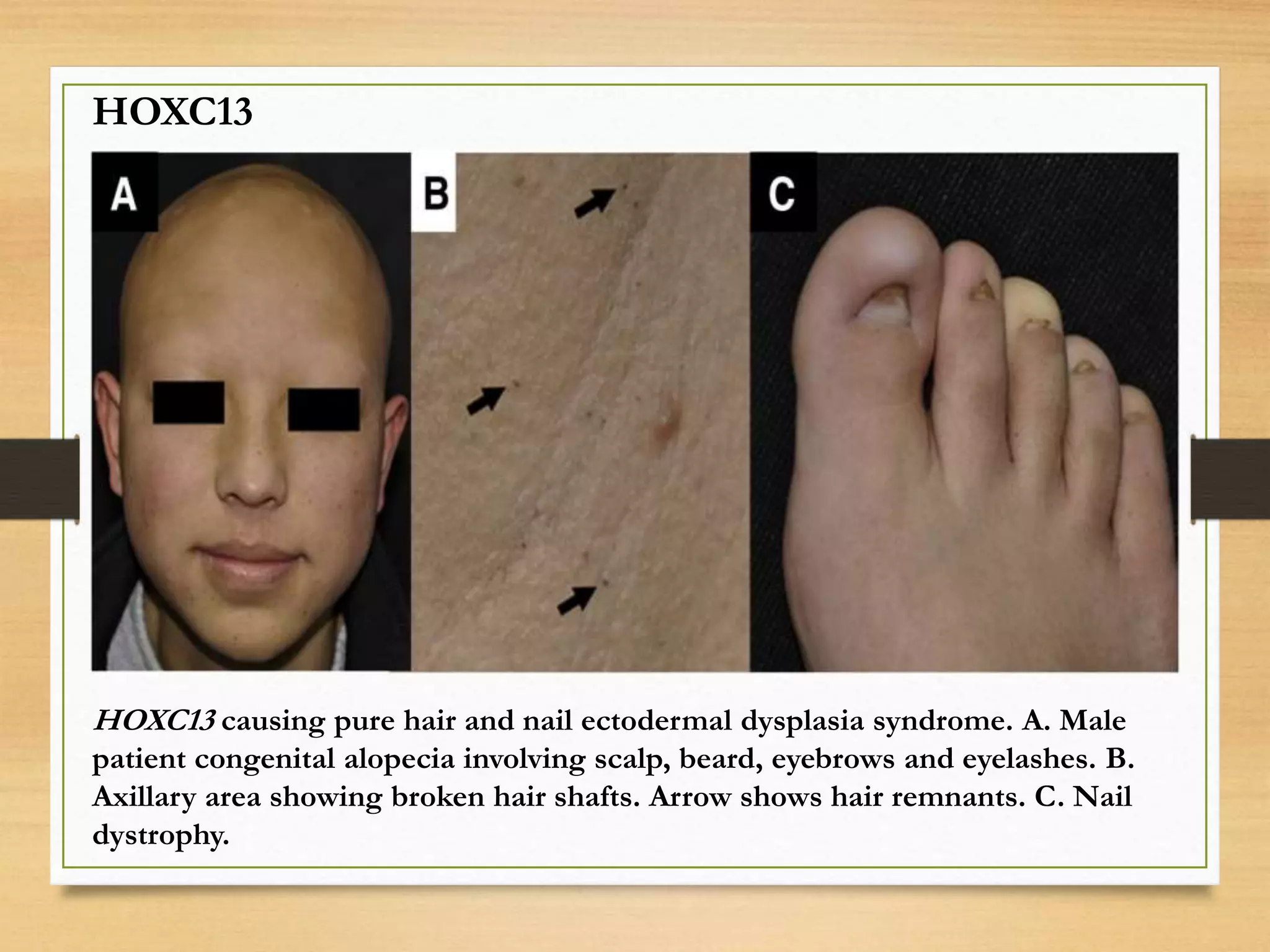
HOXC13 causing pure hair and nail ectodermal dysplasia syndrome. A. Male
patient congenital alopecia involving scalp, beard, eyebrows and eyelashes. B.
Axillary area showing broken hair shafts. Arrow shows hair remnants. C. Nail
dystrophy.
HOXC13
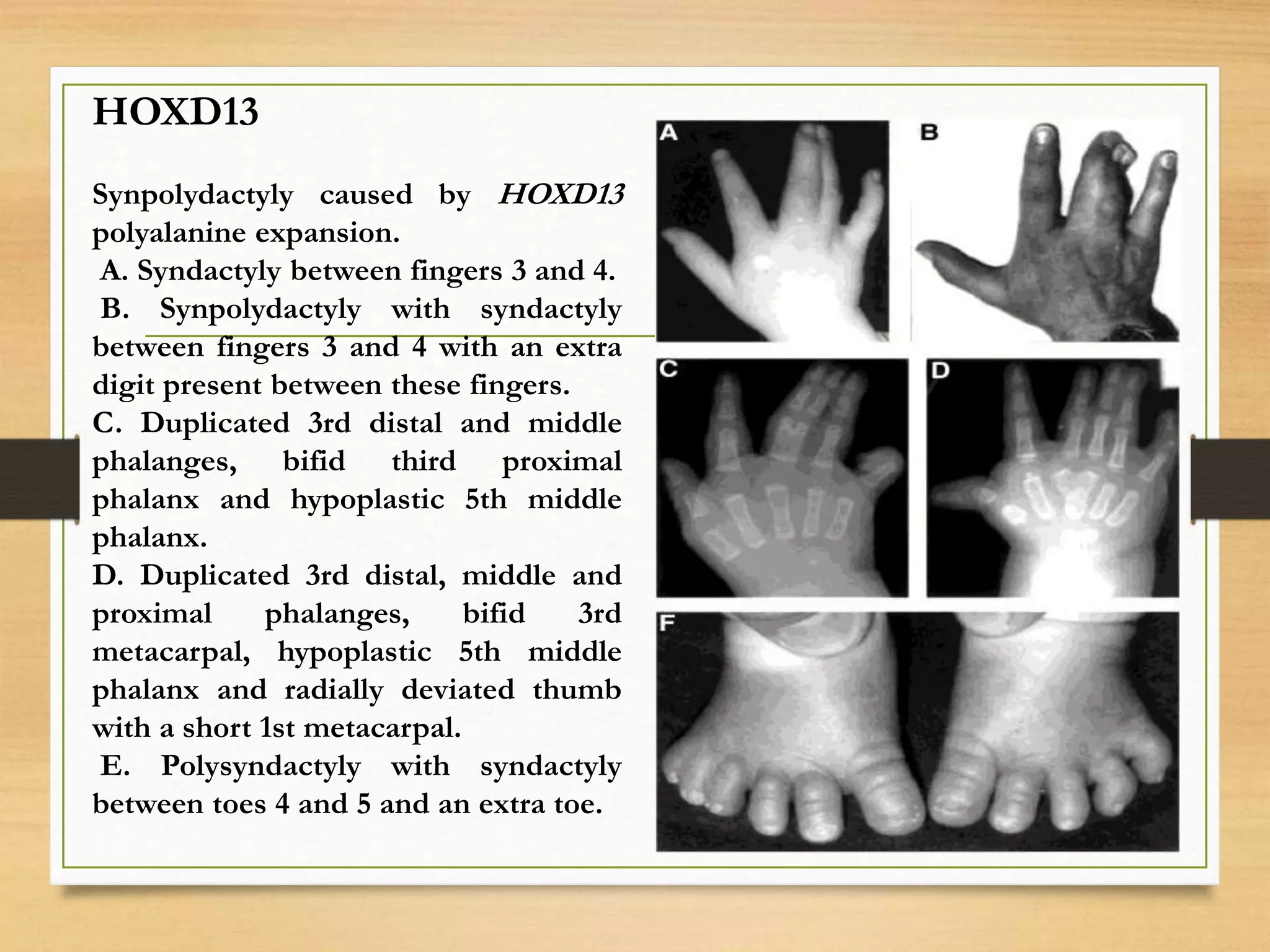
HOXD13
Synpolydactyly caused by HOXD13
polyalanine expansion.
A. Syndactyly between fingers 3 and 4.
B. Synpolydactyly with syndactyly
between fingers 3 and 4 with an extra
digit present between these fingers.
C. Duplicated 3rd distal and middle
phalanges, bifid third proximal
phalanx and hypoplastic 5th middle
phalanx.
D. Duplicated 3rd distal, middle and
proximal phalanges, bifid 3rd
metacarpal, hypoplastic 5th middle
phalanx and radially deviated thumb
with a short 1st metacarpal.
E. Polysyndactyly with syndactyly
between toes 4 and 5 and an extra toe.
Thank you…

hox genes and its role in development

  • 1.
    HOX GENES its rolein development
  • 2.
    WHAT ARE HOXGENES? • The term "Hox" is a contraction of homeobox, of which Hox genes are a subset, in the field of genetics • a subset of homeotic genes • group of related genes that control the body plan of an embryo along the head-tail axis • the Hox proteins determine the type of appendages (e.g. legs, antennae, and wings in fruit flies) or the different types of vertebrae (in humans) that will form on a segment • confer segmental identity, but do not form the actual segments themselves • Each Hox gene contains a well-conserved DNA sequence known as the homeobox • Hox genes are thus a subset of the homeobox transcription factor genes.
  • 3.
    DISCOVERY • Homeotic transformationswere first identified and studied by William Bateson in 1894, who coined the term "homeosis“ • This mutant shows a partial duplication of the thorax and was therefore named Bithorax (bx). It transforms the third thoracic segment (T3) toward the second (T2) • Ed Lewis, Christiane Nüsslein-Volhard and Eric F. Wieschaus identified and classified 15 genes of key importance in determining the body plan and the formation of body segments of the fruit fly D. melanogaster in 1980 • Lewis, Nüsslein-Volhard, and Wieschaus were awarded the Nobel Prize in Physiology or Medicine in 1995 • In 1983, the homeobox was discovered independently by researchers in two labs: Ernst Hafen, Michael Levine, and William McGinnis (in Walter Gehring's lab at the University of Basel, Switzerland) and Matthew P. Scott and Amy Weiner (in Thomas Kaufman's lab at Indiana University in Bloomington).
  • 5.
    HOX GENE INDrosophila: Drosophila, like all insects, has eight Hox genes. These are clustered into two complexes, both of which are located on chromosome 3. The Antennapedia complex (not to be confused with the Antp gene) consists of five genes: labial (lab), proboscipedia (pb), deformed (Dfd), sex combs reduced (Scr), and Antennapedia (Antp) The Bithorax complex, named after the Ultrabithorax gene, consists of the remaining three genes: Ultrabithorax (Ubx), abdominal-A (abd-A) and abdominal-B (abd-B).
  • 6.
  • 7.
  • 8.
    CLUSTERS CHROMOSOM ES GENES FUNCTIONS HOXACHROMOSOME7 HOXA1, HOXA2, HOXA3, HOXA4, HOXA5, HOXA6, HOXA7, HOXA9, HOXA10, HOXA11, HOXA13 The homeobox protein Hox-A1 may be involved in the placement of hindbrain segments in the proper location along the anterior-posterior axis during development. HOXA2 controls the embryonic development of the lower and middle part of the face and of the middle ear The rest genes is part of the A cluster encodes a DNA-binding transcription factor which may regulate gene expression, morphogenesis, and differentiation HOX B CHROMOSOME1 7 HOXB1, HOXB2, HOXB3, HOXB4, HOXB5, HOXB6, HOXB7, HOXB8, HOXB9, HOXB13 The HOXB1 encoded protein functions as a sequence-specific transcription factor that is involved in development The HOXB4 encoded protein functions as a sequence-specific transcription factor that is involved in lung and gut development The HOXB6 encoded nuclear protein functions as a sequence-specific transcription factor that is involved in cell proliferation and differentiation.
  • 9.
    CLUSTERS CHROMOSOMES GENESFUNCTIONS HOXC CHROMOSOME12 HOXC4, , HOXC5, HOXC6, HOXC8, HOXC9, HOXC10, HOXC11 , HOXC12 HOXC13 The product of this gene HOXC8 may play a role in the regulation of cartilage differentiation The protein HOXC10 has a role in origin activation The gene HOXC11 also may play a role in early intestinal development The gene HOXC13 may play a role in the development of hair, nail, and filiform papilla HOXD CHROMOSOME2 HOXD1, HOXD3, HOXD4, HOXD8, HOXD9, HOXD10, HOXD11, HOXD12, HOXD13 The protein HOXD3 encoded by this gene may play a role in the regulation of cell adhesion processes The protein HOXD4 encoded by this gene may play a role in determining positional values in developing limb buds This gene HOXD8 may also play a role in adult urogenital tract function The gene HOXD10 may also play a role in adult urogenital tract function
  • 10.
  • 11.
    HOXA2 Three affected patientswith HOXA2-associated microtia .Unilateral or bilateral hypoplastic tympanic membranes, poorly developed mastoid air cells, small middle ear cavity and absent inner-ear structures DISORDERS DUE TO LACK OF HOX GENES
  • 12.
    Clinical features ofpatients with homozygous HOXB1 mutations. (A) “Masked facies” of affected patients due to bilateral facial weakness. (B) Right esotropia of an affected patient. (C–E) Brain MR of affected patients. (F) Facial features of 2 affected siblings showing masked facies and bilateral facial weakness, as exhibited in the male sibling's attempt to smile. Both siblings with midface retrusion, upturned nasal tips and micrognathia. Male sibling also with right exotropia and low set ears HOXB1
  • 13.
    HOXC13 causing purehair and nail ectodermal dysplasia syndrome. A. Male patient congenital alopecia involving scalp, beard, eyebrows and eyelashes. B. Axillary area showing broken hair shafts. Arrow shows hair remnants. C. Nail dystrophy. HOXC13
  • 14.
    HOXD13 Synpolydactyly caused byHOXD13 polyalanine expansion. A. Syndactyly between fingers 3 and 4. B. Synpolydactyly with syndactyly between fingers 3 and 4 with an extra digit present between these fingers. C. Duplicated 3rd distal and middle phalanges, bifid third proximal phalanx and hypoplastic 5th middle phalanx. D. Duplicated 3rd distal, middle and proximal phalanges, bifid 3rd metacarpal, hypoplastic 5th middle phalanx and radially deviated thumb with a short 1st metacarpal. E. Polysyndactyly with syndactyly between toes 4 and 5 and an extra toe.
  • 15.