MITOCHONDRIAL
INHERITANCE
- DAYANA.K
Mitochondrial DNA
 Mitochondrial DNA (mtDNA or mDNA) is the DNA located in the mitochondria.
 They are double stranded circular DNA molecule.
 It is haploid in nature.
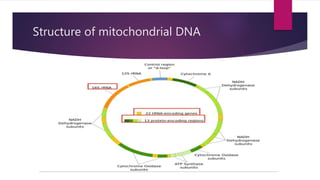
 The mitochondrial genome is made of 16,569 DNA base pairs and it contains 37
genes that encode 13 proteins, 22 tRNAs and 2 rRNAs.
 All the 13 proteins instruct cells to produce protein subunits of enzyme complex of
oxidative phosphorylation. It is a process that uses oxygen and simple sugars to
create ATP. It is responsible for energy production within the cell.
 It contains only exons (coding section of RNA) and no introns (noncoding section of
RNA)
Structure of mitochondrial DNA
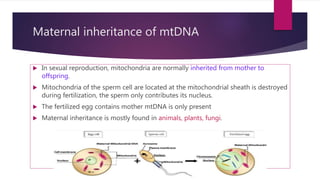
Maternal inheritance of mtDNA
 In sexual reproduction, mitochondria are normally inherited from mother to
offspring.
 Mitochondria of the sperm cell are located at the mitochondrial sheath is destroyed
during fertilization, the sperm only contributes its nucleus.
 The fertilized egg contains mother mtDNA is only present
 Maternal inheritance is mostly found in animals, plants, fungi.
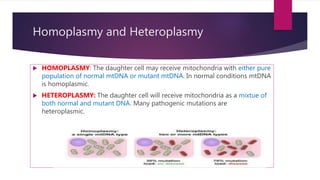
Homoplasmy and Heteroplasmy
 HOMOPLASMY: The daughter cell may receive mitochondria with either pure
population of normal mtDNA or mutant mtDNA. In normal conditions mtDNA
is homoplasmic.
 HETEROPLASMY: The daughter cell will receive mitochondria as a mixtue of
both normal and mutant DNA. Many pathogenic mutations are
heteroplasmic.
Mitochondrial mutation
 The mitochondrial genome has a very high mutation rate, 10-17 fold
hiher than that observed in nuclear DNA. It is due to
 Insufficient DNA repair system
 Lack of DNA proteins such as histones
 Spontaneous errors arising during DNA
 Oxygenation process is high percentage
 The mtDNA mutation rate can be increased by
environmental agents.
Types of mutation
 There are three types of mutation has been identified in mtDNA.
1. Missense mutation: The coding regions of genes that alter the
activity of an oxidative phosphorylation protein .
2. Point mutation: In tRNA or rRNA that impair mitochondrial
protein synthesis.
3. Deletion or Duplication of mtDNA: They are generally somatic in
origin, although a small is inherited in some diseases.
Mitochondrial Diseases
1. Kearn sayre syndrome: Large deletion in mitochondrial DNA cause this condition.
The symptoms such as weakness of the muscle, control eyelid and eye movement,
degeneration of retina and development of heart disease.
2. Myoclonic epilepsy with red fibers(MERRF): It is a multisystem disorder
characterized by myoclonus, the first symptom followed by generalised epilepsy,
ataxia, weakness and dementia.
3. Myopathy epilepsy lactic acidosis(MELAS): This syndrome have an accumulation
of lactic acid in the blood that can leads to vomiting, abdominal pain, fatigue,
muscle weakness, difficulty in breathing.
4. Leber’s hereditary optic atropy(LHON): Blurring and clouding of vision.
5. Leigh syndrome: The earliest signs may be poor sucking ability and loss of head
control and motor skills. These symptoms may be loss of appetite, vomiting,
irritability, continuous crying and seizures.
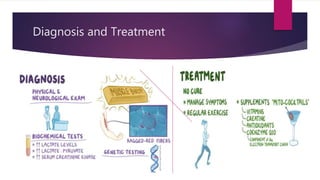
Diagnosis and Treatment
Mitochondrial Inheritance slideshare

Mitochondrial Inheritance slideshare

  • 1.
  • 2.
    Mitochondrial DNA  MitochondrialDNA (mtDNA or mDNA) is the DNA located in the mitochondria.  They are double stranded circular DNA molecule.  It is haploid in nature.  The mitochondrial genome is made of 16,569 DNA base pairs and it contains 37 genes that encode 13 proteins, 22 tRNAs and 2 rRNAs.  All the 13 proteins instruct cells to produce protein subunits of enzyme complex of oxidative phosphorylation. It is a process that uses oxygen and simple sugars to create ATP. It is responsible for energy production within the cell.  It contains only exons (coding section of RNA) and no introns (noncoding section of RNA)
  • 3.
  • 4.
    Maternal inheritance ofmtDNA  In sexual reproduction, mitochondria are normally inherited from mother to offspring.  Mitochondria of the sperm cell are located at the mitochondrial sheath is destroyed during fertilization, the sperm only contributes its nucleus.  The fertilized egg contains mother mtDNA is only present  Maternal inheritance is mostly found in animals, plants, fungi.
  • 5.
    Homoplasmy and Heteroplasmy HOMOPLASMY: The daughter cell may receive mitochondria with either pure population of normal mtDNA or mutant mtDNA. In normal conditions mtDNA is homoplasmic.  HETEROPLASMY: The daughter cell will receive mitochondria as a mixtue of both normal and mutant DNA. Many pathogenic mutations are heteroplasmic.
  • 7.
    Mitochondrial mutation  Themitochondrial genome has a very high mutation rate, 10-17 fold hiher than that observed in nuclear DNA. It is due to  Insufficient DNA repair system  Lack of DNA proteins such as histones  Spontaneous errors arising during DNA  Oxygenation process is high percentage  The mtDNA mutation rate can be increased by environmental agents.
  • 8.
    Types of mutation There are three types of mutation has been identified in mtDNA. 1. Missense mutation: The coding regions of genes that alter the activity of an oxidative phosphorylation protein . 2. Point mutation: In tRNA or rRNA that impair mitochondrial protein synthesis. 3. Deletion or Duplication of mtDNA: They are generally somatic in origin, although a small is inherited in some diseases.
  • 9.
    Mitochondrial Diseases 1. Kearnsayre syndrome: Large deletion in mitochondrial DNA cause this condition. The symptoms such as weakness of the muscle, control eyelid and eye movement, degeneration of retina and development of heart disease. 2. Myoclonic epilepsy with red fibers(MERRF): It is a multisystem disorder characterized by myoclonus, the first symptom followed by generalised epilepsy, ataxia, weakness and dementia. 3. Myopathy epilepsy lactic acidosis(MELAS): This syndrome have an accumulation of lactic acid in the blood that can leads to vomiting, abdominal pain, fatigue, muscle weakness, difficulty in breathing.
  • 10.
    4. Leber’s hereditaryoptic atropy(LHON): Blurring and clouding of vision. 5. Leigh syndrome: The earliest signs may be poor sucking ability and loss of head control and motor skills. These symptoms may be loss of appetite, vomiting, irritability, continuous crying and seizures.
  • 11.