Landmark trials in treatment of
carcinoma breast
Dr. Namrata Das
Junior Resident, 6th semester
Moderator: Dr. Kannan P
1
Outline
• What is a landmark trial?
• CONSORT Statement
• Non-metastatic breast cancer
• Locoregional management
• Local
• Regional lymph node management
• Evolution of radiotherapy
• Systemic therapy
• Chemotherapy
• Hormonal therapy
• Targeted therapy
• Metastatic breast cancer/ Advanced
breast cancer
• Hormone receptor positive, Her2 neu
negative BC
• Her2 neu positive BC
• Triple negative breast cancer
• Non-invasive breast cancer
• Management of DCIS
• Conclusion
2
“In God we trust. All others [must] have data.”
Dr. Bernard Fisher, surgeon, chairman of NSABP 3
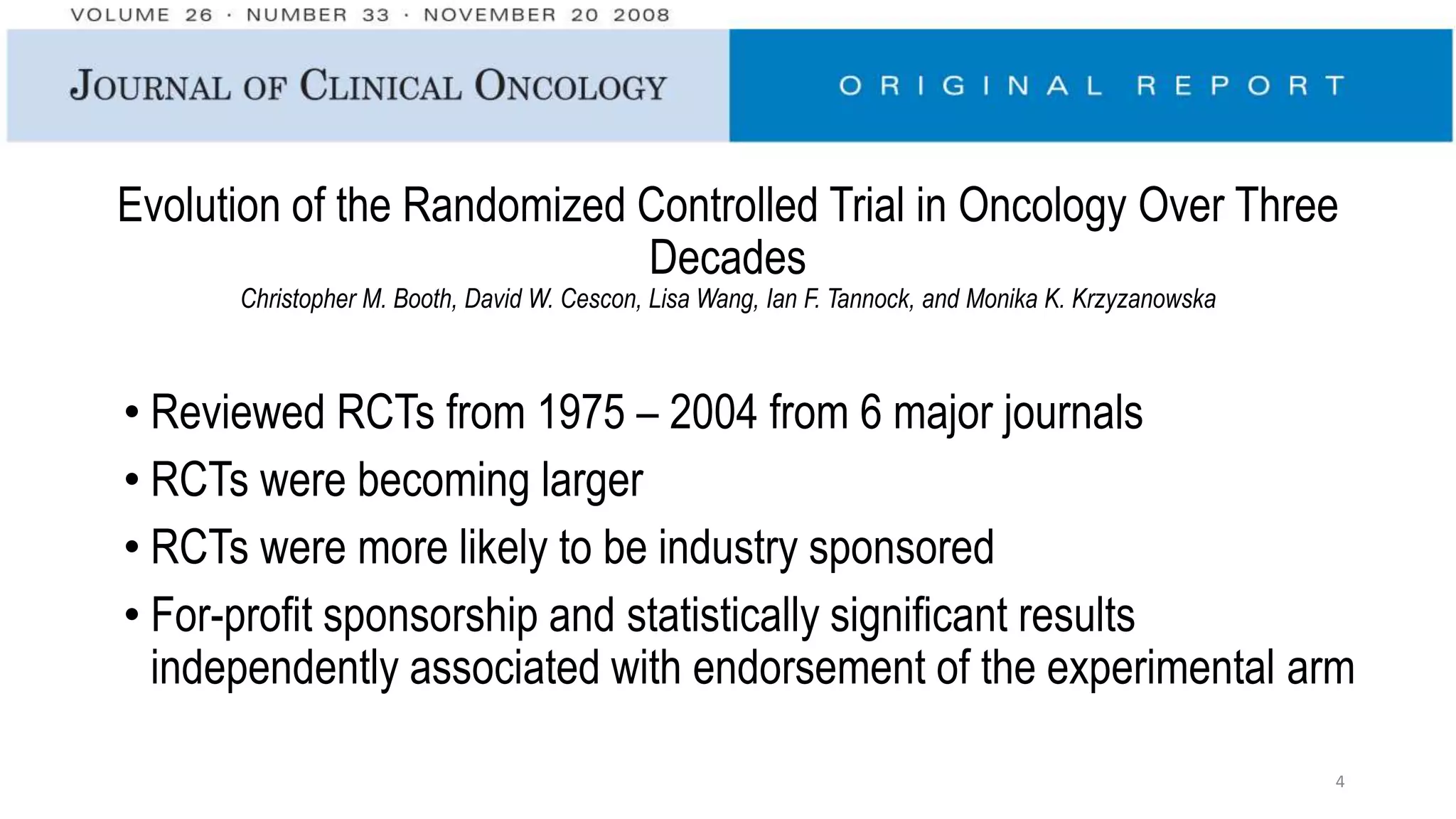
Evolution of the Randomized Controlled Trial in Oncology Over Three
Decades
Christopher M. Booth, David W. Cescon, Lisa Wang, Ian F. Tannock, and Monika K. Krzyzanowska
• Reviewed RCTs from 1975 – 2004 from 6 major journals
• RCTs were becoming larger
• RCTs were more likely to be industry sponsored
• For-profit sponsorship and statistically significant results
independently associated with endorsement of the experimental arm
4
Assessed for eligibility (n= )
Excluded (n= )
 Not meeting inclusion criteria (n= )
 Declined to participate (n= )
 Other reasons (n= )
Analysed (n= )
 Excluded from analysis (give reasons) (n= )
Lost to follow-up (give reasons) (n= )
Discontinued intervention (give reasons) (n= )
Allocated to intervention (n= )
 Received allocated intervention (n= )
 Did not receive allocated intervention (give
reasons) (n= )
Lost to follow-up (give reasons) (n= )
Discontinued intervention (give reasons) (n= )
Allocated to intervention (n= )
 Received allocated intervention (n= )
 Did not receive allocated intervention (give
reasons) (n= )
Analysed (n= )
 Excluded from analysis (give reasons) (n= )
Allocation
Analysis
Follow-Up
Randomized (n= )
Enrollment
CONSORT 2010 Flow Diagram
CONSORT STATEMENT
CONSOLIDATED STANDARDS
FOR REPORTING TRIALS
Evidence based, minimum set
of recommendations for
reporting randomized trials
5
Section/Topic
Item
No Checklist item
Reported
on page No
Title and abstract
1a Identification as a randomised trial in the title
1b Structured summary of trial design, methods, results, and conclusions (for specific guidance see CONSORT for abstracts)
Introduction
Background and
objectives
2a Scientific background and explanation of rationale
2b Specific objectives or hypotheses
Methods
Trial design 3a Description of trial design (such as parallel, factorial) including allocation ratio
3b Important changes to methods after trial commencement (such as eligibility criteria), with reasons
Participants 4a Eligibility criteria for participants
4b Settings and locations where the data were collected
Interventions 5 The interventions for each group with sufficient details to allow replication, including how and when they were
actually administered
Outcomes 6a Completely defined pre-specified primary and secondary outcome measures, including how and when they
were assessed
6b Any changes to trial outcomes after the trial commenced, with reasons
Sample size 7a How sample size was determined
7b When applicable, explanation of any interim analyses and stopping guidelines
Randomisation:
Sequence
generation
8a Method used to generate the random allocation sequence
8b Type of randomisation; details of any restriction (such as blocking and block size)
Allocation
concealment
mechanism
9 Mechanism used to implement the random allocation sequence (such as sequentially numbered containers),
describing any steps taken to conceal the sequence until interventions were assigned
Implementation 10 Who generated the random allocation sequence, who enrolled participants, and who assigned participants to
interventions
Blinding 11a If done, who was blinded after assignment to interventions (for example, participants, care providers, those
assessing outcomes) and how
11b If relevant, description of the similarity of interventions
Statistical methods 12a Statistical methods used to compare groups for primary and secondary outcomes
CONSORT
CHECKLIST
“12 894 women with early breast cancer who had
completed 5 years of treatment with tamoxifen were
randomly allocated to continue tamoxifen to 10 years or
stop at 5 years (open control). Allocation (1:1) was by
central computer, using minimization”
6
CONSORT
CHECKLIST
Statistical methods 12a Statistical methods used to compare groups for primary and secondary outcomes
12b Methods for additional analyses, such as subgroup analyses and adjusted analyses
Results
Participant flow (a
diagram is strongly
recommended)
13a For each group, the numbers of participants who were randomly assigned, received intended treatment, and
were analysed for the primary outcome
13b For each group, losses and exclusions after randomisation, together with reasons
Recruitment 14a Dates defining the periods of recruitment and follow-up
14b Why the trial ended or was stopped
Baseline data 15 A table showing baseline demographic and clinical characteristics for each group
Numbers analysed 16 For each group, number of participants (denominator) included in each analysis and whether the analysis was
by original assigned groups
Outcomes and
estimation
17a For each primary and secondary outcome, results for each group, and the estimated effect size and its
precision (such as 95% confidence interval)
17b For binary outcomes, presentation of both absolute and relative effect sizes is recommended
Ancillary analyses 18 Results of any other analyses performed, including subgroup analyses and adjusted analyses, distinguishing
pre-specified from exploratory
Harms 19 All important harms or unintended effects in each group (for specific guidance see CONSORT for harms)
Discussion
Limitations 20 Trial limitations, addressing sources of potential bias, imprecision, and, if relevant, multiplicity of analyses
Generalisability 21 Generalisability (external validity, applicability) of the trial findings
Interpretation 22 Interpretation consistent with results, balancing benefits and harms, and considering other relevant evidence
Other information
Registration 23 Registration number and name of trial registry
Protocol 24 Where the full trial protocol can be accessed, if available
Funding 25 Sources of funding and other support (such as supply of drugs), role of funders
7
NON – METASTATIC BREAST CANCER
LANDMARK TRIALS IN LOCOREGIONAL
TREATMENT
LANDMARK TRIALS IN SYSTEMIC
TREATMENT
LANDMARK TRIALS IN EVOLUTION OF
RADIOTHERAPY
8
LANDMARK TRIALS IN LOCOREGIONAL TREATMENT
REGIONAL
LYMPH NODES
BREAST
SURGERY
RADIOTHERAPY
9
Dr. William Halsted (holding a mallet) operates on a patient at Johns Hopkins in 1904
Revolutionized breast surgery by perfecting the radical mastectomy (Halsted
mastectomy) under asepsis, anaesthesia
Dr. William
Halsted
(1852 – 1922)
Father of
modern
surgery
10
1960s: scientists started questioning the status quo
1. Are there alternatives to this morbid surgery?
2. Is Halsted’s contiguous theory of spread (tumour -> lymph nodes ->
systemic spread) universally applicable?
3. Can the success of chemotherapy seen in other sites be replicated
here?
RADICAL MASTECTOMY Perils of poor cosmesis, lymphedema,
distant metastasis
11
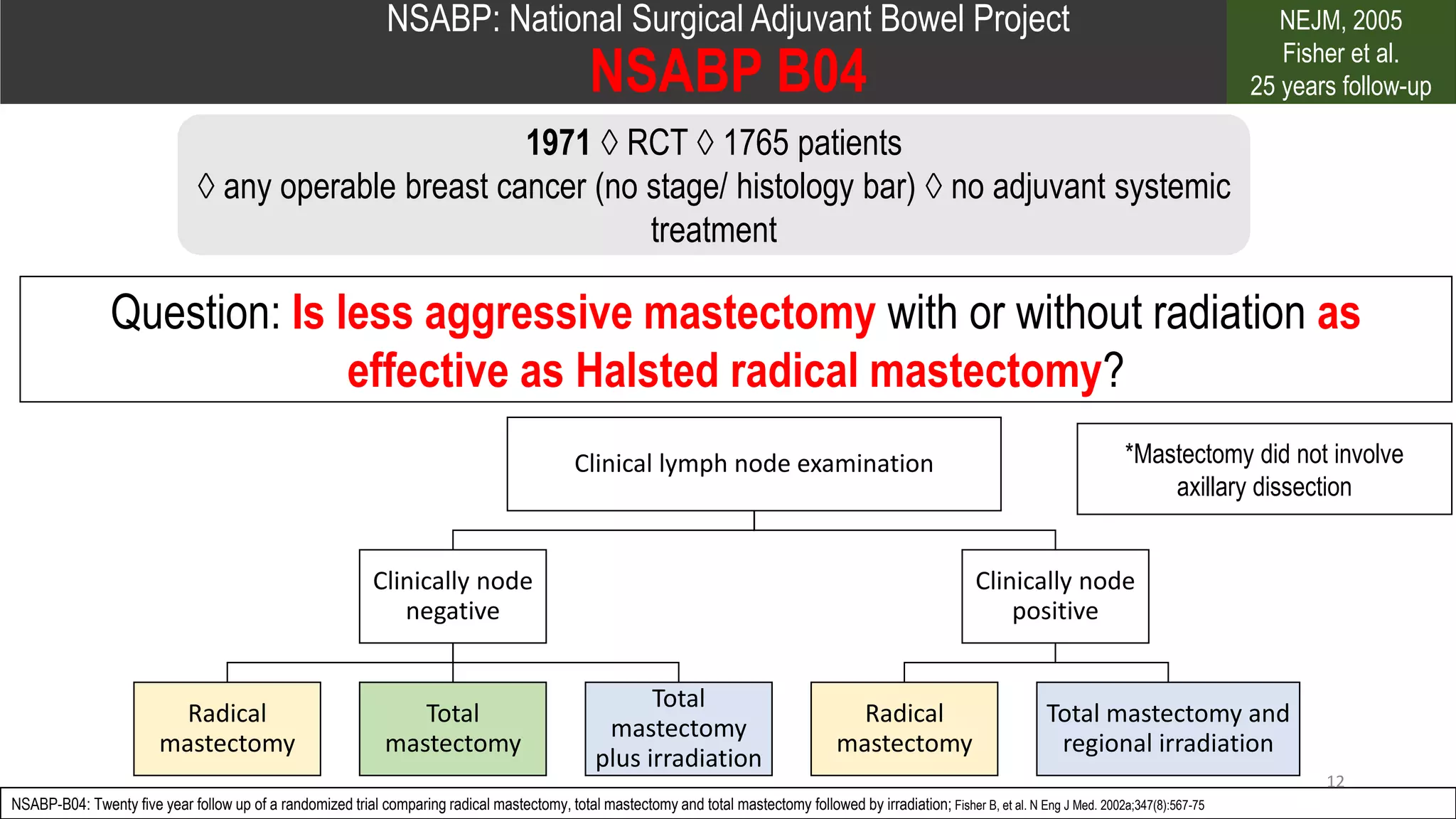
NSABP: National Surgical Adjuvant Bowel Project
NSABP B04
Question: Is less aggressive mastectomy with or without radiation as
effective as Halsted radical mastectomy?
NSABP-B04: Twenty five year follow up of a randomized trial comparing radical mastectomy, total mastectomy and total mastectomy followed by irradiation; Fisher B, et al. N Eng J Med. 2002a;347(8):567-75
1971 ◊ RCT ◊ 1765 patients
◊ any operable breast cancer (no stage/ histology bar) ◊ no adjuvant systemic
treatment
Clinical lymph node examination
Clinically node
negative
Radical
mastectomy
Total
mastectomy
Total
mastectomy
plus irradiation
Clinically node
positive
Radical
mastectomy
Total mastectomy and
regional irradiation
NEJM, 2005
Fisher et al.
25 years follow-up
*Mastectomy did not involve
axillary dissection
12
Radiotherapy details
Node negative
(*radiation not addressing the
regional lymph nodes)
Chest wall: 50 Gy in
25 fractions
Node positive
Chest wall: 50 Gy in
25 fractions -> 10 –
20 Gy boost
45 Gy in 25 fractions
to supraclavicular
fossa and internal
mammary chain
NSABP B04
Supervoltage: 500 kV to 1 MV
13
STATISTICAL ANALYSIS
• Local recurrence: Tumor recurrences in the chest wall, surgical scar or both
• Regional recurrence: recurrences in supraclavicular, subclavicular or internal
mammary nodes or in the ipsilateral axilla (radical mastectomy or total
mastectomy and regional irradiation
• End points:
• Disease Free Survival
• Relapse Free Survival
• Overall survival
NSABP B04
14
Event All women (N = 1665)
Any event 1372 (82%)
Any recurrence other than
contralateral breast
755 (45%)
Local recurrence 81 (5%)
Regional recurrence 108 (6%)
Distant recurrence 566 (34%)
Contralateral breast cancer 105 (6%)
Second primary cancer
other than breast
99 (6%)
Dead, no evidence of
cancer
413 (25%)
Alive, event free 293 (18%)
NSABP B04
RESULTS: 25 years follow up
Local recurrence across groups
Clinically
Node Positive
Clinically node
negative
Radical
mastectomy
16% 9%
Total
mastectomy and
irradiation
14% 4%
Total
mastectomy
14%
Any event = Any recurrence (local +
regional + distant) + contralateral breast
cancer + second primary cancer + death
(no evidence of cancer)
15
Disease-free survival: first local, regional, or distant recurrence of tumor; contralateral breast cancer or a
second primary tumor other than a tumor in the breast; and death of a woman who had no evidence of cancer
NSABP B04
DFS across groups
Clinically
Node
Positive
Clinically
node
negative
Radical
mastectomy
11% 19%
Total
mastectomy
and
irradiation
10% 13%
Total
mastectomy
19%
16
CONCLUSION
• No survival advantage of radical mastectomy in any group
• 40% of clinically node negative patients had pathologically positive
nodes on radical mastectomy
• 19% of clinically node negative patients developed axillary
metastasis on follow up
NSABP B04
Less extensive mastectomy is as effective as radical mastectomy
Limitation:
• Toxicity, QOL not documented
• 25% total mastectomy cases: inadvertent removal of axillary lymph nodes
17
MILAN TRIAL
NEJM, 2002
Veronesi et al.
20 years follow-up
Question: Is breast conservative treatment safe in early breast cancer?
Stage I (< 2cm)
Radical mastectomy
Quadrantectomy with
radiation
1973 ◊ RCT ◊ 701 patients
◊Stage I (< 2 cm) operable breast cancer ◊ adjuvant systemic treatment
(CMF) for node positive patient
No difference in survival end-points: Breast cancer mortality (26% versus 24%), OS (41% both
groups); local recurrence in BCS group more
*Whole breast irradiation by
LINAC/ Cobalt 60 using
tangents; regional nodal
irradiation in node positive
patients
Veronesi U, Cascinelli N, Mariani L, Greco M, Saccozzi R, Luini A, Aguilar M, Marubini E. Twenty-year follow-up of a randomized study comparing breast-conserving
surgery with radical mastectomy for early breast cancer. N Engl J Med. 2002 Oct 17;347(16):1227-32
18
NSABP B06
Question: Is lumpectomy with or without radiation therapy as
effective as total mastectomy in Stage I or II breast cancer (< 4 cm)?
NSABP B-06: Twenty-year follow-up of a randomized trial comparing total mastectomy, lumpectomy and lumpectomy plus irradiation for the treatment of invasive breast cancer; Fisher B, et al. N Engl J Med. 2002b;347(16):1233-41
1976 ◊ RCT ◊ 1851 patients
◊Stage I, II (< 4 cm) operable breast cancer ◊ adjuvant systemic treatment (melphalan or 5
FU) for node positive patient
NEJM, 2002
Fisher et al.
20 years follow-up
Stage I, II (< 4cm)
N = 1851
Total mastectomy
Lumpectomy with
radiation
Lumpectomy without
radiation
*All patients underwent axillary dissection (only
level I II for lumpectomy patients)
19
NSABP B06
Cumulative incidence of recurrence for all BCS patients
20 year
results
Recurrence
after
lumpectomy
alone
Recurrence
rate after
lumpectomy
plus irradiation
P value
All BCS
patients
39.2% 14.3% P<0.001
Negative
nodes
36.2% 17% P<0.001
Positive
nodes
44.2% 8.8% P <0.001
Significant decrease in risk of ipsilateral tumour
recurrence after radiation regardless of nodal status in
patients undergoing BCS
RESULTS: 20 years follow up
20
CONCLUSION
• No difference in DFS (~ 35%), distant disease free survival (~ 45%) and overall survival
between groups (~ 47%)
• Significant decrease in risk of ipsilateral tumour recurrence after radiation regardless of
nodal status
NSABP B06
Local recurrence: Lumpectomy + irradiation < Lumpectomy = Total mastectomy
• All patients underwent ALND
• Survival end points equal
BCT (BCS + Radiotherapy) is the new standard of care for early stage
breast cancer
21
LANDMARK TRIALS IN LOCOREGIONAL TREATMENT
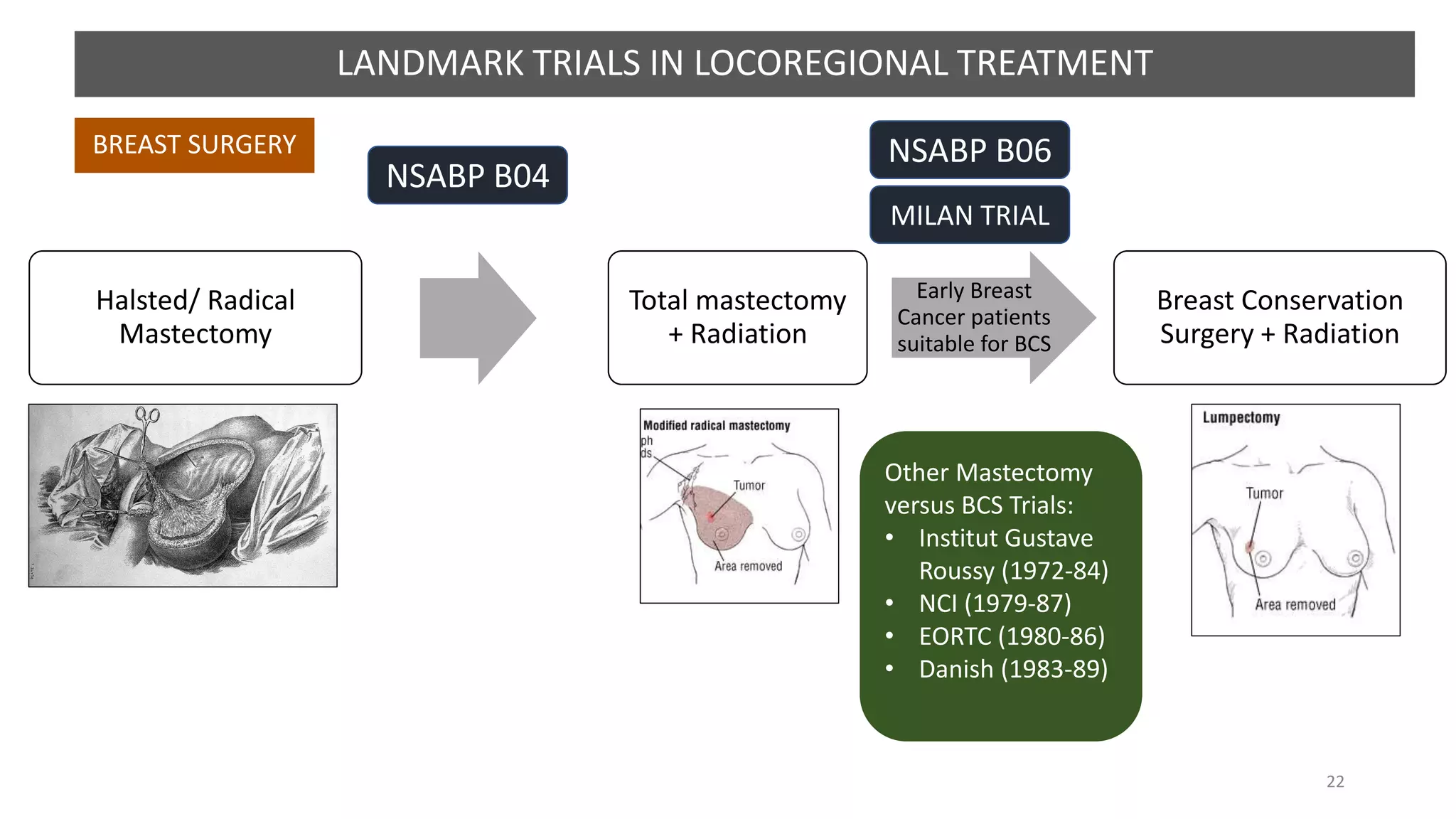
BREAST SURGERY
Halsted/ Radical
Mastectomy
Total mastectomy
+ Radiation
Early Breast
Cancer patients
suitable for BCS
Breast Conservation
Surgery + Radiation
NSABP B04
MILAN TRIAL
NSABP B06
Other Mastectomy
versus BCS Trials:
• Institut Gustave
Roussy (1972-84)
• NCI (1979-87)
• EORTC (1980-86)
• Danish (1983-89)
22
LANDMARK TRIALS IN LOCOREGIONAL TREATMENT
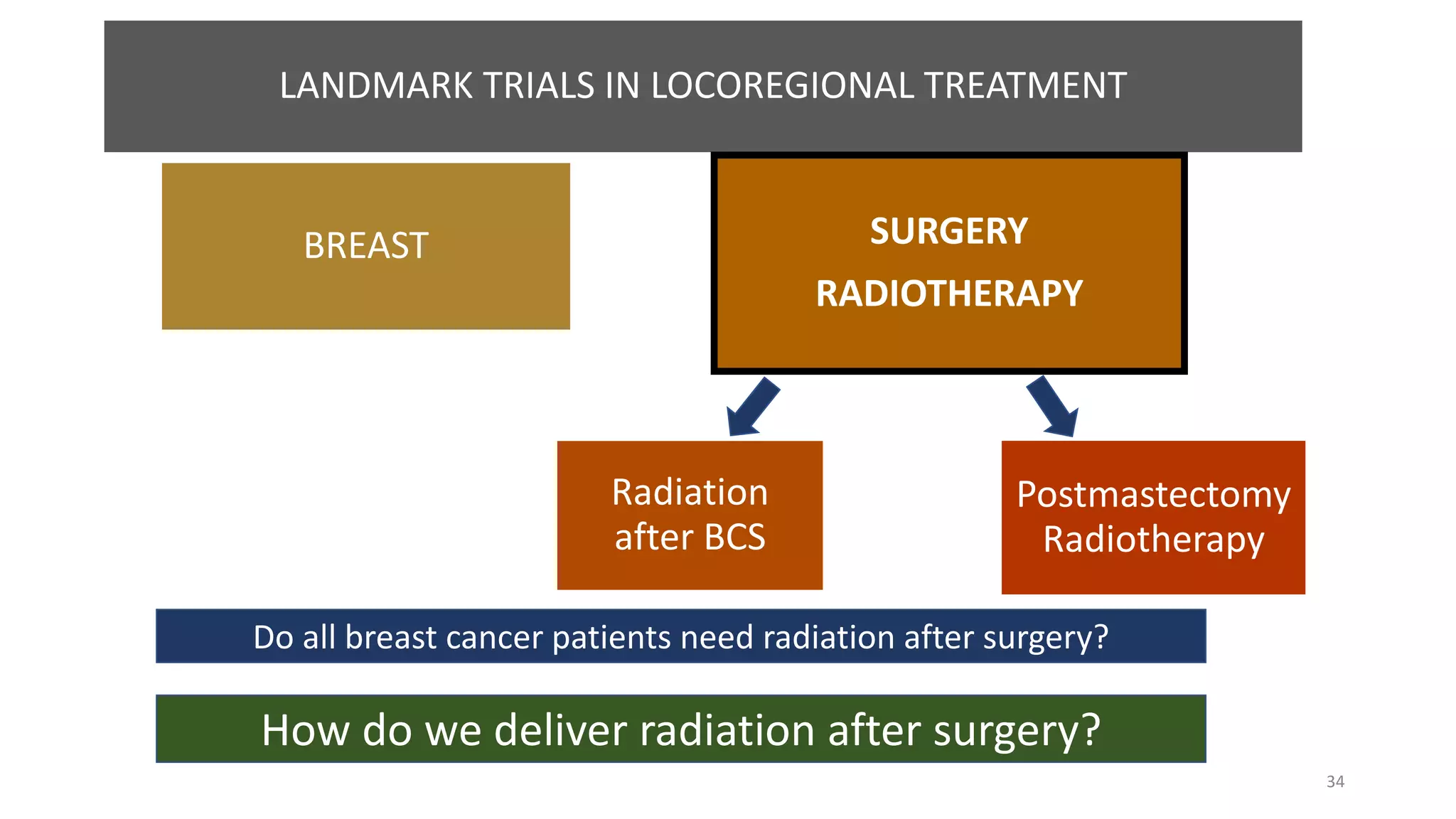
BREAST
SURGERY
RADIOTHERAPY
Radiation
after BCS
Postmastectomy
Radiotherapy
Do all breast cancer patients need radiation after surgery?
23
Radiation after BCS
24
EBCTG Metanalysis
Effect of Radiotherapy after Breast Conservation Surgery
Lancet, 2011
Darby et al.
Early Breast Cancer Trialists' Collaborative Group (EBCTCG), Darby S, McGale P, et al. Effect of radiotherapy after breast-conserving surgery on 10-year recurrence and 15-year breast cancer
death: meta-analysis of individual patient data for 10,801 women in 17 randomised trials. Lancet. 2011;378(9804):1707-1716.
2011 ◊ Metanalysis ◊ 10801 patients, 17 RCTs
◊ Trials comparing radiotherapy versus no
radiotherapy after BCS
1. 10-year risk of first recurrence: 15.7 % absolute reduction
(35% to 19%, 2p<0.00001)
2. 15-year risk of breast cancer death: 3.4 % absolute
reduction (25% to 21%, 2p=0.00005)
“one breast cancer death was avoided by year 15 for every
four recurrences avoided by year 10”
by year 10
After BCS: RT to the conserved breast halves the rate at
which the disease recurs and reduces the breast cancer
death rate by about a sixth
25
Bartelink H, Maingon P, Poortmans P, et al. Whole-breast irradiation with or without a boost for patients treated with breast-conserving surgery for early breast cancer: 20-year
follow-up of a randomised phase 3 trial [published correction appears in Lancet Oncol. 2015 Jan;16(1):e6]. Lancet Oncol. 2015;16(1):47-56.
EORTC trial
Whole breast irradiation with or without boost
Lancet Oncology, 2015
Bartelink et al.
20 years follow-up
Question: How does a radiation boost following whole breast irradiation impact overall survival, local
control and fibrosis for early breast cancer patients?
Early breast cancer: Post BCS, pT1-2, pN0-1, M0 ◊ n = 5569
◊ Adjuvant chemotherapy when indicated
Early BC post lumpectomy, axillary dissection
Whole breast
irradiation
50 Gy/ 25 fractions/ 5
weeks
Whole breast irradiation (50
Gy/25 fractions) followed by
16 Gy/8 fractions boost
• Radiation boost improves local control (20
years cumulative: 16% in no boost versus
12% boost (more for younger age)
• No OS benefit
• Moderately increases severe fibrosis
• Can be avoided in women > 60 years
26
CALGB 9343
Cancer and Leukemia Group B (CALGB) 9343: Lumpectomy plus tamoxifen with or without irradiation in women age 70 years or older with early breast cancer: long term follow up of CALGB 9343; Hughes K, et al.
J ClinOncol. 2013;31(19):2382-7
Question: Can adjuvant radiation be omitted in a select group of older (> 70 years), Stage I, estrogen
receptor positive breast cancer patients who had undergone breast conservation surgery?
JCO, 2013
Hughes et al.
10 years follow-up
Early breast cancer post lumpectomy
Lumpectomy plus tamoxifen with radiation Lumpectomy plus tamoxifen without radiation
1994 ◊ RCT ◊ 636 patients
◊ > 70 years, BCS, negative margins ◊ lymph node negative ◊ER positive
No statistical significance in overall survival, breast cancer specific survival
Impact of breast cancer on mortality is low in this group of patients:
21 patients (3%) died as a result of breast cancer; 313 (49%) deaths due to other causes
27
Postmastectomy
Radiotherapy
28
Danish Breast Cancer Trials: 82b, 82c
Radiotherapy and Oncology, 2007
Overgaard et al.
15 years follow-up
Overgaard M, Nielsen HM, Overgaard J. Is the benefit of postmastectomy irradiation limited to patients with four or more positive nodes, as
recommended in international consensus reports? A subgroup analysis of the DBCG 82 b&c randomized trials. Radiother Oncol. 2007;82(3):247-253
1982-89 ◊ RCT ◊ 1708 patients
◊ Premenopausal, high risk (T3, T4,
node positive, fascia, skin
involvement)
◊ 9 cycles CMF ◊ Mastectomy and
axillary dissection
1982-90 ◊ RCT ◊ 1375 patients
◊ Postmenopausal ◊high risk
(T3, T4, node positive, fascia,
skin involvement)
Mastectomy and one year
Tamoxifen
82b 82c
82b
No adjuvant
postmastectomy
RT
Postmastectomy RT
(PMRT)
82c
No adjuvant
postmastectomy
RT
Postmastectomy RT
(PMRT)
RT: 50 Gy/ 25#, 48 Gy/22# to
chest wall, SCF, IMN
*Seminal trial in describing
PMRT radiation volumes
*2D planning
29
15 years: Postmastectomy RT improved
OS, locoregional control in both patients
having 1 – 3 lymph nodes positive, >= 4
lymph nodes positive
Post mastectomy RT improves OS,
locoregional control in node
positive patients
30
Early Breast Cancer Trialists’ Collaborative Group (EBCTCG). Effect of Radiotherapy After Mastectomy
and Axillary Surgery on 10-year Recurrence and 20-year Breast Cancer Mortality: Meta-analysis of
Question: Is there any benefit of adding radiation post
mastectomy and axillary dissection in women with one to
three positive nodes?
EBCTG Postmastectomy Metanalysis 2014
Lancet, 2014
20 years follow up
22 trials from 1964–86 ◊ Metanalysis
◊ 8135 patients
◊ Trials post mastectomy and axillary surgery with and
without radiotherapy to the chest wall and regional lymph
nodes
31
1 – 3 lymph nodes positive:
radiotherapy reduced
locoregional recurrence,
overall recurrence and
breast cancer mortality
(irrespective of adjuvant
chemotherapy)
“For every 1.5
recurrences avoided in
first 10 years, 1 breast
cancer death avoided”
32
LANDMARK TRIALS IN LOCOREGIONAL TREATMENT
BREAST SURGERY
Halsted/ Radical
Mastectomy
Total mastectomy
+ Radiation
Early Breast
Cancer patients
suitable for BCS
Breast Conservation
Surgery + Radiation
NSABP B04
MILAN TRIAL
NSABP B06
Other Mastectomy
versus BCS Trials:
• Institut Gustave
Roussy (1972-84)
• NCI (1979-87)
• EORTC (1980-86)
• Danish (1983-89)
2011 EBCTG
Metanalysis for effect of RT post BCS
*CALGB 9343: Omission of RT post
BCS in select older, low risk patients
Early BC not
suitable/ opting
for BCS, LABC
Postmastectomy RT
in node positive
patients
2014 EBCTG
Postmastectomy metanalysis
Other PMRT trials: British
Columbia
Danish BC trial
82b, 82c
33
LANDMARK TRIALS IN LOCOREGIONAL TREATMENT
BREAST SURGERY
RADIOTHERAPY
Radiation
after BCS
Postmastectomy
Radiotherapy
Do all breast cancer patients need radiation after surgery?
How do we deliver radiation after surgery?
34
NON – METASTATIC BREAST CANCER
LANDMARK TRIALS IN LOCOREGIONAL
TREATMENT
LANDMARK TRIALS IN SYSTEMIC
TREATMENT
LANDMARK TRIALS IN EVOLUTION OF
RADIOTHERAPY
35
HYPOFRACTIONATION
36
N = 2236
1998
50 Gy/ 25 fractions/ 5
weeks
41.6/ 13 fractions/ 5 weeks
(3.2 Gy/#)
Mon/Wed/Sat, Tue/Thu
alternating weeks
N = 2215
1999
50 Gy/ 25
fractions/ 5 weeks
40 Gy/ 15
fractions/ 3 weeks
(2.67 Gy/#)
Question: What is the benefit of radiotherapy schedule using fraction sizes greater than 2 Gy in terms
of tumour local control, normal tissue responses, quality of life, economic consequences?
START: STANDARDIZATION OF BREAST RADIOTHERAPY TRIALS
Haviland JS, Owen JR, Dewar JA, et al. The UK Standardisation of Breast Radiotherapy (START) trials of radiotherapy hypofractionation for treatment of early breast cancer: 10-year follow-up results of two
randomised controlled trials. Lancet Oncol. 2013;14(11):1086-1094.
Lancet Oncology, 2013
Haviland et al.
10 years follow-up
START A
Early breast cancer: Post BCS/Mastectomy, pN0-1, M0
◊ Adjuvant chemotherapy when indicated
START B
37
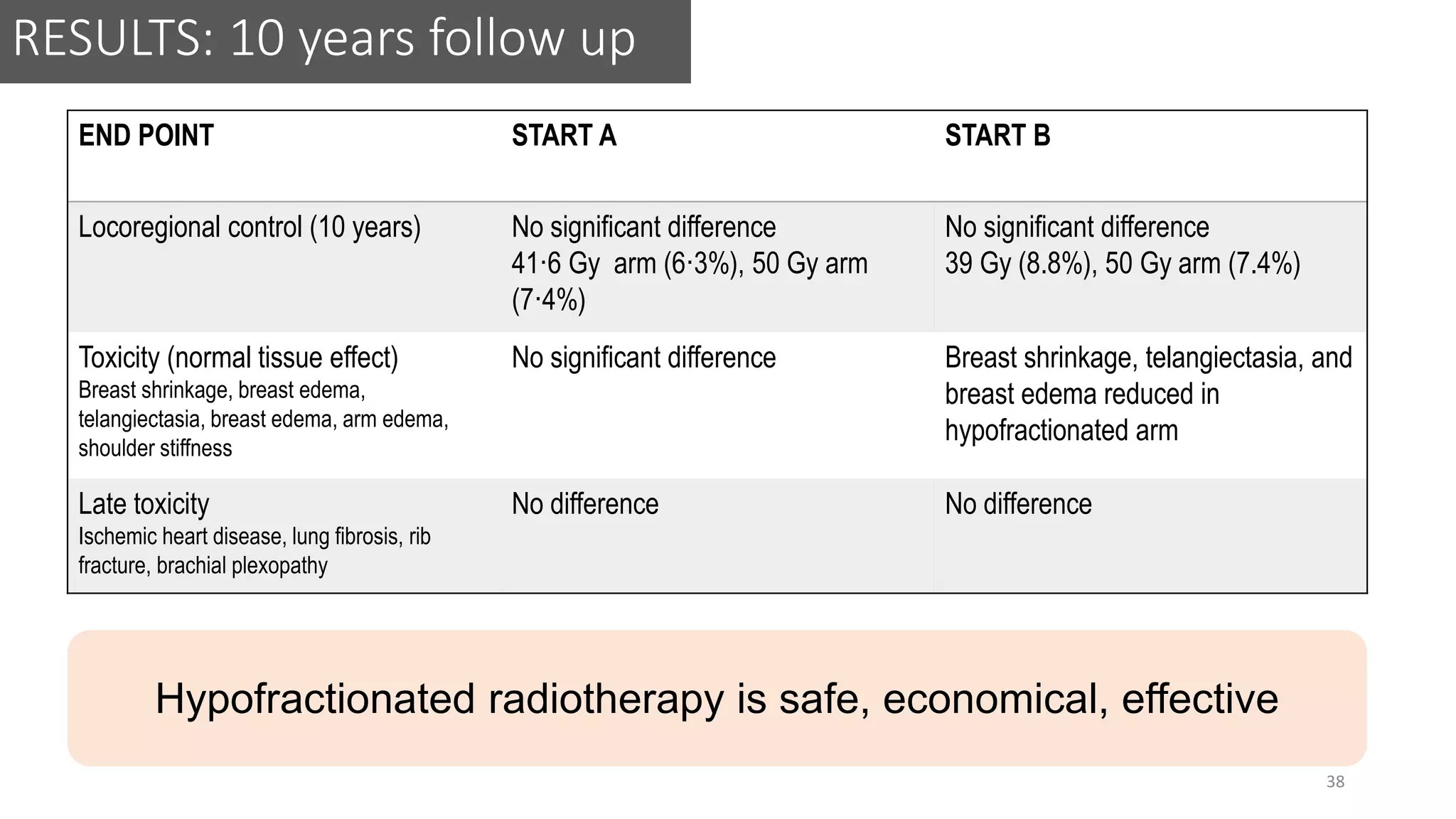
END POINT START A START B
Locoregional control (10 years) No significant difference
41·6 Gy arm (6·3%), 50 Gy arm
(7·4%)
No significant difference
39 Gy (8.8%), 50 Gy arm (7.4%)
Toxicity (normal tissue effect)
Breast shrinkage, breast edema,
telangiectasia, breast edema, arm edema,
shoulder stiffness
No significant difference Breast shrinkage, telangiectasia, and
breast edema reduced in
hypofractionated arm
Late toxicity
Ischemic heart disease, lung fibrosis, rib
fracture, brachial plexopathy
No difference No difference
Hypofractionated radiotherapy is safe, economical, effective
RESULTS: 10 years follow up
38
PGI Hypofractionation trial
IJORBP, 2017
Yadav et al.
4 years follow-up
Question: Is hypofractionated adjuvant radiotherapy to whole breast/ chest wall and/or regional nodal
radiation feasible?
◊2013 ◊ Phase II study ◊ N = 50
◊ Post BCS/Mastectomy, pT1-3a, pN0-1, M0
◊ Adjuvant chemotherapy when indicated
Yadav BS, Sharma SC. A Phase 2 Study of 2 Weeks of Adjuvant Whole Breast/Chest Wall and/or Regional Nodal Radiation Therapy for Patients With
Breast Cancer. Int J Radiat Oncol Biol Phys. 2018;100(4):874-881
Hypo-fractionated RT: 34 Gy / 10 fractions / 2 weeks
BCS: boost: 10 Gy/ 5 fractions / 1 week
Primary objectives:
• Acute grade 2 and 3
skin toxicity was seen in 16 (32%) and 1 (2%)
patients
• Cosmesis was excellent/good in
8(80%) and fair/poor in 2(20%) patients
Hypofractionated radiotherapy in 2
weeks = 3 weeks in terms of feasibility
39
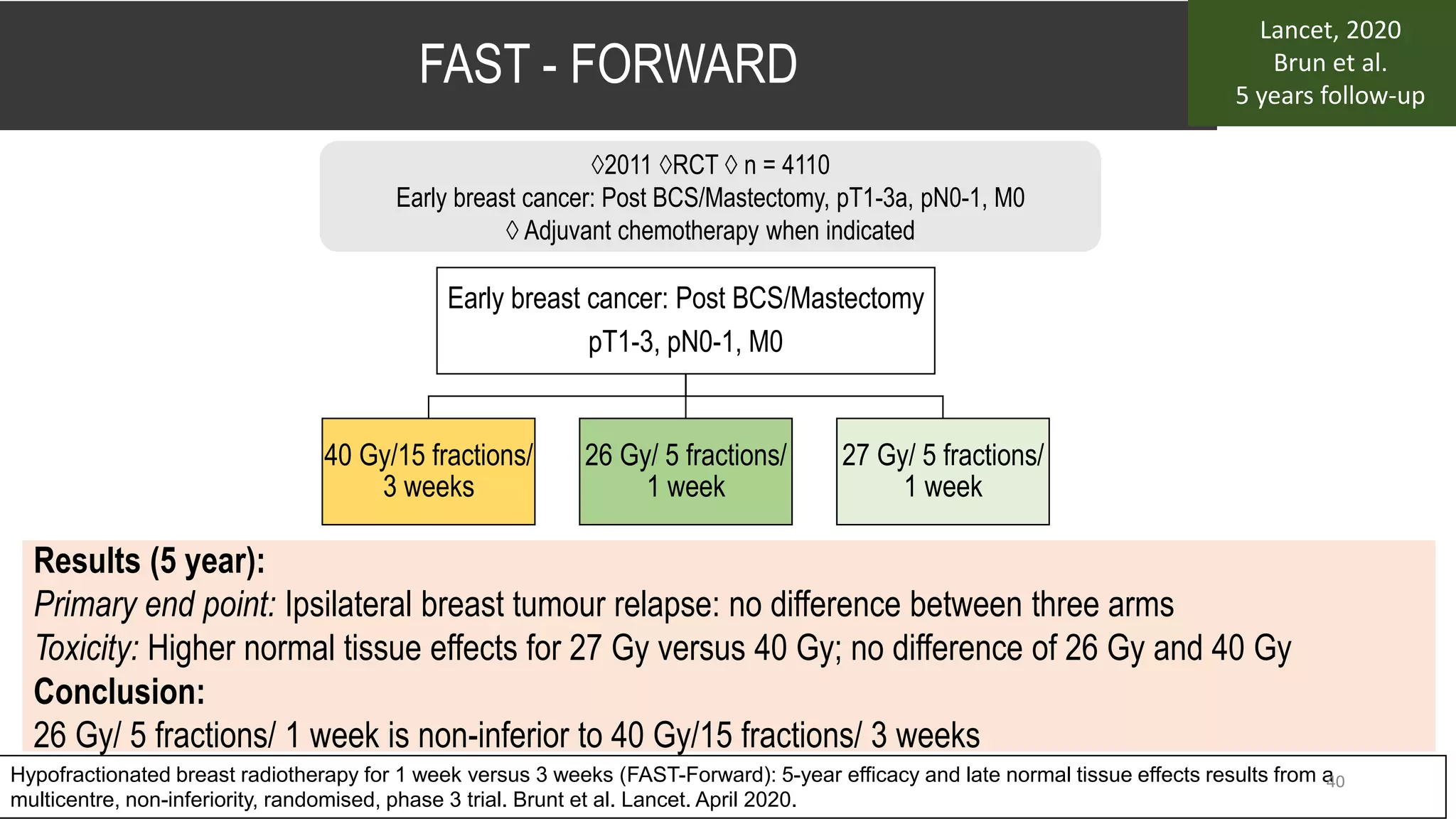
FAST Forward Trial
Early breast cancer: Post BCS/Mastectomy
pT1-3, pN0-1, M0
40 Gy/15 fractions/
3 weeks
26 Gy/ 5 fractions/
1 week
27 Gy/ 5 fractions/
1 week
Hypofractionated breast radiotherapy for 1 week versus 3 weeks (FAST-Forward): 5-year efficacy and late normal tissue effects results from a
multicentre, non-inferiority, randomised, phase 3 trial. Brunt et al. Lancet. April 2020.
Results (5 year):
Primary end point: Ipsilateral breast tumour relapse: no difference between three arms
Toxicity: Higher normal tissue effects for 27 Gy versus 40 Gy; no difference of 26 Gy and 40 Gy
Conclusion:
26 Gy/ 5 fractions/ 1 week is non-inferior to 40 Gy/15 fractions/ 3 weeks
FAST - FORWARD
Lancet, 2020
Brun et al.
5 years follow-up
◊2011 ◊RCT ◊ n = 4110
Early breast cancer: Post BCS/Mastectomy, pT1-3a, pN0-1, M0
◊ Adjuvant chemotherapy when indicated
40
PARTIAL BREAST IRRADIATION (PBI)/ ACCELERATED
PARTIAL BREAST IRRADIATION (APBI)
41
Hickey BE, Lehman M, Francis DP, See AM. Partial breast irradiation for early breast cancer. Cochrane Database Syst Rev. 2016 Jul 18;7(7):CD007077.
Cochrane review: Partial breast irradiation for EBC Cochrane database, 2016
Hickey et al.
Question: Is partial breast irradiation/ accelerated partial breast irradiation equivalent to or better than
conventional or hypofractionated whole breast radiotherapy after BCS for EBC?
• Local recurrence-free survival appeared worse for women receiving PBI/APBI compared to WBRT (hazard ratio
(HR) = 1.62)
• Late toxicity (subcutaneous fibrosis) more, acute toxicity less with PBI
• No difference in survival, distant metastasis free survival, mastectomy rates
42
NSABP B-39/RTOG 0413
Lancet, 2019
Vicini et al.
10 years follow-up
Vicini FA, Cecchini RS, White JR, et al. Long-term primary results of accelerated partial breast irradiation after breast-conserving surgery for early-
stage breast cancer: a randomised, phase 3, equivalence trial. Lancet. 2019;394(10215):2155-2164
Question: Is Accelerated Partial Breast Irradiation (APBI) to only the tumour bearing quadrant an
effective alternative to whole breast irradiation?
◊ 2005, ◊ N = 4216
Early breast cancer: Post BCS, pT1-2, pN0-1, M0, ◊Age > 18 years
◊ Adjuvant chemotherapy when indicated
Early BC post lumpectomy, axillary dissection
Whole breast
irradiation (50 Gy/25
#) with/without
tumour bed boost
APBI: Accelerated Partial
Breast Irradiation
APBI delivery:
1. Interstitial Brachytherapy (6%)
2. MammoSite (21%)
3. 3D Conformal EBR (73%)
Dose:
• 34 Gy of brachytherapy
• 38.5 Gy of external bream radiation
Fractionation: 10 fractions, 2 fractions per day,
5 treatment days within an 8-day period
43
10-year cumulative incidence of IBTR: 4.6% in the APBI group versus 3.9% in the whole-breast irradiation group
• APBI did not meet the criteria for equivalence to whole-breast irradiation in controlling IBTR for
breast-conserving therapy
• However, with an absolute difference of less than 1% in the 10-year cumulative incidence of
IBTR, APBI might be an acceptable alternative for some women
44
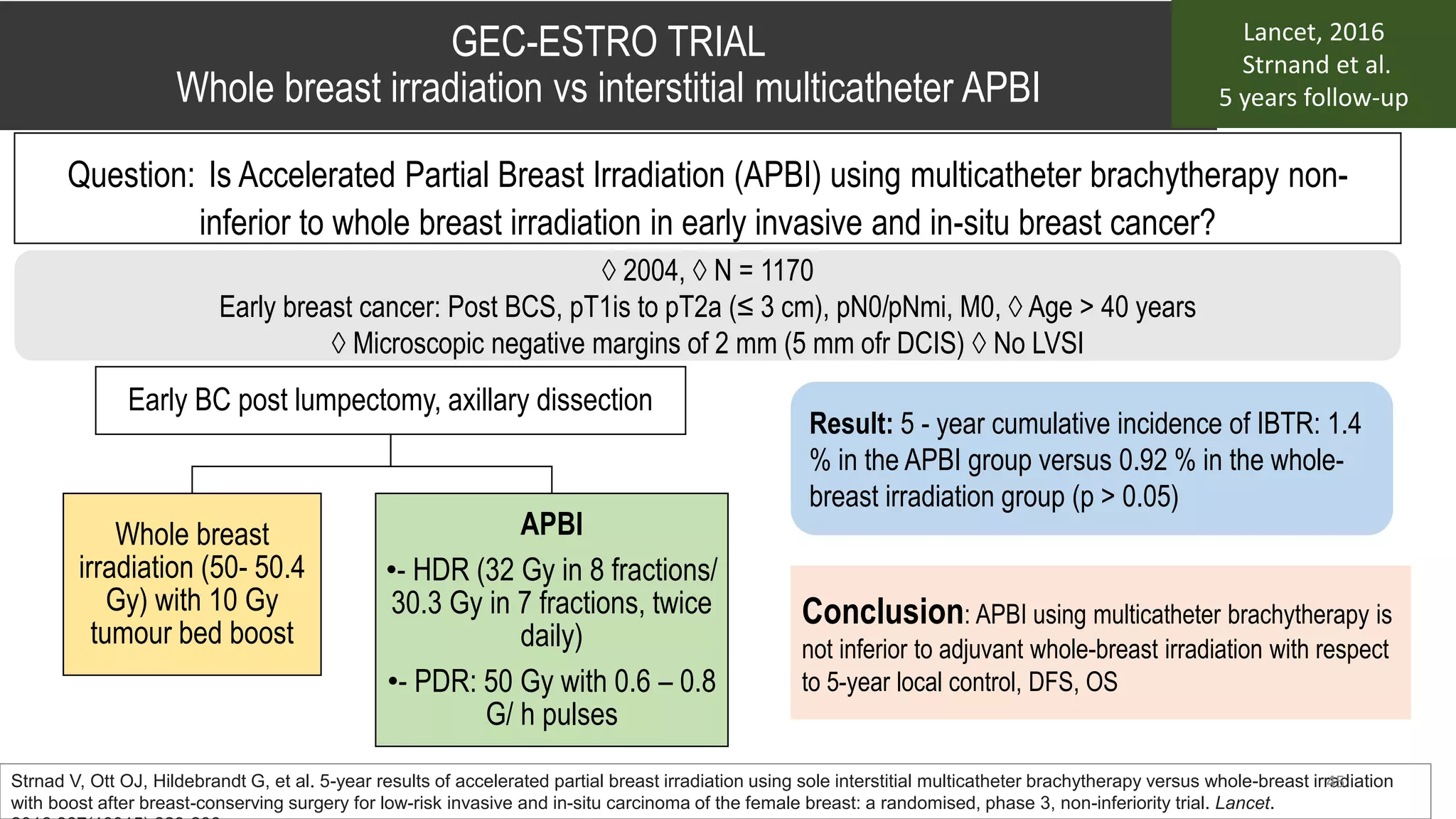
Strnad V, Ott OJ, Hildebrandt G, et al. 5-year results of accelerated partial breast irradiation using sole interstitial multicatheter brachytherapy versus whole-breast irradiation
with boost after breast-conserving surgery for low-risk invasive and in-situ carcinoma of the female breast: a randomised, phase 3, non-inferiority trial. Lancet.
GEC-ESTRO TRIAL
Whole breast irradiation vs interstitial multicatheter APBI
Lancet, 2016
Strnand et al.
5 years follow-up
Question: Is Accelerated Partial Breast Irradiation (APBI) using multicatheter brachytherapy non-
inferior to whole breast irradiation in early invasive and in-situ breast cancer?
◊ 2004, ◊ N = 1170
Early breast cancer: Post BCS, pT1is to pT2a (≤ 3 cm), pN0/pNmi, M0, ◊ Age > 40 years
◊ Microscopic negative margins of 2 mm (5 mm ofr DCIS) ◊ No LVSI
Early BC post lumpectomy, axillary dissection
Whole breast
irradiation (50- 50.4
Gy) with 10 Gy
tumour bed boost
APBI
•- HDR (32 Gy in 8 fractions/
30.3 Gy in 7 fractions, twice
daily)
•- PDR: 50 Gy with 0.6 – 0.8
G/ h pulses
Result: 5 - year cumulative incidence of IBTR: 1.4
% in the APBI group versus 0.92 % in the whole-
breast irradiation group (p > 0.05)
Conclusion: APBI using multicatheter brachytherapy is
not inferior to adjuvant whole-breast irradiation with respect
to 5-year local control, DFS, OS
45
ASTRO CONSENSUS STATEMENT 2018
46
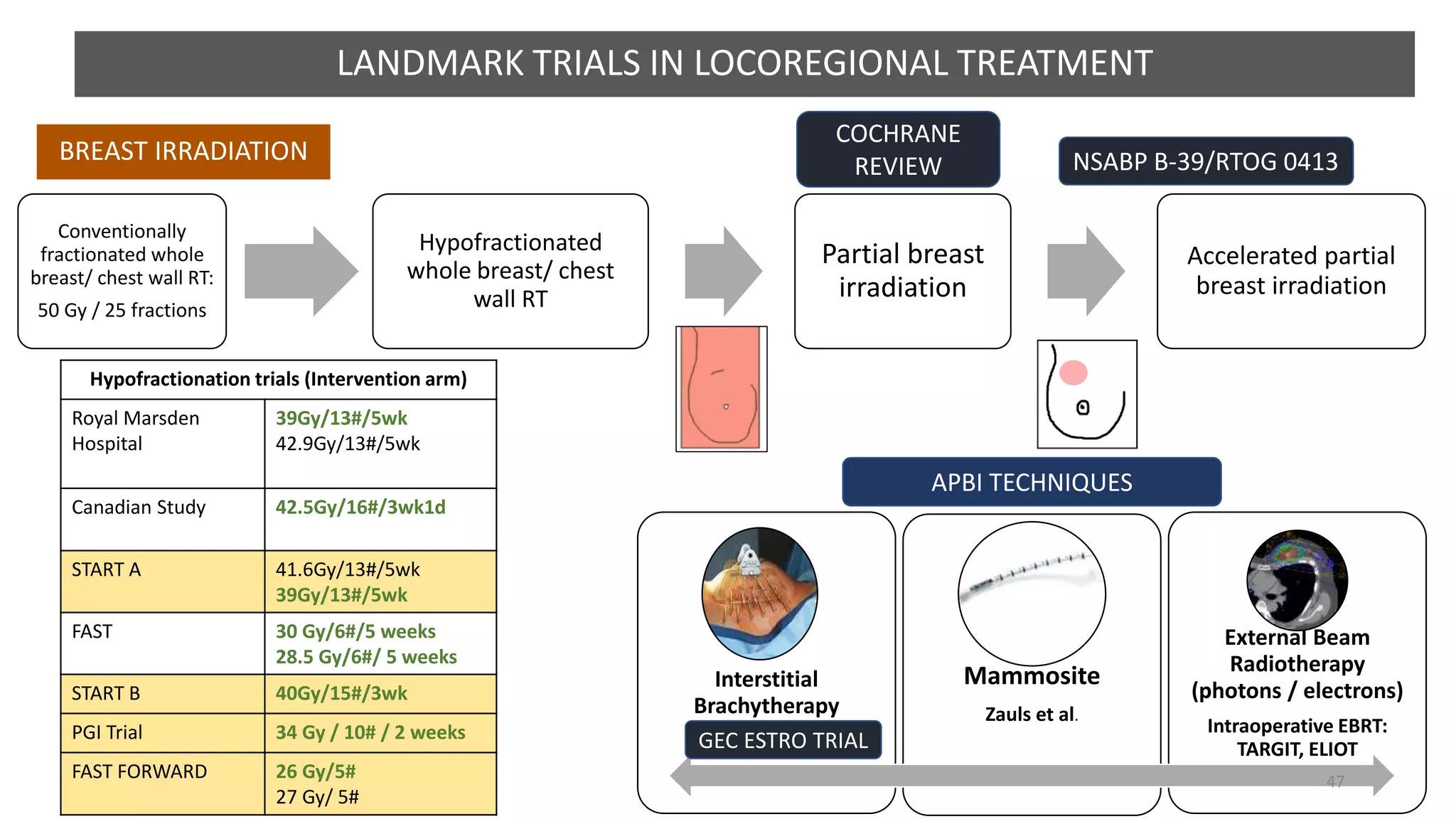
LANDMARK TRIALS IN LOCOREGIONAL TREATMENT
BREAST IRRADIATION
Conventionally
fractionated whole
breast/ chest wall RT:
50 Gy / 25 fractions
Hypofractionated
whole breast/ chest
wall RT
Partial breast
irradiation
Accelerated partial
breast irradiation
Interstitial
Brachytherapy
Mammosite
Zauls et al.
External Beam
Radiotherapy
(photons / electrons)
Intraoperative EBRT:
TARGIT, ELIOT
Hypofractionation trials (Intervention arm)
Royal Marsden
Hospital
39Gy/13#/5wk
42.9Gy/13#/5wk
Canadian Study 42.5Gy/16#/3wk1d
START A 41.6Gy/13#/5wk
39Gy/13#/5wk
FAST 30 Gy/6#/5 weeks
28.5 Gy/6#/ 5 weeks
START B 40Gy/15#/3wk
PGI Trial 34 Gy / 10# / 2 weeks
FAST FORWARD 26 Gy/5#
27 Gy/ 5#
COCHRANE
REVIEW NSABP B-39/RTOG 0413
APBI TECHNIQUES
GEC ESTRO TRIAL
47
BREAST SURGERY
Halsted/ Radical
Mastectomy
Total mastectomy
+ Radiation
Early Breast
Cancer patients
suitable for BCS
Breast Conservation
Surgery + Radiation
NSABP B04
MILAN TRIAL
NSABP B06
LANDMARK TRIALS IN LOCOREGIONAL TREATMENT
BREAST IRRADIATION
Conventionally
fractionated whole
breast/ chest wall RT:
50 Gy / 25 fractions
Hypofractionated
whole breast/ chest
wall RT
Partial breast
irradiation
Accelerated partial
breast irradiation
IMPORT LOW NSABP B-39/RTOG 0413
Postmastectomy RT in node
positive patients
2014 EBCTG
Postmastectomy metanalysis
2011 EBCTG
Metanalysis for effect of RT post BCS
48
LANDMARK TRIALS IN LOCOREGIONAL TREATMENT
REGIONAL LYMPH NODES
SURGERY
RADIOTHERAPY
49
Sentinel lymph node resection compared with conventional axillary lymph node dissection in clinically node negative patients with breast cancer: overall survival findings from the NSABP B-32
randomized phase 3 trial; Krag D, et al. Lancet Oncol. 2010;11(10):927-33
Question: Can sentinel lymph node biopsy be an alternative to axillary lymph node
dissection in some women with clinically negative axillary lymph nodes?
NSABP B32
Lancet oncology, 2010
Krag D et al.
8 years follow-up
1999 ◊ RCT ◊ 5611 patients
◊Invasive breast cancer with clinically negative nodes ◊ adjuvant chemotherapy (80%), adjuvant radiation (80%)
Clinically negative nodes
N = 5611
Sentinel node resection
plus axillary resection
N = 2807
Sentinel lymph node
positive or unknown
Sentinel lymph node
negative
Sentinel node resection
N = 2804
Sentinel node positive*
*Axillary Dissection
Sentinel node negative
Stratification
1. Age: <= 49 years, >= 50 years
2. Clinical tumour size (<= 2 cm, 2.1
– 4 cm, > 4 cm)
3. Type of surgery (BCS/
mastectomy)
50
No difference in regional control of disease, OS, DFS
Patient reported outcomes of pain, edema, range of motion and sensory
deficits: worse in dissection arm
Axillary nodal dissection can be eliminated in SLN negative patients
51
IBCSG 23-01
Lancet Oncology, 2013
Galimberti et al.
5 years follow-up
Galimberti V, Cole BF, Zurrida S, et al. Axillary dissection versus no axillary dissection in patients with sentinel-node micrometastases (IBCSG 23-01): a phase 3 randomised
controlled trial [published correction appears in Lancet Oncol. 2013 Jun;14(7):e254]. Lancet Oncol. 2013;14(4):297-305.
2001 ◊ RCT ◊ 931 patients
◊T1, T2 with clinically negative nodes ◊ 1 – 2 sentinel lymph node containing micro-metastases
◊ 90% received adjuvant chemotherapy, whole breast RT by tangents
Question: Is avoidance of axillary dissection non inferior to axillary dissection in patients with
one or more micrometastatic (<= 2 mm) sentinel lymph nodes and tumour <= 5 cm?
Post lumpectomy, adjuvant treatment
SLN Biopsy: 1 or 2 sentinel lymph nodes containing micro-
metastases
SLND
ALND
5 years DFS: No difference (87% in no AD
versus 84% in AD)
Toxicity: More cases of Grade 3-4 toxicity
(1 case of sensory neuropathy, 3
lymphedema, 3 motor neuropathy) in
ALND arm
Routine axillary dissection should be excluded in this subgroup of patients provided they receive
adequate adjuvant treatment
52
ACOSOG Z0011
Effect of axillary dissection vs no axillary dissection on 10 year overall survival among women with invasive breast cancer and sentinel node metastasis: the ACOSOG
Z0011 (Alliance) randomized clinical trial; Giuliano A, et al. JAMA. 2017;318(10):918-26
Question: Is SLND alone in patients with positive SLN metastases non inferior to ALND
in patients treated with breast conservation surgery?
Post lumpectomy, adjuvant treatment
SLN Biopsy: 1 or 2 sentinel lymph nodes containing metastases
SLND
ALND
JAMA, 2017
Giuliano et al.
10 years follow-up
1999 ◊ RCT ◊ 891 patients
◊T1, T2 with clinically negative nodes ◊ 1 – 2 sentinel lymph node containing metastases
◊ Adjuvant chemotherapy received ◊ Whole breast RT by tangents (no third field allowed)
No difference in DFS (80% versus 78%), OS (86% versus 83%)
Routine axillary dissection can be excluded in the subgroup of patients
53
Radiotherapy or surgery of the axilla after a positive sentinel node in breast cancer (EORTC 10981-22023 AMAROS): a randomized, multicenter, open label, phase 3 non inferiority trial; Donker M,
et al. Lancet Oncol. 2014;15:1303-10
AMAROS/ EORTC 10981-22023
Question: In patients in whom treatment of axilla is recommended after a positive
axillary node, can radiation to axilla replace axillary lymph node dissection?
2001 ◊ RCT ◊ 4806 patients
◊T < 5 cm with clinically negative nodes ◊ SLN positive ◊ BCS (80%)/ Mastectomy
◊ Adjuvant chemotherapy (60% both groups), radiotherapy to breast/ chest wall
Lancet Oncology, 2014
Donker M et al.
6 years follow-up
0.5 < T < 3 cm, cN0, invasive breast cancer
Randomisation
Sentinel Node Biopsy
SN- Negative
Follow-up
SN-Positive
Axillary Lymph Node Dissection Radiotherapy of the axilla
54
• 5-year axillary recurrence was 0·43% after axillary lymph node dissection
versus 1·19% after axillary radiotherapy
• Underpowered to detect difference
• Lymphoedema in the ipsilateral arm was significantly more after ALND than
after axillary radiotherapy
After positive SLN: Axillary RT = ALND for T1-2 (< 3 cm) primary tumour with
no palpable lymphadenopathy with significantly less morbidity
55
56
REGIONAL LYMPH NODE
IRRADIATION
Whelan T, et al. N Engl J Med. 2015;373:307-16
Question: Does addition of regional irradiation to whole breast irradiation improve
outcomes in early breast cancer post breast conservation surgery?
Post BCS + ALND/SLND
Node positive or negative with high risk features
Whole breast radiation Whole breast irradiation + regional
lymph node irradiation
High risk features in node
negative patients:
1. T >= 5 cm
2. T >= 2 cm with fewer than
10 axillary nodes removed
and at least one of the
following:
• Grade 3
• ER negative
• LVSI present
MA 20
NEJM, 2015
Whelan T et al.
10 years follow-up
2000 ◊ RCT ◊ 1832 patients
◊Early breast cancer patients treated with upfront BCS + ALND/SLND (followed by ALND
if SLN present): Positive axillary lymph nodes; Negative axillary lymph nodes with high
risk features ◊ Adjuvant chemotherapy, endocrine therapy or both
- 50 Gy in 25 fractions by tangents: Whole breast
- nodal irradiation group: axillary, supraclavicular, internal mammary groups
included (1st three ICS) 57
SURVIVAL
10 year OS: No difference (82.8% versus
81.8%)
*ER negative patients better OS
10 year DFS: Significantly better DFS in
the regional irradiation arm (82% versus
77%, p<0.001)
QOL
Nodal irradiation group: Lymphedema was
twice (8.4% versus 4.5%)
TOXICITY
Nodal irradiation group: higher Grade 2 or
greater acute pneumonitis
RESULTS: 10 years follow up
In node-positive or high-risk node-negative breast cancer, addition of regional nodal irradiation to
whole-breast irradiation did not improve overall survival but reduced the rate of breast-cancer
recurrence
58
EORTC 2292/10925
Poortmans PM, Collette S, Kirkove C, et al. Internal Mammary and Medial Supraclavicular Irradiation in Breast Cancer. N Engl J Med. 2015;373(4):317-
Question: What is the effect of adding internal mammary and supraclavicular
irradiation to whole breast/ chest wall radiation in early breast cancer?
1996 ◊ RCT ◊ 4004 patients
◊ Stage I, II, III ◊ Central or medially located tumour irrespective of nodal status ◊ Externally located tumour with axillary
involvement ◊ Post BCS (76%) or mastectomy ◊
Post BCS / Mastectomy
Whole breast radiation Whole breast irradiation +
regional lymph node irradiation
Improvement in 10 years OS, DFS, rate
of distant disease survival with addition
of regional irradiation
59
LANDMARK TRIALS IN LOCOREGIONAL TREATMENT
REGIONAL LYMPH NODES
Clinically node positive/
Preoperative chemotherapy
planned
Confirm by FNA/ Core
needle biopsy
Axillary Lymph Node Dissection
Clinically node
negative/ 1- 2
suspicious nodes on
imaging
Sentinel Lymph Node
mapping and
dissection
Sentinel node negative
* If no sentinel node
identified: to proceed
with axillary dissection
No axillary surgery
Sentinel node
positive
Only micro
metastases seen
No axillary surgery
No axillary surgery
Radiotherapy to
axilla
Axillary surgery
IBCSG 23-01
Meets ACOSOG
Z0011 criteria
AMAROS criteria
met
60
LANDMARK TRIALS IN LOCOREGIONAL TREATMENT
REGIONAL LYMPH NODE IRRADIATION
Early breast cancer
- Node positive
- High risk node negative
Whole breast/ chest wall irradiation with
regional nodal irradiation
MA 20
EORTC 2292/10925
Supraclavicular
fossa
Axilla IMC
Locally advanced breast cancer
61
NON – METASTATIC BREAST CANCER
LANDMARK TRIALS IN LOCOREGIONAL
TREATMENT
LANDMARK TRIALS IN SYSTEMIC
TREATMENT
LANDMARK TRIALS IN EVOLUTION OF
RADIOTHERAPY
62
LANDMARK TRIALS IN SYSTEMIC THERAPY
CHEMOTHERAPY
HORMONAL THERAPY
TARGETED THERAPY
63
ADJUVANT CHEMOTHERAPY
64
CMF versus observation
Bonadonna G, et al. Adjuvant cyclophosphamide, methotrexate, and fluorouracil in node positive breast cancer. the results of 20 years of follow-up. N
Engl J Med. 1995;332(14):901–6
Question: Does addition of chemotherapy post mastectomy improve survival outcomes in node
positive patients?
Node positive breast cancer patients post
mastectomy
Observation
(n = 179)
12 monthly CMF
chemotherapy (n = 207)
20 years follow
up
Observation Chemotherapy
Median time to
relapse
40 months 83 months
Median overall
survival
104 months 137 months
NEJM, 1995
Bonadonna et al.
20 years follow-up
1978 ◊ RCT ◊ 1804 patients
◊ Operable breast cancer ◊ pN+
Conclusion: addition of adjuvant chemotherapy in node positive women improves survival
65
NSABP B-23
JCO, 2001
Fisher et al.
5 years follow-up
Fisher B, Anderson S, Tan-Chiu E, et al. Tamoxifen and chemotherapy for axillary node-negative, estrogen receptor-negative breast cancer: findings
from National Surgical Adjuvant Breast and Bowel Project B-23. J Clin Oncol. 2001;19(4):931-942
Question: What is the worth of doxorubicin/cyclophosphamide (AC) as compared to CMF; is there any
benefit of adding tamoxifen in node negative, estrogen receptor negative patients?
1991 ◊ RCT ◊ 2008 patients
◊ Operable breast cancer ◊ Lymph node negative ◊
Estrogen receptor negative
Node negative, estrogen receptor
negative postop patients
CMF +
Placebo
CMF +
Tamoxifen
AC + Placebo AC + Tamoxifen
• No difference in 5 years RFS, EFS, OS
between four groups
• AC (vs CMF): lesser days of treatment (63
days versus 6 months), lesser hospital visits,
better tolerated
AC is equivalent to CMF
No benefit of adding Tamoxifen to ER
negative patients
66
CALGB 9344/Intergroup 0148
JCO, 2003
Henderson et al.
5 years follow-up
Henderson IC, Berry DA, Demetri GD, et al. Improved outcomes from adding sequential Paclitaxel but not from escalating Doxorubicin dose in an
adjuvant chemotherapy regimen for patients with node-positive primary breast cancer. J Clin Oncol. 2003;21(6):976-983.
Question: Whether increasing the dose of doxorubicin or adding paclitaxel to standard adjuvant
chemotherapy in node positive patients improve survival outcome?
1994 ◊ RCT ◊ 3121 patients
◊ Operable breast cancer ◊ Lymph node positive • Adding paclitaxel improved DFS (75% vs 65%),
OS (80% vs 77%)
• No benefit of escalating doxorubicin dose
No benefit of increasing dose of doxorubicin beyond
60 mg/m2
Addition of four cycles of paclitaxel improves DFS, OS
67
Intergroup 9623
Citron M, et al. Randomized trial of dose-dense versus conventionally scheduled and sequential versus concurrent combination chemotherapy as postoperative adjuvant treatment of node-positive primary breast
cancer: first report of Intergroup Trial C9741/Cancer and Leukemia Group B Trial 9741. J Clin Oncol. 2003;21:1431–9.
Question: Is there a role of addition of high-dose chemotherapy (HDC) with autologous
hematopoietic progenitor cell support (AHPCS) to adjuvant chemotherapy?
Node positive (>= 4 LN) breast cancer patients post mastectomy
Sequential dose dense (3
cycles each): Doxorubicin
-> Paclitaxel ->
Cyclophosphamide
4 cycles doxorubicin,
cyclophosphamide -> High dose
chemotherapy, AHPCS
5 years follow
up
Dose dense
chemotherapy
Transplant
DFS 80% 75%
OS 88% 84%
Toxicity
(Gr 4 leukopenia)
52% 88% (3 treatment
related deaths)
JCO, 2003
Citron et al.
5 years
1996 ◊ RCT ◊ 536 patients
◊ Node positive (>= 4 LN) breast cancer patients post mastectomy
Conclusion: no evidence that transplantation was superior to dose-dense dose-escalated therapy
68
INT C9741/ CALGB 9741
Citron M, et al. Randomized trial of dose-dense versus conventionally scheduled and sequential versus concurrent combination chemotherapy as postoperative adjuvant
treatment of node-positive primary breast cancer: first report of Intergroup Trial C9741/Cancer and Leukemia Group B Trial 9741. J Clin Oncol. 2003;21:1431–9.
Question: Does dose dense schedule improve
survival then conventionally scheduled
chemotherapy?
Sequential schedule: One drug at a time
Concurrent: AC combined followed by
paclitaxel
Conventional schedule: 3 weekly
Dose dense: 2 weekly
JCO, 2003
Citron et al.
5 years follow-up
1997 ◊ RCT ◊ 2005 patients
◊ Node positive (>= 4 LN) breast cancer patients post surgery
◊ Radiation, endocrine therapy as indicated
69
RESULT
• Dose dense schedule improves DFS (4 years DFS 82% versus 75%), OS
• No interaction between dose density and schedule
• Severe neutropenia less severe in dose dense schedule
CONCLUSION
• Dose density improves clinical outcomes significantly
• Sequential chemotherapy is as effective as concurrent chemotherapy
70
Early Breast Cancer Trialists' Collaborative Group (EBCTCG), Peto R, Davies C, Godwin J, Gray R, Pan HC, Clarke M, Cutter D, Darby S, McGale P, Taylor C, Wang YC,
Bergh J, Di Leo A, Albain K, Swain S, Piccart M, Pritchard K. Comparisons between different polychemotherapy regimens for early breast cancer: meta-analyses of long-term
outcome among 100,000 women in 123 randomised trials. Lancet. 2012 Feb 4;379(9814):432-44.
EBCTG Metanalysis: Comparison between different
polychemotherapy regimes for EBC
Lancet, 2012
EBCTG group
• Addition of four cycles of taxane to a fixed anthracycline based control regimen reduces breast
cancer mortality (RR: 0.86)
• Four cycles of AC is equivalent to standard CMF
• Greater mortality reduction with FAC as compared to 4AC or standard CMF
• “Some taxane plus anthracycline based or higher cumulative dosage anthracycline based regiment
reduced reast cancer mortality by one third”: irrespective of age or tumour characteristics
71
NEOADJUVANT
CHEMOTHERAPY
72
Rastogi P, Anderson SJ, Bear HD, et al. Preoperative chemotherapy: updates of National Surgical Adjuvant Breast and Bowel Project Protocols B-18 and B-27 [published
correction appears in J Clin Oncol. 2008 Jun 1;26(16):2793]. J Clin Oncol. 2008;26(5):778-785. doi:10.1200/JCO.2007.15.0235
NSABP B18, B27
JCO, 2008
Rastogi et al.
Update of the two trials
Question: NSABP 18: How does addition of 4
cycles of AC preoperatively compare with
adjuvant AC?
NSABP B27: What is the effect of addition of
docetaxel to AC preoperatively?
Preoperative therapy = adjuvant therapy
B-27: Addition of preoperative taxanes to AC improves response compared with only AC
NSABP B18: Neoadjuvant AC is equivalent to adjuvant AC in terms of DFS, OS
NSABP B27: Preoperative T added to AC significantly increased pathologic complete responses (pCRs) compared with preoperative
AC alone (26% vs 13%)
*patients with pCR have significantly better OS, DFS than those who did not
73
Mauri D, et al. Neoadjuvant versus adjuvant systemic treatment in breast cancer: a meta-analysis. J Natl Cancer Inst. 2005;97:188–94
Neoadjuvant versus adjuvant systemic therapy: metanalysis J Natl Cancer Inst, 2005
Mauri D et al.
1995-2003 ◊ 9 RCTs ◊ 3946 patients
◊ Trials comparing neoadjuvant and adjuvant chemotherapy with
same regime
Question: Is neoadjuvant and adjuvant systemic therapy equivalent in terms of local recurrence and
survival outcome?
74
No difference in death, disease progression, distant recurrence
75
Sparano JA, et al. Adjuvant chemotherapy guided by a 21-gene expression assay in breast cancer. N Engl J Med. 2018;379:111–21
Trial Assigning Individualized Options for Treatment
(TAILORx)
Question: Is adjuvant chemotherapy beneficial for hormone receptor positive, Her-2
neu negative, axillary node negative patients with a mid range oncotype DX score (11
– 25)?
Recurrence Score of ≤10
Endocrine Therapy
(N = 1619)
Recurrence Score of
11–25
Endocrine Therapy
(N = 3399)
Recurrence Score of 11–25
Chemoendocrine
Therapy
(N = 3312)
Recurrence Score of ≥26
Chemoendocrine
Therapy
(N = 1389)
RESULTS:
• 9 years follow up: DFS, OS, freedom from recurrence of breast cancer at distant site or local-regional site similar in both
groups
• Age < 50 years, recurrence score of 11 – 25: there is benefit of adding chemotherapy
• Adjuvant endocrine therapy and chemoendocrine therapy have similar efficacy in midrange recurrence score group
• There is some benefit of chemotherapy was found in some women 50 years of age or younger
NEJM, 2018
Sparano et al.
2006 ◊ RCT ◊
10273 patients
◊ Early BC, node
negative, ER
positive
76
LANDMARK TRIALS IN SYSTEMIC THERAPY
CMF
1970s
Adriamycin containing
regimes
1980s
Taxol containing regimes
1990s
ADJUVANT CHEMOTHERAPY
Bonadonna et al. NSABP B23
NCIC MA5 (Canadian) FASG 05 (French study)
CALGB 9344
CALGB 9741: dose
dense schedule
NEOADJUVANT CHEMOTHERAPY
AC AC + Taxol
NSABP B18 NSABP B27
Node
positive
• Adjuvant chemotherapy
Node
negative
• Adjuvant chemotherapy
• (NSABP B13, B19)
Node
negative,
HR
positive,
Her2
negative
early BC
• TAILOREX Trial: Decide adjuvant
chemotherapy based on Oncotype
DX score
• Can be omitted if Recurrence
Score < 26 (Age > 50 years)
77
LANDMARK TRIALS IN SYSTEMIC THERAPY
CHEMOTHERAPY
HORMONAL THERAPY
TARGETED THERAPY
78
Question: What is the role of endocrine therapy in lymph node
negative, estrogen receptor positive breast cancer?
Fisher B, et al. Treatment of lymph node negative, oestrogen-receptor positive breast cancer: long term findings from National Surgical Adjuvant Breast and Bowel Project randomized clinical trials. Lancet. 2004;364:858–68
NSABP B14
1982
Primary operable breast cancer post surgery
Lymph nodes negative, ER positive
Placebo (n=1453)
Tamoxifen
(n=1439)
Primary operable breast cancer post surgery
Lymph nodes negative, ER positive
Cyclophosphamide,
Methotrexate, Fluorouracil, and
Tamoxifen (CMFT, n=789)
Tamoxifen (n=788)
NSABP B14, B20
Lancet 2004
Fisher et al.
15 years follow-up
Primary operable breast cancer post surgery
◊ Lymph nodes negative ◊ ER positive
NSABP B20
1988
79
Recurrence-free
survival: 78% vs 65%,
p<0·0001
Overall survival: 71% vs
65%, p=0·0008
Recurrence-free
survival: 89% vs 79%,
p<0·0001
Overall survival: 87%
vs 83%,
p=0·063
NSABP 14
15 years FU
NSABP 20
15 years FU
80
EBCTG Metanalysis: Aromatase Inhibitor versus
Tamoxifen in early breast cancer
Early Breast Cancer Trialists’ Collaborative Group (EBCTCG). Aromatase inhibitors versus tamoxifen in early breast cancer: patient-level meta-analysis of the randomized trials. Lancet. 2015;386:1341–52
Question: What is the optimal way of using tamoxifen and aromatase inhibitors in the
treatment of estrogen receptor positive early breast cancer?
31920, postmenopausal women with ER positive early breast cancer from clinical trials comparing:
• 5 years of aromatase inhibitor versus 5 years of tamoxifen
• 5 years of aromatase inhibitor versus 2–3 years of tamoxifen then aromatase inhibitor to year 5
• 2–3 years of tamoxifen then aromatase inhibitor to year 5 versus 5 years of tamoxifen
Endpoints:
• Recurrence of breast cancer
• Breast cancer mortality
• Death without recurrence
• All-cause mortality
Lancet 2015
EBCTG group
81
5 years of AI versus 5
years of tamoxifen
10-year breast cancer
mortality was lower with
aromatase inhibitors
5 years of AI versus 2–3 years
of tamoxifen then AI to year 5
- Fewer recurrences with only AI
- No difference in breast cancer
mortality
2–3 years of tamoxifen then AI
to year 5 versus 5 years of
tamoxifen
- 10 year breast mortality lower after
switching to AI
- RR lower with AI
RESULTS
Aromatase inhibitors reduce recurrence rates, improve breast cancer
mortality rate
82
Davies C, Pan H, Godwin J, et al. Long-term effects of continuing adjuvant tamoxifen to 10 years versus stopping at 5 years after
diagnosis of oestrogen receptor-positive breast cancer: ATLAS, a randomised trial. Lancet. 2013 Mar 9;381(9869):804
ATLAS
Adjuvant Tamoxifen: Longer Against Shorter trial
Lancet 2013
Davies et al.
5 years FU
Question: What is the further effect of continuing tamoxifen to 10 years instead of stopping at 10
years?
Early Breast Cancer, completed 5 years
of Tamoxifen
Continue
Tamoxifen for 5
more years
Stop Tamoxifen
1996 ◊ n = 12894
Early breast cancer ◊ ER positive
• Significant improvement in reduction in breast
recurrence, DFS, OS with continuation of Tamoxifen
• Mortality from other causes other than breast cancer not
different
• Relative risk of pulmonary embolus, ischemic heart
disease, endometrial cancer increased
Continuation of Tamoxifen for 10 years
provides further reduction in breast cancer
recurrence and mortality
83
Tailoring Adjuvant Endocrine Therapy for Premenopausal
Breast Cancer
NEJM 2018
Francis et al.
8 years follow up
Francis PA, Pagani O, Fleming GF, et al. Tailoring Adjuvant Endocrine Therapy for Premenopausal Breast Cancer. N Engl J Med. 2018;379(2):122-137
SOFT
N = 3066
Tamoxifen
Tamoxifen +
Ovarian
Suppression
Exemestane
+ Ovarian
Suppression
TEXT
2003, N = 2672
Tamoxifen + Ovarian
Suppression
(triptorelin)
Exemestane + Ovarian
Suppression
(triptorelin)
Suppression of
Ovarian Function
Trial (SOFT)
2003
Tamoxifen and
Exemestane
Trial (TEXT)
2003
Premenopausal ◊ ER positive
Ovarian suppression in SOFT: Triptorelin (GnRH
analogue) 2.75 mg SC every 28 days/ bilateral
oophorectomy/ bilateral ovarian irradiation
84
CONCLUSION
• Addition of ovarian suppression to tamoxifen leads to better OS, DFS
• Exemestane and OS leads to higher rates of freedom from recurrence than with
tamoxifen and OS
• Frequency of adverse effects higher in the OS group
Pooled results
DFS DFS
Tamoxifen 78.9 91.5
Tamoxifen and
ovarian suppression
83.2 93.3
Exemestane and
ovarian suppression
85.9 92.1
85
NSABP P-1
Fisher B, et al. Tamoxifen for the prevention of breast cancer: current status of the National Surgical Adjuvant Breast and Bowel Project P-1 Study. J Natl Cancer Inst. 2005;97(22):1652–62.
1995
98 018
participants
underwent risk
assessment
57 641 eligible
60 years of age or older/ between 35 and 59 with 5-
year predicted risk of breast
cancer of at least 1.66%
14 453 agreed to be
medically evaluated
13388 finally
randomized: Placebo
or Tamoxifen 20 mg
for 5 years
Question: Can tamoxifen can used to prevent breast cancer?
J Natl Cancer Inst, 2005
Fisher et al.
7 years FU
Gail model used to assess risk
86
7 years FU
• Cumulative incidence of invasive
breast cancer reduced in favor of
tamoxifen group (42.5 to 24.8 per
1000 women, p < 0.001)
• Cumulative incidence of
noninvasive breast cancer (both
DCIS and LCIS) reduced (15.8 to
10.2 per 1000)
• Tamoxifen group: reduced rates of
bone fractures; increased rates of
uterine cancer, thromboembolic
events, cataracts
87
HORMONAL THERAPY
Tamoxifen
5 years/ Pre-menopausal/ Peri-
menopausal/ Post-menopausal
Aromatase
Inhibitor
5 years
Post menopausal
Ovarian Suppression +
Tamoxifen/Exemestane
Premenopausal
Tamoxifen
10 years
Aromatase Inhibitor
10 years
SOFT
TEXT
NSABP B14, 20 EBCTG Metanalysis
ATLAS MA 17R
CHEMOPREVENTION TRIALS
Tamoxifen vs placebo Raloxifene vs placebo Raloxifene vs Tamoxifen
NSABP P1
Royal
Marsden
MORE
Italian
IBIS -1
STARR
Hormone receptor
positive BC
88
LANDMARK TRIALS IN SYSTEMIC THERAPY
CHEMOTHERAPY
HORMONAL THERAPY
TARGETED THERAPY
89
NSABP B – 31, NCCTG N9831
Perez E, et al. Trastuzumab plus adjuvant chemotherapy for human epidermal growth factor receptor 2-positive breast cancer: planned joint analysis of overall
survival from NSABP B-31 and NCCTG N9831. J Clin Oncol. 2014;32:3744–52
HER2-positive operable breast cancer
Year: 2000, N = 4046
Doxorubicin and cyclophosphamide ->
trastuzumab plus paclitaxel -> trastuzumab
(1 year complete)
Doxorubicin and cyclophosphamide ->
paclitaxel
Question: Does addition of trastuzumab to chemotherapy for Her2
positive early breast cancer patients improve survival?
Significant improvement in OS, DFS on adding trastuzumab (10-year OS increased from 75.2% to 84%, DFS: 62.2% to 73.7%)
JCO, 2014
Fisher et al.
7 years FU
90
HERA trial
Cameron D, et al. 11 Year follow up of trastuzumab after adjuvant chemotherapy in HER2-positive early breast cancer: final analysis of the HERceptin adjuvant (HERA) trial. Lancet. 2017;389:1195–205
Question: What is the optimum duration of trastuzumab in the adjuvant setting for Her2 positive early
breast cancer (one versus two years)?
HER2-positive operable breast cancer after completion of primary therapy (surgery, chemotherapy, RT)
Year: 2001, N = 5102
1 year of trastuzumab
2 years of trastuzumab
Observation
10-year DFS: 63% for observation, 69% for 1 year of trastuzumab, 69% for 2 years of trastuzumab
No difference between one years and two years
Toxicity: No difference in primary cardiac endpoint (1% in trastuzumab groups), higher secondary cardiac endpoint in 2 years
trastuzumab group
JCO, 2014
Fisher et al.
7 years FU
91
Gunter von Minckwitz et al. for the APHINITY Investigators. Adjuvant pertuzumab and trastuzumab in early HER2-positive breast cancer. N Engl J Med. 2017;377:122–31
APHINITY
Question: Does the addition of pertuzumab to adjuvant trastuzumab and
chemotherapy improve survival outcomes of previously untreated, Her-2 neu positive
non-metastatic breast cancer?
Non - metastatic Her-2 neu positive breast cancer either:
Node positive; Node negative with: tumour > 1 cm/ tumour between 0. 5 – 1 cm with high risk features: IDC grade 3, ER, PR negative,
age < 35 years
Year: 2011, N = 4805
Pertuzumab, trastuzumab, adjuvant chemotherapy
Trastuzumab, adjuvant chemotherapy
3-year DFS improved: 93.2% in the placebo arm to 94.1% in the pertuzumab arm (HR = 0.81)
NEJM, 2017
Minckwitz et al.
92
TARGETED THERAPY
HER2 positive BC
Adjuvant trastuzumab
Adjuvant trastuzumab +
pertuzumab
NSABP B31 APHINITY
HERA
NOAH
93
Neoadjuvant trastuzumab
+ pertuzumab
Neosphere
Tryphaena
METASTATIC BREAST CANCER/ ADVANCED
BREAST CANCER
Hormone receptor positive
HER2 - negative
Hormone receptor negative
HER2 - positive
Hormone receptor
negative, HER2 – negative
(TNBC) 94
SERMS, AI,
SERD,
CDK4/6 inh,
mTOR inh
Trastuzumab,
Pertuzumab,
Lapatinib
Denosumab versus zolendronic acid for of bone metastasis
Question: How does denosumab compare with zolendronic acid in alleviating skeletal
related events (SRE)
SRE: RT to alleviate bone pain/ surgery to bone to treat and prevent fractures/ pathological fracture or
spinal cord compression that can result in paraesthesia/incontinence/ paralysis
Stopeck A, et al. Denosumab compared with zoledronic acid for the treatment of bone metastases in patients with advanced breast cancer: a randomized, double-blind study. J Clin Oncol. 2010;28:5132–9
Subcutaneous denosumab
120 mg every 4 weeks (n
1,026)
IV zoledronic acid 4 mg (n
1,020) every 4 weeks
Significantly reduced time to
first SRE
Median not reached
Toxicity: excess
hypocalcemia
Median time to first SRS:
26.4 months
Toxicity: excess of renal
AEs and acute-phase
reactions
Supplementation of Calcium (>= 500 mg) and Vitamin D
(>= 400 U) mandatory
JCO, 2010
Stopeck et al.
2006 ◊ RCT ◊
2049 patients
◊ Metastatic
breast cancer
(bone mets)
95
96
Hormone receptor positive
HER2 - negative
Finn RS, Martin M, Rugo HS, Jones S, Im SA, Gelmon K, Harbeck N, Lipatov ON, Walshe JM, Moulder S, Gauthier E, Lu DR, Randolph S, Diéras V, Slamon DJ. Palbociclib and
Letrozole in Advanced Breast Cancer. N Engl J Med. 2016 Nov 17;375(20):1925-1936
PALOMA 2 NEJM, 2016
Finn et al.
Question: What is the benefit of adding CDK 4/6 inhibitor to Letrozole in hormone receptor
positive, HER2 negative advanced breast cancer?
Metastatic BC, HR positive, HER2 negative
Year: 2013, N = 666
Palbociclib + Letrozole
Letrozole
PFS significantly higher with Palbociclib (24. 8 months versus 14.5 months)
1.8% patients reported febrile neutropenia in the Palbociclib group
97
98
Hormone receptor negative
HER2 - positive
CLEOPATRA
Swain S et al. for the CLEOPATRA Study Group. Pertuzumab, trastuzumab, and docetaxel in HER2-positive metastatic breast cancer. N Engl J Med. 2015;372:724–34
Question: Does the addition of pertuzumab to trastuzumab and docetaxel improve
survival outcomes of previously untreated, Her-2 neu positive metastatic breast
cancer?
Metastatic Her-2 neu positive breast cancer
Year: 2008, N = 808
Trastuzumab, pertuzumab,
Docetaxel
Trastuzumab,
docetaxel
OS improvement of 15.7 months (40.8 months in control arm versus 56.5 months in pertuzumab, HR: 0.68)
PFS improvement of 6.3 months (12.4 months in the control arm versus 18.8 months in the pertuzumab arm)
NEJM, 2015
Swain S et al.
99
METASTATIC BREAST CANCER
Check for bone metastasis
Present: Bone Modifying Agent (Denusumab > Zolendronic acid)
HER2 negative, Hormone Receptor positive
*Ovarian suppression if premenopausal
AI + CDK 4/6 Inhibitor
(Palbociclib/Ribociclib/Abemaciclib)
Selective ER downregulator +- AI
(Fulvestrant +- letrozole/anastrozole)
Fulvestrant + CDK 4/6 Inhibitor
(Palbociclib/Ribociclib/Abemaciclib)
AI/ SERM
HER2 positive, Hormone
receptor negative
Trastuzumab +
Peruzumab + Taxol
TNBC
Chemotherapy: Platinum based
PD-L1 expression >= 1% on TIL:
Atezolizumab + Nab Paclitaxel
Visceral crisis: Chemotherapy
BRCA mutant: Olaparib,
talazoparib
PALOMA 2:
Palbociclib +
Letrozole
MONALEESA 2:
Ribociclib +
Letrozole
MONARCH 3:
Abemaciclib + AI
CLEOPATRA
100
NON INVASIVE BREAST CANCER
101
DCIS: 85%
Question: Is lumpectomy followed by radiation an appropriate treatment for properly selected patients with
DCIS?
Lumpectomy and radiation therapy for the treatment of intraductal breast cancer: findings from National Surgical Adjuvant Breast and Bowel Project B-17; Fisher B, et al. J Clin Oncol. 1998;16(2):441-52
NSABP B17
JCO, 1998
Fisher et al.
8 years follow-up
1985 ◊ RCT ◊ 815 patients
◊DCIS ◊ no adjuvant chemotherapy
DCIS
All negative margins
N = 818
Lumpectomy with
radiation
N = 413
Lumpectomy without
radiation
N = 405
Local recurrence free survival (both for non-invasive IBT, invasive IBT):
Radiation plus lumpectomy > Lumpectomy alone
102
Postoperative radiotherapy for DCIS
Cochrane Database, 2013
Goodwin et al.
Goodwin A, Parker S, Ghersi D, Wilcken N. Post-operative radiotherapy for ductal carcinoma in situ of the breast. Cochrane Database Syst Rev. 2013 Nov 21;(11):CD000563.
RCTs of breast conserving surgery with and without radiotherapy in women of pure ductal
carcinoma in situ (no invasive disease present)
Addition of radiotherapy post BCS improved:
• ipsilateral breast events (HR: 0.49)
• ipsilateral invasive recurrence (HR: 0.5)
• ipsilateral DCIS recurrence (HR 0.61)
• No significant long-term toxicity from radiotherapy was found
103
Fisher B, et al. Tamoxifen in treatment of intraductal breast cancer: National Surgical Adjuvant Breast and Bowel Project B-24 randomized controlled trial. Lancet. 1999;353:1993–2000
DCIS, post lumpectomy,
post RT
Placebo
(n=902)
Tamoxifen
(n=902)
Question: Is lumpectomy, radiation therapy and tamoxifen of more benefit than
lumpectomy and radiation alone for DCIS?
NSABP B24
Lancet 1999
Fisher et al.
5 years follow-up
1991 ◊ RCT ◊ 1804 patients
◊ DCIS patients ◊ BCS and RT
◊ ER status any
5 years: Fewer breast events with tamoxifen (8.2% versus 13.4%, P = 0.0009).
Event-free survival improved (87.4% versus 83.3%)
104
CONCLUSION
• Landmark trials have shown the evolution of multimodality treatment
• Well designed clinical trials, CONSORT statement for RCTs
• Central role of palliative medicine
• In our clinical practice, patient should always be first
105
THANK YOU
“The clinician, no matter how venerable, must accept the fact that experience,
voluminous as it might be, cannot be employed as a sensitive indicator of scientific
validity.”
Dr. Bernard Fisher
106
107

Landmark trials in breast cancer.pptx

  • 1.
    Landmark trials intreatment of carcinoma breast Dr. Namrata Das Junior Resident, 6th semester Moderator: Dr. Kannan P 1
  • 2.
    Outline • What isa landmark trial? • CONSORT Statement • Non-metastatic breast cancer • Locoregional management • Local • Regional lymph node management • Evolution of radiotherapy • Systemic therapy • Chemotherapy • Hormonal therapy • Targeted therapy • Metastatic breast cancer/ Advanced breast cancer • Hormone receptor positive, Her2 neu negative BC • Her2 neu positive BC • Triple negative breast cancer • Non-invasive breast cancer • Management of DCIS • Conclusion 2
  • 3.
    “In God wetrust. All others [must] have data.” Dr. Bernard Fisher, surgeon, chairman of NSABP 3
  • 4.
    Evolution of theRandomized Controlled Trial in Oncology Over Three Decades Christopher M. Booth, David W. Cescon, Lisa Wang, Ian F. Tannock, and Monika K. Krzyzanowska • Reviewed RCTs from 1975 – 2004 from 6 major journals • RCTs were becoming larger • RCTs were more likely to be industry sponsored • For-profit sponsorship and statistically significant results independently associated with endorsement of the experimental arm 4
  • 5.
    Assessed for eligibility(n= ) Excluded (n= )  Not meeting inclusion criteria (n= )  Declined to participate (n= )  Other reasons (n= ) Analysed (n= )  Excluded from analysis (give reasons) (n= ) Lost to follow-up (give reasons) (n= ) Discontinued intervention (give reasons) (n= ) Allocated to intervention (n= )  Received allocated intervention (n= )  Did not receive allocated intervention (give reasons) (n= ) Lost to follow-up (give reasons) (n= ) Discontinued intervention (give reasons) (n= ) Allocated to intervention (n= )  Received allocated intervention (n= )  Did not receive allocated intervention (give reasons) (n= ) Analysed (n= )  Excluded from analysis (give reasons) (n= ) Allocation Analysis Follow-Up Randomized (n= ) Enrollment CONSORT 2010 Flow Diagram CONSORT STATEMENT CONSOLIDATED STANDARDS FOR REPORTING TRIALS Evidence based, minimum set of recommendations for reporting randomized trials 5
  • 6.
    Section/Topic Item No Checklist item Reported onpage No Title and abstract 1a Identification as a randomised trial in the title 1b Structured summary of trial design, methods, results, and conclusions (for specific guidance see CONSORT for abstracts) Introduction Background and objectives 2a Scientific background and explanation of rationale 2b Specific objectives or hypotheses Methods Trial design 3a Description of trial design (such as parallel, factorial) including allocation ratio 3b Important changes to methods after trial commencement (such as eligibility criteria), with reasons Participants 4a Eligibility criteria for participants 4b Settings and locations where the data were collected Interventions 5 The interventions for each group with sufficient details to allow replication, including how and when they were actually administered Outcomes 6a Completely defined pre-specified primary and secondary outcome measures, including how and when they were assessed 6b Any changes to trial outcomes after the trial commenced, with reasons Sample size 7a How sample size was determined 7b When applicable, explanation of any interim analyses and stopping guidelines Randomisation: Sequence generation 8a Method used to generate the random allocation sequence 8b Type of randomisation; details of any restriction (such as blocking and block size) Allocation concealment mechanism 9 Mechanism used to implement the random allocation sequence (such as sequentially numbered containers), describing any steps taken to conceal the sequence until interventions were assigned Implementation 10 Who generated the random allocation sequence, who enrolled participants, and who assigned participants to interventions Blinding 11a If done, who was blinded after assignment to interventions (for example, participants, care providers, those assessing outcomes) and how 11b If relevant, description of the similarity of interventions Statistical methods 12a Statistical methods used to compare groups for primary and secondary outcomes CONSORT CHECKLIST “12 894 women with early breast cancer who had completed 5 years of treatment with tamoxifen were randomly allocated to continue tamoxifen to 10 years or stop at 5 years (open control). Allocation (1:1) was by central computer, using minimization” 6
  • 7.
    CONSORT CHECKLIST Statistical methods 12aStatistical methods used to compare groups for primary and secondary outcomes 12b Methods for additional analyses, such as subgroup analyses and adjusted analyses Results Participant flow (a diagram is strongly recommended) 13a For each group, the numbers of participants who were randomly assigned, received intended treatment, and were analysed for the primary outcome 13b For each group, losses and exclusions after randomisation, together with reasons Recruitment 14a Dates defining the periods of recruitment and follow-up 14b Why the trial ended or was stopped Baseline data 15 A table showing baseline demographic and clinical characteristics for each group Numbers analysed 16 For each group, number of participants (denominator) included in each analysis and whether the analysis was by original assigned groups Outcomes and estimation 17a For each primary and secondary outcome, results for each group, and the estimated effect size and its precision (such as 95% confidence interval) 17b For binary outcomes, presentation of both absolute and relative effect sizes is recommended Ancillary analyses 18 Results of any other analyses performed, including subgroup analyses and adjusted analyses, distinguishing pre-specified from exploratory Harms 19 All important harms or unintended effects in each group (for specific guidance see CONSORT for harms) Discussion Limitations 20 Trial limitations, addressing sources of potential bias, imprecision, and, if relevant, multiplicity of analyses Generalisability 21 Generalisability (external validity, applicability) of the trial findings Interpretation 22 Interpretation consistent with results, balancing benefits and harms, and considering other relevant evidence Other information Registration 23 Registration number and name of trial registry Protocol 24 Where the full trial protocol can be accessed, if available Funding 25 Sources of funding and other support (such as supply of drugs), role of funders 7
  • 8.
    NON – METASTATICBREAST CANCER LANDMARK TRIALS IN LOCOREGIONAL TREATMENT LANDMARK TRIALS IN SYSTEMIC TREATMENT LANDMARK TRIALS IN EVOLUTION OF RADIOTHERAPY 8
  • 9.
    LANDMARK TRIALS INLOCOREGIONAL TREATMENT REGIONAL LYMPH NODES BREAST SURGERY RADIOTHERAPY 9
  • 10.
    Dr. William Halsted(holding a mallet) operates on a patient at Johns Hopkins in 1904 Revolutionized breast surgery by perfecting the radical mastectomy (Halsted mastectomy) under asepsis, anaesthesia Dr. William Halsted (1852 – 1922) Father of modern surgery 10
  • 11.
    1960s: scientists startedquestioning the status quo 1. Are there alternatives to this morbid surgery? 2. Is Halsted’s contiguous theory of spread (tumour -> lymph nodes -> systemic spread) universally applicable? 3. Can the success of chemotherapy seen in other sites be replicated here? RADICAL MASTECTOMY Perils of poor cosmesis, lymphedema, distant metastasis 11
  • 12.
    NSABP: National SurgicalAdjuvant Bowel Project NSABP B04 Question: Is less aggressive mastectomy with or without radiation as effective as Halsted radical mastectomy? NSABP-B04: Twenty five year follow up of a randomized trial comparing radical mastectomy, total mastectomy and total mastectomy followed by irradiation; Fisher B, et al. N Eng J Med. 2002a;347(8):567-75 1971 ◊ RCT ◊ 1765 patients ◊ any operable breast cancer (no stage/ histology bar) ◊ no adjuvant systemic treatment Clinical lymph node examination Clinically node negative Radical mastectomy Total mastectomy Total mastectomy plus irradiation Clinically node positive Radical mastectomy Total mastectomy and regional irradiation NEJM, 2005 Fisher et al. 25 years follow-up *Mastectomy did not involve axillary dissection 12
  • 13.
    Radiotherapy details Node negative (*radiationnot addressing the regional lymph nodes) Chest wall: 50 Gy in 25 fractions Node positive Chest wall: 50 Gy in 25 fractions -> 10 – 20 Gy boost 45 Gy in 25 fractions to supraclavicular fossa and internal mammary chain NSABP B04 Supervoltage: 500 kV to 1 MV 13
  • 14.
    STATISTICAL ANALYSIS • Localrecurrence: Tumor recurrences in the chest wall, surgical scar or both • Regional recurrence: recurrences in supraclavicular, subclavicular or internal mammary nodes or in the ipsilateral axilla (radical mastectomy or total mastectomy and regional irradiation • End points: • Disease Free Survival • Relapse Free Survival • Overall survival NSABP B04 14
  • 15.
    Event All women(N = 1665) Any event 1372 (82%) Any recurrence other than contralateral breast 755 (45%) Local recurrence 81 (5%) Regional recurrence 108 (6%) Distant recurrence 566 (34%) Contralateral breast cancer 105 (6%) Second primary cancer other than breast 99 (6%) Dead, no evidence of cancer 413 (25%) Alive, event free 293 (18%) NSABP B04 RESULTS: 25 years follow up Local recurrence across groups Clinically Node Positive Clinically node negative Radical mastectomy 16% 9% Total mastectomy and irradiation 14% 4% Total mastectomy 14% Any event = Any recurrence (local + regional + distant) + contralateral breast cancer + second primary cancer + death (no evidence of cancer) 15
  • 16.
    Disease-free survival: firstlocal, regional, or distant recurrence of tumor; contralateral breast cancer or a second primary tumor other than a tumor in the breast; and death of a woman who had no evidence of cancer NSABP B04 DFS across groups Clinically Node Positive Clinically node negative Radical mastectomy 11% 19% Total mastectomy and irradiation 10% 13% Total mastectomy 19% 16
  • 17.
    CONCLUSION • No survivaladvantage of radical mastectomy in any group • 40% of clinically node negative patients had pathologically positive nodes on radical mastectomy • 19% of clinically node negative patients developed axillary metastasis on follow up NSABP B04 Less extensive mastectomy is as effective as radical mastectomy Limitation: • Toxicity, QOL not documented • 25% total mastectomy cases: inadvertent removal of axillary lymph nodes 17
  • 18.
    MILAN TRIAL NEJM, 2002 Veronesiet al. 20 years follow-up Question: Is breast conservative treatment safe in early breast cancer? Stage I (< 2cm) Radical mastectomy Quadrantectomy with radiation 1973 ◊ RCT ◊ 701 patients ◊Stage I (< 2 cm) operable breast cancer ◊ adjuvant systemic treatment (CMF) for node positive patient No difference in survival end-points: Breast cancer mortality (26% versus 24%), OS (41% both groups); local recurrence in BCS group more *Whole breast irradiation by LINAC/ Cobalt 60 using tangents; regional nodal irradiation in node positive patients Veronesi U, Cascinelli N, Mariani L, Greco M, Saccozzi R, Luini A, Aguilar M, Marubini E. Twenty-year follow-up of a randomized study comparing breast-conserving surgery with radical mastectomy for early breast cancer. N Engl J Med. 2002 Oct 17;347(16):1227-32 18
  • 19.
    NSABP B06 Question: Islumpectomy with or without radiation therapy as effective as total mastectomy in Stage I or II breast cancer (< 4 cm)? NSABP B-06: Twenty-year follow-up of a randomized trial comparing total mastectomy, lumpectomy and lumpectomy plus irradiation for the treatment of invasive breast cancer; Fisher B, et al. N Engl J Med. 2002b;347(16):1233-41 1976 ◊ RCT ◊ 1851 patients ◊Stage I, II (< 4 cm) operable breast cancer ◊ adjuvant systemic treatment (melphalan or 5 FU) for node positive patient NEJM, 2002 Fisher et al. 20 years follow-up Stage I, II (< 4cm) N = 1851 Total mastectomy Lumpectomy with radiation Lumpectomy without radiation *All patients underwent axillary dissection (only level I II for lumpectomy patients) 19
  • 20.
    NSABP B06 Cumulative incidenceof recurrence for all BCS patients 20 year results Recurrence after lumpectomy alone Recurrence rate after lumpectomy plus irradiation P value All BCS patients 39.2% 14.3% P<0.001 Negative nodes 36.2% 17% P<0.001 Positive nodes 44.2% 8.8% P <0.001 Significant decrease in risk of ipsilateral tumour recurrence after radiation regardless of nodal status in patients undergoing BCS RESULTS: 20 years follow up 20
  • 21.
    CONCLUSION • No differencein DFS (~ 35%), distant disease free survival (~ 45%) and overall survival between groups (~ 47%) • Significant decrease in risk of ipsilateral tumour recurrence after radiation regardless of nodal status NSABP B06 Local recurrence: Lumpectomy + irradiation < Lumpectomy = Total mastectomy • All patients underwent ALND • Survival end points equal BCT (BCS + Radiotherapy) is the new standard of care for early stage breast cancer 21
  • 22.
    LANDMARK TRIALS INLOCOREGIONAL TREATMENT BREAST SURGERY Halsted/ Radical Mastectomy Total mastectomy + Radiation Early Breast Cancer patients suitable for BCS Breast Conservation Surgery + Radiation NSABP B04 MILAN TRIAL NSABP B06 Other Mastectomy versus BCS Trials: • Institut Gustave Roussy (1972-84) • NCI (1979-87) • EORTC (1980-86) • Danish (1983-89) 22
  • 23.
    LANDMARK TRIALS INLOCOREGIONAL TREATMENT BREAST SURGERY RADIOTHERAPY Radiation after BCS Postmastectomy Radiotherapy Do all breast cancer patients need radiation after surgery? 23
  • 24.
  • 25.
    EBCTG Metanalysis Effect ofRadiotherapy after Breast Conservation Surgery Lancet, 2011 Darby et al. Early Breast Cancer Trialists' Collaborative Group (EBCTCG), Darby S, McGale P, et al. Effect of radiotherapy after breast-conserving surgery on 10-year recurrence and 15-year breast cancer death: meta-analysis of individual patient data for 10,801 women in 17 randomised trials. Lancet. 2011;378(9804):1707-1716. 2011 ◊ Metanalysis ◊ 10801 patients, 17 RCTs ◊ Trials comparing radiotherapy versus no radiotherapy after BCS 1. 10-year risk of first recurrence: 15.7 % absolute reduction (35% to 19%, 2p<0.00001) 2. 15-year risk of breast cancer death: 3.4 % absolute reduction (25% to 21%, 2p=0.00005) “one breast cancer death was avoided by year 15 for every four recurrences avoided by year 10” by year 10 After BCS: RT to the conserved breast halves the rate at which the disease recurs and reduces the breast cancer death rate by about a sixth 25
  • 26.
    Bartelink H, MaingonP, Poortmans P, et al. Whole-breast irradiation with or without a boost for patients treated with breast-conserving surgery for early breast cancer: 20-year follow-up of a randomised phase 3 trial [published correction appears in Lancet Oncol. 2015 Jan;16(1):e6]. Lancet Oncol. 2015;16(1):47-56. EORTC trial Whole breast irradiation with or without boost Lancet Oncology, 2015 Bartelink et al. 20 years follow-up Question: How does a radiation boost following whole breast irradiation impact overall survival, local control and fibrosis for early breast cancer patients? Early breast cancer: Post BCS, pT1-2, pN0-1, M0 ◊ n = 5569 ◊ Adjuvant chemotherapy when indicated Early BC post lumpectomy, axillary dissection Whole breast irradiation 50 Gy/ 25 fractions/ 5 weeks Whole breast irradiation (50 Gy/25 fractions) followed by 16 Gy/8 fractions boost • Radiation boost improves local control (20 years cumulative: 16% in no boost versus 12% boost (more for younger age) • No OS benefit • Moderately increases severe fibrosis • Can be avoided in women > 60 years 26
  • 27.
    CALGB 9343 Cancer andLeukemia Group B (CALGB) 9343: Lumpectomy plus tamoxifen with or without irradiation in women age 70 years or older with early breast cancer: long term follow up of CALGB 9343; Hughes K, et al. J ClinOncol. 2013;31(19):2382-7 Question: Can adjuvant radiation be omitted in a select group of older (> 70 years), Stage I, estrogen receptor positive breast cancer patients who had undergone breast conservation surgery? JCO, 2013 Hughes et al. 10 years follow-up Early breast cancer post lumpectomy Lumpectomy plus tamoxifen with radiation Lumpectomy plus tamoxifen without radiation 1994 ◊ RCT ◊ 636 patients ◊ > 70 years, BCS, negative margins ◊ lymph node negative ◊ER positive No statistical significance in overall survival, breast cancer specific survival Impact of breast cancer on mortality is low in this group of patients: 21 patients (3%) died as a result of breast cancer; 313 (49%) deaths due to other causes 27
  • 28.
  • 29.
    Danish Breast CancerTrials: 82b, 82c Radiotherapy and Oncology, 2007 Overgaard et al. 15 years follow-up Overgaard M, Nielsen HM, Overgaard J. Is the benefit of postmastectomy irradiation limited to patients with four or more positive nodes, as recommended in international consensus reports? A subgroup analysis of the DBCG 82 b&c randomized trials. Radiother Oncol. 2007;82(3):247-253 1982-89 ◊ RCT ◊ 1708 patients ◊ Premenopausal, high risk (T3, T4, node positive, fascia, skin involvement) ◊ 9 cycles CMF ◊ Mastectomy and axillary dissection 1982-90 ◊ RCT ◊ 1375 patients ◊ Postmenopausal ◊high risk (T3, T4, node positive, fascia, skin involvement) Mastectomy and one year Tamoxifen 82b 82c 82b No adjuvant postmastectomy RT Postmastectomy RT (PMRT) 82c No adjuvant postmastectomy RT Postmastectomy RT (PMRT) RT: 50 Gy/ 25#, 48 Gy/22# to chest wall, SCF, IMN *Seminal trial in describing PMRT radiation volumes *2D planning 29
  • 30.
    15 years: PostmastectomyRT improved OS, locoregional control in both patients having 1 – 3 lymph nodes positive, >= 4 lymph nodes positive Post mastectomy RT improves OS, locoregional control in node positive patients 30
  • 31.
    Early Breast CancerTrialists’ Collaborative Group (EBCTCG). Effect of Radiotherapy After Mastectomy and Axillary Surgery on 10-year Recurrence and 20-year Breast Cancer Mortality: Meta-analysis of Question: Is there any benefit of adding radiation post mastectomy and axillary dissection in women with one to three positive nodes? EBCTG Postmastectomy Metanalysis 2014 Lancet, 2014 20 years follow up 22 trials from 1964–86 ◊ Metanalysis ◊ 8135 patients ◊ Trials post mastectomy and axillary surgery with and without radiotherapy to the chest wall and regional lymph nodes 31
  • 32.
    1 – 3lymph nodes positive: radiotherapy reduced locoregional recurrence, overall recurrence and breast cancer mortality (irrespective of adjuvant chemotherapy) “For every 1.5 recurrences avoided in first 10 years, 1 breast cancer death avoided” 32
  • 33.
    LANDMARK TRIALS INLOCOREGIONAL TREATMENT BREAST SURGERY Halsted/ Radical Mastectomy Total mastectomy + Radiation Early Breast Cancer patients suitable for BCS Breast Conservation Surgery + Radiation NSABP B04 MILAN TRIAL NSABP B06 Other Mastectomy versus BCS Trials: • Institut Gustave Roussy (1972-84) • NCI (1979-87) • EORTC (1980-86) • Danish (1983-89) 2011 EBCTG Metanalysis for effect of RT post BCS *CALGB 9343: Omission of RT post BCS in select older, low risk patients Early BC not suitable/ opting for BCS, LABC Postmastectomy RT in node positive patients 2014 EBCTG Postmastectomy metanalysis Other PMRT trials: British Columbia Danish BC trial 82b, 82c 33
  • 34.
    LANDMARK TRIALS INLOCOREGIONAL TREATMENT BREAST SURGERY RADIOTHERAPY Radiation after BCS Postmastectomy Radiotherapy Do all breast cancer patients need radiation after surgery? How do we deliver radiation after surgery? 34
  • 35.
    NON – METASTATICBREAST CANCER LANDMARK TRIALS IN LOCOREGIONAL TREATMENT LANDMARK TRIALS IN SYSTEMIC TREATMENT LANDMARK TRIALS IN EVOLUTION OF RADIOTHERAPY 35
  • 36.
  • 37.
    N = 2236 1998 50Gy/ 25 fractions/ 5 weeks 41.6/ 13 fractions/ 5 weeks (3.2 Gy/#) Mon/Wed/Sat, Tue/Thu alternating weeks N = 2215 1999 50 Gy/ 25 fractions/ 5 weeks 40 Gy/ 15 fractions/ 3 weeks (2.67 Gy/#) Question: What is the benefit of radiotherapy schedule using fraction sizes greater than 2 Gy in terms of tumour local control, normal tissue responses, quality of life, economic consequences? START: STANDARDIZATION OF BREAST RADIOTHERAPY TRIALS Haviland JS, Owen JR, Dewar JA, et al. The UK Standardisation of Breast Radiotherapy (START) trials of radiotherapy hypofractionation for treatment of early breast cancer: 10-year follow-up results of two randomised controlled trials. Lancet Oncol. 2013;14(11):1086-1094. Lancet Oncology, 2013 Haviland et al. 10 years follow-up START A Early breast cancer: Post BCS/Mastectomy, pN0-1, M0 ◊ Adjuvant chemotherapy when indicated START B 37
  • 38.
    END POINT STARTA START B Locoregional control (10 years) No significant difference 41·6 Gy arm (6·3%), 50 Gy arm (7·4%) No significant difference 39 Gy (8.8%), 50 Gy arm (7.4%) Toxicity (normal tissue effect) Breast shrinkage, breast edema, telangiectasia, breast edema, arm edema, shoulder stiffness No significant difference Breast shrinkage, telangiectasia, and breast edema reduced in hypofractionated arm Late toxicity Ischemic heart disease, lung fibrosis, rib fracture, brachial plexopathy No difference No difference Hypofractionated radiotherapy is safe, economical, effective RESULTS: 10 years follow up 38
  • 39.
    PGI Hypofractionation trial IJORBP,2017 Yadav et al. 4 years follow-up Question: Is hypofractionated adjuvant radiotherapy to whole breast/ chest wall and/or regional nodal radiation feasible? ◊2013 ◊ Phase II study ◊ N = 50 ◊ Post BCS/Mastectomy, pT1-3a, pN0-1, M0 ◊ Adjuvant chemotherapy when indicated Yadav BS, Sharma SC. A Phase 2 Study of 2 Weeks of Adjuvant Whole Breast/Chest Wall and/or Regional Nodal Radiation Therapy for Patients With Breast Cancer. Int J Radiat Oncol Biol Phys. 2018;100(4):874-881 Hypo-fractionated RT: 34 Gy / 10 fractions / 2 weeks BCS: boost: 10 Gy/ 5 fractions / 1 week Primary objectives: • Acute grade 2 and 3 skin toxicity was seen in 16 (32%) and 1 (2%) patients • Cosmesis was excellent/good in 8(80%) and fair/poor in 2(20%) patients Hypofractionated radiotherapy in 2 weeks = 3 weeks in terms of feasibility 39
  • 40.
    FAST Forward Trial Earlybreast cancer: Post BCS/Mastectomy pT1-3, pN0-1, M0 40 Gy/15 fractions/ 3 weeks 26 Gy/ 5 fractions/ 1 week 27 Gy/ 5 fractions/ 1 week Hypofractionated breast radiotherapy for 1 week versus 3 weeks (FAST-Forward): 5-year efficacy and late normal tissue effects results from a multicentre, non-inferiority, randomised, phase 3 trial. Brunt et al. Lancet. April 2020. Results (5 year): Primary end point: Ipsilateral breast tumour relapse: no difference between three arms Toxicity: Higher normal tissue effects for 27 Gy versus 40 Gy; no difference of 26 Gy and 40 Gy Conclusion: 26 Gy/ 5 fractions/ 1 week is non-inferior to 40 Gy/15 fractions/ 3 weeks FAST - FORWARD Lancet, 2020 Brun et al. 5 years follow-up ◊2011 ◊RCT ◊ n = 4110 Early breast cancer: Post BCS/Mastectomy, pT1-3a, pN0-1, M0 ◊ Adjuvant chemotherapy when indicated 40
  • 41.
    PARTIAL BREAST IRRADIATION(PBI)/ ACCELERATED PARTIAL BREAST IRRADIATION (APBI) 41
  • 42.
    Hickey BE, LehmanM, Francis DP, See AM. Partial breast irradiation for early breast cancer. Cochrane Database Syst Rev. 2016 Jul 18;7(7):CD007077. Cochrane review: Partial breast irradiation for EBC Cochrane database, 2016 Hickey et al. Question: Is partial breast irradiation/ accelerated partial breast irradiation equivalent to or better than conventional or hypofractionated whole breast radiotherapy after BCS for EBC? • Local recurrence-free survival appeared worse for women receiving PBI/APBI compared to WBRT (hazard ratio (HR) = 1.62) • Late toxicity (subcutaneous fibrosis) more, acute toxicity less with PBI • No difference in survival, distant metastasis free survival, mastectomy rates 42
  • 43.
    NSABP B-39/RTOG 0413 Lancet,2019 Vicini et al. 10 years follow-up Vicini FA, Cecchini RS, White JR, et al. Long-term primary results of accelerated partial breast irradiation after breast-conserving surgery for early- stage breast cancer: a randomised, phase 3, equivalence trial. Lancet. 2019;394(10215):2155-2164 Question: Is Accelerated Partial Breast Irradiation (APBI) to only the tumour bearing quadrant an effective alternative to whole breast irradiation? ◊ 2005, ◊ N = 4216 Early breast cancer: Post BCS, pT1-2, pN0-1, M0, ◊Age > 18 years ◊ Adjuvant chemotherapy when indicated Early BC post lumpectomy, axillary dissection Whole breast irradiation (50 Gy/25 #) with/without tumour bed boost APBI: Accelerated Partial Breast Irradiation APBI delivery: 1. Interstitial Brachytherapy (6%) 2. MammoSite (21%) 3. 3D Conformal EBR (73%) Dose: • 34 Gy of brachytherapy • 38.5 Gy of external bream radiation Fractionation: 10 fractions, 2 fractions per day, 5 treatment days within an 8-day period 43
  • 44.
    10-year cumulative incidenceof IBTR: 4.6% in the APBI group versus 3.9% in the whole-breast irradiation group • APBI did not meet the criteria for equivalence to whole-breast irradiation in controlling IBTR for breast-conserving therapy • However, with an absolute difference of less than 1% in the 10-year cumulative incidence of IBTR, APBI might be an acceptable alternative for some women 44
  • 45.
    Strnad V, OttOJ, Hildebrandt G, et al. 5-year results of accelerated partial breast irradiation using sole interstitial multicatheter brachytherapy versus whole-breast irradiation with boost after breast-conserving surgery for low-risk invasive and in-situ carcinoma of the female breast: a randomised, phase 3, non-inferiority trial. Lancet. GEC-ESTRO TRIAL Whole breast irradiation vs interstitial multicatheter APBI Lancet, 2016 Strnand et al. 5 years follow-up Question: Is Accelerated Partial Breast Irradiation (APBI) using multicatheter brachytherapy non- inferior to whole breast irradiation in early invasive and in-situ breast cancer? ◊ 2004, ◊ N = 1170 Early breast cancer: Post BCS, pT1is to pT2a (≤ 3 cm), pN0/pNmi, M0, ◊ Age > 40 years ◊ Microscopic negative margins of 2 mm (5 mm ofr DCIS) ◊ No LVSI Early BC post lumpectomy, axillary dissection Whole breast irradiation (50- 50.4 Gy) with 10 Gy tumour bed boost APBI •- HDR (32 Gy in 8 fractions/ 30.3 Gy in 7 fractions, twice daily) •- PDR: 50 Gy with 0.6 – 0.8 G/ h pulses Result: 5 - year cumulative incidence of IBTR: 1.4 % in the APBI group versus 0.92 % in the whole- breast irradiation group (p > 0.05) Conclusion: APBI using multicatheter brachytherapy is not inferior to adjuvant whole-breast irradiation with respect to 5-year local control, DFS, OS 45
  • 46.
  • 47.
    LANDMARK TRIALS INLOCOREGIONAL TREATMENT BREAST IRRADIATION Conventionally fractionated whole breast/ chest wall RT: 50 Gy / 25 fractions Hypofractionated whole breast/ chest wall RT Partial breast irradiation Accelerated partial breast irradiation Interstitial Brachytherapy Mammosite Zauls et al. External Beam Radiotherapy (photons / electrons) Intraoperative EBRT: TARGIT, ELIOT Hypofractionation trials (Intervention arm) Royal Marsden Hospital 39Gy/13#/5wk 42.9Gy/13#/5wk Canadian Study 42.5Gy/16#/3wk1d START A 41.6Gy/13#/5wk 39Gy/13#/5wk FAST 30 Gy/6#/5 weeks 28.5 Gy/6#/ 5 weeks START B 40Gy/15#/3wk PGI Trial 34 Gy / 10# / 2 weeks FAST FORWARD 26 Gy/5# 27 Gy/ 5# COCHRANE REVIEW NSABP B-39/RTOG 0413 APBI TECHNIQUES GEC ESTRO TRIAL 47
  • 48.
    BREAST SURGERY Halsted/ Radical Mastectomy Totalmastectomy + Radiation Early Breast Cancer patients suitable for BCS Breast Conservation Surgery + Radiation NSABP B04 MILAN TRIAL NSABP B06 LANDMARK TRIALS IN LOCOREGIONAL TREATMENT BREAST IRRADIATION Conventionally fractionated whole breast/ chest wall RT: 50 Gy / 25 fractions Hypofractionated whole breast/ chest wall RT Partial breast irradiation Accelerated partial breast irradiation IMPORT LOW NSABP B-39/RTOG 0413 Postmastectomy RT in node positive patients 2014 EBCTG Postmastectomy metanalysis 2011 EBCTG Metanalysis for effect of RT post BCS 48
  • 49.
    LANDMARK TRIALS INLOCOREGIONAL TREATMENT REGIONAL LYMPH NODES SURGERY RADIOTHERAPY 49
  • 50.
    Sentinel lymph noderesection compared with conventional axillary lymph node dissection in clinically node negative patients with breast cancer: overall survival findings from the NSABP B-32 randomized phase 3 trial; Krag D, et al. Lancet Oncol. 2010;11(10):927-33 Question: Can sentinel lymph node biopsy be an alternative to axillary lymph node dissection in some women with clinically negative axillary lymph nodes? NSABP B32 Lancet oncology, 2010 Krag D et al. 8 years follow-up 1999 ◊ RCT ◊ 5611 patients ◊Invasive breast cancer with clinically negative nodes ◊ adjuvant chemotherapy (80%), adjuvant radiation (80%) Clinically negative nodes N = 5611 Sentinel node resection plus axillary resection N = 2807 Sentinel lymph node positive or unknown Sentinel lymph node negative Sentinel node resection N = 2804 Sentinel node positive* *Axillary Dissection Sentinel node negative Stratification 1. Age: <= 49 years, >= 50 years 2. Clinical tumour size (<= 2 cm, 2.1 – 4 cm, > 4 cm) 3. Type of surgery (BCS/ mastectomy) 50
  • 51.
    No difference inregional control of disease, OS, DFS Patient reported outcomes of pain, edema, range of motion and sensory deficits: worse in dissection arm Axillary nodal dissection can be eliminated in SLN negative patients 51
  • 52.
    IBCSG 23-01 Lancet Oncology,2013 Galimberti et al. 5 years follow-up Galimberti V, Cole BF, Zurrida S, et al. Axillary dissection versus no axillary dissection in patients with sentinel-node micrometastases (IBCSG 23-01): a phase 3 randomised controlled trial [published correction appears in Lancet Oncol. 2013 Jun;14(7):e254]. Lancet Oncol. 2013;14(4):297-305. 2001 ◊ RCT ◊ 931 patients ◊T1, T2 with clinically negative nodes ◊ 1 – 2 sentinel lymph node containing micro-metastases ◊ 90% received adjuvant chemotherapy, whole breast RT by tangents Question: Is avoidance of axillary dissection non inferior to axillary dissection in patients with one or more micrometastatic (<= 2 mm) sentinel lymph nodes and tumour <= 5 cm? Post lumpectomy, adjuvant treatment SLN Biopsy: 1 or 2 sentinel lymph nodes containing micro- metastases SLND ALND 5 years DFS: No difference (87% in no AD versus 84% in AD) Toxicity: More cases of Grade 3-4 toxicity (1 case of sensory neuropathy, 3 lymphedema, 3 motor neuropathy) in ALND arm Routine axillary dissection should be excluded in this subgroup of patients provided they receive adequate adjuvant treatment 52
  • 53.
    ACOSOG Z0011 Effect ofaxillary dissection vs no axillary dissection on 10 year overall survival among women with invasive breast cancer and sentinel node metastasis: the ACOSOG Z0011 (Alliance) randomized clinical trial; Giuliano A, et al. JAMA. 2017;318(10):918-26 Question: Is SLND alone in patients with positive SLN metastases non inferior to ALND in patients treated with breast conservation surgery? Post lumpectomy, adjuvant treatment SLN Biopsy: 1 or 2 sentinel lymph nodes containing metastases SLND ALND JAMA, 2017 Giuliano et al. 10 years follow-up 1999 ◊ RCT ◊ 891 patients ◊T1, T2 with clinically negative nodes ◊ 1 – 2 sentinel lymph node containing metastases ◊ Adjuvant chemotherapy received ◊ Whole breast RT by tangents (no third field allowed) No difference in DFS (80% versus 78%), OS (86% versus 83%) Routine axillary dissection can be excluded in the subgroup of patients 53
  • 54.
    Radiotherapy or surgeryof the axilla after a positive sentinel node in breast cancer (EORTC 10981-22023 AMAROS): a randomized, multicenter, open label, phase 3 non inferiority trial; Donker M, et al. Lancet Oncol. 2014;15:1303-10 AMAROS/ EORTC 10981-22023 Question: In patients in whom treatment of axilla is recommended after a positive axillary node, can radiation to axilla replace axillary lymph node dissection? 2001 ◊ RCT ◊ 4806 patients ◊T < 5 cm with clinically negative nodes ◊ SLN positive ◊ BCS (80%)/ Mastectomy ◊ Adjuvant chemotherapy (60% both groups), radiotherapy to breast/ chest wall Lancet Oncology, 2014 Donker M et al. 6 years follow-up 0.5 < T < 3 cm, cN0, invasive breast cancer Randomisation Sentinel Node Biopsy SN- Negative Follow-up SN-Positive Axillary Lymph Node Dissection Radiotherapy of the axilla 54
  • 55.
    • 5-year axillaryrecurrence was 0·43% after axillary lymph node dissection versus 1·19% after axillary radiotherapy • Underpowered to detect difference • Lymphoedema in the ipsilateral arm was significantly more after ALND than after axillary radiotherapy After positive SLN: Axillary RT = ALND for T1-2 (< 3 cm) primary tumour with no palpable lymphadenopathy with significantly less morbidity 55
  • 56.
  • 57.
    Whelan T, etal. N Engl J Med. 2015;373:307-16 Question: Does addition of regional irradiation to whole breast irradiation improve outcomes in early breast cancer post breast conservation surgery? Post BCS + ALND/SLND Node positive or negative with high risk features Whole breast radiation Whole breast irradiation + regional lymph node irradiation High risk features in node negative patients: 1. T >= 5 cm 2. T >= 2 cm with fewer than 10 axillary nodes removed and at least one of the following: • Grade 3 • ER negative • LVSI present MA 20 NEJM, 2015 Whelan T et al. 10 years follow-up 2000 ◊ RCT ◊ 1832 patients ◊Early breast cancer patients treated with upfront BCS + ALND/SLND (followed by ALND if SLN present): Positive axillary lymph nodes; Negative axillary lymph nodes with high risk features ◊ Adjuvant chemotherapy, endocrine therapy or both - 50 Gy in 25 fractions by tangents: Whole breast - nodal irradiation group: axillary, supraclavicular, internal mammary groups included (1st three ICS) 57
  • 58.
    SURVIVAL 10 year OS:No difference (82.8% versus 81.8%) *ER negative patients better OS 10 year DFS: Significantly better DFS in the regional irradiation arm (82% versus 77%, p<0.001) QOL Nodal irradiation group: Lymphedema was twice (8.4% versus 4.5%) TOXICITY Nodal irradiation group: higher Grade 2 or greater acute pneumonitis RESULTS: 10 years follow up In node-positive or high-risk node-negative breast cancer, addition of regional nodal irradiation to whole-breast irradiation did not improve overall survival but reduced the rate of breast-cancer recurrence 58
  • 59.
    EORTC 2292/10925 Poortmans PM,Collette S, Kirkove C, et al. Internal Mammary and Medial Supraclavicular Irradiation in Breast Cancer. N Engl J Med. 2015;373(4):317- Question: What is the effect of adding internal mammary and supraclavicular irradiation to whole breast/ chest wall radiation in early breast cancer? 1996 ◊ RCT ◊ 4004 patients ◊ Stage I, II, III ◊ Central or medially located tumour irrespective of nodal status ◊ Externally located tumour with axillary involvement ◊ Post BCS (76%) or mastectomy ◊ Post BCS / Mastectomy Whole breast radiation Whole breast irradiation + regional lymph node irradiation Improvement in 10 years OS, DFS, rate of distant disease survival with addition of regional irradiation 59
  • 60.
    LANDMARK TRIALS INLOCOREGIONAL TREATMENT REGIONAL LYMPH NODES Clinically node positive/ Preoperative chemotherapy planned Confirm by FNA/ Core needle biopsy Axillary Lymph Node Dissection Clinically node negative/ 1- 2 suspicious nodes on imaging Sentinel Lymph Node mapping and dissection Sentinel node negative * If no sentinel node identified: to proceed with axillary dissection No axillary surgery Sentinel node positive Only micro metastases seen No axillary surgery No axillary surgery Radiotherapy to axilla Axillary surgery IBCSG 23-01 Meets ACOSOG Z0011 criteria AMAROS criteria met 60
  • 61.
    LANDMARK TRIALS INLOCOREGIONAL TREATMENT REGIONAL LYMPH NODE IRRADIATION Early breast cancer - Node positive - High risk node negative Whole breast/ chest wall irradiation with regional nodal irradiation MA 20 EORTC 2292/10925 Supraclavicular fossa Axilla IMC Locally advanced breast cancer 61
  • 62.
    NON – METASTATICBREAST CANCER LANDMARK TRIALS IN LOCOREGIONAL TREATMENT LANDMARK TRIALS IN SYSTEMIC TREATMENT LANDMARK TRIALS IN EVOLUTION OF RADIOTHERAPY 62
  • 63.
    LANDMARK TRIALS INSYSTEMIC THERAPY CHEMOTHERAPY HORMONAL THERAPY TARGETED THERAPY 63
  • 64.
  • 65.
    CMF versus observation BonadonnaG, et al. Adjuvant cyclophosphamide, methotrexate, and fluorouracil in node positive breast cancer. the results of 20 years of follow-up. N Engl J Med. 1995;332(14):901–6 Question: Does addition of chemotherapy post mastectomy improve survival outcomes in node positive patients? Node positive breast cancer patients post mastectomy Observation (n = 179) 12 monthly CMF chemotherapy (n = 207) 20 years follow up Observation Chemotherapy Median time to relapse 40 months 83 months Median overall survival 104 months 137 months NEJM, 1995 Bonadonna et al. 20 years follow-up 1978 ◊ RCT ◊ 1804 patients ◊ Operable breast cancer ◊ pN+ Conclusion: addition of adjuvant chemotherapy in node positive women improves survival 65
  • 66.
    NSABP B-23 JCO, 2001 Fisheret al. 5 years follow-up Fisher B, Anderson S, Tan-Chiu E, et al. Tamoxifen and chemotherapy for axillary node-negative, estrogen receptor-negative breast cancer: findings from National Surgical Adjuvant Breast and Bowel Project B-23. J Clin Oncol. 2001;19(4):931-942 Question: What is the worth of doxorubicin/cyclophosphamide (AC) as compared to CMF; is there any benefit of adding tamoxifen in node negative, estrogen receptor negative patients? 1991 ◊ RCT ◊ 2008 patients ◊ Operable breast cancer ◊ Lymph node negative ◊ Estrogen receptor negative Node negative, estrogen receptor negative postop patients CMF + Placebo CMF + Tamoxifen AC + Placebo AC + Tamoxifen • No difference in 5 years RFS, EFS, OS between four groups • AC (vs CMF): lesser days of treatment (63 days versus 6 months), lesser hospital visits, better tolerated AC is equivalent to CMF No benefit of adding Tamoxifen to ER negative patients 66
  • 67.
    CALGB 9344/Intergroup 0148 JCO,2003 Henderson et al. 5 years follow-up Henderson IC, Berry DA, Demetri GD, et al. Improved outcomes from adding sequential Paclitaxel but not from escalating Doxorubicin dose in an adjuvant chemotherapy regimen for patients with node-positive primary breast cancer. J Clin Oncol. 2003;21(6):976-983. Question: Whether increasing the dose of doxorubicin or adding paclitaxel to standard adjuvant chemotherapy in node positive patients improve survival outcome? 1994 ◊ RCT ◊ 3121 patients ◊ Operable breast cancer ◊ Lymph node positive • Adding paclitaxel improved DFS (75% vs 65%), OS (80% vs 77%) • No benefit of escalating doxorubicin dose No benefit of increasing dose of doxorubicin beyond 60 mg/m2 Addition of four cycles of paclitaxel improves DFS, OS 67
  • 68.
    Intergroup 9623 Citron M,et al. Randomized trial of dose-dense versus conventionally scheduled and sequential versus concurrent combination chemotherapy as postoperative adjuvant treatment of node-positive primary breast cancer: first report of Intergroup Trial C9741/Cancer and Leukemia Group B Trial 9741. J Clin Oncol. 2003;21:1431–9. Question: Is there a role of addition of high-dose chemotherapy (HDC) with autologous hematopoietic progenitor cell support (AHPCS) to adjuvant chemotherapy? Node positive (>= 4 LN) breast cancer patients post mastectomy Sequential dose dense (3 cycles each): Doxorubicin -> Paclitaxel -> Cyclophosphamide 4 cycles doxorubicin, cyclophosphamide -> High dose chemotherapy, AHPCS 5 years follow up Dose dense chemotherapy Transplant DFS 80% 75% OS 88% 84% Toxicity (Gr 4 leukopenia) 52% 88% (3 treatment related deaths) JCO, 2003 Citron et al. 5 years 1996 ◊ RCT ◊ 536 patients ◊ Node positive (>= 4 LN) breast cancer patients post mastectomy Conclusion: no evidence that transplantation was superior to dose-dense dose-escalated therapy 68
  • 69.
    INT C9741/ CALGB9741 Citron M, et al. Randomized trial of dose-dense versus conventionally scheduled and sequential versus concurrent combination chemotherapy as postoperative adjuvant treatment of node-positive primary breast cancer: first report of Intergroup Trial C9741/Cancer and Leukemia Group B Trial 9741. J Clin Oncol. 2003;21:1431–9. Question: Does dose dense schedule improve survival then conventionally scheduled chemotherapy? Sequential schedule: One drug at a time Concurrent: AC combined followed by paclitaxel Conventional schedule: 3 weekly Dose dense: 2 weekly JCO, 2003 Citron et al. 5 years follow-up 1997 ◊ RCT ◊ 2005 patients ◊ Node positive (>= 4 LN) breast cancer patients post surgery ◊ Radiation, endocrine therapy as indicated 69
  • 70.
    RESULT • Dose denseschedule improves DFS (4 years DFS 82% versus 75%), OS • No interaction between dose density and schedule • Severe neutropenia less severe in dose dense schedule CONCLUSION • Dose density improves clinical outcomes significantly • Sequential chemotherapy is as effective as concurrent chemotherapy 70
  • 71.
    Early Breast CancerTrialists' Collaborative Group (EBCTCG), Peto R, Davies C, Godwin J, Gray R, Pan HC, Clarke M, Cutter D, Darby S, McGale P, Taylor C, Wang YC, Bergh J, Di Leo A, Albain K, Swain S, Piccart M, Pritchard K. Comparisons between different polychemotherapy regimens for early breast cancer: meta-analyses of long-term outcome among 100,000 women in 123 randomised trials. Lancet. 2012 Feb 4;379(9814):432-44. EBCTG Metanalysis: Comparison between different polychemotherapy regimes for EBC Lancet, 2012 EBCTG group • Addition of four cycles of taxane to a fixed anthracycline based control regimen reduces breast cancer mortality (RR: 0.86) • Four cycles of AC is equivalent to standard CMF • Greater mortality reduction with FAC as compared to 4AC or standard CMF • “Some taxane plus anthracycline based or higher cumulative dosage anthracycline based regiment reduced reast cancer mortality by one third”: irrespective of age or tumour characteristics 71
  • 72.
  • 73.
    Rastogi P, AndersonSJ, Bear HD, et al. Preoperative chemotherapy: updates of National Surgical Adjuvant Breast and Bowel Project Protocols B-18 and B-27 [published correction appears in J Clin Oncol. 2008 Jun 1;26(16):2793]. J Clin Oncol. 2008;26(5):778-785. doi:10.1200/JCO.2007.15.0235 NSABP B18, B27 JCO, 2008 Rastogi et al. Update of the two trials Question: NSABP 18: How does addition of 4 cycles of AC preoperatively compare with adjuvant AC? NSABP B27: What is the effect of addition of docetaxel to AC preoperatively? Preoperative therapy = adjuvant therapy B-27: Addition of preoperative taxanes to AC improves response compared with only AC NSABP B18: Neoadjuvant AC is equivalent to adjuvant AC in terms of DFS, OS NSABP B27: Preoperative T added to AC significantly increased pathologic complete responses (pCRs) compared with preoperative AC alone (26% vs 13%) *patients with pCR have significantly better OS, DFS than those who did not 73
  • 74.
    Mauri D, etal. Neoadjuvant versus adjuvant systemic treatment in breast cancer: a meta-analysis. J Natl Cancer Inst. 2005;97:188–94 Neoadjuvant versus adjuvant systemic therapy: metanalysis J Natl Cancer Inst, 2005 Mauri D et al. 1995-2003 ◊ 9 RCTs ◊ 3946 patients ◊ Trials comparing neoadjuvant and adjuvant chemotherapy with same regime Question: Is neoadjuvant and adjuvant systemic therapy equivalent in terms of local recurrence and survival outcome? 74
  • 75.
    No difference indeath, disease progression, distant recurrence 75
  • 76.
    Sparano JA, etal. Adjuvant chemotherapy guided by a 21-gene expression assay in breast cancer. N Engl J Med. 2018;379:111–21 Trial Assigning Individualized Options for Treatment (TAILORx) Question: Is adjuvant chemotherapy beneficial for hormone receptor positive, Her-2 neu negative, axillary node negative patients with a mid range oncotype DX score (11 – 25)? Recurrence Score of ≤10 Endocrine Therapy (N = 1619) Recurrence Score of 11–25 Endocrine Therapy (N = 3399) Recurrence Score of 11–25 Chemoendocrine Therapy (N = 3312) Recurrence Score of ≥26 Chemoendocrine Therapy (N = 1389) RESULTS: • 9 years follow up: DFS, OS, freedom from recurrence of breast cancer at distant site or local-regional site similar in both groups • Age < 50 years, recurrence score of 11 – 25: there is benefit of adding chemotherapy • Adjuvant endocrine therapy and chemoendocrine therapy have similar efficacy in midrange recurrence score group • There is some benefit of chemotherapy was found in some women 50 years of age or younger NEJM, 2018 Sparano et al. 2006 ◊ RCT ◊ 10273 patients ◊ Early BC, node negative, ER positive 76
  • 77.
    LANDMARK TRIALS INSYSTEMIC THERAPY CMF 1970s Adriamycin containing regimes 1980s Taxol containing regimes 1990s ADJUVANT CHEMOTHERAPY Bonadonna et al. NSABP B23 NCIC MA5 (Canadian) FASG 05 (French study) CALGB 9344 CALGB 9741: dose dense schedule NEOADJUVANT CHEMOTHERAPY AC AC + Taxol NSABP B18 NSABP B27 Node positive • Adjuvant chemotherapy Node negative • Adjuvant chemotherapy • (NSABP B13, B19) Node negative, HR positive, Her2 negative early BC • TAILOREX Trial: Decide adjuvant chemotherapy based on Oncotype DX score • Can be omitted if Recurrence Score < 26 (Age > 50 years) 77
  • 78.
    LANDMARK TRIALS INSYSTEMIC THERAPY CHEMOTHERAPY HORMONAL THERAPY TARGETED THERAPY 78
  • 79.
    Question: What isthe role of endocrine therapy in lymph node negative, estrogen receptor positive breast cancer? Fisher B, et al. Treatment of lymph node negative, oestrogen-receptor positive breast cancer: long term findings from National Surgical Adjuvant Breast and Bowel Project randomized clinical trials. Lancet. 2004;364:858–68 NSABP B14 1982 Primary operable breast cancer post surgery Lymph nodes negative, ER positive Placebo (n=1453) Tamoxifen (n=1439) Primary operable breast cancer post surgery Lymph nodes negative, ER positive Cyclophosphamide, Methotrexate, Fluorouracil, and Tamoxifen (CMFT, n=789) Tamoxifen (n=788) NSABP B14, B20 Lancet 2004 Fisher et al. 15 years follow-up Primary operable breast cancer post surgery ◊ Lymph nodes negative ◊ ER positive NSABP B20 1988 79
  • 80.
    Recurrence-free survival: 78% vs65%, p<0·0001 Overall survival: 71% vs 65%, p=0·0008 Recurrence-free survival: 89% vs 79%, p<0·0001 Overall survival: 87% vs 83%, p=0·063 NSABP 14 15 years FU NSABP 20 15 years FU 80
  • 81.
    EBCTG Metanalysis: AromataseInhibitor versus Tamoxifen in early breast cancer Early Breast Cancer Trialists’ Collaborative Group (EBCTCG). Aromatase inhibitors versus tamoxifen in early breast cancer: patient-level meta-analysis of the randomized trials. Lancet. 2015;386:1341–52 Question: What is the optimal way of using tamoxifen and aromatase inhibitors in the treatment of estrogen receptor positive early breast cancer? 31920, postmenopausal women with ER positive early breast cancer from clinical trials comparing: • 5 years of aromatase inhibitor versus 5 years of tamoxifen • 5 years of aromatase inhibitor versus 2–3 years of tamoxifen then aromatase inhibitor to year 5 • 2–3 years of tamoxifen then aromatase inhibitor to year 5 versus 5 years of tamoxifen Endpoints: • Recurrence of breast cancer • Breast cancer mortality • Death without recurrence • All-cause mortality Lancet 2015 EBCTG group 81
  • 82.
    5 years ofAI versus 5 years of tamoxifen 10-year breast cancer mortality was lower with aromatase inhibitors 5 years of AI versus 2–3 years of tamoxifen then AI to year 5 - Fewer recurrences with only AI - No difference in breast cancer mortality 2–3 years of tamoxifen then AI to year 5 versus 5 years of tamoxifen - 10 year breast mortality lower after switching to AI - RR lower with AI RESULTS Aromatase inhibitors reduce recurrence rates, improve breast cancer mortality rate 82
  • 83.
    Davies C, PanH, Godwin J, et al. Long-term effects of continuing adjuvant tamoxifen to 10 years versus stopping at 5 years after diagnosis of oestrogen receptor-positive breast cancer: ATLAS, a randomised trial. Lancet. 2013 Mar 9;381(9869):804 ATLAS Adjuvant Tamoxifen: Longer Against Shorter trial Lancet 2013 Davies et al. 5 years FU Question: What is the further effect of continuing tamoxifen to 10 years instead of stopping at 10 years? Early Breast Cancer, completed 5 years of Tamoxifen Continue Tamoxifen for 5 more years Stop Tamoxifen 1996 ◊ n = 12894 Early breast cancer ◊ ER positive • Significant improvement in reduction in breast recurrence, DFS, OS with continuation of Tamoxifen • Mortality from other causes other than breast cancer not different • Relative risk of pulmonary embolus, ischemic heart disease, endometrial cancer increased Continuation of Tamoxifen for 10 years provides further reduction in breast cancer recurrence and mortality 83
  • 84.
    Tailoring Adjuvant EndocrineTherapy for Premenopausal Breast Cancer NEJM 2018 Francis et al. 8 years follow up Francis PA, Pagani O, Fleming GF, et al. Tailoring Adjuvant Endocrine Therapy for Premenopausal Breast Cancer. N Engl J Med. 2018;379(2):122-137 SOFT N = 3066 Tamoxifen Tamoxifen + Ovarian Suppression Exemestane + Ovarian Suppression TEXT 2003, N = 2672 Tamoxifen + Ovarian Suppression (triptorelin) Exemestane + Ovarian Suppression (triptorelin) Suppression of Ovarian Function Trial (SOFT) 2003 Tamoxifen and Exemestane Trial (TEXT) 2003 Premenopausal ◊ ER positive Ovarian suppression in SOFT: Triptorelin (GnRH analogue) 2.75 mg SC every 28 days/ bilateral oophorectomy/ bilateral ovarian irradiation 84
  • 85.
    CONCLUSION • Addition ofovarian suppression to tamoxifen leads to better OS, DFS • Exemestane and OS leads to higher rates of freedom from recurrence than with tamoxifen and OS • Frequency of adverse effects higher in the OS group Pooled results DFS DFS Tamoxifen 78.9 91.5 Tamoxifen and ovarian suppression 83.2 93.3 Exemestane and ovarian suppression 85.9 92.1 85
  • 86.
    NSABP P-1 Fisher B,et al. Tamoxifen for the prevention of breast cancer: current status of the National Surgical Adjuvant Breast and Bowel Project P-1 Study. J Natl Cancer Inst. 2005;97(22):1652–62. 1995 98 018 participants underwent risk assessment 57 641 eligible 60 years of age or older/ between 35 and 59 with 5- year predicted risk of breast cancer of at least 1.66% 14 453 agreed to be medically evaluated 13388 finally randomized: Placebo or Tamoxifen 20 mg for 5 years Question: Can tamoxifen can used to prevent breast cancer? J Natl Cancer Inst, 2005 Fisher et al. 7 years FU Gail model used to assess risk 86
  • 87.
    7 years FU •Cumulative incidence of invasive breast cancer reduced in favor of tamoxifen group (42.5 to 24.8 per 1000 women, p < 0.001) • Cumulative incidence of noninvasive breast cancer (both DCIS and LCIS) reduced (15.8 to 10.2 per 1000) • Tamoxifen group: reduced rates of bone fractures; increased rates of uterine cancer, thromboembolic events, cataracts 87
  • 88.
    HORMONAL THERAPY Tamoxifen 5 years/Pre-menopausal/ Peri- menopausal/ Post-menopausal Aromatase Inhibitor 5 years Post menopausal Ovarian Suppression + Tamoxifen/Exemestane Premenopausal Tamoxifen 10 years Aromatase Inhibitor 10 years SOFT TEXT NSABP B14, 20 EBCTG Metanalysis ATLAS MA 17R CHEMOPREVENTION TRIALS Tamoxifen vs placebo Raloxifene vs placebo Raloxifene vs Tamoxifen NSABP P1 Royal Marsden MORE Italian IBIS -1 STARR Hormone receptor positive BC 88
  • 89.
    LANDMARK TRIALS INSYSTEMIC THERAPY CHEMOTHERAPY HORMONAL THERAPY TARGETED THERAPY 89
  • 90.
    NSABP B –31, NCCTG N9831 Perez E, et al. Trastuzumab plus adjuvant chemotherapy for human epidermal growth factor receptor 2-positive breast cancer: planned joint analysis of overall survival from NSABP B-31 and NCCTG N9831. J Clin Oncol. 2014;32:3744–52 HER2-positive operable breast cancer Year: 2000, N = 4046 Doxorubicin and cyclophosphamide -> trastuzumab plus paclitaxel -> trastuzumab (1 year complete) Doxorubicin and cyclophosphamide -> paclitaxel Question: Does addition of trastuzumab to chemotherapy for Her2 positive early breast cancer patients improve survival? Significant improvement in OS, DFS on adding trastuzumab (10-year OS increased from 75.2% to 84%, DFS: 62.2% to 73.7%) JCO, 2014 Fisher et al. 7 years FU 90
  • 91.
    HERA trial Cameron D,et al. 11 Year follow up of trastuzumab after adjuvant chemotherapy in HER2-positive early breast cancer: final analysis of the HERceptin adjuvant (HERA) trial. Lancet. 2017;389:1195–205 Question: What is the optimum duration of trastuzumab in the adjuvant setting for Her2 positive early breast cancer (one versus two years)? HER2-positive operable breast cancer after completion of primary therapy (surgery, chemotherapy, RT) Year: 2001, N = 5102 1 year of trastuzumab 2 years of trastuzumab Observation 10-year DFS: 63% for observation, 69% for 1 year of trastuzumab, 69% for 2 years of trastuzumab No difference between one years and two years Toxicity: No difference in primary cardiac endpoint (1% in trastuzumab groups), higher secondary cardiac endpoint in 2 years trastuzumab group JCO, 2014 Fisher et al. 7 years FU 91
  • 92.
    Gunter von Minckwitzet al. for the APHINITY Investigators. Adjuvant pertuzumab and trastuzumab in early HER2-positive breast cancer. N Engl J Med. 2017;377:122–31 APHINITY Question: Does the addition of pertuzumab to adjuvant trastuzumab and chemotherapy improve survival outcomes of previously untreated, Her-2 neu positive non-metastatic breast cancer? Non - metastatic Her-2 neu positive breast cancer either: Node positive; Node negative with: tumour > 1 cm/ tumour between 0. 5 – 1 cm with high risk features: IDC grade 3, ER, PR negative, age < 35 years Year: 2011, N = 4805 Pertuzumab, trastuzumab, adjuvant chemotherapy Trastuzumab, adjuvant chemotherapy 3-year DFS improved: 93.2% in the placebo arm to 94.1% in the pertuzumab arm (HR = 0.81) NEJM, 2017 Minckwitz et al. 92
  • 93.
    TARGETED THERAPY HER2 positiveBC Adjuvant trastuzumab Adjuvant trastuzumab + pertuzumab NSABP B31 APHINITY HERA NOAH 93 Neoadjuvant trastuzumab Neoadjuvant trastuzumab + pertuzumab Neosphere Tryphaena
  • 94.
    METASTATIC BREAST CANCER/ADVANCED BREAST CANCER Hormone receptor positive HER2 - negative Hormone receptor negative HER2 - positive Hormone receptor negative, HER2 – negative (TNBC) 94 SERMS, AI, SERD, CDK4/6 inh, mTOR inh Trastuzumab, Pertuzumab, Lapatinib
  • 95.
    Denosumab versus zolendronicacid for of bone metastasis Question: How does denosumab compare with zolendronic acid in alleviating skeletal related events (SRE) SRE: RT to alleviate bone pain/ surgery to bone to treat and prevent fractures/ pathological fracture or spinal cord compression that can result in paraesthesia/incontinence/ paralysis Stopeck A, et al. Denosumab compared with zoledronic acid for the treatment of bone metastases in patients with advanced breast cancer: a randomized, double-blind study. J Clin Oncol. 2010;28:5132–9 Subcutaneous denosumab 120 mg every 4 weeks (n 1,026) IV zoledronic acid 4 mg (n 1,020) every 4 weeks Significantly reduced time to first SRE Median not reached Toxicity: excess hypocalcemia Median time to first SRS: 26.4 months Toxicity: excess of renal AEs and acute-phase reactions Supplementation of Calcium (>= 500 mg) and Vitamin D (>= 400 U) mandatory JCO, 2010 Stopeck et al. 2006 ◊ RCT ◊ 2049 patients ◊ Metastatic breast cancer (bone mets) 95
  • 96.
  • 97.
    Finn RS, MartinM, Rugo HS, Jones S, Im SA, Gelmon K, Harbeck N, Lipatov ON, Walshe JM, Moulder S, Gauthier E, Lu DR, Randolph S, Diéras V, Slamon DJ. Palbociclib and Letrozole in Advanced Breast Cancer. N Engl J Med. 2016 Nov 17;375(20):1925-1936 PALOMA 2 NEJM, 2016 Finn et al. Question: What is the benefit of adding CDK 4/6 inhibitor to Letrozole in hormone receptor positive, HER2 negative advanced breast cancer? Metastatic BC, HR positive, HER2 negative Year: 2013, N = 666 Palbociclib + Letrozole Letrozole PFS significantly higher with Palbociclib (24. 8 months versus 14.5 months) 1.8% patients reported febrile neutropenia in the Palbociclib group 97
  • 98.
  • 99.
    CLEOPATRA Swain S etal. for the CLEOPATRA Study Group. Pertuzumab, trastuzumab, and docetaxel in HER2-positive metastatic breast cancer. N Engl J Med. 2015;372:724–34 Question: Does the addition of pertuzumab to trastuzumab and docetaxel improve survival outcomes of previously untreated, Her-2 neu positive metastatic breast cancer? Metastatic Her-2 neu positive breast cancer Year: 2008, N = 808 Trastuzumab, pertuzumab, Docetaxel Trastuzumab, docetaxel OS improvement of 15.7 months (40.8 months in control arm versus 56.5 months in pertuzumab, HR: 0.68) PFS improvement of 6.3 months (12.4 months in the control arm versus 18.8 months in the pertuzumab arm) NEJM, 2015 Swain S et al. 99
  • 100.
    METASTATIC BREAST CANCER Checkfor bone metastasis Present: Bone Modifying Agent (Denusumab > Zolendronic acid) HER2 negative, Hormone Receptor positive *Ovarian suppression if premenopausal AI + CDK 4/6 Inhibitor (Palbociclib/Ribociclib/Abemaciclib) Selective ER downregulator +- AI (Fulvestrant +- letrozole/anastrozole) Fulvestrant + CDK 4/6 Inhibitor (Palbociclib/Ribociclib/Abemaciclib) AI/ SERM HER2 positive, Hormone receptor negative Trastuzumab + Peruzumab + Taxol TNBC Chemotherapy: Platinum based PD-L1 expression >= 1% on TIL: Atezolizumab + Nab Paclitaxel Visceral crisis: Chemotherapy BRCA mutant: Olaparib, talazoparib PALOMA 2: Palbociclib + Letrozole MONALEESA 2: Ribociclib + Letrozole MONARCH 3: Abemaciclib + AI CLEOPATRA 100
  • 101.
    NON INVASIVE BREASTCANCER 101 DCIS: 85%
  • 102.
    Question: Is lumpectomyfollowed by radiation an appropriate treatment for properly selected patients with DCIS? Lumpectomy and radiation therapy for the treatment of intraductal breast cancer: findings from National Surgical Adjuvant Breast and Bowel Project B-17; Fisher B, et al. J Clin Oncol. 1998;16(2):441-52 NSABP B17 JCO, 1998 Fisher et al. 8 years follow-up 1985 ◊ RCT ◊ 815 patients ◊DCIS ◊ no adjuvant chemotherapy DCIS All negative margins N = 818 Lumpectomy with radiation N = 413 Lumpectomy without radiation N = 405 Local recurrence free survival (both for non-invasive IBT, invasive IBT): Radiation plus lumpectomy > Lumpectomy alone 102
  • 103.
    Postoperative radiotherapy forDCIS Cochrane Database, 2013 Goodwin et al. Goodwin A, Parker S, Ghersi D, Wilcken N. Post-operative radiotherapy for ductal carcinoma in situ of the breast. Cochrane Database Syst Rev. 2013 Nov 21;(11):CD000563. RCTs of breast conserving surgery with and without radiotherapy in women of pure ductal carcinoma in situ (no invasive disease present) Addition of radiotherapy post BCS improved: • ipsilateral breast events (HR: 0.49) • ipsilateral invasive recurrence (HR: 0.5) • ipsilateral DCIS recurrence (HR 0.61) • No significant long-term toxicity from radiotherapy was found 103
  • 104.
    Fisher B, etal. Tamoxifen in treatment of intraductal breast cancer: National Surgical Adjuvant Breast and Bowel Project B-24 randomized controlled trial. Lancet. 1999;353:1993–2000 DCIS, post lumpectomy, post RT Placebo (n=902) Tamoxifen (n=902) Question: Is lumpectomy, radiation therapy and tamoxifen of more benefit than lumpectomy and radiation alone for DCIS? NSABP B24 Lancet 1999 Fisher et al. 5 years follow-up 1991 ◊ RCT ◊ 1804 patients ◊ DCIS patients ◊ BCS and RT ◊ ER status any 5 years: Fewer breast events with tamoxifen (8.2% versus 13.4%, P = 0.0009). Event-free survival improved (87.4% versus 83.3%) 104
  • 105.
    CONCLUSION • Landmark trialshave shown the evolution of multimodality treatment • Well designed clinical trials, CONSORT statement for RCTs • Central role of palliative medicine • In our clinical practice, patient should always be first 105
  • 106.
    THANK YOU “The clinician,no matter how venerable, must accept the fact that experience, voluminous as it might be, cannot be employed as a sensitive indicator of scientific validity.” Dr. Bernard Fisher 106
  • 107.

Editor's Notes

  • #14 ? supervoltage
  • #15 End points were calculated from the date of mastectomy Women with negative nodes who had total mastectomy alone and who subsequently had ipsilateral positive nodes that required axillary dissection were not considered to have had a recurrence unless the nodes could not be removed
  • #18 18.6% patients of clinically negative patients undergoing only mastectomy subsequently has pathological confirmation of axillary disease (median time = 14.8 months)
  • #27 The boost dose was 16 Gy in eight fractions delivered with electrons or oblique wedged photon beams, or 15 Gy delivered with with an 1⁹2Ir implant at a dose rate of 0・5 Gy per h (a 15 Gy internal dose is equivalent to a 16 Gy external dose) Ipsilateral breast tumour recurrence was the first treatment failure for 354 patients (13%) in the no boost group versus 237 patients (9%) in the boost group, HR 0·65, (99% CI 0·52–0·81, p<0·0001)
  • #32 resected nodes was at least ten, level I, II
  • #33 Similar figure of patients with no lymph nodes positive showed no significant difference between two groups 1 – 3 lymph nodes positive: radiotherapy reduced locoregional recurrence (2p<0·00001), overall recurrence (RR 0·68, 95% CI 0·57–0·82, 2p=0·00006), and breast cancer mortality (RR 0·80, 95% CI 0·67–0·95, 2p=0·01)
  • #38 START: Standardisation of breast Radiotherapy Radiotherapy started 2 weeks after surgery
  • #39 Primary endpoints were local-regional tumour relapse and late normal tissue effects. Limitation: conventionally fractionated boost
  • #51 sentinel lymph node procedure works for melanoma
  • #54 Limitation of trial: 11% received no RT 18.9% received nodal irradiation
  • #55 Honest, good statistics. Non-inferiority design. After the previous trial, there will still be a high risk group requiring addressal of the axillary lymph nodes
  • #56 Axillary radiotherapy included the contents of all three levels of the axilla and the medial part of the supraclavicular fossa. The prescribed dose was 25 fractions of 2 Gy The primary endpoint was non-inferiority of 5-year axillary recurrence, considered to be not more than 4% for the axillary radiotherapy group compared with an expected 2% in the axillary lymph node dissection group.
  • #58 A level I or II axillary dissection was required for patients with positive results on sentinel-node biopsy excluded if they had T4 tumors (clinical evidence of direct extension to chest wall or skin) or N2–3 nodes (involvement of axillary nodes that are fixed or of internal mammary nodes), distant metastasis
  • #59 modified wide-tangent technique, separate internal photon field 82.8% in the nodal-irradiation group and 81.8% in the control group (hazard ratio, 0.91; 95% confidence interval [CI], 0.72 to 1.13; P = 0.38). The rates of disease-free survival were 82.0% in the nodal-irradiation group and 77.0% in the control group (hazard ratio, 0.76; 95% CI, 0.61 to 0.94; P = 0.01). Patients in the nodal-irradiation group had higher rates of grade 2 or greater acute pneumonitis (1.2% vs. 0.2%, P = 0.01) and lymphedema (8.4% vs. 4.5%, P = 0.001).
  • #60 first three intercostal spaces, up to and including the first five intercostal spaces in patients with lower inner-quadrant tumors
  • #66 CMF treatment consisted of the cyclic administration of cyclophosphamide (100 mg per square meter of body-surface area orally from day 1 to 14), methotrexate (40 mg per square meter intravenously on days 1 and 8), and fluorouracil (600 mg per square meter intravenously on days 1 and 8). Each cycle was followed by a two-week rest period (day 15 to 28).
  • #69 Arm 1: three cycles each of doxorubicin 80 mg/m2, paclitaxel 200 mg/m2, and cyclophosphamide 3 g/m2 (total nine cycles over 18 weeks), with a cumulative doxorubicin dose of 240 mg/m2 Arm 2: four cycles of doxorubicin 80 mg/m2 and cyclophosphamide 600 mg/m2 (AC) in combination repeated every 3 weeks followed by HDC with AHPCT
  • #71 estimated DFS rates (and 95% CIs) for the dose-dense and conventional 3-week schedules were 97% (95% CI, 96.8% to 97.1%) versus 95% (95% CI, 94.8% to 95.2%) at 1 year, 91% (95% CI, 90.6% to 91.4%) versus 87% (95% CI, 86.5% to 87.5%) at 2 years, 85% (95% CI, 84.5% to 85.5%) versus 81% (95% CI, 80.3% to 81.7%) at 3 years, and 82% (95% CI, 80.7% to 83.3%) versus 75% (95% CI, 73.7% to 76.2%) at 4 years.
  • #75 All randomized controlled studies that compared neoadjuvant with adjuvant systemic treatment (chemotherapy or endocrine therapy) for breast cancer, in which the same regimen was given preoperatively to one group and postoperatively to another group, were considered eligible (I) doxorubicin 60 mg/m2 every 3 weeks for four cycles followed by paclitaxel 175 mg/m2 every 3 weeks for four cycles followed by cyclophosphamide 600 mg/m2 every 3 weeks for four cycles; (II) doxorubicin 60 mg/m2 every 2 weeks for four cycles followed by paclitaxel 175 mg/m2 every 2 weeks for four cycles followed by cyclophosphamide 600 mg/m2 every 2 weeks for four cycles, with filgrastim days 3 to 10 of each cycle (a total of seven doses) at 5 g/kg, which could be rounded to either 300 or 480 g total dose; (III) doxorubicin 60 mg/m2 plus cyclophosphamide 600 mg/m2 every 3 weeks for four cycles followed by paclitaxel 175 mg/m2 every 3 weeks for four cycles; (IV) doxorubicin 60 mg/m2 plus cyclophosphamide 600 mg/m2 every 2 weeks for four cycles followed by paclitaxel 175 mg/m2 every 2 weeks for four cycles, with filgrastim days 3 to 10 of each cycle at 5 g/kg rounded to either 300 or 480 g total dose.
  • #77 The recurrence score based on the 21-gene assay ranges from 0 to 100 and is predictive of chemotherapy benefit when it is high, whether a high score is defined as 31 or higher or 26 or higher recurrence score is low (0 to 10), it is prognostic for a very low rate of distant recurrence (2%) at 10 years that is not likely to be affected by adjuvant chemotherapy docetaxel–cyclophosphamide (56%) and anthracycline-containing regimens (36%). The endocrine therapy regimens among postmenopausal women most commonly included an aromatase inhibitor (91%); among premenopausal women, endocrine therapy regimens most commonly included either tamoxifen alone or tamoxifen followed by an aromatase inhibitor (78%), and suppression of ovarian function was used in 13% of premenopausal women (83.3% in the endocrine-therapy group and 84.3% in the chemoendocrine-therapy group), freedom from disease recurrence at a distant site (94.5% and 95.0%) or at a distant or local–regional site (92.2% and 92.9%), and overall survival (93.9% and 93.8%)
  • #80 10 or more fmol per mg cytosol protein
  • #81 CMFT was compared with placebo, there were reductions in treatment failure of about 65% in all age-groups
  • #83 Aromatase inhibitors reduce recurrence rates by about 30% (proportionately) compared with tamoxifen while treatments differ, but not thereafter. 5 years of an aromatase inhibitor reduces 10-year breast cancer mortality rates by about 15% compared with 5 years of tamoxifen, hence by about 40% (proportionately) compared with no endocrine treatment
  • #84 *Worldwide trial: AIIMS Delhi Treatment for 5 years continues to decrease mortality through 15 years
  • #85 Postmenopausal (NCCN): 1. > 60 years, prior B/L oophorectomy, Age < 60 years and amenorrheic in the absence of chemo, tamoxifen, OS; If taking tamoxifen and age < 60 years, FSH and ER in postmenopausal range
  • #86 *Importance of long term followup
  • #87 Gail model: age, number of first-degree relatives with breast cancer, nulliparity or age at first live birth, number of breast biopsies, pathologic diagnosis of atypical hyperplasia, and age at menarche 1) signed a consent document that had been witnessed and dated before randomization; 2) been either 60 years of age or older or between the ages of 35 and 59 years with a 5-year predicted risk for breast cancer of at least 1.66% or had a history of lobular carcinoma in situ (LCIS); 3) had a life expectancy of at least 10 years; 4) had a breast examination that demonstrated no clinical evidence of cancer; 5) had a mammogram within 180 days before randomization that showed no evidence of breast cancer; 6) had normal white blood cell and platelet counts and normal hepatic and renal function tests; 7) not been pregnant upon entry into the study or planned not to become pregnant while on protocol therapy; 8) been accessible for follow-up; 9) undergone an endometrial sampling before randomization if they had a uterus and were randomly assigned after July 8, 1994 (Endometrial sampling upon study entry was optional for participants randomly assigned before that date.); 10) taken no estrogen or progesterone replacement therapy, oral contraceptives, or androgens for at least 3 months before randomization; and 11) had no history of deep vein thrombosis or pulmonary embolism
  • #88 A landmark trial answers a question; it might not lead to a mainstream solution that is commercially used but rather evaluates at the benefits and side-effects of a treatment without bias
  • #91 median follow-up of just 2 years, there was a 52% reduction in disease-free survival (DFS) events (P.001) with a trend toward improvement in overall survival (OS; P.015) with the addition of trastuzumab
  • #92 HERceptin Adjuvant) baseline, at months 3, 6, 12, 18, 24, 30, and 36, and annually thereafter up to 10 years from randomisation secondary cardiac endpoints was 122 (7.3%) in the 2-years trastuzumab group, 74 (4.4%) in the 1-year trastuzumab group, and 15 (0.9%) in the observation group primary cardiac endpoint was defined as New York Heart Association (NYHA) class III or IV toxicity, confirmed by a cardiologist, and a clinically significant LVEF drop of at least 10 percentage points from baseline and to an absolute LVEF below 50%, or cardiac death. A secondary cardiac endpoint was defined as asymptomatic (NYHA class I) or mildly symptomatic (NYHA class II) with a clinically significant LVEF drop of at least 10 percentage points from baseline and to an absolute LVEF below 50% confirmed by repeat assessment observation group (two [0.1%] in the observation group, 18 [1%] in the 1-year trastuzumab group, and 17 [1%] in the 2-years trastuzumab group; figure 4; appendix
  • #93 phase II NeoSphere, phase II TRYPHAENA
  • #96 80% metastatic breast cancer patients develop bone metastasis; Skeletal related events (SRE): radiation therapy to alleviate pain or prevent fracture, surgery to bone to treat or prevent fractures, and pathologic fracture or spinal cord compression that can result in paresthesias, incontinence, paralysis Cost: denosumab
  • #100 Clinical Evaluation of Pertuzumab and Trastuzumab (CLEOPATRA) trial Pertuzumab (at a dose of 840 mg) or placebo was given on day 1 of cycle 1, followed by 420 mg on day 1 of each subsequent cycle;
  • #105 No hormone receptor positive requirement