Presented by:
Aynle Mohammad Ali
ID: 141-19-1537
Al-Amin Prince
ID: 141-19-1539
Abdirisak Dahir Karie
ID: 133-19-1525
Presentation Topic: QUANTITATIVE AND
QUALITATIVE VARIABLES
Submitted to:
DR.MD.ZOBAER HASAN
Lecturar, Statistics
Definitions of quantitative and
qualitative variables
 Variables :is a measurable quantity, which
can vary within its domain, there are two
types of variables
 Qualitative variable: the variables which can
not categorized by numbers are called
qualitative variable
 Quantitative variable: the variables which can
be categorized by numbers are called
quantitative variable
How to classify Quantitative or
Qualitative variables
Step 1: Rank or order the items in your category. Some
examples of items that can be ordered are: number of
computers sold in a month, students’GPAs or bank account
balances. Anything with numbers or amounts can be
ranked or ordered. If you find it impossible to rank or
order your items, you have a qualitative item. Examples
of qualitative items are “car models,” “types of potato,”
“Shakespeare quotes.”
Step 2: Make sure you haven’t added information. For
example, you could rank car models by popularity or
expense, but popularity and expense are separate variables
from “car model.” If the item is “potatoes,” it’s qualitative.
If the item is “number of potatoes sold,” it’s quantitative.
 That’s it!
EXAMPLES OF Quantitative and
Qualitative variables
 Qualitative variable :
 EXAMPLES OF QUALITATIVE VARIABLE
:out put of a coin tosses ,sex of person, color
of skin, car models, types of potato,”
“Shakespeare quotes.”.
 Quantitative variable:
 Examples of quantitative variable :yield of a
crop, height of a person, number of children in
family
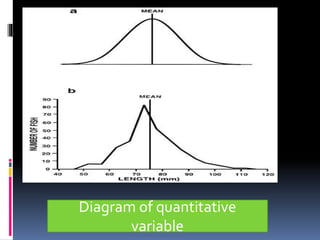
Diagrams of quantitative and
qualitative variables
Diagram of qualitative variable
Diagram of quantitative
variable
General applications of quantitative and
qualitative variable
 More generally, quantitative research is widely used in social
sciences such as psychology, economics, sociology, marketing,
community health, health & human development, gender
and political science, and less frequently
in anthropology and history. Research in mathematical sciences
such as physics is also 'quantitative' by definition, though this use
of the term differs in context. In the social sciences, the term
relates to empirical methods, originating in both
philosophical positivism and the history of statistics, which
contrast with qualitative research methods.
 Quantitative methods can be used to verify which of such
hypotheses are true.
 A comprehensive analysis of 1274 articles published in the top
two American sociology journals between 1935 and 2005 found
that roughly two thirds of these articles used quantitative
methods.
References of the presentation
I. DR. MD .ZOBAER HASAN, SIR LECTURER,
CLASS NOTESAND BOARD NOTE
 EMPIRICAL RESEARCH or RANDOM
RESEARCH IN GOOGLE
 A comprehensive analysis of 1274 articles
published in the top two American sociology
journals between 1935 and 2005
Quantitative and qualitative variables

Quantitative and qualitative variables

  • 1.
    Presented by: Aynle MohammadAli ID: 141-19-1537 Al-Amin Prince ID: 141-19-1539 Abdirisak Dahir Karie ID: 133-19-1525 Presentation Topic: QUANTITATIVE AND QUALITATIVE VARIABLES Submitted to: DR.MD.ZOBAER HASAN Lecturar, Statistics
  • 2.
    Definitions of quantitativeand qualitative variables  Variables :is a measurable quantity, which can vary within its domain, there are two types of variables  Qualitative variable: the variables which can not categorized by numbers are called qualitative variable  Quantitative variable: the variables which can be categorized by numbers are called quantitative variable
  • 3.
    How to classifyQuantitative or Qualitative variables Step 1: Rank or order the items in your category. Some examples of items that can be ordered are: number of computers sold in a month, students’GPAs or bank account balances. Anything with numbers or amounts can be ranked or ordered. If you find it impossible to rank or order your items, you have a qualitative item. Examples of qualitative items are “car models,” “types of potato,” “Shakespeare quotes.” Step 2: Make sure you haven’t added information. For example, you could rank car models by popularity or expense, but popularity and expense are separate variables from “car model.” If the item is “potatoes,” it’s qualitative. If the item is “number of potatoes sold,” it’s quantitative.  That’s it!
  • 4.
    EXAMPLES OF Quantitativeand Qualitative variables  Qualitative variable :  EXAMPLES OF QUALITATIVE VARIABLE :out put of a coin tosses ,sex of person, color of skin, car models, types of potato,” “Shakespeare quotes.”.  Quantitative variable:  Examples of quantitative variable :yield of a crop, height of a person, number of children in family
  • 5.
    Diagrams of quantitativeand qualitative variables Diagram of qualitative variable
  • 6.
  • 7.
    General applications ofquantitative and qualitative variable  More generally, quantitative research is widely used in social sciences such as psychology, economics, sociology, marketing, community health, health & human development, gender and political science, and less frequently in anthropology and history. Research in mathematical sciences such as physics is also 'quantitative' by definition, though this use of the term differs in context. In the social sciences, the term relates to empirical methods, originating in both philosophical positivism and the history of statistics, which contrast with qualitative research methods.  Quantitative methods can be used to verify which of such hypotheses are true.  A comprehensive analysis of 1274 articles published in the top two American sociology journals between 1935 and 2005 found that roughly two thirds of these articles used quantitative methods.
  • 8.
    References of thepresentation I. DR. MD .ZOBAER HASAN, SIR LECTURER, CLASS NOTESAND BOARD NOTE  EMPIRICAL RESEARCH or RANDOM RESEARCH IN GOOGLE  A comprehensive analysis of 1274 articles published in the top two American sociology journals between 1935 and 2005